I’ve long suspected that my late-night commiseration with other men about watches was not fellowship but camouflage. We called it passion—dial textures, lume performance, the moral superiority of mechanical over quartz—but beneath the jargon was something quieter and more embarrassing: loneliness.
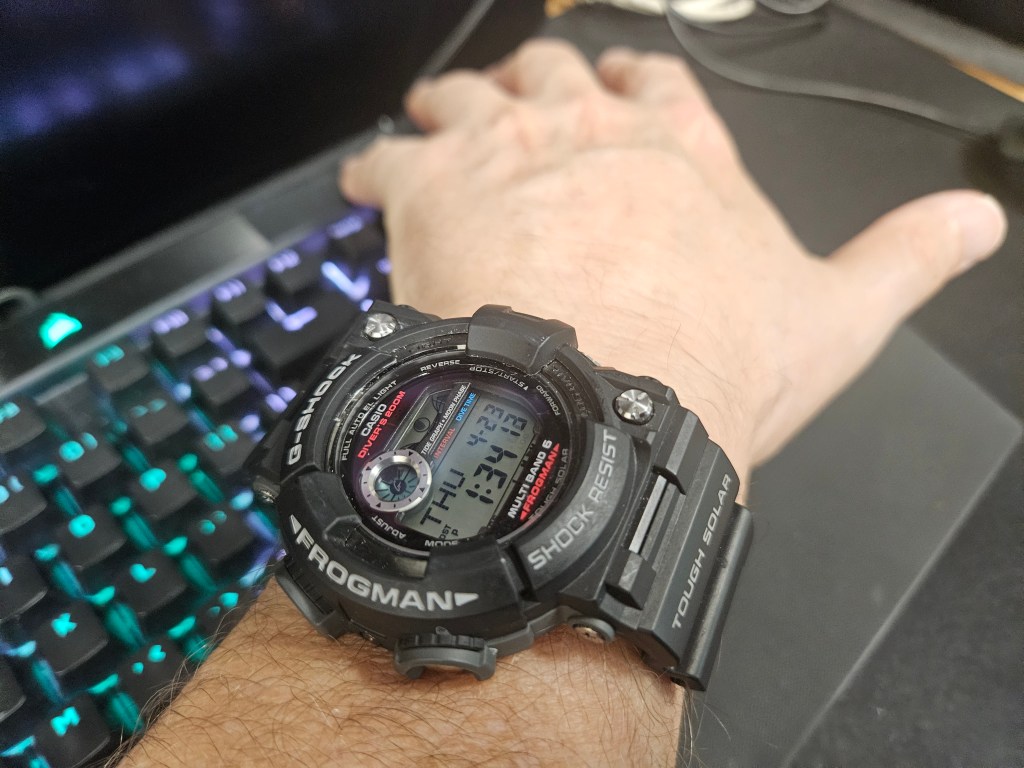
Lately, a more unsettling thought has taken hold. My transformation into the Frogman—the resin-clad apostle of atomic time—may not be about horology at all. It may be an attempt to imagine myself as a man who exudes the kind of charisma that draws an abundance of real friendships. Not forum acquaintances. Not usernames. Real people who might, inexplicably, choose to spend time with me.
I have a name for this pathology: the Horological Substitution Effect. It’s the quiet exchange a man makes when real connection feels too risky—he trades the messy, unpredictable labor of friendship for the controlled ritual of online hobby talk. The watch becomes a proxy for intimacy. The forum becomes a stage where vulnerability is replaced with specifications. It looks like connection. It feels like connection. It isn’t.
My suspicions hardened into something closer to fact when my wife began sending me short videos of comedy skits about a subject that has no business being funny: the epidemic of friendless adult men. The jokes land with the precision of an indictment. Get off your ass. Build a life that includes other human beings. Not for amusement. For survival. For the family.
The problem is I don’t know how.
My friendships didn’t end dramatically. They dissolved. Quietly. Gradually. Like hair circling a drain until there’s nothing left to catch. I haven’t met a friend for a movie and a meal in over a decade. Solitude didn’t arrive as a crisis; it moved in, rearranged the furniture, and declared itself permanent. Worse, it feels justified. I operate under a private assumption so efficient it barely needs words: no one would choose this. Why would they? Friendship is an investment, and I’ve already decided I’m a bad bet. Rejection is neatly avoided by never extending the invitation. It’s surrender, dressed up as self-respect.
If I trace the origin, I land somewhere around 2005. Dinner with my cousin in downtown Los Angeles. Afterward, he wanted me to follow him to Silver Lake for coffee and more conversation. It wasn’t the original plan, just a spontaneous thought. I felt the anxiety spike, sharp and immediate. Dinner had been the contract; anything beyond it felt like a breach. I went along, but badly. He noticed. He never asked again. He went on to build a life dense with friendships, a calendar that requires pruning. I refined a different skill: leaving early. It’s part of my neurosis and a condition called Extension Anxiety Reflex: the immediate surge of discomfort triggered when a social encounter exceeds its original scope, prompting withdrawal, compliance-with-resistance, or emotional shutdown. The reflex prioritizes escape over connection, often at the exact moment intimacy might begin.
I inherited the inclination to not maintain friendships. My parents spent the last decades of their lives without friends. My father outsourced social contact through his second wife but never rebuilt what he’d lost. My mother claimed acquaintances the way a diner claims rapport with a waiter—polite, transactional, ultimately imaginary. Loneliness wasn’t diagnosed in our house; it was modeled. It wore the mask of normalcy. I didn’t choose to avoid friendships so much as follow a script.
My parents weren’t bad people. They were self-involved, chemically dependent, emotionally unavailable. My father once told me, with the bluntness of a man who had stopped editing himself, that if he could do it over again, he wouldn’t have children. People recoil at that. I didn’t. It sounded like a sentence I’d already been living. My mother oscillated between warmth and collapse, her depressions so severe she vanished into hospitals while I vanished into my grandparents’ home. Childhood became less a place to grow than a place to endure.
So I adapted. I became self-sufficient. I entertained myself. I removed the need for others before they could remove themselves from me. Isolation wasn’t a failure; it was a system—efficient, predictable, safe.
In my twenties, desire disrupted the system. I wanted relationships, so I built a version of myself that could secure them. Talkative. Confident. Funny. A man with timing. It worked. Women believed in the performance. So did I. But the performance had no depth. It couldn’t support anything real. Relationships collapsed under the combined weight of my anxiety and self-absorption. I could attract; I could not attach. I had charisma without the anchor: the ability to generate attraction through confidence, humor, and social fluency while lacking the emotional grounding required to sustain a relationship. I could initiate connection but could not stabilize it, resulting in repeated relational collapse.
That hasn’t entirely changed. I can still be charming in controlled doses. Colleagues enjoy me in passing. I generate conversation the way a barista generates foam—pleasant, temporary, decorative. But conversation is not friendship. Friendship requires escalation. Risk. The unthinkable act of asking someone to step outside the script and spend time with you. That’s where the system fails. I assume the answer will be no, so I never ask the question. It’s a perfect loop: I avoid rejection by guaranteeing isolation.
This morning, sitting in my car waiting to take my daughters to school, I nearly performed another ritual. I reached for my watch, ready to photograph it for Instagram—a small sacrifice to the gods of trivial validation. For a moment, I considered it. Then the idea turned on me. The absurdity was too clean to ignore. As if a watch photo could compensate for a hollow social life. As if attention could masquerade as connection. It felt like eating sugar to cure hunger and calling the crash nourishment.
So I sat there instead.
I thought about those videos my wife keeps sending. They’re funny the way a diagnosis is funny—because it’s accurate. She’s worried. She should be.
The truth is not complicated. It’s just unflattering. I have built a life optimized to avoid risk, and in doing so, I have optimized it to avoid connection. And here’s the irony that would be funny if it weren’t so exact: as the self-appointed Frogman—the man of action, the avatar of decisiveness—I am acutely aware of the contradiction. The Frogman is not a watch; it is an aspiration. Like Steely Dan’s suburbanite Deacon, dreaming of escape through saxophone and whiskey, I imagine a version of myself that moves, acts, engages—a man who shows up, who serves, who answers the call.
A man who doesn’t leave early.


Leave a Reply