Tag: friendship

  • The Horological Substitution Effect

    The Horological Substitution Effect

    I’ve long suspected that my late-night commiseration with other men about watches was not fellowship but camouflage. We called it passion—dial textures, lume performance, the moral superiority of mechanical over quartz—but beneath the jargon was something quieter and more embarrassing: loneliness.

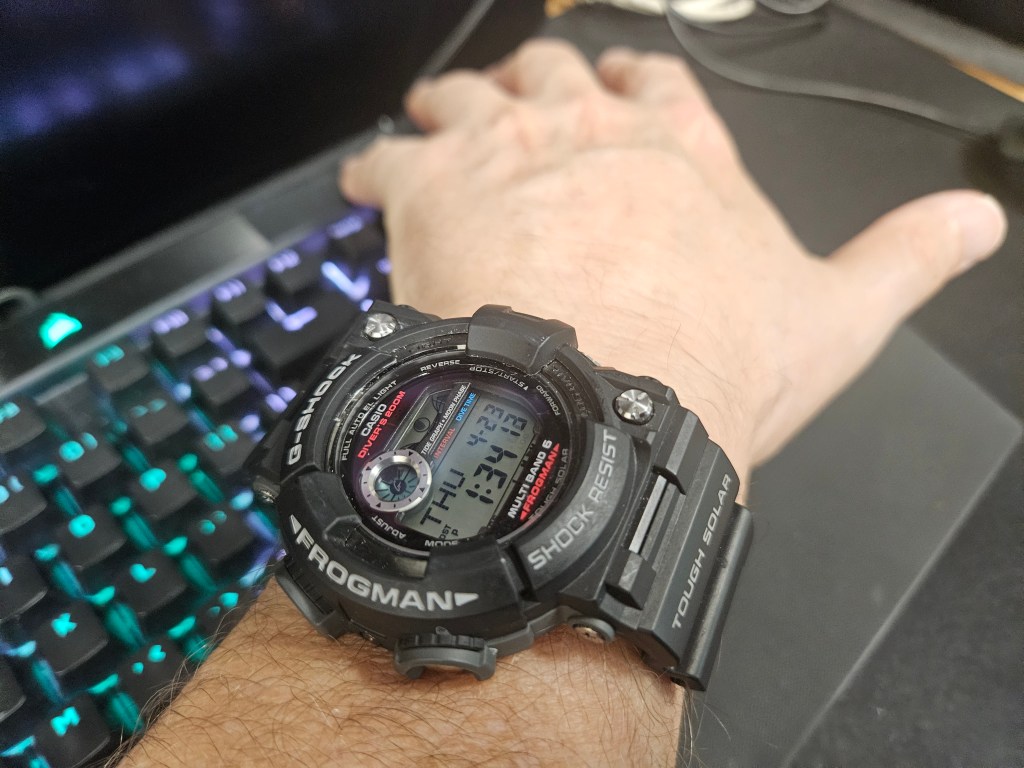
    Lately, a more unsettling thought has taken hold. My transformation into the Frogman—the resin-clad apostle of atomic time—may not be about horology at all. It may be an attempt to imagine myself as a man who exudes the kind of charisma that draws an abundance of real friendships. Not forum acquaintances. Not usernames. Real people who might, inexplicably, choose to spend time with me.

    I have a name for this pathology: the Horological Substitution Effect. It’s the quiet exchange a man makes when real connection feels too risky—he trades the messy, unpredictable labor of friendship for the controlled ritual of online hobby talk. The watch becomes a proxy for intimacy. The forum becomes a stage where vulnerability is replaced with specifications. It looks like connection. It feels like connection. It isn’t.

    My suspicions hardened into something closer to fact when my wife began sending me short videos of comedy skits about a subject that has no business being funny: the epidemic of friendless adult men. The jokes land with the precision of an indictment. Get off your ass. Build a life that includes other human beings. Not for amusement. For survival. For the family.

    The problem is I don’t know how.

    My friendships didn’t end dramatically. They dissolved. Quietly. Gradually. Like hair circling a drain until there’s nothing left to catch. I haven’t met a friend for a movie and a meal in over a decade. Solitude didn’t arrive as a crisis; it moved in, rearranged the furniture, and declared itself permanent. Worse, it feels justified. I operate under a private assumption so efficient it barely needs words: no one would choose this. Why would they? Friendship is an investment, and I’ve already decided I’m a bad bet. Rejection is neatly avoided by never extending the invitation. It’s surrender, dressed up as self-respect.

    If I trace the origin, I land somewhere around 2005. Dinner with my cousin in downtown Los Angeles. Afterward, he wanted me to follow him to Silver Lake for coffee and more conversation. It wasn’t the original plan, just a spontaneous thought. I felt the anxiety spike, sharp and immediate. Dinner had been the contract; anything beyond it felt like a breach. I went along, but badly. He noticed. He never asked again. He went on to build a life dense with friendships, a calendar that requires pruning. I refined a different skill: leaving early. It’s part of my neurosis and a condition called Extension Anxiety Reflex: the immediate surge of discomfort triggered when a social encounter exceeds its original scope, prompting withdrawal, compliance-with-resistance, or emotional shutdown. The reflex prioritizes escape over connection, often at the exact moment intimacy might begin.

    I inherited the inclination to not maintain friendships. My parents spent the last decades of their lives without friends. My father outsourced social contact through his second wife but never rebuilt what he’d lost. My mother claimed acquaintances the way a diner claims rapport with a waiter—polite, transactional, ultimately imaginary. Loneliness wasn’t diagnosed in our house; it was modeled. It wore the mask of normalcy. I didn’t choose to avoid friendships so much as follow a script. 

    My parents weren’t bad people. They were self-involved, chemically dependent, emotionally unavailable. My father once told me, with the bluntness of a man who had stopped editing himself, that if he could do it over again, he wouldn’t have children. People recoil at that. I didn’t. It sounded like a sentence I’d already been living. My mother oscillated between warmth and collapse, her depressions so severe she vanished into hospitals while I vanished into my grandparents’ home. Childhood became less a place to grow than a place to endure.

    So I adapted. I became self-sufficient. I entertained myself. I removed the need for others before they could remove themselves from me. Isolation wasn’t a failure; it was a system—efficient, predictable, safe.

    In my twenties, desire disrupted the system. I wanted relationships, so I built a version of myself that could secure them. Talkative. Confident. Funny. A man with timing. It worked. Women believed in the performance. So did I. But the performance had no depth. It couldn’t support anything real. Relationships collapsed under the combined weight of my anxiety and self-absorption. I could attract; I could not attach. I had charisma without the anchor: the ability to generate attraction through confidence, humor, and social fluency while lacking the emotional grounding required to sustain a relationship. I could initiate connection but could not stabilize it, resulting in repeated relational collapse.

    That hasn’t entirely changed. I can still be charming in controlled doses. Colleagues enjoy me in passing. I generate conversation the way a barista generates foam—pleasant, temporary, decorative. But conversation is not friendship. Friendship requires escalation. Risk. The unthinkable act of asking someone to step outside the script and spend time with you. That’s where the system fails. I assume the answer will be no, so I never ask the question. It’s a perfect loop: I avoid rejection by guaranteeing isolation.

    This morning, sitting in my car waiting to take my daughters to school, I nearly performed another ritual. I reached for my watch, ready to photograph it for Instagram—a small sacrifice to the gods of trivial validation. For a moment, I considered it. Then the idea turned on me. The absurdity was too clean to ignore. As if a watch photo could compensate for a hollow social life. As if attention could masquerade as connection. It felt like eating sugar to cure hunger and calling the crash nourishment.

    So I sat there instead.

    I thought about those videos my wife keeps sending. They’re funny the way a diagnosis is funny—because it’s accurate. She’s worried. She should be.

    The truth is not complicated. It’s just unflattering. I have built a life optimized to avoid risk, and in doing so, I have optimized it to avoid connection. And here’s the irony that would be funny if it weren’t so exact: as the self-appointed Frogman—the man of action, the avatar of decisiveness—I am acutely aware of the contradiction. The Frogman is not a watch; it is an aspiration. Like Steely Dan’s suburbanite Deacon, dreaming of escape through saxophone and whiskey, I imagine a version of myself that moves, acts, engages—a man who shows up, who serves, who answers the call.

    A man who doesn’t leave early.

  • You Can’t Hack Friendship

    You Can’t Hack Friendship

    A shortage of friendship seeps into everything. It distorts your thinking, magnifies your obsessions, and turns both your work and your home life into echo chambers. What begins as a quiet absence becomes a governing condition. The burden doesn’t stay neatly contained within you; it spills outward, pressing on your family, altering the atmosphere of every room you occupy.

    Active friendship is not a luxury. It is a nutrient. Deprive the soul of it and you don’t merely feel a little off—you begin to atrophy. The comparison is almost clinical: friendship is to the psyche what protein is to muscle. Neglect it long enough and weakness follows, then dysfunction, then a kind of emotional brittleness that snaps under ordinary strain.

    Your predicament has a familiar shape. You reach out. The response is lukewarm, delayed, or politely distant. You respect boundaries—yours and theirs—so you retreat. The retreats accumulate. What began as courtesy hardens into habit. Eventually, not seeing friends stops feeling like a temporary lull and starts to resemble a lifestyle. The absence becomes routine, then normal, then invisible.

    The culture is more than happy to bless this arrangement. Adults, we’re told, naturally drift into smaller circles. Life is busy. Everyone is tired. The internet offers a thin, flickering substitute for presence. Add in economic pressure—the side hustles, the quiet anxiety about money—and friendship begins to look like a discretionary expense. Time becomes a zero-sum game, and friendship is the line item that keeps getting cut.

    Age compounds the problem. The older you get, the more fixed your habits become. The friction of meeting new people increases. The old friendships fade—some through neglect, some through conscious uncoupling, most through the slow erosion of time. Replacements don’t arrive. They rarely do.

    Then there’s pride, that silent enforcer. You don’t talk about the absence. You don’t announce your loneliness. The first rule is to pretend there is no problem. You keep your complaints internal, your need concealed. You perform composure. You suffer privately, as if dignity requires it.

    You may even suspect this was always your trajectory. You look back at your parents and see hints of the same pattern—difficult temperaments, limited circles, a tendency toward inwardness. You begin to wonder if you’re not simply repeating a script written long before you understood it.

    Over time, solitude becomes architecture. You build a small, fortified life and call it independence. It starts to resemble something like C. S. Lewis’s description of hell: a self-constructed enclosure where nothing enters and nothing leaves. You seal the doors, throw the key beyond the walls, and then convince yourself this arrangement is freedom. It is, in fact, a perfectly engineered loneliness.

    Inside the fortress, you have time—too much of it. Memory begins to intrude. You recall childhood, when friendship required no strategy and no scheduling. It was as natural as breathing. You laughed without agenda. You learned who you were in the presence of others. Those early alliances—messy, loud, unfiltered—helped shape your sense of right and wrong, belonging and identity.

    Adulthood replaces that immediacy with calculation. Time fragments. Obligations multiply. Your circle shrinks. The hunger for connection doesn’t disappear; it mutates. You turn to social media, posting curated glimpses of a life that appears connected. The response—likes, comments, brief exchanges—offers a diluted version of what you’re actually missing. It looks like friendship at a distance, but it lacks weight. Eventually, even that thin substitute fails to satisfy, and you drift away from it too.

    You try another route: creation. You write. You play music. You hope that expression will generate connection. People may admire what you produce. They may even love it. But admiration is not friendship. Applause is not companionship. A well-received paragraph cannot sit across from you at a table.

    There is no workaround. No clever substitution. No technological proxy or “life hack” that fills the gap.

    At some point, you have to say it plainly: the absence of friendship is a problem.

    What follows that admission is uncertain. There is no neat solution waiting on the other side of the sentence. But there is at least this: you are no longer pretending. You are no longer calling deprivation a preference or isolation a virtue.

    You are, finally, telling the truth.

  • Maybe There’s a Friendship Renaissance Waiting for Retirees, Or Maybe There Isn’t

    Maybe There’s a Friendship Renaissance Waiting for Retirees, Or Maybe There Isn’t

    In a recent conversation with Mike Moynihan on The Moynihan Report, media analyst Doug Rushkoff described social media life as a kind of self-inflicted madness: we willingly lobotomize ourselves into shrill binaries, flattening nuance until the “other side” is little more than a demon enemy. His words echoed Jaron Lanier’s decade-long dirge about how the online hive mind debases us into cheap caricatures.

    After fifteen years inside this funhouse, I can vouch for Rushkoff. Chasing likes and subs is a direct pipeline to despair. The algorithm isn’t designed for truth or connection — it’s a slot machine that spits out dopamine crumbs in exchange for outrage and hype. And yet, podcasters like Rushkoff and Moynihan point to a counterargument: in the right hands, social media can host intelligent conversations. But it’s a fragile victory, like surviving on a vegan diet — possible, but you’ll work twice as hard and swallow twice as much chalk.

    Socially, though, the medium is barren. Scroll long enough and the promise of “connection” curdles into loneliness.

    This hits me harder as retirement creeps closer — twenty-one months and counting. I’ve spent forty years teaching face-to-face, and I’ll miss it desperately. This semester I have student-athletes: sharp, disciplined, driven, engaging. Those classroom connections have been the marrow of my career, and they won’t be replicated by a Facebook feed.

    I’ll still have a family. I’ll still have two best friends in Torrance. But unlike my wife, who maintains a weekly social circuit of concerts, trips, dinners, and parties, my friendships are skeletal. Months-long “friendship fasts” punctuated by rare meetups. Husbands, as the cliché goes, lean too heavily on their wives for connection — a weight she may already feel pressed under. An isolated husband becomes a burden.

    You reap what you sow. Neglect friendships for decades, and you retire into isolation, wondering if you can still course-correct. Maybe it’s too late. Maybe habit calcifies into solitude.

    Or maybe not. Maybe there’s a friendship renaissance waiting out there: gray-haired amateur philosophers huddled at gritty diners, pickleball warriors at dawn, retirees solving the world over coffee. Maybe the beach yoga crowd will embrace me.

    Or maybe that’s just wishcasting. We’ll see.

  • Lost at the Light: A Dream of Unfinished Witness

    Lost at the Light: A Dream of Unfinished Witness

    Last night I dreamed I was flung through time to witness the Crucifixion—not once, but over and over again, as if history were caught in an eternal loop. It wasn’t a single event but a kaleidoscope of perspectives: I viewed it from the ground, from a hillside, even from above. The landscape shifted with each new angle—sometimes the sky was slate gray, sometimes scorched bronze, sometimes bruised with orange light like an eternal dusk.

    I was obsessed with seeing it clearly, as though clarity itself were salvation. But the method of execution began to morph. The Cross, once tall and stark on a mountaintop, gave way to a giant catapult. I watched as faceless figures were hurled skyward like rag dolls flung by fate. I couldn’t tell if they were victims, martyrs, or simply vanishing into the void.

    There was mention—or maybe just a sensation—of a third method of sacrifice, one hidden, unnamed, and deeply unsettling. Its very vagueness gnawed at me, filling me with a dread I couldn’t explain.

    Realizing that perfect understanding was impossible—that I would never grasp the full shape of this cosmic agony—I finally surrendered. The moment I did, I was somewhere else.

    Now I was behind the wheel of a car, trying to follow a caravan of friends along an unfamiliar road. They all made it through a green light; I didn’t. I was left behind, lost beneath a concrete overpass, disoriented and doubting whether these friends were friends at all.

    Eventually, I caught up. We arrived at our destination: a picnic by the sea. No one spoke of what had happened. We passed around barbecued trout and fresh fruit, relieved more than joyful. We were just glad to be there, to eat together in silence. The chaos of the journey was forgiven in the quiet rhythm of chewing and the sound of waves.