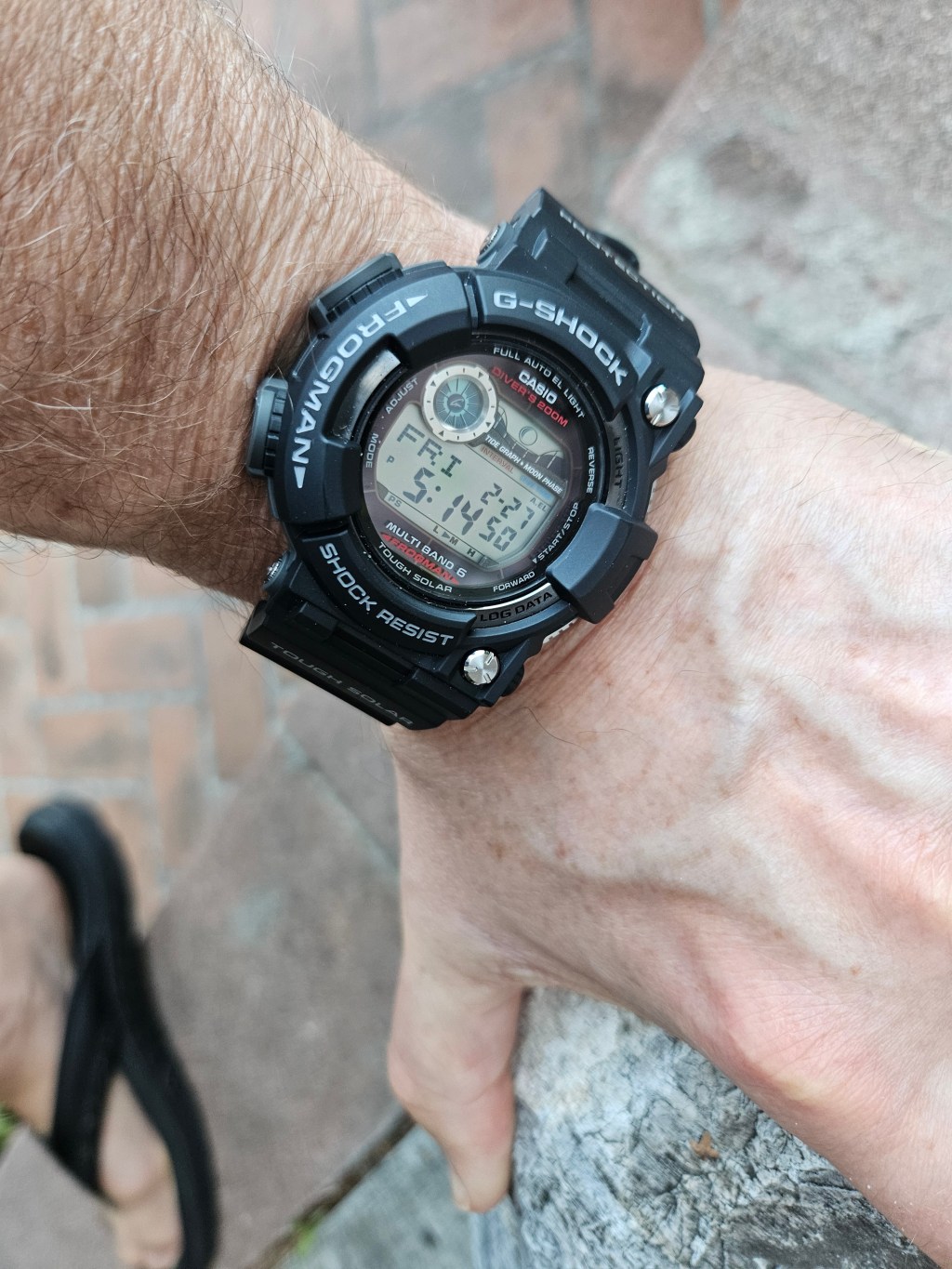
There is roughly $15,000 worth of mechanical excellence sitting quietly in your watch box—exquisite engineering, heritage, finishing, the whole cathedral of craftsmanship. And yet they might as well be museum pieces, because the G-Shock Frogman has taken the wrist and declared permanent residency.
This is not a casual preference. This is occupation.
The Frogman isn’t a watch anymore; it’s a Wrist Squatter with a law degree. It has studied the bylaws, mastered the wrist codes, and executed a flawless psychological campaign. Try to remove it and it counters with arguments you can’t defeat: atomic accuracy, zero maintenance, indifference to your moods, and the quiet authority of a tool that never disappoints.
You think about intervention. Maybe a therapist can help you reintroduce rotation, restore balance, rebuild your relationship with mechanical craft.
Then you arrive at the therapist’s office.
He’s wearing the same Frogman. He too has a Wrist Squatter.
At that moment, you realize the deck is rigged and the case is closed. The system isn’t broken. The system agrees with the Frogman. You are not seeking treatment; you are seeking confirmation.
The truth becomes unavoidable.
You are not managing the watch.
The watch is managing you.
And eventually you reach the only rational conclusion: resistance is futile. The Frogman isn’t louder, flashier, or more prestigious than the watches in the box.
It’s simply stronger.
More reliable. More honest. More aligned with daily life.
You can keep the mechanical collection for memory, for beauty, for the version of yourself that once needed ceremony.
But the wrist belongs to the squatter now.
And he’s not leaving.
 Cinemorphosis
Leave a comment