Author: Jeffrey McMahon

  • When “Your Truth” Stops Being Believable

    When “Your Truth” Stops Being Believable

    Helen Lewis’ Atlantic essay “The Death of Millennial Feminism” observes that Lindy West “is the most successful feminist writer of her (and my) generation,” propelled by raw, often self-deprecating confessionals and “viral takedowns.” She had the ears of women everywhere. She became the loudest evangelist for feminism and a tireless promoter of “fat positivity.” Then she wrote a memoir that brought it all to a halt. Adult Braces reverses many of the feminine ideals she once championed.

    Much in the book makes Lewis cringe, but one detail stands out: West allows her partner to enter a throuple with another woman—someone significantly thinner than West. She concedes that her once-admired feminist life was, in Lewis’s words, “a buffed-up version of the truth.” She describes feeling alienated from like-minded writers in editorial spaces. The online scorn she endured was more debilitating than she had admitted. And her body-positivity project falters under the weight of her own confession: “I am at my biggest when I am at my saddest.”

    West’s self-mythologizing of her past undermines the credibility of her present claims. Lewis is therefore skeptical of West’s assertion that she finds fulfillment in a polyamorous relationship in which her partner pursues other women, while West herself undergoes cosmetic dentistry—perhaps to remain competitive in these newly charged dynamics. 

    Equally dubious is West’s claim that she is rejecting monogamy, framed as “a system of ownership,” partly to please her mixed-race partner. The reliance on progressive clichés to justify what appears to be a self-abasing arrangement lends her argument an air of strained rationalization. It also reflects the same intellectual evasiveness that helped fuel her rise in the 2010s, when social media rewarded this kind of performative certainty.

    If Lewis finds any consolation in her irritation, it is that “basically no one else believes” West’s claims of polyamorous happiness. The book has not landed as intended.

    Lewis is at her sharpest when she expresses a dry, almost surgical pity for West’s disbelief that readers are unconvinced. She writes: “Nonetheless, I do feel great sympathy for West. How was she to know that the great omerta of Millennial Feminism—that we had to take whatever people said about their life stories at face value—had broken?”

    As Lewis pulls back the curtain on West’s method, she arrives at a harsher conclusion: feminism was never the central principle. The organizing force was a highly curated self, elevated by moral certainty and insulated from critique. West’s work encouraged others—teenagers included—to treat intense emotion as authoritative truth, to equate feeling with reality.

    Lewis argues that this elevation of emotion was not liberating but coercive. “Perhaps the greatest hallmark of Millennial Feminism was how harshly it treated women,” she writes. “We were the ones who were supposed to give up our boundaries, rewrite our sexualities, and defenestrate our heroines.” Doubt became a liability. Fallibility, a form of shame. In reality, both are conditions of sanity.

    For that reason, many women—including Lewis—walked away. To remain required submission to groupthink and to a mythology that, as she puts it, “required submitting ourselves to a voluntary lobotomy.”

    Meanwhile, as this strain of feminism frayed, countervailing forces emerged on the right—forces often just as reductive, just as intellectually numbing. The result is not correction but polarization: competing orthodoxies shouting past one another, while common sense and moral clarity struggle to regain a foothold.


  • Pedaling Through the Voice That Says Quit

    Pedaling Through the Voice That Says Quit

    Ninety percent of the time, the Schwinn Airdyne—known in honest circles as the Misery Machine—treats me like a competent operator. I settle into a rhythm and burn roughly 730 calories an hour, sometimes pushing past 800 over a 51–58 minute stretch. It’s hard work, but it feels governed, almost cooperative. The Rate Select hovers around 52, climbs to 58 when I press it, and rewards effort with visible progress. Numbers rise, and with them, morale.

    Then there is the other ten percent—the mutiny.

    You know it immediately. The first minute betrays you. The legs feel like they’ve been filled with wet cement. The lungs are slow to negotiate. The machine, once a willing accomplice, turns indifferent. No matter how much you push, the Rate Select stalls in the high 40s, as if it has quietly downgraded your status. Today was one of those days. Fifty-eight minutes of negotiation yielded 601 calories—an 18 percent deficit from my usual output. I clawed my way past 600 not out of strength, but out of stubborn bookkeeping: at least I could claim I burned off breakfast.

    The real struggle, of course, isn’t physical. It’s narrative. When the numbers climb, the mind becomes a cheerleader—faster, harder, more. But when they sag, a different voice takes the microphone. You’re finished. You’ve lost it. This is a young man’s game, and you’re trespassing. The body tires, but the mind drafts a eulogy.

    That’s the moment that matters. Not the calories, not the pace, but the argument. Today, I didn’t win cleanly, but I held the line. I kept pedaling. I refused the early exit. Six hundred calories is not a triumph, but it is a refusal to collapse.

    These lag days arrive like monthly audits. They expose the fault lines—the impatience, the vanity, the dependence on numbers for validation. The task is not to dominate the machine, but to manage the voice that wants to quit. The reasonable adult has to step in, take the whining child by the shoulders, and say: Not today.

  • The Theology of Winter: Genius, Power, and the Will to Prevail

    The Theology of Winter: Genius, Power, and the Will to Prevail

    I can admire the intellect of Augustine of Hippo and John Calvin without signing on to their theology. Their vision—infants consigned to damnation, humanity stamped at birth with moral rot—feels less like illumination and more like a spiritual winter that never thaws. It is rigorous, yes. It is also airless.

    Set against that severity, Pelagius reads like a man arguing for oxygen. He offered a more generous account of human possibility, one that trusted effort and moral agency. History did not reward him for it. Augustine prevailed, sanctified and institutionalized, while Pelagius was exiled to the margins, labeled a heretic for his trouble. The verdict tells you as much about power as it does about truth.

    I don’t doubt the sincerity of Augustine or Calvin. But sincerity is not the same as innocence. The unconscious has its own ambitions, and theirs often read like combat. These were not only theologians; they were fighters—relentless, articulate, and unwilling to yield an inch of doctrinal territory. They argued to persuade, but also to dominate. They didn’t just defend a vision of faith; they enforced it.

    You can see the lineage in Paul the Apostle himself. At his best—Philippians, luminous and humane—he sounds like a poet of grace. At his worst, he is a man sharpening his pen against rivals, guarding authority with the ferocity of someone who feels it slipping. The contrast is jarring, but revealing.

    Augustine, Calvin, Paul—each too large to be reduced to a single impulse, each capable of brilliance and depth. But running through their work, like a low electrical current, is something harder: the instinct of the embattled mind, the need to be right, to prevail, to settle accounts. It is the scent of the theological pugilist—the man who doesn’t just seek truth, but victory.

  • The Cruel Question Every Writer Must Answer

    The Cruel Question Every Writer Must Answer

    When you pitch a book, the publisher asks a question that feels less like business and more like interrogation: Why must this exist? Why this book, now, and not another? What justifies its presence in a world already swollen with print? The question has teeth. It strips away the soft fog of aspiration and leaves you standing with nothing but purpose—or the absence of it.

    A book is not a monument to your desire to “be published.” It is not your name in lights, your moment on the marquee. That impulse—vanity dressed as vocation—is the surest path to creative mediocrity. Purpose is the only defense. Without it, the work collapses under its own self-importance.

    The same cross-examination applies to everything else we produce. A blog post, a video, a channel—why does it exist? To collect attention? To be applauded by a tribe? To monetize a persona? To assemble the vague scaffolding of a “brand”? These are not answers; they are evasions.

    What, then, is my brand? Nothing coherent. I wander. I collect. I react. I move through the culture like a flâneur with a notebook, jotting down whatever strikes the nerves—ideas, trends, obsessions—and trying to distill some fragment of meaning from the debris. This is not a brand. It is a habit of attention. It resists consolidation. It refuses to become a product.

    I did write a book recently—a real one, nearly seventy thousand words. But even that resisted form. It wasn’t a narrative or an argument so much as a catalog of compulsions about watch enthusiasts: short, sharp definitions of obsessive behavior. A lexicon of affliction. Did it need to exist? I can argue that it did. The market delivered a quieter verdict. A few dozen copies moved. Meanwhile, a fifteen-minute video built from the same material drew thousands. The idea survived in video form. The book format did not.

    This is the final insult: even if you can construct an airtight case for a book’s existence, the audience may still decline to care. You can formulate the perfect product—nutrient-rich, elegantly packaged—but if no one consumes it, it sits on the shelf like expensive dog food no dog will eat. And its silence asks the only question that matters, the one you thought you had already answered:

    Why does this exist?

  • When Writing Stops You From Lying to Yourself

    When Writing Stops You From Lying to Yourself

    Kafka called writing a form of prayer. Not as piety, but as precision. Prayer, properly understood, is the act of stepping out of ordinary time—the noisy, transactional churn—and entering a space where attention is no longer scattered but gathered. Writing does the same. It refuses the chaos of profane time and insists, however briefly, on the discipline of the sacred.

    The sacred is not mystical fog. It is clarity stripped of dopamine. It is the quiet room where you examine the state of your own soul without distraction or performance. It is where you test whether your words can survive contact with your actions. It demands humility because it exposes how often they don’t. And it offers a kind of nourishment the chronophage—the great time-eating machine—cannot provide, because it cannot be consumed passively. It must be earned.

    To live thoughtfully is to move between two worlds: the sacred and the profane. You cannot remain in either one. You must descend into the ordinary—work, errands, obligations—but carry with you the standards forged in that quieter space. Otherwise, the sacred becomes theater, and the profane becomes drift.

    So the question arrives, unwelcome but necessary: Do my actions align with my ideals? No. Not yet.

    If they did, my life would contract, not expand. I would eat with intention—three meals, no grazing—and call the absence of snacks what it is: a fast, not a deprivation. I would step away from the digital carnival that thrives on FOMO, because I know its rewards are counterfeit—brief spikes followed by longer, duller lows.

    I would stop buying watches. I already own more than I can meaningfully wear. Two G-Shocks tell perfect time. The rest sit like artifacts of former appetites. Rotation is not variety; it is indecision dressed as sophistication.

    And I would reconsider what I make. If my videos exist to chase attention, to measure my worth in clicks and spikes of approval, then they are extensions of the same problem. The medium is different; the mechanism is identical. But if a video can carry an idea forward—if it can clarify rather than agitate—then it earns its place.

    Writing, then, is not an escape. It is a reckoning. It is the act of bringing the sacred into contact with the profane and asking, without flinching, whether they agree. Most days, they don’t. The work is to narrow that distance.

  • Life Inside the Chronophage

    Life Inside the Chronophage

    You can still read, technically. The eyes move. The words register. But something essential has thinned out. Years inside the chronophage—the great time-eating machine—have rewired the circuitry. You no longer take in ideas; you absorb fragments. You skim life the way you skim a feed. You prefer voices at 1.25 speed, ideas pre-chewed, narratives delivered in twelve-minute installments with thumbnails that promise revelation and deliver stimulation.

    You know what it is. The Internet is not a library—it’s a galactic food court, a neon sprawl of drive-through kiosks serving intellectual fast food. Ninety-nine percent of it is forgettable at best, corrosive at worst. You try to manage your intake. You play the piano. You lift weights. You show up for your family. You perform the rituals of a grounded life. But the residue remains. The machine has had its way with you.

    And then comes the quieter poison: self-pity. No one reads anymore, you tell yourself. Everyone is grazing from the same algorithmic trough. You feel stranded, a refugee from a literate past. You invoke the phrase “post-literate society” not as analysis but as lament. And yet, the only reason you can even diagnose the condition is because you remember something else—an earlier version of attention, slower, deeper, less contaminated. You carry that memory like a fading photograph and call it protection.

    You came across a word last week: chronophage—a system that feeds on your time while convincing you it is nourishing you. It fits too well. The system is not broken; it is functioning perfectly. Its purpose is to consume time, and it does so with industrial efficiency. In the attention economy, attention is not honored—it is harvested. Your mind is not engaged; it is extracted from. There is no mercy in this design. The only consolation is a thin, uneasy solidarity: your mind is not uniquely damaged. It is simply part of a mass casualty you are lucid enough to witness.

  • Chosen by the Frogman

    Chosen by the Frogman

    More than a decade ago, a seasoned watch obsessive told me something I dismissed at the time: you don’t hunt a Holy Grail—you stumble into it. It doesn’t arrive with fireworks or a four-figure invoice. It slips onto your wrist quietly, and then, without asking permission, it takes over. Everything else starts to feel like a costume. You try to rotate, you try to be fair, you give the others their appointed wrist time—but you feel a faint resentment, like you’re cheating on something that actually fits. Eventually the charade collapses. You stop negotiating. You wear the same watch because it works, and because you no longer have the patience for anything that doesn’t.

    When that happens, the chronophage loses its grip. The endless scroll of “must-haves,” the dopamine carnival of releases and reviews, the debates over marginal gains—all of it begins to look like noise generated by people who haven’t found their watch yet. You close the tabs. You ignore the hype. You retire from the rotation economy. Let the others keep spinning the wheel. You’re done. You’ve chosen, or more accurately, you’ve been chosen.

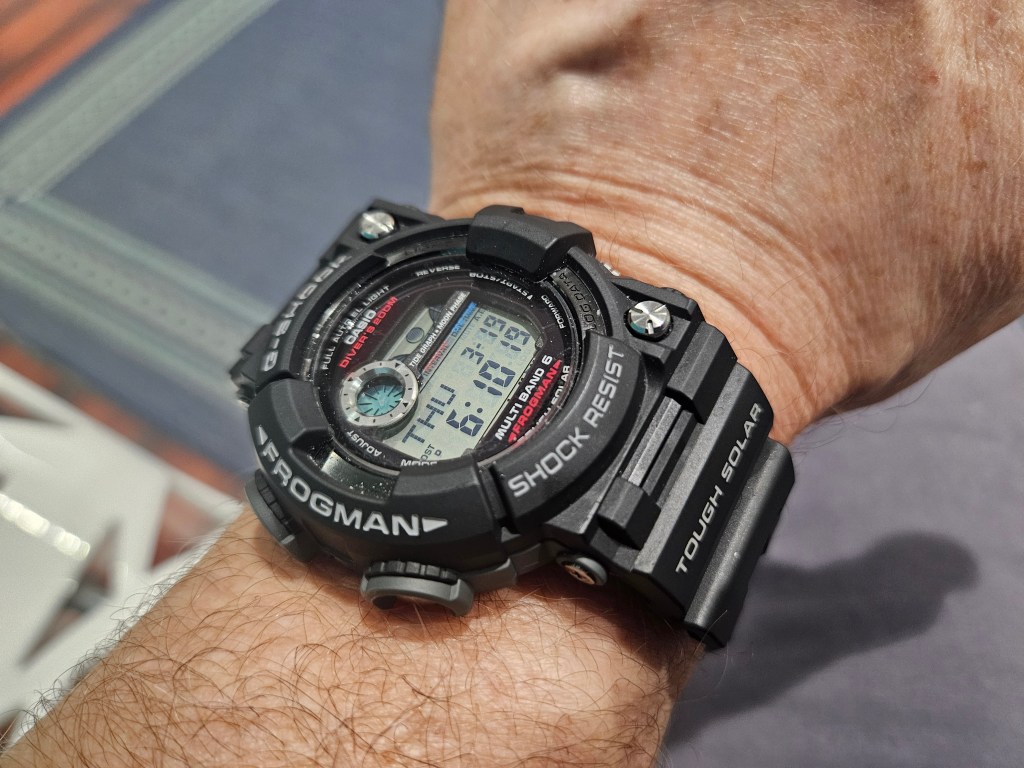
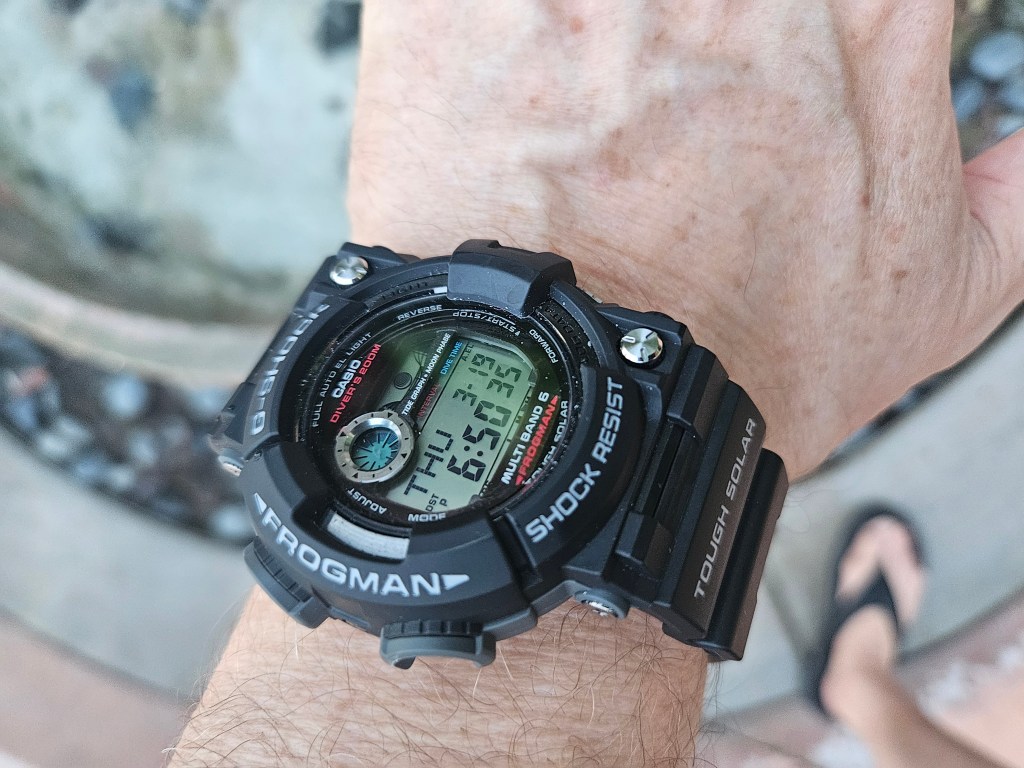
    If you had told me a year ago that a black resin digital watch would be the one to do this, I would have laughed you out of the room. My tastes, I thought, were too refined, too anchored in steel and mechanical romance to be hijacked by a plastic instrument. And yet, a month ago, the G-Shock Frogman GWF-1000 landed on my wrist and quietly began rewriting my habits. It doesn’t leave. The only thing that occasionally displaces it is another G-Shock—the GW-7900—which, if I didn’t have the Frogman, would be my undisputed daily driver. 

    Of course, I know the trap. The honeymoon phase has seduced better men than me. Give it six months, I tell myself. Let time do its work. If the Frogman is still there—if the others still feel like substitutes—then this isn’t infatuation. It’s alignment.

    The grail, it turns out, is not the watch you chase. It’s the one that makes you stop.

  • When the Hobby Becomes a Spectacle of Torment

    When the Hobby Becomes a Spectacle of Torment

    A man in the watch community watched my Frogman video, declared it had caused him “emotional damage,” and proceeded to prove his point by buying Frogman after Frogman in a spree of excess that seemed to be driven more by torment than joy. 

    The watch hobby already carries enough built-in torment. It doesn’t need to be escalated into a public ritual of compulsion. When I share a video about a watch I enjoy, the aim is simple: appreciation, not contagion. Yet in the attention economy, moderation is invisible. What gets rewarded is escalation—bigger reactions, louder confessions, more dramatic spirals. Attention, after all, is a scarce resource, and the surest way to capture it is to weaponize feeling.

    But there is a cost to that performance. When a hobby becomes tethered to the language of “emotional damage,” something has gone wrong. The line between enjoyment and dependency blurs, and what should be a small, contained pleasure metastasizes into something heavier—something that follows you around, nags at you, drains you.

    The only countermeasure is deliberate restraint. We have to regulate our intake of the digital world the way we regulate food—set limits, step away, return to the analog. Read a book. Play the piano. Lift something heavy. Walk outside without a device narrating your existence. Relearn what it feels like to occupy your own life without commentary.

    If someone discovers the Frogman and it brings them genuine satisfaction, that’s a good outcome. But if it becomes another entry point into a cycle of restless acquisition and theatrical distress, then the watch is no longer the problem—it’s the system surrounding it.

    I can’t control what anyone does after watching a video. No one can. The only thing I can do is speak plainly about the effect this environment has on me, and about the boundaries I’ve had to build to keep a hobby from turning into something corrosive. That’s not a solution. It’s a discipline. And it’s ongoing.

  • The Man Who Announced His Freedom—and Proved He Was Still Addicted

    The Man Who Announced His Freedom—and Proved He Was Still Addicted

    It is a curious spectacle: a man announcing, with ceremonial flair, that he has escaped his watch addiction. He uploads the video, writes the post, polishes the proclamation. Freedom, apparently, requires an audience.

    But the performance gives him away. The urge to broadcast his liberation is not evidence of recovery—it is the addiction changing costumes. The watches may be gone, but the craving remains, now dressed as applause. He has traded the bracelet for the comment section, the bezel for the algorithm. Different object, same dependency.

    He insists the talons are gone. Yet the need to be seen announcing their removal reveals the grip is still there. Attention is the fuel that powered the obsession in the first place, and he is still running on it—only now he calls it transformation.

    The man who is actually free does not declare it. He disappears. His watch box gathers dust, his browser history clears, his name fades from forums and feeds. Over time, people notice—not because he told them, but because he stopped needing to be noticed. Silence, in this case, is not absence. It is proof.

    The one who boasts of escape is still inside the cage, narrating his exit to anyone who will listen.

  • You Are No Longer Shopping. You Are Being Stimulated

    You Are No Longer Shopping. You Are Being Stimulated

    As a “well-informed consumer,” you may discover—too late, of course—that you’ve built your own cage and furnished it with glowing screens. The hours of scrolling, the endless debates over “the best,” the obsessive rituals designed to avoid buyer’s remorse, the chorus of disembodied voices instructing you what to purchase and what to shun—all of it has rewired your attention. Each swipe delivers a small electric thrill, followed by a quieter, more persistent anxiety. What you call “research” is, in practice, a carefully engineered agitation. You are no longer shopping. You are being stimulated.

    And so the identity of the “well-informed consumer” begins to collapse under scrutiny. You are not informed; you are saturated. You resemble less a discerning buyer and more a laboratory animal, dutifully pressing the lever in hopes that the next pellet will finally satisfy. It never does. The cycle resets. The wheel spins.

    This is Consumer Epistemic Fog: a condition in which the sheer volume of opinions, reviews, rankings, and “definitive guides” does not sharpen judgment but dissolves it. Clarity is replaced by static. Confidence erodes into hesitation. The more you know, the less you trust yourself to act. In the end, the tragedy is not that you might make the wrong purchase—it is that you can no longer make a decision at all.