Author: Jeffrey McMahon

  • Stop Chasing the Perfect Watch–It Doesn’t Exist

    Stop Chasing the Perfect Watch–It Doesn’t Exist

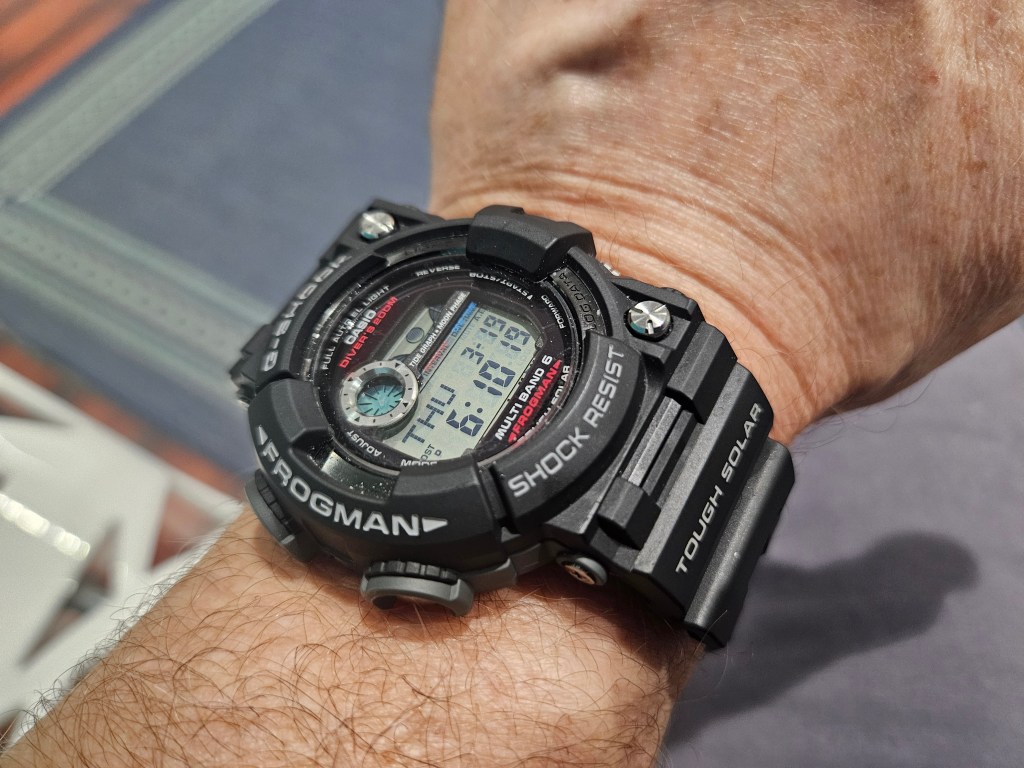
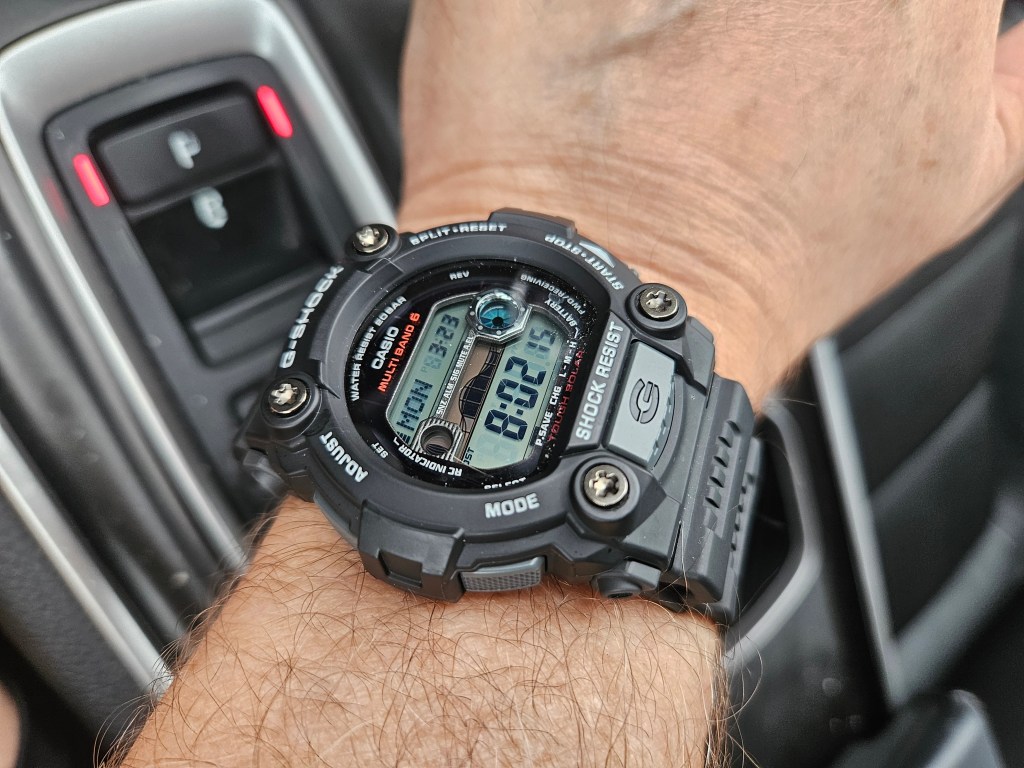
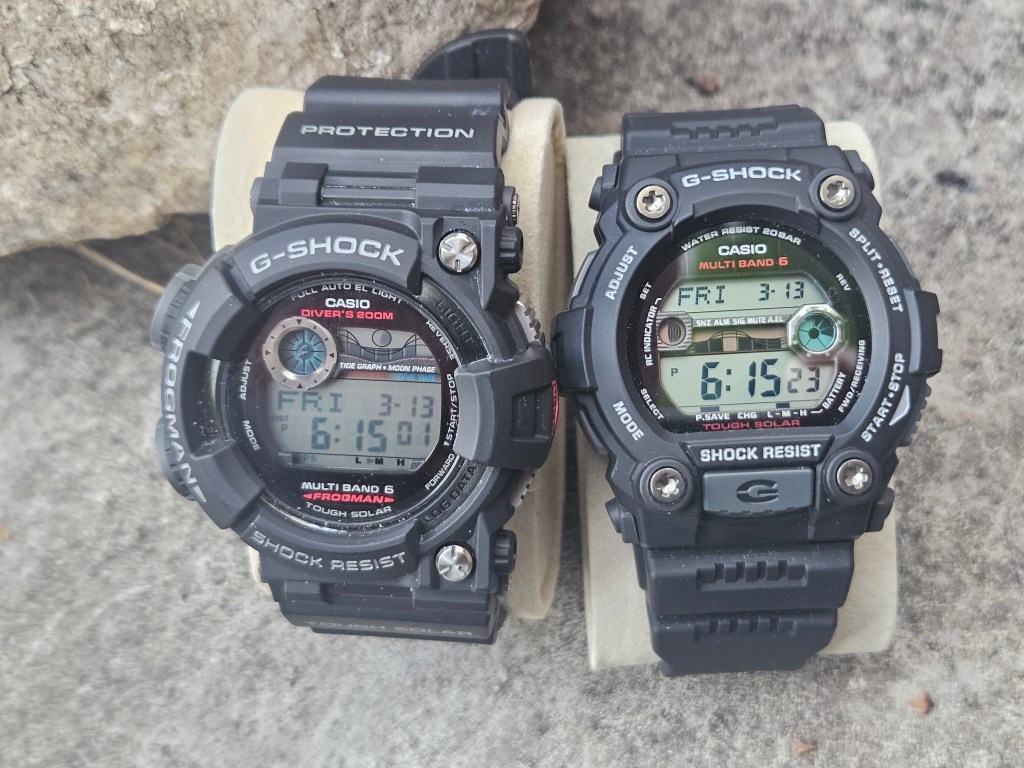
    I love the digital displays on my Casio G-Shock Frogman GWF-1000 and Casio G-Shock GW-7900. They tell me the time with blunt authority. No interpretation. No ceremony. Just numbers that land in the brain like a verdict.

    And yet, apparently, that isn’t enough.

    Somewhere along the way I developed a new appetite—no, let’s call it what it is, greed. I don’t just want clear numerals anymore. I want absurdly large numerals. I want wrist-mounted billboards. I want a wall clock strapped to my arm so I can read the time from across the room like a man who refuses to participate in subtlety.

    Naturally, the good people of G-Shock Nation pointed me toward the Casio G-Shock GW-9500 Mudman. The Mudman, they said, has the numbers. Big, bold, unapologetic digits that look like they were designed for someone who has lost patience with squinting.

    And they’re right—mostly.

    Mudman owners speak about their watch with a curious mix of affection and confession. They praise the size of the numerals, the rugged build, the sheer presence of the thing. Then, almost sheepishly, they admit that the display can blur at certain angles, that the duplex layering introduces a faint haze, that it’s not quite as clean as they’d like. They dock it a star. Four out of five.

    Then they shrug and say they love it anyway.

    That’s the part that matters.

    Because it raises a question most of us spend years avoiding: is there such a thing as a five-star watch?

    I’ve finally accepted the answer. There isn’t. There are only trade-offs you can tolerate without resentment.

    I’ve been chasing a very specific fantasy: huge numerals, high contrast, perfect viewing angles, and zero cognitive load. A watch that doesn’t need to be read so much as absorbed. A watch that behaves like a wall clock—instant, effortless, undeniable. What I’ve discovered is that watches can deliver three of those qualities with confidence. They just can’t deliver all four at once.

    My GW-7900 comes closest to frictionless clarity. Its display is stable, legible, and immediate. But the digits, while excellent, don’t quite scratch that billboard itch. The Mudman 9500 pushes in the opposite direction. It gives me the numbers—big, thick, impossible to ignore—but introduces a new problem: at certain angles, the display hesitates. Instead of receiving the time, I have to negotiate with it.

    Then there are the Pro Trek models, with their crisp, high-contrast STN displays. Technically superior. Visually disciplined. And yet, in their refinement, they lose that blunt, wall-clock immediacy. They are precise, but not emphatic.

    What fascinates me is how quickly Mudman owners make peace with imperfection. They acknowledge the flaws, subtract a star, and keep wearing the watch. That’s not compromise in the defeated sense. It’s acceptance. They’ve decided which imperfection they can live with, and they’ve moved on.

    That realization forced me to confront what I’m actually chasing. It isn’t a watch. It’s a state of mind—frictionless time perception. I want to glance at my wrist and have the time imposed on me without effort, hesitation, or ambiguity. But a wristwatch isn’t built for that ideal. It’s constrained by size, power, durability, and the stubborn limits of display technology. Something always gives.

    There is, to be fair, a strong case for the Mudman. Bigger numerals do make the time easier to read most of the time. Its toughness invites confidence. Its design has a certain muscular charisma. For many people, that combination outweighs the occasional moment of haze or glare.

    But I’ve had to admit something about myself: I value consistency over peak performance. A watch that is occasionally perfect but intermittently irritating will wear me down. I don’t want to negotiate with my watch. I want to glance and know.

    So the conclusion is both obvious and oddly liberating. There is no perfect watch. Once you accept that, the chase loses its urgency. You stop looking for the mythical five-star object and start making deliberate choices.

    The real question isn’t, “Which watch gets me closest to perfection?”

    It’s this: Which imperfection can I live with—and still enjoy checking the time a hundred times a day?

  • Take a Year Off Buying Watches—And See What’s Left

    Take a Year Off Buying Watches—And See What’s Left

    Daniel Samayoa and I met at several watch meet-ups in Long Beach, just outside Mimo’s Jewelry. We quickly discovered a shared fascination not only with watches themselves, but with the strange ways timepieces take hold of the mind. With that in mind, Daniel offers a guest post for my blog Cinemorphosis, examining the psychology of watch addiction and the habits that keep collectors in its grip:

    At a certain point, the habit stops being a hobby and starts looking like compulsion dressed up as enthusiasm.

    We all like new watches. We also all like taking a good shit. That doesn’t mean you should do it ten times a day and call it a hobby.

    The same principle applies to watch collecting. Just because you feel the urge doesn’t mean you need to act on it. That “great value” diver you just discovered—the one you’re convinced is different this time—will likely be worn twice before it disappears into the padded anonymity of your watch box.

    And that’s the problem.

    You tell yourself you’re building a collection, but what you’re really doing is chasing a small hit of excitement with every purchase. The watch isn’t the point. The transaction is. The anticipation is. The brief illusion of completion is.

    Then it fades, and you’re back where you started.

    It shows.

    Some of you don’t have collections. You have accumulation—watch boxes that resemble clearance racks, full of pieces that once felt essential and now feel optional at best.

    Here’s a simple experiment: stop buying watches for a year. Not a month. Not a “cooling-off period.” A full year.

    A one-year hiatus isn’t punishment; it’s diagnostic. When you remove the option to buy, you strip away the easiest form of self-distraction and force the habit into the open. The itch doesn’t disappear—it sharpens. You start to notice when it shows up: late at night, after a long day, in those idle gaps where boredom masquerades as curiosity. Without the relief of a purchase, you’re left to examine the mechanism itself—the rationalizations, the urgency, the quiet belief that the next watch will complete something that has never quite been defined. Over time, the noise subsides. What remains is clarity: which watches you actually reach for, what you value in them, and how much of your “collection” was built on impulse rather than need. The hiatus doesn’t take anything away. It reveals what was never there to begin with.

    More importantly, you’ll be forced to confront what you actually enjoy wearing. Not what impressed you in a YouTube review. Not what felt like a smart deal. The watches that earn wrist time—the ones that fit your life without effort.

    If you own nineteen watches and rotate through four, then you already have your answer. The rest are noise.

    The next time the urge hits, pause. Ask a direct question: does this watch have a clear role in my collection, or am I just bored and looking for stimulation?

    That question alone will eliminate most purchases.

    Then take it one step further: sell what you don’t wear. Not someday. Not when the market is better. Now.

    What remains won’t just be smaller—it will be coherent. Intentional. Yours.

    Because most people don’t need another watch.

    They need restraint.

    And a watch box that reflects decisions, not impulses.

  • I Can’t Count on Casio to Keep Making the Kind of Watch That I Want

    I Can’t Count on Casio to Keep Making the Kind of Watch That I Want

    My G-Shock GW-7900 is the best watch I’ve ever owned. Objectively speaking, it works better than my Frogman because its slightly smaller size makes it a better daily driver and its bigger, bolder digits are easy to read. I have thought of getting another 7900 (soon to be discontinued?) as a backup. I could wait and see if G-Shock makes another Tough Solar Multiband-6 with legible digital readout, but my wait might be in vain because I’ve come to accept something I didn’t want to admit at first: I can’t count on Casio to keep making the kind of watch I want. The combination I’ve zeroed in on—Tough Solar, Multiband 6, large, high-contrast digits, and a strap that comfortably fits my eight-inch wrist—isn’t just uncommon; it’s quietly disappearing. Watches like the GW-7900 didn’t fail. If anything, they solved the problem too well. They delivered time with such blunt clarity that there was nowhere obvious to go next—at least not if readability was the priority. But Casio doesn’t build its future around my priorities. It builds forward, and forward now means more sensors, more layers, more data, and more visual complexity.

    I can see the shift in the newer models. The GW-9500 Mudman looks like progress on paper: bigger digits, more information, more sophistication. But the duplex display muddies the water. The gray-on-gray layering introduces a subtle interference that makes the time less immediately legible, even as the numbers themselves get larger. The Pro Trek PRW-3500 goes the opposite route—clean, crisp, and highly readable—but with smaller digits and a more restrained, instrument-like feel. The Frogman GWF-D1000 adds size and presence, but also adds visual density. I can read it, but I have to look. I have to engage. The effortless glance is gone. In each case, something is gained. And in each case, something essential—immediacy—is diluted.

    This isn’t a fluke. It’s a direction. Casio is moving toward watches that look more technical, more advanced, more information-rich. The design language has shifted from blunt clarity to layered capability. In that world, a watch that simply tells me the time instantly starts to look almost primitive. But that so-called primitiveness is exactly what I value. The GW-7900 doesn’t ask me to process anything. It tells me the time with authority. I glance, and I know. No interpretation. No delay.

    I keep thinking maybe Casio will circle back. Maybe they’ll rediscover the appeal of simplicity and release something that restores that kind of clarity. It’s possible. But it’s not how they’ve operated. Casio doesn’t rewind; it iterates forward. And when a design philosophy gets left behind, it tends to stay there. The GW-9500 is probably as close as we’re going to get to a modern successor, and its compromises tell me everything I need to know.

    So I’m left with a realization that feels both obvious and unsettling: peak usability might already be behind me—not in some nostalgic sense, but in the simple fact that the problem I care about was already solved. The GW-7900 isn’t outdated. It’s optimized for a value the market is drifting away from. And that puts me in a different position than I expected. I’m not waiting for something better. I’m deciding whether I’m smart enough to recognize what I already have.

    Because the real risk isn’t missing out on the next great watch. The real risk is waiting. Waiting for a future model that aligns with my preferences while the present quietly disappears. I can easily imagine the moment: I decide I want another GW-7900, I go looking for one, and I realize the window has closed. The model is gone, or overpriced, or reduced to whatever scraps are left in the aftermarket.

    That’s the part that changes the equation for me. I’m not chasing something new. I’m securing something that already works.

  • Watch Straps, Paradise, and the Return of Mother

    Watch Straps, Paradise, and the Return of Mother

    Last night I found myself standing on a hill in Hawaii, the kind of place real estate agents describe as “transcendent” and charge accordingly. Below me, the ocean moved with rehearsed elegance—waves rolling in like they had been coached for the occasion. A tech billionaire, naturally, had invited my family and me to his New Year’s Eve party. In dreams, invitations arrive without explanation and are accepted without skepticism.

    Inside his mansion was a room devoted entirely to appetizers—a cathedral of small bites. I approached it with the zeal of a man who believes abundance is a moral right. Everything was sampled, nothing spared. Then I came upon a glass bowl filled with what appeared to be black licorice. I took a bite and immediately discovered I had made a categorical error. It wasn’t licorice. It was a bowl of rubber watch straps. I had, with full dental commitment, chewed into one of them like a lab animal testing the limits of its environment.

    The billionaire did not react. He stood in the next room, calmly painting a model holding yoga poses—his attention fixed, his world undisturbed. Either he hadn’t noticed, or he lived in a realm where a man biting into a watch strap barely registers as an event.

    Then my mother appeared.

    She has been gone for six years, but in the dream she returned without ceremony, as if death were a clerical error that had been quietly corrected. I greeted her with genuine joy and surprising composure, as though we had simply missed a few phone calls. She told me she was going for a swim. I said I’d join her later, the way one postpones something assumed to be indefinitely available.

    Time, as it does in dreams, rearranged itself. Someone came running to say she had cut her finger on coral. A doctor—there is always a doctor at these gatherings—offered to come with me, iodine and bandages in hand. But as we descended toward the water, word arrived that she had already been treated and had left for California.

    Meanwhile, I had waded into the ocean. The water was warm, enveloping, almost indulgent in its softness. It reached my chest and held me there, like something that preferred I not leave. Faced with the choice between urgency and comfort, I chose comfort. I stayed in the water. My mother, once again, slipped out of reach.

    What kind of dream arranges such a sequence? A billionaire’s excess, a son’s carelessness, a mother’s brief return and second departure. If I had to impose meaning, I’d say the ocean felt less like scenery and more like origin—a return to something pre-verbal, pre-ambition, pre-everything. Call it the womb, call it nature, call it a memory the body keeps when the mind forgets.

    But I hesitate to turn it into a sermon about mortality. Not every dream in one’s sixties needs to carry a funeral program in its back pocket. Perhaps it was about regeneration. Or the persistent illusion that what we lose might reappear long enough to test how we respond.

    I hope my dream was not some portent of mortality. But whatever the case, I’m glad the tech billionaire didn’t send security after me for leaving bite marks in one of his rubber watch straps. 

  • The Acrobats I Misjudged

    The Acrobats I Misjudged

    Sometime around 2018, I’d make the daily trek from the tennis courts to my office and pass the library lawn—a patch of campus that should have offered a quiet, pastoral glide into the workday. Instead, it hosted a recurring spectacle: half a dozen young men staging what can only be described as a low-budget Cirque du Campus. Shirtless or half-shirted, draped in genie pants or frayed denim cut-offs, they performed for an audience that did not exist. Their language was pure motion—flips that flirted with kung fu, kicks that negotiated with gravity, juggling routines that collapsed into chaos, and the occasional hacky sack circle, that ancient ritual of collegiate aimlessness.

    They were hungry—visibly, almost heroically so—for attention. Unfortunately, they possessed more appetite than assets. The enthusiasm was volcanic; the talent, less so. Their charm came in bursts, like a faulty engine. I found them unbearable. My morning walk, once a minor pastoral pleasure, was now hijacked by these blustering soltimbancos—performers without a stage, noise without necessity. I dismissed them with the easy confidence of a man certain he had outgrown foolishness.

    Today, I walked past that same lawn. Empty. Sunlit. Silent. The performance had ended without ceremony, as all such performances do. And I caught myself wondering—not with irritation, but with a strange, reluctant tenderness—what became of those boys.

    Because here is the inconvenient truth: youth is not a time for dignity. It is a sanctioned season of excess—of overreach, bad judgment, inflated self-regard, and public experiments in identity that collapse under their own absurdity. We try on personas the way they tried on those ridiculous pants: boldly, badly, and without permission. We embarrass ourselves in broad daylight and only later, with the benefit of distance, call it “growth.”

    So what changed? Not them. Me.

    Time performs a quiet surgery on the ego. It dulls the impulse to sneer and replaces it with something more complicated—recognition, perhaps, or even a flicker of respect. Those young men were not interrupting my peace; they were spending a currency I no longer possessed: the freedom to look ridiculous without apology.

    And so, to those lawn acrobats—wherever you’ve landed, whatever respectable disguises you now wear—I offer this: I hope life has been kind to you. I hope you found your footing, literal and otherwise.

    But for the sake of civilization, I must insist on one thing.

    Put a shirt on.

  • Freedom in a Thong: The Theater of Letting It All Hang Out

    Freedom in a Thong: The Theater of Letting It All Hang Out

    Yesterday I watched the final episode of HBO’s Neighbors, and it delivered a character who refuses to be ignored: Danny Smiechowski, seventy-two, sunburned into leather, hair cascading past his shoulders, and dressed—if that’s the word—in a fluorescent yellow-green thong that assaults the eye like a traffic cone with delusions of grandeur. He conducts his workouts in his front yard, a one-man parade of defiance, and reacts to criticism the way a cornered animal does—snarling one minute, weeping the next.

    To his neighbors and the churchgoers across the street, decency means restraint, a baseline agreement about how to occupy public space without turning it into a spectacle. To Danny, decency is the opposite: the right to strip away all constraints, to declare the body sovereign territory. His creed echoes a distant era—the hazy, incense-soaked optimism of the early 1970s, when “freedom” often meant discarding clothing along with inhibition and calling it enlightenment.

    Danny believes the world has failed him by refusing to catch up. He swings between belligerent bravado and wounded self-pity, neither of which strengthens his argument. The result is less a philosophy than a performance—loud, erratic, and increasingly lonely.

    Exiled in spirit from his San Diego suburb, he seeks refuge in Eden, a Florida nudist enclave populated largely by fellow Boomers who seem preserved in amber from the Age of Aquarius. It’s a place where retired engineers and former professionals shed not only their clothes but their timelines, reliving a moment when rebellion felt like revelation. Add cheap wine, a little chemical haze, and a game of naked water polo, and you have a community convinced it has outsmarted the system.

    At the colony’s karaoke bar—equal parts nostalgia lounge and social experiment—Danny encounters a young woman with the clarity of someone who has no illusions about the transaction she’s proposing. She wants a sponsor, not a soulmate. Danny, eager for validation, obliges: shoes, dinner, the usual gestures of misplaced hope. She exits with efficiency. He is left with the bill and a deflated sense of destiny.

    Back in San Diego, Danny does what any committed ideologue would do—he builds his own Eden in his backyard, a private republic of one, governed by the constitution of his own stubbornness.

    The episode raises a question that refuses to stay trivial: why do some people feel compelled to be naked as a permanent state, not an occasional choice? Nostalgia plays a role. For many in that generation, nudity carries the residue of a time when breaking rules felt like breaking through. To be unclothed was to signal membership in a select tribe—the enlightened, the unshackled, the ones who had slipped past the guards of convention.

    There’s also a theatrical element. Just as children dress as superheroes to feel invincible, adults can costume themselves as liberated sensualists. The wardrobe is minimal, but the identity is elaborate. It promises transformation without requiring much beyond attitude.

    And yet, beneath the surface, something feels off. At Eden, I saw intelligent, accomplished people—engineers, inventors, individuals who had clearly mastered complex systems. One man, surrounded by photos of extraterrestrials, warned of a creature called Draconian poised to devour humanity. He seemed to believe that rejecting society’s norms—walking naked within the colony’s borders—offered a kind of existential protection. It was as if the abandonment of convention could ward off forces far larger than decorum.

    That’s the paradox. These people are not fools. Many are thoughtful, even admirable in their way. But the lifestyle strikes me less as freedom and more as a carefully maintained illusion—a soft-focus rebellion that never quite matures into anything durable.

    I can observe it with curiosity, even a touch of amusement. But I can’t inhabit it. To me, freedom isn’t the absence of clothing or the indulgence of every impulse. It’s something quieter, less theatrical. What I saw in Eden felt less like liberation and more like a well-rehearsed fantasy—Peter Pan with a pension plan, still refusing to land.

  • Unless You’re Certain Your G-Shockification Is Permanent, Keep Your Mechanical Divers

    Unless You’re Certain Your G-Shockification Is Permanent, Keep Your Mechanical Divers

    My mechanical watches sit in their box like retired athletes—well-kept, occasionally exercised, no longer in the game. Every so often I take one out, give it a few dutiful shakes, wind it like a ritual I don’t quite believe in, and return it to its padded cell. The magic has evaporated. In its place: the afterimage of a fever swamp—a mind that mistook obsession for discernment, a man who let proportion slip while calling it passion.

    Did I quit watches? No. I still strap one on every day. I rotate between two Tough Solar, Multiband-6 G-Shocks—the Frogman and the Rescue—and they do the one thing I apparently wanted all along: tell the correct time without drama. Precision, delivered nightly from a radio tower, not coaxed from springs and sentiment.

    The question nags: are these G-Shocks the nicotine patch—same habit, fewer toxins? A maintenance dose that keeps the shakes at bay while I detox from romance? Or have I simply traded one dependency for another, swapping lacquered nostalgia for resin certainty? I can imagine a small, sane G-Shock lineup—four, maybe five—but I recoil at the thought of a sprawling collection that demands wardrobe changes, spreadsheets, and a personality built around rotation schedules.

    I’m not selling the mechanicals. Not yet. A month is not a verdict; it’s a mood with good PR. I’ve undergone what I’m tempted to call a conversion—G-Shockification—but I don’t trust conversions. They arrive like thunder and leave like weather. If this holds, time will tell me so—accurately, for once.

    There’s also the quieter force at work: the sunk-cost instinct dressed up as dignity. When you’ve poured money, hours, and a piece of your identity into something, you don’t walk away—you renegotiate with yourself. You call it loyalty. You call it patience. You call it anything but regret.

    Let’s keep perspective. I own four mechanical divers and one quartz. This isn’t a warehouse liquidation. I’m not torching a museum. I’m a man with a small box and a slightly embarrassed past.

    So the divers stay—for now—on the shelf to my upper left as I type. They used to summon me: strap changes, wrist rotations, the ceremonial wipe-down. Now they sit in a quiet that feels less like neglect and more like clarity. The box hasn’t moved. I have.

  • The Boxes She Carried

    The Boxes She Carried

    This afternoon I dozed off after an hour of cardio, the body spent, the mind drifting, when a memory surfaced from the early nineties with unnerving clarity. I was around thirty then, teaching composition in a university town carved out of the California desert—a place where the light felt harsh and permanent, as if it refused to let anything hide. A loose circle of us—lecturers, adjuncts, hopefuls—would gather for dinners now and then, clinging to one another for a sense of community. Among us was an art professor, a woman in her mid-fifties. She wore her age without apology: short gray hair, angular features, and eyes the color of oxidized copper—blue-green, arresting, a little distant.

    I hadn’t seen her in months, and then one afternoon, in a neighborhood a few miles from my apartment—I was walking to my car after dropping off a date—I saw her again. A couple of houses over, I saw her unloading boxes from her SUV. The image is fixed in my mind with painful precision. Her head was wrapped in a scarf. Her frame had narrowed to something almost architectural, all angles and shadows. She was moving the boxes to her rental house, each trip measured, as if gravity had grown heavier for her alone.

    I remember I had a choice. I could walk to my car and drive away or walk toward the art instructor. I felt she needed me. So I walked over and stopped her—almost abruptly—and insisted I take over. She didn’t resist. There was no polite demurral, no social choreography. She simply yielded, nodded once, and lowered herself onto a nearby bench. Then she sat there, hands folded loosely, staring straight ahead—not at me, not at the house, but somewhere beyond both, as if the horizon held something she alone could see.

    I carried the boxes inside, one after another, trying to fill the silence with small talk that dissolved the moment it left my mouth. She didn’t answer. Not out of rudeness, but because the effort seemed beyond her. The air around her felt thinned out, as if speech itself required too much oxygen.

    Only now, decades later, does the obvious land with force: those boxes were likely the contents of her office. She wasn’t just moving houses. She was being removed—from her work, her routines, the life she had constructed. And she was doing it alone.

    Had I understood that, I would have done more than carry boxes from curb to doorway. I would have met her at the beginning of the task, at the office, at the place where the real loss was happening. I would have recognized the moment for what it was: not an errand, but an ending.

    When the last box was inside, I don’t remember much of what I said. A brief hug, probably. A few inadequate words. Then I left, as people often do when they sense something too large for them to face directly.

    I believe she died not long after. What remains with me is not just her frailty, though that alone was striking, but the expression she wore as she sat on that bench—an expression that seemed to belong not only to her but to all of us. It carried a quiet indictment: of time, of indifference, of the way we move past one another without truly seeing.

    I take a small measure of comfort in the fact that I stopped, that I helped in the only way I knew how in that moment. But that comfort is thin. What lingers is the recognition of how little I understood, how quickly I settled for the minimum, how unprepared I was to meet her where she actually was.

    She sat there, silent, looking past everything in front of her. And that look—plaintive, unguarded, already halfway gone—is something I have never been able to set down.

  • The Man Who Collected Timepieces and Ignored Time

    The Man Who Collected Timepieces and Ignored Time

    For more than twenty years, I lived inside the watch hobby like a man living inside a museum—reverent, obsessive, and curiously uninterested in the exhibits’ stated purpose. I rotated Seiko divers, admired their dials like stained glass, felt their rotors hum like distant machinery—and barely cared what time it was. That’s the joke with teeth: the one function watches exist to perform was never the center of my fixation. I wasn’t tracking time. I was courting it. Romance, nostalgia, the giddy satisfaction of gears responding to my wrist’s movement—those were my currencies. Timekeeping was just the pretext.

    G-Shock, in that world, was vulgar. Too digital. Too close to the smartwatch species I distrust—the glowing, needy devices that feel less like tools and more like supervisors. A G-Shock belonged on a mannequin posed mid-adventure, not on a human being trying to convince himself he possessed taste.

    And yet, sometime around 2010, the Frogman GWF-1000 slipped past my defenses. That asymmetrical case had a crooked charisma, like a boxer with a broken nose who still wins fights. I’d think about it, then shut it down with the usual litany: plastic, digital, not my tribe. I repeated those lines for years, the way a man repeats vows he secretly hopes to break.

    About a month ago, something in me stopped negotiating. The impulse didn’t arrive politely; it landed like a fever. I ordered the Frogman from Japan and watched it crawl through customs as if it were being interrogated for treason. Three weeks later, it showed up. I strapped it on.

    And there it was—presence. Not the polished, self-conscious presence of a luxury diver, but a blunt, physical authority. It didn’t ask for admiration. It assumed compliance.

    Then came the real disruption: Tough Solar and Multiband-6. Set it and forget it—except you don’t forget it, because it quietly corrects you. The watch syncs itself to atomic time, and suddenly you are no longer negotiating with approximation. You are pinned to reality. No drift, no romance, no mechanical shrug. Just accuracy, arriving nightly like a silent auditor.

    I didn’t expect the psychological effect. Being anchored to exact time produced a strange calm, the way a well-balanced diet makes you realize how erratic you’ve been eating. My mechanical divers—beautiful, expensive, lovingly chosen—never gave me that. They gave me narrative. The Frogman gave me certainty.

    The numbers didn’t help the old regime either. Five hundred dollars for the Frogman. A little over a hundred for the GW-7900 Rescue. Both delivered the same atomic truth. Meanwhile, my divers sat there—two, three times the price—offering charm, yes, but also drift, maintenance, and the faint suspicion that I’d been paying for the idea of precision rather than precision itself.

    Before I start sounding like a late-night infomercial for resin and radio signals, I need to detour—briefly, and deliberately—to a song that used to haunt my teenage gym sessions: “You Light Up My Life” by Debby Boone. It would float through the speakers while I benched and curled, all syrup and sentiment, and it filled me with such irritation that I lifted harder just to drown it out. The song wasn’t just bad; it was suffocating in its insistence on emotional purity.

    This matters because the watch hobby is full of that same conversion energy. The language of revelation. The before-and-after testimony. And men, in particular, are suckers for it.

    We don’t adopt hobbies; we convert to them. We don’t adjust our diets; we declare them. We don’t experiment; we renounce and rebuild. One week it’s mechanical purity, the next it’s quartz precision, then solar enlightenment. Each shift arrives with the force of a Damascus-road epiphany, complete with blind spots and overconfidence.

    I know this pattern because I’ve lived it—in watches, in fitness, in every arena where identity can be strapped on, laced up, or swallowed. Men love absolutes. We love the feeling of total overhaul. We love the idea of the metamorphosis so much we may have a figurine on our desk: Thing or Megatron–icons of brute conversion. We mistake intensity for clarity and call it transformation.

    So when I talk about G-Shock, I have to keep one hand on the brake. Because “being anchored to Real Time” has the flavor of conversion, and conversion is intoxicating. It makes you want to declare the past obsolete and the present definitive. It turns a purchase into a philosophy.

    And yet—facts remain stubborn. I’m typing this wearing the GW-7900 Rescue. Tomorrow will be the Frogman. The next day, back to the Rescue. The mechanicals sit in their box a few feet away, arranged with care, untouched—like last year’s tax documents: important, preserved, and no longer consulted.

    That doesn’t make G-Shock a religion. It makes it a correction. Whether I treat it as one or the other will determine whether this is clarity—or just another episode in a long history of well-dressed delusion.

  • How Not to Cut Out 400 Calories and Then Eat Them Back

    How Not to Cut Out 400 Calories and Then Eat Them Back

    Eleven months ago in Miami, I took stock of myself at 242 pounds and didn’t like the verdict. Back home, I pushed the number down to 230—respectable, if not heroic—then, as these things go, it drifted upward with quiet persistence. I stopped weighing myself for four months, which is another way of saying I chose not to know. When my brother asked for the number, I guessed: “238.” The next afternoon, post-workout, the scale confirmed it with irritating accuracy. I was 238 on the nose. I know my body. It keeps receipts.

    I’d like to get to 220. Not as fantasy, but as a controlled descent. The obvious move—cut my yogurt and protein powder snack—promises a clean 400-calorie reduction. The problem is just as obvious: hunger is not a passive participant. Remove those calories in the afternoon and they return at dinner, louder and less negotiable. You don’t eliminate the calories; you relocate them.

    So the adjustment has to be surgical, not theatrical. I’ll drop the whey protein from the yogurt—about 200 calories—while keeping the yogurt itself to hold the line on satiety. Then I’ll remove the hemp seeds from my morning buckwheat groats or oatmeal—another 200 calories quietly erased. No grand gestures, no hunger theatrics. Just subtraction where it won’t provoke a rebellion later.

    That’s a 400-calorie deficit without inviting a 7 p.m. mutiny. Add a weekly weigh-in—not daily obsession, just regular accountability—and the trajectory should correct itself. Not dramatic. Not heroic. But reliable, which is the only quality that matters over time.