Author: Jeffrey McMahon

  • Gunmetal, DLC, and the Case Against Babying a Watch

    Gunmetal, DLC, and the Case Against Babying a Watch

    If you’re a watch collector, you’ve probably flirted with the idea of a black watch. At some point, the monochrome seduction gets you. A black case on a matching bracelet has a severity to it—stealthy, self-contained, faintly militant. I’ve fallen for it more than once. I’ve owned some genuinely beautiful black watches.

    I no longer own any of them.

    Such is life in the fever swamp of watch addiction, where flipping is not a behavior but a temperament. Watches arrive. Watches depart. Attachments form briefly and dissolve without ceremony.

    Take me back to around 2012. I owned two PVD-coated Seiko kinetic divers: the SUN007 and the SKA427P1. They were handsome, purposeful, and—contrary to every online hand-wringing session about coatings—remarkably resilient. I never scratched them. Not once. And yet they’re gone, casualties of some forgotten bout of restless dissatisfaction.

    Here’s the dangerous part: you can still find them brand new on eBay. I know this because I went looking. The prices are tempting. I felt the familiar tightening in the chest as I typed the model numbers. Relapse always begins with “just checking.”

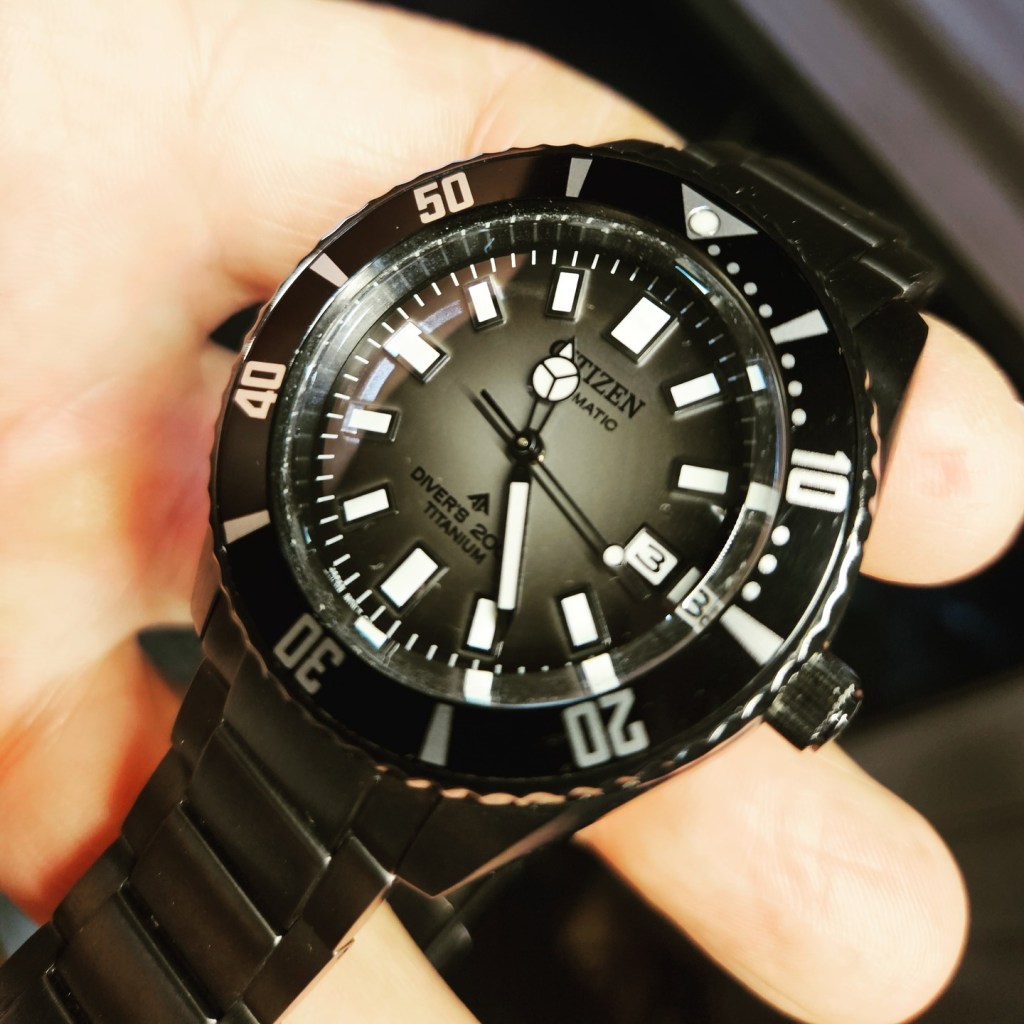
    Another repeat offender from my past was the Citizen Promaster Sky BY0084-56E. I owned that watch no fewer than seven times over a decade. That’s not ownership—that’s a custody arrangement. Unlike PVD, the Citizen used Super Titanium treated with Duratect—often described as DLC. Marketing aside, the material difference is real. Stainless steel sits around 200 on the Vickers hardness scale. DLC-coated Super Titanium pushes north of 1,000. That’s not invincible, but it’s not cosplay either.

    In real life, that translates to this: the clasp will show desk-diver scuffs, because clasps always do. The rest of the watch? It shrugs off normal wear with indifference.

    Which brings me to the present. In a couple of days, the Citizen Super Titanium Gunmetal Diver NB6025-59H will return to my collection. Its DLC coating reads more dark gray than true black—an advantage, frankly. I plan to take it traveling. Miami. Hawaii. Heat. Salt water. Airport bins. Sunscreen. Sweat. This watch is not entering witness protection. It’s not being boxed, babied, or preserved for a future auction. It’s being worn.

    I’m glad to have one black—or gunmetal—watch in the rotation. It’s a welcome disruption from stainless steel, a visual reset. But there’s a caveat worth stating. Black watches are all about proximity. Up close, the details are rich and seductive. From a distance, they collapse into silhouette—lume floating in darkness. If you need your watch to announce itself across a room, black may frustrate you.

    For me, that quiet severity is the point.

  • How We Went from Breakfast Mascots to Political Tribes

    How We Went from Breakfast Mascots to Political Tribes

    A few nights ago, I watched Big Vape: The Rise and Fall of Juul, the four-part autopsy of a company that promised salvation from combustible cigarettes and instead managed to hijack a generation’s taste buds. Juul framed itself as a public-health crusader. What it actually built was a sleek delivery system for addiction, turbocharged by flavors engineered to lodge themselves deep in the dopamine circuitry of young brains.

    Former employees and users all pointed to the same thing: mango. Mango wasn’t just a flavor; it was an event. People didn’t vape mango casually. They marinated in it. Mango was the hook.

    Watching this, I was transported back to my own childhood and my first chemical romance: Cap’n Crunch.

    There was something about that unholy alliance of corn flour, palm oil, and brown sugar that short-circuited my will. I didn’t want moderation; I wanted saturation. My parents imposed limits, which only deepened my resolve to grow up as fast as possible so I could make my own enlightened dietary decisions—namely, Cap’n Crunch for breakfast, lunch, and dinner. I failed to notice the irony that a grown man subsisting on sugar cereal would represent not maturity but infantilization.

    Cap’n Crunch’s true genius wasn’t just sweetness. It was proliferation. The same cereal reappeared in endless costumes—Crunch Berries, Peanut Butter Crunch—each one offering the illusion of choice. King Vitamin was the most audacious iteration: Cap’n Crunch in a health halo, a masterclass in rebranding junk as virtue. Lipstick on a pig, poured into a cereal bowl.

    Then there were the mascots. Quisp the Martian. Quake the muscle-bound coal miner. As a child steeped in superhero comics and Hulk fantasies, I gravitated toward Quake. Strength. Power. Identity. I didn’t realize I was choosing a brand avatar, not a breakfast.

    Cereal companies were having a field day. We watched cartoons while eating the very product being advertised between scenes. It never occurred to us that we were being conditioned—trained to celebrate a non-nutritive food substance that dissolved teeth and rewired appetite. The Juul kids didn’t know it either. They thought they were buying into a sleek, adult lifestyle. What they were really purchasing was dependence, with a mango aftertaste.

    What troubles me now is that adults don’t seem any less susceptible.

    Today, many people consume political tribes the way we once consumed sugar cereal and flavored vapor. Politics has been repackaged as lifestyle branding—complete with slogans, merch, cosplay, and dopamine hits. The substance is thin. The stimulation is constant. Critical thinking is nowhere to be found.

    These aren’t political commitments; they’re identity snacks. Sugar rushes masquerading as convictions. Defense of one’s “views” consists of chanting talking points with the same reflexive loyalty I once reserved for Cap’n Crunch. No wonder the country feels like it’s in free fall. We haven’t grown up—we’ve just swapped mascots.

    We are a nation of adult children, hooked on political flavors the way kids were hooked on cereal and Juul users were hooked on mango. Politics has become a consumer product: addictive, polarizing, shallow, and wildly profitable. All dopamine. No nutrition.

  • My Rotator Cuff Injury Taught Me Patience and Restraint

    My Rotator Cuff Injury Taught Me Patience and Restraint

    I hesitate to say this out loud, for fear of angering whatever capricious deity oversees orthopedic recoveries, but my torn rotator cuff appears to have turned a corner.

    For the first time in five months, I’ve gone without ibuprofen. No chemical truce. No white tablets brokered between inflammation and denial. My range of motion has improved by more than sixty percent, and for two nights in a row I’ve slept without that familiar 4 a.m. arthritis ambush—just a bit of stiffness, the kind that registers as information rather than alarm.

    When discomfort does surface, I can quiet it with embarrassingly small interventions: lateral raises with a three-pound dumbbell, posterior-delt pulls using a resistance band anchored to a garage wall strut. Movements so light they feel like apologies. And yet—they work.

    Two weeks ago, an ultrasound revealed inflammatory fluid. The doctor promptly suggested the modern holy trinity: cortisone shot, MRI, and escalation. I declined all three. Why submit to a needle when the pain isn’t screaming? Why enter an MRI tube when claustrophobia turns it into a medieval punishment device? And why rush toward surgery when my rehab therapist, calm and unflappable, says I’ll heal just fine without it?

    So I stick with what got me here.

    Careful shoulder work. Kettlebell leg training. Trap shrugs. Slow, deliberate cleans. Reverse curls. Close-hand push-ups on my knees—humbling but honest. Anything that irritates the shoulder—dumbbell flyes, grand gestures, heroic nonsense—gets cut without appeal. I’ve become ruthless in the best way. No bargaining. No ego.

    Injury has a way of clarifying priorities. You don’t truly appreciate the orchestration of a whole body until one part goes rogue and holds the rest hostage. Healing teaches restraint. Progress rewards patience. And recovery, when it finally begins, feels less like triumph than like a quiet ceasefire—one you’re careful not to violate.

  • The Schwinn Airdyne and the Three Realms of Fitness

    The Schwinn Airdyne and the Three Realms of Fitness

    About fifteen years ago, the literary magazine Zyzzyva published one of my short stories, “Phittnut’s Progress.” It followed a workout addict who trained with the same manic devotion Martin Luther once applied to penance and self-flagellation. At the time, I thought I was being clever. In retrospect, I was being autobiographical.

    I’ve long understood exercise as a spiritual journey—less Peloton, more Dante. Every workout is a descent, an ascent, or, on rare days, a brief glimpse of paradise. I grasped this intuitively long before I had any formal exposure to theology.

    When I was about seven, I watched a 1960s TV show in which a man in a gorilla suit terrorized castaways on a nameless island. The production values were laughable; the fear was not. That night, the gorilla followed me to my room. I lay in bed convinced the beast was beneath my mattress, growling, reaching upward, eager to drag me into its lair.

    Sleep was impossible until I deployed my first metaphysical escape hatch. I imagined myself drifting on a raft along a calm river, safely beyond the monster’s reach. Above me stood a benevolent woman—a hybrid of the Statue of Liberty and Dante’s Beatrice—watching over my passage. Ahead was a luminous haze, the same gauzy heaven Fred Gwynne’s Patience the Guardian Angel inhabits in the 1969 film The Littlest Angel. Only then did peace return.

    This architecture still governs my workouts.

    When I’m out of shape, I’m back in the Monster’s Lair. When conditioning improves, I find myself floating along Beatrice’s River. And when I hit my goal—when effort dissolves into rhythm—I enter the Glory of Patience.

    My Schwinn Airdyne is the portal between these realms.

    Six months ago, my ambition was modest: 600 calories in 54 minutes. Respectable. Enough to keep the gorilla at bay. As fitness returned, so did ambition. A month ago, I raised the standard. To remain outside the inferno, I now needed 700 calories in roughly 55 minutes.

    Then reality intervened.

    Four days ago, after brutalizing my body with an ill-advised plumbing project, I plunged straight into the pit. Two days later, I slogged for 56 minutes and scraped together a humiliating 500 calories. Full inferno. The simian breathed hotly.

    Today, I clawed my way back to 603 calories in 54 minutes. Not glorious. Not close to the 810 calories I burned in 61 minutes six days ago. But it’s movement in the right direction. The river is visible again. The monster’s reach falls short.

    For now, that’s enough.

  • Overthinking Puts You in the Way of Enjoying Your Watch Hobby

    Overthinking Puts You in the Way of Enjoying Your Watch Hobby

    I’m trying not to get in the way of enjoying my watch hobby. Let me restate that, because it sounds absurd even as I say it: I’m attempting to stop sabotaging my own pleasure in a hobby I genuinely love. I’m trying to step aside so I can simply look at a watch and enjoy it like a normal human being.

    What’s the obstruction?

    Overthinking.

    Yes, I’m addicted to watches—but that’s a minor vice compared to my real dependency. I’m addicted to thinking about thinking. Overthinking is my true Grail, and it’s always in stock. The more I indulge it, the darker and more pessimistic my inner monologue becomes. I don’t pretend to have a cure for something that has been with me my entire life. I do, however, recognize the pattern.

    This goes back a long way.

    In 1967, I was five years old and anxious about lunch. When was it coming? Why wasn’t it here yet? My grandmother looked at me and said, “Jeff, you worry too much.” The moment she said it, a switch flipped. I wasn’t comforted. I was horrified. She was right. I did worry too much. And now I had something new to worry about: the fact that I worried too much.

    Congratulations, kid. You’ve unlocked the meta-anxiety level.

    I do the same thing with watches. I overthink my overthinking. I analyze my tendency to analyze. Then I wonder if that analysis itself is the problem. Before long, the joy drains out of something that should be simple: wearing a watch.

    Do I have a solution? Not really.

    What I do have is a strategy borrowed from a therapist I saw as a neurotic college student in the 1980s. His advice was disarmingly calm: when negative thoughts appear, don’t fight them. Don’t suppress them. Just notice them. Observe them as if they were weather passing through. No judgment. No panic. No dramatic counteroffensive.

    So that’s the plan. Observation without self-flagellation.

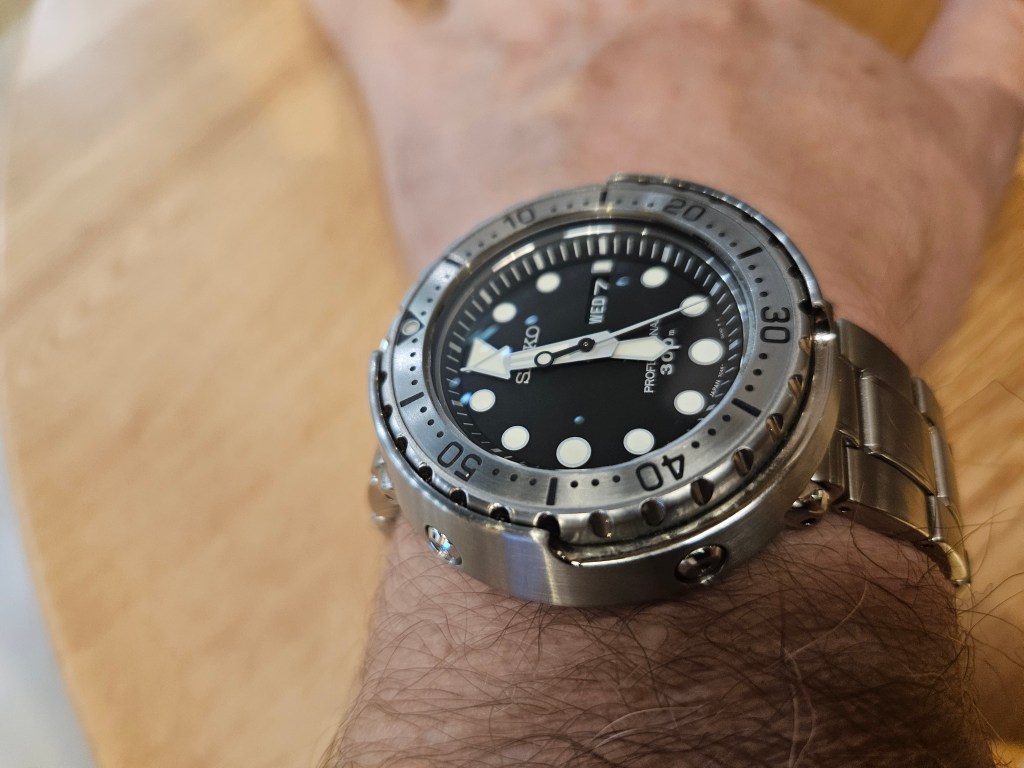
    This morning, for example, I strapped on the mighty Seiko Tuna SBBN049—on a bracelet, no less—and immediately my brain went to work. Is this watch too big? Too bold? Will I still be wearing a Tuna in my eighties? Will octogenarian me look ridiculous?

    The thoughts were stupid. They were also funny. And—most importantly—irrelevant. Rather than scolding myself, I watched the thoughts float by, labeled them mental debris, swept them out, and got on with my day.

    My oatmeal was excellent.
    My coffee was perfect.
    The Tuna looks fine on the wrist.

    Sometimes that’s enough.

  • The Hot Take Is the Chronic Cough of Something Gone Wrong

    The Hot Take Is the Chronic Cough of Something Gone Wrong

    We live in a Hot Take culture, and on balance, hot takes do more harm than good.

    For a decade, I feasted on them. Back when it was still called Twitter, my days were seasoned with sharp one-liners, instant judgments, and rhetorical mic drops. It felt bracing at first—intellectual espresso shots delivered in 280 characters. But over time, the feed stopped feeling like conversation and started feeling like a room full of people shouting clever insults at a fire.

    About a year ago, I deleted my account. By then, I barely recognized the people I once followed. Everything had gone shrill. Bombast replaced thought. Even the impressive hot takes—clever, ruthless, beautifully phrased—eventually blurred into something anesthetizing. A constant buzz that left me dull rather than informed.

    I didn’t quit social media entirely. What I actually want is boring, old-fashioned breaking news. Tell me what happened. Tell me where. Tell me when. I don’t need a verdict within thirty seconds. So now I drift through places like Threads, mostly lurking. Many of the smart people I used to follow migrated there. Some still do what they’ve always done: post headlines and context. Others can’t resist the gravitational pull of commentary. News first, hot take immediately after. Their allies cheer them on inside familiar silos, and the machine rewards escalation.

    To be fair, not everyone posting is chasing dopamine. Some journalists are doing real work. They have massive audiences and feel a genuine obligation to interpret chaos in real time. They live in a crucible of praise and abuse, applause and outrage. That kind of constant psychic weather can’t be healthy, but the motive is understandable—meaningful engagement. If this were a pre-digital era, they’d still be doing something similar, just with deadlines instead of feeds. Slower. Quieter. Possibly saner.

    But then there’s another species entirely: the professional Hot Taker.

    This person has mastered the form. Their posts are short, sharp, structurally elegant. A good hot take is witty, memorable, and instantly legible. It lands. It spreads. It racks up likes and reposts like a slot machine hitting cherries. Success is measurable, public, addictive.

    And that’s the trap.

    When identity and self-worth become tethered to engagement metrics, the self gets commodified. Everything becomes raw material for the next take. Nuance is a liability. Hesitation is death. The hot take demands boldness, outrage, and certainty—even when certainty is fraudulent.

    At that point, the Hot Taker is no longer responding to the world; they are farming it.

    I’ve watched thoughtful, decent people slide into this role. At first, their posts are useful. Then they overshare. Then they pick fights they don’t need to fight. Eventually, their online life becomes a series of skirmishes that feel exhausting even to sympathetic observers. They can’t stop—not because they’re evil, but because the machine has trained them well.

    So yes, we live in the Age of the Hot Take, where people measure their purpose by their ability to generate applause from the faithful. Hot takes don’t convert anyone. They delight the choir and enrage the opposition. Polarization intensifies. Nothing moves.

    Is it unfair to call this a disease? I don’t think so.

    First, there’s the hijack. The belief that constant expression equals relevance, that relevance equals worth. It’s a delusion reinforced by numbers. Likes don’t satisfy; they sharpen hunger.

    Then there are the consumers. By liking and reposting, they feel they’re participating in history, bending reality toward justice. In practice, they’re mostly helping tribes harden their borders. Everyone believes they’re weaponizing truth. No one notices the epistemic ground eroding beneath them.

    When COVID hit, I assumed the crisis would force clarity. Instead, it deepened the divide. Now measles—a disease we already solved—is making a comeback. Science, once the shared floor, has become another battlefield. If pandemics and preventable deaths can’t bring us together, hot takes certainly won’t.

    You can fire off the most righteous, viral condemnation imaginable. Measles will still spread.

    So what should we do instead?

    The answer isn’t attractive. Reality hasn’t hit hard enough yet. Historically, people abandon fantasy only when consequences become unavoidable. Until then, we chatter. We posture. We perform. Hot takes aren’t solutions. They’re symptoms—the chronic cough that tells you something deeper is wrong.

  • The Myth of the Ultimate Watch Collection

    The Myth of the Ultimate Watch Collection

    There is no such thing as an ultimate watch collection. That fantasy survives only in Instagram grids and forum signatures. In real life, your taste sharpens, clarifies, narrows—and that clarity does bring you closer to something satisfying. But it never brings closure.

    The problem is not the watches. The problem is us.

    We are capricious animals. One day we crave restraint; the next day we want spectacle. Nostalgia ambushes us and sends us chasing a watch tied to some earlier version of ourselves—college years, first job, first illusion of competence. Sometimes that works. Sometimes it doesn’t. A watch can be a time machine or a dead end.

    Then there’s money. Grail pieces often cost so much that they can’t be worn without anxiety. They live in safes, not on wrists. You admire them abstractly but never bond with them. On the other end, budget watches sometimes fail the respect test. You want to love them, but something feels compromised—finish, heft, presence. The relationship never quite takes.

    So if there is a destination, it isn’t perfection. It’s the sweet spot.

    The watch isn’t too small or too large. It isn’t priced so high that you fear it, or so low that you dismiss it. It isn’t dull, but it isn’t shouting either. You can look at it from different angles and keep finding reasons to linger. It holds your attention without demanding it.

    Some people chase that feeling through complexity. Chronographs seduce with their subdials and mechanical busyness. I tried that path. Instead of enchantment, I got sensory overload. Too much information. Too much pleading. I found myself longing for the blunt honesty of a diver.

    But even a diver has to earn its place.

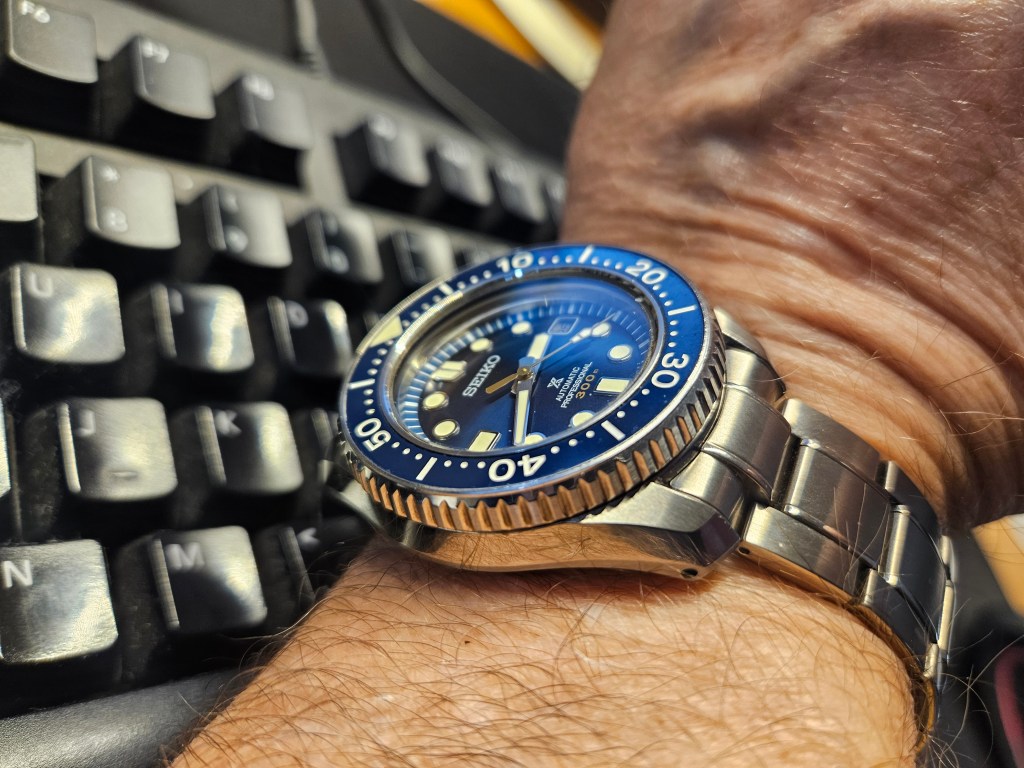
    It needs salient features. Bold, but not desperate. Visually striking, but instantly legible. Purposeful without cosplay. The Seiko MM300 SLA023 comes to mind. It’s a legend in the Seiko lineup because it commits fully to its identity. Over 44mm wide. About 15mm thick. It doesn’t apologize. If you can carry those dimensions, it rewards you with gravitas and coherence.

    If you can’t, there are alternatives.

    The Seiko Alpinist SBDC209 is a different kind of seduction. At 39.5mm, it’s compact, refined, endlessly stare-able. You can live with it all day without fatigue. On the right wrist, it’s perfect. On mine, it disappears. And when a watch disappears, the answer is simple: no.

    That’s the truth most collectors avoid. The “ultimate” collection isn’t about consensus or rankings. It’s about proportion—between the watch and the wrist, between desire and restraint, between fantasy and daily life.

    You don’t arrive at it once.
    You circle it.
    And if you’re lucky, you pause there for a while.

  • The $80 Radio That Beat the Big Boys

    The $80 Radio That Beat the Big Boys

    Five mornings a week, I work out in my garage—kettlebells clanging, yoga mat unrolled, joints negotiating a ceasefire. The soundtrack is Larry Mantle on LAist 89.3 FM, broadcasting from Pasadena. This matters because Torrance is not Pasadena, and 89.3 is a notoriously fragile signal here. It fades, ghosts, sulks. Catching it cleanly is less a matter of tuning than of faith.

    Then there’s the noise. Torrance mornings are an industrial symphony: garbage trucks reversing, leaf blowers screaming like jet engines, lawnmowers revving, cars tearing past as if late for something existential. Any garage radio that can’t project authority is immediately demoted to paperweight.

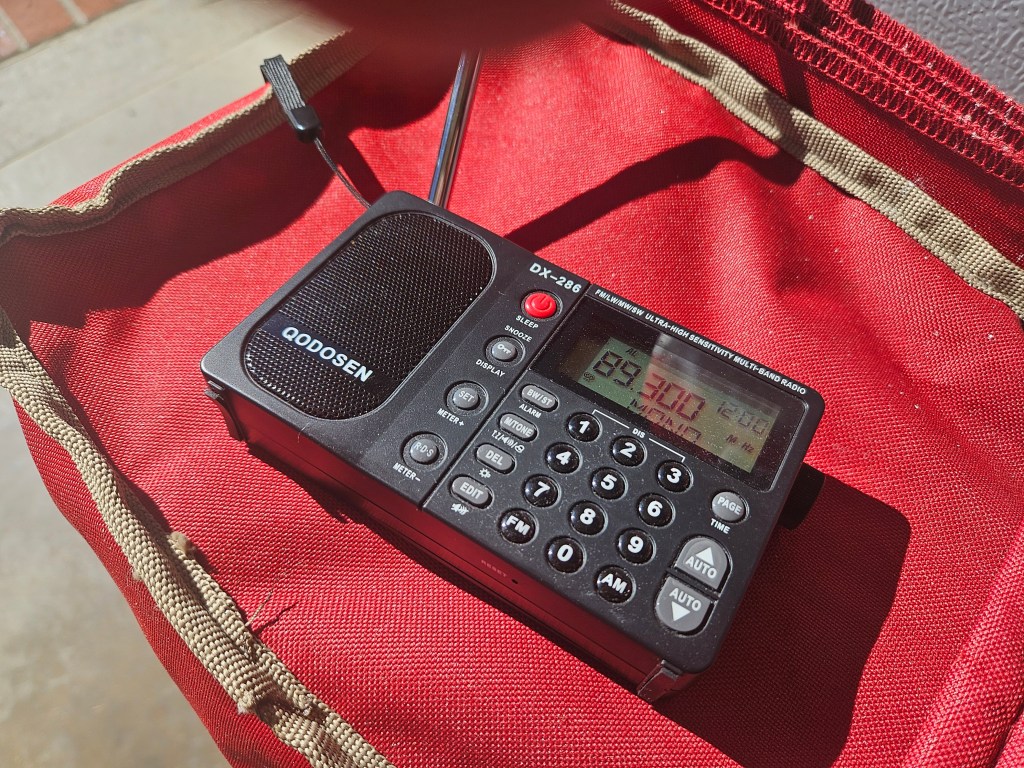
    I briefly considered going big—dropping $300 on a Tecsun S-8800 field radio, a machine that looks like it should come with a government-issued lanyard. But after cycling a parade of smaller radios through the garage, I landed—almost sheepishly—on the Qodosen DX-286. And it has been an ambush.

    On FM, the Qodosen is a brute. It grabs 89.3 at full strength and refuses to let go. Its 3-watt speaker is loud without being cruel, present without being shrill. Placed in just the right corner of the garage, away from interference, it becomes a small, defiant monument to good engineering. Unfettered, it sings.

    The most embarrassing part is that I once returned it.

    I didn’t trust it. An $80 radio performing this well felt like a trick. Too good to be true. I convinced myself it was a short-lived overachiever—high performance, early death. So I sent it back and went crawling to my more expensive radios: the Tecsun PL-660, the PL-680. Fine machines. Respectable. And yet, one by one, they lost the FM battle and the speaker war.

    The absence of the Qodosen grew louder than the radios I owned.

    Eight months ago, I rebought it, tail between my legs. It has been my garage companion ever since. Morning after morning, it cuts through the din and delivers Larry Mantle like clockwork. Kettlebells swing. Downward dogs are held. The signal holds.

    Sometimes the best gear isn’t the one with the most gravitas or the highest price tag. Sometimes it’s the small, stubborn box you didn’t believe in—until it refused to be ignored.

  • The Submarine That Got Me Punished

    The Submarine That Got Me Punished

    One afternoon in Mrs. Eckhart’s fifth-grade class, I finished my reading questions early and found myself with a full hour to kill. So I did what any quietly restless child with access to art paper would do: I drew a gigantic submarine.

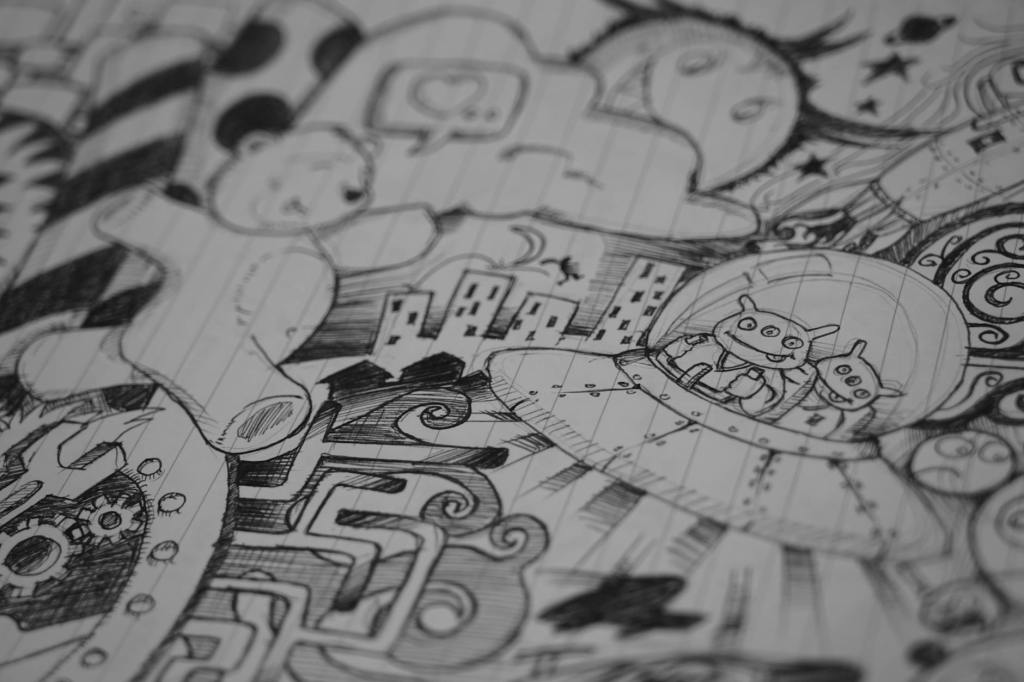
    It was glorious. The hull bristled with portal windows, and inside each window lived a tiny, talkative world. Every occupant had something urgent to say. One man was making pancakes and inviting others over. A woman, her hair set in curlers, announced she was in no condition to be seen. Another guy sulked over a bowl of cereal because the box promised a free toy and delivered nothing. Someone tried to nap in a hammock but complained about the noise. A girl had a strip of apple skin lodged between her teeth and was losing her mind over it. There were at least a dozen such figures—boasting, whining, confessing, performing.

    It was a floating anthology of minor human grievances.

    I was proud of it. I felt like I was getting valuable training for my future career writing for Mad Magazine. I was quiet. I was finished with my work. I was bothering no one.

    Then Mrs. Eckhart appeared.

    She moved down the aisle between desks, paused, and studied my drawing. I waited for praise—some acknowledgment of creativity, wit, talent. Instead, I got disdain. Her red hair was stacked into a bouffant, her eyebrows arched in judgment.

    “Is this how you spend your time in my class?”

    “But I finished the assignment,” I said. “I was working quietly.”

    She ignored that and began reading my dialogue bubbles aloud, dripping sarcasm into every line. The class erupted in laughter—not the good kind, the kind that comes from watching someone get filleted by authority.

    Then she delivered the verdict.

    “Your parents should know how you’re spending your time in my classroom.”

    She flipped the page over and wrote a note explaining my offense. I was to take it home, secure parental signatures, and return it like evidence.

    That evening, after dinner, I showed my father the drawing.

    He was livid.

    “You pissed off your teacher,” he said.

    “I don’t know why,” I said. “I finished my work. I was quiet.”

    “It doesn’t matter. You insulted her.”

    “I don’t get it.”

    “By finishing early and doodling, you implied her work was too easy. You disrespected her.”

    “But I didn’t say anything. I just drew.”

    “It doesn’t matter if you’re right,” he said. “What matters is you made her angry. In life, it’s better to be smart than to be right.”

    “I thought those were the same thing.”

    “Not always. Go to your room. Write her an apology.”

    I wrote the apology. But even then, I knew—deep down—I had done nothing wrong. In fact, to this day, that submarine remains the best use of time I ever managed in her class.

    The truth was simple: Mrs. Eckhart didn’t like me. I was brooding, inward, melancholic. She sensed something in me she found intolerable. Once, after she criticized a homework assignment, I tried to explain myself.

    “You have an excuse for everything, don’t you?” she snapped.

    If all my teachers had felt that way, I might accept the diagnosis. But they didn’t. Every other teacher thought I was polite, attentive, fine. There was something specific between us that never resolved.

    Sometimes hostility is not psychological; it’s biblical. It has no cause, no logic, no cure.

    I think of the excellent movie The Banshees of Inisherin. Colm abruptly ends his friendship with Padraic. No grievance. No inciting incident. “I just don’t like you anymore.” That’s it. Padraic hasn’t changed. Colm simply finds him unbearable.

    After nearly forty years of teaching, I know this pattern well. I’ve been popular, well-liked, even beloved by students—but that hasn’t spared me the occasional student who radiated pure contempt. Once, friendly students asked if I noticed a guy in the back who glowered at me all semester. I told them yes. Every so often, someone decides you are intolerable. There is no appeal process.

    In those cases, effort only makes things worse. Trying to win favor intensifies the repulsion. The Chinese phrase captures it perfectly: mei ban fa—nothing can be done.

    Do I resent Mrs. Eckhart? A little. She was an authority figure with a visceral dislike for a ten-year-old boy. But what endures most isn’t bitterness. It’s joy.

    That submarine was alive. It was funny. It was mine. No note home, no scolding, no pinch-faced teacher can take that away.

  • Losing My Classroom Key and Finding the End of the World

    Losing My Classroom Key and Finding the End of the World

    Twenty-six years ago, I lost my classroom key at a university. This was not treated as a minor inconvenience. It was treated as a moral failure.

    I was summoned before a college administrator whose demeanor suggested I had been caught shoplifting ideas from Plato. She informed me—slowly, with relish—that the one thing a college instructor does not do is lose his key. She scanned me from head to toe the way a customs agent inspects a suitcase that smells faintly of contraband. My carelessness, she implied, had finally revealed my true identity: a professional bum, a sloth masquerading as an educator, a man unfit to shepherd students through anything more complex than a vending machine.

    Once she had finished anatomizing my character, I asked—meekly—how one went about replacing a lost key.

    “You don’t just get a replacement,” she said. “It’s a process.”

    The word process landed like a sentence.

    She explained that I would need to drive to a remote outpost on the edge of campus called Plant-Ops. There, I would meet a locksmith. I would give him my personal information and twenty dollars in cash. No check. No receipt. The arrangement sounded less like facilities management and more like a back-alley transaction involving counterfeit passports.

    “How will I know who the locksmith is?” I asked.

    “You’ll know him,” she said. “He’s the only person there.”

    “What’s the place called again?”

    “Plant-Ops.”

    I repeated the name aloud, hoping to brand it into my memory. She looked at me as one looks at a child who has accidentally set fire to a jungle gym and informed me that I was dismissed.

    Shamed and slightly afraid, I drove east from campus. The pavement gave way to dirt, then rubble, then something that barely qualified as a road. My car bucked and rattled as I passed cow skulls bleaching in the sun and tumbleweeds drifting like omens. Buzzards circled overhead. I was no longer in Southern California. I had crossed into a grim pocket dimension where entropy had been fast-forwarded and everything was quietly rehearsing its own ending. If someone had told me I would die there, I would not have argued.

    At last, I reached Plant-Ops: a dilapidated hangar that looked one strong gust away from becoming a weather event. Inside stood the locksmith. He was short, grouchy, bespectacled, and gaunt, with a bushy mustache and a few desperate strands of black hair clinging to his bald skull. He wore a grease-splattered apron. Wind howled through the corrugated metal walls, and I half-expected the structure to lift off and spin into the sky like Dorothy’s house.

    The man stood over a battered wooden workbench, glaring at me while eating cold SpaghettiOs straight from the can. His eyes bulged with irritation. My presence had clearly ruined his meal. Worse, it confirmed his theory of the world: incompetents abound, and today one had wandered into his hangar.

    I explained that I had lost my key. I apologized as though I had personally engineered his inconvenience. He demanded twenty dollars in cash—up front—made the key, and then leaned in to warn me that he was retiring soon. His replacement, he said, was a complete idiot, incapable of making a functional key. I took this prophecy seriously.

    I fled the hangar, drove directly to a hardware store, and purchased a Kevlar keychain with a tether reel, a high-density nylon belt loop, and enough industrial reinforcement to secure a small boat. From that day forward, my keys were attached to my body like an ankle monitor.

    I have done worse things in my life—objectively worse—but for reasons I still don’t fully understand, losing that key put me briefly at odds with the universe. I had been consigned to a shame dungeon, escaped it by the skin of my teeth, and sworn never to return.