Category: Confessions

  • Chosen by the Frogman

    Chosen by the Frogman

    More than a decade ago, a seasoned watch obsessive told me something I dismissed at the time: you don’t hunt a Holy Grail—you stumble into it. It doesn’t arrive with fireworks or a four-figure invoice. It slips onto your wrist quietly, and then, without asking permission, it takes over. Everything else starts to feel like a costume. You try to rotate, you try to be fair, you give the others their appointed wrist time—but you feel a faint resentment, like you’re cheating on something that actually fits. Eventually the charade collapses. You stop negotiating. You wear the same watch because it works, and because you no longer have the patience for anything that doesn’t.

    When that happens, the chronophage loses its grip. The endless scroll of “must-haves,” the dopamine carnival of releases and reviews, the debates over marginal gains—all of it begins to look like noise generated by people who haven’t found their watch yet. You close the tabs. You ignore the hype. You retire from the rotation economy. Let the others keep spinning the wheel. You’re done. You’ve chosen, or more accurately, you’ve been chosen.

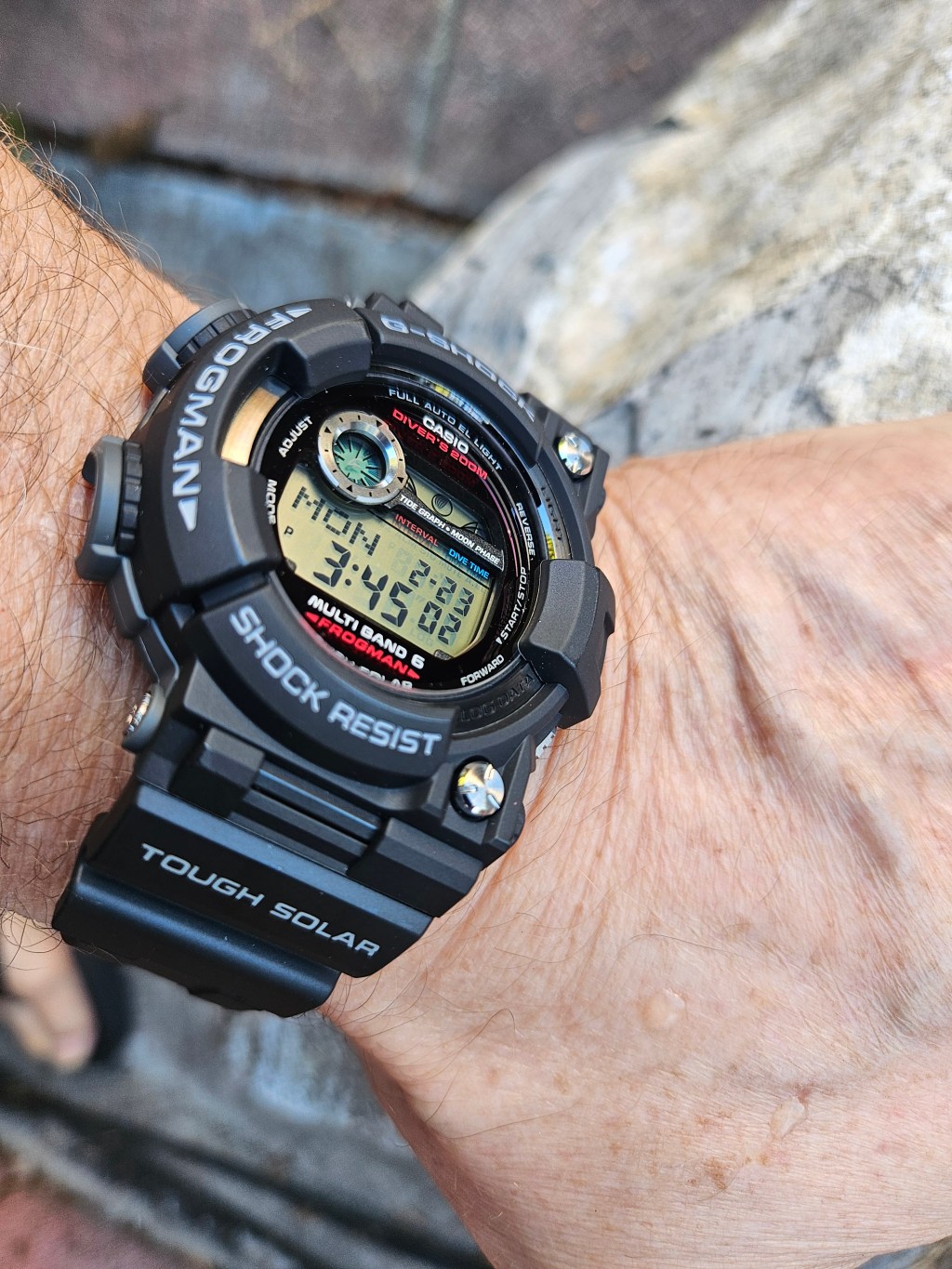
    If you had told me a year ago that a black resin digital watch would be the one to do this, I would have laughed you out of the room. My tastes, I thought, were too refined, too anchored in steel and mechanical romance to be hijacked by a plastic instrument. And yet, a month ago, the G-Shock Frogman GWF-1000 landed on my wrist and quietly began rewriting my habits. It doesn’t leave. The only thing that occasionally displaces it is another G-Shock—the GW-7900—which, if I didn’t have the Frogman, would be my undisputed daily driver. 

    Of course, I know the trap. The honeymoon phase has seduced better men than me. Give it six months, I tell myself. Let time do its work. If the Frogman is still there—if the others still feel like substitutes—then this isn’t infatuation. It’s alignment.

    The grail, it turns out, is not the watch you chase. It’s the one that makes you stop.

  • When the Hobby Becomes a Spectacle of Torment

    When the Hobby Becomes a Spectacle of Torment

    A man in the watch community watched my Frogman video, declared it had caused him “emotional damage,” and proceeded to prove his point by buying Frogman after Frogman in a spree of excess that seemed to be driven more by torment than joy. 

    The watch hobby already carries enough built-in torment. It doesn’t need to be escalated into a public ritual of compulsion. When I share a video about a watch I enjoy, the aim is simple: appreciation, not contagion. Yet in the attention economy, moderation is invisible. What gets rewarded is escalation—bigger reactions, louder confessions, more dramatic spirals. Attention, after all, is a scarce resource, and the surest way to capture it is to weaponize feeling.

    But there is a cost to that performance. When a hobby becomes tethered to the language of “emotional damage,” something has gone wrong. The line between enjoyment and dependency blurs, and what should be a small, contained pleasure metastasizes into something heavier—something that follows you around, nags at you, drains you.

    The only countermeasure is deliberate restraint. We have to regulate our intake of the digital world the way we regulate food—set limits, step away, return to the analog. Read a book. Play the piano. Lift something heavy. Walk outside without a device narrating your existence. Relearn what it feels like to occupy your own life without commentary.

    If someone discovers the Frogman and it brings them genuine satisfaction, that’s a good outcome. But if it becomes another entry point into a cycle of restless acquisition and theatrical distress, then the watch is no longer the problem—it’s the system surrounding it.

    I can’t control what anyone does after watching a video. No one can. The only thing I can do is speak plainly about the effect this environment has on me, and about the boundaries I’ve had to build to keep a hobby from turning into something corrosive. That’s not a solution. It’s a discipline. And it’s ongoing.

  • Seven Watches Have Made Me Contemplate the Tyranny of Want

    Seven Watches Have Made Me Contemplate the Tyranny of Want

    I was raised to believe that wanting something was reason enough to have it.

    Not a suggestion. Not a temptation. A principle.

    In the 60s and 70s, appetite was rebranded as intelligence. If you knew how to indulge—food, gadgets, experiences—you weren’t weak. You were evolved. The man who said no looked like a malfunction: tight-lipped, joyless, possibly afraid of his own shadow.

    The rest of us were out there chasing pleasure like it was a civic duty.

    And I didn’t just participate—I specialized.

    I built a life around calibrated indulgence. Watches, food, stimulation. I didn’t impulse-buy; I strategized. I had rotations, hierarchies, justification frameworks. I could explain any purchase with the calm authority of a man who had already made the purchase.

    Which is why it’s unsettling—borderline alarming—that I now feel relief that my watch collection is down to seven.

    Seven.

    At one point, seven watches would have been the warm-up act. Now it feels like silence after a fire alarm. Manageable. Contained. Almost peaceful.

    Out of curiosity, I tried to imagine adding just one more watch.

    Not buying it—just imagining it.

    Within seconds, I felt the familiar anxiety spool up: Where does it fit? When do I wear it? What does it replace? What problem is it solving that doesn’t exist?

    That’s when the illusion cracked.

    What I used to call “expanding the collection” was actually expanding the burden.

    Which led to a thought I’ve spent most of my life avoiding:

    What if self-denial isn’t deprivation?
    What if it’s relief?

    This idea runs against decades of conditioning. My instincts are trained like a high-performance lab animal: stimulus, response, reward. See it. Want it. Acquire it. Repeat until the dopamine system starts filing complaints.

    And yet the results are undeniable.

    The next watch doesn’t calm me—it destabilizes me.
    The next meal doesn’t satisfy me—it expands me.
    The next YouTube video doesn’t enlighten me—it hooks me into a slot machine where the jackpot is always one more spin away.

    Different behaviors. Same engine.

    I’ve spent years obeying impulses that don’t know how to stop—and calling that freedom.

    Now I’m starting to see it for what it is: a feedback loop that promises satisfaction and delivers agitation.

    So I’m experimenting with a radical intervention.

    Not buying the watch.
    Not eating the extra food.
    Not clicking the next video.

    It sounds trivial. It feels trivial. But it isn’t.

    Because when you interrupt the impulse—even once—you discover something unexpected: nothing collapses. The urgency fades. The world keeps spinning. You’re still here.

    And in that small gap between wanting and doing, something rare appears.

    Control.

    Self-denial, it turns out, is not a punishment. It’s leverage.

    It’s the ability to step between impulse and action and say, “Not this time.” It’s the quiet refusal that breaks the loop. It doesn’t feel dramatic. It feels almost boring. But it works.

    Which raises a question I can’t quite shake:

    Why did no one make this case to me when I was younger?

    Or did they—and I dismissed it because it sounded like the philosophy of people who weren’t having any fun?

    Would I have listened? Or would I have reacted the way anyone reacts when you threaten their favorite addiction—with polite skepticism covering a deeper hostility?

    Tonight, the old circuitry is still humming.

    There’s hunger—not real hunger, but the kind that shows up after dinner with a marketing pitch.
    There’s restlessness—the urge to check something, watch something, consume something.
    There’s the gravitational pull toward the kitchen and the screen.

    I know how this ends.

    Stay up late, and discipline dissolves. You eat something unnecessary while watching something forgettable and go to bed slightly disappointed in both.

    So I try something different.

    Go to sleep.

    End the day before the impulses take over.

    It’s not heroic. It won’t trend. No one is going to applaud the man who defeated temptation by becoming unconscious.

    But it might be the smartest move I make all day.

    And still—because habits don’t die quietly—the voice is there, smooth as ever:

    I’ll deny myself.

    Just not yet.

  • Abducted by My Hygienist, Grounded by Reality

    Abducted by My Hygienist, Grounded by Reality

    My dentist—one year younger than I am, which in our age bracket feels less like a difference and more like a rounding error—peered into my mouth and delivered his verdict with clinical calm: two abrasions, self-inflicted, the result of brushing with the zeal of a man trying to erase his past. They would need fillings. Then, without missing a beat, he pivoted from my dental erosion to his own existential one. At sixty-three, he said, fatigue had begun to collect in the corners of his life. Travel, once a pleasure, had become an ordeal. He had lost interest in vacations altogether.

    He offered evidence. His sister-in-law had been stranded in Dubai while missiles stitched the sky over Iran. When she finally escaped, her flight climbed higher than usual to avoid the problem of being blown out of the sky—a detail that tends to sour the in-flight experience. Twenty hours later she landed in Dallas, dazed and displaced, only to discover she still needed to purchase a separate ticket to get home to Los Angeles. The modern vacation: a geopolitical obstacle course with snacks.

    I told him I understood completely. I, too, have entered the era of strategic energy management. I work out five days a week, yes—but I also schedule two naps a day with the seriousness of board meetings. Europe, at this point, feels less like a destination and more like a test of endurance. Cabo I can handle—two hours, a controlled burst. Miami, perhaps, if I marshal my resources. But a transatlantic flight? The return on investment collapses. The juice is no longer worth the squeeze.

    While we were discussing the slow recalibration of ambition, his technician went to work on my teeth with a collection of instruments that sounded like extraterrestrial diplomats arguing through a metal wall. Half sedated by the hum and whine, I drifted into the plausible conclusion that I had been abducted. Not metaphorically—literally. I was on a ship, somewhere above the atmosphere, being examined by beings who had mastered interstellar travel but still hadn’t figured out how to make dental procedures pleasant.

    Eventually, they released me—back into the chair, back into my life—with instructions to gargle fluoride and abstain from food and water for thirty minutes. The kind of post-op protocol that suggests the aliens, for all their advancements, remain deeply committed to inconvenience.

  • My 57-Minute Relationship with the G-Shock GW-6900

    My 57-Minute Relationship with the G-Shock GW-6900

    I got home at 5:00 p.m. to find my Amazon package waiting for me like a promise I didn’t remember making. Inside: the G-Shock GW-6900, the much-celebrated Three-Eyed Monster. I unboxed it, performed the usual initiation rituals—set it to LAX, marched through the modes, customized everything like a man preparing a command center—and then attempted the simplest task imaginable: return to Timekeeping.

    Impossible.

    No matter what I pressed, held, or pleaded with, the watch snapped back to UTC like a bureaucrat rejecting incomplete paperwork. I consulted the manual. I consulted YouTube. I even consulted AI, that modern oracle of last resort. Nothing. The watch refused to cooperate, as if it had been programmed with a small but firm sense of contempt.

    Meanwhile, the physical object itself began to lose its charm under scrutiny. Next to the Frogman and the 7900, the 6900 felt… cheap and underfed. Lighter, cheaper, less resolved. The strap clung to my wrist like it had second thoughts about the relationship—barely long enough, noticeably less comfortable. This wasn’t a heroic tool watch. This was a compromise wearing a reputation.

    The decision arrived with unusual clarity: return it.

    By 5:57 p.m., I had already processed its return on Amazon, dropped it off at the nearby UPS, and said good riddance. It is now on its way back to wherever failed expectations are processed. I had made the round trip—anticipation, confusion, disappointment, rejection—in under an hour. A full consumer arc compressed into a sitcom episode.

    Now the house is quiet again. Seven watches remain. The cognitive clutter has thinned. No more scrolling through modes like a man trapped in a digital maze. No more negotiating with a watch that refuses to tell time on command.

    The 6900 is gone.

    And for the first time today, everything is exactly where it should be, and I can now move forward with my life. 

    Update:

    Two friends messaged me to explain that with the 6900 you don’t press the upper left button to exit UTC and get into Timekeeping. You press the upper right button, so the watch was probably not defective. But it was so inferior to the 7900 in terms of build quality and strap length that I’m glad I returned it.

  • The Discipline of Less: How One Watch and Three Meals Without Snacks Will Save Your Sanity

    The Discipline of Less: How One Watch and Three Meals Without Snacks Will Save Your Sanity

    My G-Shock Frogman has become my horological Holy Grail—the watch that ends the endless tribunal of wrist-rotation decisions. No more standing before the watch box like a minor bureaucrat weighing options no one asked for. The Frogman abolishes the committee. It declares: This is the watch. Proceed with your life.

    The 3-Meals-a-Day Plan performs the same quiet coup in my diet. It eliminates the constant negotiations with the fridge, the whispered justifications for a “quick snack” that metastasizes into a caloric ambush. Three meals. Defined borders. No loopholes. The hunger doesn’t disappear—it files a complaint—but the chaos does.

    Both systems teach the same unfashionable truth: happiness is less about expansion than restriction. The modern instinct is to maximize choice, to curate endlessly, to keep every option alive like a hedge fund of desires. But abundance breeds friction. Every additional option is another small burden, another decision tax. The Frogman removes the tax. The 3-Meal Plan shuts down the snack economy. What remains is not deprivation but clarity.

    Yes, you lose variety. The other watches sit in their velvet purgatory. The snacks call out from the kitchen like minor demons. But something more valuable takes their place: a clean line between decision and action. You stop asking, What should I wear? What should I eat? and start living inside the answer.

    And in that narrowing, something unexpected happens—you bond with the choice you’ve made. The Frogman becomes not just a watch but a fixed point. The 3-Meal Plan becomes not just a diet but a structure that holds you together when appetite tries to scatter you.

    So the command is simple, almost severe:

    Wear the Frogman.
    Eat the three meals.

    Not because you have to—but because without boundaries, everything dissolves into noise.

  • Why I’m Not Fully G-Shockified (Yet)

    Why I’m Not Fully G-Shockified (Yet)

    A month ago, I fell—hard—for the G-Shock Frogman GWF-1000. Not a mild infatuation. Not a passing curiosity. A full conversion experience. Within days, I recruited two accomplices—the GW-7900 Rescue and the GW-6900 Three-Eyed Monster—and suddenly my mechanical divers, once the crown jewels of my collection, were sitting in the watch box like retired prizefighters telling stories no one asked to hear.

    Let me be clear: I have not renounced them. I still admire the Seiko SLA055. I still regard the quartz Tuna SBBN049 with something close to reverence. But admiration is not the same as use. Once you’ve tasted atomic time—precise, indifferent, quietly superior—it’s difficult to return to the charming imprecision of mechanical watches. You don’t switch back from filtered water to a garden hose unless nostalgia is doing the driving.

    And I’m not alone. Since confessing my condition, I’ve received a steady stream of testimonials. Men who bought a GW-M5610 or a GW-5000U and quietly stopped wearing everything else. Not because they planned to. Not because they declared war on their collections. But because the G-Shock—comfortable, accurate, frictionless—refused to leave their wrist. Their curiosity still wandered, their addiction still whispered, but the watch stayed put. Anchored. Unmoved.

    This phenomenon deserves a name: G-Shockification.

    It is the moment when a watch enthusiast, steeped in the romance of mechanical horology, is overtaken by the brute efficiency of atomic precision. At first, there is resistance. Then rationalization. Finally, surrender. Variety collapses. The rotation dies. The watch box becomes a museum, and the G-Shock becomes the only living artifact. What began as a hobby turns into a single, dominant habit—quiet, practical, and oddly liberating.

    Some resist the change. Some embrace it. Some preach it like a new religion. But they all share one outcome: the mechanical watch, once a daily companion, becomes an occasional guest.

    Which brings me to the uncomfortable question: Have I been G-Shockified?

    The honest answer is: not quite.

    I have my objections. With a G-Shock, I cannot simply glance at the time. I must present the watch to my face like an offering, or press a button and summon light—an act that triggers a faint but persistent anxiety about draining the solar charge. In a dark movie theater, the problem becomes almost philosophical. Do I illuminate my wrist and disrupt the room? Or do I behave like a civilized adult and wear something else?

    This is where the quartz Tuna reenters the story.

    Since my G-Shock conversion began, the Tuna has enjoyed a quiet renaissance. It is as if atomic time granted me permission to appreciate quartz accuracy without guilt. At night, it is flawless—constant lume, instant readability, no negotiation required. It does not ask for a button press. It does not demand a ritual. It simply tells the time, like a professional.

    And so I arrive at a compromise.

    I am not fully G-Shockified because I am not willing to tolerate certain frictions: the angle-sensitive readability, the dependence on backlight, the small social calculations about when it is appropriate to illuminate my wrist. These are minor issues, but they are enough to prevent total surrender.

    What I have instead is something more complicated: Hybridification.

    My collection is now split down the middle—four analog watches, four G-Shocks. This is not harmony. It is a negotiated settlement. The G-Shocks govern precision, durability, and daily utility. The analog watches—especially the Tuna—reclaim territory where immediate readability and luminous clarity matter.

    The result is a managed tension between two philosophies:

    • the digital world of accuracy, convenience, and indifference
    • the analog world of presence, legibility, and quiet satisfaction

    It is not a perfect system. But it is stable.

    For now.

  • Escaping the G-Shock Dopamine Hamster Wheel

    Escaping the G-Shock Dopamine Hamster Wheel

    I offer no apologies for wearing my G-Shock Frogman with the unfiltered delight of a boy kneeling in the sandbox, staging epic battles with a platoon of GI Joes. When I strap that amphibious brick to my wrist, a certain kind of theater begins. I become a heroic caricature of myself—a grizzled football coach barking orders, a deep-sea operative, a cyborg navigator of hostile terrain. It’s ridiculous, yes. But it’s also fun. And fun, when properly contained, is one of life’s few renewable resources.

    The key phrase, of course, is properly contained. Because there’s a difference between fun and desperation, and any hobby that survives long enough eventually reveals the line between the two.

    Right now my G-Shock situation sits comfortably on the side of fun. I own three models: the Frogman, the GW-7900, and the GW-6900. By coincidence—or perhaps by horological fate—each of these watches debuted in 2009. That means the design language on my wrist has survived seventeen years without revision. The 6900, in fact, traces its lineage back to 1995, when the digital watch still believed it might someday conquer the Earth.

    In other words, I have not assembled a museum of the new. I have assembled a small triumvirate of classics. No influencer told me to buy them. No YouTube oracle guided my hand. I simply chose them myself. It’s comforting to believe, even briefly, that one’s consumer decisions were made under the influence of free will.

    And I genuinely enjoy wearing them. When I look down at the wrist, something childish and harmless awakens. The imagination reactivates. Suddenly I’m a spy, a special-ops diver, a space monster, and occasionally a wrestling coach with a suspiciously tactical sense of timekeeping. I accept this man-child energy. I embrace it. There are worse midlife coping mechanisms than a durable plastic watch that makes you smile.

    But every hobby contains traps, and the G-Shock world offers two of them in fluorescent colors.

    The first is the dopamine hamster wheel. This is the stage where watches cease being tools and begin behaving like glazed donuts. One purchase leads to another, then another, until the collector starts foaming with evangelical excitement over limited editions, colorways, and collaborations with Japanese streetwear designers whose names sound like software updates. The language shifts from appreciation to hysteria. FOMO spreads like a rash. Consumer diabetes sets in.

    That spectacle has nothing to do with why G-Shock exists.

    The brand was born to serve people who actually need tough watches—rescue workers, law enforcement officers, soldiers, wilderness guides. It was designed to provide durable, accurate timekeeping to people whose jobs might involve cliffs, oceans, explosions, or at least a very bad Tuesday. It was never intended to become a glittering shrine to hype.

    So I refuse to ride the hamster wheel.

    The second trap is attention hunger. Sharing enthusiasm for a hobby is healthy. Talking about watches with fellow enthusiasts can be joyful. But somewhere along the spectrum, conversation mutates into performance. The watch becomes less about personal enjoyment and more about being seen enjoying it.

    And that distinction reminds me of a film I loved in high school: Saturday Night Fever.

    John Travolta’s Tony Manero dominates the disco floor with effortless charisma. When he dances with Stephanie Mangano, the attention they receive feels earned. Their chemistry produces its own gravitational field. People watch because something authentic is happening.

    But the film also shows another kind of attention.

    Tony’s friend Bobby C., trapped by family shame and a pregnancy he feels powerless to handle, tries desperately to be noticed. Near the end of the film, he asks Tony to look at a new shirt he bought. It’s a small request—a fragile signal that he wants someone to see him. Tony barely registers it. Shortly afterward, Bobby climbs the bridge railing and falls to his death.

    The moment lingers because it exposes the difference between joyful attention and desperate attention.

    When I think about my G-Shocks, I want to remain firmly on the joyful side of that divide. I don’t want to become the collector who escalates endlessly into more extreme watches—bigger, louder, rarer—while begging the internet to notice. In this regard, I want to employ the Contained Fun Principle: the discipline of enjoying a hobby while consciously preventing it from expanding into compulsive acquisition. The Contained Fun Principle recognizes that pleasure remains healthy only when boundaries are enforced—when a collector deliberately limits the size of the collection so the hobby remains play rather than psychological obligation.

    Once containment is gone, the fun is gone.

    Once containment is gone, I’m in the Bobby C. Zone.

    So for now I’ll keep things simple. Three G-Shocks. Three classic designs. All born in 2009. I’ll enjoy the boyish pleasure they bring and try to stay off the dopamine treadmill.

    After all, the whole point of a watch is to tell time—not to consume it.

  • The Multi-Headed Dopamine Monster

    The Multi-Headed Dopamine Monster

    Any halfway attentive observer eventually stumbles upon a depressing but unmistakable truth: modern life is a carnival of pleasures engineered to be irresistible and endlessly repeatable. Physical indulgence, consumer toys, and the shimmering applause of social media metrics arrive every day like trays of free samples at a supermarket. The problem is not their existence. The problem is their limitless availability. When gratification can be summoned instantly—one click, one swipe, one purchase—the temptation to pursue it with manic dedication becomes nearly impossible to resist.

    The results are rarely noble. Self-discipline dissolves. Organization frays. Focus collapses like a folding chair under a heavy guest. In their place arrives a nervous state of agitation accompanied by a dull, persistent suspicion: You are wasting your life on trinkets. The realization is humiliating because it is so obvious. Hedonism, convenience, consumerism, and the intoxicating glow of digital approval are not spiritual achievements. They are simply the brain chasing dopamine like a lab rat pounding a reward lever.

    At first the dopamine feels marvelous. A new gadget, a flattering comment, a few hundred views, the pleasing geometry of a purchase confirmation page. But like all stimulants, the effect fades. The rewards grow thinner. The hits arrive faster but satisfy less. Eventually a quiet despair creeps in. You feel oddly disconnected—from other people, from yourself, from the adult you imagined becoming. You begin asking dangerous questions. Is there anything meaningful enough to lift you out of this quicksand of micro-pleasures? Is there any pursuit capable of competing with the relentless ease of cheap gratification?

    You remember that you possess other faculties—creativity, curiosity, philosophical struggle, the ability to tell a story that might illuminate something about the human condition. These pursuits possess real dignity. Yet they struggle to survive in the same ecosystem as frictionless entertainment and effortless affirmation. The brain, like a spoiled monarch, prefers velvet pillows to hard chairs.

    Eventually the interrogation becomes more specific. The real engine of this predicament is not merely pleasure but technology. Your phone and computer function as a many-headed dopamine creature sitting permanently on your desk. Slaying the monster would be satisfying—but impossible. Unlike alcohol, which the addict can abandon entirely, the digital world is inseparable from modern survival. You need the machine to work, communicate, pay bills, manage life, create things, and occasionally attempt to think.

    So you continue to live beside the creature.

    You read the tidy aphorisms offered by productivity gurus: Be mindful. Stay disciplined. Follow your North Star. But these slogans feel faintly ridiculous when the dopamine cauldron sits inches away—one browser tab from ignition. The advice begins to sound less like wisdom and more like a variety of motivational wallpaper.

    And so you arrive at a strange emotional position.

    You do not yet possess a solution. But you possess something useful: anger. Anger at the machinery of distraction. Anger at the cheapness of digital applause. Anger at your own willingness to accept the bargain.

    It is not a cure, but it is a beginning.

    You can see the problem clearly now.

    The only remaining question is what you intend to do about it.

  • The Seiko Tuna Epiphany: A Late-Night Strategy for Escaping Watch Madness

    The Seiko Tuna Epiphany: A Late-Night Strategy for Escaping Watch Madness

    Last night, while watching television with my wife in a room lit about as brightly as a submarine corridor, I made a small but unsettling discovery: I am not always in the mood to press the G-Shock light button just to see the time. Not because the button is difficult—it isn’t—but because every tap reminds me that I’m siphoning a little solar life from the battery. For a normal person, this would register as trivia. For someone like me, it becomes a moral drama about energy management.

    Earlier that day both my G-Shocks—the Frogman and the GW-7900—were sitting at the dreaded Medium charge level. Medium is technically acceptable, but emotionally intolerable. So I placed them on the windowsill for four hours like two reptiles basking on a warm rock. By evening they had risen to the only status that calms my nervous system: High.

    Wanting to give their solar batteries a night of rest—and perhaps to give my brain a rest as well—I hung the GW-7900 on the industrial T-bar stand so it could quietly chase atomic signals overnight. In its place I strapped on my quartz Seiko Tuna SBBN049. The room was dark, but the Tuna’s lume glowed like a tiny lighthouse. No button pressing. No anxiety about draining solar reserves. Just the quiet satisfaction of luminous markers doing their job without negotiation.

    And something interesting happened: I rediscovered the Tuna.

    While I’ve been cooling off from my mechanical divers, this quartz brute suddenly felt…perfect. Reliable. Legible. Calm. A watch that does not demand emotional supervision.

    Then a second realization arrived.

    The Tuna—already equipped with sapphire—might quietly occupy the exact niche I’ve been trying to justify filling with the sapphire Frogman, the thousand-dollar titanium idol currently whispering to me from the internet.

    If the Tuna fills that lane, several pleasant consequences follow.

    First, I stop the collection at eight watches, a number that still resembles discipline rather than pathology.

    Second, I avoid introducing a sapphire Frogman that would inevitably start competing with my beloved Frogman GWF-1000, turning the watch box into a small arena of amphibious rivalry.

    Third, the Tuna—currently receiving about as much wrist time as a museum artifact—gets to live again.

    Fourth, I avoid spending nine hundred dollars on what is essentially a prestige upgrade: a watch whose improvements amount to slightly clearer digits and bragging rights for social media spectators.

    Fifth, I avoid paying nearly a thousand dollars for a watch that, if I squint hard enough and tilt my head toward the light like a suspicious jeweler, looks almost identical to the one I already own.

    What I’m really saying, ladies and gentlemen, is that I’m searching for an exit ramp.

    Not an exit from watches entirely, but an exit from the compulsion to keep expanding the collection as if the next acquisition might finally calm the storm.

    Because the truth is obvious. My eight watches already do everything a watch can possibly do. Another one at this point isn’t a tool—it’s an additional weight tied to the ankle of enjoyment.

    Another watch becomes an anchor.

    Another watch becomes kryptonite.

    Another watch dilutes the potency of the ones I already love.

    Of course, this is the speech I’m giving myself this morning. Whether I remain faithful to it is another matter entirely. A watch obsessive, after all, is simply a man locked in a polite but relentless argument with himself.

    And perhaps that is the broader human condition. The very pursuits that bring us joy—hobbies, ambitions, passions—also contain the seeds of excess. Mishandled, they curdle. What began as pleasure turns into agitation.

    These are the thoughts rushing through my brain today, pouring forward like a swollen river after heavy rain.

    If it weren’t watches, it would be something else.

    That much, I know for certain.