Category: Confessions

  • Frogman Monstrosity Acceptance

    Frogman Monstrosity Acceptance

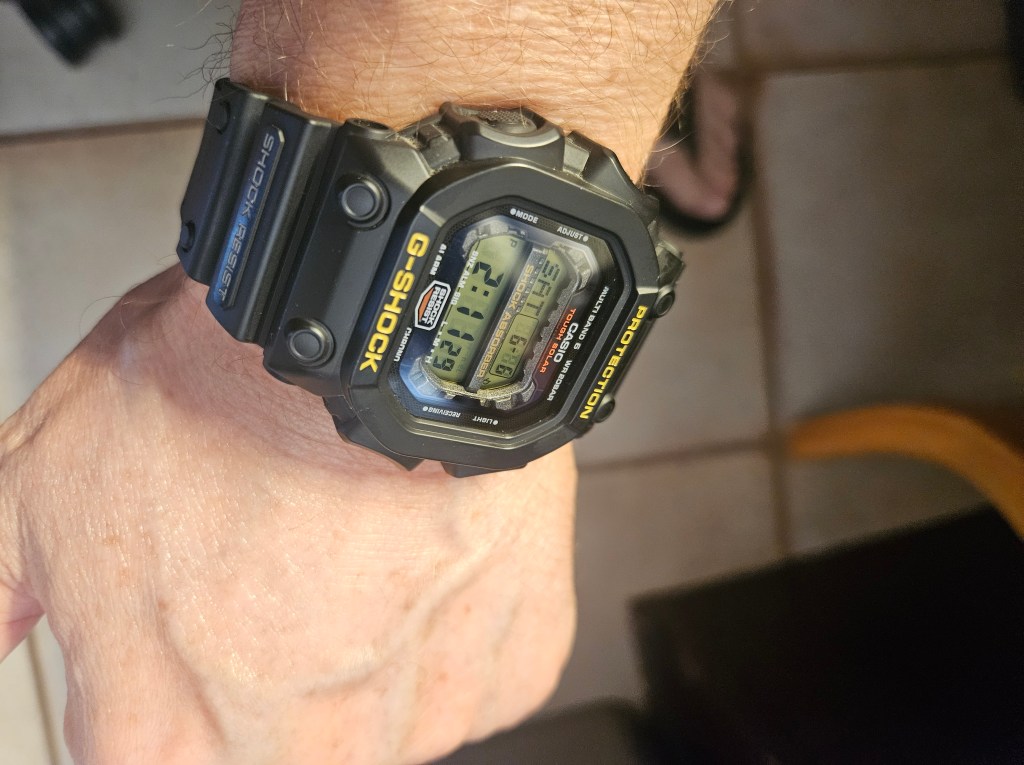
    I’ve tried to be candid about where my watch hobby is headed. For years I lived in the land of mechanical divers—those charming little machines that require winding, adjusting, and periodic visits to a watchmaker who looks at you the way a veterinarian looks at a sick horse. Lately, however, I seem to be drifting toward a different ecosystem: Multiband 6 atomic time delivered by my G-Shock Frogman, a watch that feeds on sunlight and quietly synchronizes itself with atomic clocks while I sleep. It is difficult to compete with a device that performs its duties with the calm efficiency of a Swiss train conductor who never needs coffee. The responses to this confession have been varied. Some readers nod knowingly and say they went through the same conversion. Their mechanical watches now sit motionless in drawers like retired prizefighters who once thrilled crowds but now spend their days remembering the old days. One friend is currently wandering around Thailand with a GW-5000U on his wrist and reports a level of contentment normally associated with Buddhist monks. Others have taken the opposite path and begun collecting Frogman models the way medieval villagers stockpiled shields before a siege, as if surrounding themselves with these massive amphibious contraptions might repel the chaos of modern life.

    And then there are the critics. They inform me—sometimes gently, sometimes with theatrical alarm—that I have lost my mind, contracted a disease, and strapped a grotesque monstrosity to my wrist. I concede every point. I am indeed crazed with enthusiasm, and the Frogman is unquestionably a monstrosity. But it is the most magnificent monstrosity I have ever encountered. I appear to have entered what might be called Frogman Monstrosity Acceptance: the psychological stage in which the owner stops apologizing for the watch’s outrageous proportions and instead embraces them with pride. Yes, it is enormous. Yes, it looks like a small amphibious armored vehicle designed by engineers who distrust gravity. But once you surrender to its scale, the Frogman ceases to be embarrassing and becomes something far better—a gleefully excessive titan among polite timepieces.


  • The Frogman Fidelity Oath

    The Frogman Fidelity Oath

    Dear God, hear the humble prayer of a watch addict who is trying—heroically, if imperfectly—to stay faithful to his G-Shock Frogman. Grant me the strength to appreciate the magnificent amphibious creature already on my wrist and to resist coveting other G-Shocks, especially the cheaper ones that whisper seductive promises of practicality and convenience. Protect me from the restless itch that sends me wandering through YouTube at midnight, where cheerful reviewers with macro lenses and enthusiastic voices assure me that the next watch will transform my life, my character, and possibly my posture.

    Please quiet the anxious machinery in my brain that insists on researching watches I do not need. Help me understand that the Frogman already fulfills every rational requirement a man could have for a digital timepiece: it is solar, atomic, indestructible, and built like a submarine designed by an engineer with trust issues. Remind me that my obsessive excursions into the G-Shock ecosystem are not noble acts of research but rather neurotic pilgrimages through a desert of comparison charts and unboxing videos.

    And please, dear God, intervene quickly, because the temptation is growing stronger by the hour. I can feel myself drifting toward the purchase of a GW-7900—not because I need it, but because my mind has begun whispering the most dangerous phrase in the collector’s vocabulary: “backup watch.” I tell myself the 7900 would merely protect my Frogman from harsh conditions, as though the Frogman were a delicate orchid rather than an armored amphibian designed to survive the Mariana Trench.

    If this prayer sounds familiar, you already understand the Frogman Fidelity Oath: the solemn pledge made by the watch enthusiast who believes he has finally found the perfect G-Shock and now begs for the strength not to betray it. The oath is heartfelt, sincere, and deeply moving—and it usually lasts right up until the moment the addict watches two enthusiastic YouTube reviews and convinces himself that buying a second watch is not an act of infidelity but an act of responsible stewardship.

  • The Digital Purist’s G-Shock Manifesto

    The Digital Purist’s G-Shock Manifesto

    When I bought my G-Shock Frogman and experienced the peculiar bond that many G-Shock owners describe, I began hearing from other enthusiasts who spoke about their watches with the same kind of fervor usually reserved for religion, motorcycles, or properly cooked brisket. Curious, I started watching G-Shock videos online. What struck me was not the technical analysis—though there was plenty of that—but the sheer affection people felt for these watches. It was humbling to see someone speak with genuine reverence about a $100 resin timepiece with the same poetic intensity that others reserve for ten-thousand-dollar Swiss luxury watches. Apparently joy does not scale with price tags.

    After enough of these videos, I discovered something about myself: my lane in the G-Shock universe is extremely narrow. My watches must be digital. They must be Tough Solar. They must be Multiband 6. And they must come on straps. The moment a watch wanders outside those borders—analog hands, shiny bracelets, smartwatch features that make it look like a Garmin auditioning for a triathlon—it falls off my radar. Limited editions that feel like marketing departments squeezing collectors for lunch money also fail to stir my soul. My tastes are simple: give me the rugged, atomic-synchronized machinery of the late-20th-century Casio imagination.

    And that is where the magic happens. Casio is the undisputed curator of the 1980s and 1990s technological mood: efficient, unapologetically digital, and blissfully free from the surveillance culture of modern smart devices. A Tough Solar Multiband 6 G-Shock does everything you ask of it without demanding attention in return. It is competent, quiet, and oddly comforting. Once you step into that retro-technical atmosphere, you discover the purest G-Shock vibe: a blend of practicality, nostalgia, and cool restraint.

    Based on this revelation, I created what I now consider my essential G-Shock quartet:

    G-Shock Frogman GWF-1000
    G-Shock Rangeman GW-9400
    G-Shock Rescue GW-7900
    G-Shock GW-5000U

    I already own the first one. The other three remain safely outside my possession—at least for the moment. My strategy for maintaining discipline is simple: I try to read books and articles like a normal person. Unfortunately, every fifteen minutes my browser opens a new tab where I begin “researching” the Rangeman, the 7900, or the GW-5000U with the dedication of a graduate student preparing a thesis on atomic timekeeping. So far the watches remain unpurchased.

    But I would not advise betting against them.

    The Man Who Lost His Mind to Watches is my book about the watch madness that many of us share. It is now on Amazon Kindle:

  • The Man Who Lost His Mind to Watches

    The Man Who Lost His Mind to Watches

    The Man Who Lost His Mind to Watches is not a book about watches. It is a book about obsession—the kind that begins with a single innocent purchase and metastasizes into spreadsheets, late-night forum debates, and existential dread over lume brightness. What starts as an appreciation for craftsmanship becomes a full-blown psychological expedition into masculinity, consumer desire, envy, tribal belonging, and the strange belief that the right object will fix what’s unsettled inside. If you have ever convinced yourself that one more acquisition would finally complete you, this book is already about you.

    The watch obsession is told in lexicon entries. Each term for some facet of the watch addiction exposes the watch enthusiast who descends into the glittering underworld of timepieces—divers, bracelets, straps, limited editions—only to discover that the chase for the “perfect watch” is really a chase for certainty in a world that offers none. The deeper he goes, the more absurd the quest becomes. He compares millimeters as if they were moral virtues. He debates dial legibility as if it were a constitutional right. He imagines that mastering reference numbers will somehow grant him mastery over time itself. Instead, he finds himself trapped in a hall of mirrors where identity is reflected in polished steel.

    And yet this is not merely satire. Beneath the laughter lies a serious question: why do intelligent, disciplined adults hand over their peace of mind to objects? The Man Who Lost His Mind to Watches is a confession, a cautionary tale, and a strangely hopeful map back to sanity. It exposes the machinery of obsession while refusing to sneer at it. Because in the end, the watches were never the enemy. The illusion that perfection could be purchased—that was the real complication.

    I have published this book on Amazon Kindle, but you do not need a Kindle device to read it. Once you purchase it, you can read the book directly on your computer screen using the Kindle app or the Kindle cloud reader. If the book gains meaningful traction and sells well, I will consider releasing a paperback edition as well.

  • Mechanical Atrophy Prevention

    Mechanical Atrophy Prevention

    I wear my G-Shock Frogman GWF-1000 almost every day. It has become the default setting of my wrist, the horological equivalent of gravity. Twice a week, however, I stage a small act of resistance. I slip on one of my Seiko divers. If I don’t, the Frogman will quietly suffocate the rest of the collection. It already has, to a degree. The moment I first strapped that Frogman on, it felt less like a purchase and more like a declaration: this watch had my name written across it in thick permanent ink. It fit my life with such ruthless competence that every other watch in the box began to look like an understudy waiting for a call that will never come.

    So twice a week I impose discipline. The Seikos get their turn. Think of it as horological cross-training. Most days I’m on the exercise bike or doing yoga, but I still force myself to swing the kettlebells twice a week so my muscles don’t dissolve into decorative noodles. The Seikos perform the same function. They are my defense against mechanical watch atrophy.

    This ritual belongs to what I call my Mechanical Atrophy Prevention program: the deliberate act of wearing a mechanical watch just often enough to preserve one’s emotional bond with gears, springs, and that hypnotic sweeping second hand. Without this intervention, the human brain quickly adapts to the ruthless efficiency of digital timekeeping. Soon you’re living in a world of solar charging, atomic synchronization, and clinical precision, and the charming little clockwork creatures in your watch box begin to feel quaint—like writing letters with a quill.

    Wearing the Seikos twice a week is my version of lifting weights so my body doesn’t evolve into an ergonomic office chair with legs. The practice keeps alive the fragile illusion that I am still a “mechanical watch person,” not a man who has quietly surrendered to the cold efficiency of quartz.

    Does this sound crazy to you?

    Welcome to my world.

  • Dessert from the Department of Cybersecurity

    Dessert from the Department of Cybersecurity

    Yesterday I endured my college’s annual cybersecurity training program, a ritual as joyful as renewing your driver’s license at the DMV. The course came complete with a quiz—an “opportunity,” they called it—to demonstrate that I had absorbed the essential lesson of modern digital survival: pause before you click.

    The training was earnest, repetitive, and soaked in the bureaucratic optimism that a thirty-minute slideshow can transform ordinary humans into elite cyber-defense agents. The core commandment appeared again and again like scripture: use common sense and do not click suspicious emails.

    I completed the training, collected my imaginary gold star, and moved on with my day.

    The following morning the universe presented its practical exam.

    An email arrived addressed to everyone in my department. The subject line screamed with theatrical desperation: “Please! I need some assistance!” The sender was a student who had never taken my class, never spoken to me, and almost certainly had no idea who I was. Attached to the email were several transcripts, as if she had dumped a stack of paperwork onto the digital sidewalk.

    Her message contained a four-paragraph narrative describing the tragic injustice that had befallen her: she had not been admitted to the university of her dreams. She wanted me—a total stranger—to read the attachments and vouch for her qualifications. The request carried the confident tone of someone who had mistaken mass-emailing professors for a reasonable life strategy.

    My reaction was immediate and uncharitable. This was not a cry for help. This was hubris wearing sweatpants. The entire message radiated a level of absurd entitlement that made the delete key glow with moral clarity.

    So I deleted it.

    Later that day I was in the garage swinging kettlebells, grunting my way through a set, when a thought crept into my mind. What if this email had been the cybersecurity department’s final exam? Perhaps after forcing me through their mandatory training, they had decided to test whether I would actually apply the lesson.

    Pause before you click.

    Did I pass because I exercised common sense?

    Possibly.

    But if I’m honest, I passed because the email offended me. Its sheer stupidity triggered the one defensive system that never fails: irritation. Suspicion might falter. Curiosity might betray you. But righteous annoyance is a powerful cybersecurity tool.

    So thank you, Department of Cybersecurity. You were not content to burden me with a half-hour training session. You also sent along dessert.

    And I did exactly what you hoped I would do with it.

    I sent it back to the kitchen.

  • After the Fever Dream: Life After Finishing a Book

    After the Fever Dream: Life After Finishing a Book

    You write the book the way a man fights a war—sleepless, exhilarated, slightly deranged. The watch obsession pours out of you in a manic fever dream. Paragraphs multiply. Arguments sharpen. The dragons of doubt are hunted down and slain one by one. The process is violent, cathartic, intoxicating. Then one day the battlefield goes silent.

    The book is finished.

    You resist the temptation to congratulate yourself. You are not a novelist emerging from a mahogany-paneled publishing house. You are a self-publishing writer who lives in the strange modern territory between the written page and the spoken performance. Your books feed your videos. Your videos feed your books. You are part author, part storyteller, part one-man theater troupe trying to keep reading culture alive in an age that prefers the human voice and the glowing screen.

    So the manuscript about your horological madness is uploaded, and the waiting begins.

    Amazon’s machinery now takes possession of your work. Your manuscript passes through a quiet bureaucratic gauntlet. The system inspects your file the way a customs officer inspects luggage. It checks whether the text converts properly into Kindle’s internal formats—the KPF and MOBI skeletons that power the ecosystem. It scans for broken hyperlinks, missing images, corrupted fonts, copyright problems, suspicious passages that resemble plagiarism, and metadata that smells like deception.

    Once the manuscript survives inspection, Amazon manufactures the retail version of your book. A downloadable Kindle file appears. The “Look Inside” preview is generated. Internal indexing is built so readers can search the text. Page locations are mapped so the book behaves properly across Kindle devices. Then the storefront is assembled: title, subtitle, description, keywords, categories, price, royalties. When all of this is complete, the book is pushed into the distribution queue.

    For roughly seventy-two hours, you exist in a peculiar form of creative purgatory.

    You are finished with the book, yet the book does not exist.

    Meanwhile your mind refuses to stop working. New sentences appear uninvited. Fresh paragraphs demand insertion. You sketch revisions for the next edition even though the current one has not yet been born. These are the creative aftershocks—the involuntary spasms that follow the completion of a major piece of work. The engine keeps firing even though the race is over. The sensation resembles a phantom limb: the writer’s brain continues to move muscles that are no longer attached to the task.

    Eventually the tremors subside.

    And then the crash arrives.

    When you were writing, your mind functioned like a soldier in combat—focused, purposeful, rewarded with small chemical bursts every time a paragraph landed cleanly on the page. Once the book is done, the mission vanishes overnight. The brain suddenly finds itself unemployed.

    What follows is the Post-Manuscript Collapse.

    Energy drains. Conversation feels exhausting. The meaning of life becomes suspiciously vague. You stare at walls, wondering whether a medically induced coma might be the most efficient way to pass the time. This stage is unpleasant, but it is not pathological. It is the nervous system resetting after prolonged creative exertion.

    Think of the narrators in Tony Banks’ finest Genesis compositions. In “Mad Man Moon” and “Afterglow,” a man constructs a world around himself only to watch that world age, crumble, and lose its meaning. The collapse is not merely tragic—it is necessary. Something must die so that something else can emerge.

    The writer experiences the same cycle.

    You must shed the identity you inhabited while writing the book. That identity served its purpose, but it cannot follow you into the next chapter. This transitional stage is what might be called the Snakeskin Interval—the quiet, uncomfortable period when the old creative skin peels away.

    Do not mistake this shedding for failure. It is renewal in disguise.

    The only appropriate response is humility. Resist the theatrical temptation to despair. Instead, recognize that this strange melancholy is part of the creative metabolism. Listen again to those Genesis songs. Let their melancholy wisdom remind you that endings are rarely endings at all.

    They are merely the silence that makes the next beginning possible.

  • The Day the Watch Romantic Bought a G-Shock

    The Day the Watch Romantic Bought a G-Shock

    Some of you have labored over your mechanical watches with the devotion of vineyard monks. Years—perhaps decades—spent winding crowns, nudging the seconds hand into alignment, and delivering the little engines to the watchmaker for their ritual spa treatments. You treated them the way men once treated Italian sports cars: reverently, nervously, always aware that beauty of this caliber comes with maintenance bills and emotional volatility. These watches connected you to a heroic past of gears, springs, and human ingenuity. They whispered romance. They promised soul. And inside that horological snow globe, you were euphoric.

    But romance, like a carburetor, eventually clogs.

    Perhaps you remember the day it happened. You once drove your lovingly preserved 1975 BMW sedan through Los Angeles traffic with the stubborn pride of a man rowing his own gears while the world drifted toward automation. Stick shift. Manual choke. Mechanical authenticity. Then one morning you woke up and felt something unfamiliar: indifference. The ritual had curdled into labor. The winding felt like homework. Adjusting the time no longer felt like communion with the past—it felt like merging onto the 405 at rush hour.

    Friend, you have contracted Mechanical Watch Fatigue.

    This condition arrives quietly after years of curating, servicing, regulating, and explaining your watches to people who politely pretend to care. What once felt like connoisseurship now feels suspiciously like unpaid custodial work. The disease does not destroy your admiration for mechanical watches. You still respect them the way one respects antique furniture or classical architecture. You simply no longer wish to babysit them.

    And so the transformation occurs.

    One day the mechanical aristocracy disappears from your wrist and is replaced by something that would have horrified your former self: a G-Shock Tough Solar Multiband 6 Master of G Frogman. No winding. No servicing anxiety. No obsessive time adjustments. The watch feeds itself on sunlight and checks atomic clocks while you sleep.

    You have, in effect, traded the vintage European sedan for a flagship Lexus.

    The doors close with a reassuring thud. The engine hums like a well-fed housecat. The cabin seals you off from the fumes, noise, and moral chaos of Los Angeles traffic. Everything simply works. No drama. No ritual. No heroic suffering.

    You are now the Chillin’ Man.

    You do not apologize for your comfort. You have earned it. After years of horological asceticism, you have graduated to reliability, quiet luxury, and peace of mind.

    Occasionally someone will ask the inevitable question.

    “What happened to your mechanical watches?”

    You shrug with the serene indifference of a man who has crossed the desert and discovered air-conditioning.

    “What about them?”

  • The Watch You Love Is the One on Your Wrist (The Rest Are Fairy Dust)

    The Watch You Love Is the One on Your Wrist (The Rest Are Fairy Dust)

    I have painful news. We do not gather here to flatter one another’s delusions, so let’s drop the incense and speak plainly: you, me, and our inner watch cyborgs do not love our watches. We love saying we love them. We call them “beloved.” We insist they define our identity. We admire our “curated collections” as if they were doctoral theses in horological self-actualization. We stand before our watch boxes like minor kings surveying a conquered province. It feels noble. It sounds impressive. It is largely fiction.

    How do I know? Because of the evidence you provided. One of you tucked two dozen watches into a hidden trunk. Months passed. No withdrawal symptoms. No late-night longing. No tremor in the wrist. Just silence. These were not impulse purchases from a clearance bin. They were carefully researched, thoughtfully selected, celebrated arrivals. Each one represented taste refined, knowledge deepened, discernment sharpened. And yet, when placed out of sight, they might as well have been holiday decorations in July. That question now hovers over you like an uncomfortable relative at Thanksgiving: Do you love these watches—or do you love the idea of loving them?

    Here is what is happening. The inner watch cyborg is running the show. He is not sentimental; he is strategic. He manufactures urgency. He whispers about grails. He frames purchases as destiny. This is Cyborg Puppetmaster Theory in action: the internal algorithm that thrives on pursuit, not possession. The hunt is intoxicating. The checkout page is a sacrament. The shipping notification is foreplay. But once the box is opened and the novelty metabolized, the cyborg moves on. He feeds on anticipation and starves on contentment. The object was never the point. The chase was.

    And so we arrive at the diagnosis: Collection Delusion Syndrome—the condition in which a collector mistakes the performance of passion for the experience of it. The watches are polished, photographed, insured, cataloged, and then quietly exiled to a trunk where they gather dust without being mourned. The owner declares devotion, yet absence produces no ache. The romance was theatrical. The attachment atmospheric. The only watch that truly exists is the one on your wrist—the one that interrupts your day, absorbs your scratches, accumulates your hours. The rest are fairy dust with serial numbers.

    Let us be honest. This is not a dream. Real money left a real checking account. The fever swamp is funded.

    And now the confessor, staring at his untouched two dozen “prized” watches, considers the unthinkable: Perhaps I should let them go. Perhaps I should move along.

    Yes. Do so—if your inner watch cyborg permits parole.

  • Why the Small G-Shock Square GW5000 Beats the Giant Rangeman GW-9400

    Why the Small G-Shock Square GW5000 Beats the Giant Rangeman GW-9400

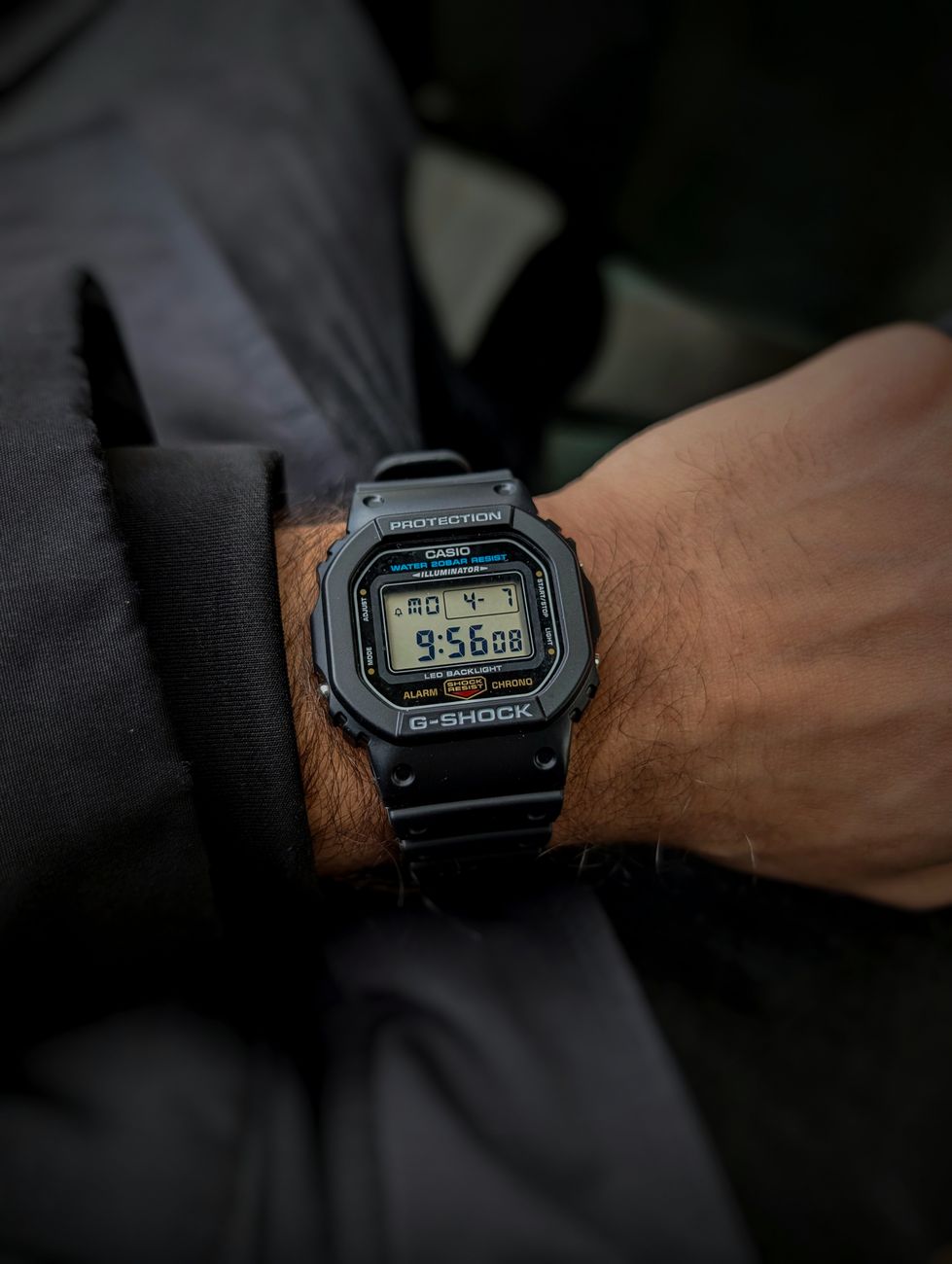
    I am not a delicate man. I’m built like Larry Csonka charging through a defensive line—thick wrists, burly forearms, the kind of limb geometry that usually demands “wrist presence.” On paper, the Rangeman GW-9400 should be my natural habitat: big, armored, survivalist, ready to rappel down a canyon at a moment’s notice. The smaller GW-5000U Square, by contrast, looks modest—almost restrained. If you were casting the role of “watch for the large man,” you would hand me the Rangeman without hesitation. And yet, I may very well buy the Square.

    Because this decision has nothing to do with testosterone per millimeter. It comes down to the most ruthless metric in watchmaking: how quickly your eye extracts the time without negotiation. The Rangeman is a dashboard—altimeter, barometer, compass—a field manual wrapped around your ulna. It is physically larger, louder, more armored. But its time display is portioned into compartments, trimmed down, crowded by supporting actors. The numerals are not the star of the show; they are part of an ensemble cast. The GW-5000U, by contrast, clears the stage. Big, centered digits. High contrast. No clutter. It understands something fundamental: a watch’s first job is legibility, not cosplay. Size without clarity is just acreage.

    Now, the Rangeman does offer more capability. Triple Sensor technology. Tactical presence. Expedition energy. All true. But capability is irrelevant if the core function requires squinting, tilting, or activating a backlight like you’re cracking a safe. A watch that grows in diameter while shrinking its time display commits a design sin. It mistakes bulk for usability. The GW-5000U may be smaller, but it is proportionally optimized. Its screen serves the hour, not the ego. It doesn’t pretend to be base camp. It tells the time—immediately, decisively, without drama.

    This is the lesson of the Bloat Paradox: the absurd condition in which a larger watch delivers smaller, less legible time information, proving that increased case size can inversely correlate with functional clarity. In the hierarchy of horology, clarity outranks spectacle. The square wins. The giant loses.