Category: Confessions

  • The Watch Relapse Spectacle

    The Watch Relapse Spectacle

    Watch addicts eventually reach a terminal stage of torment: the moment when the hobby that once delivered pleasure produces only agitation. The rotation feels oppressive. The collection feels accusatory. At this point, the addict does what desperate cultures have always done—he invents a ritual.

    Surveying the landscape for deliverance, one inevitably recalls the 2014 viral fever dream known as the Ice Bucket Challenge. The watch world demands its own purgative spectacle. Enter the One-Watch Challenge.

    The ritual is simple and public. A ten-minute YouTube video is required. The setting must be tasteful—backyard at golden hour or living room with flattering light. Friends gather. Straws are drawn. Every watch in the collection is claimed except the one the addict secretly hopes will remain. The winners strap on their spoils, grinning like looters at the fall of a city. The subject is then lifted into the air, victorious yet emptied, holding aloft his single remaining watch.

    He is reborn. He is no longer a collector. He is a Oner—a new creature who has renounced rotation days for the austere monogamy of one watch, worn for the rest of his natural life. He speaks of clarity. He speaks of peace. He uploads the video and waits for absolution.

    Naturally, the movement does not end there.

    A counter-genre soon emerges: the Relapser. These videos document former Oners discovered months later, sprawled on their carpets amid a shameful abundance of watches. Boxes are open. Straps are tangled. The men appear undone—glassy-eyed, infantile, muttering references to limited editions and “just one more.” The videos are initially consumed as comedy, shared with a wink and a laugh.

    Over time, the laughter fades.

    The genre acquires a formal name: the Watch Relapse Spectacle—the inevitable counter-ritual in which renunciation collapses into excess. What began as entertainment hardens into parable. For the first time, the wider public glimpses the pathology beneath the polish. The madness is no longer charming. It is instructive.

  • Why Giving a Watch Away Hurts Less Than Selling It

    Why Giving a Watch Away Hurts Less Than Selling It

    The true watch obsessive learns, sooner or later, that giving a watch away hurts far less than selling one—especially when the sale takes place on eBay, under fluorescent lighting, at the mercy of low-ball bidders with no evident shame. Money changes hands, but dignity does not.

    When a watch is given to a friend, there is grief, yes, but it is clean grief. The obsessive knows where the watch has gone. It has not disappeared into the void. It has been adopted. The new owner will wind it, strap it on, and—most importantly—understand it. The watch now lives in a reliable home. The separation has narrative continuity.

    Selling a watch to a stranger is something else entirely. The watch vanishes into anonymity, shipped off like a misfit toy condemned to an unloving Christmas morning. One imagines it being worn carelessly, scratched against countertops, left overnight in damp gym lockers, its history erased by someone who never asked to hear it. Worse still is the insult of the low bid, as if the watch’s years of loyal service have been publicly appraised and found wanting.

    This is why giving a watch away produces a strange, paradoxical pleasure. It feels like an act of stewardship rather than loss. Selling, by contrast, curdles the stomach. It tastes like bile. The obsessive may need the money, but the transaction leaves a moral residue that no PayPal balance can cleanse.

    This condition is known as Custodial Consolation: the relief that comes not from letting go, but from knowing exactly where the thing has gone. The obsessive is comforted by certainty. The watch is not lost—it is merely relocated, where it will be understood, protected, and occasionally admired, which is all it ever really wanted.

  • The Exit Watch That Blew the Exit

    The Exit Watch That Blew the Exit

    There comes a moment in every watch influencer’s career when he announces, with ceremonial gravity, that he has found his Exit Watch. This watch, he assures his audience, is different. It stands apart from the rest of the collection not merely in design, but in destiny. It promises completion. Closure. A sense that the long pilgrimage through steel and lume has reached its ordained end.

    The watch is so magnificent that it demands narrative consequences. The influencer hints at “big changes.” New content. A reimagined channel. Perhaps fewer uploads, perhaps deeper reflections. The implication is clear: the Exit Watch has not merely ended a collecting phase—it has matured the man.

    Then the watch arrives.

    It is flawless. Better than expected. The case sings. The dial radiates authority. The bracelet feels engineered by monks. The unboxing video trembles with reverence. For approximately forty-eight hours, the influencer experiences peace.

    Then something goes wrong.

    The watch does not quiet desire. It amplifies it. Instead of satiation, there is hunger—acute, feral, unprecedented. The Exit Watch behaves less like a sedative and more like a stimulant. New watches begin to haunt his thoughts. He starts browsing late at night. He rationalizes. He reopens tabs he swore were closed forever. The collection multiplies wildly, untethered from logic or restraint.

    Within months, the spiral is complete. The influencer is on the brink of losing his sanity, his marriage, and his house—saved only by a merciful uncle who wires sixty thousand dollars to send him to a rehab facility in the Utah desert. There, stripped of his collection, he learns to play the flute, hunt his own food, and live without Wi-Fi. He emerges thinner, quieter, and reconciled to a solitary G-Shock Frogman, worn not for pleasure but for survival.

    This is Exit Watch Reversal: the affliction in which a watch intended to conclude a collecting arc instead detonates it. The subject does not experience closure, but acceleration—as though the watch has unlocked a previously dormant appetite and handed it the keys.

  • Applause Collapse and the Perils of a “New Direction”

    Applause Collapse and the Perils of a “New Direction”

    There comes a moment in every watch influencer’s career when he believes—sincerely, even nobly—that his audience is ready to applaud his growth. He has done the hard work. He has pared down. He has purified. Five watches remain, all on straps, each presented as evidence of restraint and moral clarity. The comments are approving. The tone is reverent. He is, at last, becoming free.

    Naturally, this serenity bores him.

    So he shakes things up. Three new watches enter the fold. The collection now stands at eight—four on straps, four on bracelets—symmetry restored, balance achieved. He announces a “new direction.” He films a YouTube video about his “evolving philosophy.” He speaks earnestly of equilibrium, versatility, and personal growth. The framing is careful. The lighting is soft. The music is tasteful. He waits for the applause.

    It does not come.

    Instead, the comment section turns cold. The audience, once indulgent, becomes prosecutorial. I thought you were healing. This feels like relapse. You were doing so well at five. The verdict is unanimous and devastating: the addiction has returned. What’s worse is not the criticism itself, but its accuracy. The influencer feels it immediately, like a clean punch to the ribs. The comments articulate the doubt he was trying not to hear.

    Shame sets in. He replays the video and cringes at his own rhetoric. “Quest for balance” now sounds like a euphemism. The watches feel heavier on the wrist. Within weeks, he detonates the entire enterprise. Seven watches are given away. One remains, kept on a strap, stripped of pleasure and worn more as a reminder than an object of joy. He deletes his YouTube channel. He nukes Instagram. He earns a kettlebell certification. He eats clean. He helps clients. He speaks of social media with quiet contempt, like someone describing a former addiction he has sworn never to touch again.

    This is Applause Collapse: the moment an influencer unveils a carefully staged transformation, expecting affirmation, only to encounter moral disappointment so severe that disappearance feels like the only honest response. It is not the loss of praise that breaks him. It is the realization that the crowd was not watching his journey—they were auditing his compliance.

  • Gunmetal, DLC, and the Case Against Babying a Watch

    Gunmetal, DLC, and the Case Against Babying a Watch

    If you’re a watch collector, you’ve probably flirted with the idea of a black watch. At some point, the monochrome seduction gets you. A black case on a matching bracelet has a severity to it—stealthy, self-contained, faintly militant. I’ve fallen for it more than once. I’ve owned some genuinely beautiful black watches.

    I no longer own any of them.

    Such is life in the fever swamp of watch addiction, where flipping is not a behavior but a temperament. Watches arrive. Watches depart. Attachments form briefly and dissolve without ceremony.

    Take me back to around 2012. I owned two PVD-coated Seiko kinetic divers: the SUN007 and the SKA427P1. They were handsome, purposeful, and—contrary to every online hand-wringing session about coatings—remarkably resilient. I never scratched them. Not once. And yet they’re gone, casualties of some forgotten bout of restless dissatisfaction.

    Here’s the dangerous part: you can still find them brand new on eBay. I know this because I went looking. The prices are tempting. I felt the familiar tightening in the chest as I typed the model numbers. Relapse always begins with “just checking.”

    Another repeat offender from my past was the Citizen Promaster Sky BY0084-56E. I owned that watch no fewer than seven times over a decade. That’s not ownership—that’s a custody arrangement. Unlike PVD, the Citizen used Super Titanium treated with Duratect—often described as DLC. Marketing aside, the material difference is real. Stainless steel sits around 200 on the Vickers hardness scale. DLC-coated Super Titanium pushes north of 1,000. That’s not invincible, but it’s not cosplay either.

    In real life, that translates to this: the clasp will show desk-diver scuffs, because clasps always do. The rest of the watch? It shrugs off normal wear with indifference.

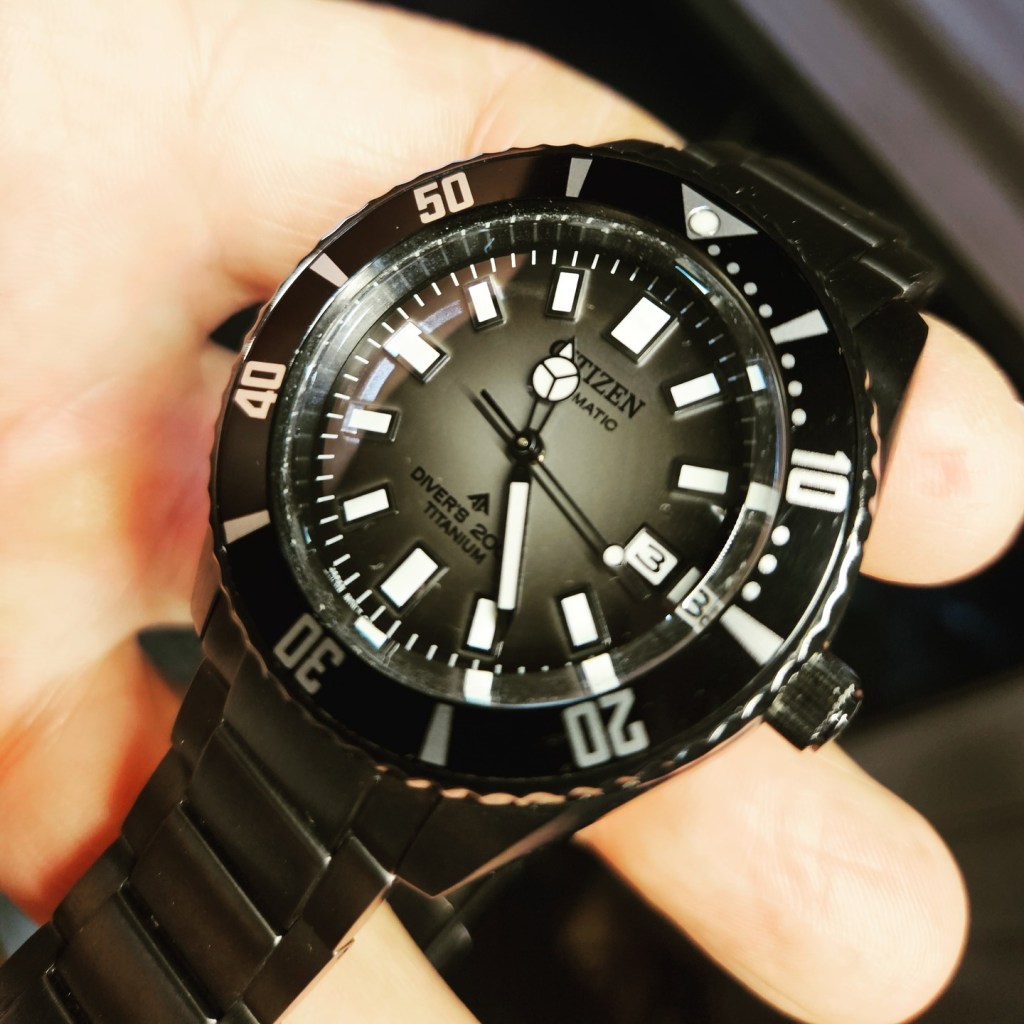
    Which brings me to the present. In a couple of days, the Citizen Super Titanium Gunmetal Diver NB6025-59H will return to my collection. Its DLC coating reads more dark gray than true black—an advantage, frankly. I plan to take it traveling. Miami. Hawaii. Heat. Salt water. Airport bins. Sunscreen. Sweat. This watch is not entering witness protection. It’s not being boxed, babied, or preserved for a future auction. It’s being worn.

    I’m glad to have one black—or gunmetal—watch in the rotation. It’s a welcome disruption from stainless steel, a visual reset. But there’s a caveat worth stating. Black watches are all about proximity. Up close, the details are rich and seductive. From a distance, they collapse into silhouette—lume floating in darkness. If you need your watch to announce itself across a room, black may frustrate you.

    For me, that quiet severity is the point.

  • My Rotator Cuff Injury Taught Me Patience and Restraint

    My Rotator Cuff Injury Taught Me Patience and Restraint

    I hesitate to say this out loud, for fear of angering whatever capricious deity oversees orthopedic recoveries, but my torn rotator cuff appears to have turned a corner.

    For the first time in five months, I’ve gone without ibuprofen. No chemical truce. No white tablets brokered between inflammation and denial. My range of motion has improved by more than sixty percent, and for two nights in a row I’ve slept without that familiar 4 a.m. arthritis ambush—just a bit of stiffness, the kind that registers as information rather than alarm.

    When discomfort does surface, I can quiet it with embarrassingly small interventions: lateral raises with a three-pound dumbbell, posterior-delt pulls using a resistance band anchored to a garage wall strut. Movements so light they feel like apologies. And yet—they work.

    Two weeks ago, an ultrasound revealed inflammatory fluid. The doctor promptly suggested the modern holy trinity: cortisone shot, MRI, and escalation. I declined all three. Why submit to a needle when the pain isn’t screaming? Why enter an MRI tube when claustrophobia turns it into a medieval punishment device? And why rush toward surgery when my rehab therapist, calm and unflappable, says I’ll heal just fine without it?

    So I stick with what got me here.

    Careful shoulder work. Kettlebell leg training. Trap shrugs. Slow, deliberate cleans. Reverse curls. Close-hand push-ups on my knees—humbling but honest. Anything that irritates the shoulder—dumbbell flyes, grand gestures, heroic nonsense—gets cut without appeal. I’ve become ruthless in the best way. No bargaining. No ego.

    Injury has a way of clarifying priorities. You don’t truly appreciate the orchestration of a whole body until one part goes rogue and holds the rest hostage. Healing teaches restraint. Progress rewards patience. And recovery, when it finally begins, feels less like triumph than like a quiet ceasefire—one you’re careful not to violate.

  • The Schwinn Airdyne and the Three Realms of Fitness

    The Schwinn Airdyne and the Three Realms of Fitness

    About fifteen years ago, the literary magazine Zyzzyva published one of my short stories, “Phittnut’s Progress.” It followed a workout addict who trained with the same manic devotion Martin Luther once applied to penance and self-flagellation. At the time, I thought I was being clever. In retrospect, I was being autobiographical.

    I’ve long understood exercise as a spiritual journey—less Peloton, more Dante. Every workout is a descent, an ascent, or, on rare days, a brief glimpse of paradise. I grasped this intuitively long before I had any formal exposure to theology.

    When I was about seven, I watched a 1960s TV show in which a man in a gorilla suit terrorized castaways on a nameless island. The production values were laughable; the fear was not. That night, the gorilla followed me to my room. I lay in bed convinced the beast was beneath my mattress, growling, reaching upward, eager to drag me into its lair.

    Sleep was impossible until I deployed my first metaphysical escape hatch. I imagined myself drifting on a raft along a calm river, safely beyond the monster’s reach. Above me stood a benevolent woman—a hybrid of the Statue of Liberty and Dante’s Beatrice—watching over my passage. Ahead was a luminous haze, the same gauzy heaven Fred Gwynne’s Patience the Guardian Angel inhabits in the 1969 film The Littlest Angel. Only then did peace return.

    This architecture still governs my workouts.

    When I’m out of shape, I’m back in the Monster’s Lair. When conditioning improves, I find myself floating along Beatrice’s River. And when I hit my goal—when effort dissolves into rhythm—I enter the Glory of Patience.

    My Schwinn Airdyne is the portal between these realms.

    Six months ago, my ambition was modest: 600 calories in 54 minutes. Respectable. Enough to keep the gorilla at bay. As fitness returned, so did ambition. A month ago, I raised the standard. To remain outside the inferno, I now needed 700 calories in roughly 55 minutes.

    Then reality intervened.

    Four days ago, after brutalizing my body with an ill-advised plumbing project, I plunged straight into the pit. Two days later, I slogged for 56 minutes and scraped together a humiliating 500 calories. Full inferno. The simian breathed hotly.

    Today, I clawed my way back to 603 calories in 54 minutes. Not glorious. Not close to the 810 calories I burned in 61 minutes six days ago. But it’s movement in the right direction. The river is visible again. The monster’s reach falls short.

    For now, that’s enough.

  • Overthinking Puts You in the Way of Enjoying Your Watch Hobby

    Overthinking Puts You in the Way of Enjoying Your Watch Hobby

    I’m trying not to get in the way of enjoying my watch hobby. Let me restate that, because it sounds absurd even as I say it: I’m attempting to stop sabotaging my own pleasure in a hobby I genuinely love. I’m trying to step aside so I can simply look at a watch and enjoy it like a normal human being.

    What’s the obstruction?

    Overthinking.

    Yes, I’m addicted to watches—but that’s a minor vice compared to my real dependency. I’m addicted to thinking about thinking. Overthinking is my true Grail, and it’s always in stock. The more I indulge it, the darker and more pessimistic my inner monologue becomes. I don’t pretend to have a cure for something that has been with me my entire life. I do, however, recognize the pattern.

    This goes back a long way.

    In 1967, I was five years old and anxious about lunch. When was it coming? Why wasn’t it here yet? My grandmother looked at me and said, “Jeff, you worry too much.” The moment she said it, a switch flipped. I wasn’t comforted. I was horrified. She was right. I did worry too much. And now I had something new to worry about: the fact that I worried too much.

    Congratulations, kid. You’ve unlocked the meta-anxiety level.

    I do the same thing with watches. I overthink my overthinking. I analyze my tendency to analyze. Then I wonder if that analysis itself is the problem. Before long, the joy drains out of something that should be simple: wearing a watch.

    Do I have a solution? Not really.

    What I do have is a strategy borrowed from a therapist I saw as a neurotic college student in the 1980s. His advice was disarmingly calm: when negative thoughts appear, don’t fight them. Don’t suppress them. Just notice them. Observe them as if they were weather passing through. No judgment. No panic. No dramatic counteroffensive.

    So that’s the plan. Observation without self-flagellation.

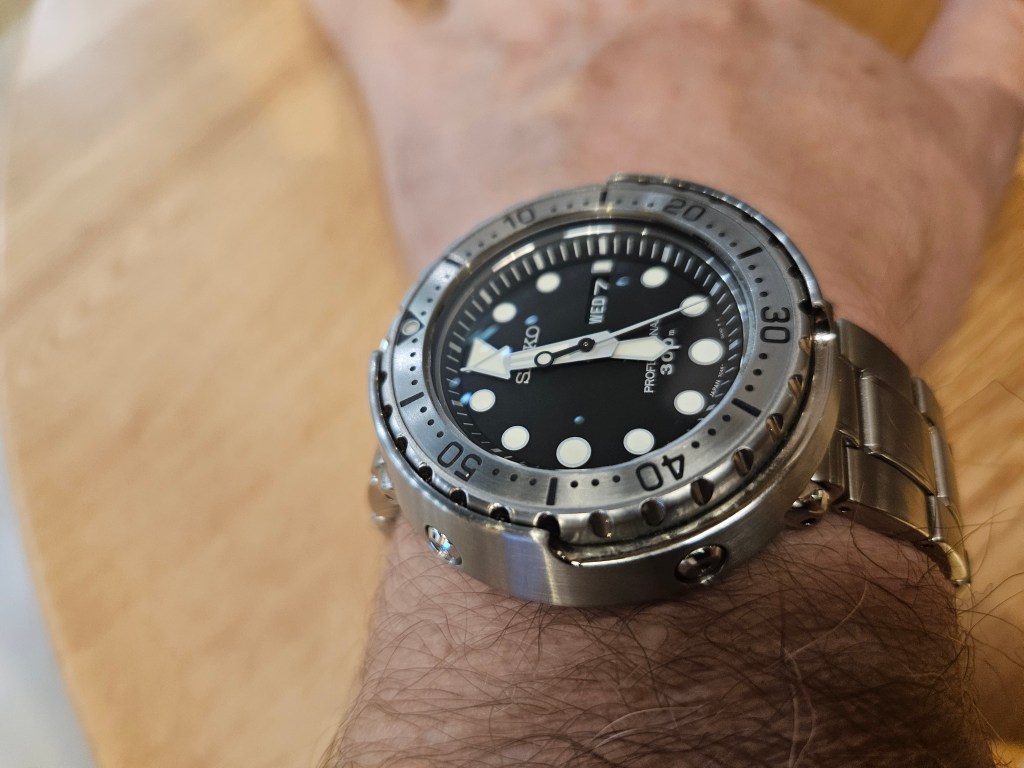
    This morning, for example, I strapped on the mighty Seiko Tuna SBBN049—on a bracelet, no less—and immediately my brain went to work. Is this watch too big? Too bold? Will I still be wearing a Tuna in my eighties? Will octogenarian me look ridiculous?

    The thoughts were stupid. They were also funny. And—most importantly—irrelevant. Rather than scolding myself, I watched the thoughts float by, labeled them mental debris, swept them out, and got on with my day.

    My oatmeal was excellent.
    My coffee was perfect.
    The Tuna looks fine on the wrist.

    Sometimes that’s enough.

  • The Myth of the Ultimate Watch Collection

    The Myth of the Ultimate Watch Collection

    There is no such thing as an ultimate watch collection. That fantasy survives only in Instagram grids and forum signatures. In real life, your taste sharpens, clarifies, narrows—and that clarity does bring you closer to something satisfying. But it never brings closure.

    The problem is not the watches. The problem is us.

    We are capricious animals. One day we crave restraint; the next day we want spectacle. Nostalgia ambushes us and sends us chasing a watch tied to some earlier version of ourselves—college years, first job, first illusion of competence. Sometimes that works. Sometimes it doesn’t. A watch can be a time machine or a dead end.

    Then there’s money. Grail pieces often cost so much that they can’t be worn without anxiety. They live in safes, not on wrists. You admire them abstractly but never bond with them. On the other end, budget watches sometimes fail the respect test. You want to love them, but something feels compromised—finish, heft, presence. The relationship never quite takes.

    So if there is a destination, it isn’t perfection. It’s the sweet spot.

    The watch isn’t too small or too large. It isn’t priced so high that you fear it, or so low that you dismiss it. It isn’t dull, but it isn’t shouting either. You can look at it from different angles and keep finding reasons to linger. It holds your attention without demanding it.

    Some people chase that feeling through complexity. Chronographs seduce with their subdials and mechanical busyness. I tried that path. Instead of enchantment, I got sensory overload. Too much information. Too much pleading. I found myself longing for the blunt honesty of a diver.

    But even a diver has to earn its place.

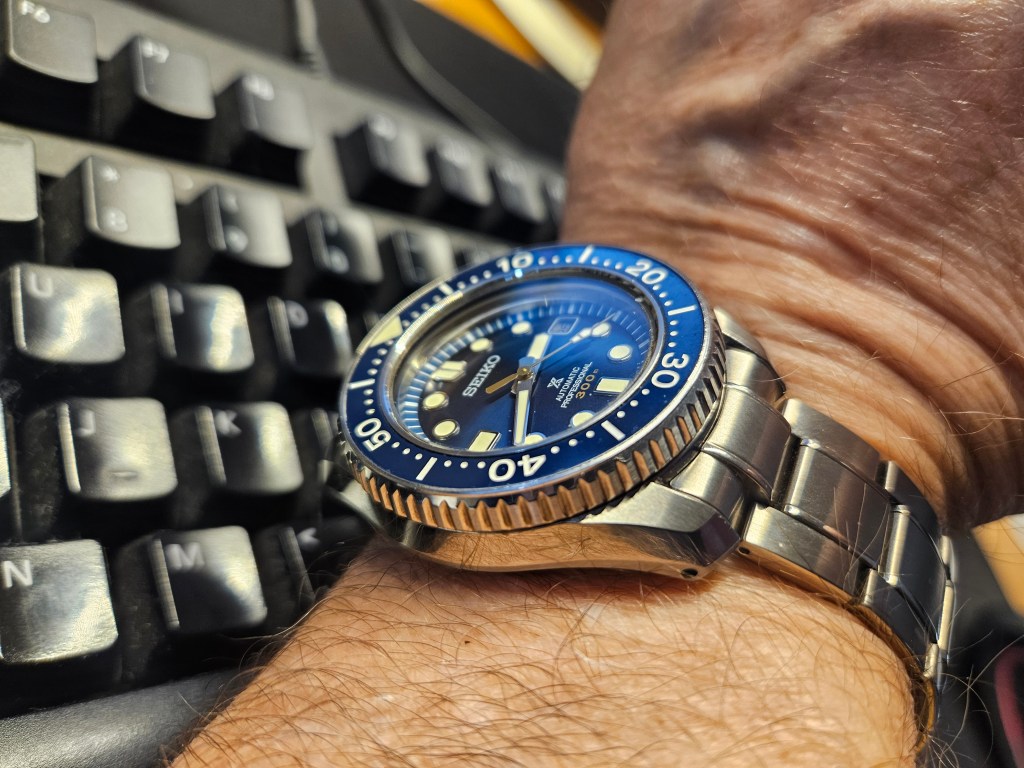
    It needs salient features. Bold, but not desperate. Visually striking, but instantly legible. Purposeful without cosplay. The Seiko MM300 SLA023 comes to mind. It’s a legend in the Seiko lineup because it commits fully to its identity. Over 44mm wide. About 15mm thick. It doesn’t apologize. If you can carry those dimensions, it rewards you with gravitas and coherence.

    If you can’t, there are alternatives.

    The Seiko Alpinist SBDC209 is a different kind of seduction. At 39.5mm, it’s compact, refined, endlessly stare-able. You can live with it all day without fatigue. On the right wrist, it’s perfect. On mine, it disappears. And when a watch disappears, the answer is simple: no.

    That’s the truth most collectors avoid. The “ultimate” collection isn’t about consensus or rankings. It’s about proportion—between the watch and the wrist, between desire and restraint, between fantasy and daily life.

    You don’t arrive at it once.
    You circle it.
    And if you’re lucky, you pause there for a while.

  • The Submarine That Got Me Punished

    The Submarine That Got Me Punished

    One afternoon in Mrs. Eckhart’s fifth-grade class, I finished my reading questions early and found myself with a full hour to kill. So I did what any quietly restless child with access to art paper would do: I drew a gigantic submarine.

    It was glorious. The hull bristled with portal windows, and inside each window lived a tiny, talkative world. Every occupant had something urgent to say. One man was making pancakes and inviting others over. A woman, her hair set in curlers, announced she was in no condition to be seen. Another guy sulked over a bowl of cereal because the box promised a free toy and delivered nothing. Someone tried to nap in a hammock but complained about the noise. A girl had a strip of apple skin lodged between her teeth and was losing her mind over it. There were at least a dozen such figures—boasting, whining, confessing, performing.

    It was a floating anthology of minor human grievances.

    I was proud of it. I felt like I was getting valuable training for my future career writing for Mad Magazine. I was quiet. I was finished with my work. I was bothering no one.

    Then Mrs. Eckhart appeared.

    She moved down the aisle between desks, paused, and studied my drawing. I waited for praise—some acknowledgment of creativity, wit, talent. Instead, I got disdain. Her red hair was stacked into a bouffant, her eyebrows arched in judgment.

    “Is this how you spend your time in my class?”

    “But I finished the assignment,” I said. “I was working quietly.”

    She ignored that and began reading my dialogue bubbles aloud, dripping sarcasm into every line. The class erupted in laughter—not the good kind, the kind that comes from watching someone get filleted by authority.

    Then she delivered the verdict.

    “Your parents should know how you’re spending your time in my classroom.”

    She flipped the page over and wrote a note explaining my offense. I was to take it home, secure parental signatures, and return it like evidence.

    That evening, after dinner, I showed my father the drawing.

    He was livid.

    “You pissed off your teacher,” he said.

    “I don’t know why,” I said. “I finished my work. I was quiet.”

    “It doesn’t matter. You insulted her.”

    “I don’t get it.”

    “By finishing early and doodling, you implied her work was too easy. You disrespected her.”

    “But I didn’t say anything. I just drew.”

    “It doesn’t matter if you’re right,” he said. “What matters is you made her angry. In life, it’s better to be smart than to be right.”

    “I thought those were the same thing.”

    “Not always. Go to your room. Write her an apology.”

    I wrote the apology. But even then, I knew—deep down—I had done nothing wrong. In fact, to this day, that submarine remains the best use of time I ever managed in her class.

    The truth was simple: Mrs. Eckhart didn’t like me. I was brooding, inward, melancholic. She sensed something in me she found intolerable. Once, after she criticized a homework assignment, I tried to explain myself.

    “You have an excuse for everything, don’t you?” she snapped.

    If all my teachers had felt that way, I might accept the diagnosis. But they didn’t. Every other teacher thought I was polite, attentive, fine. There was something specific between us that never resolved.

    Sometimes hostility is not psychological; it’s biblical. It has no cause, no logic, no cure.

    I think of the excellent movie The Banshees of Inisherin. Colm abruptly ends his friendship with Padraic. No grievance. No inciting incident. “I just don’t like you anymore.” That’s it. Padraic hasn’t changed. Colm simply finds him unbearable.

    After nearly forty years of teaching, I know this pattern well. I’ve been popular, well-liked, even beloved by students—but that hasn’t spared me the occasional student who radiated pure contempt. Once, friendly students asked if I noticed a guy in the back who glowered at me all semester. I told them yes. Every so often, someone decides you are intolerable. There is no appeal process.

    In those cases, effort only makes things worse. Trying to win favor intensifies the repulsion. The Chinese phrase captures it perfectly: mei ban fa—nothing can be done.

    Do I resent Mrs. Eckhart? A little. She was an authority figure with a visceral dislike for a ten-year-old boy. But what endures most isn’t bitterness. It’s joy.

    That submarine was alive. It was funny. It was mine. No note home, no scolding, no pinch-faced teacher can take that away.