Category: Confessions

  • Comma Splices and Other Endangered Species

    Comma Splices and Other Endangered Species

    I’ve been grading college essays for nearly forty years, and for most of that time, spotting a comma splice was like being a tennis umpire catching an out-of-bounds serve: instant whistle, raised flag, righteous indignation. A run-on sentence was not merely a mistake—it was a moral offense. A fragment was a cry for divine intervention. I was the Grammar Constable, badge polished, citation pad ready.

    But something has shifted. I look at a comma splice now and instead of reacting like a hall monitor on Red Bull, I simply ask: What’s the point? In a world where students increasingly treat AI like an in-house copyeditor, how long will “grammar errors” even exist? Am I really supposed to send them to syntax jail when a few prompts and a grammar model will sand off their linguistic rough edges? Policing grammar suddenly feels as antiquated as lecturing people about proper carburetor maintenance. The role I’ve played for decades—keeper of the mechanical rules—feels obsolete.

    This morning I graded a paper with a textbook comma splice. A few years ago, I’d have winced like I’d bitten into a lemon rind. Today? I barely blinked. The author will eventually click a button and let a machine fix it. My outrage, like the comma splice itself, is becoming a relic of the combustible-engine era.

  • The Cult of the Desktop Shrine

    The Cult of the Desktop Shrine

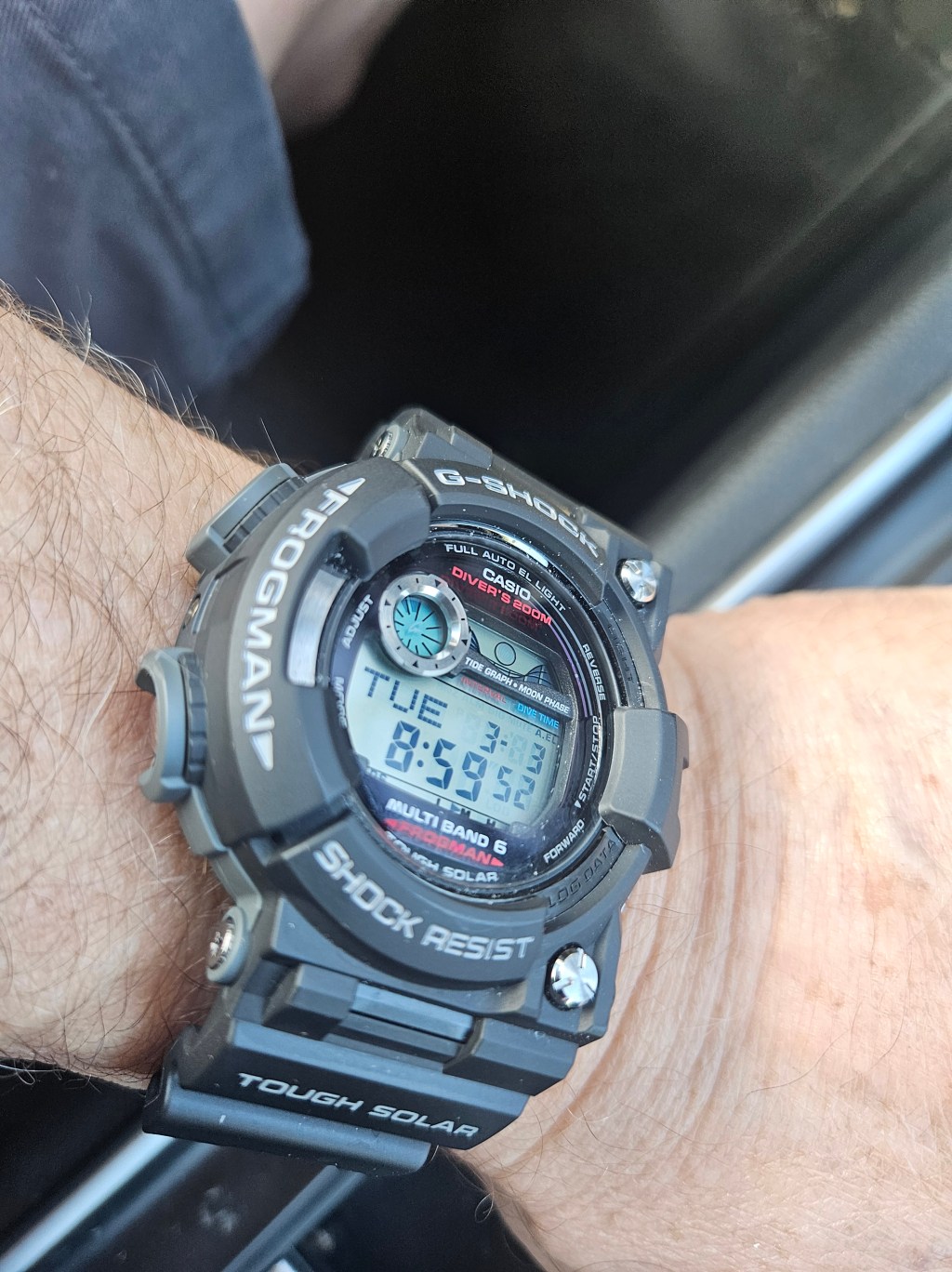
    There is a particular species of human for whom a new computer is not a tool — it’s a religious conversion. The desktop isn’t a workspace; it’s a cockpit for a future self, the glamorous avatar of the writer, artist, or content sorcerer they imagine they will become. People like this do not simply buy machines. They curate private shrines. A desk becomes an escape pod: LED lights humming like temple candles, two monitors glowing like stained-glass windows, and the mechanical keyboard serving as a holy relic. Once seated, the outside world ceases to exist — or so the fantasy goes — until an eBay tab opens and suddenly a $2,500 dive watch begs for attention, or a pair of ergonomic walking shoes on sale becomes a spiritual priority. Sacredness is delicate; it collapses at the first whiff of retail dopamine.

    I speak as one of these zealots. I live in a small home with a wife and two teenage daughters, so I protect the illusion of solitude with the devotion of a medieval monk. My desktop setup has become my monastery. For seven years, I have sat beside the same computer: a 15.6-inch Acer Predator Triton 500 with an RTX 2080, perched like a retired fighter pilot on a wooden pedestal. Beside it stands a 27-inch Asus Designo 4K monitor. My keyboard is an Asus Rog Strix Scope II fitted with “quiet snow” switches — though I still regret not choosing switches that click like a typewriter possessed by Bukowski.

    Here’s the problem: the machine refuses to die. It doesn’t slow down, wheeze, or show symptoms of electronic mortality. It handles everything I throw at it. This stubborn longevity has become an accusation. If I truly mattered — if I were a world-crushing content creator — surely I would need M4 silicon or a Windows Ultra 9. But here I am, a humble i7 and RTX 2080 carrying my entire life on its back like a mule. The message is humiliating: you produce so little that even an elderly predator laptop barely notices your existence. I am not a digital gladiator. I am an NPC.

    One half of me wants to honor the Acer’s absurd durability. I want to see how long it lasts: eight years? Ten? Will it run until I am eighty and my daughters sell it on Facebook Marketplace to a grad student writing her dissertation? The other half of me yearns for a new identity — a fresh cockpit. I fantasize about a Lenovo ThinkPad P16, a machine with the aesthetic of a NATO command center. In my imagination I would sit before it, efficient and unstoppable, a productivity samurai. Then I read about thermals, swollen batteries, and the corporate decay of ThinkPad build quality, and the fantasy curdles.

    Mini PCs tempt me, too — elegant little cubes promising freedom from laptop fan noise. But then I scroll deeper and learn about overheating, BIOS drama, firmware rituals, and mysterious Windows gremlins that exist only for people who try to “optimize.” This is when I confront the truth: Windows PCs are for people fluent in Linux, the jiu-jitsu masters of tech. These individuals have tattoos of penguins on their forearms and spend weekends customizing drivers the way normal people mow their lawns. They don’t “use computers.” They tame them.

    I am not that creature. I am a man who gets nervous updating his router. This leaves me with one path: the Mac Mini. Not because I am enlightened, but because the walls of Apple’s walled garden keep me from accidentally burning the place down. Windows is a vast golf course stretching to the horizon. MacOS is miniature golf: enclosed, guarded, brightly colored obstacles that keep your ball out of the swamp. I must accept who I am — a timid, high-functioning idiot — and pick the putter.

    And yet, when people complain about laptops dying after three years, I can raise a hand and say: “Seven years. RTX 2080. Still alive.” It is not greatness, but it is a kind of glory.

  • The Monster in the Ravine and the Moon Over the Suburbs

    The Monster in the Ravine and the Moon Over the Suburbs

    Last night I dreamed I was wandering through a house I didn’t recognize. The world outside was pitch black. A small family dog pressed its nose to the sliding glass door and barked toward the backyard, desperate to escape. I opened the door and watched the little creature trot behind the bushes to relieve itself. That’s when a monster rose out of the ravine—some hulking mastiff with the skull of a bull, as if a guard dog from the underworld had crawled up to inspect the living. It ignored the pet and fixed its gaze on me. Without hesitation, it entered the house and began to contort into different shapes of malice. At first, I trembled. Then anger boiled in me like a furnace. This thing wasn’t just ugly; it was the source of suffering and rot in the world. I begged God to purify me so I could destroy it, but heaven stayed silent. What I received instead was a strange consolation: a feeling that at least my rage was righteous, and that I still knew where my moral compass pointed.

    Eventually the creature disappeared and daylight arrived. I made a long trek back toward what I understood to be “home.” Across the street, my neighbors were ecstatic, pointing skyward. Hovering above their house was a massive white dome—like a camper shell the size of a Costco, a fallen moon with decorative crenellations. Soon crowds formed. It was a city attraction, a spectacle engineered to “bring excitement.” Snowflakes—artificial, slow-motion confetti—drifted through the air. People gasped, laughed, and posed for photos, thrilled by the distraction.

    The beast was gone, but the problem of evil remained unsolved. In its place, my city embraced pageantry, gimmicks, and civic cheerleading. I touched my aching left shoulder, the one crippled by a three-month rotator cuff tear, and wondered what I would become—a broken man, a burden, a questionable member of society. Fake snow drifted onto the jubilant crowd, and their rosy smiles suggested that change, or at least the illusion of it, was already underway.

  • Camp Flog Gnaw: The Weekend That Broke My Driving Career

    Camp Flog Gnaw: The Weekend That Broke My Driving Career

    Camp Flog Gnaw was a weekend-long bacchanal of sound and sweat for my wife and our twin daughters, two days of music and mayhem baked under the unforgiving Los Angeles sun. My wife braved the trip on Friday and came home looking like a survivor of a maritime disaster, muttering that leaving Dodger Stadium traffic was like trying to escape a collapsing pyramid. She begged me to handle Sunday drop-off and assured me they would Uber home like civilized people. Armed with a “Fast Pass” for the 110 North, I engaged Google Maps, which promptly betrayed me and sent me barreling into downtown—an urban obstacle course specifically engineered to destroy men my age. Pedestrians sprang into the street like feral pigeons, daring me to earn a manslaughter charge. Driverless Waymo cars drifted past me with pastel-lit antennae, cheerful like clown hearses guiding me into the underworld. The lanes themselves seemed painted by committee: solid, dashed, turning, not turning, red, green, “maybe stop,” “maybe don’t”—a psychedelic optical exam administered at 20 mph.

    When I finally dropped off my wife and daughters, I whispered a confession to my wife: “I think I’m giving my Accord to you, and the other car to the girls. I’m retiring from the driving game.” They didn’t laugh; they’ve seen cracks in the armor. I’m a high-strung man, and at sixty-four, the neurons don’t fire like they used to. I can still handle a five-mile radius around my house—my personal demilitarized zone—but pull me into the wilds of Los Angeles traffic and I’m ready to hang up my driver’s jersey. Downtown LA isn’t a city. It’s a gladiatorial arena where the young come to dominate, and I say to myself, “This is no country for old men.” 

  • The Tecsun PL-660 and PL-680 Twins Aren’t Really Twins

    The Tecsun PL-660 and PL-680 Twins Aren’t Really Twins

    If you’ve never encountered my particular strain of madness, here it is: I buy far more radios than any reasonable adult should. I currently own three that serve no practical purpose whatsoever. This has little to do with listening and everything to do with nostalgia—those plastic boxes with antennas still trigger the same 1960s daydreams I had as a boy, sitting in the cockpit of some imaginary fighter jet. To rationalize the excess, I started rotating my Tecsun PL-660 and PL-680 in the garage, two nostalgia pieces I bought eight months ago to recapture the glow of my 2008 radio-obsession era.

    For months I believed the only distinction between them was sensitivity. The 660 grabs 89.3 LAist with ease; the 680 needs coaxing, behaving like a finicky cat that requires just the right antenna angle before it cooperates. But yesterday I discovered the difference that truly matters: volume without distortion. The 680 can punch through lawnmowers, leaf blowers, and low-flying planes. The 660 collapses the moment I turn it past indoor volume. Inside, it sounds lovely; outside, it simply can’t keep up.

    I even photographed both radios for this post before realizing they were coated in a fine layer of garage dust. I had to haul them into the kitchen and wipe them down before taking new photos. Whether these performance quirks reflect real design differences or simple Tecsun quality-control roulette, I can’t say. Neither radio is perfect. And if I’m honest, I should have skipped both and stuck with my PL-880—but that’s a confession for another day.

    As for my garage setup, I’ve removed the 660 and 680 completely and replaced them with the C.Crane CCRadio Solar—a small, dust-resistant plastic unit with a 3-watt speaker that outperforms the 1-watt speakers on both Tecsuns. 

    Final Note:

    Regardless of what radio you use in the garage, I learned a valuable lesson: Drape a towel over it. The garage collects dust 100 times more than inside your house. You need to keep your “garage radio” covered and only uncovered when in use. This lesson is perhaps the most valuable one I learned of all during this “adventure.”

  • The Myth of the Inner Circle

    The Myth of the Inner Circle

    It’s wired into the species—not just the desire to belong, but the craving to belong intensely, to slip past the outer ring of acquaintances and take a seat inside the inner ring, the secret hearth where the real warmth allegedly lives. Decades ago, I convinced myself I had secured that coveted spot within my friend group. Then came the day I wasn’t invited to what I imagined was a grand, festive gathering. One tiny exclusion detonated my entire reality. I felt betrayed, humiliated, and terrified. Had I been exiled? Had I never belonged at all? What kind of fool mistakes polite laughter for fellowship? The hurt settled in for years. I saw myself as a wounded wolf limping away from the pack, nipped at the heels, slipping into the freezing brush alone—shivering, haggard, staring back at the others as I wondered what was left for me now.

    Three decades later, the story has taken on different contours. If I’m honest, I suspect I was never part of anyone’s inner circle; I was the victim of my own wishcasting. My glum tendencies—funny in small doses, exhausting in larger ones—probably nudged me to the periphery from the start. And in a twist more humbling than any imagined exile, I eventually learned the friend group didn’t have an inner circle at all. After one member retired, another admitted they rarely saw each other, that their camaraderie had been built on workplace convenience, not tribal loyalty. My grand narrative of being cast out by a cabal of insiders evaporated. There had been no cabal—just ordinary friendships and my own melodramatic imagination.

    So now the task is simple and difficult at once: forgive myself for the fears and delusions that shaped the story. Reclaim myself. Return to the only inner circle that was ever guaranteed—my own. Maybe that hunger for return is the quiet power of religion: the promise that we can wander, fall apart, and still be welcomed home. The myth of my “expulsion from the inner circle” now feels biblical in scale, a parable of longing not just for belonging, but for wholeness, acceptance, and the grace of being taken back as I am.

  • The Age of Academic Anhedonia

    The Age of Academic Anhedonia

    I started teaching college writing in the 80s under the delusion that I was destined to be the David Letterman of higher education—a twenty-five-year-old ham with a chalkboard, half-professor and half–late-night stand-up. For a while, the act actually worked. A well-timed deadpan joke could mesmerize a room of eighteen-year-olds and soften their outrage when I saddled them with catastrophically ill-chosen books (Ron Rosenbaum’s Explaining Hitler—a misfire so spectacular it deserves its own apology tour). My stories carried the class, and for decades I thought the laughter was evidence of learning. If I could entertain them, I told myself, I could teach them.

    Then 2012 hit like a change in atmospheric pressure. Engagement thinned. Phones glowed. Students behaved as though they were starring in their own prestige drama, and my classroom was merely a poorly lit set. I was no longer battling boredom—I was competing with the algorithm. This was the era of screen-mediated youth, the 2010–2021 cohort raised on the oxygen of performance. Their identities were curated in Instagram grids, maintained through Snapstreaks, and measured in TikTok microfame points. The students were not apathetic; they were overstimulated. Their emotional bandwidth was spent on self-presentation, comparison loops, and the endless scoreboard of online life. They were exhausted but wired, longing for authenticity yet addicted to applause. I felt my own attention-capture lose potency, but I still recognized those students. They were distracted, yes, but still alive.

    But in 2025, we face a darker beast: the academically anhedonic student. The screen-mediated generation ran hot; this one runs cold. Around 2022, a new condition surfaced—a collapse of the internal reward system that makes learning feel good, or at least worthwhile. Years of over-curation, pandemic detachment, frictionless AI answers, and dopamine-dense apps hollowed out the very circuits that spark curiosity. This isn’t laziness; it’s a neurological shrug. These students can perform the motions—fill in a template, complete a scaffold, assemble an essay like a flat-pack bookshelf—but they move through the work like sleepwalkers. Their curiosity is muted. Their persistence is brittle. Their critical thinking arrives pre-flattened. 

    My colleagues tell me their classrooms are filled with compliant but joyless learners checking boxes on their march toward a credential. The Before-Times students wrestled with ideas. The After-Times students drift through them without contact. It breaks our hearts because the contrast is stark: what was once noisy and performative has gone silent. Academic anhedonia names that silence—a crisis not of ability, but of feeling.

  • The Man of Rotation

    The Man of Rotation

    My family gave me a custom T-shirt last Christmas emblazoned with “Man of Rotation.” It wasn’t a compliment; it was a diagnosis. They were mocking the fact that I rotate everything like a monk tending sacred relics.

    I wear a different watch every day from my seven-piece Seiko harem. I rotate three kinds of medium-to-dark roasts as if the coffee beans need equal custody time. I alternate between my Gillette Fatboy and Slim razors with the solemnity of a Cold War arms treaty. Astra blades on Monday, Feather blades when I feel reckless. Even my soaps—triple-milled rose, triple-milled almond—take scheduled turns, like aristocrats queuing for a royal audience.

    It gets worse. Quilted and fleece sweatshirts take their laps. Knit caps cycle through the week as if they were a jury pool. My radios each get a “shift” in the garage during my kettlebell workouts, which is the closest they’ll ever get to military service. Even my podcasts rotate, governed by a sliding scale of how much political despair I can tolerate without bursting into flames. Hoka tennis shoes? They march in formation. My pairs of dark-washed boot-cut jeans—virtually indistinguishable to the human eye—are treated like unique Renaissance tapestries. Golf shirts and T-shirts are matched to the day of the week because my synesthesia demands order, not chaos. And breakfast? A solemn liturgy of alternation: buckwheat groats one day, steel-cut oats the next—my personal Eucharist of complex carbs.

    What is rotation, exactly? A philosophy? A pathology? Maybe it’s my attempt to mimic the cosmic cycles of life: moons, tides, seasons, me choosing a different razor. Maybe it’s a counterfeit sense of forward motion for a man who often feels marooned in his own stagnation. Maybe it’s ritual as a pressure valve, keeping the anxieties from boiling over.

    Or perhaps these rotations are my charm against the rising madness of the world—a tiny pocket of structure in a universe that increasingly behaves like it’s had too much caffeine and too little therapy. A way of keeping my Jungian Shadow from dragging me into the basement and locking the door behind me.

    Forgive me: I’m no oracle. I don’t have definitive answers. I have suspicions, hunches, and a working familiarity with amateur psychoanalysis.

    What I do know is this: it’s time to get up, get ready for work, and select today’s Hoka. The wheel must turn.

  • My Fifth-Decade Crisis in the Writing Classroom

    My Fifth-Decade Crisis in the Writing Classroom

    My students lean on AI the way past generations leaned on CliffsNotes and caffeine. They’re open about it, too. They send me their drafts: the human version and the AI-polished version, side by side, like before-and-after photos from a grammatical spa treatment. The upside? Their sentences are cleaner, the typos are nearly extinct, and dangling modifiers have been hunted to the brink. The downside? Engagement has flatlined. When students outsource their thinking to a bot, they sever the emotional thread to the material.

    It’s not that they’re getting dumber—they’re just developing a different flavor of intelligence, one optimized for our algorithmic future. And I know they’ll need that skill. But in the process, they grow numb to the very themes I’m trying to teach: how fashion brands and fitness influencers weaponize FOMO; how adolescent passion differs from mature purpose; how Frederick Douglass built a heroic code to claw his way out of the Sunken Place of slavery.

    This numbness shows up in the classroom. They’re present but elsewhere, half-submerged in the glow of their phones and laptops. Yesterday I screened The Evolution of the Black Quarterback—a powerful account of Black athletes who faced death threats and racist abuse to claim their place in the NFL. While these stories unfolded onscreen, my student-athletes were scrolling through sports highlights, barely glancing at the actual documentary in front of them.

    I’m not the kind of instructor who polices technology like a hall monitor. Still, I’m no longer convinced I have the power to pull students out of their world and into mine. I once believed I did. Perhaps this is my own educational Sunken Place: the realization that attention capture has shifted the center of gravity, and I’m now orbiting the edges.

    I’ve been teaching writing full-time since the 1980s. For decades, I believed I could craft lessons—and a persona—that made an impact. Now, in my fifth decade, I’m not sure I can say that with the same certainty. The ground has moved, and I’m still learning how to stand on it.

  • Dream Exam for a Retiring Professor in the Bedroom of Time

    Dream Exam for a Retiring Professor in the Bedroom of Time

    Last night I found myself back in the primary bedroom of my parents’ 1970s house—a room fossilized in memory but somehow updated to the present day. I was perched on their king-sized bed, the same monolithic slab of furniture that once seemed big enough to host the United Nations, scribbling notes about my long, bruised, oddly tender career as a college instructor. It was the kind of dream where the past and present shake hands awkwardly, unsure who invited whom.

    Outside, I heard the rumble of a moving truck. A couple had arrived next door, and before I could finish a sentence in my notebook, they had already unpacked their lives, established themselves as the new neighborhood aristocracy, and decided—God help me—to visit. Instead of knocking at the front door like terrestrial beings, they wandered from their backyard onto a dirt trail, crossed into my parents’ yard like friendly invaders, and slipped through the sliding glass doors behind the beige curtains as if they were stepping into a beachfront Airbnb.

    Their names were Dan and Deidre, early forties, both in education—the D & D Couple. I wrote their names down immediately because even in dreams I have the short-term memory of a concussed squirrel, and I didn’t want to fail the basic decency test of remembering the names of unexpected houseguests. They asked my age. I told them sixty-four. I told them I was still lifting weights, still teaching after thirty-eight years, still clinging to the last threads of my profession with a mix of pride, resignation, and the kind of melancholy that whispers, It’s almost time to go.

    They listened politely, heads tilted just enough to convey admiration without actually committing to it. Then Dan—the more mischievous half of the D & D Duo—decided to spring a quiz on me. “Do you remember our names?” he asked, as if I were auditioning for senior citizenship.

    For one horrifying second, my mind decided their names were Karl and Kathy—the K & K Couple. But before I committed social suicide, I dropped my gaze to my notebook, where my handwriting—half cryptic scrawl, half cry for help—reminded me: Dan and Deidre. D & D. Not K & K.

    I delivered the correct answer, and the couple beamed at me as if I had passed a cosmic entrance exam for the next stage of my life. Their smiles weren’t just approval; they were a benediction, assuring me that even as one chapter closed, another waited—stranger, softer, intruded upon, but somehow welcoming.