Category: Confessions

  • The Signal Hunter: From Vintage Radios to Atomic G-Shocks

    The Signal Hunter: From Vintage Radios to Atomic G-Shocks

    For a long time before I became a watch obsessive, I was a radio obsessive. This was the early 2000s, when my idea of a thrilling evening involved testing AM sensitivity and comparing FM clarity the way sommeliers compare Burgundy. I developed an unhealthy admiration for 1960s and 70s Sony and Panasonic radios—machines that looked as if NASA engineers had been given permission to design living-room furniture.

    That obsession never really left. I still keep half a dozen high-end Tecsun radios scattered around the house like electronic houseplants. One in the kitchen. One in the bedroom. One in the garage. Each quietly sipping signals from the air.

    Over the next two decades my attention drifted from radios to watches, and not modest watches either. I assembled a small stable of Seiko mechanical divers, some pushing well north of three thousand dollars. They were beautiful machines—tiny brass orchestras ticking away beneath sapphire glass.

    Then, about a month ago, something strange happened. I unplugged emotionally from the mechanicals and wandered into the strange, glowing world of G-Shock Multiband-6 atomic watches.

    And to my surprise, I’m having more fun with this hobby than I ever did before.

    These watches cost a fraction of my mechanical divers. Yet I’m connecting with them more deeply. That should bother me. It doesn’t.

    But let’s not dramatize this as some kind of betrayal of my mechanical diver heritage. This is not treason. It’s zoning.

    Think of it like Jay Leno’s Big Dog Garage near the Burbank airport. Leno divides his collection between vintage machines and modern ones. Two different eras. Two different moods.

    My watch world now works the same way.

    On one side of the garage sit my mechanical divers. They’re the horological equivalent of a 1959 BMW 507 convertible with a four-speed manual. When I strap one on, it’s like taking a country drive through nostalgia. The wind is loud. The ride is bumpy. The engine chatters like a coffee grinder full of marbles.

    And occasionally, that experience is glorious.

    But as the years pile up, those drives become less frequent. The wind noise, the rattling, the mechanical fussiness—eventually the romance demands a bit more patience than my bones want to give.

    Now walk across the garage.

    Here you’ll find the modern fleet: my Multiband-6 G-Shocks.

    These are the Honda, Lexus, and BMW sedans of the watch world. Smooth handling. Effortless precision. A cabin so insulated from chaos that time itself arrives wirelessly in the middle of the night.

    Moving between a G-Shock and a mechanical diver is like stepping from a luxury sedan into a vintage convertible. Two different universes. Neither one replaces the other. You simply choose which universe you feel like visiting.

    And as my eyes grow older and slightly crankier, I can already see where I may end up parking more often: something like the G-Shock Mudman GW-9500 with a big positive display.

    Positive display only, mind you. Negative displays are pure muscle-flex cosplay. I already get plenty of testosterone from the armored tank aesthetic of G-Shock design. I don’t need the digits hiding in a cave as well.

    But here’s the deeper truth.

    My attraction to Multiband-6 watches has quietly returned me to my radio roots.

    The vintage radio hobby and the atomic watch hobby attract the same personality type. They scratch the same itch.

    Both revolve around the quiet thrill of pulling invisible signals out of the air.

    In that sense, I am what I like to call a Signal Hunter.

    A signal hunter doesn’t simply collect equipment. He collects moments of reception. The tiny surge of satisfaction when a device—a Sony shortwave radio or a G-Shock atomic watch—locks onto something traveling through the ether.

    The world is whispering signals constantly. Most people never notice.

    But if you have the right instrument, the air suddenly comes alive.

    To improve my odds of catching those signals, I recently ordered an industrial pipe jewelry and headphone stand. Apparently many G-Shock owners swear that letting the watch rest overnight on a piece of metal—like a pipe or curtain rod—helps the antenna catch the atomic time signal more reliably.

    The moment I read this, resistance was futile. I ordered the stand immediately.

    Because suddenly I was six years old again.

    I had my Batman Bat-Signal flashlight. I had my decoder ring. And the universe was sending secret messages again.

    Syncing my G-Shocks has become a nightly ritual.

    And rituals are my natural habitat.

    Coffee. Oatmeal. Protein powder. Kettlebells. Mechanical watch winding. Atomic watch syncing.

    Different objects.

    Same impulse.

    Order the world. Listen closely. Catch the signal.
  • The Day the G-Shock Frogman Hired Security

    The Day the G-Shock Frogman Hired Security

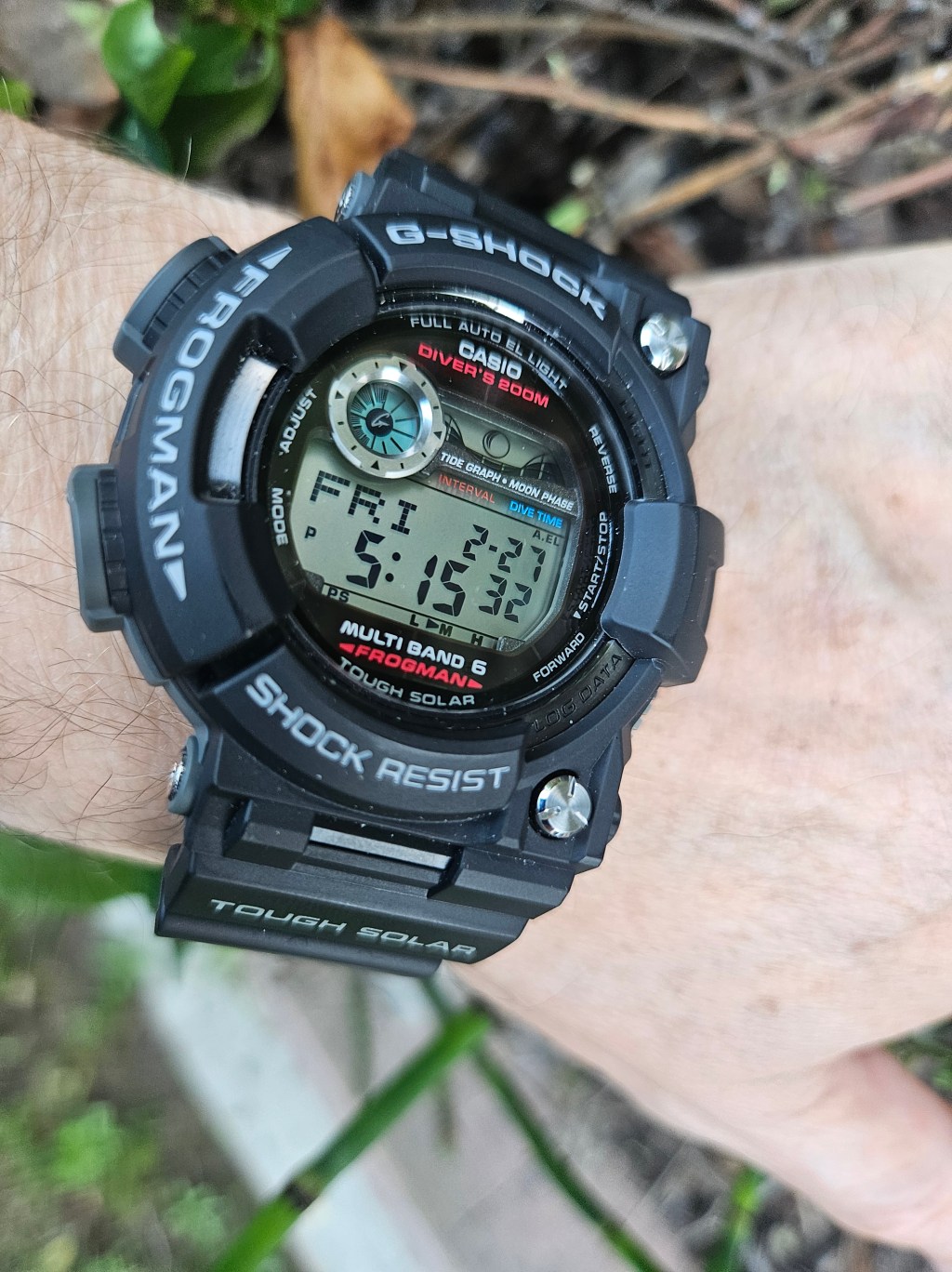
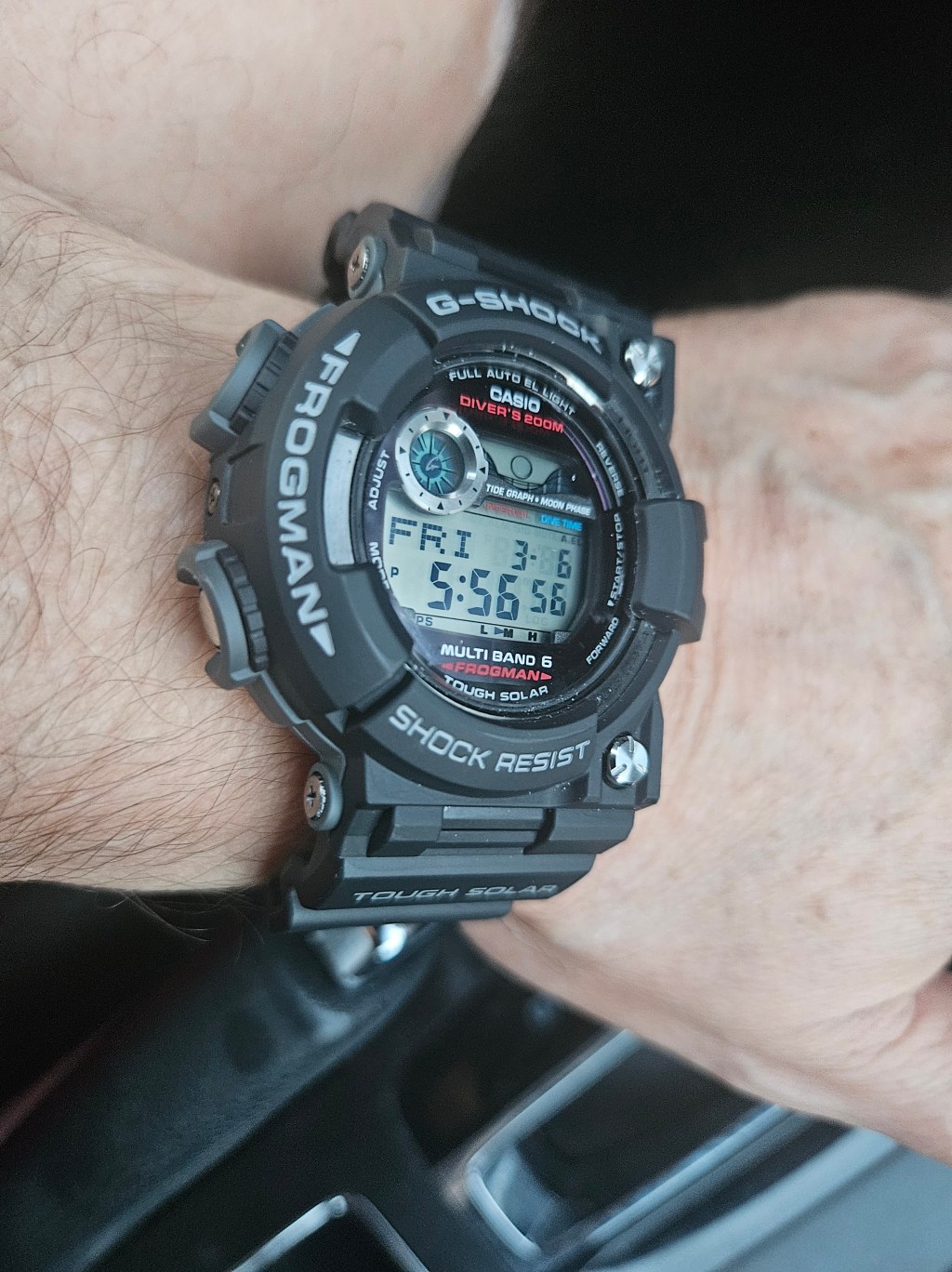
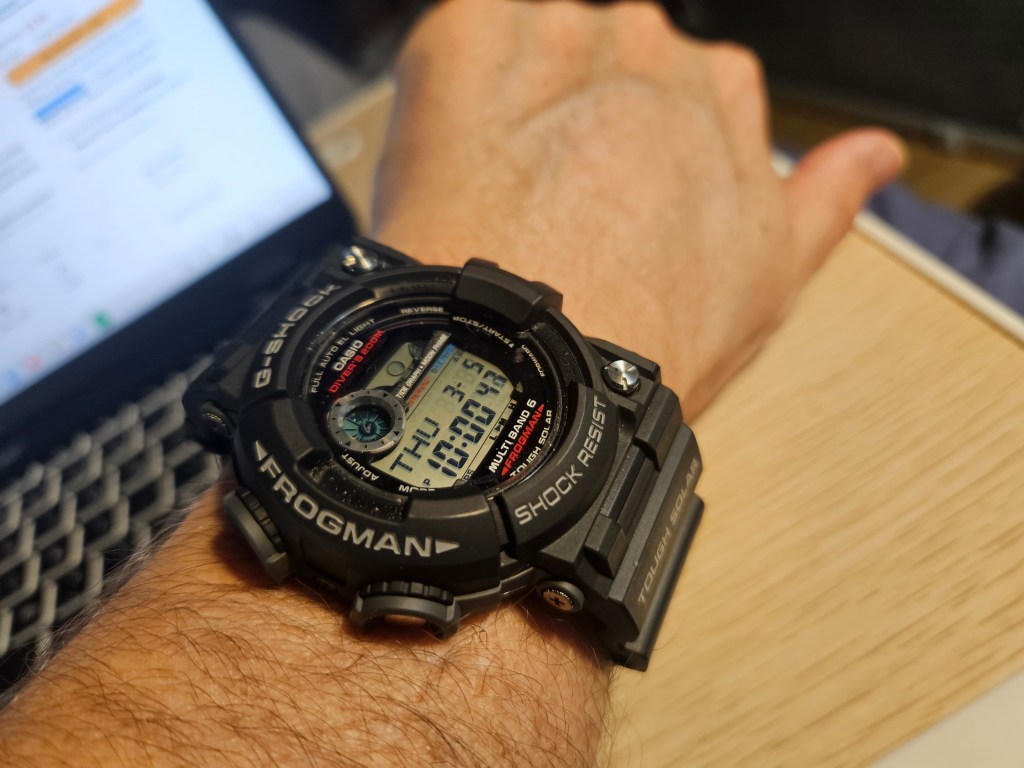
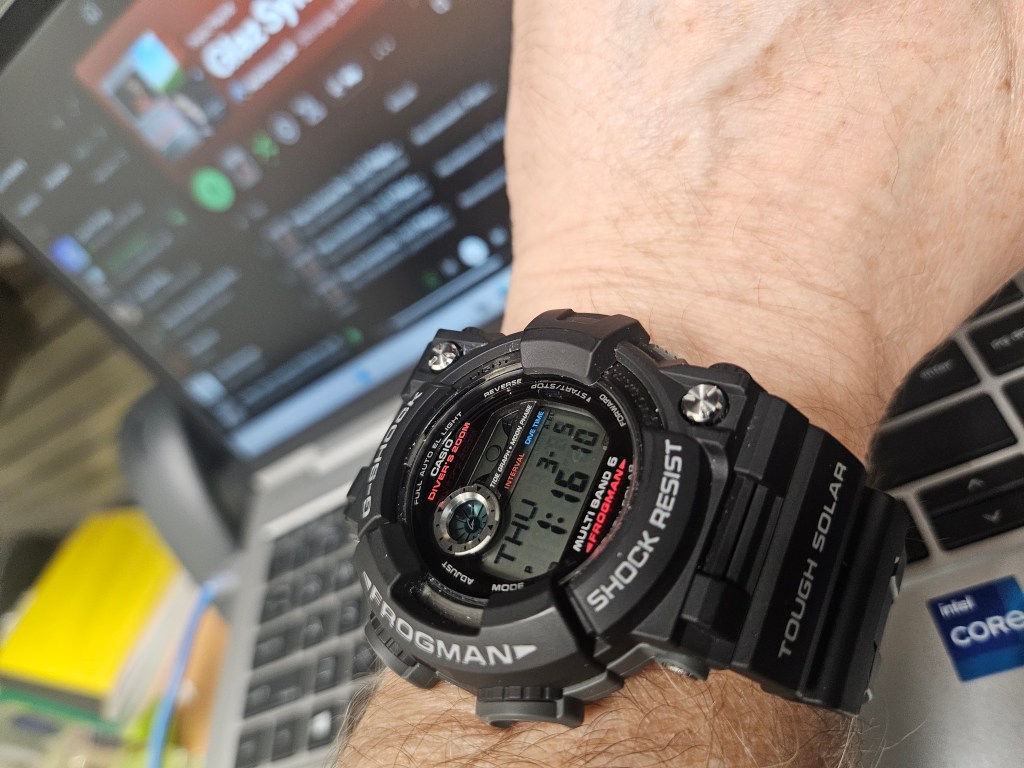
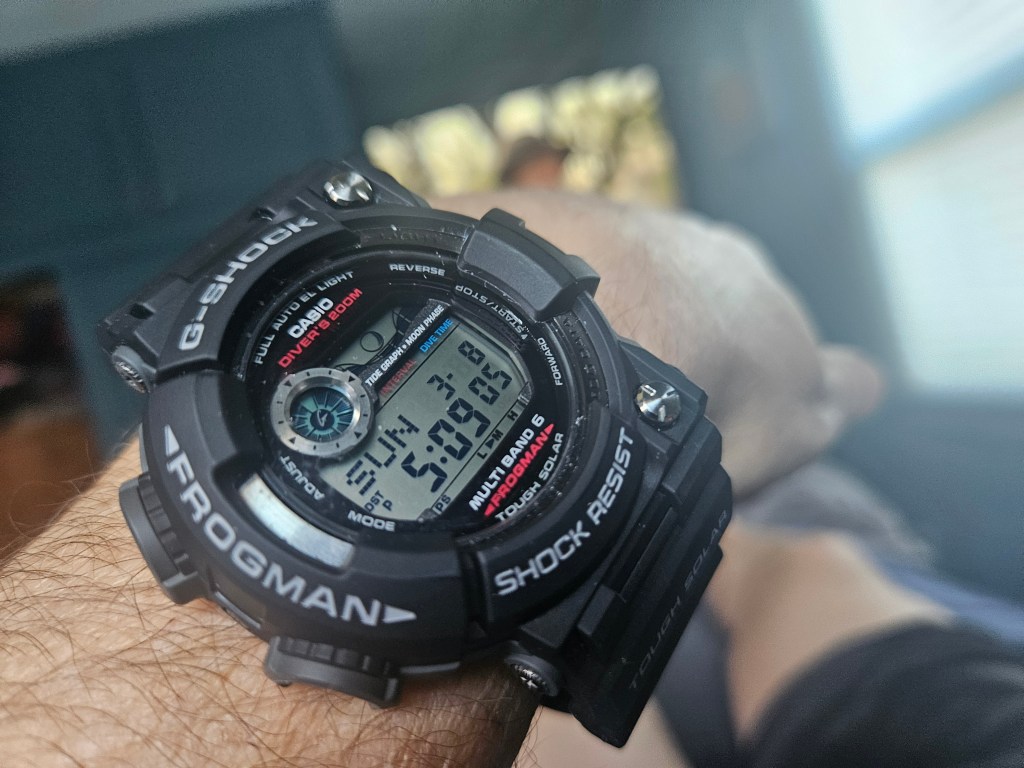
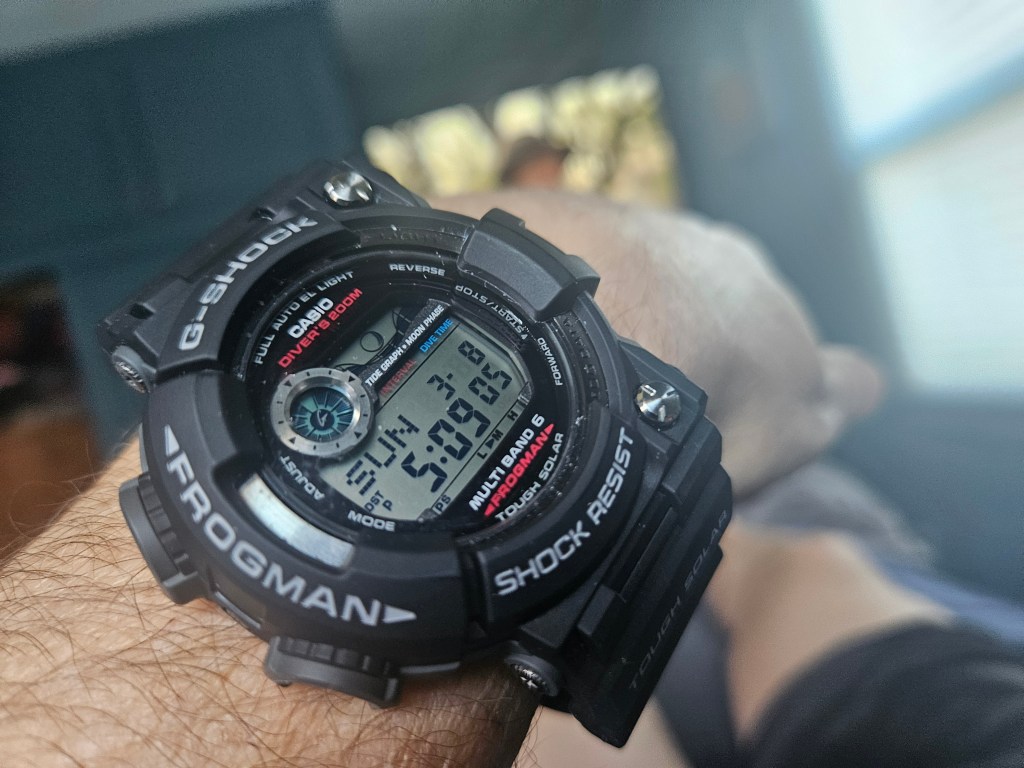
    Owning a single G-Shock—the mighty Frogman GWF-1000, no less—has taught me several humbling lessons about the realities of atomic timekeeping and solar-powered heroism.

    Lesson one: one Multiband-6 watch, even a legendary one, is not enough.

    I learned this during the night of Daylight Saving Time, when my Frogman—strapped proudly to my wrist—failed to synchronize with the atomic signal from Colorado. The problem, as I later realized, was strategic error. The watch should have been resting nobly on the windowsill, antenna pointed toward the Rocky Mountains, quietly listening for the midnight radio whisper from the WWVB tower. Instead, it was trapped on my wrist like a submarine trying to receive satellite signals from inside a cave.

    Lesson two: the Frogman occasionally deserves a night off.

    The solar battery is hardy, but I have a habit of activating the backlight like a man signaling aircraft during a blackout. Letting the watch rest on the windowsill overnight gives it two gifts: sunlight recharge during the day and atomic calibration during the night.

    Lesson three: there are places where wearing the Frogman is unnecessarily risky. Airports. Crowded cities. Questionable neighborhoods. Situations where theft, damage, or simple bad luck might separate a man from his amphibious masterpiece.

    These revelations led to an unavoidable conclusion: the Frogman needed protection.

    Enter the G-Shock GW-7900, acquired for the almost suspiciously reasonable price of $110. A watch this loyal and hardworking cannot remain nameless, so I have given it a title worthy of its mission: The Protector.

    Now the system is simple. Frogman and Protector—a tag team.

    The Protector belongs to a broader category I call Bodyguard Watches: rugged backup watches deployed when the owner wishes to preserve the dignity, resale value, or physical safety of a more expensive timepiece. The bodyguard absorbs scratches, suspicion, and general abuse while the principal remains comfortably out of harm’s way.

    I briefly considered naming the GW-7900 “The Bodyguard,” but that sounded less like a watch and more like a brand of anti-perspirant.

    So the name stands.

    The Frogman commands.
    The Protector takes the hits.

  • The Day Grief Turned Into Courage at Canyon High School

    The Day Grief Turned Into Courage at Canyon High School

    This happened about fifty years ago, so forgive me if some of the details have softened around the edges. Memory fades, but certain moments burn themselves into the mind so deeply that time cannot erase them. This is one of those moments.

    I was fourteen, a freshman at Canyon High School. It was during PE, just before lunch, and we were on the outdoor basketball courts. The courts sat beside a grassy field that sloped down into a steep canyon. A narrow trail zigzagged up the canyon wall toward a quiet residential neighborhood above us.

    The trail had its regular occupants: the self-appointed tough guys who preferred ditching PE to playing sports. They would lean on the canyon tiers like spectators in cheap seats, laughing at the rest of us for following the rules.

    One of them was a loudmouth whose name I’ve forgotten. Let’s call him Jeremy.

    That day Jeremy and his friends stood above us on the canyon trail, tossing dirt clods down onto the courts. Most of them missed, but one landed close enough to sting the air around my friend Mark Redman.

    Mark stood out among us. He was over six feet tall, lean and muscular, with long black wavy hair that brushed his shoulders. He ran track and threw the javelin. Quiet, mostly to himself. My friends had recently told me that Mark had just lost a parent. I don’t remember whether it was his mother or father, but I remember the grief in his eyes when I offered my condolences.

    When the dirt clod nearly struck him, Mark looked up and calmly told Jeremy to cut it out.

    Jeremy grinned and shouted something cruel back down. I don’t remember the exact words, but it was the kind of remark meant to wound—something low and cheap.

    Then something changed.

    Mark went perfectly still. His eyes locked onto Jeremy. The expression on his face shifted into something I will never forget: fury mixed with resolve, the kind of cold certainty that comes when a man has decided exactly what must happen next.

    Without a word he tore off his tank top, balled it up, and started climbing the canyon.

    The transformation stunned everyone.

    But it wasn’t only Mark who transformed. So did Jeremy. His grin vanished. His mouth hung open as he watched Mark coming toward him. In that instant he understood the situation perfectly. He could run, but Mark was faster. He could fight, but Mark was animated by a courage Jeremy would never have. So Jeremy did the only thing left to him.

    He stood there and waited.

    When Mark reached him, Jeremy made a weak attempt to defend himself—more out of pride than hope. It lasted only seconds. Mark pummeled Jeremy to the ground, delivered the message clearly, and told him never to treat him that way again.

    Then, without celebration or swagger, Mark walked back down the canyon, disappeared into the locker room, and left the rest of us standing there in stunned silence.

    Over the years I’ve thought about that moment often. Watching a grieving young man summon that kind of conviction gives me a kind of moral clarity that has stayed with me. In a world that often feels confused and chaotic, I remember the look on Mark’s face that day.

    Mark, wherever you are, I have never forgotten you.

  • Why My Neighbors Saw a Man in Pajamas Pointing a G-Shock Frogman at the Heavens

    Why My Neighbors Saw a Man in Pajamas Pointing a G-Shock Frogman at the Heavens

    Last night I went to bed wearing my trusty G-Shock Frogman GWF-1000, fully expecting it to perform its quiet nightly miracle: synchronize itself with the atomic clock in Colorado and glide effortlessly into Daylight Saving Time. The watch is, after all, marketed as a technological marvel—solar-powered, radio-controlled, and rugged enough to survive the Mariana Trench. Surely a modest seasonal time change would present no difficulty.

    At three in the morning I woke up for my traditional pilgrimage to the bathroom. Alexa informed me it was 3:00 a.m. My Frogman, however, insisted it was 2:00. The great amphibian had failed. The atomic signal from Colorado had apparently skipped my wrist entirely. When I woke up again at six for breakfast, the Frogman still clung stubbornly to 5:00. My heart sank. The watch I had imagined as a cybernetic superhero was, in fact, a mere mortal—another electronic device at the mercy of radio reception.

    After breakfast I decided to intervene. I confirmed the watch was set to receive the signal automatically and then attempted four manual syncs. Each attempt ended in humiliation: ERR. The signal indicator stubbornly displayed L1, the horological equivalent of a whisper. I tried the front patio. I tried the backyard. Still L1. At that point the situation escalated from casual troubleshooting to full-scale field operation.

    With the Frogman draped ceremoniously over my daughter’s oversized yellow duck squishy, dressed in blue plaid pajama bottoms and a grey T-shirt, I marched into the middle of the street like a man conducting an amateur radio experiment. I walked slow circles, rotating the watch like a sacred artifact, watching the signal meter with the concentration of a NASA engineer awaiting telemetry. At last the screen flickered: L3. Full signal. While a group of worm-eating crows nearby cackled at the spectacle, I wondered if my neighbors were peering through their curtains thinking, “I knew he was crazy all along. This confirms it.”

    Five minutes later the watch synchronized. Atomic time flowed once again from Colorado to my wrist, and the harmony of the cosmos was restored.

    Still, the episode leaves me with questions. Would the Frogman have corrected itself within a day or two if I had simply left it alone? Or was my early-morning expedition into the street the necessary act that secured the precious L3 signal?

    Another thought occurs to me. This operation was manageable with a single G-Shock. But what if I owned half a dozen Multiband-6 models? Twice a year I might find myself conducting a small civic ceremony in the middle of the road, rotating watches toward the northeast like a priest consulting celestial omens. The ritual would deserve a proper name: The Atomic Pilgrimage—the journey undertaken by the devoted G-Shock owner who abandons the domestic safety of patios and kitchens in search of the elusive WWVB signal.

    The experience has made me reconsider expanding my G-Shock collection. And yet, if I’m honest, a small part of my inner child found the whole adventure glorious—like standing in the backyard with a toy rocketship, waiting for mission control at NASA to say, “Signal acquired.”

  • Frogman Monstrosity Acceptance

    Frogman Monstrosity Acceptance

    I’ve tried to be candid about where my watch hobby is headed. For years I lived in the land of mechanical divers—those charming little machines that require winding, adjusting, and periodic visits to a watchmaker who looks at you the way a veterinarian looks at a sick horse. Lately, however, I seem to be drifting toward a different ecosystem: Multiband 6 atomic time delivered by my G-Shock Frogman, a watch that feeds on sunlight and quietly synchronizes itself with atomic clocks while I sleep. It is difficult to compete with a device that performs its duties with the calm efficiency of a Swiss train conductor who never needs coffee. The responses to this confession have been varied. Some readers nod knowingly and say they went through the same conversion. Their mechanical watches now sit motionless in drawers like retired prizefighters who once thrilled crowds but now spend their days remembering the old days. One friend is currently wandering around Thailand with a GW-5000U on his wrist and reports a level of contentment normally associated with Buddhist monks. Others have taken the opposite path and begun collecting Frogman models the way medieval villagers stockpiled shields before a siege, as if surrounding themselves with these massive amphibious contraptions might repel the chaos of modern life.

    And then there are the critics. They inform me—sometimes gently, sometimes with theatrical alarm—that I have lost my mind, contracted a disease, and strapped a grotesque monstrosity to my wrist. I concede every point. I am indeed crazed with enthusiasm, and the Frogman is unquestionably a monstrosity. But it is the most magnificent monstrosity I have ever encountered. I appear to have entered what might be called Frogman Monstrosity Acceptance: the psychological stage in which the owner stops apologizing for the watch’s outrageous proportions and instead embraces them with pride. Yes, it is enormous. Yes, it looks like a small amphibious armored vehicle designed by engineers who distrust gravity. But once you surrender to its scale, the Frogman ceases to be embarrassing and becomes something far better—a gleefully excessive titan among polite timepieces.


  • The Frogman Fidelity Oath

    The Frogman Fidelity Oath

    Dear God, hear the humble prayer of a watch addict who is trying—heroically, if imperfectly—to stay faithful to his G-Shock Frogman. Grant me the strength to appreciate the magnificent amphibious creature already on my wrist and to resist coveting other G-Shocks, especially the cheaper ones that whisper seductive promises of practicality and convenience. Protect me from the restless itch that sends me wandering through YouTube at midnight, where cheerful reviewers with macro lenses and enthusiastic voices assure me that the next watch will transform my life, my character, and possibly my posture.

    Please quiet the anxious machinery in my brain that insists on researching watches I do not need. Help me understand that the Frogman already fulfills every rational requirement a man could have for a digital timepiece: it is solar, atomic, indestructible, and built like a submarine designed by an engineer with trust issues. Remind me that my obsessive excursions into the G-Shock ecosystem are not noble acts of research but rather neurotic pilgrimages through a desert of comparison charts and unboxing videos.

    And please, dear God, intervene quickly, because the temptation is growing stronger by the hour. I can feel myself drifting toward the purchase of a GW-7900—not because I need it, but because my mind has begun whispering the most dangerous phrase in the collector’s vocabulary: “backup watch.” I tell myself the 7900 would merely protect my Frogman from harsh conditions, as though the Frogman were a delicate orchid rather than an armored amphibian designed to survive the Mariana Trench.

    If this prayer sounds familiar, you already understand the Frogman Fidelity Oath: the solemn pledge made by the watch enthusiast who believes he has finally found the perfect G-Shock and now begs for the strength not to betray it. The oath is heartfelt, sincere, and deeply moving—and it usually lasts right up until the moment the addict watches two enthusiastic YouTube reviews and convinces himself that buying a second watch is not an act of infidelity but an act of responsible stewardship.

  • The Digital Purist’s G-Shock Manifesto

    The Digital Purist’s G-Shock Manifesto

    When I bought my G-Shock Frogman and experienced the peculiar bond that many G-Shock owners describe, I began hearing from other enthusiasts who spoke about their watches with the same kind of fervor usually reserved for religion, motorcycles, or properly cooked brisket. Curious, I started watching G-Shock videos online. What struck me was not the technical analysis—though there was plenty of that—but the sheer affection people felt for these watches. It was humbling to see someone speak with genuine reverence about a $100 resin timepiece with the same poetic intensity that others reserve for ten-thousand-dollar Swiss luxury watches. Apparently joy does not scale with price tags.

    After enough of these videos, I discovered something about myself: my lane in the G-Shock universe is extremely narrow. My watches must be digital. They must be Tough Solar. They must be Multiband 6. And they must come on straps. The moment a watch wanders outside those borders—analog hands, shiny bracelets, smartwatch features that make it look like a Garmin auditioning for a triathlon—it falls off my radar. Limited editions that feel like marketing departments squeezing collectors for lunch money also fail to stir my soul. My tastes are simple: give me the rugged, atomic-synchronized machinery of the late-20th-century Casio imagination.

    And that is where the magic happens. Casio is the undisputed curator of the 1980s and 1990s technological mood: efficient, unapologetically digital, and blissfully free from the surveillance culture of modern smart devices. A Tough Solar Multiband 6 G-Shock does everything you ask of it without demanding attention in return. It is competent, quiet, and oddly comforting. Once you step into that retro-technical atmosphere, you discover the purest G-Shock vibe: a blend of practicality, nostalgia, and cool restraint.

    Based on this revelation, I created what I now consider my essential G-Shock quartet:

    G-Shock Frogman GWF-1000
    G-Shock Rangeman GW-9400
    G-Shock Rescue GW-7900
    G-Shock GW-5000U

    I already own the first one. The other three remain safely outside my possession—at least for the moment. My strategy for maintaining discipline is simple: I try to read books and articles like a normal person. Unfortunately, every fifteen minutes my browser opens a new tab where I begin “researching” the Rangeman, the 7900, or the GW-5000U with the dedication of a graduate student preparing a thesis on atomic timekeeping. So far the watches remain unpurchased.

    But I would not advise betting against them.

    The Man Who Lost His Mind to Watches is my book about the watch madness that many of us share. It is now on Amazon Kindle:

  • The Man Who Lost His Mind to Watches

    The Man Who Lost His Mind to Watches

    The Man Who Lost His Mind to Watches is not a book about watches. It is a book about obsession—the kind that begins with a single innocent purchase and metastasizes into spreadsheets, late-night forum debates, and existential dread over lume brightness. What starts as an appreciation for craftsmanship becomes a full-blown psychological expedition into masculinity, consumer desire, envy, tribal belonging, and the strange belief that the right object will fix what’s unsettled inside. If you have ever convinced yourself that one more acquisition would finally complete you, this book is already about you.

    The watch obsession is told in lexicon entries. Each term for some facet of the watch addiction exposes the watch enthusiast who descends into the glittering underworld of timepieces—divers, bracelets, straps, limited editions—only to discover that the chase for the “perfect watch” is really a chase for certainty in a world that offers none. The deeper he goes, the more absurd the quest becomes. He compares millimeters as if they were moral virtues. He debates dial legibility as if it were a constitutional right. He imagines that mastering reference numbers will somehow grant him mastery over time itself. Instead, he finds himself trapped in a hall of mirrors where identity is reflected in polished steel.

    And yet this is not merely satire. Beneath the laughter lies a serious question: why do intelligent, disciplined adults hand over their peace of mind to objects? The Man Who Lost His Mind to Watches is a confession, a cautionary tale, and a strangely hopeful map back to sanity. It exposes the machinery of obsession while refusing to sneer at it. Because in the end, the watches were never the enemy. The illusion that perfection could be purchased—that was the real complication.

    I have published this book on Amazon Kindle, but you do not need a Kindle device to read it. Once you purchase it, you can read the book directly on your computer screen using the Kindle app or the Kindle cloud reader. If the book gains meaningful traction and sells well, I will consider releasing a paperback edition as well.

  • Mechanical Atrophy Prevention

    Mechanical Atrophy Prevention

    I wear my G-Shock Frogman GWF-1000 almost every day. It has become the default setting of my wrist, the horological equivalent of gravity. Twice a week, however, I stage a small act of resistance. I slip on one of my Seiko divers. If I don’t, the Frogman will quietly suffocate the rest of the collection. It already has, to a degree. The moment I first strapped that Frogman on, it felt less like a purchase and more like a declaration: this watch had my name written across it in thick permanent ink. It fit my life with such ruthless competence that every other watch in the box began to look like an understudy waiting for a call that will never come.

    So twice a week I impose discipline. The Seikos get their turn. Think of it as horological cross-training. Most days I’m on the exercise bike or doing yoga, but I still force myself to swing the kettlebells twice a week so my muscles don’t dissolve into decorative noodles. The Seikos perform the same function. They are my defense against mechanical watch atrophy.

    This ritual belongs to what I call my Mechanical Atrophy Prevention program: the deliberate act of wearing a mechanical watch just often enough to preserve one’s emotional bond with gears, springs, and that hypnotic sweeping second hand. Without this intervention, the human brain quickly adapts to the ruthless efficiency of digital timekeeping. Soon you’re living in a world of solar charging, atomic synchronization, and clinical precision, and the charming little clockwork creatures in your watch box begin to feel quaint—like writing letters with a quill.

    Wearing the Seikos twice a week is my version of lifting weights so my body doesn’t evolve into an ergonomic office chair with legs. The practice keeps alive the fragile illusion that I am still a “mechanical watch person,” not a man who has quietly surrendered to the cold efficiency of quartz.

    Does this sound crazy to you?

    Welcome to my world.

  • Dessert from the Department of Cybersecurity

    Dessert from the Department of Cybersecurity

    Yesterday I endured my college’s annual cybersecurity training program, a ritual as joyful as renewing your driver’s license at the DMV. The course came complete with a quiz—an “opportunity,” they called it—to demonstrate that I had absorbed the essential lesson of modern digital survival: pause before you click.

    The training was earnest, repetitive, and soaked in the bureaucratic optimism that a thirty-minute slideshow can transform ordinary humans into elite cyber-defense agents. The core commandment appeared again and again like scripture: use common sense and do not click suspicious emails.

    I completed the training, collected my imaginary gold star, and moved on with my day.

    The following morning the universe presented its practical exam.

    An email arrived addressed to everyone in my department. The subject line screamed with theatrical desperation: “Please! I need some assistance!” The sender was a student who had never taken my class, never spoken to me, and almost certainly had no idea who I was. Attached to the email were several transcripts, as if she had dumped a stack of paperwork onto the digital sidewalk.

    Her message contained a four-paragraph narrative describing the tragic injustice that had befallen her: she had not been admitted to the university of her dreams. She wanted me—a total stranger—to read the attachments and vouch for her qualifications. The request carried the confident tone of someone who had mistaken mass-emailing professors for a reasonable life strategy.

    My reaction was immediate and uncharitable. This was not a cry for help. This was hubris wearing sweatpants. The entire message radiated a level of absurd entitlement that made the delete key glow with moral clarity.

    So I deleted it.

    Later that day I was in the garage swinging kettlebells, grunting my way through a set, when a thought crept into my mind. What if this email had been the cybersecurity department’s final exam? Perhaps after forcing me through their mandatory training, they had decided to test whether I would actually apply the lesson.

    Pause before you click.

    Did I pass because I exercised common sense?

    Possibly.

    But if I’m honest, I passed because the email offended me. Its sheer stupidity triggered the one defensive system that never fails: irritation. Suspicion might falter. Curiosity might betray you. But righteous annoyance is a powerful cybersecurity tool.

    So thank you, Department of Cybersecurity. You were not content to burden me with a half-hour training session. You also sent along dessert.

    And I did exactly what you hoped I would do with it.

    I sent it back to the kitchen.