Category: Confessions

  • The Price of Your Work Exit

    The Price of Your Work Exit

    Retirement was supposed to feel like a gentle descent. Instead, it arrives with an invoice. For years, your college played the role of benevolent patron: five hundred dollars a month to insure a family of four at Kaiser Permanente, with a co-pay so small it felt almost ceremonial. Now the curtain lifts. Your wife’s middle school, thrifty to the point of cruelty, hands you the real number—nearly triple. At the same time, your paycheck shrinks to about eighty-five percent of its former self. The vise tightens from both ends: less coming in, far more going out. Retirement, it turns out, is not an exit but a recalibration of anxiety.

    On a Saturday morning, under the fluorescent calm of Trader Joe’s, you confess this arithmetic of dread to the cashier who has watched you age in weekly installments for two decades. He listens, nods, and then offers a solution with the confidence of a man suggesting a new brand of hummus: get a part-time job here. Be a cashier. Let the paycheck subsidize your health insurance. You have the build, the stamina, the conversational ease. In his telling, the transition is almost heroic—a late-life pivot, sleeves rolled, dignity intact.

    But you can already see the other version. You, sixty-five, standing in a Hawaiian shirt that once signaled leisure and now reads as camouflage, being told in a quarterly review that your tone lacks “warmth.” That you cleared the line too efficiently, failed to linger, failed to affirm. That your sarcasm—once a badge of intellect—needs to be diluted into something safer, sweeter, more compliant. You imagine the language of correction: more honey, less acid. You imagine nodding while someone half your age explains emotional calibration. The phrase writes itself in your head: a Late-Life Vocational Humility Crisis—the moment when accumulated status collides with the small, bright humiliations of starting over at the bottom, where friendliness is a metric and personality is a deliverable.

    You float the idea at home. Your wife laughs—not cruelly, but decisively. The verdict is clear: you are not built for this theater. The fantasy collapses on contact with reality. It was never a plan, only a flattering daydream in which you played the rugged provider, stacking pinto beans beside water-packed albacore, funding your family’s security with cheerful competence.

    So you stand in front of the mirror and deliver the final ruling: Trader Joe’s is a no-go. The new discipline will be quieter, less cinematic. No convertibles. No Swiss watch indulgences. No Cabo timeshare fantasies dressed up as investments. Just a narrower life, lived within its means, spared the indignity of proving—too late—that you can still take orders and smile about it.

  • The Man Who Refused to Retire and Learned to Fly at Costco

    The Man Who Refused to Retire and Learned to Fly at Costco

    You will be sixty-five in less than a year—fifteen months from your last day of work—and you would be wise to bury the word “retirement” before it buries you. It is a feeble, anemic term, a linguistic sedative that disguises the collapse of identity as leisure. Nothing about what lies ahead deserves that kind of small thinking.

    What you are approaching requires a name with altitude, velocity, and a touch of myth.

    You are entering the Sovereign Phase.

    In the Sovereign Phase, you do not keep a schedule—you issue one. You do not await approval—you render decisions. This is not an ending ceremonially dressed in khakis and early dinners; it is a coronation. You are not stepping away. You are stepping above.

    Your final act has begun, and it demands a certain boldness. The first order of business is symbolic but essential: you will upgrade your Costco membership to Executive. No committees. No approvals. No memos. You will simply decide—and it will be done.

    And then, one morning, before the doors officially open to the masses, you will enter.

    The aisles are empty. The pallets stand fresh and untouched. The air itself feels newly issued. You move through this cathedral of abundance with first access, first choice, first claim. Something happens to you here—something disproportionate to the act itself. A quiet but unmistakable inflation of the self. A sense that you have not merely arrived early, but ascended.

    You feel it in your chest first, then in your stride. The strange conviction that you are no longer bound by ordinary constraints. That you have, somehow, earned this.

    You have entered Executive Aisle Rapture.

    It is a near-mystical condition in which logistical privilege is mistaken for existential elevation, where empty aisles and shrink-wrapped towers of goods produce a sensation that borders on the divine. You begin to suspect that wings—actual wings—may be forming beneath your shirt, preparing you for a short, ill-advised flight toward the sun.

    This is not a side effect of the Sovereign Phase. It is a requirement.

    So when your last day of work arrives, do not mark it with melancholy or relief. Mark it with a transaction. Upgrade the membership. Secure your access. Step into the early light of the warehouse.

    And when the doors part and the aisles open before you, walk forward without hesitation.

    You are no longer a worker.

    You are sovereign.

  • The Psychological Mess of Wanting Things We Neither Need Nor Intend to Use

    The Psychological Mess of Wanting Things We Neither Need Nor Intend to Use

    One of the strangest features of materialism is the spectacular mismatch between what we imagine an object will do for us and what it actually does. In the mind, the object arrives polished, transcendent—an emblem of taste, discipline, even identity. In reality, it often sits there, unnecessary and faintly ridiculous, like a prop waiting for a performance that never begins. 

    I own an eight-year-old Accord with fewer than 30,000 miles on it—a statistic that quietly announces I neither drive much nor particularly enjoy driving. And yet I can picture, with embarrassing clarity, a brand-new Accord or Camry resting in my garage, gleaming like a sacred artifact I would prefer not to disturb by actually using it.

    Watches operate under the same spell. I can easily imagine owning a Tudor Black Bay or a Tudor Pelagos, each one promising a kind of quiet authority on the wrist. But my habits betray me. I’m not roaming public spaces, not projecting presence, not leveraging this object as a social signal. The watch would sit, admired in theory, unused in practice. I know dozens—no, hundreds—of watch enthusiasts who live in this same contradiction, accumulating pieces they rarely wear because the idea of ownership is more intoxicating than the act of use.

    This gap between having and being is hardly new. I was reminded of it while thinking about Erich Fromm and his book To Have or To Be?, which argues that materialism quietly erodes the possibility of a meaningful life grounded in connection and experience. The argument is persuasive—almost obvious once stated. And yet, knowing this changes very little.

    That’s the part that unsettles me. You can understand the critique, agree with it, even teach it, and still find yourself browsing for the next unnecessary object with the focus of a predator. Clarity does not neutralize desire. It merely observes it, like a detached narrator watching the same old plot unfold. There’s something almost comical about it—this split between the thinking self and the acquisitive impulse. If you wanted to document the absurdity of human behavior, you could dedicate an entire season of Dirty Jobs to it: not the grime of physical labor, but the psychological mess of wanting things we neither need nor intend to use.

  • From Lecture Hall to Checkout Line: A Better Second Act

    From Lecture Hall to Checkout Line: A Better Second Act

    Over the past several years, I’ve watched a pattern unfold. A colleague retires, disappears for a while, and then—two years later—reappears in the writing center as a volunteer. On paper, it looks noble. In person, it looks something else.

    They don’t return with ease or quiet confidence. They return looking unsettled—eyes fixed forward, posture stiff, like deer caught in headlights that never turn off. I’ve seen them alone on the writing lounge couch, staring straight ahead, as if waiting for something that never quite arrives. The impression is hard to shake: retirement didn’t liberate them; it hollowed something out. And so they came back to the place where their sense of worth once had structure and witnesses.

    Students, however, are not sentimental. They don’t greet these returnees as beloved elders. They approach them the way one approaches a last option—politely, cautiously, and only when necessary. The exchange feels inverted. Instead of giving value, the retiree seems to be extracting it: a little affirmation, a little proof of continued relevance, a small ration of being needed.

    The idea of volunteering after retirement sounds admirable in theory. In practice, it reminds me of Lot’s wife—turning back, unable to release the past, even when the mandate is to move forward.

    And I say all this with some unease, because I’m about fifteen months away from retirement myself. My job has kept my mind engaged for decades—lectures, lesson plans, essays, the constant friction of thinking. I can’t pretend I’m immune to the same forces that seem to have pulled my colleagues back: the slow creep of isolation, the loss of structure, the quiet erosion of purpose. Sloth and complacency don’t arrive dramatically; they seep in.

    Still, I’m fairly certain of one thing: I won’t be returning as a volunteer tutor. I see too much of Lot’s wife in that gesture and not enough of a forward-facing project that justifies it.

    There’s also the matter of audience. Students gravitate toward youth. My own teen daughters regard “Boomers” like me with a mix of mild embarrassment and occasional alarm, as if we are well-meaning but out of date. I’m not eager to test that perception in a room where attention is already scarce.

    If pride is a vice, it’s at least an honest one here. My read on younger students, combined with my own instincts, tells me that the writing center would not be my best second act.

    There may be other roles. I’ve entertained, half-seriously, the idea of working part-time at my local Trader Joe’s. I know the staff. I could use the income for health insurance. And I have a skill set that would actually translate: I can talk to people, keep a line moving, and bag groceries without turning it into a philosophical crisis. There’s dignity in that—perhaps more than in hovering around a former life, waiting to be needed.

    One thing I do know: wherever I land, I don’t intend to sit there staring into the middle distance, hoping someone will give me back a version of myself I’ve already lived.

  • The Tape Tyrant of Postmaster Plus

    The Tape Tyrant of Postmaster Plus

    I went to Postmaster Plus this morning to ship a defective camera back to Kodak—a routine errand, the kind you knock out between coffee and whatever comes next. I’ve been going there for years. The place is run by a family from Bombay, and over the last decade they’ve shipped more of my watches than I care to admit. It’s a familiar, efficient operation. Or at least, it usually is.

    When I walked in, the rhythm was off.

    At the counter stood a couple in their mid-sixties, locked in some elaborate transaction with M, the family patriarch, a man in his seventies who has the calm of someone who has seen everything and survived it. Behind the couple stood a woman clutching a stack of flattened cardboard, her face arranged in a quiet expression of despair. She looked at me as if to say, You’re seeing this too, right?

    I was.

    The woman at the counter—a redhead with severe bifocals and a face that seemed permanently braced against disappointment—had taken possession of M’s tape roller and was using it with the zeal of someone preparing artifacts for burial. Her husband hovered nearby, a classic Palm Springs Q-Tip: white hair under a baseball cap, mouth slightly open, limbs thin as dowels, torso betraying a fondness for buffets. He contributed nothing except presence.

    “I’ve seen these packages break before,” the redhead announced, as she wrapped the parcels in what could only be described as a second skin of tape. Not a practical layer—no, this was ceremonial. A kind of adhesive exorcism. When the tape ran out, she didn’t pause, didn’t apologize. She demanded another roll with the urgency of a field commander low on ammunition.

    The woman behind them caught my eye again. This time the look was unmistakable: We are both trapped here. I returned the glance with equal solemnity. Yes, we were sharing this moment. No, there was no escape.

    Then came the breaking point. The cardboard woman asked M when his son W would return from break.

    “Twenty minutes or so,” M replied.

    She nodded, made a decision, and fled. A wise woman. She chose freedom.

    I stayed.

    The redhead, now fully committed to her role as High Priestess of Packaging Integrity, began lecturing the room about the fragility of parcels and the absolute necessity of excessive tape. She spoke as if we were all negligent amateurs, one poorly wrapped box away from societal collapse.

    I opted out.

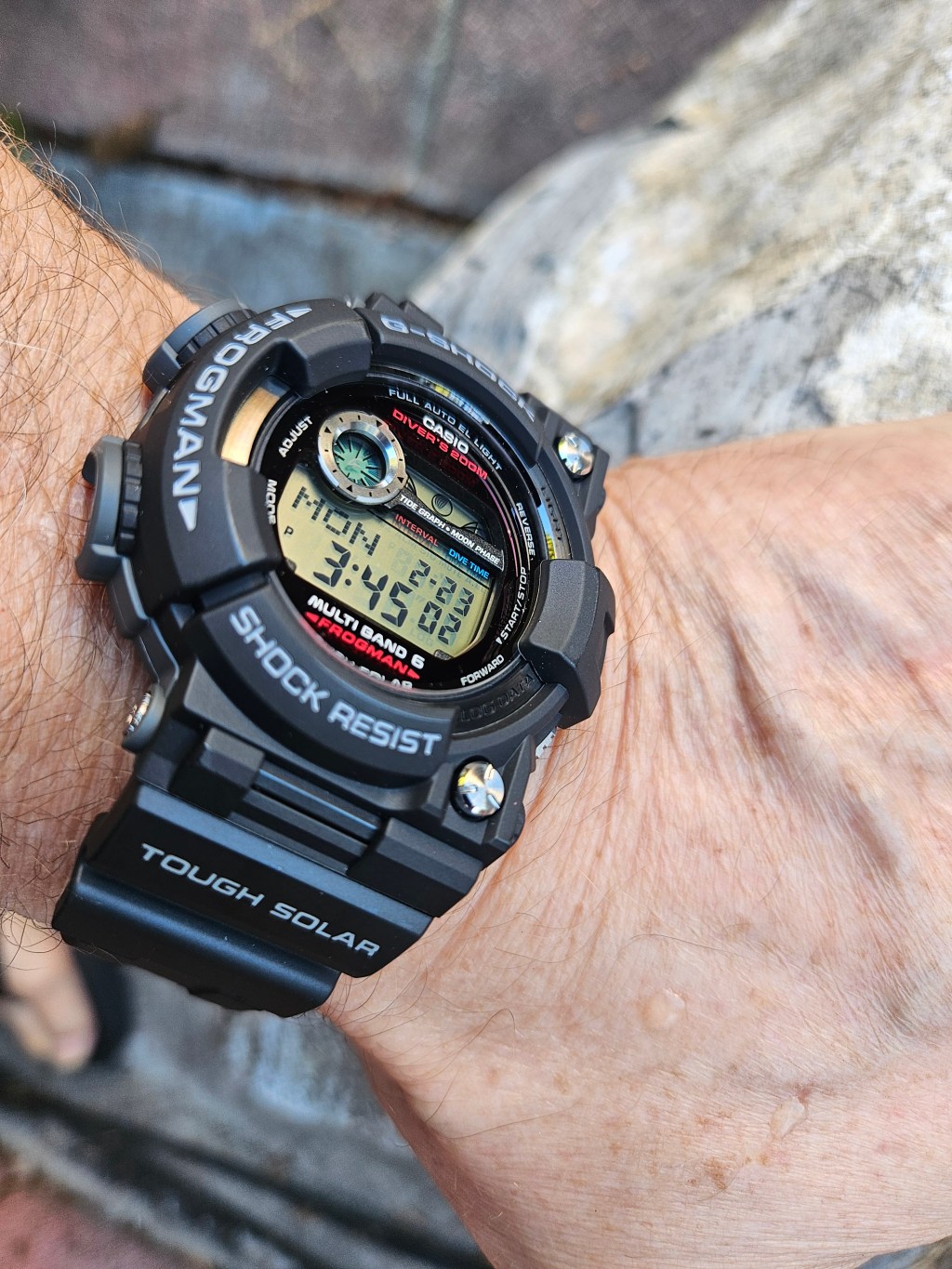
    I pulled out my phone, photographed my Casio G-Shock GW-7900, and posted it to Instagram. If I was going to be held hostage, I might as well document something worthwhile.

    Eventually—mercifully—the couple completed their transaction. Eighty dollars later, their packages were no longer parcels but laminated relics, ready to withstand not just shipping, but geological time. I stepped forward, paid for my own shipment, and shared a brief, knowing laugh with M about the spectacle we had just endured.

    We thought it was over.

    It wasn’t.

    The door opened. The couple returned.

    The redhead, unsatisfied with her previous efforts, declared that a third layer of tape was necessary for her “peace of mind.” At this point, the packages were less shipments and more mummies awaiting a sarcophagus.

    I gave M a look—the kind of look that conveys sympathy, disbelief, and resignation all at once. He nodded, the stoic veteran of countless such encounters.

    I left.

    As I walked out, I knew two things. First, those packages would survive anything short of a volcanic eruption. Second, I had just acquired a story—one that would be waiting patiently for me to tell my wife the moment I got home.

  • Escape from Seikotraz: Starring Jeff McMahon

    Escape from Seikotraz: Starring Jeff McMahon

    This morning I woke up with a small, undeserved victory. My second shingles shot had not flattened me into a feverish heap of aches and regret. No vaccine hangover. No sack-of-muscle soreness. Just a functioning body and a clear head. I glanced down at my Casio G-Shock GW-7900 before swinging my legs out of bed, and as I reached for the coffee ritual, a thought crept in—quiet at first, then strangely intoxicating:

    What if I owned only G-Shocks?

    What if I were free of my Seiko divers?

    Free from what, exactly? That part remains stubbornly undefined.

    Three years ago, the fracture began. I developed an aversion to bracelets—not a mild preference, but a full-blown irritation, as if every metal link were conspiring against my wrist. I moved my Seiko divers onto straps, experimenting like a man searching for ergonomic salvation, until I discovered Divecore FKM. Suddenly, everything clicked. The watches felt right—balanced, secure, almost inevitable. For a brief moment, I thought I had solved the problem.

    Then came the contamination.

    August 2025. A message. A study. PFAS—“forever chemicals”—lurking in FKM. The phrase alone sounded like a villain in a low-budget sci-fi film. Dutifully, almost piously, I removed the straps. The watches went back onto inferior substitutes, and with that small act, something essential drained out of them. They were no longer “just right.” They were tolerable.

    Divecore, to their credit, pivoted—hydrogenated rubber, safer materials, a new Waffle strap on the way. I’m waiting for it now, like a man waiting for a repaired marriage.

    But in that interim, I did something careless. Or revealing.

    On a lark, I bought a Casio G-Shock Frogman GWF-1000.

    And I didn’t just like it. I fell for it immediately.

    Its design wasn’t elegant—it was aggressively industrial, almost defiant. Its timekeeping wasn’t approximate—it was absolute. Atomic. Unquestionable. It didn’t ask for attention; it delivered certainty. One watch became three. The Rescue. The incoming Casio G-Shock GW-9500 Mudman. A quiet shift became a migration.

    This morning, still basking in my vaccine survival, I entertained a more radical thought: eliminate the Seikos entirely. Replace them with two final pieces—the sapphire Frogman D1000 and the GW-5000U Square, my so-called “dress watch,” a term that feels almost satirical in this context.

    At what point does a preference become a slide?

    Was it the PFAS scare that loosened the foundation? Or something deeper? Do the Seiko divers now carry the residue of an older obsession—one tied to acquisition, to the promise that the next watch would finally complete the picture? And if so, what exactly is this new G-Shock phase? Liberation? Or simply addiction in a more utilitarian costume?

    There are a few things I can say with certainty. I prefer atomic time to mechanical approximation. I prefer digital clarity to analog interpretation. Yes, the digital display demands a slight tilt of the wrist, a negotiation with the light, but I’ve made peace with that. It’s a small concession in exchange for precision.

    Maybe there is no grand psychological drama here. Maybe I’ve grown lazy in the most practical sense. I like convenience. I like certainty. I like not having to set the time like a monk tending to a ceremonial clock. Perhaps this is not a crisis of identity but a simple shift toward ease.

    But then I hear from others.

    Men who made this transition years ago. Men who, after watching my videos, bought a G-Shock out of curiosity and quietly abandoned their mechanical collections. No fanfare. No farewell. Just a gradual, almost polite disappearance.

    It suggests something larger. A quiet exodus.

    You could make a documentary about it: aging watch obsessives laying down their expensive mechanical relics and walking into the sunset wearing Squares and Mudmans, relieved, unburdened, and slightly confused about how it happened.

    Meanwhile, my own collection sits in a kind of purgatory. The Seiko divers wait, their fate undecided. Two have already been sold—the Captain Willard Ice Diver and the 62MAS—and their absence has not registered as loss. That’s the unsettling part. Watches that once felt essential have vanished without leaving a dent.

    And here I was, thinking of myself as a careful curator, a man assembling a coherent, meaningful collection.

    The truth is less flattering.

    My hobby is governed not by principle, but by impulse. By shifting preferences, passing anxieties, and the occasional well-timed scare about “forever chemicals.” I would prefer to believe in a deeper logic, a narrative of refinement and evolution.

    But honesty requires a different conclusion.

    I am not curating.

    I am drifting.

    I look into the mirror. “Oh my God,” I scream. “I am a capricious watch collector.”

    Meanwhile, my YouTube subscribers are making cogent remarks in the comment section. A gentleman who goes by the name of MDchaz recently wrote: “Coming to a theater near you “Escape from Seikotraz” starring Jeff McMahon.” I wrote back, “I’ll have to steal your idea for my next YouTube video.”

    And this blog post. 

  • Two Hours in a Hotel Room: My Mechanical Watch Purgatory

    Two Hours in a Hotel Room: My Mechanical Watch Purgatory

    At night, I go to bed wearing one of my Tough Solar, Multiband-6 G-Shocks. When I wake up, it’s still there—quietly correct, indifferent to my dreams. I make coffee. I eat porridge fortified with protein powder, as if I’m feeding a machine that happens to have a pulse. I write. I take my daughters to school. I return home, sit at the piano, and tap out something halfway between discipline and distraction before changing into workout clothes.

    Then the ritual begins.

    Before I train, I remove the G-Shock and place it—carefully, almost ceremonially—into an open ceramic butter dish. Inside are two watch pillows, like small upholstered altars. I set the dish by the living room window, perched on actual pillows, and let the watches drink sunlight. I don’t charge them. I feed them. They sit there absorbing photons like obedient livestock while I sweat through my penance.

    After the workout, after the shower, after lunch, I leave the G-Shocks at the window, basking in their solar feast, and I reach for a mechanical Seiko diver. This is where things get strange.

    I wear the mechanical for my nap.

    Not because I prefer it. Not because I need it. But because I feel I owe it something.

    For two hours, I strap on a relic of my former life—polished steel, automatic movement, the old romance of gears and springs. I rotate through four of them, day after day, as if fulfilling a contractual obligation. They sit on my wrist like ghosts with good machining.

    And then I take them off.

    I return to my G-Shock the way a traveler returns home after a brief, awkward stay in a hotel. The mechanical watch is the Holiday Inn—clean, respectable, vaguely unsettling in its impermanence. I check out after two hours, hand in the key to a staff member in the hotel lobby, and fly back to where I actually live: atomic time, solar power, numbers that tell the truth without flourish.

    Something happened to me. I can feel it, but I can’t fully explain it yet.

    For twenty years, I was immersed in mechanical dive watches. Not casually—devotionally. They were objects of study, desire, identity. And now, when I look at them, I don’t feel longing. I feel… residue. A faint aftertaste of something that once promised more than it could deliver.

    Pain might be too strong a word. But it’s in the neighborhood.

    I find myself wondering if addiction—because let’s stop pretending it wasn’t that—is less about pleasure and more about escape. About trying to solve something internal with something external. A watch becomes a talisman, a small, gleaming object that whispers: This will fix it. This will complete you.

    It never does, of course. It just resets the hunger.

    Maybe that’s what I’m processing now. Not just the watches, but what they stood in for. The idea that acquiring the right object could quiet something restless inside me. The belief that completion was one purchase away.

    Now I’m in a strange in-between state. Not fully attached to the old world, not entirely settled into the new one. The two-hour mechanical watch session feels like a concession—an obligation to a former self I haven’t fully buried. It’s polite. It’s controlled. It’s also faintly absurd.

    The G-Shocks, by contrast, feel like clarity. They don’t seduce. They don’t promise transcendence. They just tell the time—accurately, relentlessly, without commentary. And for now, that’s enough.

    But I don’t fully understand what’s happened to me yet.

    Give me a year.

    I suspect I’ll have a better answer—or at least a more honest question.

  • Stop Chasing the Perfect Watch–It Doesn’t Exist

    Stop Chasing the Perfect Watch–It Doesn’t Exist

    I love the digital displays on my Casio G-Shock Frogman GWF-1000 and Casio G-Shock GW-7900. They tell me the time with blunt authority. No interpretation. No ceremony. Just numbers that land in the brain like a verdict.

    And yet, apparently, that isn’t enough.

    Somewhere along the way I developed a new appetite—no, let’s call it what it is, greed. I don’t just want clear numerals anymore. I want absurdly large numerals. I want wrist-mounted billboards. I want a wall clock strapped to my arm so I can read the time from across the room like a man who refuses to participate in subtlety.

    Naturally, the good people of G-Shock Nation pointed me toward the Casio G-Shock GW-9500 Mudman. The Mudman, they said, has the numbers. Big, bold, unapologetic digits that look like they were designed for someone who has lost patience with squinting.

    And they’re right—mostly.

    Mudman owners speak about their watch with a curious mix of affection and confession. They praise the size of the numerals, the rugged build, the sheer presence of the thing. Then, almost sheepishly, they admit that the display can blur at certain angles, that the duplex layering introduces a faint haze, that it’s not quite as clean as they’d like. They dock it a star. Four out of five.

    Then they shrug and say they love it anyway.

    That’s the part that matters.

    Because it raises a question most of us spend years avoiding: is there such a thing as a five-star watch?

    I’ve finally accepted the answer. There isn’t. There are only trade-offs you can tolerate without resentment.

    I’ve been chasing a very specific fantasy: huge numerals, high contrast, perfect viewing angles, and zero cognitive load. A watch that doesn’t need to be read so much as absorbed. A watch that behaves like a wall clock—instant, effortless, undeniable. What I’ve discovered is that watches can deliver three of those qualities with confidence. They just can’t deliver all four at once.

    My GW-7900 comes closest to frictionless clarity. Its display is stable, legible, and immediate. But the digits, while excellent, don’t quite scratch that billboard itch. The Mudman 9500 pushes in the opposite direction. It gives me the numbers—big, thick, impossible to ignore—but introduces a new problem: at certain angles, the display hesitates. Instead of receiving the time, I have to negotiate with it.

    Then there are the Pro Trek models, with their crisp, high-contrast STN displays. Technically superior. Visually disciplined. And yet, in their refinement, they lose that blunt, wall-clock immediacy. They are precise, but not emphatic.

    What fascinates me is how quickly Mudman owners make peace with imperfection. They acknowledge the flaws, subtract a star, and keep wearing the watch. That’s not compromise in the defeated sense. It’s acceptance. They’ve decided which imperfection they can live with, and they’ve moved on.

    That realization forced me to confront what I’m actually chasing. It isn’t a watch. It’s a state of mind—frictionless time perception. I want to glance at my wrist and have the time imposed on me without effort, hesitation, or ambiguity. But a wristwatch isn’t built for that ideal. It’s constrained by size, power, durability, and the stubborn limits of display technology. Something always gives.

    There is, to be fair, a strong case for the Mudman. Bigger numerals do make the time easier to read most of the time. Its toughness invites confidence. Its design has a certain muscular charisma. For many people, that combination outweighs the occasional moment of haze or glare.

    But I’ve had to admit something about myself: I value consistency over peak performance. A watch that is occasionally perfect but intermittently irritating will wear me down. I don’t want to negotiate with my watch. I want to glance and know.

    So the conclusion is both obvious and oddly liberating. There is no perfect watch. Once you accept that, the chase loses its urgency. You stop looking for the mythical five-star object and start making deliberate choices.

    The real question isn’t, “Which watch gets me closest to perfection?”

    It’s this: Which imperfection can I live with—and still enjoy checking the time a hundred times a day?

  • Watch Straps, Paradise, and the Return of Mother

    Watch Straps, Paradise, and the Return of Mother

    Last night I found myself standing on a hill in Hawaii, the kind of place real estate agents describe as “transcendent” and charge accordingly. Below me, the ocean moved with rehearsed elegance—waves rolling in like they had been coached for the occasion. A tech billionaire, naturally, had invited my family and me to his New Year’s Eve party. In dreams, invitations arrive without explanation and are accepted without skepticism.

    Inside his mansion was a room devoted entirely to appetizers—a cathedral of small bites. I approached it with the zeal of a man who believes abundance is a moral right. Everything was sampled, nothing spared. Then I came upon a glass bowl filled with what appeared to be black licorice. I took a bite and immediately discovered I had made a categorical error. It wasn’t licorice. It was a bowl of rubber watch straps. I had, with full dental commitment, chewed into one of them like a lab animal testing the limits of its environment.

    The billionaire did not react. He stood in the next room, calmly painting a model holding yoga poses—his attention fixed, his world undisturbed. Either he hadn’t noticed, or he lived in a realm where a man biting into a watch strap barely registers as an event.

    Then my mother appeared.

    She has been gone for six years, but in the dream she returned without ceremony, as if death were a clerical error that had been quietly corrected. I greeted her with genuine joy and surprising composure, as though we had simply missed a few phone calls. She told me she was going for a swim. I said I’d join her later, the way one postpones something assumed to be indefinitely available.

    Time, as it does in dreams, rearranged itself. Someone came running to say she had cut her finger on coral. A doctor—there is always a doctor at these gatherings—offered to come with me, iodine and bandages in hand. But as we descended toward the water, word arrived that she had already been treated and had left for California.

    Meanwhile, I had waded into the ocean. The water was warm, enveloping, almost indulgent in its softness. It reached my chest and held me there, like something that preferred I not leave. Faced with the choice between urgency and comfort, I chose comfort. I stayed in the water. My mother, once again, slipped out of reach.

    What kind of dream arranges such a sequence? A billionaire’s excess, a son’s carelessness, a mother’s brief return and second departure. If I had to impose meaning, I’d say the ocean felt less like scenery and more like origin—a return to something pre-verbal, pre-ambition, pre-everything. Call it the womb, call it nature, call it a memory the body keeps when the mind forgets.

    But I hesitate to turn it into a sermon about mortality. Not every dream in one’s sixties needs to carry a funeral program in its back pocket. Perhaps it was about regeneration. Or the persistent illusion that what we lose might reappear long enough to test how we respond.

    I hope my dream was not some portent of mortality. But whatever the case, I’m glad the tech billionaire didn’t send security after me for leaving bite marks in one of his rubber watch straps. 

  • The Acrobats I Misjudged

    The Acrobats I Misjudged

    Sometime around 2018, I’d make the daily trek from the tennis courts to my office and pass the library lawn—a patch of campus that should have offered a quiet, pastoral glide into the workday. Instead, it hosted a recurring spectacle: half a dozen young men staging what can only be described as a low-budget Cirque du Campus. Shirtless or half-shirted, draped in genie pants or frayed denim cut-offs, they performed for an audience that did not exist. Their language was pure motion—flips that flirted with kung fu, kicks that negotiated with gravity, juggling routines that collapsed into chaos, and the occasional hacky sack circle, that ancient ritual of collegiate aimlessness.

    They were hungry—visibly, almost heroically so—for attention. Unfortunately, they possessed more appetite than assets. The enthusiasm was volcanic; the talent, less so. Their charm came in bursts, like a faulty engine. I found them unbearable. My morning walk, once a minor pastoral pleasure, was now hijacked by these blustering soltimbancos—performers without a stage, noise without necessity. I dismissed them with the easy confidence of a man certain he had outgrown foolishness.

    Today, I walked past that same lawn. Empty. Sunlit. Silent. The performance had ended without ceremony, as all such performances do. And I caught myself wondering—not with irritation, but with a strange, reluctant tenderness—what became of those boys.

    Because here is the inconvenient truth: youth is not a time for dignity. It is a sanctioned season of excess—of overreach, bad judgment, inflated self-regard, and public experiments in identity that collapse under their own absurdity. We try on personas the way they tried on those ridiculous pants: boldly, badly, and without permission. We embarrass ourselves in broad daylight and only later, with the benefit of distance, call it “growth.”

    So what changed? Not them. Me.

    Time performs a quiet surgery on the ego. It dulls the impulse to sneer and replaces it with something more complicated—recognition, perhaps, or even a flicker of respect. Those young men were not interrupting my peace; they were spending a currency I no longer possessed: the freedom to look ridiculous without apology.

    And so, to those lawn acrobats—wherever you’ve landed, whatever respectable disguises you now wear—I offer this: I hope life has been kind to you. I hope you found your footing, literal and otherwise.

    But for the sake of civilization, I must insist on one thing.

    Put a shirt on.