Category: Confessions

  • The Pee Fairy and Other Family Legends

    The Pee Fairy and Other Family Legends

    Last night I found myself in Studio City, raising a glass to my cousin Pete, who has officially turned 75. His older brother Glenn, still sharp at 77, had flown in from Mercer Island, and the two of them instantly pulled me into a time warp. Suddenly I was no longer a 63-year-old man at a birthday party but a wide-eyed kid again, spending summers with them in the late ’60s on Maryland Street.

    They lived in a Spanish-style home built in the 1920s, the kind of place that looked like it was made for nostalgia: clay tiles, creaky wood floors, and a kitchen that always smelled of coffee, bagels and pumpernickel browning in the toaster. Pete’s Dodgers photos hung in the den, alongside a bobblehead that seemed drunk even before the games started.

    The backyard was Eden in miniature—orange, lemon, and tangerine trees glowed in the California sun, and we’d pedal our bikes past rose-drenched houses while Donovan’s “Sunshine Superman” warbled from my transistor radio. Old ladies waved as if we were celebrities, which of course we believed we were.

    Then came my most infamous contribution to family lore: at six years old, I wet the bed and, unwilling to admit it, blamed the “Pee Fairy.” Pete, Glenn, and their parents—Gladys and Gene—laughed as though I’d landed a Vegas comedy set. Gladys, saintly and unflappable, washed the sheets and hung them out beneath lemon-scented sunshine. That was love, the real thing, not nostalgia’s gauzy counterfeit.

    And last night, as Pete blew out his candles, that same love filled the room—messy, enduring, funny, and fierce. I left grateful to have been part of it, both then and now.


  • The Road to Studio City Is Paved with Lane Closures

    The Road to Studio City Is Paved with Lane Closures

    Yesterday I braved my cousin Pete’s 75th birthday blowout in Studio City, dragging my wife and one of my twin daughters along for the ordeal. Like a fool, I skipped the Google Maps pre-check. The punishment: three lane closures on the 405. What should have been a breezy forty-minute jaunt became a 95-minute death march in a metal box. I joked that Pete should’ve hired a therapist specifically for the traumatized survivors of Southern California traffic—“Welcome, let’s unpack your freeway PTSD before the cake is served.”

    The party itself was bigger than I bargained for—150 guests orbiting around a swimming pool, lubricated by a taco bar, hummus hills, pita plains, and charcuterie slabs that could feed a small country. A band of four septuagenarians hacked out Beatles and Stones covers with the enthusiasm of men reliving their garage-band glory years.

    I chatted with cousins and one of the guitarists, but inevitably the conversation veered into my professional life: “So, Jeff, what about AI in the classroom?” I gave them my stock answer: AI is a double-edged sword. It can turn us into lazy bots outsourcing our brains—or, on the bright side, it can make my grading life less of a grammar police beat. I explained that AI gives every student a free grammar tutor, a perk I never thought I’d live to see. And yes, I confessed my own guilty pleasure: I write a sprawling Nabokovian memo, feed it to the machine, and tell it, “Sharpen this. Add acid wit.” What comes back is so tight and sly that I want to light a candle in gratitude.

    Left unsupervised, AI churns out limp, hollow paragraphs—Shakespeare’s “sound and fury, signifying nothing.” But with a solid draft and precise marching orders, it can take my word-bloated gasbaggery and spin it into crisp, surgical prose. The tool is neither angel nor demon; the sin or virtue belongs to the user.

    Of course, I also sinned in the culinary department. My “moderation” consisted of three or four thick slabs of brie smothered with figs and crackers, plus a couple of carne asada tacos. I had a token bite of my daughter’s birthday cake, which was so sweet it could have stripped paint, but that was restraint by default, not discipline. I’m certain I left Pete’s bash two pounds heavier.

    The drive home was mercifully shorter—just an hour—though Google still had the gall to insist the 405 was the “fast” route, lane closures and all. Let’s just say the 405 and I are on a trial separation for at least a year.

  • Farmer’s Walks, Rotator Cuffs, and the Ghosts of TypePad

    Farmer’s Walks, Rotator Cuffs, and the Ghosts of TypePad

    Everyday I try to learn something new, though today’s lessons felt like a report card in masochism. After three weeks of doing the Farmer’s Walk—barefoot, lugging kettlebells across hot pavement like some deranged strongman wannabe—my feet staged a revolt. Now I shuffle around in cushioned flip-flops, praying for pardon from my inflamed soles.

    Lesson two: a rotator cuff tear heals on its own calendar, not mine. Gone are the days of explosive kettlebell theatrics; now I creep through slow, deliberate rows like a man tiptoeing past a sleeping dragon.

    But the real education arrived online. When TypePad collapsed and I ferried a few dozen radio-obsessive posts over to Cinemorphosis, I stared into the abyss of my own archive. What I saw wasn’t noble enthusiasm but neurotic Internet poisoning: the frenzied output of a man hooked on the performance of being “a journalist,” even if only in cosplay. The early 2000s gave me all the symptoms of attention addiction—posting too often, sharing too much, mistaking volume for meaning.

    I’m grateful to have deleted X and demoted Facebook to a ghost town. My writing belongs elsewhere now. On Cinemorphosis I can stretch out, let literature, culture, music, television, even dreams bloom into full color. It feels like stepping through a door into a new world, one I don’t intend to leave.

  • How I Tricked Myself Into Reading Dostoevsky

    How I Tricked Myself Into Reading Dostoevsky

    The irony gnaws at me: I’ve been a college writing instructor for forty years, yet thanks to what I’ll politely call “Internet poisoning,” I can barely read anymore. In the ’80s, I devoured Nabokov the way bodybuilders slam protein shakes—voraciously, obsessively, as if prose itself were anabolic fuel. Now? Most books I start end up abandoned halfway through, like gym memberships in February.

    It’s not just the degraded Internet brain. There’s a physical component, too. Try cracking open a hard copy of Dostoevsky—his books are printed in fonts so microscopic they might as well be Morse code. But last night, I pulled a stunt: Crime and Punishment on my Kindle app, magnified in glorious large print across my 16-inch laptop. And I thought, “Hey, this isn’t half bad.” Almost breezy. Practically Dean Koontz with Russian orthodoxy.

    Sure, it’s lugubrious. A brooding, handsome nihilist—today we’d label him an Incel—is plotting a crime that amounts to little more than a cry for a hug. Why did Dostoevsky obsess over this guy? What subterranean morbidity haunted the man?

    So I play my mind a trick. I whisper: “This isn’t Russian gloom. This is metaphysical pop fiction. Dean Koontz with samovars.” That little spoonful of honey lets me swallow the medicine.

    Maybe next I’ll tackle Demons. Then The Brothers Karamazov. Then The Idiot. And who knows? I may one day become a Dostoevsky scholar—simply by convincing myself I’m binging airport thrillers.

  • Safari Hats and Leviathan Eyes

    Safari Hats and Leviathan Eyes

    Last night I dreamed my wife and I were walking along a South African beach at twilight, the sky streaked with salmon and violet, the horizon shimmering as if we had stumbled into a myth rather than a place on any map.

    The coastline was no ordinary shore. Instead, a massive conveyor belt rattled along the sand, carrying an endless parade of women from every corner of the globe. Each time one of them reached my wife, the belt shuddered to a halt. The woman—frumpy, froggy, apologetic, swaddled in baggy safari khakis and hats that looked like they had been flattened in a suitcase—would plead for my wife’s opinion on her outfit.

    With gentle authority, my wife made her adjustments—a tuck here, a trim there—and declared the woman presentable. At once, the supplicant would bow effusively, glowing with gratitude, before the conveyor belt whisked her off into the twilight. This was my wife’s destiny, her sacred vocation, and she bore it with effortless grace.

    Behind us, the ocean brooded. From the waves, leviathan shapes drifted in the gloom, colossal witnesses to this human pageant of absurdity. Their eyes glowed with the cold contempt of ancient gods, as if to say: This is what civilization amounts to—hats and hemlines, endlessly corrected.

    The dream inspired me to write a song this morning, “The Sadness of Summer Fashion”:

  • Maybe There’s a Friendship Renaissance Waiting for Retirees, Or Maybe There Isn’t

    Maybe There’s a Friendship Renaissance Waiting for Retirees, Or Maybe There Isn’t

    In a recent conversation with Mike Moynihan on The Moynihan Report, media analyst Doug Rushkoff described social media life as a kind of self-inflicted madness: we willingly lobotomize ourselves into shrill binaries, flattening nuance until the “other side” is little more than a demon enemy. His words echoed Jaron Lanier’s decade-long dirge about how the online hive mind debases us into cheap caricatures.

    After fifteen years inside this funhouse, I can vouch for Rushkoff. Chasing likes and subs is a direct pipeline to despair. The algorithm isn’t designed for truth or connection — it’s a slot machine that spits out dopamine crumbs in exchange for outrage and hype. And yet, podcasters like Rushkoff and Moynihan point to a counterargument: in the right hands, social media can host intelligent conversations. But it’s a fragile victory, like surviving on a vegan diet — possible, but you’ll work twice as hard and swallow twice as much chalk.

    Socially, though, the medium is barren. Scroll long enough and the promise of “connection” curdles into loneliness.

    This hits me harder as retirement creeps closer — twenty-one months and counting. I’ve spent forty years teaching face-to-face, and I’ll miss it desperately. This semester I have student-athletes: sharp, disciplined, driven, engaging. Those classroom connections have been the marrow of my career, and they won’t be replicated by a Facebook feed.

    I’ll still have a family. I’ll still have two best friends in Torrance. But unlike my wife, who maintains a weekly social circuit of concerts, trips, dinners, and parties, my friendships are skeletal. Months-long “friendship fasts” punctuated by rare meetups. Husbands, as the cliché goes, lean too heavily on their wives for connection — a weight she may already feel pressed under. An isolated husband becomes a burden.

    You reap what you sow. Neglect friendships for decades, and you retire into isolation, wondering if you can still course-correct. Maybe it’s too late. Maybe habit calcifies into solitude.

    Or maybe not. Maybe there’s a friendship renaissance waiting out there: gray-haired amateur philosophers huddled at gritty diners, pickleball warriors at dawn, retirees solving the world over coffee. Maybe the beach yoga crowd will embrace me.

    Or maybe that’s just wishcasting. We’ll see.

  • The Sandwich Shop of Eternal Regret

    The Sandwich Shop of Eternal Regret

    Last night, I dreamed I retired too early, lost my tenure, and found myself cobbling together two humiliating jobs to survive. By day I was a part-time writing instructor, hustling between second-rate colleges. By night I was reduced to a takeout delivery boy for the sandwich shop where my wife cheerfully worked.

    If there was a silver lining, it was this: while waiting for her to assign me deliveries, I could pedal furiously on a stable of exercise bikes provided by the restaurant. Because, naturally, this wasn’t just a sandwich joint — it was part health club, part tourist mecca. At one point, a gaggle of Danish tourists descended, cackling in a booth for hours, treating the sandwich shop as though it were the Eiffel Tower of their itinerary.

    My wife flourished. She collaborated with the shop’s original owners, a warm couple from Hong Kong, brainstorming new sandwiches and ambitious upgrades, while I sweated like a condemned man on the bikes. Fortunately, I had a secret weapon: a dark brown leather jacket with supernatural properties. Each time I donned it before a delivery, every bead of sweat, every impurity, vanished as though I’d been baptized anew.

    But there was more. To scrape together a living, I also moonlighted in a third job — mysterious manual labor in a basement with a nameless partner. To reach this purgatory, I rode a bus into the “forbidden city,” a nightmare realm painted in muted oranges, where the architecture sulked in jagged, miserable shapes and its citizens were shackled to endless toil. It was a geometry lesson in despair.

    I was heartsick, regretting my decision to retire early. Only when the bus carried me back to the sandwich shop did relief arrive. There, I could mingle with long-lost friends and international tourists, ride the exercise bikes, and cling to the reassuring thought that my leather jacket would always purge me of sweat and shame.

  • The Pea Protein Plague

    The Pea Protein Plague

    For three days, I flirted with the fantasy of going vegan in the protein department. Out went my dependable whey; in came Orgain’s peanut butter-flavored vegan powder ($32), built on the gritty backbone of pea protein. Waiting in the wings was OWYN Pro Elite in dark chocolate ($47), still sealed, still smug.

    But curiosity didn’t last. It curdled into resolve — the kind of resolve born from three days of gut-twisting cramps so vicious they stole my ability to work out. Imagine the irony: my protein obsession, meant to fuel training, knocked me out of the gym entirely. Not just any protein, but vegan protein, embraced in part to end my petty larceny of cow’s milk from calves. My humanitarian mission dissolved in a haze of bloating and despair.

    So I texted my neighbor Holly, handed over $80 of organic powders, and felt as if I were banishing demons. She was delighted. Her family loves vegan protein powder for their smoothies. I was both exorcised and relieved. Good riddance to powders that turned my insides into a war zone.

    Looking forward, I’ll still be a thief — but only a petty one. A scoop of whey stirred into my morning buckwheat groats. Two modest helpings of plain Greek yogurt with honey at lunch and after my nap. A splash of stolen milk here and there. I hope the calves understand: my theft is not egregious, just survivable.

    Still, my diet is 90 percent plants, enough to keep my conscience propped up. My protein intake will slide from 180 grams to about 140, and so be it. I’ll trade hypertrophy for digestive peace.

    Because let me say it clearly: some of us must never touch pea protein again. It expands inside us like an alien organism, leaving us to wish for death’s consoling embrace. Never again.

  • The Lobster That Lifted Kettlebells

    The Lobster That Lifted Kettlebells

    Last night, I slipped into a dream where I was less man and more detective cliché: trench coat, team at my side, the whole noir package. We prowled the tiled underworld of a health club, where women lay dead in the shower stalls. The air carried a rank perfume—pungent, briny, unmistakable. It was the signature of our quarry, The Alligator Man, a serial killer who apparently marinated in fish guts before slaughter.

    Our trap was absurd but effective. We laced another health club’s showers with his own scent, as if baiting him with eau de swamp monster. Sure enough, the predator slithered into the stall, and I lunged. But instead of the hulking brute I expected, I clutched a young, handsome man, small enough to vanish in a crowd. His boyish face said innocent; his stench said otherwise. I locked eyes with him and announced, with grim satisfaction, that he was evil—and that evil was about to rot in a cell forever.

    Then, with dream logic’s usual whiplash, I found myself at a holiday party with my family. My wife had crafted me a lobster costume: claws for hands, a scarlet exoskeleton, and a hat shaped like a boiled crustacean’s head. I looked like a seafood platter at a masquerade ball. I ate cake while dodging feline landmines—the hosts’ cats had redecorated the house with cat mess. The carpet was stained with these “accidents.” With cake fork in hand, I declared this exhibit A for my lifelong “no pets policy.”

    The party oozed past midnight into the pale gray of morning. Bored stiff and craving endorphins, I trudged home. Still zipped inside my lobster suit, I cranked up a kettlebell workout in the living room. My claws clacked as I swung iron, the sweat pooling beneath my polyester shellfish skin.

    Headlights swept across the window. My wife and twin daughters walked in. I assumed they, too, had abandoned the litter-box bacchanal. She spotted me mid-squat, lobster claws snapping, and didn’t so much as flinch. I worried she’d rage over my soaking her handmade costume in salt and sweat. Instead, she simply yawned, brushed past my lobster theatrics, and announced she was going to bed. Evil had been vanquished, cats had soiled carpets, and the lobster workout was apparently just another Tuesday in her world.

  • From Watch Nirvana to Strap Hell and Back Again (a Short Story)

    From Watch Nirvana to Strap Hell and Back Again (a Short Story)

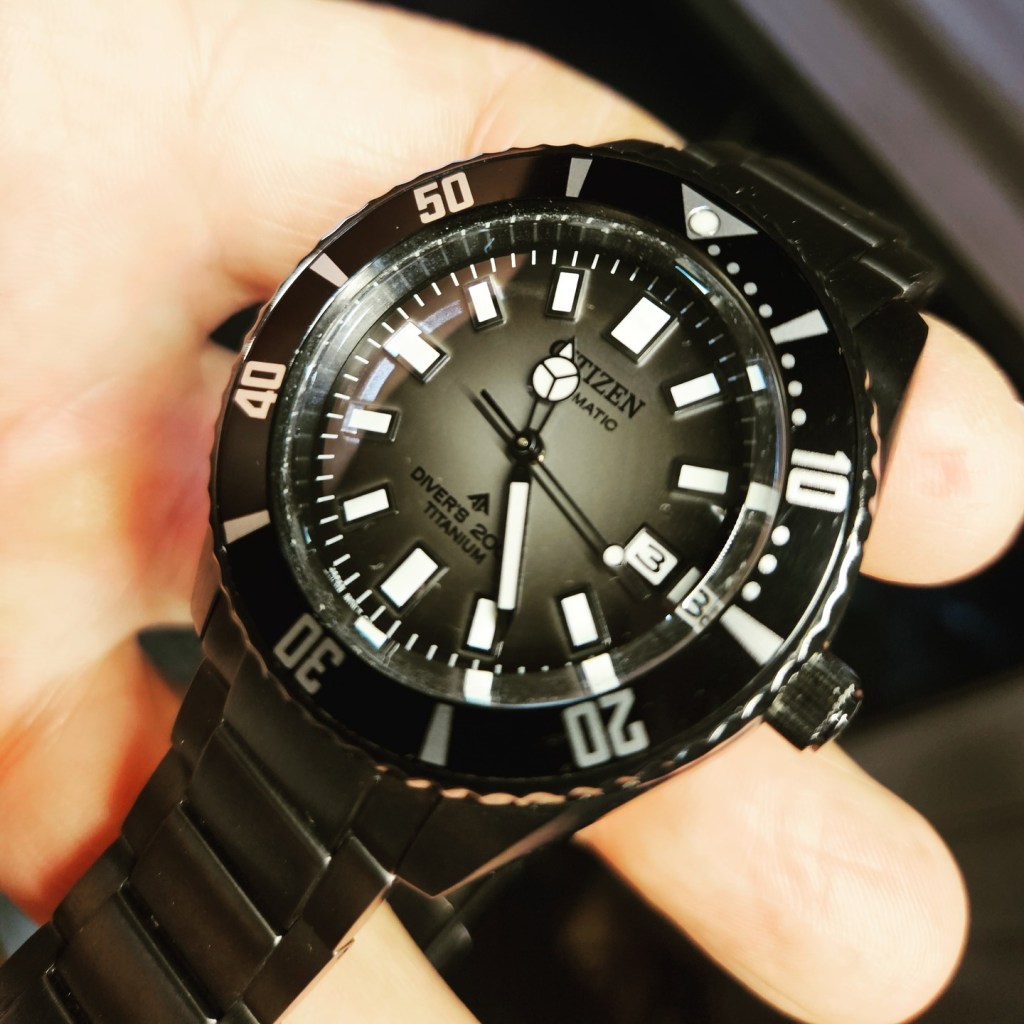
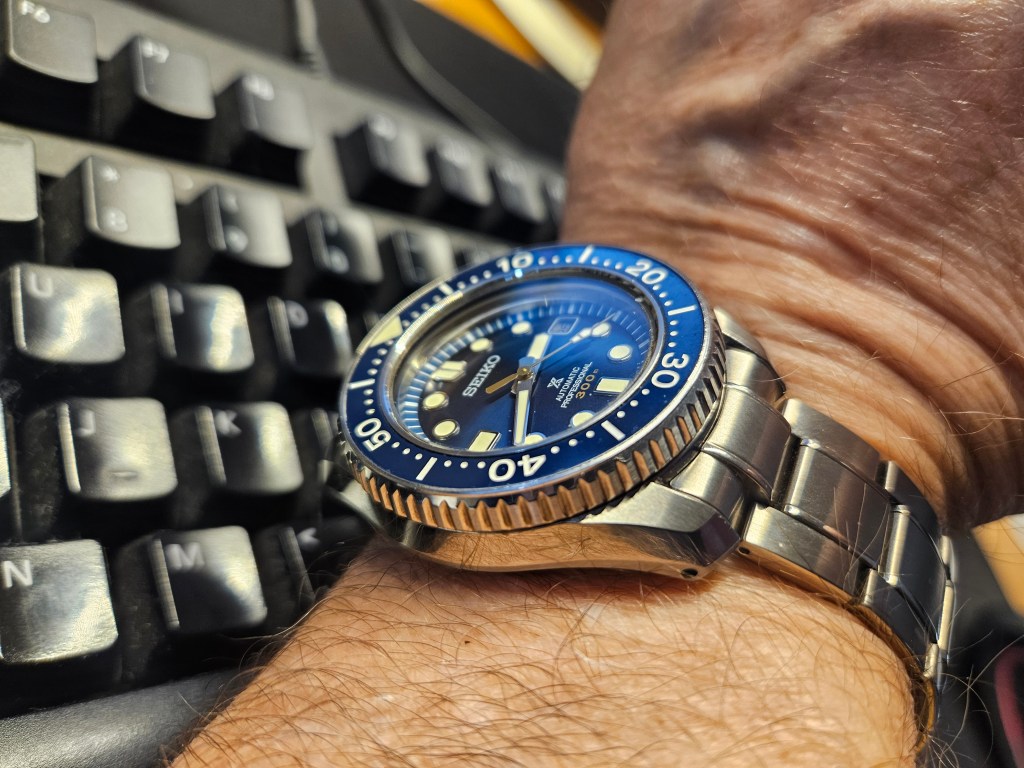
    I’m nearing sixty-four, and you’d think the resume of my life would say it all: married man, father of twin teenage daughters, lifelong weightlifter, and full-time college writing instructor pushing four decades in the trenches. Yet none of those titles define me quite like the pathology that has consumed my last twenty years: an obsession with diver watches.

    The disease began in 2005, when I bought my first “Hero Watch,” a Citizen Ecozilla. I was a suburbanite with all the aquatic daring of a backyard kiddie pool, but strapping that hulk of steel on my wrist turned me into a fantasy adventurer. The Ecozilla was my passport into adventurist cosplay, proof that even if my only dive was into Costco’s frozen food aisle, I could still play Jacques Cousteau in my imagination.

    For nearly two decades, I clung to bracelets and dismissed rubber. Rubber straps were sticky, sweaty, and cheap—the footwear of wristwear. But then, in 2024, a fellow enthusiast on Instagram whispered the gospel of Minotaur, a boutique strap company out of Houston. Their FKM rubber was no ordinary rubber—it was luxury-grade, accordion-style, fat spring bar holes, the kind of strap that doesn’t just hold a watch but weds it. Think craft brewery meets haute horology.

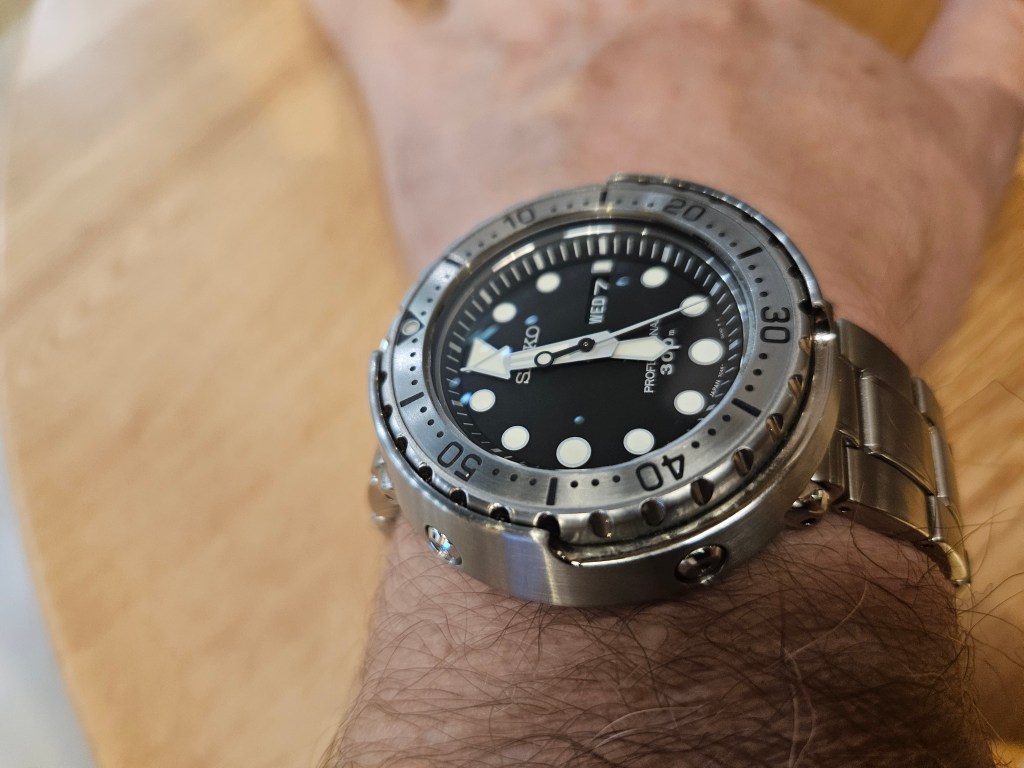
    When I slipped a Minotaur onto my Seiko diver, it was a conversion experience. Think Paul in Damascus. The strap was supple yet firm, sleek yet rugged. It was the hand-in-glove perfection every watch collector secretly craves.

    Suddenly, my seven Seiko divers weren’t just watches—they were sacraments. I no longer needed to fuss with bracelet links or endure the daily annoyance of micro-adjustments. The Minotaur straps brought equilibrium to my collection, and by extension, to my life.

    I became the town crier of Minotaur. Instagram posts, YouTube videos, flowery effusions of praise—my strap evangelism knew no bounds.

    I even struck up a friendship with Ron Minitrie, the Minotaur founder himself, who sent me models to showcase. For a while, I was living the influencer’s dream: watch bliss, strap perfection, hobby fulfillment so complete I worried it might be dangerous.

    But what happens when you reach nirvana? Do you close the YouTube channel, ride off into the sunset, and live happily ever after? Of course not. That’s when the gods get bored and send you a curse.

    The curse arrived in the form of a comment from a viewer named Infiniti-88. He linked to a Notre Dame study that accused FKM rubber straps of being Trojan horses of doom. According to the study, FKM bled PFAS “forever chemicals” into the bloodstream, potentially wrecking organs, scrambling hormones, and sowing cancer. Because watch straps are worn all day—sweat, heat, friction, even while sleeping—the risk was presented as constant exposure.

    Infiniti-88’s question was simple: “What are you going to do?”

    Cue the descent into madness. I read the study, panicked, and stripped all my Minotaur straps, replacing them with silicone and vulcanized rubber. Immediately, my watches felt diminished, like Ferraris stuck on snow tires. They lost their soul.

    I made a YouTube confessional and discussed the finer points of the Notre Dame Study. Half the viewers thanked me for raising the alarm; the other half mocked me for peddling paranoia. They insisted FKM risk was bottom-tier, a blip in the PFAS risk hierarchy. My response? Oscillation. I switched from Minotaur to silicone and back again—sometimes eight times in a single day. I was a man possessed, toggling straps like a lab rat on amphetamines.

    Desperate for clarity, I appealed to the digital oracles: Gemini, Claude, ChatGPT. Their verdict was unanimous: the study was flawed. The researchers had tortured the straps—soaked them in solvents, scorched them with heat, abraded them into pulp. In short, conditions no wristwatch strap would ever endure on a human arm. The Minotaur straps, they said, were stable, inert, safe.

    I breathed relief. For about three minutes. Then paranoia struck again. Were the AI platforms telling me the truth, or, as the dutiful sycophants they are, just feeding me the reassurance I craved? Was I clinging to wishful thinking dressed up as “analysis”?

    Meanwhile, fellow watch obsessives chimed in from YouTube and Instagram, their chorus split evenly between “Don’t worry” and “Panic with me.” Their voices joined the cacophony in my head. Certainty dissolved. Once you’ve pictured poison seeping into your wrist, you can’t unsee it.

    I began to hate the hobby itself. Hate the straps, hate the watches, hate the endless cycle of worry. It wasn’t about horology anymore—it was about risk management as a form of neurosis. I even considered selling everything and defecting to Tudor, whose bracelets come with the T-fit clasp–a miracle of quick adjustment that eliminates the fuss of links and tools. No chemicals, no rubber, no paranoia. Just a slide-and-click mechanism that promises freedom from my madness.

    When I think of my complicated relationship with Minotaur straps, the potentially-flawed Notre Dame Study, the fear of forever chemicals, and thoughts of a T-fit clasp, an image comes to mind that defines the insanity of my current situation:

    I’m thinking of the Balrog in The Lord of the Rings: The Fellowship of the Ring.

    In Moria, Gandalf confronts the Balrog on the Bridge of Khazad-dûm. They fall together into the abyss, and after an epic battle that spans mountains and caverns, Gandalf is mortally spent. It’s not a literal tail piercing—Tolkien describes Gandalf being dragged down by the Balrog’s whip after he breaks the bridge. The trauma of the battle kills him in his “Gandalf the Grey” form, but he is later sent back, transfigured, as Gandalf the White.

    Gandalf is never the same again, not because of the wound, but because his role changes: he comes back more powerful, more detached from the mortal world, and closer to a messenger of the divine.

    If I’m to survive my Minotaur strap crisis, I must follow the trajectory of Gandalf : I have to let the old self fall into the abyss. Like Gandalf, I must die to the madness and come back reborn, detached, stronger, armed with perspective. Because at this point, it’s not just about straps. It’s about what kind of man I am when the watch box stares back at me.