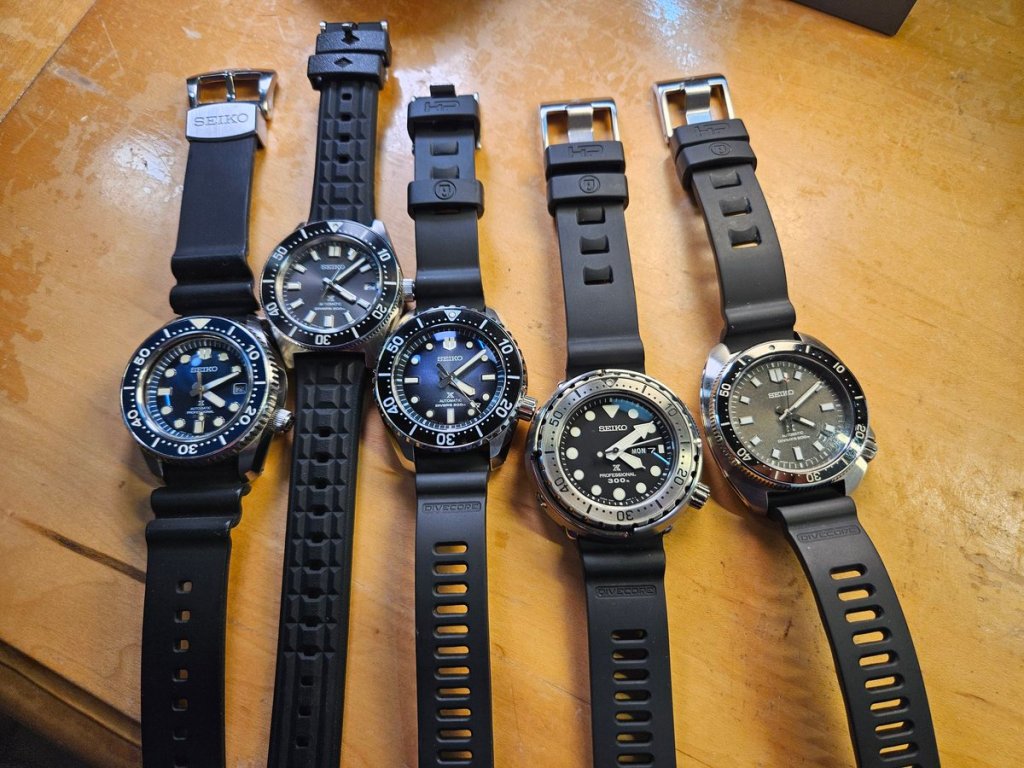
- You’ve sold and rebought the same Seiko twelve times, as if flipping it repeatedly will unlock a spiritual truth—or at least reduce the buyer’s remorse.
- You use your Submariner bezel to time pasta, because naturally, a $12,000 tool watch was designed to ensure your rigatoni hits al dente.
- You wear one watch exclusively for months while the other twelve sulk in a drawer, exiled as part of your emotional detox protocol.
- You sleep with a watch on—not for timekeeping, but for comfort. It’s not horology anymore; it’s therapy. That watch is your blankie with a dial.
- You buy back the same discontinued Seiko Monster you sold six years ago for seven times the original price, and feel a deep, almost religious sense of relief—like recovering a lost heirloom from a war-torn attic.
- You curate a “State of the Collection” video for YouTube, omitting your secret stash of watches like a drunk hiding vodka in shampoo bottles. That drawer in the closet? Classified.
- You lie about your watch count the way others lie about cholesterol. “Oh, maybe nine or ten,” you say, casually ignoring the drawer, the safe, the storage unit.
- You experience wrist-rotation anxiety so paralyzing each morning, you consider wearing no watch at all—only to remember that’s what serial killers do.
- You’ve nearly crashed your car admiring how the AR coating on your sapphire crystal plays with the sunlight. “Distracted driving” doesn’t cover it. This is horological hypnosis.
- You fabricated a hurricane off the coast of Maui so your family would cancel vacation and you could redirect funds to a Planet Ocean Ultra Deep. You’ll confess the lie on your deathbed, right after asking for one last wrist shot.
Category: Confessions
-

The Watch Habits of the Truly Deranged
-

My Watch Hobby Has Taught Me That Consumerism Can Become a Full-Time Job Resulting in Madness
Experience has taught me that one more watch could push me from “mild enthusiast” to full-blown horological lunatic. I currently own seven watches I like. Each serves a function, fills a niche, scratches an aesthetic itch. And yet, the siren song of three very specific timepieces keeps playing in my head: the Tudor Pelagos, the Seiko Astron SBXD025, and the Citizen Attesa CC4105-69E.
These aren’t idle cravings. They’re fully staged daydreams with lighting, music, and a voiceover narrated by my inner Watch Demon. But I resist. And I resist for three very good reasons.
First: Trying to fit more watches into my already-balanced rotation turns my so-called hobby into a logistical nightmare. It’s no longer joyful—it’s wrist-based Uber driving, shuttling watches in and out of rotation like I’m managing a fleet. I find myself resenting time itself for not giving me enough wrist hours to justify the collection. A hobby should not feel like an unpaid internship.
Second: I fall into the delusion that this next purchase—the Pelagos, the Astron, the Attesa—will be the final watch, the one that ends the madness and ushers in a golden era of contentment and minimalist grace. But let’s be honest: feeding the Watch Demon only sharpens its teeth. Every new arrival rewires the brain for more dopamine hits, not less. It’s not a cure. It’s a catalyst.
Third: Whenever I buy a new watch, something twisted happens—I begin to resent the ones I already own. Not because they’ve failed me, but because I need to invent reasons to justify their exit. The logic goes: “This new watch is more versatile,” or “I’ve outgrown that one.” Then I sell a beloved watch, feel instant regret, and enter the soul-destroying loop of rebuying what I never should have sold.
So what’s the solution? Lately, a single thought has been rising above the noise like a lighthouse in the fog:
“Jeff, put on your Tuna.”
Specifically, my Seiko Tuna SBBN049—possibly the most salient, most “me” watch I own. When it’s on my wrist, I don’t think about the next acquisition. I don’t scroll listings or pace the floor of my psyche looking for the next horological fix. I’m just… good.Maybe that’s the Truth Path: stop chasing. Start wearing. Let the Tuna do its quiet, oversized magic and get back to the point of all this—joy, not inventory management.
-

Crying at the Sink: The Dishwashing Grammy Awards
Don’t ask me why, but there’s something about doing dishes after dinner that turns me into a soft-focus emotional wreck. Somewhere between the soap suds and the rinse cycle, I cue up Rickie Lee Jones’s “Living It Up”—one of my all-time favorite songs—and without fail, it punctures the heart like a stiletto dipped in nostalgia. Tonight, it brought on another weepy micro-moment, which means it’s time to officially give it The Most Likely to Make Me Cry from Too Much Beauty Award.
This of course sent me spiraling into my own kitchen-sink Grammy ceremony, where I began handing out awards like a deranged emotional sommelier.
- Todd Rundgren’s “Can We Still Be Friends” wins The Song That Makes You Recommit to Being a Half-Decent Human Being Award. It’s the sonic equivalent of an awkward apology after ruining Thanksgiving.
- The Isley Brothers’ “Living for the Love of You” earns The Track Most Likely to Be Playing in Heaven When You Arrive Award—assuming heaven has good speakers and excellent taste.
- Yes’s “And You and I” takes home The Sounds-Like-It-Was-Composed-by-Angels-on-a-Mountain-Top Award. I don’t know what dimension that song came from, but it wasn’t this one.
- John Mayer’s “No Such Thing” is given The Makes You Happy to Be a Living, Breathing Fool Award. It’s that rare pop song that makes you want to fist-pump your own mediocrity.
- The Sundays’ “You’re Not the Only One I Know” walks away with The Makes Sadness So Gorgeous You Forget to Be Upset Award. It’s a musical sigh pressed between lace and rain.
I could keep going—my brain has a whole red carpet lined up—but I’ve got another episode of Sirens on Netflix to cry through. Turns out the best part of my day is a cross between dish soap, beautiful songs, and low-level existential unraveling. What a life.
- Todd Rundgren’s “Can We Still Be Friends” wins The Song That Makes You Recommit to Being a Half-Decent Human Being Award. It’s the sonic equivalent of an awkward apology after ruining Thanksgiving.
-

The Vegan That Lives in My Head (and Nowhere Else)
At six a.m., mug in hand, I sat down at my desk with the smug satisfaction of a man pretending to be in control of his day—only to be ambushed by a large brown spider launching itself from my desk drawer like it was fleeing the FBI. It vanished into the shadows, and I was left stewing in the indignity of defeat. I didn’t catch it. Worse, for the second morning in a row, I couldn’t remember my dream. Something about a car near the ocean, a faceless authority figure mumbling instructions, and then—blank. Freud would be disappointed. I’m more annoyed.
My dreams often involve cars. They also often involve the ocean. I suspect this means I’m perpetually trying to get somewhere, while simultaneously wanting to be swallowed by the Great Womb of the Deep. Birth, Death, and the Cycle of Life.
Midway through my coffee, my teenage daughter wandered into my office, eyebrows raised in alarm as I recounted the spider saga and my failed dream recall. She showed the appropriate amount of concern, then casually announced she was heading to Starbucks for a chai latte. It’s comforting how the rituals of youth persist, even as their fathers spiral existentially over arachnids and unconscious symbolism.
I banged out a new essay prompt for next semester—something about manufactured authenticity and influencer FOMO—then drove the girls to school, came back, and burned 805 calories in 61 minutes on the Schwinn Airdyne. Or as I’ve come to call it: The Misery Machine. This isn’t exercise. This is penance. Only those seeking redemption or working through unresolved guilt buy these medieval contraptions. The bike doesn’t offer health—it offers absolution.
Post-shower weigh-in: 231. Still twenty pounds away from my goal, but less disgusting than I was yesterday, so—progress.
Later, I drifted into my usual morning fantasy: becoming a vegan. No, not a preachy zealot in hemp sandals, but a serene, plant-based domestic monk, stirring lentils and sipping soy lattes like some morally superior Miyagi of meal prep. In this fantasy, I don’t haul home slabs of meat leaking blood onto Trader Joe’s paper bags. No. I have evolved.
In this alternate timeline, breakfast is steel-cut oatmeal or buckwheat groats with walnuts, berries, soy milk, and a dash of protein powder. Lunch and dinner are identical—because I’m disciplined, not boring—a sacred Le Creuset Dutch oven bubbling with a Caribbean rice-and-beans concoction: quinoa or white rice, black beans, cubes of tempeh, coconut milk, tomato sauce, and enough spice to remind me I’m still alive. The afternoon snack is a tall glass of soy milk with a scoop of vegan protein, because the aspirational me is nothing if not consistent.
Of course, this will never happen.
My wife and daughters won’t eat this way. Neither, frankly, will I. I’ve known student-athletes who withered into pale husks trying to go vegan. Others have thrived and glowed like enlightened celery sticks. I, on the other hand, turn into a foggy-headed anemic with the energy of a depressed manatee. But the fantasy persists. This vegan version of me—let’s call him “The Better Me”—exists only in the realm of self-mythology, filed away with other fictional selves: The Novelist Who Writes Before Dawn, The Man Who Loves Yoga, and The Guy Who Only Checks His Phone Twice a Day.
They’re all gathering dust in the mental trophy case labeled Deferred Dreams. To catalogue them all would require another post—and a second pot of coffee.
-

I’ve Become Leery of the Ronnie Coleman Effect in AI Writing
My college writing students and I have been collaborating with ChatGPT for over a year now. I’ve often been impressed with this writing platform. Provided I give very specific instructions and make it clear what kind of tone and persona I want, ChatGPT can perform in ways I can’t. It can’t make a turn of phrase and make language sing in ways that dwarf my own solid writing skills.
But recently, I’ve been leery of ChatGPT and have been eager to write without it. What I’ve noticed is that it can flex its prose muscles in impressive ways that I call the Ronnie Coleman Effect. Ronnie Coleman was a champion bodybuilder, arguably the best in his era, late 90s to early 2000s. At 290 pounds, his steroidal muscles exploded in ways that made him look impossibly superhuman. I was a natural bodybuilder in my youth. Coleman would blow me off the stage. Coleman’s 290 pounds to my 190 pounds is what my prose is compared to ChatGPT’s: I’m the natural, lean, almost boring bodybuilder while ChatGPT is the flexing, bulging Ronnie Coleman who steals all the attention. I’m simply overpowered by this AI platform.
However, there are downsides: AI overwrites, can obscure clarity, can be florid in nonsensical ways, can be grossly inaccurate, and can steal my confidence because it says, “You’re nothing compared to me,” and it can make me lazy because it whispers, “Just jot a few notes. I’ll take care of the rest.”
For this reason, I started writing without ChatGPT. I need to get out from under the oppressive Ronnie Coleman Effect and be human again.
-

I Have No Illusions About Converting My Students to “The Ways of Literacy”
My college students admit that they barely read. They avoid books. They’ll skim an article. Their “cognitive load” is taken up by texting on their phones and watching TikTok and YouTube videos. They don’t have bandwidth for doing deep reading.
Many of them were in the eighth grade during the pandemic. They lost close to two years of school, spent time on their phones and Chromebooks, and see ChatGPT as a godsend. They can outsource college instructors’ writing assignments and no longer have to worry about grammar or formatting.
Teaching college writing, I have to meet students where they are. I have to teach them rhetorical skills, critical thinking skills, and the transforming power of literacy, so I show them powerful arguments, and what makes them persuasive, and people who have found their higher selves through literacy, such as Frederick Douglass and Malcolm X, and the happiness derived from Cal Newport’s notion of “deep work” as an antidote to the despair and nihilism of popular culture’s default setting for cheap dopamine hits, immediate gratification, and meretricious consumer hype.
The good news is that my lessons resonate with the students evidenced by their engagement with class discussions. The less than good news is that these philosophical discussions don’t turn them into readers, don’t make them want to trade their phones and social media platforms for a novel or a biography, and don’t make them want to learn the finer points of rhetoric.
My students are smart, decent, reasonable, and pragmatic. They learn what they feel is essential to adapt to life’s challenges. Doing a deep dive into reading and writing doesn’t seem that essential to them even though they’ll acknowledge many of the writers and writing samples I present to them are impressive and worthy of admiration.
My students seem to appreciate me for giving them an entertaining presentation and for having made the effort to sell literacy as an essential tool for becoming our aspirational selves, but at the end of the day, they focus on getting their homework done as efficiently as possible, working a part-time job to pay the bills, enjoying their friendships, and nurturing their romantic interest.
The unspoken agreement between my students and me is that I will be entertaining and enthusiastic about my subject for 90 minutes, but I will not have any delusions about converting them to The Ways of Literacy. That is a teacher’s fantasy, made even more elusive in the AI Age.
-

The Handwriting Is on the Wall for Writing Instructors Like Myself
There’s a cliché I’ve avoided all my life because I’m supposed to be offended by cliches. I teach college writing. But now, God help me, I must say it: I see the handwriting on the wall. And it’s blinking in algorithmic neon and blinding my eyes.
I’ve taught college writing for forty years. My wife, a fellow lifer in the trenches, has clocked twenty-five teaching sixth and seventh graders. Like other teachers, we got caught off-guard by AI writing platforms. We’re now staring down the barrel of obsolescence while AI platforms give us an imperious smile and say, “We’ve got this now.”
Try crafting an “AI-resistant” assignment. Go ahead. Ask students to conduct interviews, keep journals, write about memories. They’ll feed your prompt into ChatGPT and create an AI interview, journal entry, and personal reflection that has all the depth and soul of stale Pop-Tart. You squint your eyes at these AI responses, and you can tell something isn’t right. They look sort of real but have a robotic element about them. Your AI-detecting software isn’t reliable so you refrain from making accusations.
When I tell my wife I feel that my job is in danger, she shrugs and says there’s little we can do. The toothpaste is out of the tube. There’s no going back.
I suppose my wife will be a glorified camp counselor with grading software. For me, it will be different. I teach college. I’ll have to attend a re-education camp dressed up as “professional development.” I’ll have to learn how to teach students to prompt AI like Vegas magicians—how to trick it into coherence, how to interrogate its biases. Writing classes will be rebranded as Prompt Engineering.”
At sixty-three, I’m no fool. I know what happens to tired draft horses when the carriage goes electric. I’ve seen the pasture. I can smell the industrial glue. And I’m not alone. My colleagues—bright, literate, and increasingly demoralized—mutter the same bitter mantra: “We are the AI police. And the criminals are always one jailbreak ahead.”
-

The Rebranding of College Writing Instructors as Prompt Engineers
There’s a cliché I’ve sidestepped for decades, the kind of phrase I’ve red-penned into oblivion in freshman essays. But now, God help me, I must say it: I see the handwriting on the wall. And it’s written in 72-point sans serif, blinking in algorithmic neon.
I’ve taught college writing for forty years. My wife, a fellow lifer in the trenches, has clocked twenty-five teaching sixth and seventh graders. Between us, we’ve marked enough essays to wallpaper the Taj Mahal. And yet here we are, staring down the barrel of obsolescence while AI platforms politely tap us on the shoulder and whisper, “We’ve got this now.”
Try crafting an “AI-resistant” assignment. Go ahead. Ask students to conduct interviews, keep journals, write about memories. They’ll feed your prompt into ChatGPT with the finesse of a hedge fund trader moving capital offshore. The result? A flawlessly ghostwritten confession by a bot with a stunning grasp of emotional trauma and a suspicious lack of typos.
Middle school teachers, my wife says, are on their way to becoming glorified camp counselors with grading software. As for us college instructors, we’ll be lucky to avoid re-education camps dressed up as “professional development.” The new job? Teaching students how to prompt AI like Vegas magicians—how to trick it into coherence, how to interrogate its biases, how to extract signal from synthetic noise. Critical thinking rebranded as Prompt Engineering.
Gone are the days of unpacking the psychic inertia of J. Alfred Prufrock or peeling back the grim cultural criticism of Coetzee’s Disgrace. Now it’s Kahoot quizzes and real-time prompt battles. Welcome to Gamified Rhetoric 101. Your syllabus: Minecraft meets Brave New World.
At sixty-three, I’m no fool. I know what happens to tired draft horses when the carriage goes electric. I’ve seen the pasture. I can smell the industrial glue. And I’m not alone. My colleagues—bright, literate, and increasingly demoralized—mutter the same bitter mantra: “We are the AI police. And the criminals are always one jailbreak ahead.”
We keep saying we need to “stop the bleeding,” another cliché I’d normally bin. But here I am, bleeding clichés like a wounded soldier of the Enlightenment, fighting off the Age of Ozempification—a term I’ve coined to describe the creeping automation of everything from weight loss to wit. We’re not writing anymore; we’re curating prompts. We’re not thinking; we’re optimizing.
This isn’t pessimism. It’s clarity. And if clarity means leaning on a cliché, so be it.
-

Trapped in the AI Age’s Metaphysical Tug-of-War
I’m typing this to the sound of Beethoven—1,868 MP3s of compressed genius streamed through the algorithmic convenience of a playlist. It’s a 41-hour-and-8-minute monument to compromise: a simulacrum of sonic excellence that can’t hold a candle to the warmth of an LP. But convenience wins. Always.
I make Faustian bargains like this daily. Thirty-minute meals instead of slow-cooked transcendence. Athleisure instead of tailoring. A Honda instead of high horsepower. The good-enough over the sublime. Not because I’m lazy—because I’m functional. Efficient. Optimized.
And now, writing.
For a year, my students and I have been feeding prompts into ChatGPT like a pagan tribe tossing goats into the volcano—hoping for inspiration, maybe salvation. Sometimes it works. The AI outlines, brainstorms, even polishes. But the more we rely on it, the more I feel the need to write without it—just to remember what my own voice sounds like. Just as the vinyl snob craves the imperfections of real analog music or the home cook insists on peeling garlic by hand, I need to suffer through the process.
We’re caught in a metaphysical tug-of-war. We crave convenience but revere authenticity. We binge AI-generated sludge by day, then go weep over a hand-made pie crust YouTube video at night. We want our lives frictionless, but our souls textured. It’s the new sacred vs. profane: What do we reserve for real, and what do we surrender to the machine?
I can’t say where this goes. Maybe real food will be phased out, like Blockbuster or bookstores. Maybe we’ll subsist on GLP-1 drugs, AI-tailored nutrient paste, and the joyless certainty of perfect lab metrics.
As for entertainment, I’m marginally more hopeful. Chris Rock, Sarah Silverman—these are voices, not products. AI can churn out sitcoms, but it can’t bleed. It can’t bomb. It can’t riff on childhood trauma with perfect timing. Humans know the difference between a story and a story-shaped thing.
Still, writing is in trouble. Reading, too. AI erodes attention spans like waves on sandstone. Books? Optional. Original thought? Delegated. The more AI floods the language, the more we’ll acclimate to its sterile rhythm. And the more we acclimate, the less we’ll even remember what a real voice sounds like.
Yes, there will always be the artisan holdouts—those who cook, write, read, and listen with intention. But they’ll be outliers. A boutique species. The rest of us will be lean, medicated, managed. Data-optimized units of productivity.
And yet, there will be stories. There will always be stories. Because stories aren’t just culture—they’re our survival instinct dressed up as entertainment. When everything else is outsourced, commodified, and flattened, we’ll still need someone to stand up and tell us who we are.
-

Dreams of Debt, Pastries, and Postponed Purpose
I dreamed I was working in a café—one of those indie joints that sells artisanal pastries dusted with powdered irony—while slogging through my Master’s in English. Picture a barista apron slung over a grad student’s existential dread.
I carried a phone that wasn’t just smart—it was sorcerous. With one tap, it summoned a stream of music from a satellite orbiting somewhere above Earth’s pettiness. This music wasn’t Spotify-tier. It was celestial—otherworldly symphonies that made Bach sound like background noise at a carwash. The entire café basked in it, as if rapture had been accidentally triggered over the scones.
Then he appeared. A mysterious man—part career counselor, part trickster god—told me that if I attended a career convention, I could buy a van for my family. Not just any van. A magical, dream-fulfilling van priced at $400, which in dream economics is about the cost of a single textbook in grad school.
The convention was a riot of lanyards and desperation. Voices swirled about the final class I needed to finish my degree: the dreaded seminar with Professor Boyd, a real professor from my waking life, whose lectures felt like intellectual CrossFit and whose office smelled faintly of despair and dry-erase markers.
I never found the van man.
The dream logic began to wobble. Doubt crept in like a late fee. I wandered through the convention’s gray carpeted purgatory and began rehearsing how I’d tell my family we would remain vanless, bound to our modest, immobile fate.
And then—like a plot twist penned by a sentimental sportswriter—I ran into two Hawaiian brothers I hadn’t seen since Little League. We were kids once. They were legends. One of them, Wesley, struck me out four times in a single game, and I still remembered the way the ball moved like it had free will. Decades later, we were all adrift—middle-aged, mildly broke, and marvelously unsure of ourselves.
We stood there, in that convention center of failed ambitions and discounted dreams, and talked about what we could’ve been. I told them they had enough charisma to turn their names into brands. I hugged Wesley and said, “You struck me out four times, and it’s a privilege to see you again.”
None of us had a career. But we had memories. And love. And the unspeakable beauty of a satellite song that once played over cinnamon rolls.