Category: culture

  • When the Levees Broke, Love Held: Kinship and Trust as Survival Codes (A College Essay Prompt)

    When the Levees Broke, Love Held: Kinship and Trust as Survival Codes (A College Essay Prompt)

    Essay Prompt

    When Hurricane Katrina hit in August 2005, it wasn’t only a natural disaster; it was a test of the nation’s moral infrastructure. Hurricane Katrina: Race Against Time (Hulu) and Katrina: Come Hell and High Water (Netflix) lay bare a grim truth: while government agencies stumbled, delayed, or failed outright, it was ordinary people—families, neighbors, church groups, and communities—who often became the real lifelines of survival.

    This paradox deserves attention. Katrina exposed systemic abandonment: broken levees, collapsed evacuation plans, and botched relief efforts. Yet amid this neglect, stories emerged of neighbors carrying the elderly through floodwaters, families sharing scarce food, and communities improvising codes of loyalty and solidarity to keep one another alive. These grassroots responses were not bureaucratic; they were visceral, rooted in bonds of kinship, shared suffering, and a deep sense of responsibility to one another.

    The films reveal a cultural alchemy unique to New Orleans—where music, food, faith, and kinship traditions already wove people together. During Katrina, those traditions became lifeboats, not metaphorically but literally. In the absence of functioning institutions, families and neighbors reinvented survival itself, showing that human dignity doesn’t only exist in comfort or prosperity but can be forged in the crucible of catastrophe.

    Your Task: Write a 1,700-word essay analyzing how bonds of kinship and community loyalty functioned as lifeboats of survival in post-Katrina New Orleans.

    Address the following questions in your essay:

    • How did family love and neighborhood trust create improvised survival systems when formal institutions failed?
    • In what ways did communities create a code of resilience, a shared moral contract, during the disaster?
    • What lessons can be drawn from this improvisational solidarity about human dignity, loyalty, and the meaning of community in times of collapse?

    Your essay should balance analysis of the documentaries with close attention to human stories of resilience. Use specific examples and consider how these lessons apply beyond Katrina: What do they teach us about disaster, community, and the fragile but essential bonds that keep us human?


    Sample 9-Paragraph Outline

    Introduction (1 paragraph)

    • Hook: Paint the scene—abandoned streets, flooded houses, helicopters circling, and yet neighbors wading through water with makeshift rafts.
    • Context: Briefly note government failures highlighted in both documentaries (FEMA delays, stranded citizens, broken levees).
    • Thesis: Argue that when institutions collapse, kinship and neighborhood bonds become codes of resilience—informal but powerful lifeboats—that preserve human dignity, improvise survival, and reveal enduring truths about community loyalty in catastrophe.

    Body Paragraph 1: Government Collapse vs. Community Response

    • Detail FEMA delays, local government paralysis, and the abandonment felt by residents.
    • Contrast with ordinary people organizing rescues, distributing food, and opening their homes.
    • Set up the theme: resilience grows where systems fail.

    Body Paragraph 2: Families as First Responders

    • Show how families stayed together, sharing resources, protecting elders and children.
    • Examples from the films: families wading together through water, refusing to abandon one another.
    • Argue that love in the family unit became the most reliable “infrastructure” of survival.

    Body Paragraph 3: Neighbors as Kin

    • Explore how neighbors expanded the definition of family.
    • Community members who had never spoken before suddenly acted as protectors and caregivers.
    • This shows the elasticity of kinship: disaster stretches the definition of who counts as “family.”

    Body Paragraph 4: The Code of Resilience

    • Define the unwritten rules that emerged: share what you have, protect the vulnerable, don’t abandon your people.
    • These codes operated faster and more effectively than bureaucratic policies.
    • Examples: strangers pooling resources, neighborhood patrols against looters, churches as shelters.

    Body Paragraph 5: Improvisation as Survival Strategy

    • Show how ordinary people became engineers, medics, and rescuers.
    • Example: makeshift boats, rafts, and supply lines.
    • Connect to the broader point: resilience is not planned in a manual; it is improvised under pressure.

    Body Paragraph 6: Dignity Amid Despair

    • Explore how solidarity preserved dignity in dehumanizing conditions (Superdome chaos, flooded homes).
    • Argue that dignity comes not from institutions but from mutual recognition—neighbors affirming each other’s worth when society seems to have abandoned them.

    Body Paragraph 7: Lessons Beyond Katrina

    • Broaden the lens: how does this apply to future disasters (pandemics, climate change, social unrest)?
    • Argue that resilience depends less on bureaucracies than on the cultural strength of communities.
    • Point: family and community loyalty may be the last firewall against collapse.

    Body Paragraph 8: Counterargument & Rebuttal

    • Acknowledge critics: some argue neighbor-to-neighbor efforts were insufficient or uneven, that only systemic reform can prevent tragedy.
    • Rebuttal: While systemic change is essential, Katrina shows that human dignity cannot wait for bureaucratic rescue—it depends on immediate solidarity.

    Conclusion (1 paragraph)

    • Restate thesis: Katrina revealed abandonment but also exposed the cultural wealth of kinship and loyalty as lifeboats of survival.
    • End with a powerful image: in the floodwaters, where the state faltered, the human heart did not.
    • Call to action: value, protect, and invest in community bonds before the next disaster arrives.

  • Muscle Man: A Novel of Rants in Disguise

    Muscle Man: A Novel of Rants in Disguise

    Jordan Castro’s Muscle Man is a strange beast: less a conventional novel than a stack of scathing essays stitched together with the thread of a character named Harold, an English professor obsessed with bodybuilding. Harold isn’t so much flesh and blood as a delivery system for polemics. He rants against bureaucratic absurdities, the avalanche of pointless emails, academia’s desperate clawing for relevance, and the smug Groupthink masquerading as intellectual superiority. He rails at the hypocrisy of universities that wave the flag of social justice while exploiting adjuncts, athletes, and students, and he sneers at the notion of campus as sanctuary when his inbox is clogged with alerts about robberies and assaults.

    Where the novel shines is precisely in these acidic rants. Castro’s Harold is less character than conduit, channeling fury and despair at a culture unraveling into nihilism. The ironies abound: Harold, who clings to bodybuilding as a refuge, is ironically less muscle than mouthpiece—an abstraction desperate for mass. And that is both the strength and weakness of Muscle Man. The pleasure lies in the essays-in-disguise, the delicious insights, the spectacle of academia and American culture descending into entropy. What you won’t find is narrative immersion, the joy of getting lost in a world that feels lived-in.

    That doesn’t make Castro’s experiment invalid. Novels aren’t bound by rules; if a writer wants to build a stage for ideas instead of characters, so be it. But a novel that thrives on abstractions will only light up some of the reader’s neurons, not all. If you want a narrative that delivers both scabrous cultural critique and the visceral, personal journey of a bodybuilder spiraling into madness, reach for Samuel Wilson Fussell’s Muscle: Confessions of an Unlikely Bodybuilder. That book flexes.

  • True Crime Shows Us the Demon That Hides Behind the Diagnosis

    True Crime Shows Us the Demon That Hides Behind the Diagnosis

    I still gag a little when I think of tabloid TV from the ’80s and ’90s—A Current Affair, Hard Copy, Inside Edition. The formula was simple: snarl into the camera, crank up the drama, and serve audiences their daily ration of moral panic wrapped in neon graphics. Having swallowed enough of that sludge in my twenties, I swore off the “true crime” genre, suspecting most modern entries were little more than tabloid reruns with higher production values.

    Then my wife and daughters talked me into it. In the last week I watched Love Con Revenge, a six-episode saga of con artists devouring their marks and detectives chasing them down like bloodhounds, and Unknown Number: The High School Catfish, the tale of a grotesque mother harassing her own daughter and boyfriend with a relentless barrage of obscene texts. Both were polished, chilling, and—for my sins—utterly absorbing.

    No shock, then, that Netflix, Hulu, and every other platform groan under the weight of hundreds of these fraudster chronicles. They mirror our times: technology weaponized into psychological napalm, the digital swamp rising up to engulf ordinary people. The stories console us by drawing a line between the “real world” of decent citizens and the fever swamp where predators feed—though that line, as these shows prove, is faint and fragile.

    What gnaws at me are the faces of these fraudsters: unrepentant, smug, cannibalizing innocence with the appetite of vultures while spinning narratives in which they—God help us—are the real victims. Watching Unknown Number, I thought of Scott Peck’s People of the Lie, a book that haunted my twenties. The book explores the unsettling terrain where mental illness and evil blur into one another, arguing that certain destructive patterns of thought and behavior cannot be neatly filed under psychiatric diagnosis alone. Peck suggests that some people hide behind the language of neurosis or dysfunction when what they are really exhibiting is a willful commitment to deceit, denial, and cruelty—a kind of “malignant self-righteousness” that psychiatry struggles to name. In his case studies, ordinary families cloak acts of profound betrayal and abuse in banality, showing how evil masquerades as normality. The book’s disturbing thesis is that evil is not always the exotic monster of horror stories but can manifest in the evasions, manipulations, and rationalizations of those who choose to deform their humanity, collapsing the categories of illness and moral corruption into one corrosive force.

    And here’s the ugly echo: the fraudster’s toolbox of deceit, self-victimization, and gaslighting isn’t confined to con men or deranged mothers. It has migrated, wholesale, into the attention economy. TikTok influencers now weaponize the same tactics, performing ailments and afflictions as if auditioning for sainthood, diagnosing themselves in real time while amassing legions of followers. This is fraud with a ring light: branding through pathology, monetized self-deception packaged as authenticity. It is the same theater of manipulation, dressed up in pastel filters instead of burner phones. And maybe that’s why these true-crime tales fascinate us: they remind us that manipulation, gaslighting, and deception have found their ultimate playground online. We watch to reassure ourselves that we’re still anchored to reality, but what we see instead is how terrifyingly porous the line is between mental illness and pure, corrosive evil.

    When we slap a psychiatric label on every grotesque act, we risk letting the guilty off the hook. To call fraud, cruelty, or sadism merely a “condition” is to dodge the darker truth—that people are capable of choosing evil. Peck was right to warn that deceit and malignant self-righteousness are not just quirks of the psyche but deliberate acts of corruption. If we keep misnaming evil as illness, we blind ourselves to the reality that a demon can take root inside ordinary people, feeding on their rationalizations until it grows strong enough to wreak chaos and devastation in the world around them.

  • How Soon Is Theft?

    How Soon Is Theft?

    In 1990, I was in my late twenties, a newly minted college writing instructor drifting through life with the ethereal soundtrack of The Smiths, the Cocteau Twins, The Trash Can Sinatras, and The Sundays rattling in my head. One afternoon on Hollywood Boulevard with my girlfriend, I did what any self-respecting young melancholic would do: I bought Smiths T-shirts and posters like sacred relics. The crown jewel was my “How Soon Is Now” poster, a portrait of an angst-drenched youth in a gray cable-knit sweater, gazing downward as if staring into the abyss. I taped it proudly to my office door, a shrine to my tribe. Within a week, it was gone—stolen.

    The theft still smolders decades later. It wasn’t just the insult of having something ripped from my door; it was the betrayal of the faith I placed in The Smiths’ congregation. Their music was heartbreak bottled into beauty, sadness transmuted into community. To love The Smiths, I believed, was to be incapable of theft. Fans were supposed to be fellow pilgrims on the same road to melancholy salvation. You don’t rob your brother of his relics. You light a candle with him and hum “There Is a Light That Never Goes Out.”

    But there it was: my poster ripped away not by a barbarian from the outside, but by a fellow initiate. The irony was unbearable. If The Smiths could not protect us from base impulses, if their music could not ennoble even their most ardent listeners, then what was art worth? Wasn’t it supposed to make us better, kinder, less brutish? The theft of that poster wasn’t just petty larceny. It was the murder of a principle.

    To this day, I remember the empty rectangle of tape marks left on my office door, staring back at me like a smirk from the abyss. The thief didn’t just pocket a poster; they handed me a lesson in nihilism, gift-wrapped in Morrissey’s sorrowful croon. And I’ve been suspicious of beauty ever since, knowing it can inspire devotion and betrayal in the same breath.

  • The Shock Jock Who Forgot to Pivot

    The Shock Jock Who Forgot to Pivot

    I still tune in to Howard Stern now and then, but most of what I hear these days sounds like a half-hearted reprise of his old shtick—sophomoric gags, body-function chatter, and adolescent innuendo that once jolted the airwaves but now just sag. In his prime, Stern was combustible: he blended pranks, irreverence, and enough genuine insight to keep his circus from collapsing. He earned his Radio Hall of Fame status by kicking down doors no one else dared touch.

    Now, as rumors of his retirement bubble and I endure his weary, autopilot banter with Robin, three thoughts claw at me. First: they don’t sound like they’re having fun anymore. This is a zombie act, plodding through the motions. Second: filling three hours of airtime every single day is a Sisyphean curse—nobody has that much worth saying without stuffing the sausage with sawdust. Third: we all have a shelf life. Relevance expires, and dignity demands a graceful exit.

    Stern’s curse is worse than most. His career persona—edgy, raunchy, forever pandering to prurience—has gone stale, but he’s trapped in it. The irony is brutal: a man smart enough to evolve chose to calcify. A decade ago, he could have pivoted, shed the shock-jock skin, and re-emerged as the wise veteran with conversations that mattered. Instead, while podcasts multiplied like caffeinated rabbits, he let himself be left behind.

    But maybe it isn’t too late. Imagine Howard 2.0: no longer the carnival barker of Sirius, but the philosopher-in-residence of his own café, sipping coffee and musing about culture, mortality, and meaning. Not fifteen hours of filler a week, but four hours of distilled insight—an hour twice a week, sharp and substantive. Podcasting is radio’s heir, and radio is in his DNA. Reinvention is the only antidote to irrelevance, and if he can summon the nerve, Stern could still surprise us.

  • The Tabloid Mind Vs. The Thoughtful Mind

    The Tabloid Mind Vs. The Thoughtful Mind

    The verdict is in: after fifteen years of running their experiment on us, social media has mangled the human psyche. It has sandblasted away nuance, turned civility into snarling, and left us performing as shrill tribal mascots. The trouble begins with its essence: an Attention Machine. Every scroll is a sugar hit for the brain—quick spike, hard crash. We learn the trick ourselves, spitting out content like human Pez dispensers, packaging our thoughts as candy for the feed.

    Belonging is rationed out in likes and retweets, and the cost is subtlety. To win attention, you don’t weigh both sides—you crank the volume, you caricature, you inflame. What begins as a hook metastasizes into belief. We develop the Tabloid Mind: the reflex to turn every notion into a screaming headline. And once we inhabit the Tabloid Mind, we degrade, becoming not better humans but better performers for the algorithm.

    The Thoughtful Mind never stood a chance. A Tabloid platform attracts tens of millions; the Thoughtful Mind, if lucky, limps along with scraps. Yet the difference is stark. The Thoughtful Mind asks, listens, considers contradictions, and cools the room so clarity can thrive. The Tabloid Mind, by contrast, thrives on panic and rage, reducing discourse to a lizard-brain cage match where opponents are demons and the fire must never go out.

    A culture enthroned by the Tabloid Mind breeds paranoia, extremism, conspiracy, and violence. And violence doesn’t need to be shouted—it can be winked into existence by the constant drip of toxic adrenaline.

    I know the alternative exists because I live it daily in the classroom. When my students wrestle with bro culture, influencer fakery, or the cultural fallout of GLP-1 drugs, they do so with humor, nuance, and critical thought. The Thoughtful Mind lives there, in the room, face to face. No one is frothing at the dopamine mouth. No one is shitposting for clout. We disagree, we wrestle, we laugh—but we think.

    The Tabloid Mind is not sustainable. It’s a toxin, and unchecked, it will kill us. Our survival depends on choosing the Thoughtful Mind instead. The fight between them—clickbait versus clarity, heat versus light—is not just cultural noise. It’s the defining battle of our age.

  • When the Radio Becomes God: Eavesdropping on Despair

    When the Radio Becomes God: Eavesdropping on Despair

    The word “satisfactory” can be a bit of an oxymoron. There’s not much that is satisfying about being satisfactory when the word is a proxy for mediocrity and ennui. To be in life’s sweet spot of income, career, and social status may feel like a prison. To keep your “satisfactory” status, you may be playing house, as they say. You go through the motions of what is considered respectable but feel empty inside. You may find yourself to be the unflattering subject of the famous Talking Heads song “Once in a Lifetime.” The song’s theme is the shock of waking up inside your own life and not recognizing how you got there. David Byrne delivers his lines like a dazed preacher, cataloging the trappings of middle-class success—“a beautiful house,” “a beautiful wife”—yet always undercutting them with the anxious refrain, “Well, how did I get here?” The song captures the disorientation of modern existence, where routines and consumer comforts can feel alien, as if someone else scripted your life while you were sleepwalking through it. Beneath its hypnotic bassline and tribal rhythm, the song is less celebration than existential panic: a reminder that time moves in one direction, that choices pile up invisibly, and that one day you might look around and realize the current has carried you somewhere you never meant to go. The song came out as a video in 1981 and remains one of the most famous videos ever made.

    Cut to 2014 and you’ll find a companion song–Father Misty’s “Bored in the USA.” The song skewers the hollowness of the American Dream by presenting a narrator who has all the trappings of comfort yet feels utterly vacant inside. Over a piano ballad that mimics Springsteen’s Born in the U.S.A. anthem but inverts its spirit, he lists his modern dissatisfactions—student debt, prescription meds, existential malaise—with a deadpan delivery that borders on satire. The song’s title itself is a punchline: in a land of abundance, the greatest affliction is ennui. Misty sharpens the critique by layering laugh-track chuckles over his lament, exposing the absurdity of personal despair as entertainment. The theme is clear: American prosperity doesn’t guarantee purpose, and in a culture that commodifies everything, even boredom becomes a spectacle.

    Perhaps the precursor to the above songs is Malvina Reynolds’ “Little Boxes” (1962).  All three songs wrestle with the discontent lurking beneath middle-class comfort. Reynolds’ folk satire ridicules postwar conformity: rows of identical houses, “ticky-tacky” lives, and the way education, careers, and family structures stamp people into cookie-cutter molds. Byrne picks up this theme two decades later, asking in “Once in a Lifetime” how one can inhabit that prefab life without ever choosing it, caught in the current of routine until bewilderment sets in. Misty, in turn, gives the 21st-century update: not only are the houses still there, but so is the crushing boredom, debt, and medicated detachment that follow from chasing that same ideal. Together, the songs form a lineage of American self-critique—“Little Boxes” mocking the architecture of conformity, “Once in a Lifetime” exposing the existential vertigo inside it, and “Bored in the USA” diagnosing its emptiness in an age of irony and overmedication.

    All three songs—“Little Boxes,” “Once in a Lifetime,” and “Bored in the USA”—resonate with Paula Fox’s masterpiece novella Desperate Characters in their shared critique of middle-class paralysis. Fox’s novel follows Sophie and Otto Bentwood, a couple trapped in a Brooklyn brownstone, surrounded by the comforts of professional success yet gnawed by alienation, decay, and a sense that life has slipped beyond their control. Reynolds’ “Little Boxes” mocks the social machinery that produces people like the Bentwoods—educated, well-off, but indistinguishable. Byrne’s “Once in a Lifetime” channels Sophie’s disorientation, the feeling of waking up one day to a “beautiful house” and a “beautiful wife” yet asking, “How did I get here?” Misty’s “Bored in the USA” pushes the critique further, mirroring the Bentwoods’ emptiness with a 21st-century inventory of malaise: debt, pharmaceuticals, and soul-crushing ennui. Taken together, the songs and Fox’s novella expose the fragility beneath affluence, suggesting that comfort without meaning curdles into desperation.

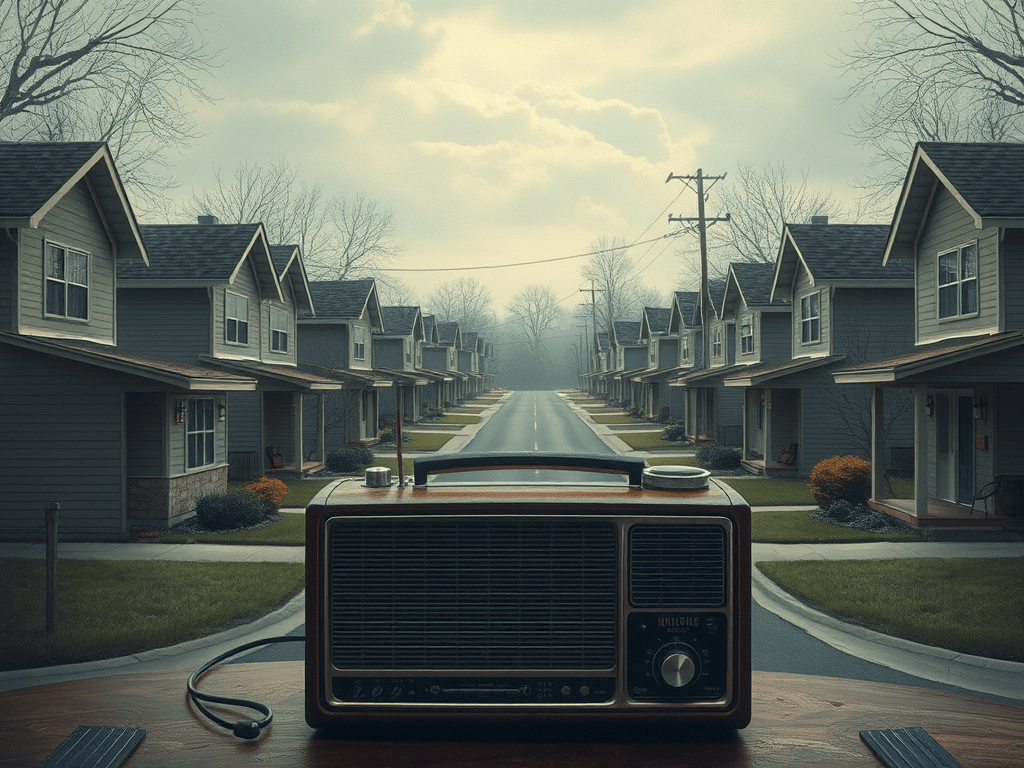
    John Cheever’s “The Enormous Radio” joins the chorus. Jim and Irene Westcott are respectable enough to be alumni-brochure fodder, yet their lives hum with nothingness. Then comes the radio, their supposed luxury upgrade—a hulking gumwood cabinet that looks less like a household appliance and more like a coffin standing on end. At first it malfunctions with grotesque noises, coughing and wheezing like a consumptive beast. But when it “works,” its real gift is supernatural: it picks up not Brahms or Mozart but the raw, unedited conversations of the neighbors. Suddenly Irene is granted an unwanted superpower, the ability to eavesdrop on lives stripped of pretense. Through the radio’s crackle, she overhears quarrels, confessions, betrayals, the bitter sediment of other people’s marriages. Respectable couples she once envied are exposed as small, petty, furious, and miserable. Irene becomes both priest and voyeur, holding court over the private sins of her building. The radio doesn’t merely broadcast sound; it rips open walls, tears down curtains, and forces Irene into an intimacy she never asked for but quickly can’t live without. Jim recoils in disgust, but Irene is entranced, feeding on the poison like it’s oxygen. The radio becomes their third eye, their unwelcome oracle, a device that transforms a bourgeois apartment into a haunted theater of human despair.

    The question Cheever poses—and which Reynolds, Byrne, and Misty circle—is whether too much knowledge of others, or of ourselves, is corrosive. The radio doesn’t merely reveal secrets; it corrupts. Irene begins with curiosity, but soon she’s chained to the cabinet, hypnotized by its stream of confessions and recriminations. What she hears doesn’t just stain her view of others; it infects her own marriage, her finances, even her sense of self. She grows convinced that her life is flimsy, precarious, and wasted, as though the radio is no longer a machine but a judgmental deity, casting its pitiless light on everything she’s tried to keep tidy and respectable. For Irene, the radio becomes both oracle and executioner, transforming her from passive listener into a woman undone by revelation. And that’s the horror Cheever leaves us with: the possibility that self-examination, when magnified by an unblinking device, doesn’t lead to wisdom at all, but to paralysis and despair. Respectability is not protection. The walls are paper-thin. The “satisfactory” life is a coffin with good upholstery.

  • Naked, Unshy, Beautiful: What Happens When the Killjoy Leaves

    Naked, Unshy, Beautiful: What Happens When the Killjoy Leaves

    I screened The Game Changers for my student-athletes, pausing every few minutes like a referee blowing the whistle on another bogus call. The film is a carnival of half-baked studies and overcooked claims about the superiority of a plant-based diet, and I wasn’t about to let it slide. Still, I tried to be generous: a well-planned plant-based diet can be a heart’s best friend. But then we hit my favorite scene, the one I couldn’t resist rewinding. Derrick Morgan, the former Tennessee Titans linebacker, is feasting with teammates on a vegan spread prepared by his wife, Charity. The science was questionable, but the spectacle of love, respect, and camaraderie at that table was undeniable. I told my students, “This—right here—is what eating is about. Not macros, not calculators, not the cold math of nutrition. It’s love.” A volleyball player nodded so hard in agreement, I swear I almost heard her whisper “Amen.”

    Because what is food without community? Nothing but calorie slop shoveled into our mouths like feral beasts at the trough. Food made with love is alchemy: it transforms ingredients into joy, health, and communion. Yet here we are, obsessed with mimicking the hollow thinness of the GLP-1 crowd, mistaking the absence of appetite for virtue. We’ve lost the plot. Food isn’t just fuel; it’s the oldest social technology we have, a medium for bonding, story-telling, and remembering why we bother to sit at a table together in the first place. Strip away the love, and you might as well be gnawing protein paste in solitary confinement.

    Someone with a strong sense of love and bonding is the unnamed Pommeroy brother who narrates the John Cheever short story “Goodbye, My Brother.” He explains that their father was drowned in a sailing accident, which accounts for the family being “very close in spirit.” Their widowed mother taught them that “familial relationships have a kind of permanence” that must be treasured. And so, when the clan gathers at a stately beach house in Laud’s Head, they long for a reunion soaked in sea air and camaraderie. Instead, they get Lawrence—the Puritan gargoyle in their garden party.

    Lawrence is the sort of malcontent who makes wallpaper peel just by standing in a room. He sneers, scolds, and sours the air with his joyless rectitude. A family feast must be stripped of flavor for fear of offending his ascetic palate; a laugh must be stifled, lest he glare with Calvinist disgust. He walks through the beach house like an undertaker taking notes. Even his children, described as thin and timid, seem malnourished by his anti-life, as if he has siphoned out their childhood and replaced it with dour lectures. He is not merely unpleasant—he is a contagion, a slow cancer metastasizing through the family’s shared spirit.

    Cheever’s brilliance is to render Lawrence as the Apollonian impulse run rancid: all order, no play; all restraint, no abandon. The rest of the Pommeroys, by contrast, embody the Dionysian: eager for pleasure, indulgence, the salty joy of swimming naked in the Atlantic. Lawrence cannot let go, cannot laugh, cannot live—and so the family cannot breathe in his presence. Only when the narrator, finally fed up, smacks his brother with a seawater-heavy root, drawing blood, does relief arrive. Lawrence slinks away with his joyless brood, leaving the others to rediscover pleasure, freedom, and even grace. The final image is unforgettable: the narrator’s wife and sister, unencumbered and unclothed, walking out of the ocean like radiant sea-goddesses. It’s as if Lawrence’s exile returned them to the very pulse of life.

    Cheever reminds us that one malcontent can poison the banquet, but also that expelling the killjoy—by violence if necessary—can restore the fragile ecstasy of family. The message is clear: the Dionysian will not be denied, not even by a Puritan scold with a permanent scowl.

  • Food as Storytelling, Not Spreadsheet

    Food as Storytelling, Not Spreadsheet

    I screened The Game Changers for my student-athletes, pausing every few minutes like a referee blowing the whistle on another bogus call. The film is a carnival of half-baked studies and overcooked claims about the superiority of a plant-based diet, and I wasn’t about to let it slide. Still, I tried to be generous: a well-planned plant-based diet can be a heart’s best friend. But then we hit my favorite scene, the one I couldn’t resist rewinding. Derrick Morgan, the former Tennessee Titans linebacker, is feasting with teammates on a vegan spread prepared by his wife, Charity. The science was questionable, but the spectacle of love, respect, and camaraderie at that table was undeniable. I told my students, “This—right here—is what eating is about. Not macros, not calculators, not the cold math of nutrition. It’s love.” A volleyball player nodded so hard in agreement, I swear I almost heard her whisper “Amen.”

    Because what is food without community? Nothing but calorie slop shoveled into our mouths like feral beasts at the trough. Food made with love is alchemy: it transforms ingredients into joy, health, and communion. Yet here we are, obsessed with mimicking the hollow thinness of the GLP-1 crowd, mistaking the absence of appetite for virtue. We’ve lost the plot. Food isn’t just fuel; it’s the oldest social technology we have, a medium for bonding, story-telling, and remembering why we bother to sit at a table together in the first place. Strip away the love, and you might as well be gnawing protein paste in solitary confinement.

  • Triple Lounge Wear: My Magnum Opus of Sloth Couture

    Triple Lounge Wear: My Magnum Opus of Sloth Couture

    When I think of Sigmund Freud, I don’t picture the sober father of psychoanalysis so much as a man presiding over an endless therapy session in which a poor soul reclines on a tufted couch, excavating their psyche with the zeal of a Siberian prisoner digging for coal. I tend to side with podcaster Katie Herzog here: all that navel spelunking doesn’t yield much juice for the squeeze. My mental health cure is more prosaic—get out of my head, do the dishes, help someone else, and remind myself that brooding isn’t a spiritual distinction but simply the human condition, dressed up in self-importance.

    That said, Freud remains a cultural heavyweight, a sort of St. Paul of the psyche. Both men dove into deep, uncharted waters: both charting neurosis and the divided self from different angles. Their remedies were at odds—St. Paul promised redemption; Freud essentially said, “There is no God. Buck up, buttercup.” But there’s always a third way. Perhaps we can podcast our way out of despair. That thought struck me as I read Rebecca Mead’s New Yorker profile of Bella Freud’s “Fashion Neurosis.” Sigmund’s great-granddaughter, Bella isn’t exactly a scholar of the old man’s work, but she leans into his therapy tropes with sly cosplay. Guests flop onto the proverbial couch, confess their quirks, addictions, and philosophies, and tie it all back to their fashion obsessions. Clothes become the psyche’s fabric, quite literally.

    As for me, Bella probably won’t be calling. My claim to fame is enjoying oatmeal for dinner. Still, if she ever asked, I’d come armed with a story. In kindergarten, I had my prized “Monkees pants,” green checkered flares with a radioactive sheen, worn proudly for Show and Tell as I belted out the Monkees’ theme song. Girls swooned, begged for autographs, and I was five going on Micky Dolenz. Then came my Hulk phase: mutilating brand-new jeans so it looked like my swelling muscles had shredded them. My parents adored this use of their clothing budget. Later, the bodybuilding years brought muscle shirts and tight jeans, followed by my “uniform” phase: gray golf shirts, boot-cut jeans, tennis shoes, repeated ad nauseam for three decades.

    My magnum opus, however, is what I call Triple Lounge Wear. A gray tank top and Champion shorts serve as daywear, pajamas, and gym attire—a holy trinity of frictionless fashion. Why cycle through outfits when you can be a one-man capsule collection of sloth and efficiency? 

    Naturally, no discussion of fashion would be complete without confessing my incurable diver watch obsession. My imagination is still shackled to childhood visions of Sean Connery suavely flashing a Submariner on a NATO strap, or Jacques Cousteau backstroking with porpoises while his orange-dial Doxa Sub 300 glowed like a miniature sun. Compared to that, what hope does any outfit of mine have? A diver watch isn’t an accessory—it’s the anchor, the crown jewel, the only thing saving me from looking like a man in oatmeal-stained gym shorts pretending he has style.

    Bella Freud would beam at my ingenuity, then lower her voice and ask, “So Jeff, tell me about your childhood.” And I’d answer, “Well, it started with the Monkees pants…”