Category: culture

  • Why Reading Is the Last Romantic Act

    Why Reading Is the Last Romantic Act


    If you take my Critical Thinking class, let me set expectations up front: I will not stand at the front of the room and lecture you into becoming an intellectual. That’s not how it works. I can’t command you to read. I can’t install curiosity like a software update.

    What I can tell you is this: the default setting is mediocrity. It’s smooth, seductive, and socially acceptable. The world—especially its algorithmic avatars—is built to exploit that setting. Platforms like OpenAI don’t just offer tools; they offer excuses. They whisper: You don’t have to think. Just prompt.

    You’ll get by on it. You’ll write tolerable essays. You might even land a job—something stable and fluorescent-lit with a breakroom fridge. But if you keep outsourcing your critical thinking to machines and your inner life to streaming platforms, you may slowly congeal into a Non-Player Character: a functionally adequate adult with no self-agency, just dopamine hits from cheap tech and cheaper opinions.

    The world needs thinkers, not task-completers.

    And that’s why I push reading—not as an obligation, but as a doorway to a higher mode of existence. Reading changes the texture of your thoughts. It exposes you to complexity you didn’t ask for and patterns of mind you didn’t inherit. But here’s the inconvenient truth: no one can make you read.

    Reading isn’t a commandment. It’s a love affair—and like any love worth having, it’s irrational, wild, and self-chosen. You don’t read because it’s good for you. You read because at some point a book wrecked you—in the best way possible. It made your brain itch, or your chest tighten, or your worldview crack open like an old floorboard.

    And that’s what I want for you. Not because it makes me feel like a good professor, but because if you don’t fall in love with ideas—on the page, in the margins, in someone else’s wild, flawed sentences—you’ll live a life someone else designed for you.

    And you’ll call it freedom.

  • Boots, Pie, and Nostalgia: Dispatch from Mortimer Farms

    Boots, Pie, and Nostalgia: Dispatch from Mortimer Farms

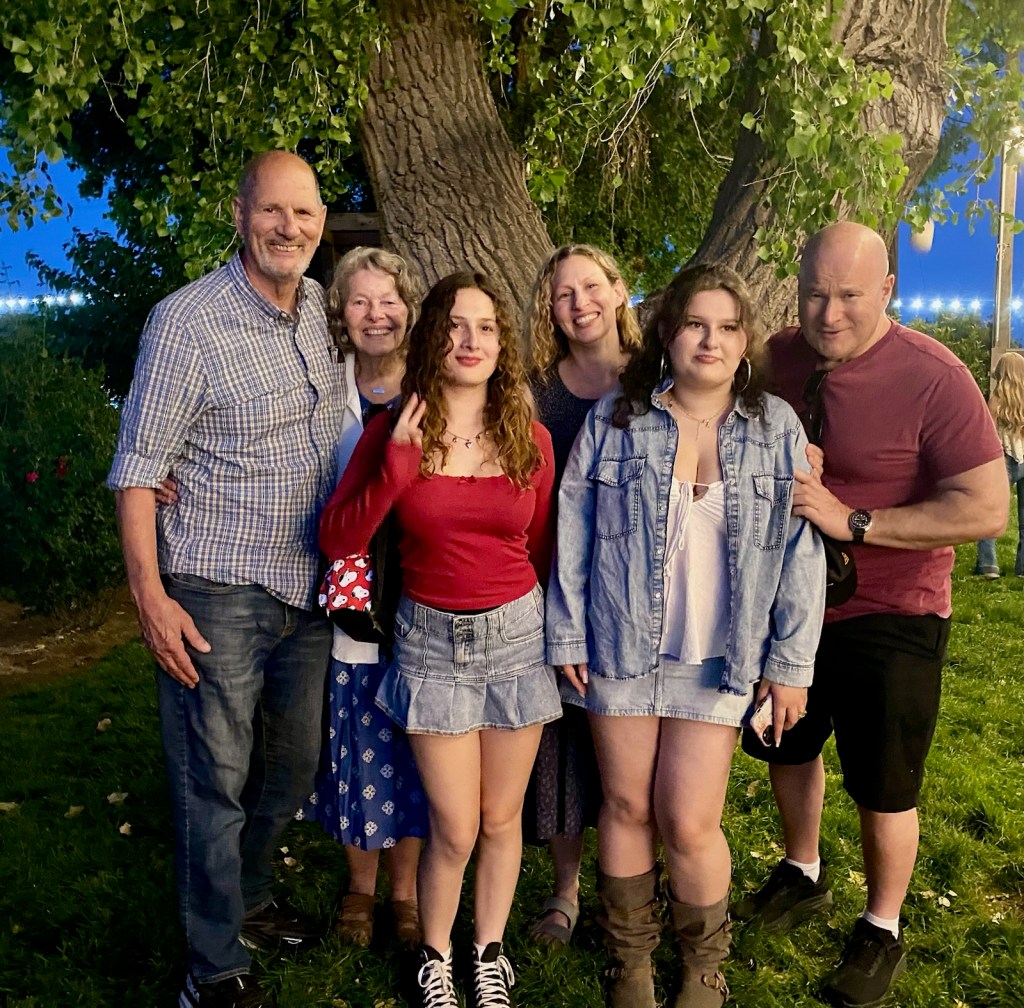
    Last night we time-traveled to a Norman Rockwell fever dream: a retro barn dance at Mortimer Farms in Dewey-Humboldt, Arizona, where about 500 people—sunburned, denim-clad, and wholly unironically patriotic—gathered to eat, dance, and mainline nostalgia.

    The soundtrack? A whiplash blend of twangy country and 70s rock that made you want to two-step and tailgate at the same time. Dinner was an unapologetic heartland spread: cheeseburgers grilled to smoky perfection, heirloom salad straight from the farm, and homemade blueberry and apple pies so rustic they practically came with a grandmother.

    As I looked around—kids doing cartwheels in the dust, old men tapping their boots in rhythm, teenagers pretending not to enjoy themselves—I realized I hadn’t tasted this much deep-fried Americana since trick-or-treating in San Jose in 1967, pillowcase in hand, chasing sugar highs under suburban streetlights.

    So yes, we took a family portrait. Not just to capture the night, but to memorialize the moment we voluntarily stepped into a live-action postcard, brazen nostalgia and all.

  • When It comes to Swim Briefs the Size of a Hotel Mint, Maybe Opt Out

    When It comes to Swim Briefs the Size of a Hotel Mint, Maybe Opt Out

    Today’s New York Times article, titled “Skimpy Men’s Swimming Briefs Are Making a Splash,” offers a solemn dispatch from the front lines of GLP-1 drugs, but I would guess that men—having exhausted every form of visible self-optimization—are now expressing their Ozempic-enabled slenderness via tiny, Lycra-clad declarations of status. We’re talking male bikinis, or what I like to call the ego sling.

    Apparently, if you’re dropping $18,000 a year to chemically suppress your appetite and shed your humanity one subcutaneous injection at a time, you deserve the privilege of looking like a Bond villain’s pool boy. I suppose this is the endgame: pay to waste away, then wrap what’s left in a luxury logoed banana peel.

    Luxury houses, never ones to miss a chance to monetize body dysmorphia, are now marketing these second-skin briefs not as mere swimwear, but as power statements. To wear them is to say: “I’ve defeated fat, joy, modesty, and comfort in one fell swoop.”

    I’m almost 64. My aspirations remain high—ideally, I’d like to look like a special-ops operator on vacation in Sardinia. But I know my place. I wear boxer-style swim trunks, the cloth of the pragmatic and the semi-dignified. They’re not exciting, but neither is seeing a sun-leathered septuagenarian adjust a spandex slingshot over a suspicious tan line.

    There’s a difference between being aspirational and being delusional. The former means striving for vitality, strength, and energy. The latter means stuffing yourself into a satirical undergarment and pretending you’re 28 with a sponsorship deal.

    To my fellow older men: sculpt your body like it’s your spiritual obligation—but when it comes to swim briefs the size of a hotel mint, maybe opt out. Not every part of youth is worth reliving. Some of it deserves to be left in the chlorine-stained past, right next to Axe body spray and Ed Hardy tank tops.

  • Vacation Nihilism: The Existential Price of That $28 Margarita

    Vacation Nihilism: The Existential Price of That $28 Margarita

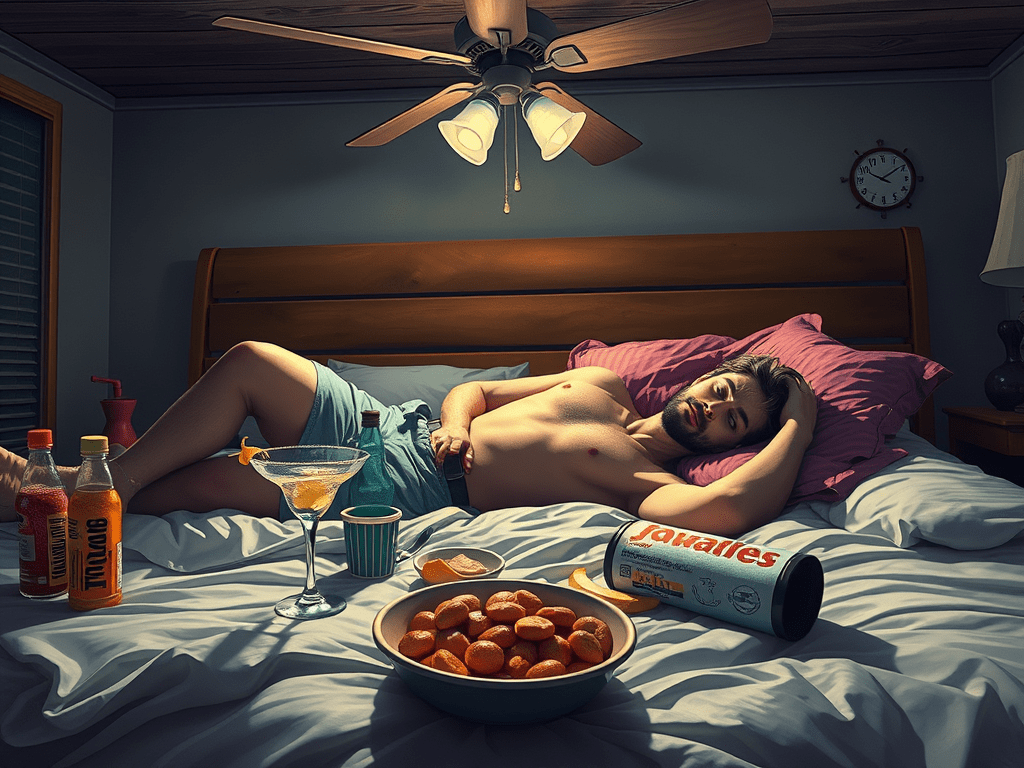
    Vacation nihilism is the uniquely modern despair that creeps in when you’re supposed to be relaxing. You’re sprawled on a rental bed, digesting overpriced novelty food, staring at the ceiling fan, and asking yourself: What am I even doing with my life? The break from your daily routine doesn’t recharge you—it exposes you. With your rituals on hold, your ambitions start to look ridiculous, your projects meaningless, and your belief in humanity’s forward march into reason and tech-fueled glory? Laughable.

    You’re not wrong, entirely. The world has gone a bit mad. But your despair isn’t just philosophical—it’s biochemical. You’ve sabotaged your sleep schedule. You’ve eaten five experimental meals in three days and haven’t seen a vegetable since the airport salad bar. Your gut is staging a coup. You’re bloated, irritable, and haven’t had ten consecutive minutes alone since the trip began. Naturally, you begin to suspect your entire existence is a long-running joke with no punchline.

    Then comes the knock: Nihilism, that smug little parasite, invites himself in. And you’re too tired to fight him off. He plops down beside you and begins dismantling your life, piece by piece: your goals, your routines, your little morning affirmations—all reduced to performance art for an indifferent universe.

    For most people, this existential fog lifts after a few days back in the saddle. The routine reboots. Coffee tastes like salvation again. But not always. Sometimes you bring it back with you, like a psychological bedbug infestation. Tiny, persistent thoughts that burrow into your habits. Questions you can’t un-ask. You might look the same on the outside, but internally, the scaffolding is rusting.

    You went on vacation to unwind. Instead, you came back with nihilism spores. And no, TSA does not screen for them.

  • Prescott Is a Foodie’s Paradise

    Prescott Is a Foodie’s Paradise

    This is my second pilgrimage to Prescott, Arizona—land of red rocks, retirees, and, as I’ve now discovered, absurdly good food. Downtown, improbably, is a foodie fever dream. Burned-out Phoenix chefs, weary of cutthroat rents and influencer-palates, have decamped to this high desert haven, setting up shop to serve artisanal fare to the town’s well-heeled retirees—many of whom fled Southern California with their pensions and discerning palates intact.

    The result? A culinary street fight. You’ll find cutthroat competition in categories you didn’t know had leagues: barbecue with bark that rivals Austin’s best, Mexican joints that don’t pull punches, ambitious Indian menus, and enough “elevated Americana” to make you rethink the humble meatloaf. There are small-batch pies. Donuts that look like sculpture. Cold brews made with more precision than most marriages.

    It’s like someone air-dropped a Brooklyn food court into an Old West postcard and didn’t tell anyone. Prescott may look like a sleepy Southwestern outpost from the outside, but inside it’s a Bohemian buffet of culinary overachievement. Bring an appetite. And a second stomach.

  • I Came for Health and Left with a Halo

    I Came for Health and Left with a Halo

    I’m stubborn—pathologically so. I know full well that going full carnivore would melt the fat right off me. A steady stream of fatty meats, maybe a token vegetable or two for show, and boom—I’d be a suburban Wolverine. Ripped, lean, possibly feral. But my suspicion kicks in around the long-term effects. Sure, eating like a seal-clubbing Inuit makes sense when you live on a glacier and need 6,000 calories just to blink. But when you’re a guy driving a hybrid through Trader Joe’s parking lots, gorging on brisket with your Apple Watch monitoring your heart rate, the “ancestral diet” starts to look less like primal wisdom and more like performative caveman cosplay.

    No, my reluctant truth is this: a mostly plant-based diet is probably my best bet. I imagine a future of buckwheat groats, steel-cut oats, rainbow chard, tofu, tempeh, and beans. My meals will be slathered with artisanal dressings composed of balsamic vinegar, spicy mustard, and nutritional yeast—because apparently sainthood is now spreadable.

    Sure, I’ll fold in some salmon twice a week. Maybe Greek yogurt. And yes, I’ll backslide into Mongolian beef barbecue once a month when life feels meaningless and I want my food to fight back. But the plan is mostly monkish. And here lies the rub: the diet starts making me feel too pure. Too righteous. The kind of person who silently judges you for using ranch dressing. The glow of self-congratulation hangs around my head like a flickering LED halo.

    And then comes the cookware. You can’t cook holy grains in a peasant pot. No, this lifestyle demands French-made enameled cast iron Dutch ovens—heirloom cookware with the price tag of a minor surgical procedure. I tell myself this is an investment in my health. What it really is: a $300 declaration that I’ve joined the priesthood of quinoa.

    Worse, the whole thing becomes a personality. Plant-based meals. Exercise tracking. Morning rituals. Deep-breathing routines. It becomes its own narcissistic opera. I’m centered. I’m optimized. I’m intolerable. My life starts to feel like an Instagram reel narrated by a smug inner voice that’s always meditating.

    The real irony? I embarked on this whole food pilgrimage to escape the traps of modern life—its clutter, chaos, and chronic disease. And yet, somewhere between my third batch of millet and Googling the mineral content of nutritional yeast, I crossed into a new disorder: a lifestyle so curated it starts to feel like a museum exhibit titled Me, Trying Too Hard.

    Sometimes the cure becomes its own kind of sickness. We chase health, only to wind up imprisoned by our own kale-scented, cast iron-coated obsessions.

  • Safe at Home with Tofu: We Need George Carlin Now More Than Ever

    Safe at Home with Tofu: We Need George Carlin Now More Than Ever

    George Carlin once built a whole comedy bit around the contrast between football and baseball. Football, he said, is war—full of blitzes, bombs, and sudden death. Baseball, by contrast, is a pastoral game, a gentle journey home. Safe at home. He could’ve done an equally scathing bit on carnivores versus vegans.

    A carnivore is a Viking. He doesn’t eat dinner; he conquers it. He roasts slabs of meat over open flame, wears elk pelts in July, and believes the phrase “nose to tail” is less a philosophy than a moral imperative. He eats liver because it’s what his ancestors did, despite the fact that his ancestors also died at 38 from dysentery and wolf bites.

    The vegan? A minimalist monk who speaks in the tone one reserves for therapy dogs and endangered turtles. His kitchen smells like soaked lentils and moral superiority. He eats “greens,” plural, as though a vague handful of chlorophyll could power a biped. His hero is the neighborhood spider, which he refuses to squash. Instead, he names it Rumi, places it gently on a compostable bamboo plate, and ushers it into the wild with a whispered prayer and a single tear.

    The carnivore doesn’t own plates. He eats standing up. The vegan has three sets of reusable dishware, made from renewable bamboo and guilt. The carnivore fills his “power bowl” with yolks, red meat, and testosterone. The vegan fills his with quinoa, miso, and the sense that one day we’ll all live on floating gardens of kale, fueled by gratitude and biotin.

    The carnivore laughs when lightning strikes. The vegan winces when the microwave beeps.

    And yet—here’s the kicker—both think they’re saving the world. One by returning to primal wisdom, the other by transcending it. One believes in survival of the fittest; the other believes in surviving without harming a single sentient thing. They are, in essence, two sides of the same self-mythologizing coin: the ancient warrior and the futuristic monk, each clinging to their menu like it’s a worldview. And perhaps that’s what diet is now—a belief system, a theology served with a side of macro tracking. Eat, pray, posture.

  • The Forgiveness Trap: When Healing Becomes a Performance

    The Forgiveness Trap: When Healing Becomes a Performance

    I remember listening to Terry Gross interview Frank McCourt in 1997, right as Angela’s Ashes was climbing every bestseller list like a starving Irish ghost with a publishing deal. At one point, Gross asked the inevitable soft-serve question: had he ever forgiven his drunken, absentee father for drinking away the family’s money and abandoning his wife and children to starvation and shame?

    McCourt didn’t flinch. He dismissed forgiveness as “pompous” and “irrelevant”—as if someone had asked him if he’d made peace with bubonic plague. He wasn’t being cruel; he was being precise. Forgiveness, he seemed to argue, is often a performance—a neat, moral bow tied onto a box of horror that refuses to stay shut.

    I thought of McCourt again this morning while reading Christina Caron’s New York Times piece, “Sometimes, Forgiveness Is Overrated.” It profiles adults who survived childhoods ruled by sadists, addicts, psychopaths, and the emotionally vacant. These were not flawed parents; they were ethical sinkholes, incapable of even the most basic decency. And yet, the self-help gospel continues to hand these survivors a soft-focus script: Forgive, and you will be free.

    Enter Amanda Gregory, therapist and author of You Don’t Need to Forgive: Trauma Recovery on Your Own Terms. Gregory’s argument is refreshingly grounded: forgiveness is not a virtue badge, not a finish line, and certainly not a moral obligation. It’s a slow, private emotional process—if you choose to pursue it. You do not owe a resolution. You do not need to sculpt your rage into affection.

    Gregory’s thesis echoes Sharon Lamb’s earlier work from 2002, which cautioned that pressuring victims to forgive can cause more damage than healing. It’s not just naive—it’s cruel. There are wounds that never close, and forcing someone to say, “It’s okay now,” when it’s absolutely not okay is a kind of spiritual gaslighting. It shifts the burden of transformation onto the person who’s already been broken.

    And what about the offenders? If they’re remorseful, truly remorseful, perhaps forgiveness enters the room. But what if they’re not? What if they’re still rewriting history or refusing to acknowledge it? Then forgiveness becomes a farce—just another round of victim-blaming wrapped in therapeutic jargon.

    In many cases, forgiveness isn’t even the right frame. With time and growth, some of us develop a different emotional posture—not forgiveness, but pity. We see our abusers not as villains to be vanquished or souls to be redeemed, but as feeble, morally bankrupt husks who couldn’t rise above their own dysfunction. We stop hating them because we no longer need to—but let’s not confuse that with forgiveness. That’s not healing; it’s emotional Darwinism.

    Forgiveness has its place, but only when it rests on shared truth and genuine contrition. Otherwise, it’s a forced ritual, a bad-faith moral contract, and a way to sell books or fill up therapy time. The therapeutic industry’s insistence that forgiveness is always the holy grail? Honestly, it’s unforgivable.

  • Lot’s Wife Was Human—And So Are You

    Lot’s Wife Was Human—And So Are You

    The story of Lot’s wife is usually trotted out as a biblical “gotcha”—a cautionary tale about disobedience, attachment, and the fatal cost of looking back. But really, it’s much darker, much richer. It’s about the soul-crushing gravity of nostalgia, the seductive pull of the past, and how the refusal to fully commit to forward motion—spiritually, morally, existentially—can leave us frozen, calcified, halfway between escape and surrender.

    Lot’s wife is never named in the Genesis account. She’s just “Lot’s wife,” a narrative afterthought, a supporting character reduced to a cautionary statue. And yet her fate is more memorable than her husband’s, etched into the landscape as a monument to hesitation.

    Fortunately, Midrashic literature gives her a name—Ado, or more memorably to my ear, Edith. Maybe it’s the residue of All in the Family, but Edith conjures a kind of moral warmth: a woman who feels deeply, who wants to do right, but is also tragically susceptible to emotion and memory. I prefer Edith to “Lot’s wife” not for historical accuracy, but for dignity. Edith feels human, conflicted, real.

    I don’t think Edith turned around because she was vain or shallow. I think she turned because she was haunted. She turned because the past was more than rubble—it was love, memories, people. Her heart was a complex web of longing, and it snagged her. The salt wasn’t a punishment. It was a crystallization of what happens when our nostalgia outweighs our conviction.

    And let’s be honest: Who among us doesn’t have some briny lump of regret weighing us down? Some internal salt pillar we’ve built in the shape of a younger self we can’t stop worshiping?

    Our culture is Edith’s playground. Social media, advertising, and even the algorithms know exactly how to pander to the Edith within. I can’t scroll without being invited into some “Golden Age of Bodybuilding” time warp: vintage photos of Arnold, Zane, Platz, Mentzer; protein powder reboots; playlists that reek of adolescent testosterone and gym chalk. Jefferson Starship and Sergio Oliva, side by side. It’s like being invited to embalm my past and celebrate its eternal youth. I can join message boards and talk shop with other proud monuments to vanished glory, all of us reenacting the same ritual: remembering what life used to feel like. Not what it is.

    This, I suspect, is what it means to turn to salt. Not just to long for the past, but to despise the present. To dig our heels into a world that no longer fits and spit at progress as if it betrayed us. To canonize a version of ourselves that no longer exists, then try to live in its shadow.

    But maybe Edith’s not just a warning. Maybe she’s a mirror. A deeply flawed, deeply human figure who reminds us that the instinct to look back isn’t evil—it’s inevitable. And maybe we don’t conquer that instinct so much as we recognize it, name it, and learn when to say: Enough. That life was real, and it was mine. But I’m walking forward now.

    Or at least trying to.

  • Hot Pockets, CliffNotes, and the Death of Deep Reading

    Hot Pockets, CliffNotes, and the Death of Deep Reading

    Before the Internet turned my brain into a beige slush of browser tabs and dopamine spikes, I used to read like a man possessed. In the early ’90s, I’d lounge by the pool of my Southern California apartment, sun-blasted and half-glossed with SPF 8, reading books with a kind of sacred monastic intensity. A. Alvarez’s The Savage God. Erik Erikson’s Young Man Luther. James Twitchell’s Carnival Culture. James Hillman and Michael Ventura’s rant against the therapy-industrial complex–We’ve Had a Hundred Years of Psychotherapy – and the World’s Getting Worse. Sometimes I’d interrupt the intellectual ecstasy to spritz my freshly tanned abs with water—because I was still vain, just literate.

    Reading back then was as natural as breathing. As Joshua Rothman points out in his New Yorker essay, “What’s Happening to Reading?”, there was a time when the written word was not merely consumed—it was inhaled. Books were companions. Anchors. Entire weekends were structured around chapters. But now? Reading is another tab, sandwiched between the news, a TikTok video of a dog on a skateboard, and an unopened Instacart order.

    Rothman nails the diagnosis. Reading used to be linear, immersive, and embodied—your hands on a book, your mind in a world. Now we shuttle between eBooks, PDFs, Reddit threads, and Kindle highlights like neurotic bees skimming data nectar. A “reading session” might include swiping through 200-word essays while eating a Hot Pocket and half-watching a documentary about narco penguins on Netflix. Our attention is fractured, our engagement ritualized but hollow. And yes, the statistics back it up: the percentage of Americans who read at least one book a year dropped from 55% to 48%. Not a cliff, but a slow, sad slide.

    Some argue it’s not worth panicking over—a mere 7% drop. I disagree. As a college instructor, I’ve seen the change up close. Students don’t read long-form books anymore. Assign Frederick Douglass and half the class will disappear into thin air—or worse, generate AI versions of Douglass quotes that never existed. Assign a “safe” book and they might skim the Wikipedia entry. We’ve entered an age where the bar for literacy is whether someone has read more than one captioned infographic per week.

    Rothman tries to be diplomatic. He argues that we’re not consuming less—we’re just consuming differently. Podcasts, YouTube explainers, TikTok essayists—this is the new literacy. And fine. I live in that world, too. I mainline political podcasts like they’re anti-anxiety meds. Most books, especially in the nonfiction space, do feel like padded TED Talks that should have stayed 4,000 words long. The first chapter dazzles; the next nine are a remix of the thesis until you feel gaslit into thinking you’re the problem.

    But now the reading apocalypse has a new beast in the basement: AI.

    We’ve entered the uncanny phase where the reader might be an algorithm, the author might be synthetic, and the glowing recommendation comes not from your friend but from a language model tuned to your neuroses. AI is now both the reader and the reviewer, compressing thousand-page tomes into bullet points so we can decide whether to fake-read them for a book club we no longer attend.

    Picture this: you’re a podcaster interviewing the author of a 600-page brick of a book. You’ve read the first 20 pages, tops. You ask your AI: “Give me a 5-page summary and 10 questions that make me sound like a tortured genius.” Boom—you’re suddenly a better interviewer than if you’d actually read the book. AI becomes your memory, your ghostwriter, your stand-in intelligence. And with every assist, your own reading muscles atrophy. You become fit only for blurbs and bar graphs.

    Or take this scenario: you’re a novelist. You’ve published 12 books. Eleven flopped. One became a cult hit. Your publisher, desperate for cash, wants six sequels. AI can generate them faster, better, and without your creative hand-wringing. You’re offered $5 million. Do you let the machine ghostwrite your legacy, or do you die on the sword of authenticity? Before you answer, consider how often we already outsource our thinking to tools. Consider how often you’ve read about a book rather than the book itself.

    Even the notion of a “writer” is dissolving. When I was in writing classes, names like Updike, Oates, Carver, and Roth loomed large—literary athletes who brawled on live television and feuded in magazines. Writers were gladiators of thought. Now they’re functionally obsolete in the eyes of the market, replaced by a system that values speed, virality, and AI-optimized titles.

    Soon, we won’t pick books. AI will pick them for us. It will scan our history, cross-reference our moods, and deliver pre-chewed summaries tailored to our emotional allergies. It will tell us what to read, what to think about it, and which hot takes to regurgitate over brunch. We’ll become readers in name only—participants in a kind of literary cosplay, where the act of reading is performed but never truly inhabited.

    Rothman’s essay is elegant, insightful, and wrong in one key respect: it shouldn’t be titled What’s Happening to Reading? It should be called What’s Happening to Reading, Writing, and the Human Mind? Because the page is still there—but the reader might not be.