Category: culture

  • Sundae Grailism

    Sundae Grailism

    When I was a kid growing up in the San Francisco Bay Area in the 1970s, there was an ice creamery called Farrell’s. In a child’s imagination, Farrell’s was the equivalent of Willy Wonka’s Chocolate Factory. You didn’t go to Farrell’s often, maybe once every two years or so. Entering Farrell’s, you were greeted by the cacophony of laughter and the clinking of spoons against glass. Servers in candy-striped uniforms dashed around with the energy of marathon runners, bearing trays laden with gargantuan sundaes. You sat down, your eyes wide with awe, and the menu was presented to you like a sacred scroll. You don’t need to read it, though. Your quest was clear: the legendary banana split. When the dessert finally arrived, it was nothing short of a spectacle. The banana split was monumental, an ice cream behemoth. I was as if the dessert gods themselves had conspired to create this masterpiece. Three scoops of ice cream, draped in velvety hot fudge and caramel, crowned with mountains of whipped cream and adorned with maraschino cherries, all nestled between perfectly ripe bananas. Sprinkles and nuts cascaded down the sides like the treasures of a sugar-coated El Dorado. As you took your first bite, you embarked on a journey as grand and transformative as any hero’s quest. The flavors exploded in your mouth, each spoonful a step deeper into the enchanted forest of dessert ecstasy. You were not just eating ice cream; you were battling dragons of indulgence and conquering kingdoms of sweetness. The sheer magnitude of the banana split demanded your full attention and stamina. Your small arms wielded the spoon like a warrior’s sword, and with each bite, you felt a mixture of triumph and fatigue. By the time you reached the bottom of the bowl, you were exhausted. Your muscles ached as if you’ve climbed a mountain, and you were certain that you’d expanded your stomach capacity to Herculean proportions. You briefly considered the possibility of needing an appendectomy. But oh, the glory of it all! Your Farrell’s sojourn was worth every ache and groan. You entered the ice creamery as an ordinary child and emerged as a hero. In this fairy-tale-like journey, you had undergone a metamorphosis. You were no longer just a kid from the Bay Area; you were now a Jedi of the dessert world, having mastered the art of indulgence and delight. As you returned home, the experience of Farrell’s left a lasting imprint on your soul. You regaled your friends with tales of your conquest, the banana split becoming a legendary feast in the annals of your childhood adventures. In your heart, you knew that this epic journey to Farrell’s, this magical pilgrimage, had elevated you to the ranks of dessert royalty, a memory that would forever glitter like a golden crown in the kingdom of your mind.

    These indulgences point to Sundae Grailism–the childhood phenomenon in which a dessert outing—particularly involving elaborate confections like banana splits—takes on the structure, stakes, and emotional intensity of an Arthurian quest. Sundae Grailism transforms a simple trip to an ice cream parlor into a mythic pilgrimage where sprinkles are sacred relics, whipped cream is a divine cloud cover, and the spoon is Excalibur.

    Children afflicted with Sundae Grailism don’t just want dessert—they are summoned to it. They enter Farrell’s or any suitably over-the-top ice creamery with the gravity of knights entering Camelot, guided by visions of the elusive Banana Split of Destiny. The menu is not read—it is interpreted like scripture. Every bite of caramel-drizzled glory is a chapter in the epic. By the end of the journey, they’re bloated but victorious, stained with fudge and swagger, ready to regale the kingdom (a.k.a. the school lunch table) with tales of conquest and near-digestive ruin.

    Sundae Grailism is not just about sugar—it’s about transcendence, myth-making, and the belief that, under the right fluorescent lighting and with enough maraschino cherries, a kid can become legend.

  • Granarchism and the Curse of the Granola Belly

    Granarchism and the Curse of the Granola Belly

    When I was in my early teens in the 1970s, my family shopped at a San Francisco Bay Area grocery store that “was owned by the people.” It was called Co-Op. The workers were friendly; the men were often bearded and wearing survival gear from Co-Op’s “Wilderness Supply Store.” I would say the affable employees were all somewhere on the Hippy Spectrum. Co-op offered the first day care center for kids while the parents shopped and the first recycling center in town.  In addition to organic wholesome foods, the store had a modest book section featuring Robert M. Pirsig’s Zen and the Art of Motorcycle Maintenance, Peter Tompkins’ The Secret Life of Plants, Erich Von Daniken’s Chariots of the Gods, Laurence J. Peters’ The Peter Principle, and the store’s grand jewel and Vegetarian Bible–Frances Moore Lappe’s Diet for a Small Planet. The store had an ample supply of countercultural foods. You could buy carob honey ice cream, wheat germ, granola, alfalfa sprout home kits with mason jars, brown rice, Japanese yams, and tofu. With its book section of countercultural reading, organic ingredients, and wilderness store, Co-Op was more than just a store. It was a sanctuary for those rebelling against The Man. Eating heaping bowls of granola, wheat germ, and organic honey was not just a self-indulgence; it was a political statement. However, this self-righteous certitude also created a condition known as Granola Belly. Scarfing down calorie-dense granola, wheat germ, and honey throughout the day, these valiant warriors raged against corporate food tyranny, their bellies growing rounder with each virtuous bowl of granola and honey. As I shopped at Co-Op with my parents, I observed these granola-loving rotund revolutionaries as they waddled through the aisles, their expanding girth a testament to the blind spots that mar even the most well-intentioned pursuits.

    Granola lovers of the Co-Op era were, without question, the spiritual forebears of Mope-a-saurus Rex—a species defined by the contradictory cocktail of high ideals and self-defeating habits. These self-proclaimed countercultural warriors strutted through the aisles of their people-owned utopia, scooping granola by the pound as if it were the holy grail of rebellion, all while sporting survival gear that screamed I’m off to fight the establishment…right after I finish this bowl of carob ice cream. The granola bowl was more than breakfast; it was a badge of moral superiority, a defiant middle finger to The Man served with a side of organic honey. But like all Mope-a-saurus endeavors, their noble intentions were undone by their own indulgence. They railed against corporate tyranny with their mouths full, their burgeoning bellies proof that even the most righteous ideals can be upended by an inability to count calories. Their expanding waistlines were not just ironic; they were emblematic of the Mope-a-saurus tendency to cling to virtue while ignoring inconvenient truths—because nothing says rebellion like eating your way to Granola Belly while preaching the gospel of moderation.

    These rotund granola bellies introduce us to the lexicon term Granarchism–the performative fusion of political virtue and unchecked appetite, where one’s anti-establishment snacking habits are cloaked in ideological nobility. Granarchism is what happens when you rage against The Machine with a spoonful of organic cashew clusters, believing your overflowing bowl of hemp-seed muesli is a protest, not a calorie bomb.

    Granarchists don’t count calories—they count causes. Every bite of honey-drizzled, brown rice-sweetened, sprouted oat goodness is framed as a moral stand, even as their bellies grow like utopian communes with no fiscal oversight. The Co-Op aisle becomes a battlefield, and the granola scoop is their weapon—except instead of overthrowing The Man, they’re just slowly replacing their belt loops.

    In the land of Granarchism, tofu is resistance, wheat germ is policy, and every heaping portion of almond butter-stuffed dates is a political manifesto. The contradiction? The revolution isn’t televised—it’s metabolized.

  • Chewtality

    Chewtality

    Every morning during my teenage years, I’d stagger out of bed and make my daily plea to the heavens: “God, please grant me the confidence and self-assuredness to ask a woman on a date without suffering from a full-blown cerebral explosion.” And every morning, God’s response was as subtle as a sledgehammer to the forehead: “You’re essentially a walking emotional landfill, a neurotic mess doomed to wander the planet bereft of charm, romantic grace, and any semblance of healthy relationships. Get used to it, buddy.” And thus commenced my legendary odyssey in the land of perpetual non-dating.

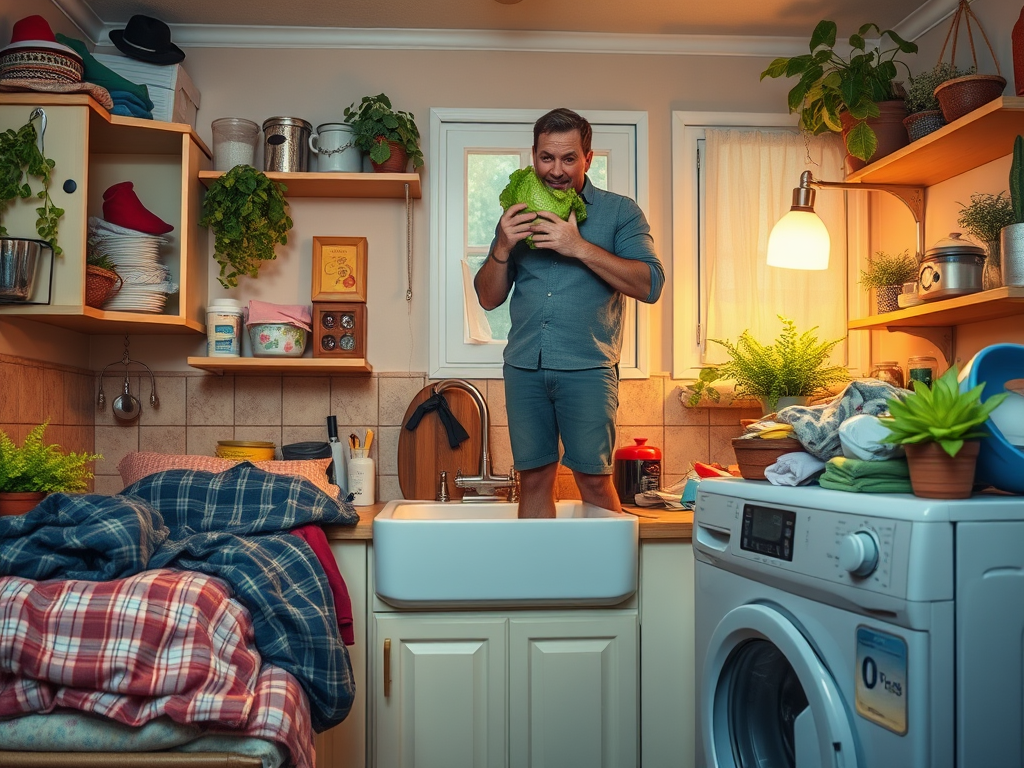
    This was not the grand design I had envisioned. No, the blueprint was to be a suave bachelor, just like my childhood idol, Uncle Norman from The Courtship of Eddie’s Father. At the ripe age of eight, I watched in awe as Uncle Norman demonstrated his revolutionary kitchen hack: why bother with dishes when you can devour an entire head of lettuce while standing over the sink? He proclaimed, “This way, you avoid cleanup, dishes, and the pesky inconvenience of sitting at a table.” In that glorious moment, I was struck with a revelation so profound it reshaped my entire existence. The Uncle Norman Method, as I would grandiosely dub it, became my life’s guiding principle, my personal beacon of satisfaction, and the defining factor of my existence for decades.

    Channeling my inner Uncle Norman, I envisioned a life of unparalleled convenience. My bed would be perpetually unmade because who needs sheets when you have a trusty sleeping bag? I’d never waste time watering plants—plastic ones were far superior. Cooking? Please. Cereal, toast, bananas, and yogurt would sustain me in perpetuity. My job would be conveniently located within a five-mile radius of my house, and my romantic escapades would be strictly zip code-based. Laundry? My washing machine’s drum would double as my hamper, and I’d simply press Start when it reached capacity. Fashion coordination? Not a concern, as all my clothes would be in sleek, omnipresent black. My linen closet would be repurposed to stash protein bars, because who needs linens anyway?

    I’d execute my grocery shopping like a stealthy ninja, hitting Trader Joe’s at the crack of dawn to dodge crowds, while avoiding those colossal supermarkets that felt like traversing a grid of football fields. 

    Embracing the Uncle Norman Way wasn’t just a new approach to dining; it was a radical overhaul of my entire lifestyle. The world would bow before the sheer efficiency and unadulterated convenience of my new existence, and I would remain eternally satisfied, basking in the glory of my splendidly uncomplicated life.

    Of course, it didn’t take long for my delusion to expand into a literary empire—or at least, that was the plan. The world, I was convinced, desperately needed The Uncle Norman Way, my magnum opus on streamlining life’s most tedious inconveniences. It would be part manifesto, part self-help guide, and part fever dream of a man who had spent far too much time contemplating the finer points of lettuce consumption over a sink. Each chapter would tackle a crucial element of existence, from the philosophy of single-pot cooking (aka, eating directly from the saucepan) to the art of strategic sock re-wearing to extend laundry cycles. I even envisioned a deluxe edition featuring tear-out coupons for discounted plastic plants, a fold-out map of the most efficient grocery store layouts, and, for true devotees, a companion workbook to track their progress toward the ultimate goal: Maximum Laziness with Minimum Effort™.

    Naturally, I imagined its meteoric rise to cultural dominance. Talk show hosts would marvel at my ingenuity, college professors would weave my wisdom into philosophy courses, and minimalists would declare me their messiah. Young bachelors, overwhelmed by the burden of societal expectations, would turn to my book in their darkest hour, finding solace in the knowledge that they, too, could abandon the tyranny of dishware and lean fully into sink-based eating. The revolution would be televised, one head of lettuce at a time.

    Uncle Norman’s “system” introduced me to Chewtality–the ruthless prioritization of caloric input over culinary pleasure, a lifestyle doctrine where taste, ambiance, and social norms are discarded like expired salad dressing. It’s the stoic efficiency of consumption that transforms meals into mechanical refueling sessions, often while hunched over a sink, shirtless, chewing with the urgency of a man on parole from dignity.

    Rooted in the gospel of Uncle Norman, Chewtality celebrates the unsentimental art of eating for sustenance and speed. Why savor when you can shovel? Why sit when you can hover? Why use plates when God invented hands and the stainless steel basin? This isn’t just a meal strategy—it’s a worldview: one where the blender pitcher is a chalice, the saucepan is a throne, and the lettuce head is both entree and ideology.

    In its highest form, Chewtality produces a false sense of superiority—an unshakable belief that your Spartan choices signify enlightenment, when in reality, you’ve just spent dinner crouched over the sink eating raw spinach like a raccoon with a library card.

  • Appetyranny

    Appetyranny

    One of the most memorable TV ad campaigns of my youth in the late 1960s was “How Do You Handle a Hungry Man?” The stakes were sky-high. Imagine the scene: a harried housewife in her perfectly pressed apron, hair teased to high heaven, facing off against her husband, the archetypal Hungry Man. He enters the kitchen with the imposing gait of a lumberjack who’s felled a forest, his appetite as vast as the Grand Canyon. He casts a skeptical eye over the bubbling pot on the stove, nostrils flaring like a bloodhound on the scent. The tension is palpable. But fear not! With a dramatic flourish, she opens a can of Campbell’s Manhandlers soup, the magical elixir that transforms her kitchen into a culinary Colosseum. She pours the contents into a pot, and it’s as if she’s summoned the culinary gods themselves. The soup is no ordinary broth; it’s a veritable cornucopia of steak chunks, peas, and potatoes, swimming in a rich, hearty base that promises to tame even the most insatiable of appetites. As the aroma wafts through the kitchen, her husband’s eyes widen in delight. He grabs a spoon and dives in, and the transformation is instantaneous. His previously skeptical demeanor melts away, replaced by pure bliss. He slurps the soup with the gusto of a Viking at a medieval banquet, and she watches, triumphant. The jingle plays in the background, a triumphant anthem to her victory over hunger.

    The food industry at the time was relying on Appetyranny–the 1970s advertising-driven psychosis in which a woman’s entire self-worth was measured by her ability to quell the beastly hunger of her man. Fueled by jingles and canned soup, Appetyranny framed female failure not in terms of character or intellect, but in spoonfuls: if he’s still hungry, you’re unlovable.

    It was the golden age of culinary gaslighting, where a man’s growling stomach was treated like a ticking bomb, and your job—housewife, mother, woman—was to neutralize it with sodium-laced beef sludge. Fail, and you risked suburban scandal. Succeed, and you were serenaded by baritone jingles that implied your marriage had been saved by soup.

    Side effects of Appetyranny include:

    • The belief that men turn feral without starch by 6 p.m.
    • Buying food with names like Manwich, Sloppy Joe, or Hearty Beef ‘n’ Barley
    • Mistaking Campbell’s labels for emotional validation
    • A lifelong association between love and ladles

    Appetyranny wasn’t just marketing. It was a meat-chunk manifesto from the patriarchal pantry, where the kitchen timer doubled as a ticking bomb of feminine adequacy.

  • Mascotopia

    Mascotopia

    In the pantheon of childhood injustices, the fall of Quake cereal stands as a monumental tragedy, rivaled only by the desecration of classic toys left to languish on the frozen island of misfit toys in Rudolph the Red-Nosed Reindeer. When Jay Ward’s cereal mascots, Quisp the Martian and Quake the Muscle-Bound Coal Miner, squared off in the great cereal showdown, the stage was set for an epic clash of taste, texture, and, most importantly, personal pride. Quake cereal, with its robust, gear-shaped nuggets, was not merely a breakfast option—it was a testament to human resilience and strength. Each nugget, dense enough to withstand the fury of a thousand spoons, stood firm in milk like a stoic warrior on the battlefield of breakfast. Meanwhile, Quisp, that whimsical Martian interloper, boasted soggy, flying saucer-shaped morsels that dissolved into a milky mush faster than a gremlin in a rainstorm. The rivalry between Quisp and Quake wasn’t just a marketing ploy; it was a battleground of epic proportions. Quake represented the pinnacle of cereal engineering—a bulwark of flavor against the encroaching tide of mediocrity. It was the hero of breakfasts, a cereal that could withstand the ravages of time and milk. Yet, despite Quake’s gallant efforts, the Martian’s insipid cereal prevailed. The decision was as senseless as declaring that the Titanic had not been adequately equipped with lifeboats because it had too many! When Quake was ultimately relegated to the annals of cereal history, I mourned as if my very soul had been denied a fundamental right. My grief was not solely about the cereal’s departure from the shelves—it was a visceral rejection of my will, a cosmic snub that struck at the very core of my breakfast autonomy. The elimination of Quake was akin to having one’s preferred superhero unceremoniously booted from the Justice League or, even worse, being told that one’s beloved comic book character had been written out of existence in the most disheartening crossover event ever imagined. The real tragedy here was not just the absence of Quake but the profound, personal affront I felt. It was as though Quake’s disappearance had somehow invalidated my very existence. Every time I poured a bowl of Quisp, I could almost hear the distant echoes of Quake’s forlorn whimpers, like a hero’s lament echoing through a desolate wasteland. The cereal aisle had become a barren landscape, a cruel reminder of a time when my preferences mattered—when I had a say in the cosmic balance of breakfast cereals. To me, Quake’s demise was not just an end to a cereal line but a grand, cosmic betrayal. It was as if the universe had conspired to mock my taste, to show me that my choice was inconsequential in the grand scheme of things. It was a stark, immutable reminder that, in the endless war between sugary Martian cereals and dense coal-miner nuggets, I was but a mere footnote in the annals of breakfast history. The apocalypse of Quake was the most tragic event in my cereal-eating career—a frozen island of disappointment, a sorrowful wasteland where only the memories of crispy, gear-shaped nuggets could console me.

    This incident introduced me to the idea of Mascotopia–the psychological condition in which the mascot of a cereal is so charismatic, heroic, or mythically overdeveloped that the actual cereal—a bland, sugar-dusted travesty—never stood a chance of living up to the hype. Victims of Mascotopia don’t eat breakfast—they mourn it. They pour a bowl expecting a hero’s journey and end up with soggy mediocrity.

    In this fever dream of commercial betrayal, Quake becomes a breakfast demigod, and Quisp a marshmallow Machiavelli. The mascots aren’t just marketing—they’re myth. And when your chosen avatar (Quake) is written out of existence in favor of a glorified puffball from Planet Bland, the resulting grief isn’t about flavor—it’s existential.

    Mascotopia is that childhood moment when you realize the cereal box is lying to you. It promised glory, grit, and nuggets that could survive the Big Bang. Instead, you’re left with dissolving saucers and a broken identity.

  • Snackjection

    Snackjection

    When I was five, my father constructed a treehouse that stood like a beacon of childhood ambition in the Flavet Villages Apartments in Gainesville, Florida. It was a fortress, a palace, a skyscraper reaching for the heavens—at least in my young mind. In this realm of wood and nails, I sought to assert my dominion, and what better way than with the power of Sun-Maid raisins? One fateful day, I lured Tammy Whitmire to ascend the tree’s wooden slats by brandishing the ultimate weapon: a box of Sun-Maid raisins. This wasn’t just any box; it featured the Sun-Maiden herself, a radiant figure holding a colossal tray of grapes. Her red bonnet and the halo of yellow light marked with white triangles around her head made her look like the Great Raisin Angel, a deity of dried fruit. Tammy, captivated by the angelic glow of the Sun-Maiden, climbed up to join me. Victory seemed imminent until Zane Johnson, lurking in a nearby tree, emerged from a leafy cluster and shattered my triumph. With a smug grin, he declared he had something far superior to my measly raisins: Captain Kangaroo Cookies. These weren’t just cookies; they were double-fudge, cream-centered cookie sandwiches, the culinary equivalent of Excalibur. In the brutal marketplace of childhood affections, my raisins didn’t stand a chance. Tammy, seduced by the allure of Zane’s superior snacks, descended my tree faster than a squirrel on espresso and sprinted to Zane’s treehouse. There, they feasted on the decadent cookies, leaving me alone with my pitiful box of raisins. My reign had ended before it began. Crushed by the betrayal, I reclined in my treehouse and sobbed myself to sleep. But the universe wasn’t done with me yet. I awoke hours later to a stinging horror: my body was swarmed by red fire ants, drawn to the sweet raisins. My skin felt like it had been lashed by a thousand stinging nettles. In agony, I bolted to my apartment where my mother, horrified, gave me a scalding bath to rid me of the ants. In the battle between Sun-Maid Raisins and Captain Kangaroo Cookies, the cookies had won, and I had learned a painful, itchy lesson about the power of snacks and the fickleness of friends.

    This traumatic memory was my introduction to Snackjection–the  soul-bruising humiliation that occurs when your lovingly curated snack—especially one featuring wholesome packaging like a bonneted raisin maiden—is publicly rejected in favor of a rival’s more brand-name, sugar-slicked treat. Often inflicted during the high-stakes snack diplomacy of childhood, Snackjection delivers a one-two punch: the collapse of your social standing and the realization that Captain Kangaroo cookies wield more romantic sway than your dried fruit ever will.

    Symptoms may include:

    • Sudden loss of confidence in your snack brand identity
    • Emotional exile to a solo treehouse
    • Uncontrollable sobbing followed by an insect siege
    • Existential questioning of why the Sun-Maid looks holy but delivers only heartbreak

    Snackjection is the snacktime equivalent of being left at the altar for someone with a lunchbox full of TV tie-in sugar bombs.

  • How to Stop Your Appetite from Heckling You and Achieve Savorosity

    How to Stop Your Appetite from Heckling You and Achieve Savorosity

    Coined Term: Cravattenuation

    (craving + attenuation)


    Extended Definition:

    Cravattenuation is the psychological and physiological art of turning down the volume on your inner snack gremlin—the one who starts kicking the back of your consciousness the moment your stomach makes a polite gurgle. It’s the deliberate process of retraining your body to interpret minor hunger signals not as existential emergencies but as low-priority system notifications: “You might want to eat in a bit” instead of “RAID THE PANTRY OR DIE.” Just as meditation teaches you to sit with discomfort rather than react impulsively, Cravattenuation teaches you that a little hunger isn’t a crisis—it’s foreplay for a better meal.

    We’ve been conditioned by snack culture and anxiety-driven consumption to treat hunger as something to be feared and fixed immediately, like a smoke alarm or a toddler tantrum. But when you practice Cravattenuation, something remarkable happens: your threshold for hunger strengthens, and the urgency softens. You learn to sit with a mild stomach pang without spiraling into carb-lust. Over time, you develop what can only be described as Hunger Discernment: the ability to separate emotional nibble-itching from true physiological need.


    The Unexpected Perk:

    By making your body earn the meal—not through punishment, but patience—you begin to eat with a clarity and joy that’s been missing since the dawn of office vending machines. Food tastes better when you’re actually hungry for it. Not “kinda bored” hungry, not “scrolling through cheese reels” hungry, but real hungry. Cravattenuation helps you not only manage your weight with more ease and grace, it re-enchants the eating experience itself. You’ll start treating meals like mini homecomings rather than pit stops at a dopamine gas station.


    Name for the Healthy State: Savorosity

    (savor + satiety + curiosity)

    Savorosity is the elegant state you enter after mastering Cravattenuation—a zone where hunger feels less like a hostage crisis and more like an invitation. It’s when you greet mealtime with curiosity and pleasure, not guilt or compulsion. It’s when you chew slower, taste deeper, and know you’ve arrived not because you gave in to a craving, but because you earned your appetite.

    Cravattenuation gets you there. Savorosity keeps you there. And together, they free you from the tyranny of the pantry’s siren call.

  • DeDopaminification: Breaking Up with the Machine That Loves You Too Much

    DeDopaminification: Breaking Up with the Machine That Loves You Too Much

    DeDopaminification is the deliberate and uncomfortable process of recalibrating the brain’s reward circuitry after years—sometimes decades—of synthetic overstimulation. It’s what happens when you look your phone in the face and whisper, “It’s not me, it’s you.” In a culture addicted to frictionless pleasure and frictionless communication, DeDopaminification means reintroducing friction on purpose. It’s the detox of the soul, not with celery juice, but with withdrawal from digital dopamine driplines—apps, feeds, alerts, porn, outrage, and validation loops disguised as “engagement.”

    In Alone Together, Sherry Turkle diagnosed the psychic fragmentation wrought by constant digital interaction: we’ve become people who talk less but text more, who perform connection while starving for authenticity. In one of her most haunting observations, she notes how teens feel panicked without their phones—not because they’re afraid of missing messages, but because they fear missing themselves in the mirror of others’ attention. Turkle’s world is one where dopamine dependency isn’t just neurological—it’s existential. We’ve been trained to outsource our worth to the algorithmic gaze.

    Anne Lembke’s Dopamine Nation picks up this thread like a clinical slap to the face. Lembke, a Stanford psychiatrist, makes it plain: the modern world is engineered to overstimulate us into oblivion. Pleasure is no longer earned—it’s swipeable. Whether it’s TikTok, sugar, or digital outrage, our brains are being rewired to expect fireworks where there used to be a slow-burning candle. Lembke writes that to reset our internal reward systems, we must embrace discomfort—yes, want less, enjoy silence, and learn how to sit with boredom like it’s a spiritual practice.

    DeDopaminification is not some puritanical rejection of pleasure. It’s the fight to reclaim pleasure that isn’t bankrupting us. It’s deleting TikTok not because you’re better than it, but because it’s better than you—so good it’s lethal. It’s deciding that your attention span deserves a tombstone with dignity, not a death-by-scroll. It’s not heroic or Instagrammable. In fact, it’s boring, slow, sometimes lonely—but it’s also real. And that’s what makes it revolutionary.

  • Reclaiming Your Sanity May Depend on DeBrandification

    Reclaiming Your Sanity May Depend on DeBrandification

    DeBrandification is the conscious, defiant act of peeling away the curated layers of your public persona like old vinyl siding from a house that never needed a makeover in the first place. It’s the moment you look at your bio—“educator, content strategist, latte enthusiast, recovering perfectionist”—and think, Who the hell is this algorithm-optimized mannequin and what has she done with my soul? DeBrandification is not rebranding; it is anti-branding. It’s the willful act of becoming unmarketable, unpredictable, and gloriously unverified. You stop asking, Will this post get engagement? and start wondering, What would I write if no one were watching and no sponsors were lurking?

    It begins subtly: you delete a profile picture, unpublish a blog, or (gasp) let your TikTok account die peacefully of neglect. Soon, you’re off the grid like a suburban Thoreau with Wi-Fi guilt, refusing to hashtag your lunch or quote-tag your trauma. You don’t disappear—you just stop performing. The metrics vanish, and in their place, something odd happens: your thoughts get weirder, your sentences wobblier, your voice less pleasing but more alive. DeBrandification is not career suicide. It’s self-resurrection. And if you do it right, you won’t just lose followers—you’ll lose the craving for them.

    The final scene of Black Mirror’s “Nosedive” is a textbook act of DeBrandification—messy, raw, and utterly liberating. After spending the entire episode contorting herself into a chirpy, pastel-colored caricature to boost her social rating, Lacie finally bottoms out—literally and metaphorically—in a jail cell. Stripped of her devices, her followers, and the suffocating need to be likable, she engages in a gloriously profane scream-fest with her fellow inmate, both of them hurling insults with reckless joy. It’s the first time we see her alive—flushed, furious, and unfiltered. In that moment, Lacie isn’t falling apart; she’s shedding the synthetic skin of her brand. No more forced smiles, no more filtered breakfasts, no more networking by emotional hostage. What remains is a person—not an avatar, not a score—a human being who, for the first time, doesn’t give a five-star damn.

  • If Paul Feuded with His Rival Apostles on Watch What Happens Live with Andy Cohen

    If Paul Feuded with His Rival Apostles on Watch What Happens Live with Andy Cohen

    Title: The Real Apostles of Jerusalem: Pentecost and Pettiness on Bravo

    [INT. Watch What Happens Live with Andy Cohen – The studio is lit like a Roman bathhouse crossed with a New York tiki bar. Andy Cohen sits gleaming between a grimacing Paul the Apostle, in an impeccably tailored robe with Roman stitching, and Peter, who looks like he’d rather be crucified upside-down again than share a couch with Paul. To the left, Bartholomew checks his cuticles while James the Lesser sips merlot like it’s judgment day.]

    ANDY COHEN
    Welcome back to Watch What Happens Live! We are blessed tonight—literally. It’s an apostolic showdown, honey. On my left, we have Peter, James, John, and the boys from Galilee. And to my right, the man who insists he’s also a real apostle—Paul of Tarsus!

    PAUL (tight smile)
    I’m not just a real apostle, Andy. I’m the apostle to the Gentiles. I practically invented the church. And yet I’m never invited to the literary salons in Antioch, never quoted at theology brunches. I wrote thirteen letters—some of which people still read. Unlike certain fishermen whose only contribution was foot-in-mouth disease.

    PETER (fuming)
    Oh give me a break, Saul—I mean Paul. You show up years after the resurrection, claim you saw a “light,” and suddenly you’re the CEO of Jesus, Inc.? The rest of us actually knew the man. We walked with Him. We ate with Him. We heard Him snore. You had a seizure on a donkey and decided you’re the oracle of salvation.

    JAMES THE LESSER (leaning in)
    Let’s be real. If Paul had a PR team any better, he’d be trending on Messianic TikTok. The man has a scroll drop every month. “To the Galatians,” “To the Ephesians,” “To My Haters.” Please.

    ANDY COHEN
    Wow, okay! So Peter, what’s your biggest gripe with Paul?

    PETER
    He’s always subtweeting us in his epistles! “Even if an angel preaches a different gospel, let him be accursed.” Oh gee, I wonder who he meant. Then he throws in a “those who seemed to be something meant nothing to me.” That’s me, Andy! He means me! I was the rock! Now I’m a footnote?

    JOHN (muttering)
    I wrote a whole gospel and he still called me “pillar adjacent.”

    PAUL (exploding)
    You accuse me of ambition, but I suffered for this calling. I was shipwrecked! Imprisoned! Bitten by snakes! You lot had fish and loaves—I had near-death experiences and unpaid missionary tours! If I boast, I boast in the Lord. And maybe also a little in my rhetorical genius.

    BARTHOLOMEW (finally speaking)
    He called himself the least of the apostles and then made himself the brand.

    PAUL
    The Spirit speaks through me!

    PETER
    The Spirit told you to call me a hypocrite in front of the Galatians?

    PAUL
    If the sandal fits.

    ANDY COHEN (grinning like a man feeding Christians to lions)
    Oof! Okay, we are flaming tonight—like the bush, not the brunch. Final thoughts? Can we bury the hatchet like it’s buried at Golgotha?

    PETER (snatching his wine glass)
    Sure. I’ll bury it right here.

    Peter hurls the wine in Paul’s face. The studio erupts. Paul stands, soaked and fuming, quoting 2 Corinthians about his sufferings while John rolls his eyes and checks his scroll for quotes about loving one another.

    ANDY COHEN (gleeful)
    Okay, that’s the gospel according to Bravo! Next week: Mary Magdalene claps back at Judas in The Real Disciples: Women Tell All! Goodnight, everybody!

    [Cue the theme song: “Turn the Other Cheek (Remix)” by DJ Pontius Pilate.]