Category: culture

  • 3 College Essay Prompts for the Theme of the Erasure of the Real Self in Black Mirror

    3 College Essay Prompts for the Theme of the Erasure of the Real Self in Black Mirror

    Prompt 1:

    The Algorithm Made Me Do It: Ozempification and the Erasure of the Authentic Self in Black Mirror

    Prompt:
    Ozempification, a term drawn from the meteoric rise of the weight-loss drug Ozempic, refers not merely to physical transformation, but to the cultural obsession with algorithmic self-optimization—a reduction of the self into something that fits marketable templates of desirability, productivity, and visibility. In this sense, Ozempification is not about becoming one’s “best self,” but about conforming to the statistical average of social approval—a bland, performative version of humanity sculpted by metrics, surveillance, and commercial algorithms.

    In Black Mirror’s “Joan Is Awful” and “Rachel, Jack and Ashley Too,” examine how the process of Ozempification is portrayed as a crisis of identity and autonomy. How do these episodes dramatize the pressure to optimize or streamline one’s personality, body, or narrative to fit the expectations of corporate systems, streaming audiences, or digital avatars? And what is lost when the self is outsourced to algorithms or AI proxies?

    Sample Thesis Statement:
    While “Joan Is Awful” explores Ozempification through the algorithmic flattening of a woman’s messy humanity into a sanitized, marketable character, “Rachel, Jack and Ashley Too” presents a pop star whose real self is chemically sedated and algorithmically exploited to maintain a corporate-friendly brand—together, the episodes argue that Ozempification is not just an aesthetic pressure but a moral one, in which authenticity is sacrificed for compliance with machine-readable norms.


    Prompt 2:

    Plastic People: Ozempification, Femininity, and the Commodification of Pain

    Prompt:
    Ozempification, in its broader cultural usage, reflects a condition in which human identity is compressed into a palatable, profitable, and programmable version of itself, often mediated by AI, performance metrics, or pharmaceutical enhancements. Particularly for women, Ozempification demands that not only the body but also emotions, voice, and even pain must be flattened into consumable, cheerful data.

    Compare “Joan Is Awful” and “Rachel, Jack and Ashley Too” through the lens of Ozempification and its gendered implications. How are the women in these episodes coerced into performing streamlined versions of themselves for media systems that extract value from emotional trauma? How is rebellion framed—not as a revolution—but as a glitch in the system?

    Sample Thesis Statement:
    Both “Joan Is Awful” and “Rachel, Jack and Ashley Too” depict Ozempification as a uniquely gendered assault, in which female characters are turned into content-producing avatars that erase the messiness of their real emotions; the episodes critique a culture that demands women’s suffering be aestheticized, compressed, and sold back to audiences as inspirational entertainment.


    Prompt 3:

    Terms and Conditions Apply: Ozempification and the Surrender of Consent

    Prompt:
    In its metaphorical use, Ozempification speaks to a larger cultural trend in which people willingly or unknowingly sign away their depth, contradictions, and agency to systems that promise optimization. Whether through weight-loss drugs, algorithmic recommendations, or AI-generated personas, this phenomenon signals a loss of human autonomy dressed up as empowerment.

    In Black Mirror’s “Joan Is Awful” and “Rachel, Jack and Ashley Too,” analyze how Ozempification is less about force and more about engineered consent. How do these characters end up surrendering their identities to systems that claim to liberate them? What role does illusion—of control, of relevance, of success—play in facilitating that surrender?

    Sample Thesis Statement:
    Through Joan’s unwitting agreement to a soul-stripping user license and Ashley O’s drug-induced compliance with her brand’s transformation, both episodes reveal Ozempification as a process that cloaks dispossession in the illusion of choice, suggesting that in the age of algorithmic consent, autonomy is not taken—it’s given away in exchange for belonging.

  • Welcome to the Age of the Algorithmic Snake Oil Salesman

    Welcome to the Age of the Algorithmic Snake Oil Salesman

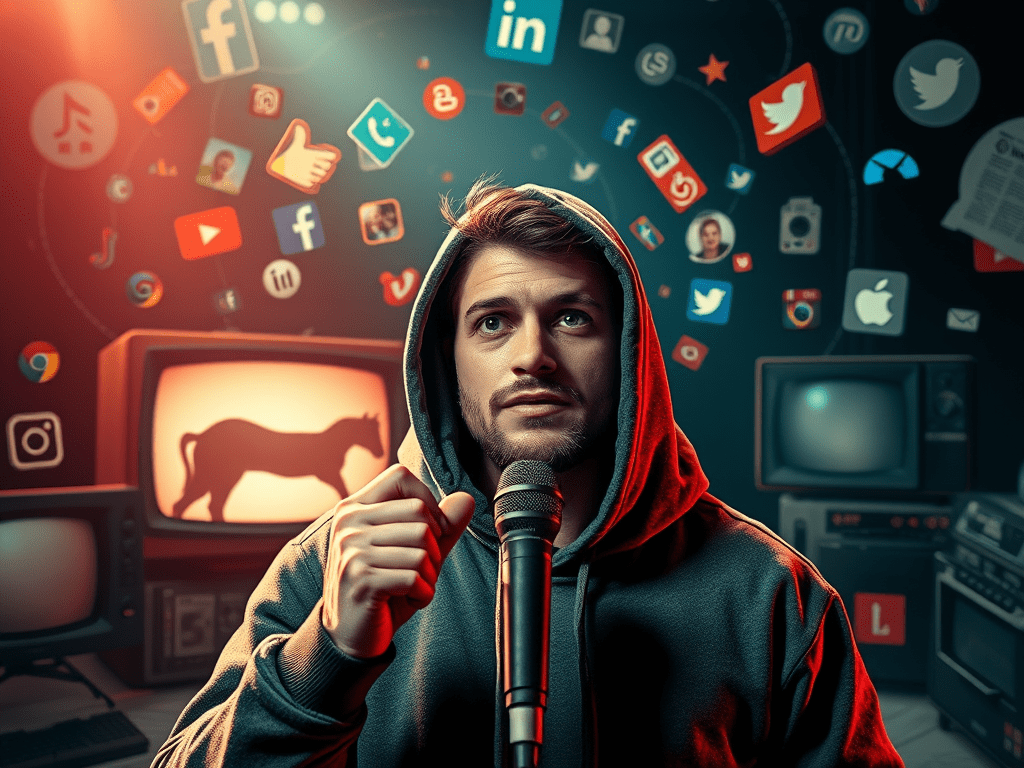
    In her clear-eyed and quietly blistering essay, “The ‘Mainstream Media’ Has Already Lost,” Helen Lewis paints a picture that should make any old-school news anchor break out in hives: a world where Joe Rogan has more political leverage than the sitting Vice President of the United States. Days before the 2024 election, Kamala Harris reportedly wanted to appear on Rogan’s podcast. He declined. Not out of spite or political protest, but simply because he could. That’s power. That’s the media landscape now.

    The term “mainstream media” has become a wheezing relic, a dusty VHS tape of a bygone era. The networks that once shaped public consensus now resemble aging bodybuilders—still flexing, but under the blinding fluorescents of a Planet Fitness instead of the Mr. Olympia stage. Meanwhile, Rogan and his ilk bench-press audiences of millions, all while wearing hoodies and sipping from branded tumblers. He doesn’t need legacy media. Legacy media needs him—and it’s already too late.

    Lewis reports that 54 percent of Americans now get their news from social media. Let that sink in. More than half the country is being spoon-fed their worldview by apps designed to addict, outrage, and silo. Instead of objective reporting, people now binge infotainment curated by opaque algorithms trained to fatten engagement at any cost. These feeds aren’t delivering news; they’re cultivating dopamine dependency.

    Welcome to the Age of the Algorithmic Snake Oil Salesman. The modern grifter doesn’t stand on a soapbox in a public square—he livestreams in 4K from a ring light-lit garage, selling supplements, conspiracies, and cultural resentment like they’re Girl Scout cookies. Facts are irrelevant. Performance is king. These charlatans don’t have to be right—they just have to be loud.

    Irony of ironies: these influencers wrap themselves in the cloak of “authenticity.” They curse, they rant, they “tell it like it is,” but their every inflection is calibrated for virality. Rage isn’t an emotion—it’s a marketing strategy. Performative outrage now passes for truth, and click-through rates replace credibility.

    As the mainstream media limps into irrelevance, it takes with it a few other quaint notions—like science. In this brave new world, you don’t need peer review when you have followers. Why believe the CDC when a ripped guy with a ring light and an Instagram handle ending in “.truth” tells you that vaccines are a globalist plot? The return of diseases like measles and tuberculosis—once considered conquered—are just collateral damage in the war on expertise.

    And with the fall of old-school journalism, our already threadbare civic discourse has collapsed into a gladiator arena of smug narcissists screaming at each other with all the subtlety of a demolition derby. Politeness is for chumps. Nuance is for cowards. The algorithm doesn’t reward thoughtful dialogue—it feeds on belligerence. Online, the dumbest guy in the room often gets the biggest microphone, because ignorance is loud, confident, and apparently good for ad revenue.

    Let’s not forget critical thinking, that delicate orchid now trampled under the steel-toed boots of clickbait and tribal rage. The marketplace of ideas has become a black market of weaponized talking points. People are no longer consuming information—they’re huffing ideological fumes. And like any good addict, they don’t want to quit. They want a stronger hit.

    Lewis doesn’t offer false hope. There’s no tidy ending where the media reclaims its place and truth triumphs in a feel-good montage. Instead, she suggests the comeback of reason, of trust in science, of civil discourse—will only happen the way all painful recalibrations happen: through crisis. It will take something even more catastrophic than COVID-19 to shock us back into reality. Only when the fantasy scaffolding collapses and we’re left staring at real, unfiltered chaos will the fever break.

    Until then, we scroll. We rage. We share. We follow. We spin deeper into silos. And we continue pretending that Joe Rogan isn’t the new Cronkite.

    But he is.

  • Dumbbells and Demagogues: The Bizarre Battle for the Bros

    Dumbbells and Demagogues: The Bizarre Battle for the Bros

    In “The Battle for the Bros,” Andrew Marantz dons his flak vest and ventures into the testosterone-slicked minefield of online masculinity, where disenfranchised young men are drifting rightward faster than a Joe Rogan cold plunge. Bro culture, Marantz argues, isn’t just real—it’s a booming cottage industry of rage, raw meat, and red pills. It thrives on podcasts, YouTube channels, and Instagram feeds soaked in motivational bile, where carnivore diets, deadlifts, and conspiracy theories all count as self-improvement.

    At the center of this digital flex-off is the Rogan Industrial Complex, which has evolved from left-leaning curiosities like The Young Turks to its current stance of muttering about immigrants while gnawing on elk jerky and praising Vladimir Putin’s virility. Rogan isn’t just an influencer—he’s a cultural battering ram who can probably swing a presidential election with a few bro-ish shrugs and an anecdote about DMT. Meanwhile, the left is left blinking in the dust, coming off to many young men as smug, brittle, and somehow both humorless and condescending—like a human resources memo with a sociology degree.

    Marantz interviews Hasan Piker, a foul-mouthed socialist Twitch-streamer with cheekbones sharp enough to cut through the culture war. Piker wants to offer a leftist alternative to the Bro pipeline, but despite his 1.5 million subscribers, he’s still playing catch-up to Rogan’s podcast empire. Piker gets it: if you tell a broke 23-year-old living in his parents’ basement that he’s “privileged,” don’t be shocked when he rage-clicks his way into the arms of Andrew Tate.

    The tragedy—and farce—of this ecosystem is that much of it runs on ersatz authenticity. Grifters wear the costume of “real talk” while peddling warmed-over xenophobia and junk-science self-help. Marantz muses on whether the left can produce its own no-nonsense avatar of male angst—someone with enough swagger, wit, and working-class rage to compete. Though not mentioned in the essay, Bill Burr came to mind as I pondered a possible counterforce to the bro culture from the right. Burr is pissed off, principled, and perpetually exasperated—a man who could roast Elon Musk and filet toxic masculinity in the same breath. But Burr is sui generis, not a manufactured product. As Marantz rightly notes, you don’t summon authenticity with a PR team and a protein shake.

    The real kicker? In a post-truth world, what matters isn’t truth—it’s vibes. And right now, the right’s vibes are winning the war for the bros.