Category: culture

  • From Bicep Envy to Rolex Envy

    From Bicep Envy to Rolex Envy

    As a teenage bodybuilder, you suffered from classic body dysmorphia—the iron game’s most reliable side effect. Your arms measured a thick, hard-earned 19 inches. Impressive by any sane standard. But Arnold’s were 23. He owned the Rolex of physiques: cathedral pecs, mountain biceps, mythological proportion. You, by comparison, felt like you were wearing a plastic Timex.

    You could bench 400 pounds. Across the gym, a human forklift was casually repping 500 to warm up his joints. He was the champion. You were the fraud. The mirror didn’t show muscle; it showed deficiency. Reality had no vote. Comparison ran the court.

    Years later, the iron left your life, but the disease simply changed wardrobes.

    Now you collect watches. You watch Bosch. Titus Welliver stalks through Los Angeles wearing a Rolex Submariner like a badge of existential authority. Lance Reddick appears in the same universe, his TAG Heuer sitting on his wrist with the quiet confidence of a man who signs warrants and ends conversations.

    It isn’t the watches that get to you. It’s the gravity. The presence. The sense that the watch is merely the visible edge of a life lived at full command.

    Then you look down.

    Your Citizen Eco-Drive stares back—accurate, reliable, environmentally responsible. The watch of a reasonable man. The watch of an overweight suburbanite who owns a good coffee maker and worries about cholesterol. For a brief moment, you consider curling into the fetal position and asking the universe for a refund.

    The condition has a name: Watch Dysmorphia.

    Watch Dysmorphia is a status-perception disorder in which satisfaction with one’s watch—and by extension, one’s life—collapses under the pressure of upward comparison. The object on the wrist may be handsome, capable, even excellent. None of that matters. Against the symbolic weight of a Rolex on a television detective or the effortless confidence of a higher-status wearer, adequacy feels like failure.

    Like its muscular ancestor, the disorder ignores objective reality. A solid Citizen becomes a narrative of smallness. A respectable collection becomes evidence of mediocrity. The luxury watch is no longer a tool for telling time; it becomes a portable mythology of power, competence, and gravitas. When you look at your own wrist, you aren’t checking the hour—you’re reading a verdict.

    The result is predictable: dissatisfaction, restless upgrading, momentary relief, then renewed deficiency. Not because the watch is lacking, but because comparison has quietly rewritten the terms of enough.

    To live with Watch Dysmorphia is to learn a hard law of modern life:

    Comparison is the mother of misery.

  • The Wrist That Ate the Workday

    The Wrist That Ate the Workday

    Working from home is supposed to be a privilege. Deliver the numbers, meet the deadlines, and you’re spared the slow death of freeway traffic and fluorescent lighting. Your company trusts you. Your productivity is tracked by a sleek little monitoring app that converts your workday into a tidy efficiency score.

    Unfortunately, your desk shares airspace with the enemy.

    The lacquered watch box sits there like a silent casino. You glance at the watch on your wrist. Nice. Solid choice. But what about the others? You lift the lid. A row of polished faces looks back at you—steel, lume, sapphire, promise. You’re supposed to be refining actuarial tables, tightening the language in your report, making sure the graphs don’t embarrass you in front of management.

    Instead, you swap.

    The new watch feels right. For three minutes.

    Then doubt creeps in. Maybe the diver was too heavy. Maybe the field watch better matches your “work-from-home professional” persona. Swap again. Back to the box. Another selection. Another micro-adjustment to your identity. Meanwhile, the cursor blinks on an unfinished paragraph, and your productivity score quietly bleeds out.

    You know the behavior is neurotic. You also know you’re waiting for a moment of revelation—for one watch to settle onto your wrist and announce, in a calm and authoritative voice, This is the one. The watches remain silent. So you keep rotating, chasing a verdict that never comes.

    What you have is Chrono-Proximity Compulsion.

    The disorder is simple: when your collection lives within eyesight, your brain enters a loop—check, compare, swap, repeat. Each decision feels minor, harmless, even rational. In aggregate, they shred your attention into chrome-plated confetti. The watches stop telling time and start interrupting it. Work hours dissolve into wrist experiments, each swap chasing a mythical state of alignment between object, mood, and self.

    The cure is drastic but effective.

    You remove the collection from the battlefield. Down to the basement it goes—sealed in a treasure trunk, out of sight, out of negotiation. No lineup. No options. No silent chorus asking to be chosen.

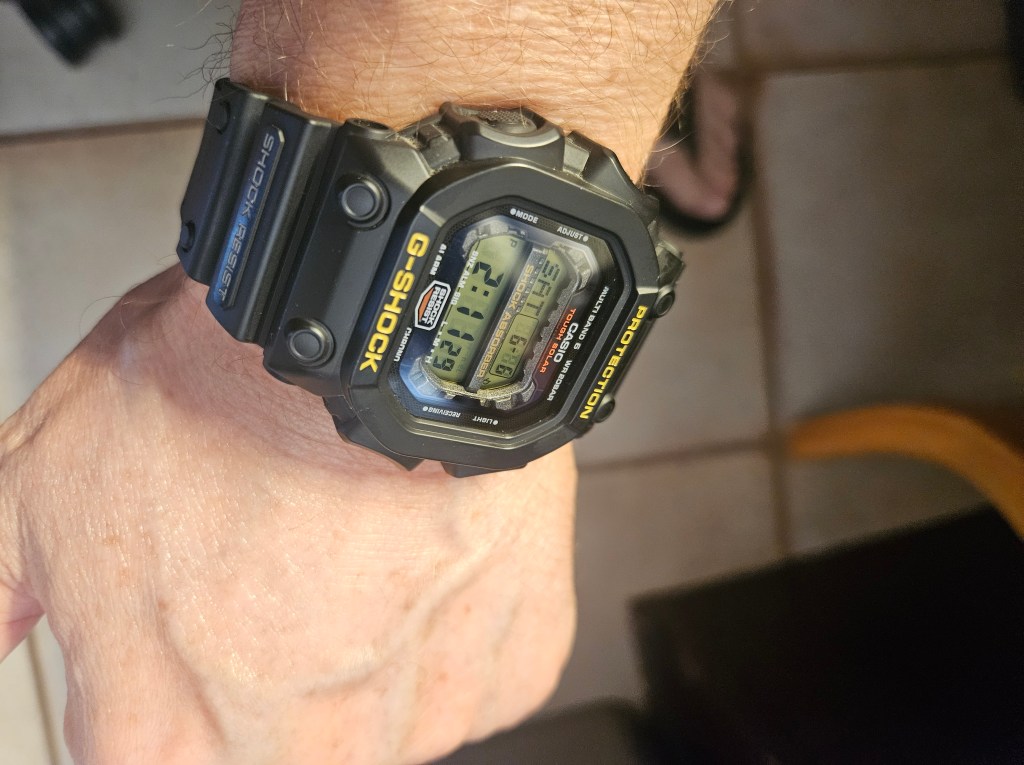
    On your wrist remains the G-Shock GW5000.

    It does not flatter you. It does not whisper about heritage, craftsmanship, or lifestyle. It does not ask to be admired or reconsidered. It delivers one message, blunt and unromantic: Get back to work.

    For the first time all day, the cursor moves.

    And the efficiency app finally has something to measure.

  • Waiting for the Next Drop: The Life of the Permanent Preorder

    Waiting for the Next Drop: The Life of the Permanent Preorder

    A man in his seventies from Europe posts auto-dubbed videos about G-Shocks with the intensity of a street prophet announcing the end times. His eyes bulge with evangelical urgency. He does not merely review watches; he radiates them. In one recent video, he leaned toward the camera and said, with grave reassurance, “I know you can’t wait for this year’s G-Shocks to become available, but until they are, I will help you pass the time with a sneak preview.”

    Pass the time.

    The phrase landed like a diagnosis. There we were—a global congregation of grown adults—looking for ways to anesthetize the hours until the next release. Life, for the watch addict, begins to resemble a holding pattern: existence reduced to the long, airless interval between one novelty hit and the next. The unboxing is the event. Everything else is the waiting room.

    This is Interval Dependency Syndrome: the condition in which a collector’s emotional life organizes itself around the gaps between launches. Ordinary days feel hollow, like static between radio stations. Meaning returns only when a preorder opens, a shipment clears customs, or a tracking number shows movement. Time is no longer inhabited. It is endured—stretched thin and restless—until the next dopamine delivery arrives.

    What unsettled me most was not the message but the messenger. A man in his seventies, serving as the Pied Piper of perpetual anticipation, guiding younger collectors deeper into a life structured around the next release window. There is something quietly alarming about old age spent in permanent prelaunch mode—experience accumulated, years spent, and still the horizon defined by sneak previews.

    At some point the question becomes unavoidable: if your life is organized around passing the time, when exactly do you plan to live it?

  • From Wrist to World: The Long Climb Out of Gollumification

    From Wrist to World: The Long Climb Out of Gollumification

    At a certain depth, the watch obsessive stops merely owning watches and begins inhabiting them. He lives in beat rates and power reserves, dreams in lume, and speaks a dialect composed entirely of tolerances, metallurgy, and micro-adjustments. This language becomes his native tongue—and everyone else’s becomes a foreign one. Instead of translating himself back into ordinary conversation, he doubles down. Why speak about people, work, or weather when there are case coatings, anti-magnetism ratings, and the eternal question of 20mm versus 22mm?

    This is Gollumification: the slow psychological narrowing that occurs when a hobby expands to occupy the territory once reserved for identity, emotion, and social life. The enthusiast begins to interpret the world through horological logic. Reliability matters more than warmth. Precision outranks connection. Conversations become monologues disguised as education. Over time, the technical vocabulary hardens into a private dialect that excludes anyone not fluent in the faith.

    The social consequences arrive quietly. Friends feel the intensity and step back. Family members nod politely, then change the subject, then eventually stop asking. Their distance confirms the collector’s growing suspicion that the outside world lacks depth or appreciation. The loop closes: fewer people, more watches; more expertise, less range as a human being.

    Advanced Gollumification produces a curious asymmetry. The collection becomes refined, curated, museum-worthy. The collector becomes narrower, guarded, and faintly brittle—capable of explaining torque tolerances at length but uncomfortable with ordinary emotional exchange. He manages mechanisms with surgical care while neglecting the untidy maintenance of relationships.

    Some drift into this state gradually, the behavioral accretion so slow they don’t notice the cave forming around them. Others embrace it knowingly, wearing their social withdrawal like a badge of purity. If the world doesn’t understand watches, the problem must be the world.

    Rarely, something interrupts the descent. A spouse’s fatigue. A child’s indifference. The uneasy realization that the collection is thriving while the rest of life is running on reserve. This is the beginning of De-Gollumification.

    De-Gollumification is the difficult return from horological exile—the moment the collector recognizes that memorizing every movement specification is not the same as being present in his own life. The shift begins with a painful inventory: relationships neglected, conversations hijacked, attention diverted into stainless steel and sapphire. The enthusiast steps back from the private dialect of lume performance and lug geometry and relearns the language of ordinary human exchange.

    The watches remain, but their jurisdiction shrinks. Identity migrates back to where it belongs. The collector stops leading with the wrist and starts leading with attention. The transition is humbling and occasionally disorienting, like emerging from a quiet bunker into daylight.

    Successful De-Gollumification does not require selling the collection. It requires abandoning the bunker. The pieces stay. The spell breaks. There are fewer lectures and more listening, fewer unboxings and more presence. The whisper of my precious gives way to something healthier and far more difficult: our life.

  • Leaving Action Park: The Day Your Watch Obsession Loses Its Voltage

    Leaving Action Park: The Day Your Watch Obsession Loses Its Voltage

    In the 1980s, some of my New Jersey friends spent their summers at a place that now sounds less like a water park and more like a liability experiment: Action Park. After watching the documentary Class Action Park, I was reminded that this was no ordinary recreational facility. It was a carnival of abrasions, concussions, electrocutions, and broken bones—a gauntlet designed by people who apparently believed safety was a form of weakness. And yet, for the locals, surviving Action Park wasn’t a warning; it was a credential. If you came out scraped, bruised, and still standing, you belonged. You were tough. You were one of them. When a former employee explained the park’s eventual collapse, his answer was simple and almost philosophical: like everything else, it just took its course.

    Watch obsession operates the same way. When you’re deep inside it, the madness feels permanent. The research, the tracking, the buying, the selling, the late-night forum autopsies—it grips you with the conviction that this is who you are now. But no obsession sustains peak intensity forever. Eventually the voltage drops. The chase slows. The emotional temperature falls. And when it does, you enter what might be called a Tribal Burnout Exit—the quiet unwinding of an identity built around a shared fixation. The relief is immediate: less pressure, less noise, less compulsion. But the sadness follows close behind. You don’t just lose the obsession; you lose the tribe, the language, the rituals, the daily structure that gave shape to your time.

    This is the strange aftertaste of recovery. You escape the psychological Action Park—but you also miss the ride. The hobby that once exhausted you also organized your days and connected you to people who spoke your dialect of madness. Without it, the calendar can feel oddly spacious, even exposed.

    That’s why the end of watch madness shouldn’t be treated as a victory lap but as a transition plan. Obsessions always have a shelf life, whether you admit it or not. When this one burns out—and it will—you’ll need something sturdier, quieter, and healthier to take its place. Otherwise, the mind, uncomfortable with empty space, will simply go looking for the next amusement park.

  • The Taco Bell Effect: How Fast Food and Watches Keep You Hungry

    The Taco Bell Effect: How Fast Food and Watches Keep You Hungry

    My daughters wanted Taco Bell for dinner. I could have abstained, assembled a respectable salad, and preserved my nutritional dignity. Instead, I chose the chicken soft tacos—modest, reasonable, practically virtuous by fast-food standards. And Taco Bell, as always, performed its engineered magic. Somewhere in Irvine, a laboratory of flavor chemists continues its quiet mission: maximize salt, fat, texture, and novelty until the brain lights up like a slot machine. The tacos tasted fantastic. Dopamine rang the bell. I walked away feeling disciplined, even proud—two tacos and a side of sliced bell peppers. Look at me, a responsible adult navigating fast food with restraint.

    Then, about an hour later, the bill came due.

    My appetite didn’t return politely. It kicked the door in. Hunger surged with a strange urgency, as if the meal had not fed me but awakened something restless and unfinished. I ate an apple. Still hungry. I opened a bag of Trader Joe’s Organic Elote Corn Chip Dippers. Still hungry. I cut a thick slice of sourdough and buried it under peanut butter. The sensation wasn’t indulgence—it was pursuit, as though my metabolism were trying to collect a debt the tacos had promised but never paid.

    I was still hungry when I finally surrendered—not to satiety, but to sleep, the only reliable way to close the kitchen.

    Clearly, I had suffered from the Taco Bell Effect: the paradoxical state in which a highly engineered, intensely satisfying experience delivers maximum sensory pleasure and minimum lasting fulfillment, triggering a rebound surge of appetite shortly after consumption. Designed for flavor density, salt, fat, and rapid dopamine, the meal convinces you—briefly—that you’ve eaten well and even responsibly. Then, an hour later, your metabolism files a formal protest. Hunger returns louder than before, prowling the kitchen like a debt collector. The Taco Bell Effect isn’t overeating; it’s under-satiation disguised as satisfaction—a culinary confidence trick in which the experience feels indulgent, the calories look reasonable, and the aftermath sends you negotiating with apples, chips, and peanut butter while wondering how two tacos opened a hunger portal instead of closing one.

    The Taco Bell Effect and the compulsive watch purchase run on the same psychological circuitry: both deliver stimulation without closure. Taco Bell gives you flavor, salt, fat, and novelty, but not satiety; the experience excites the appetite rather than resolving it. A compulsive watch purchase works the same way. You get the hit—research, tracking, unboxing, wrist shots, forum validation—but the emotional hunger remains untouched. Instead of quieting desire, the purchase sharpens it. Within days, you’re browsing again, comparing again, chasing the next micro-difference the way a fast-food meal sends you back to the pantry. In both cases, the problem isn’t excess; it’s insufficient psychological fullness.

    The illusion that traps people is the calorie logic of the hobby: “It’s only one watch,” just as “It’s only two tacos.” But the real metric isn’t the size of the purchase—it’s the behavior that follows. A healthy acquisition produces satiety: you stop looking, you forget the market, you wear the piece without agitation. A Taco Bell watch, by contrast, is engineered for stimulation—limited editions, countdown drops, spec debates, influencer hype. It tastes intense but digests poorly. The result is the horological equivalent of metabolic whiplash: the dopamine spike fades, and the mind, still unsatisfied, starts hunting again.

  • Precision Displacement: When the Bezel Replaces the Mirror

    Precision Displacement: When the Bezel Replaces the Mirror

    You know, at least in theory, that the soul deserves more attention than the watch box. But theory is one thing; the comfort of brushed titanium is another. The soul is abstract, unruly, and resistant to instruction. There is no manual, no torque specification, no authorized service interval. A watch, by contrast, behaves. It offers dimensions, tolerances, finishes, and measurable improvements. You can change a strap and feel progress. You can regulate a movement and feel control. The inner life asks unsettling questions; the outer object gives reassuring answers. And so, without ever making a formal decision, you begin treating the collection while postponing the treatment of yourself. The watches become a buffer—a polished, luminous perimeter against the vague anxiety of being a finite creature with unfinished business.

    This drift has a name: Precision Displacement Syndrome—the habit of redirecting emotional or spiritual uncertainty into domains that reward technical exactness. Instead of confronting meaning, identity, or mortality, you refine alignment, accuracy, and material quality. The language shifts accordingly. You stop asking whether your life is coherent and start asking whether the bezel action is crisp. The psyche seeks certainty wherever it can find it, and mechanics provide something the soul does not: compliance.

    Over time, this pattern produces a strange and impressive asymmetry. The collection improves. It becomes curated, rationalized, and narrated with the solemnity of a museum catalog. Meanwhile, the interior landscape narrows. Complexity is replaced by control; vulnerability by optimization. This is Gollumification—the quiet contraction of the inner life alongside the expansion of horological expertise. Faced with the untidy work of self-examination, the enthusiast retreats into the clean world of case thickness, lume performance, crown feel, and strap chemistry, where every unease can be translated into a specification and every mood can be managed with a purchase.

    The final transformation is subtle but unmistakable. Precision Displacement Syndrome does the thinking for you. Instead of asking, Who am I becoming? you ask, Is this the correct lug width? The watches grow more refined, more intentional, more spiritually justified. The wearer grows more guarded, more dependent, more quietly organized around objects that stabilize his emotional climate. Like Tolkien’s cave-dweller, he becomes pale but authoritative, whispering “my precious” over a perfectly regulated timepiece—externally upgraded, internally undernourished, and increasingly persuaded that mastery of the mechanism is a close enough substitute for mastery of his life.

  • Watch Hermit Mode

    Watch Hermit Mode

    At a certain point in the hobby, something subtle and irreversible happens: your internal rhythms begin to synchronize with the mechanical rhythms on your wrist. Time is no longer something you check; it is something you become. Welcome to Watch Hermit Mode—the state in which life is reorganized around precision, predictability, and the closed-loop efficiency of a well-regulated movement. The world outside is noisy, random, and inefficient. Your world is none of those things. Clothing becomes a uniform, routines run on fixed cycles, social invitations are flagged as system malfunctions, and discretionary hours are redirected toward higher-order maintenance: strap swaps, rotation optimization, wrist-time analytics, and the quiet satisfaction of knowing exactly how your collection is performing. Early mornings, early nights, and aggressive schedule defense are not quirks; they are operational strategy. What begins as efficiency slowly hardens into elective isolation. You are no longer merely wearing a machine. You are running its operating system.

    The symptoms appear gradually. First comes the 24-Hour Uniform Protocol. One outfit rules them all: sleep, gym, house, repeat. You go to bed in training shorts and a performance shirt, wake up in them, live in them, sweat in them, shower, and replace them with an identical specimen waiting like a spare part. Wardrobe changes are for amateurs and extroverts. You take quiet pride in your textile minimalism while lesser mortals stagger through multiple outfits a day like inefficient prototypes. Like a properly engineered movement, nothing in your system is ornamental. Every component has a function.

    Next comes the Saturday Night Diver Symposium. While your spouse and her friends are making custom concert signs for a desert music festival, you are at home performing strap swaps with surgical focus, refining a rotation calendar, and updating your annual wrist-time ledger. You know—without irony—that your Seiko Marine Master logged exactly 863 hours last year. This information feels important to you. It is less important to everyone else, who now watches you the way one observes a man who alphabetizes his spices by emotional significance.

    Your tolerance for human friction declines accordingly. Grocery shopping becomes a dawn operation conducted among the sleepwalking and the defeated. The early hour is not about convenience; it is about control. By the time the world wakes up, you have completed coffee, steel-cut oats, kettlebells, macro acquisition, and inventory storage. Bed at nine. Up at five. While the masses drift through their dreams, your system has already executed its morning cycle.

    The final stage is known domestically as Captain Cancel. Social plans are treated as hostile intrusions and neutralized with strategic intelligence: weather risks, parking deficiencies, epidemiological concerns, structural hazards, noise pollution, or the sudden discovery that a once-beloved comedian has not been funny since the Reagan administration. On the rare occasion you attend Taco Tuesday, you insert improvised ear protection, declare a medical issue, and Uber home to safety. The long-term result is operational peace. Invitations cease. The perimeter holds.

    If any of this feels familiar, the diagnosis is clear. You have optimized your life for accuracy, order, and solitude. The chaos of human variability has been replaced by the calm logic of regulated systems. In Watch Hermit Mode, you are not hiding from the world. You have engineered a better one—smaller, quieter, perfectly timed. The door is locked from the inside, the key discarded, and the movement is running beautifully.

  • Monowatch Asceticism Meets the Skinny Yoga Guy

    Monowatch Asceticism Meets the Skinny Yoga Guy

    As the clock keeps punching holes in the calendar and I drift into the middle distance of my sixties, I’m stalked by the uneasy sense that I am not the man I’m supposed to be. I carry thirty extra pounds like unpaid emotional invoices. I cave to food temptations with embarrassing regularity. I indulge in narcissistic spirals of self-pity. My body bears the archaeological record of a lifetime of weightlifting injuries. Something has to give. The question isn’t whether I’m a complex human being—of course I am—but which single image can give me dignity, courage, and self-possession as I face my obligations, stay engaged with this lunatic world, and fend off entropy. The image that keeps returning, uninvited but insistent, is this: I am the Skinny Yoga Guy.

    The Skinny Yoga Guy eats vegan, clean, and whole, not as a performance but as a quiet discipline. He hits his protein macros with buckwheat, pumpkin seeds, peas, soy, garbanzos, and nutritional yeast, without sulking or negotiating. He cooks plant-based meals anchored in Thai, Mexican, and Indian traditions, not sad beige bowls marketed as “fuel.” He doesn’t snack like a raccoon in a pantry; he sips cucumber water and green tea and moves on with his day.

    He practices yoga six days a week, a full hour each time, sweating without complaint. The body lengthens. The spine straightens. He appears taller, calmer, less compressed by life. There’s a faint health glow—less “Instagram guru,” more “someone whose joints don’t hate him.” The discipline reshapes his temperament. The short fuse and indulgent sulks fade. In their place emerges a man who notices other people, attends to their needs without sermonizing, and discovers—almost accidentally—that service makes him sturdier, not smaller.

    In this revised operating system, the watch obsession quietly dies. No more chunky diver watches as heroic cosplay. No rotation. No drama. Just one watch: the G-Shock GW-5000. The purest G-Shock because it refuses theater. Shockproof, accurate, solar-powered, atomically synced. No Bluetooth, no notifications, no begging for attention. It does one thing relentlessly well: it tells the truth about time. It is reliability without narcissism.

    If the GW-5000 is indestructibility stripped of spectacle, then my assignment is clear: I must become its carbon-based counterpart. Less bloat. Fewer features. More uptime. Yoga becomes joint maintenance. Vegan food becomes corrosion control. No supplements that blink. No gadgets that chirp. No dietary Bluetooth pairing with guilt. Just a lean system designed to absorb impact, recover quickly, and remain accurate. GW-5000 firmware, now awkwardly attempting to run on two legs. Stripped down to one G-Shock, I can enjoy Monowatch Asceticism: the deliberate reduction of a watch collection to a single, purely functional timepiece as an act of identity purification. Ownership shifts from expression to discipline; the watch becomes less an accessory than a vow—proof that the wearer has stepped off the cycle of acquisition and into a life governed by restraint, durability, and quiet competence

    The longing is real. I want to be the Skinny Yoga Guy—disciplined, light, healthy—wearing a single $300 G-Shock as a quiet marker of having stepped off the status treadmill. I no longer want validation from a $7,000 luxury watch. Wanting this man is easy. Becoming him is not. That requires character, not aspiration.

    My hunch is that I need to write my way into him. A novel titled The Skinny Yoga Guy. Not a parody, not a self-help tract, but a chronicle of real-time change rendered with mordant humor and unsparing honesty. The book isn’t the point. Transformation is. The novel would simply be the witness.

    So here I am, a larval creature trapped in my cocoon. I must emerge as a new creature. The challenge is issued. Whether the world is waiting for my metamorphosis is irrelevant. I am. And that, for once, feels like enough.

  • The Dignity Liquidation Cycle: When Buying Feels Good and Selling Feels Necessary

    The Dignity Liquidation Cycle: When Buying Feels Good and Selling Feels Necessary

    If I were brutally honest, I’d admit that over the past twenty years, ninety-five percent of my watch purchases were impulsive. Which means ninety-five percent were evidence of arrested development with a credit card. I sold most of them at a loss—not because I needed the cash, but because I needed my self-respect. This is the Dignity Liquidation Cycle: the ritual of unloading recent purchases at a financial loss to restore psychological balance. The money forfeited becomes a self-administered fine, a tuition payment to the School of Impulse, and a symbolic attempt to reassert control over a mind that briefly wandered off without supervision.

    The harder question is not what I bought, but why I kept buying. My suspicion is cultural. I come from the Me-Generation, raised in 1970s California where desire wasn’t something to question—it was something to honor. Rob Lowe captured the atmosphere perfectly in Stories I Only Tell My Friends: the Counterculture as the Worship of the Self. Whatever the Self wants, the Self gets. No brakes. No compass. In Malibu’s sunlit dreamscape, people overdosed on pleasure, vanished into excess, and confused appetite with identity. When desire becomes sacred, reality becomes negotiable—and the bill eventually arrives.

    That wiring never quite left me. When I see a watch that speaks to me, my brain lights up like I’ve taken a controlled substance without the prescription. The surge is immediate and physical. Then comes the anger—not at the price, but at the loss of command. What does self-belief even mean if a rotating bezel can override your judgment? How do you grow into adulthood if your emotional economy still runs on the logic of a sixteen-year-old with access to a catalog?

    I don’t want rehab. I don’t want a hobby that has to be locked in a drawer for my own safety. I want a watch life that fits inside reality instead of pulling me out of it. Pleasure without compulsion. Enjoyment without drama. A collection that reflects judgment rather than appetite. In other words, I want the hobby to behave like an adult, even if the hobbyist occasionally does not.

    And here’s the punchline: even diagnosing the Me-Generation triggers nostalgia for being sixteen in Southern California in 1976, when the future felt endless and impulse felt like freedom. The danger is looking back too long. That way lies Lot’s wife, calcified in longing. So I change the channel. I close the YouTube reviews. Because the distance between “research” and “purchase” is about three videos—and I’ve learned the hard way that impulse has a very convincing voice when it sounds like happiness.