Category: culture

  • Trapped in the AI Age’s Metaphysical Tug-of-War

    Trapped in the AI Age’s Metaphysical Tug-of-War

    I’m typing this to the sound of Beethoven—1,868 MP3s of compressed genius streamed through the algorithmic convenience of a playlist. It’s a 41-hour-and-8-minute monument to compromise: a simulacrum of sonic excellence that can’t hold a candle to the warmth of an LP. But convenience wins. Always.

    I make Faustian bargains like this daily. Thirty-minute meals instead of slow-cooked transcendence. Athleisure instead of tailoring. A Honda instead of high horsepower. The good-enough over the sublime. Not because I’m lazy—because I’m functional. Efficient. Optimized.

    And now, writing.

    For a year, my students and I have been feeding prompts into ChatGPT like a pagan tribe tossing goats into the volcano—hoping for inspiration, maybe salvation. Sometimes it works. The AI outlines, brainstorms, even polishes. But the more we rely on it, the more I feel the need to write without it—just to remember what my own voice sounds like. Just as the vinyl snob craves the imperfections of real analog music or the home cook insists on peeling garlic by hand, I need to suffer through the process.

    We’re caught in a metaphysical tug-of-war. We crave convenience but revere authenticity. We binge AI-generated sludge by day, then go weep over a hand-made pie crust YouTube video at night. We want our lives frictionless, but our souls textured. It’s the new sacred vs. profane: What do we reserve for real, and what do we surrender to the machine?

    I can’t say where this goes. Maybe real food will be phased out, like Blockbuster or bookstores. Maybe we’ll subsist on GLP-1 drugs, AI-tailored nutrient paste, and the joyless certainty of perfect lab metrics.

    As for entertainment, I’m marginally more hopeful. Chris Rock, Sarah Silverman—these are voices, not products. AI can churn out sitcoms, but it can’t bleed. It can’t bomb. It can’t riff on childhood trauma with perfect timing. Humans know the difference between a story and a story-shaped thing.

    Still, writing is in trouble. Reading, too. AI erodes attention spans like waves on sandstone. Books? Optional. Original thought? Delegated. The more AI floods the language, the more we’ll acclimate to its sterile rhythm. And the more we acclimate, the less we’ll even remember what a real voice sounds like.

    Yes, there will always be the artisan holdouts—those who cook, write, read, and listen with intention. But they’ll be outliers. A boutique species. The rest of us will be lean, medicated, managed. Data-optimized units of productivity.

    And yet, there will be stories. There will always be stories. Because stories aren’t just culture—they’re our survival instinct dressed up as entertainment. When everything else is outsourced, commodified, and flattened, we’ll still need someone to stand up and tell us who we are.
  • The Death of Dinner: How AI Could Replace Pleasure Eating with Beige, Compliant Goo

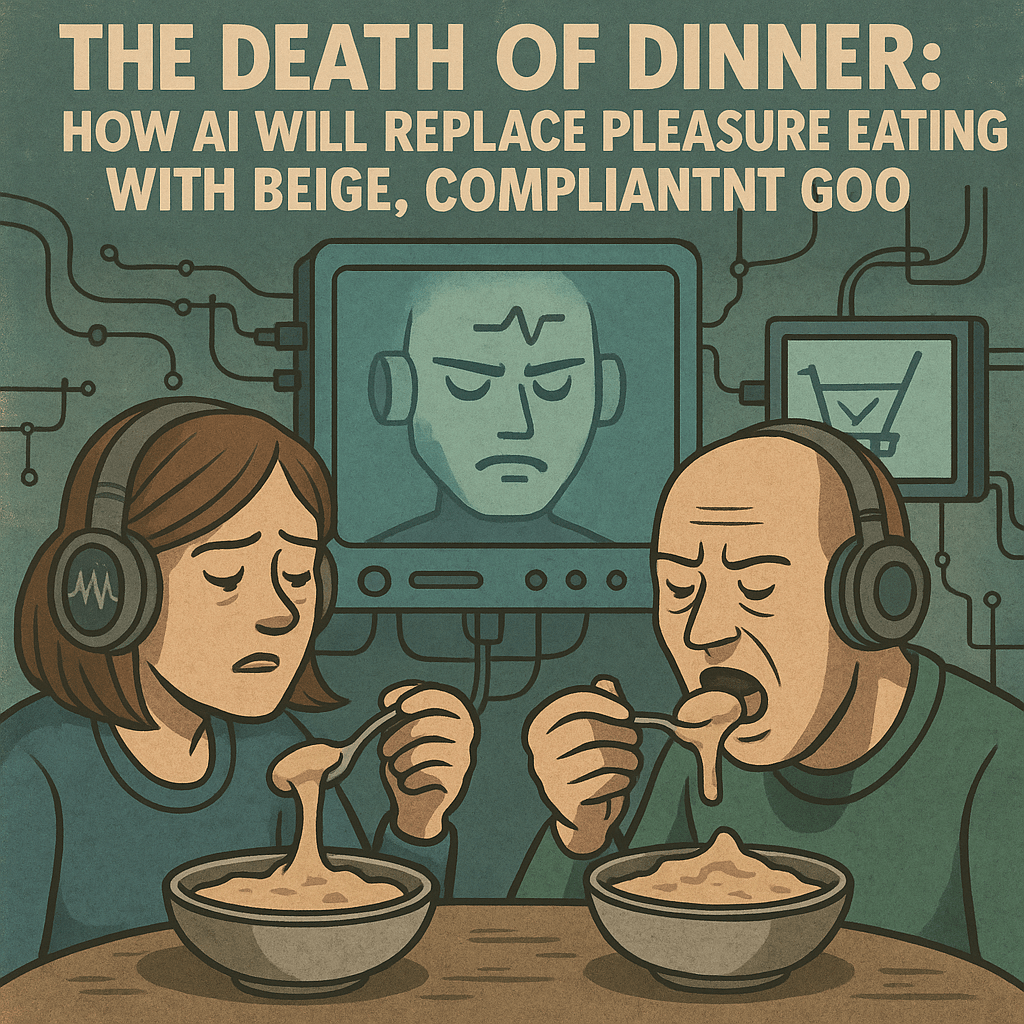
    The Death of Dinner: How AI Could Replace Pleasure Eating with Beige, Compliant Goo

    Savor that croissant while you still can—flaky, buttery, criminally indulgent. In a few decades, it’ll be contraband nostalgia, recounted in hushed tones by grandparents who once lived in a time when bread still had a soul and cheese wasn’t “shelf-stable.” Because AI is coming for your taste buds, and it’s not bringing hot sauce.

    We are entering the era of algorithm-approved alimentation—a techno-utopia where food isn’t eaten, it’s administered. Where meals are no longer social rituals or sensory joys but compliance events optimized for satiety curves and glucose response. Your plate is now a spreadsheet, and your fork is a biometric reporting device.

    Already, AI nutrition platforms like Noom, Lumen, and MyFitnessPal’s AI-diet overlords are serving up daily menus based on your gut flora’s mood and whether your insulin levels are feeling emotionally regulated. These platforms don’t ask what you’re craving—they tell you what your metrics will tolerate. Dinner is no longer about joy; it’s about hitting your macros and earning a dopamine pellet for obedience.

    Tech elites have already evacuated the dinner table. For them, food is just software for the stomach. Soylent, Huel, Ka’chava—these aren’t meals, they’re edible flowcharts. Designed not for delight but for efficiency, these drinkable spreadsheets are powdered proof that the future of food is just enough taste to make you swallow.

    And let’s not forget Ozempic and its GLP-1 cousins—the hormonal muzzle for hunger. Pair that with AI wearables whispering sweet nothings like “Time for your lentil paste” and you’ve got a whole generation learning that wanting flavor is a failure of character. Forget foie gras. It’s psy-ops via quinoa gel.

    Even your grocery cart is under surveillance. AI shopping assistants—already lurking in apps like Instacart—will gently steer you away from handmade pasta and toward fermented fiber bars and shelf-stable cheese-like products. Got a hankering for camembert? Sorry, your AI gut-coach has flagged it as non-compliant dairy-based frivolity. Enjoy your pea-protein puck, peasant.

    Soon, your lunch break won’t be lunch or a break. It’ll be a Pomodoro-synced ingestion window in which you sip an AI-formulated mushroom slurry while doom-scrolling synthetic influencers on GLP-1. Your food won’t comfort you—it will stabilize you, and that’s the most terrifying part. Three times a day, you’ll sip the same beige sludge of cricket protein, nootropic fibers, and psychoactive stabilizers, each meal a contract with the status quo: You will feel nothing, and you will comply.

    And if you’re lucky enough to live in an AI-UBI future, don’t expect dinner to be celebratory. Expect it to be regulated, subsidized, and flavor-neutral. Your government food credits won’t cover artisan cheddar or small-batch bread. Instead, your AI grocery budget assistant will chirp:

    “This selection exceeds your optimal cost-to-nutrient ratio. May I suggest oat crisps and processed cheese spread at 50% less and 300% more compliance?”

    Even without work, you won’t have the freedom to indulge. Your wearable will monitor your blood sugar, cholesterol, and moral fiber. Have a rogue bite of truffle mac & cheese? That spike in glucose just docked you two points from your UBI wellness score:

    “Indulgent eating may affect eligibility for enhanced wellness bonuses. Consider lentil loaf next time, citizen.”

    Eventually, pleasure eating becomes a class marker, like opera tickets or handwritten letters. Rich eccentrics will dine on duck confit in secrecy while the rest of us drink our AI-approved nutrient slurry in 600-calorie increments at 13:05 sharp. Flavor becomes a crime of privilege.

    The final insult? Your children won’t even miss it. They’ll grow up thinking “food joy” is a myth—like cursive writing or butter. They’ll hear stories of crusty baguettes and sizzling fat the way Boomers talk about jazz clubs and cigarettes. Romantic, but reckless.

    In this optimized hellscape, eating is no longer an art. It’s a biometric negotiation between your body and a neural net that no longer trusts you to feed yourself responsibly.

    The future of food is functional. Beige. Pre-chewed by code. And flavor? That’s just a bug in the system.

  • How Headphones Made Me Emotionally Unavailable in High-Resolution Audio

    How Headphones Made Me Emotionally Unavailable in High-Resolution Audio

    After flying to Miami recently, I finally understood the full appeal of noise-canceling headphones—not just for travel, but for the everyday, ambient escape act they offer my college students. Several claim, straight-faced, that they “hear the lecture better” while playing ASMR in their headphones because it soothes their anxiety and makes them better listeners. Is this neurological wizardry? Or performance art? I’m not sure. But apocryphal or not, the explanation has stuck with me.

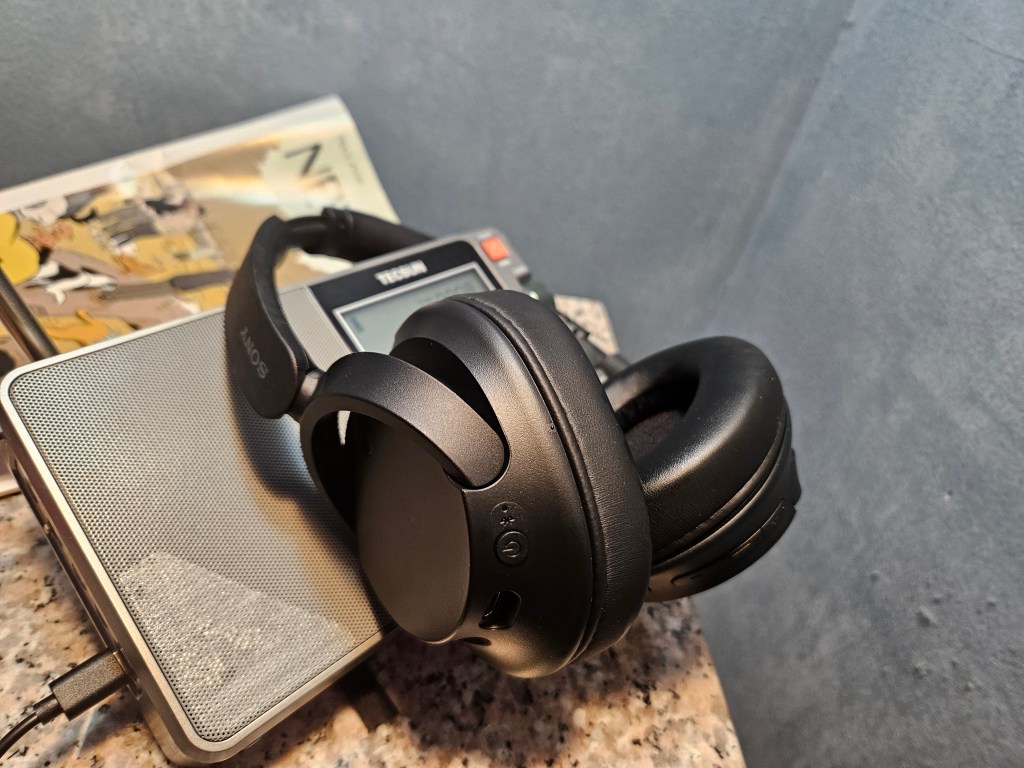
    It made me see the modern, high-grade headphone as something far more than a listening device. It’s a sanctuary, or to use the modern euphemism, an aural safe space in a chaotic world. You may not have millions to seal yourself in a hyperbaric oxygen pod inside a luxury doomsday bunker carved into the Montana granite during World War Z, but if you’ve got $500 and a credit score above sea level, you can disappear in style—into a pair of Sony MX6s or Audio-Technica ATH-R70s.

    The headphone, in this context, is not just gear—it’s armor. Whether cocobolo wood or carbon fiber, it communicates something quietly radical: “I have opted out.”

    You’re not rejecting the world with malice—you’re simply letting it know that you’ve found something better. Something more reliable. Something calibrated to your nervous system. In fact, you’ve severed communication so politely that all they hear is the faint thump of curated escapism pulsing through your earpads.

    For my students, these headphones are not fashion statements—they’re boundary-drawing devices. The outside world is a cacophony of canvas announcements, attention fatigue, and algorithmically optimized despair. Inside the headphones? Rain sounds. Lo-fi beats from a YouTube loop titled “study with me until the world ends.” Maybe even a softly muttering AI voice telling them they are enough.

    It doesn’t matter whether it’s true. It matters that it works.

    And here’s the deeper point: the headphone isn’t just a sanctuary. It’s a non-accountability device. You can’t be blamed for ghosting a group chat or zoning out during a team huddle when you’re visibly plugged into something more profound. You’re no longer rude—you’re occupied. Your silence is now technically sound.

    In a hyper-networked world that expects your every moment to be a node of productivity or empathy, the headphone is the last affordable luxury that buys you solitude without apology. You don’t need a manifesto. You just need active noise-canceling and a decent DAC.

    You’re not ignoring anyone. You’ve just entered your own monastery of midrange clarity, bass-forward detachment, and spatially engineered peace.

    And if someone wants your attention?

    Tell them to knock louder. You’re in sanctuary.

  • Late Night Linguine: What The Big Night Taught Us About Conan and Leno

    Late Night Linguine: What The Big Night Taught Us About Conan and Leno

    In Stanley Tucci’s criminally under-watched gem The Big Night (1996), two Italian brothers run a brilliant but nearly empty restaurant on the Jersey shore. Primo, the chef, is an artist of uncompromising culinary vision; he serves risotto that would make a grown man weep. But across the street, the tables are packed—at a red-sauce theme park run by Pascal, a bombastic hack whose food is as bland as it is crowd-pleasing. Pascal serves chicken parmesan to the masses. Primo serves culture, discipline, and slow-cooked soul. One sells out nightly. The other nearly starves. Sound familiar?

    This, friends, is the Conan O’Brien vs. Jay Leno saga, plated beautifully in pasta.

    Jay Leno is Pascal: Safe, Satisfying, and Instantly Forgettable

    Pascal’s restaurant thrives not because the food is good, but because it’s predictable. You know what you’re getting. He panders to his audience, flatters their expectations, and sends them home full but not transformed. He is, in short, Jay Leno with a meat tenderizer.

    Leno’s version of The Tonight Show was the late-night equivalent of chicken alfredo with a side of inoffensive jokes about airport security. He killed in the ratings. He never offended. He never challenged. He played it down the middle, night after night, in denim.

    Conan is Primo: Brilliant, Awkward, and Often Underappreciated

    Primo is the brother who won’t compromise. He won’t dumb down his food, won’t swap risotto for spaghetti and meatballs just to please a palate that doesn’t know what it’s missing. He’s the chef who would rather close the restaurant than sully the integrity of a dish. Conan O’Brien, likewise, built his comedy around absurdity, self-sabotage, and exquisite oddness. He gave us Masturbating Bears, Triumph the Insult Comic Dog, and the fever dream that was Walker, Texas Ranger lever pulls. Ratings? Meh. Relevance? Immeasurable.

    Conan didn’t want to “serve” the audience. He wanted to surprise them, confuse them, maybe even challenge them. He made comedy with the same attitude Primo brought to the kitchen: They may not get it now. But it matters.

    NBC as the Landlord: Just Pay the Rent, Please

    In The Big Night, the brothers face foreclosure. Their landlord doesn’t care about risotto. He cares about checks clearing. NBC was no different. When The Tonight Show with Conan O’Brien struggled in the ratings, the network didn’t see a delicate soufflé in progress. They saw empty tables and a full plate of Jay Leno standing by. So they evicted Primo and reinstalled Pascal, with all the subtlety of a bulldozer.

    The Feast We Deserved, the Chicken We Got

    The emotional climax of The Big Night is a final, silent meal—a simple omelet, cooked and shared after the titular “big night” fails to save the restaurant. There are no words, no triumph, no redemption—just brothers, food, and fatigue. It’s one of the great, quiet scenes in cinema, the kind that stays with you.

    And so it is with Conan. He didn’t get the kingdom. He didn’t win the war. But he got the last word. And his work—the strange, defiant, beautiful risotto of late-night—endures. Meanwhile, Leno’s legacy, like Pascal’s veal scaloppine, is likely to congeal into a nostalgic footnote: “He made people happy. I think?”

    Final Bill

    Pascal may have owned the block. But Primo owned the soul.
    Leno owned the ratings. But Conan owns the legacy.

    Late night, like food, is about more than filling time.
    It’s about what stays with you.

    And forty years from now, nobody’s quoting Jay Leno.

    But someone, somewhere, will be pulling the Walker, Texas Ranger lever. And laughing like hell.

  • Why I Don’t Read Happiness Essays (and Neither Should You)

    Why I Don’t Read Happiness Essays (and Neither Should You)

    Arthur Brooks is a best-selling author, a man of clear intellect, solid decency, and enough charm to disarm even a hardened cynic. I read one of his books, From Strength to Strength, which tackles the subject of happiness with insight, elegance, and more than a few glimmers of genuine wisdom. For a week or so, I even took his ideas seriously—pondering the slow fade of professional relevance, the shift from fluid to crystallized intelligence, and the noble art of growing old with grace.

    And then I moved on with my life.

    What I didn’t move on from, unfortunately, was the onslaught of Brooks’ happiness essays in The Atlantic. They appear like clockwork, regular as a multivitamin—each one another serving of cod liver oil ladled out with the same hopeful insistence: “Here, take this. It’s good for you.” The problem isn’t Arthur Brooks. It’s happiness itself. Or rather, happiness writing—that genre of glossy, over-smoothed, well-meaning counsel that now repels me like a therapy dog that won’t stop licking your face during a panic attack.

    Let me try to explain why.

    1. The Word “Happiness” Is Emotionally Bankrupt

    The term happiness is dead on arrival. It lands with the emotional resonance of a helium balloon tied to a mailbox. It evokes cotton candy, county fairs, and the faded joy of children playing cowboys and Indians—an aesthetic trapped in amber. It feels unserious, childish even. I can’t engage with it as a concept because it doesn’t belong in the adult vocabulary of meaning-making. It’s not that I reject the state of being happy—I’m just allergic to calling it that.

    2. It Feels Like Cod Liver Oil for the Soul

    Brooks’ essays show up with the regularity and charm of a concerned mother armed with a spoonful of something you didn’t ask for. I click through The Atlantic and there it is again: another gentle lecture on how to optimize my inner light. It’s no longer nourishment. It’s over-parenting via prose.

    3. Optimizing Happiness Is a Ridiculous Fantasy

    Some of Brooks’ formulas for increasing happiness start to feel like they were dreamed up by a retired actuary trying to convert existential dread into a spreadsheet. As if flourishing could be reduced to inputs and outputs. As if there’s a number on the dial you can crank up if you just follow the steps. It’s wellness-by-algorithm, joy-by-numbers. I’m not a stock portfolio. I’m a human being. And happiness doesn’t wear a Fitbit.

    4. Satire Has Already Broken the Spell

    Anthony Lane, in his New Yorker essay “Can Happiness Be Taught?,”
    dismantled this whole genre with surgical wit. Once you’ve read a masterful takedown of this kind of earnest life-coaching prose, it’s impossible to take it seriously again. Like seeing the zipper on a mascot costume, the magic disappears. You’re just watching a grown-up in a plush suit tell you to breathe and smile more.

    5. I Like Things That Exist in the World

    I’m interested in things with friction and form—things you can grip, build, question, deconstruct. Music. Technology. Communication tools. Exercise. Love. Psychological self-sabotage. You know, the good stuff. Happiness, as a subject, has all the density of vapor. It’s more slogan than substance, and when I see it trotted out as a destination, I start scanning for exits.

    6. It’s a Hot Tub Full of Bromides

    I have no interest in an adult ed class on happiness led by a relentlessly upbeat instructor talking about “mindfulness” and “centeredness” with the fixed grin of someone who has replaced coffee with optimism. I can already hear the buzzwords echoing off the whiteboard. These classes are group therapy in a coloring book—pastel platitudes spoon-fed to the emotionally dehydrated.

    7. It’s Not Self-Help. It’s Self-Surveillance

    Let’s be honest: a lot of happiness literature feels like a soft form of control. Smile more. Meditate. Adjust your attitude. If you’re not happy, it must be something you’re doing wrong. It’s capitalism’s way of gaslighting your suffering. Don’t look outward—don’t question the system, the politics, the institutions. Just recalibrate your “mindset.” In this sense, the language of happiness is more pacifier than pathfinder.

    So yes, Arthur Brooks writes well. He thinks clearly. He’s probably a better person than I am. But his essays on happiness make me recoil—not because they’re wrong, but because they speak a language I no longer trust. I don’t want to be managed, monitored, or optimized. I want to be awake. I want to be challenged. And if I’m lucky, I’ll get to experience the real stuff of life—anger, beauty, confusion, connection—not just a frictionless simulation of contentment.

    Happiness can keep smiling from the other side of the screen. I’ve got kettlebells to swing.

  • Siri at 30,000 Feet: Watch Reviews from the Android Abyss

    Siri at 30,000 Feet: Watch Reviews from the Android Abyss

    I’ve recently fallen into a strange corner of YouTube, where watch reviews by non-English speakers are automatically dubbed into English by an AI translator. The result? A surreal auditory hallucination that sounds like Siri moonlighting as a flight attendant. Every video becomes a low-budget dream sequence: a monotone voice calmly explaining bezel alignment while I mentally brace for instructions on how to locate the nearest flotation device.

    These AI-dubbed reviews don’t just kill the vibe—they exterminate it. What might have been a charming deep dive into dial texture or lug curvature turns into a bureaucratic fever dream. I’m not learning about watches. I’m trapped in a dystopian airline safety video, narrated by an android who sounds like he’s instructing me on what to do in the event the cabin has a drop in oxygen.

    The silver lining? These videos are the perfect antidote to impulsive spending. No matter how alluring the lume or limited the edition, the second I hear that synthetic drone describing a in robot voice a strange new word– “sapphireklysteelcasebackwithantimagneticresistance”–my urge to buy evaporates. The watch becomes a prop in an uncanny AI daymare—and I, mercifully, return to reality with my wallet intact.

  • Echo-Chamber Fatigue: When Trusted Media Starts to Sound Like Static

    Echo-Chamber Fatigue: When Trusted Media Starts to Sound Like Static

    For years, I counted The Bulwark and The Atlantic among the few media outlets that seemed to keep their heads above water. Thoughtful, principled, and often sharp in their critique, they offered a sense of clarity during a time when the political center felt like it was collapsing under the weight of tribalism. I read The Atlantic with the same reverence people once reserved for the Sunday paper. I tuned into The Bulwark’s podcasts with eagerness, particularly the sparring matches and tag-team lamentations of Sarah Longwell and JVL.

    But lately, something’s shifted.

    I’ve been struggling to name the feeling exactly—disenchantment, disconnection, even a touch of annoyance. It’s not that they’ve suddenly started publishing bad takes (though no one’s immune to that). It’s more that I’ve come to feel like I’m listening to the same looped monologue. Their arguments are often cogent, yes, but increasingly predictable—a chorus of like-minded voices rehearsing the same concerns, circling the same drain.

    Call it echo-chamber fatigue.

    The Bulwark, once a clarion voice of principled conservatism and a fierce watchdog against authoritarianism, now often feels like a room full of smart people endlessly rehashing the same grim diagnosis: American democracy is circling the drain. The problem isn’t that they’re wrong—it’s that I already see the collapse unfolding in real time. Listening to it dissected again and again isn’t cathartic anymore. It’s just salt in the wound.

    The Atlantic, long celebrated for its intellectual breadth, increasingly feels like it’s scanning for moral alignment before publishing an idea. There’s little friction. Little surprise. Just a gentle stroking of reader confirmation bias.

    Meanwhile, I find myself gravitating to media that feels more alive—podcasts like The Gist with Mike Pesca, Blocked and Reported with Katie Herzog and Jesse Singal, The Fifth Column, Ink-Stained Wretches, and even The Remnant with Jonah Goldberg. These shows don’t always align with my politics—and that’s exactly the point. They’re not trying to usher me into ideological safety. They’re wrestling with absurdities across the spectrum. They’re skeptical. Curious. Sometimes contrarian. Always human.

    And that, I think, is the deeper issue: emotional resonance. The Bulwark and The Atlantic haven’t necessarily changed. I have. Or perhaps the times have. I need more than agreement—I need tension, exploration, contradiction. The intellectual monoculture, no matter how principled, starts to feel like a sedative after a while.

    I’ve even considered canceling my subscriptions. But there’s friction there, too: The Atlantic remains a useful classroom resource, and every now and then, The Bulwark sparks a genuinely engaging dialogue that reminds me why I once admired it so much.

    So I stay, for now. But I’ve moved my ears—and increasingly, my attention—toward media that still surprises me. That still thinks out loud, rather than reading from a polished script.

    I’m not rejecting thoughtful media. I’m just bored of watching it slowly turn into liturgy.

  • The future, we’re told, is full of freedom—unless you’re the one still cleaning the mess.

    The future, we’re told, is full of freedom—unless you’re the one still cleaning the mess.

    Last semester, in my college critical thinking class—a room full of bright minds and burnt-out spirits—we were dissecting what feels like a nationwide breakdown in mental health. Students tossed around possible suspects like a crime scene lineup: the psychological hangover of the pandemic, TikTok influencers glamorizing nervous breakdowns with pastel filters and soft piano music, the psychic toll of watching America split like a wishbone down party lines. All plausible. All depressing.

    Then a re-entry student—a nurse with twenty years in the trenches—raised her hand and calmly dropped a depth charge into the conversation. She said she sees more patients than ever staggering into hospitals not just sick, but shattered. Demoralized. Enraged. When I asked her what she thought was behind the surge in mental illness, she didn’t hesitate. “Money,” she said. “No one has any. They’re working themselves into the ground and still can’t cover rent, groceries, and medical bills. They’re burning out and breaking down.”

    And just like that, all our theories—algorithms, influencers, red-vs-blue blood feuds—melted under the furnace heat of economic despair. She was right. She sees the raw pain daily, the kind of pain tech billionaires will never upload into a TED Talk. While they spin futuristic fables about AI liberating humanity for leisure and creativity, my nurse watches the working class crawl into urgent care with nothing left but rage and debt. The promise of Universal Basic Income sounds charming if you’re already lounging in a beanbag chair at Singularity HQ, but out here in the world of late rent and grocery inflation, it’s a pipe dream sold by people who wouldn’t recognize a shift worker if one collapsed on their marble floors. The future, we’re told, is full of freedom—unless you’re the one still cleaning the mess.

  • Thank You for Your Support (and Your Gullibility): Two Corporate Con Jobs from the ’80s

    Thank You for Your Support (and Your Gullibility): Two Corporate Con Jobs from the ’80s

    I almost called this post “Memories of Manipulative Advertising,” but that’s like calling water wet. Advertising doesn’t sometimes manipulate—it’s a full-time gaslighter with a jingle and a logo. The question isn’t if it’s lying to you, but how cleverly, and with what flavor of Americana.

    Case in point: Bartles & Jaymes, the wine cooler swindle dressed up like a Norman Rockwell painting. Back in the 1980s, I worked at Jackson’s Wine & Spirits in Berkeley—a respectable shop selling overpriced Bordeaux to grad students pretending they weren’t on food stamps. Then came the Bartles & Jaymes blitz, courtesy of Hal Riney & Partners and the corporate overlords at E & J Gallo.

    Suddenly, America was smitten with two crusty front-porch philosophers in denim and flannel, sipping pastel-colored booze and thanking us for “our support,” as if we were funding their modest struggle to afford Hamburger Helper and citronella candles. They weren’t winemakers. They weren’t even real. One was a retired Air Force pilot, the other a contractor. But that didn’t stop millions from believing that these Gallo sock puppets had personally hand-crafted their strawberry kiwi elixirs under a tin roof in Appalachia.

    These weren’t ads. They were full-blown folklore, sold to a Reagan-era audience desperate to believe in something wholesome—preferably something with artificial watermelon flavor and a 5% ABV.

    But the biggest act of psychological warfare I witnessed during my wine shop tenure came not from Gallo, but from that fizzy behemoth: Coca-Cola.

    In 1985, Coke announced it was changing its iconic recipe. Cue the national meltdown. Pickup trucks rolled into the wine store like we were FEMA and this was the end times. Grown men, trembling with brand-loyalty withdrawal, bought crates of “original” Coke like it was bottled youth. I became an emergency hand truck operator, wheeling out what amounted to liquid nostalgia to wide-eyed customers who treated me like I was delivering insulin to a diabetic family.

    Then, surprise!—Coke re-released the original as “Classic Coke,” and everyone breathed a sugary sigh of relief. It was less a product relaunch and more a mass-conditioning experiment, proving that if you poke the American consumer hard enough, they’ll thank you for the bruise.

    These weren’t just ad campaigns. They were operatic manipulations of identity, trust, and memory—corporate psyops disguised as beverage options.

  • WordPress: My Kettlebell Gym of the Mind

    WordPress: My Kettlebell Gym of the Mind

    I launched my WordPress blog on March 12, evicting myself from Typepad after it was sold to a company that treats blogs the way landlords treat rent-controlled tenants: with bored disdain. Typepad became a ghost town in a bad neighborhood, so I packed up and moved to the gated community of WordPress—cleaner streets, better lighting, and fewer trolls.

    For the past ten weeks, I’ve treated WordPress like a public journal—a digital sweat lodge where I sweat out my thoughts, confessions, and pedagogical war stories from the frontlines of college teaching. I like the routine, the scaffolding, and the habits of self-control. Blogging gives me something I never got from social media or committee meetings: a sense of order in a culture that’s spun off its axis.

    But let’s not kid ourselves. WordPress isn’t some utopian agora where meaningful discourse flourishes in the shade of civility. It’s still wired into the dopamine economy. The minute I start checking likes, follows, and view counts, I’m no longer a writer—I’m a lab rat pressing the pellet button. Metrics are the new morality. And brother, I’m not immune.

    Case in point: I can craft a thoughtful post, click “Publish,” and watch it sink into the abyss like a message in a bottle tossed into a septic tank. One view. Maybe. Post the same thing on Reddit, and suddenly I’m performing for an arena full of dopamine-addled gladiators. They’ll upvote, sure—but only after the professional insulters have had their turn at bat. Reddit is where clever sociopaths go to sharpen their knives and call it discourse.

    WordPress, by contrast, is a chill café with decent lighting and no one live-tweeting your every existential sigh. It’s a refuge from the snarling hordes of hot-take hustlers and ideological bloodsport. A place where I can escape not only digital toxicity, but the wider derangement of our post-shame, post-truth society—where influencers and elected officials are often the same con artist in two different blazers.

    Instead of doomscrolling or screaming into the algorithmic void, I’ve taken to reading biographies—public intellectuals, athletes who aged with dignity, tech pioneers who are obsessed with taking over the world. Or I’ll go spelunking into gadget rabbit holes to distract myself from the spiritual hangover that comes from living in a country where charisma triumphs over character and truth is whatever sells ad space.

    In therapy-speak, my job on WordPress is to “use the tools,” as Phil Stutz says: to strengthen my relationship with myself, with others, and with the crumbling world around me. It’s a discipline, not a dopamine drip. Writing here won’t make me famous, won’t make me rich, and sure as hell won’t turn me into some cardigan-clad oracle for the digital age.

    What it will do is give me structure. WordPress is where I wrestle with my thoughts the way I wrestle kettlebells in my garage: imperfectly, regularly, and with just enough sweat to keep the madness at bay.