Category: culture

  • Beauty Isn’t Enough: The Moment Desire Meets Reality

    Beauty Isn’t Enough: The Moment Desire Meets Reality

    We are, most of us, walking around with a quiet fracture. Something missing. Something we believe can be restored if only we find the right object, the right achievement, the right arrangement of circumstances. The trouble is that the very strategies we use to make ourselves whole often deepen the crack.

    Citizen Kane is the classic case study. Charles Foster Kane acquires everything—wealth, art, palaces, influence—only to die alone, whispering “Rosebud” like a man calling into an empty room. For all his possessions, he never possessed what he actually wanted: love. The sled was not valuable. It was a memory of unconditional belonging, the one thing money could not purchase.

    Once the unconscious decides that objects can deliver emotional completion, the trap is set. The shopping becomes symbolic. The acquisition becomes therapeutic. And the disappointment becomes inevitable.

    I would like to believe I’m immune to this logic. I am not.

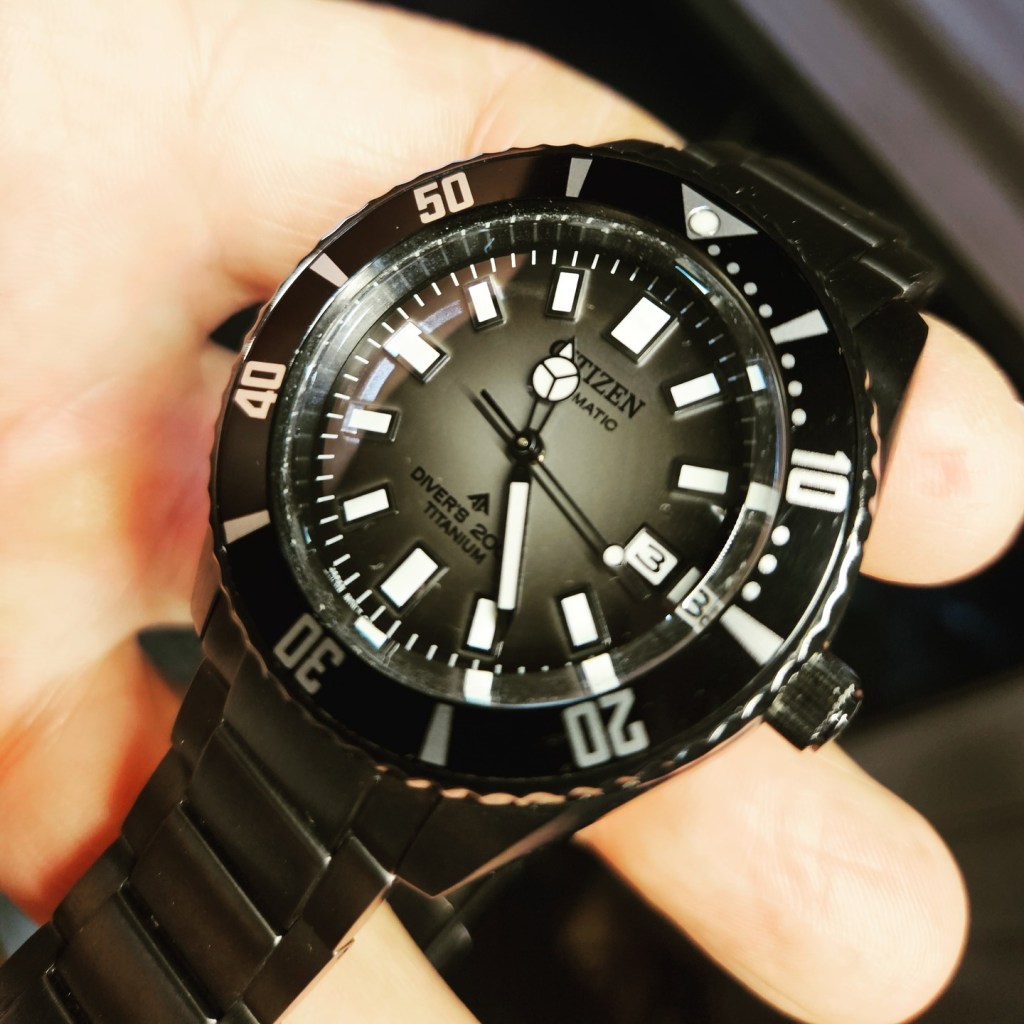
    I’m not trying to buy love, exactly. What captures me is beauty. A gunmetal sports car. A finely finished watch. Once the image enters my field of vision, it begins to work on me. Beauty has a narcotic quality. It doesn’t argue. It persuades.

    When I was nine, my father and I would slow the car to stare at Corvettes and my personal holy object, the Opel GT. We didn’t own them. That hardly mattered. Looking was enough to induce a quiet intoxication.

    Some forms of beauty age well. Twenty years ago my wife and I bought a framed Botticelli Primavera from an antique store. It hangs in our living room today. I still find myself studying the figures, pulled into the scene as if it were unfolding in slow motion. The painting asks nothing from me except attention.

    Watches work differently.

    A beautiful watch does not merely sit on the wall. It demands a relationship. It asks to be worn, justified, integrated into daily life. And here the problem begins.

    I’m drawn to intricate designs—chronographs, textured dials, bold contrasts, mechanical drama. These pieces photograph beautifully. They mesmerize under good lighting. They whisper, You are a man of taste.

    But then I put them on.

    The dial is busy. The legibility suffers. The weight feels wrong. The watch stays in the box.

    That’s the gap—the quiet but decisive chasm between aesthetic admiration and lived use. Many of the most beautiful watches I’ve owned became box queens: admired, respected, and essentially abandoned.

    A fellow collector once told me he doesn’t mind owning watches he never wears. He thinks of them as wall art. People collect paintings for beauty; he collects watches the same way.

    I can’t do that.

    Unworn watches don’t calm me. They make me uneasy, like unfinished obligations. A watch that isn’t part of daily life feels less like art and more like a small, expensive mistake.

    Years ago, a neighbor let me drive his black Corvette—a childhood Rosebud made real. Within minutes, the spell broke. The cabin was cramped. The ride was harsh. Every bump transmitted directly into my spine. I handed back the keys with relief.

    The car looked magnificent. Living with it would have been miserable.

    That experience clarified something I’ve come to accept across watches, cars, and most objects of desire:

    Beauty alone is not enough.

    At some point, every enthusiast discovers a personal boundary—what might be called a Functional Integrity Threshold. It’s the moment when aesthetic appeal loses its authority because the object fails in comfort, usability, or daily harmony.

    Below that threshold, beauty is intoxicating.
    Beyond it, beauty becomes irrelevant.

    Give me both—form and function in alignment—or give me neither. Anything else is just another Rosebud waiting to disappoint.


  • The Psychology of Watch Regret

    The Psychology of Watch Regret

    Many watch obsessives suffer from a peculiar torment: they cannot live with a certain watch—and they cannot live without it.

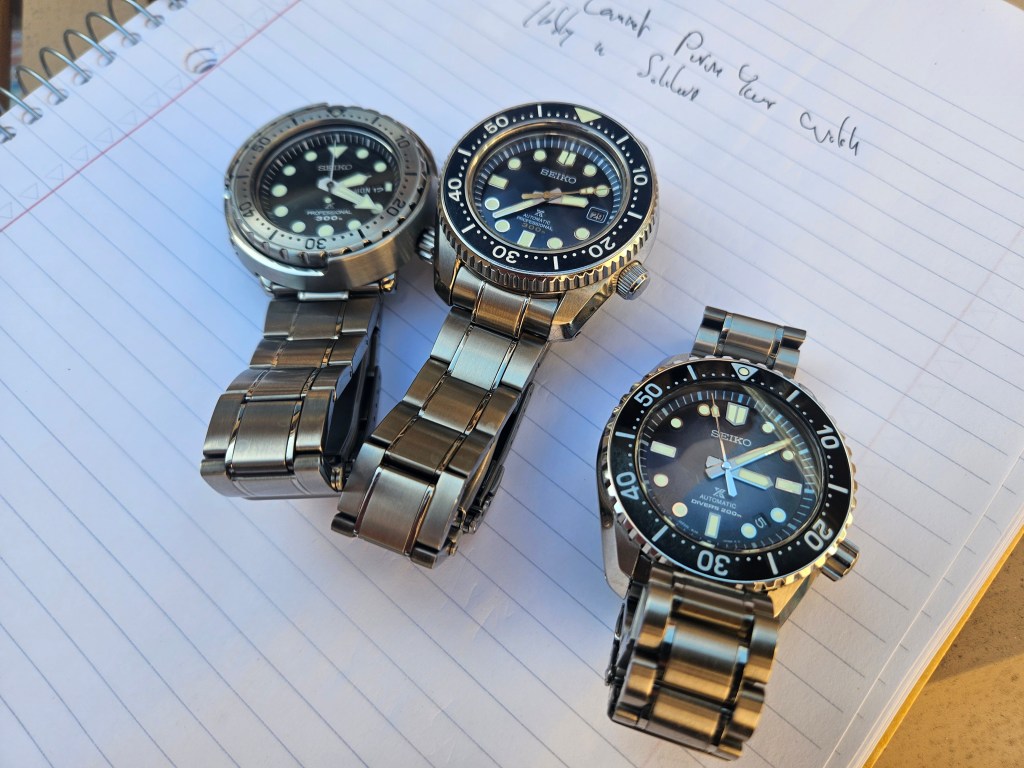
    I know men who have bought, sold, and rebought the same Seiko Tuna a dozen times. Some have done the same dance with the MM300. The watch leaves. Relief follows. Then memory begins its quiet revision. The flaws soften. The virtues glow. Soon the search begins again.

    If you stay in this hobby long enough, you may find yourself performing the same ritual.

    First comes infatuation. The watch arrives. For a few weeks it feels inevitable, permanent, right. Then something shifts. It wears too large. Too heavy. Too shiny. Too common. The magic drains out. Now the watch feels like a mistake that must be corrected immediately.

    You list it on eBay. You price it aggressively. You take the loss. You feel lighter, cleaner, restored.

    Three months later you’re browsing photos of the very same model.

    This time it looks perfect.

    You buy it back at full price.

    The cycle repeats. Sell low. Buy high. Repeat until the watch has cost you the price of a small used car. Some collectors eventually place the piece in a safe—not for protection from thieves, but from themselves.

    There is a darker variation.

    You sell the watch. Regret arrives. You go looking for it again.

    But now it’s gone.

    No listings. No used examples. No inventory anywhere. The watch has slipped into the market’s shadow, and your memory transforms it into something mythic. You dream about it. You refresh search pages like a man checking hospital monitors. You wake up with the emotional intensity of a breakup and the soundtrack of the Chi-Lites playing somewhere in your head.

    Have you seen her?

    This condition has a name: The Acquisition Reversal Loop—the compulsive pattern in which a collector sells a watch to escape dissatisfaction, only to experience renewed desire and repurchase the same model, often at repeated financial loss.

    The loop is not about watches. It is about unstable desire.

    A healthy hobby is supposed to add pleasure and structure to your life. The Acquisition Reversal Loop does the opposite. It erodes judgment. Preferences become volatile. Decisions become emotional. The collector begins to resemble a child—grabbing, rejecting, reclaiming, and insisting that this time the object will finally make everything right.

    This is not enthusiasm. It is regression.

    At this point the watches are no longer possessions. They are orbiting objects in a private gravitational field of anxiety and impulse.

    And when a hobby turns into a system that repeatedly empties your wallet, disturbs your peace, and overrides your judgment, it is no longer a pastime.

    It is a small, well-lit prison.

    The question is no longer which watch to buy.

    The question is how—and whether—you intend to leave.

  • Horological Deconversion: When the Romance Finally Breaks

    Horological Deconversion: When the Romance Finally Breaks

    I recently wrote an essay arguing that pursuing mechanical watches in a digital world is a kind of elegant absurdity—an expensive devotion to obsolete technology while the rest of civilization marches toward sensors, satellites, and software. My proposed remedy was simple and slightly heretical: sell the mechanicals and replace them with an atomic or Bluetooth G-Shock. Accuracy, durability, zero drama. Efficiency instead of romance. Sanity instead of ritual.

    The piece was meant to provoke. Not just readers—me. Writing, after all, is less self-expression than self-interrogation. As Kafka put it, it’s the axe for the frozen sea. Sometimes the ice you crack belongs to your own illusions.

    What began as a tongue-in-cheek thought experiment turned into something less comfortable. It forced me to examine the possibility that my love for mechanical watches isn’t love at all—it’s theology.

    Over the years I refined my taste, sold the excess, and curated a tight collection of mechanical divers. Vintage aesthetic. Tool-watch credibility. A faint whiff of James Bond climbing out of the ocean with a harpoon gun and moral certainty. I told myself this evolution reflected discernment, maturity, identity.

    But the thought experiment raised a harder question: Did I discover my taste—or manufacture it?

    Human beings have a habit of building sacred spaces inside a profane world. Perhaps my watches became sacred cows—objects elevated not because they were necessary, but because I needed something to stand against modern life. Mechanical time as resistance. Analog as virtue. Nostalgia as courage.

    In this story, I cast myself as a quiet rebel.

    But what if the story is fiction?

    What if I’m not resisting anything at all? What if I’ve simply joined a small tribe of aging enthusiasts who reassure each other that spending thousands on obsolete machines is an act of character rather than consumerism?

    At that point, the romance starts to look like cosplay.

    Thousands spent on purchase. Thousands more on service. All to reenact a cinematic memory of youth. The whole enterprise begins to resemble those baseball fantasy camps where middle-aged men pay to take batting practice with retired heroes and pretend, for a weekend, that the dream never ended.

    The thought experiment did something dangerous: it planted a fantasy.

    Sell everything.

    Replace the collection with one or two G-Shocks.

    Start over.

    The appeal isn’t the watch. It’s the psychological reset. The possibility of closing a chapter and reclaiming the mental bandwidth the hobby quietly occupies. Change, after all, is the most intoxicating drug available to a restless mind.

    I’ve felt this kind of impulse before.

    In 2005, after three decades of gym culture, I was standing in an LA Fitness in Torrance, wiping someone else’s sweat off a treadmill while pop music pounded overhead and everyone talked about nothing. The thought hit me with sudden clarity: I need to get out of here.

    Within a week I’d left the gym, bought kettlebells, started power yoga in my garage, and never went back. At the time it felt impulsive. In hindsight, it was alignment—something deep finally overriding inertia.

    I sometimes wonder if watch collectors experience the same internal shift—the moment when accumulation feels less like passion and more like weight. The urge to take a wrecking ball to the collection. To simplify. To breathe.

    This moment has a name: Horological Deconversion—the quiet psychological turn when watches stop looking like identity and start looking like artifacts of habit, mythology, and sunk cost.

    I know someone who went through it. A serious collector. Deeply invested. One day he had the overwhelming urge to sell everything and replace the collection with a $20 Casio F-91W. Eventually he did. He told me the move saved his sanity.

    He still reads the forums. Still watches the madness unfold. But now he’s an observer, not a participant. The zoo is still interesting when you’re no longer inside the cage.

    Anyone who sells their mechanical collection, buys a single indestructible digital, and walks away lighter will have my respect. Not because minimalism is virtuous, but because exits are hard. Leaving a closed system always is.

    There’s something quietly heroic about it—the horological version of a Shawshank escape. Crawl through the tunnel. Emerge on the other side. Stand in the rain and realize the prison was partly self-built.

    And somewhere beyond the walls, there’s a small, durable watch keeping perfect time—and a life of freedom and expanding possibilities.

  • Why a G-Shock Frogman Makes More Sense Than a Mechanical Collection

    Why a G-Shock Frogman Makes More Sense Than a Mechanical Collection

    If you come to me and confess that you’re curious about my watch hobby—intrigued, even—and ask for guidance so you can pursue the passion with the same enthusiasm, I won’t welcome you into the brotherhood.

    I’ll stop you at the door.

    If you are currently free from thoughts of watches, I will advise you to remain free. Walk away. Continue your life as a relatively sane and solvent human being. Because the mechanical watch hobby, viewed without romance or nostalgia, makes less and less sense in the modern world.

    You are paying premium money for obsolete technology in an age that worships useful technology. Why spend six thousand dollars on a Swiss machine that tells you the time when a five-hundred-dollar fitness watch can monitor your heart, track your sleep, detect arrhythmias, and quietly send your vital signs to your doctor before you collapse in a parking lot?

    Mechanical watches don’t make you healthier. They make you sentimental.

    The future is not kind to sentiment. As the world moves away from mechanical timekeeping, competent service will become slower, rarer, and more expensive. Your treasured watch will eventually be packed into a padded box and shipped across the country—or the ocean—where it will sit for months awaiting lubrication, regulation, or a gasket replacement. When it returns scratched, delayed, or mysteriously altered, you’ll enter a corporate complaint system so backlogged it feels less like customer service and more like geological time.

    Meanwhile, the social currency that once justified the expense is quietly evaporating.

    There was a time when a fine mechanical watch signaled professional success. Doctors noticed. Lawyers noticed. Bankers noticed. Today, most people don’t know a Rolex from a Fossil, and many don’t notice watches at all. The design language of luxury horology is becoming a private dialect spoken by a shrinking tribe.

    This is where the collector encounters Analog Futility Syndrome: the slow, uncomfortable realization that enormous resources are being poured into a technology that no longer solves a modern problem. The pleasure remains—but it is shadowed by a faint, persistent question: Why am I doing this?

    Meanwhile, the cultural signaling has inverted.

    Show up wearing a $500 solar-powered G-Shock that works everywhere, never needs service, survives abuse, and keeps atomic time, and people read something entirely different. Efficiency. Practical intelligence. Optimization. The G-Shock wearer looks like a person who solves problems, not one who collects them. The same watch works at the office, on a trail, or on a flight across time zones. It whispers competence. It suggests you might belong to MENSA. Or at least that you don’t spend your evenings arguing about bezel fonts.

    So if you ask me how to become a watch enthusiast, I will not guide you toward Swiss luxury and its Ferrari-like maintenance costs. I will point you toward the solar, radio-controlled, GPS-enabled tools that actually serve a modern life.

    A GPS Master of G Rangeman.
    A radio-controlled square.
    The digital Frogman.

    Real time anywhere. Light weight. Near-zero maintenance. Functional serenity.

    Writing this advice to you has caused something strange to happen to me while composing it. The argument has pointed an accusatory finger toward me. What began as guidance for you has become a prosecution of my imbecilic watch hobby.

    The longer I write, the more irritated I become at my own years of horological excess—years spent chasing mechanical romance while quietly accumulating cost, inconvenience, and low-grade anxiety.

    I may have to sell everything.

    I may have to replace the entire collection with a single indestructible digital watch and walk away.

    You think I’m exaggerating. I am not.

    Writing this has triggered a full-blown Horological Renunciation Fantasy: the emotionally charged vision of liquidating every mechanical piece and replacing them with one maintenance-free instrument—liberation not from watches, but from the psychological gravity of owning too many of them.

    The fantasy is seductive. I can’t imagine being happy right now unless I sell all my mechanicals and replace them with a digital Frogman.

    And that should tell you everything you need to know about the hobby.

  • Letting Go of the Bro Code

    Letting Go of the Bro Code

    My friend Lee retired at sixty-one, fled the tech industry, and landed in Santa Fe like a man stepping out of a chrysalis. The move gave him what he said his spirit had been begging for: a clean reinvention. These days he volunteers as a rescue worker at the local ski resort—hauling people out of trouble, useful again, awake in his body.

    My own retirement is eighteen months away, and I feel the same hunger for reinvention—but without the romance of relocation. My wife and kids aren’t uprooting, and neither am I. So if I’m going to change, the terrain has to be internal. I don’t need a new zip code; I need a new relationship with myself.

    Some of this craving is spiritual. Some of it is brutally practical. For the past five months I’ve been rehabbing a torn rotator cuff marinated in arthritis. I tried to negotiate with my kettlebell workouts—adjusting angles, trimming volume, pretending moderation would save me. It half-worked. What didn’t improve was the resentment. In fact, it metastasized.

    I know exactly how I got here. I overdid kettlebells—four days in a row, again and again—until my shoulder finally filed a formal complaint. Now the bells feel less like tools and more like accusations. I still want to train five or six days a week, but the thought of picking them up fills me with a low-grade fury. When resentment becomes chronic, it’s information. Ignoring it is how you end up injured and stubbornly proud about it.

    What I keep circling back to is yoga—specifically my mid-2000s era, when power yoga was my religion. Back when Bryan Kest and Rodney Yee videos taught me that yoga could be punishing, sweaty, and deeply satisfying. One hour. Total exhaustion. Muscles lit up, ego humbled, mind quiet. I want that again—not just the shape of it, but the mental state. I want to get lean. I want a diet that actually complements the practice: simple, semi-vegan, enjoyable. Yoga four days a week. The exercise bike on the others. Nothing heroic. Nothing destructive.

    Of course, underneath all of this is the same old human wish: character. I want a yoga lifestyle that reflects self-possession, self-discipline, and self-confidence—the real currencies of happiness. Not indulgence. Not macho theater. If I’m going to retire in the Southern California suburbs, fine. But I can’t be the retired guy slowly maiming himself in the garage, clinging to an identity that no longer serves him.

    Yoga never hurt me. Not once. It always left me clearer, calmer, and stronger in ways that mattered. As a lifetime weightlifter, I’m realizing I need to let go of the Bro-Coding and Bro-Signaling that once fed my pride. What is a real man, anyway? It isn’t someone chasing pump and punishment while overeating and limping through life. It’s someone fit, injury-free, and genuinely disciplined.

    Lee rescues skiers. I admire that. But before I can rescue anyone—before I can reinvent anything—I have to rescue myself first.

  • Evil With a Vacant Face: The Turpin Case and the Myth That Mental Illness Explains Everything

    Evil With a Vacant Face: The Turpin Case and the Myth That Mental Illness Explains Everything

    I remembered the Turpin case the way most people do: as a headline too grotesque to metabolize. Thirteen siblings chained, starved, beaten, and imprisoned by their parents until one of them finally escaped in 2018 and called the police. I hadn’t revisited the story until I saw an update, The Turpins: A New House of Horrors. In it, Diane Sawyer interviews three of the children who survived their parents’ private dungeon—only to be handed over by social services to another household that abused them all over again. The people who adopted them have since been convicted. The rescue, it turns out, was only a handoff to a new nightmare.

    What struck me immediately was how eerily gothic the parents appear, as if the story had summoned its own visual shorthand for evil. The mother, Louise Turpin, radiates menace—her face tight with cruelty and mental fracture. The father, David Turpin, looks equally arrested, a sixty-year-old man wearing the shaggy hair and slack affect of a disturbed adolescent. Both faces are blank, glum, almost vacant. And yet once you hear what they did—years of systematic starvation, torture, and control—you understand that the vacancy is not emptiness but concealment. Behind those dead expressions worked a tireless, inventive cruelty.

    They are plainly evil people. They also appear mentally ill. Those two facts do not cancel each other out. Narcissism, for instance, is a recognized pathology, but it often carries a moral charge—a pleasure in domination, a delight in harm. Watching the Turpin parents, I was reminded of M. Scott Peck’s The People of the Lie, a book I read decades ago that argued precisely this point: that evil can wear the mask of sickness, and sickness can provide cover for evil. Louise and David Turpin fit that category with chilling precision—malignant narcissists cloaked in religious piety, manipulating their children while feeding off their suffering.

    What makes Sawyer’s interview watchable, even bearable, is what comes after. The children speak about therapy, recovery, work, and the slow construction of a life that does not revolve around fear. Sawyer notes that they “won the hearts of the country,” and it’s true. They are lucid, self-possessed, and deeply sympathetic. You don’t pity them so much as root for them.

    The clearest light in the story is their sanity—and how visibly it flows from their love for one another. These siblings endured the same menace together. They shared it. They protected one another where they could, and afterward, that bond became ballast. They are not just survivors; they are witnesses for one another. Watching them, you come away with a rare conviction that sounds sentimental until you see it embodied: that love, stubborn and mutual, can outlast even prolonged, institutionalized evil. In this case, it appears to have done exactly that.

  • Buy Now, Regret Later: How Ancient Instincts Ruined Modern Shopping

    Buy Now, Regret Later: How Ancient Instincts Ruined Modern Shopping

    In the early 1990s, I saw comedian Rob Becker perform Defending the Caveman in San Francisco—a one-man anthropology class disguised as stand-up. His central thesis, stitched together from kitchen-table spats with his wife, was that men are hunters, women are gatherers, and this prehistoric wiring still runs our modern relationships like a bad operating system.

    His proof? Shopping.

    For the gatherer, shopping is a leisurely daydream. Wandering the mall for six hours and imagining buying things she can’t afford is an enriching sensory experience—like spiritual window-shopping. For the hunter, shopping is a surgical strike. He wants pants. He buys pants. He leaves. The suggestion to “just browse” makes his eye twitch.

    “Let’s get the hell out of here,” says the man. He has completed his mission. He has felled the beast.

    That moment—man as single-focus, tunnel-visioned, goal-oriented predator—explains a great deal about the pathology of watch addiction. We are still cavemen, just hairier and worse at squatting. And we don’t hunt food anymore. We hunt wristwear.

    We see a watch online and a brontosaurus steak lights up in our brain. Locked in. Target acquired. Our dopamine circuits spark like faulty Christmas lights. We must have it. There is no tranquility, no peace, until the object is in our possession.

    The problem? Our primitive instincts weren’t designed for the digital age. Back then, acquiring a new object meant trekking through wilderness, battling saber-toothed tigers, and earning your meal. Today, it’s clicking a “Buy Now” button while half-watching a YouTube review at your ergonomic standing desk, surrounded by a sea of unopened Amazon boxes. Intoxicated by online shopping platforms, we are overcome with the Horological Hunt Reflex–the involuntary lock-on response triggered by spotting a desirable watch. Once activated, attention narrows, patience evaporates, and the collector cannot rest until the object is captured—regardless of need, cost, or logic.

    Our brains still think we’re walking 40 miles to spear a mammoth. In reality, we’re reclining in office chairs with lumbar support, ordering $2,000 divers like they’re takeout sushi. The hunt requires no sacrifice, no sweat, no real effort. And so it never satisfies.

    This caveman instinct affects our watch hobby. We get the watch. We admire it. We post a photo to Instagram. Then—we twitch. We fidget. Our brain says, “Good job. Now go get another.”

    We are not content in the cave. Evolution didn’t design us for stillness. It designed us to be hungry. To prepare. To hoard. So we keep hunting. And the cave fills with stainless steel trophies until the glint attracts low-flying pterodactyls that dive-bomb us in our sleep and try to pluck the Omega off our wrist.

    We are maladapted creatures. Our eyeballs evolved for survival. Now they doom us. We were built to scan the horizon for danger. Now we scan Hodinkee, Instagram, Reddit, eBay, WatchRecon, and Chrono24 until our dopamine is a wrung-out dishrag and our bank account is an obituary.

    We’re trapped in a glitch—stone-age instincts, 5G bandwidth. Our visual fixation, once essential to survival, now chains us to a cycle of desire and regret. Thousands of watches flood our screens in a single hour, and our brains are too old and too soft to resist. The only real solution is exile. But exile from what? Our jobs, our networks, our entire digital lives?

    There is no cave to retreat to. Just another tab open.

  • The Howard Ratner School of Watch Collecting

    The Howard Ratner School of Watch Collecting

    Watch obsessives have more in common with Howard Ratner than we care to admit. Yes, that Howard Ratner—the unhinged gem pusher played with twitchy brilliance by Adam Sandler in the Safdie brothers’ cinematic panic attack, Uncut Gems. Ratner operates in the Diamond District behind bulletproof glass, drowning in sparkle and debt. We operate behind the bulletproof delusions of horological obsession, buried in brushed steel and moonphase complications.

    Like Ratner, we gamble—not at sportsbooks, but with FedEx tracking numbers. We tell ourselves, this is the one as we refresh the delivery status of the next “grail” watch. The package might as well be glowing, Pulp Fiction-style. And like Ratner chasing a cursed Ethiopian black opal mined from the bloodied crust of the Earth, we twist ourselves into financial and emotional pretzels to score that one special piece—the wrist-mounted miracle that will finally quiet the voices.

    Spoiler: it never does. Why? Because we are trapped in an Acquisitive Panic Loop–a self-perpetuating cycle of anxiety relieved only by purchase, followed immediately by renewed anxiety. Collections expand not by intention but by momentum, like debt rolling downhill.

    Like the crazed watch collector, Ratner is a man who thinks more is the cure. More bets. More jewels. More chaos. The watch obsessive runs the same play. We soothe our midlife despair not with therapy or silence, but with spring drives, meteorite dials, and limited edition bronze cases. Our collections don’t grow—they metastasize.

    Like Ratner, our problem isn’t the world. Our problem is internal. The call is coming from inside the skull. He can’t stop because he doesn’t want to stop. The thrill is the point. Every acquisition, every wrist shot, every gushing forum post—just another hit of synthetic joy to distract from the gnawing void. We call it a hobby. Let’s not kid ourselves. It’s dopamine addiction disguised as design appreciation.

    Uncut Gems is a cinematic espresso shot laced with panic. My wife and brother couldn’t sit through thirty minutes. Too stressful, they said. Too jittery. I’ve watched it three times.

    But of course I have. I’m a watch addict.

    I live in Ratner’s world. The caffeinated chaos? That’s not discomfort. That’s home.

  • Why Your Watch Doesn’t Make You Happy Anymore

    Why Your Watch Doesn’t Make You Happy Anymore

    To understand the madness of the modern watch addict, you’d do well to consult Dopamine Nation by Stanford psychiatrist Anna Lembke, a book that should be shelved somewhere between philosophy, neuroscience, and quiet screaming. Her central thesis? In an age of relentless indulgence, the line between pleasure and pain is not only blurry—it’s the same neurological pathway. You’re not escaping pain with your latest acquisition. You’re feeding it.

    “The smartphone,” she writes, “is the modern-day hypodermic needle.” And the drug? Dopamine—delivered in neat little parcels: TikToks, tweets, memes, and yes, wrist shots of watches you don’t own (yet). If you haven’t met your poison of choice, don’t worry. It’s just a click away.

    Lembke makes the uncomfortable truth clear: The more dopamine hits we seek, the more our brain adapts by reducing our baseline pleasure response. What once thrilled you—your grail watch, your Rolex Explorer, your Seiko with the Wabi-Sabi patina—now barely registers. You’re not chasing pleasure anymore. You’re just trying to feel something.

    Watch addicts, of course, understand this intimately. The pursuit of horological perfection starts out innocent enough: a G-Shock here, a vintage diver there. But soon you’re tumbling into the abyss of boutique limited editions and message board enablement, haunted by the need to stay relevant. Because here’s the twist: It’s not just about the watches. It’s about being seen. You post, you review, you flex because if you stop, you vanish. No new watches = no new content = digital extinction.

    And extinction, in a social-media world, feels like death.

    Lembke warns us that addiction thrives in secrecy, in the exhausting double life. The watch addict may present as a tasteful minimalist to family and friends, while secretly rotating 19 watches, five straps deep, waiting for the next “drop.” The addiction is fed by access, and we live in an access economy. New releases are no longer annual events—they’re hourly temptations. The vortex is bottomless. The supply creates the demand.

    Even worse, modern society normalizes this behavior. Everyone is scrolling. Everyone is upgrading. Our addiction to novelty is passed off as taste. Our frenzied consumption masquerades as identity. Lembke borrows from Philip Rieff to explain the deeper shift: “Religious man was born to be saved; psychological man is born to be pleased.” The modern watch collector doesn’t believe in salvation. He believes in configuration.

    But here’s the cruel irony: The more you seek to be pleased, the less capable you are of being pleased. In Lembke’s words: “Hedonism, the pursuit of pleasure for its own sake, leads to anhedonia—the inability to enjoy pleasure of any kind.”

    You can understand the watch addict’s feeble quest when you look at the Horological Dopamine Loop–the self-reinforcing cycle in which acquisition, posting, validation, and anticipation replace enjoyment. The watch no longer delivers pleasure; it merely resets the craving for the next hit.

    What’s the solution? A dopamine fast. Lembke prescribes it like a bitter medicine: Remove the source. Reset the brain. Let it reestablish homeostasis. For the watch addict, this means one thing: a watch fast.

    And yes—it’s brutal. I’ve been a watch obsessive for over twenty years. My longest fast? Six months. And I nearly went feral. New releases tempt. Friends enable. Algorithms whisper. Strap swaps and vintage reissues beckon like sirens. Even the FedEx truck starts to look like a personal tormentor.

    So you get creative. You stash watches in the safe and “rediscover” them. You buy new straps instead of new watches. You try to redirect the compulsion toward something productive: fitness, music, sourdough, monkish austerity. Anything but another chronograph.

    But the real cure, oddly enough, may be conversation—actual human connection. At watch meet-ups, we start out discussing bezels and spring bars, but within ten minutes we’re talking about life: real estate, parenting, knee surgeries, emotional burnout, dinner recipes. We talk for hours. But barely about watches.

    The truth slips out in these moments: we want to be free. We crave community more than we crave sapphire crystals. What began as a shared obsession has become a trap, and these conversations, paradoxically, offer relief from the very addiction that brought us together.

    Imagine a bunch of watch enthusiasts at a watch meet-up and we’re talking about everything but watches. Wrap your head around that.

  • Maudlin Grail Syndrome

    Maudlin Grail Syndrome

    As I consider Cicero’s call for self-restraint in Tusculan Disputations, my thoughts return to a story that’s haunted me for over twenty years—Anton Chekhov’s “Gooseberries.” It is, in essence, the tragic fable of a Maudlin Man, told with surgical clarity and Chekhovian cruelty.

    His name is Nicholai Ivanich, and he’s not merely pathetic—he’s morally revolting. He marries an aging, unattractive woman for her wealth and waits with predator patience for her to die. Once she obliges, he buys himself a country farmhouse ringed with gooseberry bushes, retreats from the world, and crowns himself a minor deity among the local peasants by handing out cheap liquor like some portly, provincial Dionysus.

    Chekhov doesn’t give us Nicholai’s voice. He gives us Ivan, the disgusted brother, who sees this man for what he is: a swollen, self-satisfied corpse in waiting. Ivan calls Nicholai’s farmhouse dream a “definite disorder”—not a goal, but a fixation, a fever dream dressed up as a life plan. For Ivan, his brother’s pastoral retreat is less Arcadia and more open-casket viewing. “He looked old, stout, flabby,” Ivan observes. “His cheeks, nose, and lips were pendulous. I half expected him to grunt like a pig.”

    That image sticks: Nicholai, the human piglet, grinning over his plate of gooseberries, believing he’s achieved bliss when in truth he’s just decaying in comfort.

    And then comes the moment that seals it—Nicholai’s nightly ritual: he’s brought a plate of gooseberries from his estate, and upon seeing them, he literally weeps with joy. “He looked at them in silence, laughed with joy, and could not speak for excitement.” He is consumed by the performance of happiness. It’s not the berries he loves—it’s what they symbolize. In his mind, they are proof that his life is complete.

    But it’s all delusion. Nicholai isn’t fulfilled—he’s embalmed in maudlin sentimentality, drunk on nostalgia for something that never really existed. His joy is cosmetic. He’s not flourishing. He’s fermenting.

    And this, I confess, reminds me of myself—and my fellow watch addicts.

    We, too, have our gooseberries. Ours just happen to tick.

    We post videos of our “grail watches” and glow with reverence as we hold them up to the camera like relics from a sacred shrine. We give breathless soliloquies about our “perfect” collections, our “ultimate” configurations. We praise bezels and dial textures the way Nicholai praises his berries—with trembling hands and watery eyes. And like Nicholai, we’re not convincing anyone but ourselves.

    Because deep down, we know: the drama is maudlin. We have arrived at Maudlin Grail Syndrome–a condition in which the collector performs reverence rather than experiencing peace. Tears may form, voices may soften, thumbnails may glow—but the joy is theatrical, not restorative. The grail embalms rather than liberates. The joy is hollow. The entire pageantry is just a way to distract from the torment our hobby brings us. We spend hours obsessing, comparing, flipping, tweaking, always convinced that this next watch will bring balance and peace, only to find ourselves more anxious than before.

    We are men who weep over gooseberries. And worse—we make YouTube thumbnails about them.

    If we were honest, we’d admit that one decent, mid-priced watch would offer more peace than any “holy grail” ever could. But that would mean giving up the theater. The drama. The illusion that our fixations have meaning. And that, for the Maudlin Man, is the hardest loss of all.