Category: Education in the AI Age

  • Weapons of Fear: Epistemic Collapse in Eddington and Weapons (college writing prompt)

    Weapons of Fear: Epistemic Collapse in Eddington and Weapons (college writing prompt)

    Over the last decade, American culture has undergone a profound crisis of shared reality—what scholars call an epistemic collapse. In the vacuum created by fractured institutions, algorithm-driven outrage, political opportunism, and a populace trained to distrust expertise, communities have turned inward, building their own private universes of truth. Two recent films—Ari Aster’s Eddington (2024) and Zach Cregger’s Weapons (2025)—stand at the center of this cultural conversation. While their genres differ—Eddington as a neo-Western political drama and Weapons as a folk-horror anthology—both films dramatize the same underlying catastrophe: when people no longer agree on what is real, they become dangerously easy to manipulate, divide, and weaponize.

    In Eddington, the small New Mexico town is already fractured before the plot begins. The COVID-19 pandemic becomes the spark that exposes deep fault lines: anti-mask sheriff Joe Cross stokes resentment and paranoia, pro-mandate Mayor Ted Garcia attempts to preserve public health in a community that no longer trusts him, and the town’s institutions melt under the weight of political rage, conspiracy theories, and personal vendettas. Masks, lockdowns, land rights, and municipal policy become symbols of existential war. Citizens drift into echo chambers where identity outweighs truth and where “freedom” can be invoked to justify violence. Through these tensions, Eddington examines how tribal politics, misinformation, and fear transform ordinary people into agents of chaos—into what the film metaphorically frames as “weapons.”

    Weapons begins in a seemingly different register—a folk-horror narrative involving children, trauma, and community superstition—but it ultimately reveals itself as a story about the same phenomenon: collective panic filling the void left by failed institutions. When mysterious events shake the town, people reach not for evidence, reason, or communal deliberation, but for myths. Rumors calcify into “truth,” grief mutates into paranoia, and the community turns against itself in a desperate search for someone to blame. In this atmosphere, children, grief-stricken parents, and unstable townspeople all become susceptible to narratives that promise clarity and purpose, even at the price of cruelty. Like Eddington, Weapons suggests that the human need for certainty can be exploited, turning vulnerable people into instruments of violence.

    Both films take place in communities that feel abandoned—by government, by truth, by stability, by the social contract. In Eddington, the pandemic reveals a town already primed for collapse: neighbors distrust each other, public servants abuse their power, and media ecosystems churn conspiracies at a devastating pace. In Weapons, the terror centers on mysterious disappearances and supernatural dread, but the underlying cause is similar: when people feel unmoored, they grasp at stories—however irrational—that make sense of suffering. In both cases, the crisis is not just external; it is psychological, emotional, and cultural. These films argue that a society that no longer shares a framework of truth inevitably begins producing its own monsters.

    Your task is to write a comparative, argumentative essay that analyzes how both Eddington and Weapons depict the collapse of shared reality and the transformation of ordinary individuals into “weapons”—tools of fear, ideology, grief, or superstition. You will argue how each film uses different storytelling techniques to illuminate the same cultural trauma: a nation where trust in institutions has eroded, where truth is increasingly privatized, and where communities respond to uncertainty with tribalism, scapegoating, and paranoia.

    To frame your argument, consider the following thematic questions:

    1. Epistemic Crisis: What happens when communities no longer share the same reality?

    In Eddington, the pandemic becomes a catalyst for unraveling collective trust. Sheriff Joe Cross exploits the crisis for personal power, leveraging fear and resentment to undermine public-health directives. Misinformation spreads faster than illness, and political theater replaces governance. In Weapons, suspicion and folk belief dominate; characters construct supernatural explanations for grief they cannot otherwise process. How do these fictional communities illustrate the broader national struggle to maintain a shared understanding of truth?

    2. Scapegoating and Manufactured Monsters

    Both films show societies that create monsters when reality becomes intolerable. In Weapons, grief and superstition lead to scapegoating—outsiders, children, even supernatural entities become symbols of community anxiety. In Eddington, “the monster” is political: masks, mandates, immigrants, liberals, conservatives—whatever the tribe defines as the existential threat. Analyze how each film uses its respective genre (horror vs. political drama) to critique the human impulse toward blame when confronted with collective fear.

    3. The Weaponized Individual: When people become instruments of chaos

    Sheriff Cross turns himself into a political weapon; Vernon weaponizes conspiracy thinking; Brian transforms a viral video into a career. Meanwhile, characters in Weapons become pawns of rumor and superstition. How do the films examine the way individuals can be radicalized or repurposed by fear, trauma, or ideological narratives?

    4. Institutional Failure and the Vacuum It Creates

    In Eddington, institutions collapse under pressure: public health, municipal leadership, local law enforcement, media, and even basic civic trust. In Weapons, institutions either fail or play no meaningful role, leaving individuals to fill the void with folklore and violent improvisation. Compare how each film portrays the consequences of institutional breakdown—and how that vacuum shapes community behavior.

    5. The Loss of Humanity in a Post-COVID World

    Even though Weapons is not explicitly a pandemic film, its emotional landscape reflects post-COVID anxieties: loneliness, grief, mistrust, and the longing for clear explanations. Eddington addresses the pandemic head-on, depicting how fear strips people of empathy and connection. In both films, humanity erodes as people prioritize survival, identity, or belonging over compassion. Analyze how each story portrays this transformation.

    6. The Role of Media, Algorithmic Influence, and Storytelling

    Eddington explicitly critiques media spectacle and algorithmic manipulation; Weapons does so more subtly through mythmaking and rumor. Compare how each film reveals the power of narrative—factual or fictional—to shape belief, identity, and behavior. What does each film suggest about the modern American hunger for stories that confirm our fears, validate our tribal loyalties, or simplify our grief?

    7. The Nietzschean Last Man: A Society Without Higher Purpose

    For extra depth, you may choose to integrate the concept of Nietzsche’s “Last Man”—the individual who seeks comfort over purpose, safety over meaning, distraction over responsibility. Which characters in each film exemplify this drift toward nihilism? Does each film suggest that the Last Man is a symptom of cultural decay—or part of its cause?


    Write a comparative essay of 1,800–2,200 words that argues how Eddington and Weapons portray the following intertwined themes:

    • the breakdown of shared reality
    • the rise of tribalism and paranoia
    • the transformation of ordinary people into “weapons”
    • the creation of monsters—psychological, political, or supernatural—to fill the void left by institutional failure
    • the erosion of humanity in a culture defined by fear, spectacle, and algorithmic influence

    Your thesis must make a clear, debatable claim about what these films reveal about post-COVID American society. You must support your analysis with close reading of key scenes, comparison of cinematic techniques, and sustained argumentation.

    Your essay must also include:

    1. A Counterargument

    Acknowledge at least one opposing view—for example, the claim that Eddington is primarily about political extremism while Weapons is primarily about horror and grief, and therefore the comparison is forced. Then rebut that view by showing that genre differences sharpen, rather than undermine, the thematic parallels.

    2. A Rebuttal

    Explain why your central claim still holds. You may argue that both films are ultimately parables about epistemic breakdown and human vulnerability in the absence of trusted institutions.

    3. A Conclusion That Opens Outward

    Discuss what these films suggest about where American culture may be heading if fragmentation, mistrust, and weaponized narratives continue.

    Your writing should demonstrate:

    • analytical depth
    • clarity
    • engagement with cinematic detail
    • strong comparative structure
    • thoughtful paragraph organization
    • precise sentence-level control

    This essay invites you not only to compare two compelling films, but also to reflect on the cultural moment that shaped them—and the uncertain landscape we now inhabit.
  • Confessions of a College Writing Instructor in Transition

    Confessions of a College Writing Instructor in Transition

    Yesterday morning at the college, I ran into the Writing Center director and asked whether AI had thinned out the crowds of students seeking help. To his surprise, the numbers were down only slightly—less than ten percent. I told him I’m retiring in three semesters and have no idea what the job of a writing instructor will look like five years from now. He nodded and said what we’re all thinking: we’re in the middle of a technological tectonic shift, and no one knows where the fault lines lead.

    When I got home, I realized that when I meet my students face-to-face in Spring 2026, I’ll need to level with them. Something like this:

    Hello, Students.

    I won’t sugarcoat it. Writing instructors are in transition, and many of us don’t quite know our role anymore. We’re feeling our way through the dark. To pretend otherwise would be less than honest, and the one thing we need right now is credibility. 

    In this class, you’ll write three essays—each roughly two thousand words. The first examines GLP-1 drugs like Ozempic and the messy question of free will in weight management: are we outsourcing discipline to pharmaceuticals? The second explores our dependence on emerging technologies that claim to build new skills while quietly eroding old ones—a process known as de-skillification. The final essay tackles ultra-processed foods and the accusation that eating them is a form of self-poisoning. We’ll examine that claim in a world where food technology, especially for people on GLP-1 medications, promises affordability, convenience, and enhanced nutrition. All three assignments orbit the same theme: technology’s relentless disruption of daily life.

    And speaking of disruption, we need to talk about large language models—ChatGPT, Gemini, Claude, Llama, and whatever else arrives next Tuesday. It’s obvious that students are already using these tools to write and edit their work. Many of you have used them throughout high school; for you, AI isn’t cheating—it’s normal.

    I don’t expect you to avoid these tools. They’re part of being a functioning human in a rapidly changing world. The real question isn’t whether you use them, but how. If you treat them like wish-granting genies spitting out essays on command, you’ll produce communication with all the nuance of an emoji—slick, shallow, and dead on arrival. If you use AI for quick-and-dirty summaries, your brain will soften like a forgotten banana. But if you treat these tools as collaborators—writers’ room partners who help you brainstorm, clarify arguments, test counterarguments, and refine your prose—then you’re not just surviving college, you’re evolving.

    College is where you learn to use tools that shape your professional future. But it’s also where you sharpen the questions that determine how you live: Why am I here? What does it mean to live well? Those aren’t academic abstractions; they’re the spine of adulthood. You can’t separate your ambitions from your identity.

    AI can’t give you a soul. It can’t recall your first heartbreak, your deepest disappointment, or the electricity of a song that arrived at exactly the right moment. But it can help you articulate experience. It can help you think more clearly about who you are, how you plan to work, and how to live with an intact conscience.

    The critical thinking and communication skills we practice in this class exist for that purpose—and always will.

  • Learning to Thread the Needle with ChatGPT

    Learning to Thread the Needle with ChatGPT

    I’ve been using ChatGPT for personal writing, and with my college writing students, for three years now. I don’t see ChatGPT as a savior or a demon, more like something in between. 

    My review of it is mixed. First the good: It’s a great editor. I can use it to polish grammar, syntax, and sentence clarity. I can use it to come up with essay and story titles that are better than my originals. I can find humorous similes that I couldn’t summon on my own. I can use it to help students do similar editing with their writing and teach them how to use the appropriate prompts to get the desired results. 

    Now for some things to watch for: If I’m not careful, I can let it take over my authorial presence so that I lose my writing voice. Usually this is because the prose is overwritten. I have to be careful that I don’t attenuate to this overwritten prose because florid writing pushes the reader away. My goal is to forge a connection, not put a wedge between me and the reader. 

    The other problem is one my students and I talk about all the time: Over time, we get lazier and lazier and expect AI to do the muscle work while we become Non Player Characters.

    Over time, your goal should be to thread the needle: Use ChatGPT to edit for clarity. Avoid it or tell it to do a “light edit” when it starts to overwrite your content and render you a bloviating machine.  

  • Did AI Break Education—Or Did Education Build the Perfect Tool for Its Own Collapse?

    Did AI Break Education—Or Did Education Build the Perfect Tool for Its Own Collapse?

    Argumentative Essay — 1,700 words

    Artificial intelligence has become the student’s quiet collaborator: it drafts essays, outlines arguments, rewrites weak prose, and produces thesis statements on command. Some critics insist this shift is catastrophic. They claim AI doesn’t just save time—it dissolves motivation, short-circuits difficulty, and converts students into passive operators of synthetic thought.

    Others argue AI merely reveals a truth we’ve avoided: education was already transactional, disengaged, and allergic to authentic inquiry. If a five-paragraph essay can be mass-produced by a bot in seconds, perhaps the problem was never the bot.

    Write an argumentative essay in which you take a position on the real source of the crisis.
    Your essay must answer the following question:

    Is AI dismantling human learning, or is AI a symptom of a system already committed to shallow thinking and assessment-by-template?

    To build your case:

    1. Analyze one critic who sees AI as corrosive.
      Choose one of the writers who frames AI as eroding motivation, mastery, identity, or intellectual development.
      Identify the mechanism of harm:
      How does AI damage learning? Where does the breakdown actually occur?
    2. Contrast them with one writer who shifts the blame elsewhere.
      Choose a writer who argues the deeper crisis is structural, cultural, or pedagogical.
      Show how they reframe the problem:
      Is the issue curriculum design? Academic culture? Literacy itself?
    3. Define the threshold.
      Explain when AI becomes a tool that enhances learning versus a crutch that annihilates it.
      Avoid yes/no binaries—demonstrate how context, assignment design, or student agency changes outcomes.
    4. Include a counterargument–rebuttal section.
      Address the strongest argument against your own position, then respond with evidence and reasoning.
      This should not be a token gesture—it should be the opponent you would actually fear.

    Requirements

    • Minimum 4 credible sources (MLA)
    • At least 2 of the writers listed below must appear as central interlocutors
    • Works Cited in MLA format
    • Your essay must argue, not summarize

    Your mission is not to repeat what the authors said but to confront the deeper question:
    What kind of intellectual culture emerges when AI becomes normal—and who is responsible for shaping it?

    List of Suggested Sources

    Critics who argue AI is damaging education

    1. Ashanty Rosario — “I’m a High Schooler. AI Is Demolishing My Education.”
    2. Lila Shroff — “The AI Takeover of Education Is Just Getting Started.”
    3. Damon Beres — “AI Has Broken High School and College.”
    4. Michael Clune — “Colleges Are Preparing to Self-Lobotomize.”

    Writers who reinterpret the crisis

    1. Ian Bogost — “College Students Have Already Changed Forever.”
    2. Tyler Austin Harper — “The Question All Colleges Should Ask Themselves About AI.”
    3. Tyler Austin Harper — “ChatGPT Doesn’t Have to Ruin College.”
    4. John McWhorter — “My Students Use AI. So What?”
  • The Rotator Cuff, the Honda Dealership, and the Human Soul

    The Rotator Cuff, the Honda Dealership, and the Human Soul

    Life has a way of mocking our plans. You stride in with a neat blueprint, and the universe responds by flinging marbles under your feet. My shoulder rehab, for instance, was supposed to be a disciplined, daily ritual: the holy grail of recovering from a torn rotator cuff. Instead, after one enthusiastic session, both shoulders flared with the kind of throbbing soreness reserved for muscles resurrected from the dead (though after walking home from Honda, it occurred to me that my right shoulder soreness is probably the result of a tetanus shot). So much for the doctor’s handouts of broomstick rotations and wall flexions. Today, the new fitness plan is modest: drop off the Honda for service, walk two miles home, and declare that my workout. Tomorrow: to be determined by the whims of my tendons and sore muscles.

    Teaching is no different. I’ve written my entire Spring 2026 curriculum, but then I read about humanities professor Alan Jacobs—our pedagogical monk—who has ditched computers entirely. Students handwrite every assignment in composition books; they read photocopied essays with wide margins, scribbling annotations in ink. According to Jacobs, with screens removed and the “LLM demons” exorcised, students rediscover themselves as human beings. They think again. They care again. I can see the appeal. They’re no longer NPCs feeding essays into the AI maw.

    But then I remembered who I am. I’m not a parchment-and-fountain-pen professor any more than I’m a pure vegan. I am a creature of convenience, pragmatism, and modern constraints. My students live in a world of laptops, apps, and algorithms; teaching them only quills and notebooks would be like handing a medieval knight a lightsaber and insisting he fight with a broomstick. I will honor authenticity another way—through the power of my prompts, the relevance of my themes, and the personal narratives that force students to confront their own thoughts rather than outsource them. My job is to balance the human soul with the tools of the age, not to bury myself—and my students—in nostalgia cosplay.

  • Does AI Destroy or Redefine Learning?

    Does AI Destroy or Redefine Learning?

    Argumentative Essay Prompt: The Effects of AI on Education (1,700 words)

    Artificial intelligence has raised alarm bells in education. Critics argue that students now rely so heavily on AI tools that they are becoming users rather than thinkers—outsourcing curiosity, creativity, and problem-solving to machines. In this view, the classroom is slowly deteriorating into a culture of passivity, distraction, and what some call a form of “communal stupidity.”

    In his Atlantic essay “My Students Use AI. So What?” linguist and educator John McWhorter challenges this narrative. Instead of treating AI as a threat to intelligence, he examines the everyday media consumption of his tween daughters. They spend little time reading traditional books, yet their time online exposes them to sophisticated humor, stylized language, and clever cultural references. Rather than dulling their minds, McWhorter argues, certain forms of media sharpen them—and occasionally reach the level of genuine artistic expression.

    McWhorter anticipates objections. Books demand imagination, concentration, and patience. He does not deny this. But he asks whether we have elevated books into unquestioned sacred objects. Human creativity has always existed in visual, auditory, and performative arts—not exclusively on the printed page.

    Like many educators, McWhorter also acknowledges that schooling must adapt. Just as no teacher today would demand students calculate square roots without a calculator, he recognizes that assigning a formulaic five-paragraph essay invites AI to automate it. Teaching must evolve, not retreat. He concludes that educators and parents must create new forms of engagement that work within the technological environment students actually inhabit.

    Is McWhorter persuasive? In a 1,700-word argumentative essay, defend, refute, or complicate his central claim that AI is not inherently corrosive to thinking, and that education must evolve rather than resist technological realities. Your essay should:
    • Make a clear, debatable thesis about AI’s influence on learning, creativity, and critical thinking.
    • Analyze how McWhorter defines intelligence, skill, and engagement in digital environments.
    • Include a counterargument–rebuttal section in which you address why some technologies may be so disruptive that adapting to them becomes impossible—or whether that fear misunderstands how students actually learn.
    • Use evidence from McWhorter and at least two additional credible sources.
    • Include a Works Cited page in MLA format with at least four sources total.

    Your goal is not to simply summarize McWhorter, but to weigh his claims against reality. Does AI open new modes of literacy, or does it train us into passive consumption? What does responsible adaptation look like, and where do we draw the line between embracing tools and surrendering agency?

    Building Block 1: Introduction Paragraph:

    Write a 300-word paragraph describing a non-book activity—such as a specific YouTube channel, a TikTok creator, an online gaming stream, or a subreddit—that entertains you while also requiring real engagement and intellectual effort. Do not speak in broad generalities; focus on one example. Describe what drew you to that content and what makes it more than passive consumption. If you choose a subreddit, explain how it operates: Do members debate technical details, challenge arguments, post layered memes that reference politics or philosophy, or analyze social behavior that demands you understand context and nuance? If you choose a video or stream, describe how its pacing, humor, visual cues, or language force you to track patterns, notice subtle callbacks, or recognize sarcasm and satire. Show how your brain works to interpret signals, anticipate moves, decode cultural references, or evaluate whether the creator is being sincere, ironic, or manipulative. Explain how this activity cultivates cognitive skills—pattern recognition, strategic thinking, language sensitivity, humor literacy, or cultural analysis—that are not identical to reading but still intellectually substantial. Then connect your experience to John McWhorter’s argument in “My Students Use AI. So What?” by explaining how your engagement challenges the assumption that screen-based media turns young people into passive consumers. McWhorter claims that digital content can sharpen minds by exposing viewers to stylized language, comedic timing, and creative expression; show how your chosen activity illustrates (or complicates) this point. Conclude by reflecting on whether the skills you are developing—whether from decoding layered Reddit discussions or following complex video essays—are simply different from the skills cultivated by books, or whether they offer alternative paths to intelligence that schools and parents should take seriously.

    Building Block 2: Conclusion

    Write a 250-word conclusion in which you step back from your argument and explain what your thesis reveals about the broader social implications of online entertainment. Do not summarize your paper. Instead, reflect on how your analysis has changed the way you think about digital media and your own habits as a viewer, gamer, or participant. Explain how your chosen example—whether a subreddit, a content creator, a gaming channel, or another digital space—demonstrates that online entertainment is not automatically a form of distraction or intellectual decay. Discuss how interacting with this media has trained you to interpret tone, decode humor or irony, follow complex narratives, or understand cultural signals that are easy to miss if you are not paying attention. Then consider what this means for society: If students are learning language, timing, persuasion, and nuance in digital environments, how should teachers, parents, and institutions respond? Should they continue to treat online entertainment as a threat to literacy, or as an alternate path to it? Draw a connection between your growth as a thinker and the larger question of where intelligence is cultivated in the 21st century. End your paragraph with a reflection on how your relationship to digital media has changed: Do you now view certain forms of online entertainment as trivial distractions, or as unexpected arenas where people practice rhetorical agility, cultural awareness, and cognitive skill?

  • Comma Splices and Other Endangered Species

    Comma Splices and Other Endangered Species

    I’ve been grading college essays for nearly forty years, and for most of that time, spotting a comma splice was like being a tennis umpire catching an out-of-bounds serve: instant whistle, raised flag, righteous indignation. A run-on sentence was not merely a mistake—it was a moral offense. A fragment was a cry for divine intervention. I was the Grammar Constable, badge polished, citation pad ready.

    But something has shifted. I look at a comma splice now and instead of reacting like a hall monitor on Red Bull, I simply ask: What’s the point? In a world where students increasingly treat AI like an in-house copyeditor, how long will “grammar errors” even exist? Am I really supposed to send them to syntax jail when a few prompts and a grammar model will sand off their linguistic rough edges? Policing grammar suddenly feels as antiquated as lecturing people about proper carburetor maintenance. The role I’ve played for decades—keeper of the mechanical rules—feels obsolete.

    This morning I graded a paper with a textbook comma splice. A few years ago, I’d have winced like I’d bitten into a lemon rind. Today? I barely blinked. The author will eventually click a button and let a machine fix it. My outrage, like the comma splice itself, is becoming a relic of the combustible-engine era.

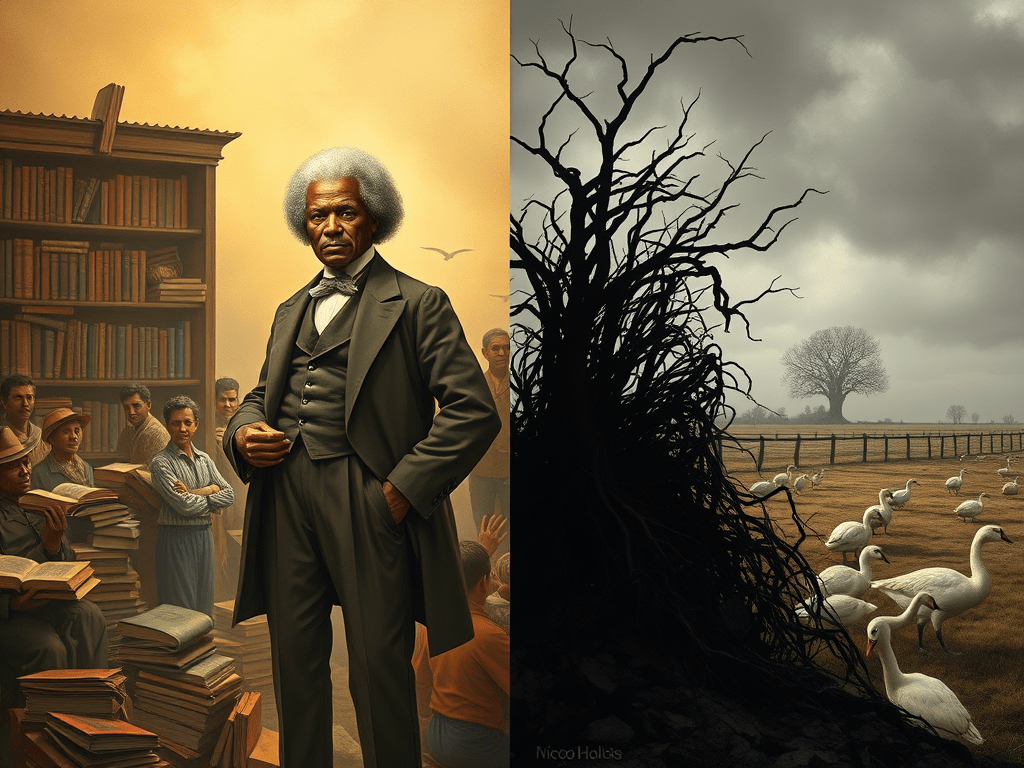
  • Heroes and Living Dead: What Douglass and Chekhov’s Nikolai Teach Us About the Meaning of a Good Life

    Heroes and Living Dead: What Douglass and Chekhov’s Nikolai Teach Us About the Meaning of a Good Life

    College Essay Prompt

    We often assume that the pursuit of freedom and happiness is a universal human impulse, shared across eras, cultures, and personal histories. Yet the paths individuals take toward those goals can be radically different, and those differences reveal whether one’s concept of happiness liberates or destroys. Few figures illustrate this divide more clearly than Frederick Douglass and Nikolai Ivanovitch from Anton Chekhov’s short story “Gooseberries.” Douglass’s character and trajectory embody a moral code that turns hardship into purpose: through literacy, community, courage, and a refusal to internalize oppression, he transforms enslavement into a platform for human dignity—not only for himself, but for others. By contrast, Nikolai pursues a narrow, adolescent fantasy of happiness, one built not on self-growth or empathy but on domination, comfort, and the myth of personal entitlement. His life becomes a grotesque parody of fulfillment—an existence of empty pleasures, self-deception, parasitic dependence, and spiritual decay beneath the veneer of material abundance.

    In a 1,700-word essay, analyze how Douglass’s journey to freedom stands as a model of healthy, ethical happiness while Nikolai’s descent exposes a warped, toxic version of happiness rooted in narcissism and self-indulgence. Your essay should do the following:

    1. Compare the moral foundations of Douglass and Nikolai’s pursuits.
      Explain how Douglass’s “Bushido-like” moral code—discipline, responsibility, representation, courage, and community—shapes his identity and empowers those around him. Contrast this with Nikolai’s rejection of accountability, his obsession with land ownership, and his willingness to deplete others—emotionally, financially, and spiritually—to maintain his fantasy of contentment. Discuss how each man’s vision of freedom manifests in their treatment of other people.
    2. Analyze the role of community vs. isolation in each character’s development.
      Douglass’s path is paradoxically individual and communal: he cultivates internal strength, but he locates freedom in solidarity—those who teach him to read, abolitionists who elevate his voice, and the enslaved people whose suffering he speaks for. Meanwhile, Nikolai constructs a private empire that excludes others, even the brother who once supported him. Consider how their relationships either amplify or erode their humanity.
    3. Examine the symbolic images of transformation and degradation.
      Use key passages from Douglass’s Narrative to show how literacy, speech, political action, and public representation transform him from an enslaved boy into a moral and political leader. Then show how Nikolai’s physical and spiritual decay—his swollen body, the petty rituals of comfort, the stagnant gooseberries—reflect the collapse of his inner self. Avoid plot summary; instead interrogate how each author uses these symbols to define what “freedom” looks like in practice.
    4. Discuss how each figure embodies or violates a healthy definition of happiness.
      What does Douglass’s version of happiness require? Effort, growth, sacrifice, connection, and the willingness to uplift others even when it hurts. What does Nikolai’s version require? Exploitation, avoidance of reality, refusal to change, and the delusion that comfort equals fulfillment. Describe how a life built on purpose creates meaning, while a life built on selfish gratification becomes spiritually unlivable.
    5. Address at least one counterargument.
      Consider why Nikolai might be appealing to some readers. Isn’t his dream of having a small estate, comfort, and peace understandable? Why might some view Douglass’s path as impossibly heroic—too demanding, too painful, or too noble for the average person? Engage with these viewpoints seriously, and rebut them using evidence from the texts.
    6. End with a conclusion that points to broader implications.
      Connect your contrast to the world we live in now. What do Douglass and Nikolai teach us about modern definitions of success, happiness, and the “good life”? Can happiness exist without social responsibility? Does personal freedom become toxic when it is purchased at the expense of others? Ask yourself what moral code has the power to sustain a person—and why some forms of comfort inevitably rot the soul.

    Your essay should not merely compare two characters; it should interrogate the meaning behind their choices. You are ultimately making an argument about what counts as real freedom and real happiness. Your goal is to show that the paths we choose do not simply determine the lives we build—they determine the kind of people we become.

  • Beyond the Self-Made Myth: Frederick Douglass, Community, and the Fight Against the Sunken Place

    Beyond the Self-Made Myth: Frederick Douglass, Community, and the Fight Against the Sunken Place

    College Essay Prompt:

    Public narratives frequently present Frederick Douglass as a “self-made man,” emphasizing his escape from slavery, his disciplined pursuit of literacy, and his celebrity as an abolitionist. In a 1,700–2,000 word essay, evaluate how this popular framing obscures the communal, political, and structural forces that shaped Douglass’s rise and activism. Which relationships, institutions, and collective efforts made his achievements possible, and why do certain commentators downplay them?

    Then, drawing on one or more of the following—Get Out, Black Panther, The Evolution of the Black Quarterback, or ALLENIV3SON—analyze how these works depict barriers that cannot be overcome through individual effort alone. In what ways do they present the “Sunken Place” as a system sustained by stereotypes, gatekeeping, or power hierarchies? Explain how collective action, representation, or community support becomes necessary for breaking those barriers. Your essay must include a counterargument that fairly represents the appeal of the “self-made” narrative and a rebuttal grounded in evidence from Douglass and your chosen texts.

  • Inside the 2026 Spring Semester: Stupidification, Katrina, and the Myth of the Self-Made Man

    Inside the 2026 Spring Semester: Stupidification, Katrina, and the Myth of the Self-Made Man

    3 Essay Assignments for my Freshman Composition and Critical Thinking Classes, Spring 2026 Semester

    Freshman Composition Class

    Essay1: How Black Mirror Imagines the Stupidification of Social Media

    This essay prompt asks you to write a 1,700-word argumentative essay analyzing how the Black Mirror episodes “Joan Is Awful” and “Nosedive” portray the digitally intensified “stupidification” Jonathan Haidt describes in “Why the Past 10 Years of American Life Have Been Uniquely Stupid.” Your goal is to take a clear, debatable position on whether these episodes exaggerate social-media anxieties or accurately reflect the psychological and social pathologies shaping online life. In a 200–250 word introduction, you must define “stupidification” using Haidt’s key ideas—such as the Babel metaphor, outrage incentives, the collapse of shared reality, identity performance, and tribal signaling—and then connect these concepts to one concrete example from your own life or observations. End your introduction with a focused thesis evaluating how effectively the two episodes illuminate the realities of social-media-driven stupidity.

    Essay 2: Hurricane Katrina: Natural Disaster or Man-Made Catastrophe?

    This essay prompt asks you to write a 1,700-word argumentative essay on the claim that Hurricane Katrina was less a natural disaster than a national failure. Drawing on the documentaries Hurricane Katrina: Race Against Time and Katrina: Come Hell and High Water, along with Clint Smith’s “Twenty Years After the Storm” and Nicholas Lemann’s “Why Hurricane Katrina Was Not a Natural Disaster,” you will analyze how government neglect, weak infrastructure, racial inequity, and media distortion contributed to the catastrophe. These works reveal a fourfold betrayal—red-lining, unprepared institutions, delayed aid, and harmful narratives—that left New Orleans, especially its Black communities, vulnerable and abandoned. Your essay should evaluate how systemic issues of race, class, and policy exacerbated the disaster while also exploring how families, neighborhoods, and cultural identity fostered resilience. Ultimately, you will consider what Katrina teaches us about justice, responsibility, and the human cost of institutional failure.

    Essay 3: The Myth of the Self-Made Man

    Many commentators, institutions, and public narratives present Frederick Douglass as the quintessential “self-made man,” using his rise from slavery to argue that personal discipline and individual grit are enough to overcome oppression. Write an essay analyzing why Douglass is framed this way: What political, cultural, or ideological purposes does this simplified narrative serve, and what parts of Douglass’s life and writing does it erase? Then, drawing on one or more of the following—Get Out, Black Panther, The Evolution of the Black Quarterback, and ALLENIV3SON—argue how these works challenge the myth that individual effort alone is sufficient to escape a modern form of the “Sunken Place.” Use evidence from Douglass and your chosen texts, address at least one counterargument, and provide a reasoned rebuttal.

    Critical Thinking Class

    Essay 1: Shame as Entertainment: The Myth of Moral Fitness in The Biggest Loser

    With 70 percent of Americans now overweight or obese, it’s no wonder the nation is obsessed with weight loss. That obsession fuels a vast industry of diets, influencers, and reality shows, none more infamous than The Biggest Loser. The series, which became the subject of the three-part docuseries Fit for TV: The Reality of The Biggest Loser, reveals how television turned the suffering of overweight people into prime-time entertainment. Contestants were pushed, shamed, and humiliated under the guise of “motivation.” The so-called fitness experts preached self-discipline, grit, and moral purity, but what they really offered was a cocktail of cruelty and pseudoscience disguised as inspiration. In a 1,700-word essay, analyze how the abuse documented in Fit for TV exposes the deeper myths behind weight loss culture. Drawing on Fit for TV, Julia Belluz and Kevin Hall’s essay “It’s Not You. It’s the Food,” and Rebecca Johns’s “A Diet Writer’s Regrets,” develop an argument that answers this question:

    What is intrinsically abusive about the gospel of self-discipline in weight loss, and how does this ideology blind us to the systemic causes of obesity while offering a hollow sense of meaning through influencers and their heroic panaceas? Your essay must include a counterargument and rebuttal section and a Works Cited page in MLA format with at least three sources.

    Essay 2: Ozempification and the Age of De-Skilling

    This essay prompt asks you to write a 1,700-word argumentative essay on whether dependence on AI always harms human skill—or whether, in some cases, it can be “bad but worth it.” Drawing on Kwame Anthony Appiah’s “The Age of De-Skilling,” you will use his distinctions between corrosive de-skilling, “bad but worth it” de-skilling, and unacceptable forms of de-skilling to evaluate how AI affects our thinking, creativity, and agency. You must take a clear position on whether AI meaningfully frees us for deeper work or mostly dulls our abilities and trains us into passivity. Your essay should distinguish between lazy reliance on AI and intentional collaboration with it, include a counterargument–rebuttal section, and incorporate an example of Ozempification—the growing cultural pattern in which people outsource effort, discipline, or agency to an external system, becoming passive “users” rather than active participants—from a Black Mirror episode such as “Joan Is Awful,” “Nosedive,” or “Smithereens.” You are required to use at least three sources in MLA format, including Appiah.

    Essay 3: The Whole Truth About Ultra-Processed Foods

    Using Olga Khazan’s “Avoiding Ultra-Processed Foods Is Completely Unrealistic,” Dhruv Khullar’s “Why Is the American Diet So Deadly?” and Julia Belluz and Kevin Hall’s “It’s Not You. It’s the Food” as your central texts, write a 1,700-word argumentative essay analyzing whether ultra-processed foods deserve their reputation as the villain of modern nutrition. Evaluate the claim that the only truly healthy diet is one built exclusively on whole foods.

    In your essay, define what counts as “whole,” “processed,” and “ultra-processed,” and analyze how clear or meaningful these categories actually are. Then examine the real-world constraints shaping American diets, including economics, time, geography, marketing, and systemic inequities. How realistic is it for the average eater to avoid ultra-processed foods altogether? What trade-offs—financial, cultural, and practical—shape people’s choices?

    As part of your argument, consider how emerging tools like GLP-1 medications or AI-guided meal planning may influence how we define “healthy eating.” Do these tools expand options for overwhelmed consumers, or push us toward a future where food becomes less cultural and more optimized?

    Your essay must include one counterargument–rebuttal section and an MLA Works Cited page with at least four sources.