Category: Education in the AI Age

  • Brushing His Teeth in Purgatory

    Brushing His Teeth in Purgatory

    Yesterday, I ran into B—a colleague and friend of thirty years—in the faculty bathroom. He stood at the sink, looking tiny in an oversized blue oxford and baggy black pleated slacks, brushing his teeth with grim determination, the way a soldier might polish his boots before a hopeless battle. His reflection wore a bloodhound’s face: drooping eyes, sagging mouth, the look of someone who’d run out of surprises.

    We exchanged small talk about our students, about AI, about how much the classroom had changed. His voice was thin, almost apologetic.
    “They’ve checked out,” he said. “They use AI so much, they’ve just… checked out.”

    I tried to commiserate, mentioning how quickly the culture had shifted since the first wave of ChatGPT essays three years ago. But he didn’t answer. He rinsed, spat, and walked out without another word—already halfway gone.

    It isn’t just B. My younger colleagues say the same thing. Even my wife, who teaches writing in middle school, tells me her students have that same vacant look. Everyone seems ghosted by their own profession, still performing the motions of care while quietly surrendering.

    The image that won’t leave me is B—graying, stooped, and haloed in the pitiless glow of the faculty bathroom’s fluorescent lights—scrubbing his molars like an inmate serving life. He looked less like a man starting his day than one serving time in it, counting down to a retirement that recedes faster than his gumline.

  • Bad But Worth It? De-skilling in the Age of AI (college essay prompt)

    Bad But Worth It? De-skilling in the Age of AI (college essay prompt)

    AI is now deeply embedded in business, the arts, and education. We use it to write, edit, translate, summarize, and brainstorm. This raises a central question: when does AI meaningfully extend our abilities, and when does it quietly erode them?

    In “The Age of De-Skilling,” Kwame Anthony Appiah argues that not all de-skilling is equal. Some forms are corrosive and hollow us out; some are “bad but worth it” because the benefits outweigh the loss; some are so destructive that no benefit can redeem them. In that framework, AI becomes most interesting when we talk about strategic de-skilling: deliberately off-loading certain tasks to machines so we can focus on deeper, higher-level work.

    Write a 1,700-word argumentative essay in which you defend, refute, or complicate the claim that not all dependence on AI is harmful. Take a clear position on whether AI can function as a “bad but worth it” form of de-skilling that frees us for more meaningful thinking—or whether, in practice, it mostly dulls our edge and trains us into passivity.

    Your essay must:

    • Engage directly with Appiah’s concepts of corrosive vs. “bad but worth it” de-skilling.
    • Distinguish between lazy dependence on AI and deliberate collaboration with it.
    • Include a counterargument–rebuttal section that uses at least one example of what we might call Ozempification—people becoming less agents and more “users” of systems. You may draw this example from one or more of the following Black Mirror episodes: “Joan Is Awful,” “Nosedive,” or “Smithereens.”
    • Use at least three sources in MLA format, including Appiah and at least one Black Mirror episode.

    For your supporting paragraphs, you might consider:

    • Cognitive off-loading as optimization
    • Human–AI collaboration in creative or academic work
    • Ethical limits of automation
    • How AI is redefining what counts as “skill”

    Your goal is to show nuanced critical thinking about AI’s role in human skill development. Don’t just declare AI good or bad; use Appiah’s framework to examine when AI’s shortcuts lead to degradation—and when, if used wisely, they might lead to liberation.

    3 building-block paragraph assignments

    1. Concept Paragraph: Explaining Appiah’s De-Skilling Framework

    Assignment:
    Write one well-developed paragraph (8–10 sentences) in which you explain Kwame Anthony Appiah’s distinctions among corrosive de-skilling, “bad but worth it” de-skilling, and de-skilling that is so destructive no benefit can justify it.

    • Use at least one short, embedded quotation from Appiah.
    • Paraphrase his ideas in your own words and clarify the differences between the three categories.
    • End the paragraph by briefly suggesting how AI might fit into one of these categories (without fully arguing your position yet).

    Your goal is to show that you understand Appiah’s framework clearly enough to use it later as the backbone of an argument.


    2. Definition Paragraph: Lazy Dependence vs. Deliberate Collaboration

    Assignment:
    Write one paragraph in which you define and contrast lazy dependence on AI and deliberate collaboration with AI in your own words.

    • Begin with a clear topic sentence that sets up the contrast.
    • Give at least one concrete example of “lazy dependence” (for instance, using AI to dodge thinking, reading, or drafting altogether).
    • Give at least one concrete example of “deliberate collaboration” (for instance, using AI to brainstorm options, check clarity, or off-load repetitive tasks while you still make the key decisions).
    • End the paragraph with a sentence explaining which of these two modes you think is more common among students right now—and why.

    This paragraph will later function as a “conceptual lens” for your body paragraphs.


    3. Counterargument Paragraph: Ozempification and Black Mirror

    Assignment:
    After watching one of the assigned Black Mirror episodes (“Joan Is Awful,” “Nosedive,” or “Smithereens”), write one counterargument paragraph that challenges the optimistic idea of “strategic de-skilling.”

    • Briefly describe a key moment or character from the episode that illustrates Ozempification—a person becoming more of a “user” of a system than an agent of their own life.
    • Explain how this example suggests that dependence on powerful systems (platforms, algorithms, or AI-like tools) can erode self-agency and critical thinking rather than free us.
    • End by posing a difficult question your eventual essay will need to answer—for example: If it’s so easy to slide from strategic use to dependence, can we really trust ourselves with AI?

    Later, you’ll rebut this paragraph in the full essay, but here your job is to make the counterargument as strong and persuasive as you can.

  • The Outrage Economy: How Moral Fury Became America’s Favorite Spectator Sport (college essay prompt)

    The Outrage Economy: How Moral Fury Became America’s Favorite Spectator Sport (college essay prompt)

    In a 1,700-word argumentative essay, analyze how the Netflix docuseries Mr. McMahon and Jonathan Haidt’s essay “Why the Past 10 Years of American Life Have Been Uniquely Stupid” explore the rise of moral outrage as a form of entertainment, social currency, and group belonging. To what extent do these works suggest that the pursuit of outrage has eroded our ability to think critically and engage in good-faith dialogue?

    Your essay should take a clear position on whether Haidt and Mr. McMahon portray moral outrage as a symptom of cultural decay, a profitable spectacle, or a distorted form of moral engagement—and whether they overstate or accurately diagnose its impact on public reason. Support your argument with specific examples and analysis from both sources.

    Be sure to include a counterargument and rebuttal section, and a Works Cited page in MLA format with at least three sources.

  • Shame as Entertainment: The Myth of Moral Fitness in The Biggest Loser (college essay prompt)

    Shame as Entertainment: The Myth of Moral Fitness in The Biggest Loser (college essay prompt)

    With 70 percent of Americans now overweight or obese, it’s no wonder the nation is obsessed with weight loss. That obsession fuels a vast industry of diets, influencers, and reality shows, none more infamous than The Biggest Loser. The series, which became the subject of the three-part docuseries Fit for TV: The Reality of The Biggest Loser, reveals how television turned the suffering of overweight people into prime-time entertainment. Contestants were pushed, shamed, and humiliated under the guise of “motivation.” The so-called fitness experts preached self-discipline, grit, and moral purity, but what they really offered was a cocktail of cruelty and pseudoscience disguised as inspiration.

    Essay Assignment (1,700 words)
    In this essay, analyze how the abuse documented in Fit for TV exposes the deeper myths behind weight loss culture. Drawing on Fit for TV, Julia Belluz and Kevin Hall’s essay “It’s Not You. It’s the Food,” and Rebecca Johns’s “A Diet Writer’s Regrets,” develop an argument that answers this question:

    What is intrinsically abusive about the gospel of self-discipline in weight loss, and how does this ideology blind us to the systemic causes of obesity while offering a hollow sense of meaning through influencers and their heroic panaceas?

    Your essay must include a counterargument and rebuttal section and a Works Cited page in MLA format with at least three sources.

  • The Flim-Flam Man of Higher Ed

    The Flim-Flam Man of Higher Ed

    In the summer of 2025, the English Chair—Steve, a mild-mannered, hyper-competent saint of a man—sent me an email that sounded innocuous enough. Would I, he asked, teach a freshman writing course for student-athletes? It would meet two mornings a week, two hours a session. The rest of my load would stay online. I should have known from the soft tone of his message that this was no ordinary assignment. This was a CoLab, an experimental hybrid of academic optimism and administrative wishcasting.

    The idea was elegant on paper: gather athletes into one class, surround them with counselors and coaches, raise retention rates, and call it innovation. Morale would soar. Grades would climb. The athletes would have a “safe space,” a phrase that always sounds like a promise from someone who’s never had reality punch their teeth in. Through the magic of cross-departmental communication, we’d form a “deep network of student support.” It all sounded like a TED Talk waiting to happen.

    Morning classes weren’t my preference. I usually reserved that time for my kettlebell ritual—my secular liturgy of iron and sweat—but I said yes without hesitation. Steve had earned my respect long ago. A decade earlier, we’d bonded over Dale Allison’s Night Comes, marveling at its lucidity on the afterlife. You don’t forget someone who reads eschatology with humility and enthusiasm. So when Steve asked, it felt less like a request than a summons.

    And yes, I’ll admit it: the offer flattered me. Steve knew my past as an Olympic weightlifter, the remnant coach swagger in my stride was visible even at sixty-three. I imagined myself the perfect fit—a grizzled academic with gym cred, able to command respect from linemen and linebackers. I said yes with gusto, convinced I was not just teaching a class but leading a mission.

    Soon enough, the flattery metastasized into full-blown delusion. I stalked the campus like a self-appointed messiah of pedagogy, convinced destiny had personally cc’d me on its latest memo. To anyone within earshot, I announced my divine assignment: to pilot a revolutionary experiment that would fuse intellect and biceps into one enlightened organism. I fancied myself the missing link between Socrates and Schwarzenegger—a professor forged in iron, sent to rescue education from the sterile clutches of the AI Age. My “muscular, roll-up-your-sleeves” teaching style, I told myself, would be a sweaty rebuke to all that was algorithmic, bloodless, and bland.

    The problem with self-congratulation is that it only boosts performance in the imagination. It blunts the discipline of preparation and tricks you into confusing adrenaline for authority. I wasn’t an educational pioneer—I was a man on a dopamine binge, inhaling the exhaust of my own hype. Beneath the swagger, there was no scholarship, no rigor, no plan—just the hollow hum of self-belief. I hadn’t earned a thing. Until I actually taught the class and produced results, my so-called innovation was vaporware. I was a loudmouth in faculty khakis, mistaking vanity for vocation. Until I delivered the goods, I wasn’t a trailblazer—I was the Flim-flam Man of Higher Ed, peddling inspiration on credit.

    Forgive me for being so hard on myself, but after thirty-eight years of full-time college teaching, I’ve earned the right to doubt my own effectiveness. I’ve sat in the back of other instructors’ classrooms during evaluations, watching them conduct symphonies of group discussions and peer-review sessions with the grace of social alchemists. Their students collaborate, laugh, and somehow stay on task. Mine? The moment I try anything resembling a workshop, it devolves into chatter about weekend plans, fantasy football, or the ethics of tipping baristas. A few students slink out early as if the assignment violated parole. I sit there afterward, deflated, convinced I’m the pedagogical equivalent of a restaurant that can’t get anyone to stay for dessert.

    I’ve been to professional development seminars. I’ve heard the gospel of “increasing engagement” and “active learning.” I even take notes—real ones, not the doodles of a man pretending to care. Yet I never manage to replicate their magic. Perhaps it’s because I’ve leaned too heavily on my teaching persona, the wisecracking moralist who turns outrage into a stand-up routine. My students laugh; I bask in the glow of my own wit. Then I drive home replaying the greatest hits—those sarcastic riffs that landed just right—while avoiding the inconvenient truth: humor is a sugar high. It keeps the crowd awake, but it doesn’t build muscle. Even if I’m half as funny as I think I am, comedy can easily become a sedative—a way to distract myself from the harder work of improvement.

    Measuring effectiveness in teaching is its own farce. If I sold cars, I’d know by the end of the quarter whether I was good at it. If I ran a business, profit margins would tell the story. But academia? It’s all smoke and mirrors. We talk about “retention” and “Student Learning Outcomes,” but everyone knows the game is rigged. The easiest graders pull the highest retention numbers. And when “learning outcomes” are massaged to ensure success, the data becomes a self-congratulatory illusion—a bureaucratic circle jerk masquerading as accountability.

    The current fetish is “engagement,” a buzzword that’s supposed to fix everything. We’re told to gamify, scaffold, diversify, digitize—anything to keep students from drifting into their screens. But engagement itself has become impossible to measure; it’s a ghost we chase through PowerPoint slides. My colleagues, battle-scarred veterans of equal or greater tenure, tell me engagement has fallen off a cliff. Screens have rewired attention spans, and a culture that prizes self-esteem over rigor has made deep learning feel oppressive. Asking students to revise an essay is now a microaggression.

    So yes, I question my value as an instructor. I prepare obsessively, dive deep into my essay topics, and let my passion show—because I know that if I don’t care, the students won’t either. But too often, my enthusiasm earns me smirks. To many of my students, I’m just an eccentric goofy man who takes this writing thing way too seriously. Their goal is simple: pass the class with minimal friction. The more I push them to care, the more resistance I meet, until the whole enterprise starts to feel like an arm-wrestling match.

    Until I find a cure for this malaise—a magic wand, a new pedagogy, or divine intervention—I remain skeptical of my own worth in the classroom. I do my best, but some days that feels like shouting into a void lined with smartphones. So yes, I’ll say it again for the record: I am the Flim-Flam Man of Higher Ed, hawking sincerity in an age that rewards performance.

  • The No Consequences Era of Education

    The No Consequences Era of Education

    It’s been a bruising semester. I’m teaching a class full of student-athletes—big personalities, bigger social circles. I like them; I even feel protective of them. But they’re driving me halfway to madness. They sit in tight cliques, chattering through lectures like it’s a locker room between drills. Every class, I play the same game of whack-a-murmur: redirect, refocus, remind them that the material matters for their essays. I promise them mercy—“just give me 30 minutes of focus before we watch the documentary or workshop your drafts”—but my voice competes with the hum of conversation and the holy glow of smartphones.

    The phones are the true sirens of the classroom—scrolling, snapping, texting, attention atomized into pixels. Maybe it’s my fault for not collecting them in a basket like contraband. I thought I was teaching adults. I thought athletes, of all people, would bring discipline and drive. Instead, I’ve got a team that treats class like study hall with Wi-Fi. My essay topics that have created engagement in past semesters—like Jordan Peele’s Sunken Place—barely register. The irony: I’m showing them the metaphor for psychological paralysis, and half the room is literally sinking into their screens.

    After thirty years of teaching, this is the hardest semester I’ve had. I kept telling myself, Five more weeks and the storm will pass. Next semester, you’ll have your groove back. Today I spoke with a colleague who teaches the same class to the general population—same disengagement, same cell phones, same glazed eyes. He added one more grim diagnosis: the rise of fragility. When he points out errors, missing citations, too much AI-speak, or low effort, students protest that his feedback “hurts their feelings.” They’re not defiant—they’re delicate. Consequences have become cruelty.

    That word—consequences—haunted me as I walked to class. I thought about my own twin daughters at their highly rated high school, where late work flows freely, “self-esteem” trumps rigor, and parental complaints terrify administrators more than failing grades. It hit me: this isn’t an athlete problem—it’s a generational shift. The No Consequences Era has arrived. Students no longer fear failure; they resent it. And the tragedy isn’t that they can’t handle criticism—it’s that they’ve never been forced to build the muscle for it.

  • Failure Is the Bedrock of Writing

    Failure Is the Bedrock of Writing

    Stephen Marche, veteran journalist and author, says the secret to becoming a writer isn’t inspiration or networking or the right MFA program. It’s endurance. Grim, stubborn, occasionally delusional endurance. His slim volume On Writing and Failure makes one argument with relentless clarity: if you want to write, prepare to suffer. Forget talk of “flourishing,” “mentorship,” and “encouragement.” Writing isn’t a wellness retreat. It’s a trench.

    Marche opens with the perennial questions writers whisper to each other after one rejection too many: Does this get easier? Do you grow thicker skin? The response he quotes from Philip Roth is a gut punch: “Your skin just grows thinner and thinner. In the end, they can hold you up to the light and see right through you.” In other words, the longer you write, the more naked you become. Vulnerability isn’t a side effect of the craft; it is the craft.

    Marche’s bleak comfort is that every writer feeds off failure. Success is accidental—a borrowed tuxedo, worn briefly. Failure is the body underneath. Even the authors smiling from dust jackets look like rescued hostages, blinking at daylight before returning to the bunker of their desks to keep going. They don’t do it because it’s glamorous. They do it because not writing would be worse.

    I understand the pathology. After decades of cranking out what I believed were novels, I finally admitted I couldn’t write one—not at the level I demanded, not at the level worth inflicting on readers. That revelation didn’t spare me failure; it merely revealed strata of it. There’s the failure of rejection, the failure of the work, and the quiet, private failure of recognizing your own limits. Perhaps I could’ve spared myself time and spared literary agents grief. But failure has its curriculum, and I attended every class.

    Marche’s book is a sober reminder that writing is less a triumphal march than a pilgrimage carried out on blistered feet. Failure isn’t a detour; it’s the terrain. Rock layers of it: topsoil doubt, subsoil rejection, shale humiliation, limestone stubbornness. Dig deeper and you hit coal—compressed ambition under impossible pressure, black and combustible.

    Failure isn’t fashionable grit or a TED Talk slogan. When executives brag about “learning from failure,” they’re dilettantes. Writers are the professionals of defeat. To be a poet today is to live like a post-apocalyptic monk, scribbling in candlelight, shadow thrown against the cave wall, not out of masochism but because there’s no other way to stay human. The world may not care, but the work insists.

  • The Case of Brandy Melville and the Ethics of Audience Capture (College Writing Prompt)

    The Case of Brandy Melville and the Ethics of Audience Capture (College Writing Prompt)

    Some critics argue that Brandy Melville relies on predatory forms of audience capture—using exclusivity, body image ideals, and social media manipulation to attract and control its customers. Others claim that in today’s influencer-driven marketplace, Brandy Melville is simply deploying the same marketing strategies any brand must use to survive online.

    Write a 1,700-word argumentative essay that takes a clear position: while you may have moral concerns about Brandy Melville’s business practices, its methods of audience capture may be necessary for competing in the modern attention economy. If this is true, what does it reveal about the culture that rewards such tactics?

    In developing your argument, consider the following questions:

    • How do companies exploit psychological vulnerabilities such as FOMO, Groupthink, and body dysmorphia to build loyalty and drive sales?
    • What does this normalization of manipulation say about consumer identity in the influencer era?
    • Is there an ethical way to succeed in digital marketing without resorting to emotional exploitation?

    Support your claims with specific examples and credible sources—from documentaries, marketing analyses, or social-media research—to show how audience capture operates as both a marketing necessity and a moral hazard.

  • The Case for Strategic De-Skilling: Rethinking Skill and Dependence in the Age of AI (a College Writing Prompt)

    The Case for Strategic De-Skilling: Rethinking Skill and Dependence in the Age of AI (a College Writing Prompt)

    Background

    AI is a tool that we use in business, the arts, and education. Since AI is the genie out of the bottle that isn’t going back in, we have to confront the way AI renders us both benefits and liabilities. One liability is de-skilling, the way we lose our personal initiative, self-reliance and critical thinking skills as our dependence on AI makes us reflexively surrender our own thought for a lazy, frictionless existence in which we assert little effort and let AI do most of the work. 

    However, in his essay “The Age of De-Skilling,” Kwame Anthony Appiah correctly points out that not all de-skilling is equal. Some de-skilling is “corrosive,” some de-skilling is bad but worth it for the benefits, and some de-skilling is so self-destructive that no benefits can redeem its devastation. 

    In this context, where AI becomes interesting is the realm of what we call strategic de-skilling. This is a mindful form of de-skilling in which we take AI shortcuts because such shortcuts give us a worthy outcome that justifies the tradeoffs of whatever we lose as individuals dependent on technology. 

    Your Essay Prompt

    Write a 1,700-word argumentative essay that defends, refutes, or complicates the position that not all dependence on AI is ruinous. Argue that strategic de-skilling—outsourcing repetitive or mechanical labor to machines—can expand our mental bandwidth for higher-order creativity and analysis. Use Appiah’s notion of “bad but worth it” de-skilling to claim that AI, when used deliberately, frees us for deeper work rather than dulls our edge.

    Your Supporting Paragraphs

    For your supporting paragraphs, consider the following mapping components: 

    • cognitive off-loading as optimization
    • human-AI collaboration
    • ethical limits of automation
    • redefinition of skill

    Use Specific Case Studies of Strategic De-Skilling

    I recommend you can pick one or two of the following case studies to anchor your essay in concrete evidence:

    1. AI-Assisted Radiology Diagnostics
    AI models like Google’s DeepMind Health or Lunit INSIGHT CXR pre-screen medical images (X-rays, CT scans, MRIs) for anomalies such as lung nodules or breast tumors, freeing radiologists from exhaustive image scanning and letting them focus on diagnosis, context, and patient communication.

    2. Robotic Surgery Systems (e.g., da Vinci Surgical System)
    Surgeons use robotic interfaces to perform minimally invasive procedures with greater precision and less fatigue. The machine steadies the surgeon’s hand and filters tremors—technically a form of de-skilling—but this trade-off allows focus on strategy, anatomy, and patient safety rather than manual dexterity alone.

    3. AI-Driven Legal Research Platforms (Lexis+, Casetext CoCounsel)
    Lawyers now off-load hours of case searching and citation checking to AI tools that summarize precedent. What they lose in raw research grind, they gain in time for argument strategy and nuanced reasoning—shifting legal skill from memorization to interpretation.

    4. Intelligent Tutoring and Grading Systems (Gradescope, Khanmigo)
    Instructors let AI handle repetitive grading or generate practice problems. The loss of constant paper-marking allows teachers to focus on the art of explanation and individualized mentorship. Students, too, can use these systems to get instant feedback, training them to self-diagnose errors rather than depend entirely on human correction.

    5. AI-Based Drug Discovery (DeepMind’s AlphaFold, Insilico Medicine)
    Pharmaceutical researchers no longer spend years modeling protein folding manually. AI predicts structures in hours, speeding up breakthroughs. Scientists relinquish tedious modeling but redirect their expertise toward hypothesis-driven design, ethics, and clinical translation.

    6. Predictive Maintenance in Aviation and Engineering
    Airline engineers now rely on machine-learning algorithms to flag part failures before they occur. Mechanics perform fewer manual inspections but use data analytics to interpret system reports and prevent disasters—redefining “skill” as foresight rather than reaction.

    7. Algorithmic Financial Trading
    Portfolio managers off-load pattern recognition and timing decisions to AI trading bots. Their role shifts from acting as human calculators to setting ethical boundaries, risk thresholds, and macro-strategic goals—skills grounded in judgment, not just speed.

    8. AI-Powered Architecture and Design (Autodesk Generative Design)
    Architects use generative AI to produce hundreds of design iterations that balance structure, sustainability, and cost. The creative act moves from drafting to curating: selecting and refining the most meaningful human aesthetic from machine-generated abundance.

    9. Autonomous Agriculture Systems (John Deere’s See & Spray)
    Farmers now use AI-guided tractors and drones to detect weeds and optimize fertilizer use. They surrender manual fieldwork but gain ecological precision and data-driven management skills that improve yields and sustainability.

    10. AI-Enhanced Music and Film Editing (Adobe Sensei, AIVA, Runway ML)
    Editors and composers off-load technical tedium—color correction, noise reduction, beat synchronization—to AI tools. This frees them to focus on emotional pacing, thematic rhythm, and creative storytelling—the distinctly human layer of artistry.

    Purpose
    Your goal is to demonstrate nuanced critical thinking about AI’s role in human skill development. Show that you understand the difference between lazy dependence and deliberate collaboration. Engage with Appiah’s complicated notion of de-skilling to explore whether AI’s shortcuts lead to degradation—or, when used wisely, to liberation.

  • The Gospel of De-Skilling: When AI Turns Our Minds into Mashed Potatoes

    The Gospel of De-Skilling: When AI Turns Our Minds into Mashed Potatoes

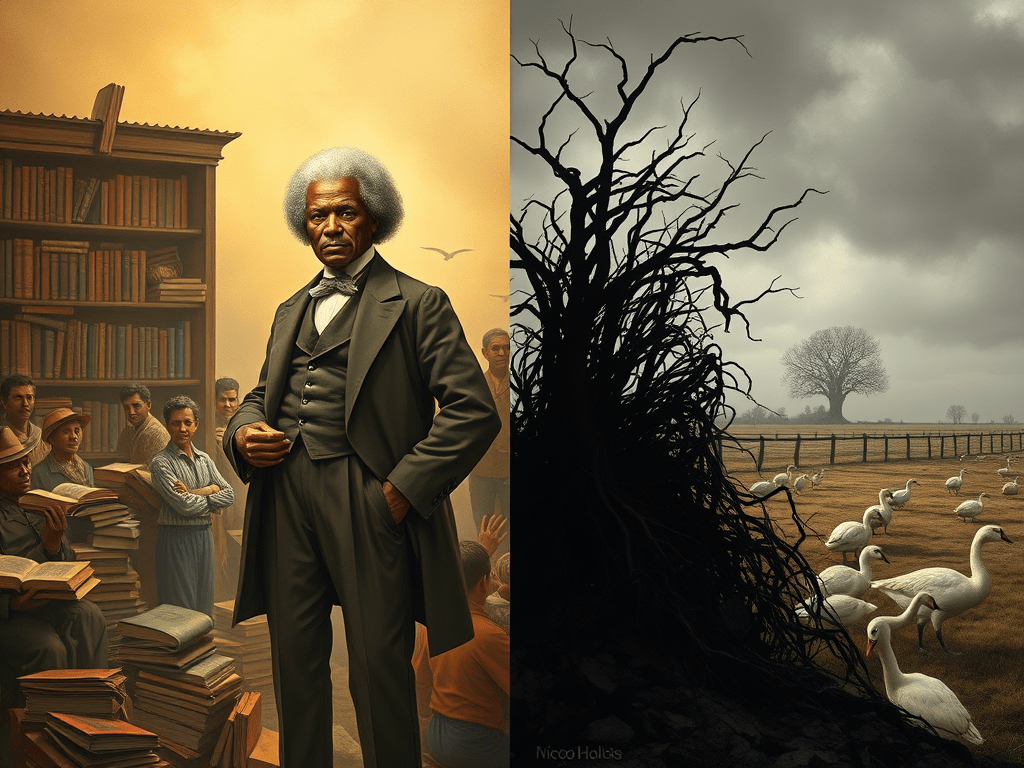
    Kwame Anthony Appiah, in “The Age of De-Skilling,” poses a question that slices to the bone of our moment: Will artificial intelligence expand our minds or reduce them to obedient, gelatinous blobs? The creeping decay of competence and curiosity—what he calls de-skilling—happens quietly. Every time AI interprets a poem, summarizes a theory, or rewrites a sentence for us, another cognitive muscle atrophies. Soon, we risk becoming well-polished ghosts of our former selves. The younger generation, raised on this digital nectar, may never build those muscles at all. Teachers who lived through both the Before and After Times can already see the difference in their classrooms: the dimming spark, the algorithmic glaze in the eyes.

    Yet Appiah reminds us that all progress extracts a toll. When writing first emerged, the ancients panicked. In Plato’s Phaedrus, King Thamus warned that this new technology—writing—would make people stupid. Once words were carved into papyrus, memory would rot, dialogue would wither, nuance would die. The written word, Thamus feared, would make us forgetful and isolated. And in a way, he was right. Writing didn’t make us dumb, but it did fundamentally rewire how we think, remember, and converse. Civilization gained permanence and lost immediacy in the same stroke.

    Appiah illustrates how innovation often improves our craft while amputating our pride in it. A pulp mill worker once knew by touch and scent when the fibers were just right. Now, computers do it better—but the hands are idle. Bakers once judged bread by smell, color, and instinct; now a touchscreen flashes “done.” Precision rises, but connection fades. The worker becomes an observer of their own obsolescence.

    I see this too in baseball. When the robotic umpire era dawns, we’ll get flawless strike zones and fewer bad calls. But we’ll also lose Earl Weaver kicking dirt, red-faced and screaming at the ump until his cap flew. That fury—the human mess—is baseball’s soul. Perfection may be efficient, but it’s sterile.

    Even my seventy-five-year-old piano tuner feels it. His trade is vanishing. Digital keyboards never go out of tune; they just go out of style. Try telling a lifelong pianist to find transcendence on a plastic keyboard. The tactile romance of the grand piano, the aching resonance of a single struck note—that’s not progress you can simulate.

    I hear the same story in sound. I often tune my Tecsun PL-990 radio to KJAZZ, a station where a real human DJ spins records in real time. I’ve got Spotify, of course, but its playlists feel like wallpaper for the dead. Spotify never surprises me, never speaks between songs. It’s all flow, no friction—and my brain goes numb. KJAZZ keeps me alert because a person, not a program, is behind it.

    The same tension threads through my writing life. I’ve been writing and weight-lifting daily since my teens. Both disciplines demand sweat, repetition, and pain tolerance. Neglect one, and the other suffers. But since I began using AI to edit two years ago, the relationship has become complicated. Some days, AI feels like a creative partner—it pushes me toward stylistic risks, surprise turns of phrase, and new tonal palettes. Other days, it feels like a crutch. I toss half-baked paragraphs into the machine and tell myself, “ChatGPT will fix it.” That’s not writing; that’s delegation disguised as art.

    When I hit that lazy stretch, I know it’s time to step away—take a nap, watch Netflix, play piano—anything but write. Because once the machine starts thinking for me, I can feel my brain fog over.

    And yet, I confess to living a double life. There’s my AI-edited self, the gleaming, chiseled version of me—the writer on literary steroids. Then there’s my secret writer: the primitive, unassisted one who writes in a private notebook, in the flickering light of what feels like a mythic waterfall. No algorithms, no polish—just me and the unfiltered soul that remembers how to speak without prompts. This secret life is my tether to the human side of creation. It gives my writing texture, contradiction, blood. When I’m writing “in the raw,” I almost feel sneaky and subversive and whisper to myself: “ChatGPT must never know about this.” 

    Appiah is right: the genie isn’t going back in the bottle. Every advance carries its shadow. According to Sturgeon’s Law, 90% of everything is crap, and AI will follow that rule religiously. Most users will become lazy, derivative, and hollow. But the remaining 10%—the thinkers, artists, scientists, doctors, and musicians who wield it with intelligence—will produce miracles. They’ll also suffer for it. Because every new tool reshapes the hand that wields it, and every gain carries a ghost of what it replaces.

    Technology changes us. We change it back. And somewhere in that endless feedback loop—between the bucket piano tuner, the dirt-kicking manager, and the writer lost between human and machine—something resembling the soul keeps flickering.