Category: Education in the AI Age

  • The Rebranding of College Writing Instructors as Prompt Engineers

    The Rebranding of College Writing Instructors as Prompt Engineers

    There’s a cliché I’ve sidestepped for decades, the kind of phrase I’ve red-penned into oblivion in freshman essays. But now, God help me, I must say it: I see the handwriting on the wall. And it’s written in 72-point sans serif, blinking in algorithmic neon.

    I’ve taught college writing for forty years. My wife, a fellow lifer in the trenches, has clocked twenty-five teaching sixth and seventh graders. Between us, we’ve marked enough essays to wallpaper the Taj Mahal. And yet here we are, staring down the barrel of obsolescence while AI platforms politely tap us on the shoulder and whisper, “We’ve got this now.”

    Try crafting an “AI-resistant” assignment. Go ahead. Ask students to conduct interviews, keep journals, write about memories. They’ll feed your prompt into ChatGPT with the finesse of a hedge fund trader moving capital offshore. The result? A flawlessly ghostwritten confession by a bot with a stunning grasp of emotional trauma and a suspicious lack of typos.

    Middle school teachers, my wife says, are on their way to becoming glorified camp counselors with grading software. As for us college instructors, we’ll be lucky to avoid re-education camps dressed up as “professional development.” The new job? Teaching students how to prompt AI like Vegas magicians—how to trick it into coherence, how to interrogate its biases, how to extract signal from synthetic noise. Critical thinking rebranded as Prompt Engineering.

    Gone are the days of unpacking the psychic inertia of J. Alfred Prufrock or peeling back the grim cultural criticism of Coetzee’s Disgrace. Now it’s Kahoot quizzes and real-time prompt battles. Welcome to Gamified Rhetoric 101. Your syllabus: Minecraft meets Brave New World.

    At sixty-three, I’m no fool. I know what happens to tired draft horses when the carriage goes electric. I’ve seen the pasture. I can smell the industrial glue. And I’m not alone. My colleagues—bright, literate, and increasingly demoralized—mutter the same bitter mantra: “We are the AI police. And the criminals are always one jailbreak ahead.”

    We keep saying we need to “stop the bleeding,” another cliché I’d normally bin. But here I am, bleeding clichés like a wounded soldier of the Enlightenment, fighting off the Age of Ozempification—a term I’ve coined to describe the creeping automation of everything from weight loss to wit. We’re not writing anymore; we’re curating prompts. We’re not thinking; we’re optimizing.

    This isn’t pessimism. It’s clarity. And if clarity means leaning on a cliché, so be it.

  • Trapped in the AI Age’s Metaphysical Tug-of-War

    Trapped in the AI Age’s Metaphysical Tug-of-War

    I’m typing this to the sound of Beethoven—1,868 MP3s of compressed genius streamed through the algorithmic convenience of a playlist. It’s a 41-hour-and-8-minute monument to compromise: a simulacrum of sonic excellence that can’t hold a candle to the warmth of an LP. But convenience wins. Always.

    I make Faustian bargains like this daily. Thirty-minute meals instead of slow-cooked transcendence. Athleisure instead of tailoring. A Honda instead of high horsepower. The good-enough over the sublime. Not because I’m lazy—because I’m functional. Efficient. Optimized.

    And now, writing.

    For a year, my students and I have been feeding prompts into ChatGPT like a pagan tribe tossing goats into the volcano—hoping for inspiration, maybe salvation. Sometimes it works. The AI outlines, brainstorms, even polishes. But the more we rely on it, the more I feel the need to write without it—just to remember what my own voice sounds like. Just as the vinyl snob craves the imperfections of real analog music or the home cook insists on peeling garlic by hand, I need to suffer through the process.

    We’re caught in a metaphysical tug-of-war. We crave convenience but revere authenticity. We binge AI-generated sludge by day, then go weep over a hand-made pie crust YouTube video at night. We want our lives frictionless, but our souls textured. It’s the new sacred vs. profane: What do we reserve for real, and what do we surrender to the machine?

    I can’t say where this goes. Maybe real food will be phased out, like Blockbuster or bookstores. Maybe we’ll subsist on GLP-1 drugs, AI-tailored nutrient paste, and the joyless certainty of perfect lab metrics.

    As for entertainment, I’m marginally more hopeful. Chris Rock, Sarah Silverman—these are voices, not products. AI can churn out sitcoms, but it can’t bleed. It can’t bomb. It can’t riff on childhood trauma with perfect timing. Humans know the difference between a story and a story-shaped thing.

    Still, writing is in trouble. Reading, too. AI erodes attention spans like waves on sandstone. Books? Optional. Original thought? Delegated. The more AI floods the language, the more we’ll acclimate to its sterile rhythm. And the more we acclimate, the less we’ll even remember what a real voice sounds like.

    Yes, there will always be the artisan holdouts—those who cook, write, read, and listen with intention. But they’ll be outliers. A boutique species. The rest of us will be lean, medicated, managed. Data-optimized units of productivity.

    And yet, there will be stories. There will always be stories. Because stories aren’t just culture—they’re our survival instinct dressed up as entertainment. When everything else is outsourced, commodified, and flattened, we’ll still need someone to stand up and tell us who we are.

  • College Essay Prompt: Your Brand, Your Legacy: How to Influence Without Selling Out

    College Essay Prompt: Your Brand, Your Legacy: How to Influence Without Selling Out

    Assignment Overview:

    In the NIL era, athletes are no longer just players—they’re entrepreneurs, role models, and public figures. The rise of influencer culture gives you the power to shape your own brand, connect with fans, and earn money. But with that power comes pressure: How do you stay real while staying relevant? How do you build your platform without becoming a product?

    In the Money Game docuseries, LSU gymnast Olivia Dunne models a smart, sustainable approach to NIL: blending athletic performance, personality, and professionalism. In contrast, the Netflix documentary Untold: The Liver King tells the story of Brian Johnson—a man who built an extreme, hyper-masculine fitness brand only to fall hard after revealing he built his image on steroids and deception.

    In this essay, you will write a “how-to manual” for student-athletes trying to build an ethical, authentic, and effective personal brand. Your argument should clearly explain what works, what doesn’t, and why. Use Olivia Dunne as a model of smart influencer strategy, the Liver King as a cautionary tale, and at least one additional athlete (from the reading list or your own research) as a supporting case study.


    Your Goals in This Essay:

    • Teach readers how to build a responsible and sustainable NIL brand
    • Compare successful and failed influencer strategies
    • Reflect on how an athlete can balance real identity with public image
    • Take a clear stance on what makes influencer branding admirable, ethical, and long-lasting

    Essay Requirements:

    • MLA format (12-point font, double-spaced, proper citations)
    • 8 paragraphs: introduction, 6 body paragraphs, conclusion
    • At least two credible sources (see the reading list or find your own)
    • In-text citations and a Works Cited page
    • A focused, argumentative thesis (not just “influencing is good/bad”)
    • Use specific examples and clear reasoning

    Suggested 8-Paragraph Outline:

    1. Introduction
      • Hook: Ask a question or tell a quick story about athlete fame or social media fame
      • Context: Briefly define NIL and explain how it has changed college athletics
      • Thesis: State your core advice—what makes an NIL brand ethical, effective, and worth following
    2. Lesson #1: Be Real, Not Just Visible
      • Use Dunne’s example to show the power of authenticity and athletic credibility
      • Contrast with the Liver King’s persona-based deception
    3. Lesson #2: Align Your Brand with Who You Are
      • Use a secondary case study (e.g., Shedeur Sanders or Chase Griffin)
      • Show how a values-based brand creates trust and long-term appeal
    4. Lesson #3: Build for the Long Run, Not Just for Likes
      • Talk about long-term goals vs. short-term popularity
      • Emphasize how transparency and substance protect your legacy
    5. Lesson #4: Know the Game—You’re a Business, Not Just a Feed
      • Explain the importance of smart partnerships, content quality, and self-discipline
      • Compare thoughtful NIL deals with hype-based gimmicks
    6. Lesson #5: The Spotlight Is Hot—Know the Risks
      • Social media can bring opportunity and scrutiny
      • One bad post or fake partnership can harm your name
      • Tie back to broader trends in sports culture
    7. Counterargument + Rebuttal
      • Acknowledge: some believe shock and virality are the fastest way to fame
      • Rebut: real influence lasts longer than a trend, and fake personas crack under pressure
    8. Conclusion
      • Restate your thesis about how to build a brand that reflects who you are
      • Leave readers with advice: if a younger athlete asked you for NIL advice, what would you say?

    Companion Reading List

    1. [“How Marketers Choose College Athlete Influencers” – Harvard Business Review](https://hbr.org/2024/05/how-marketers-choose-college-athlete-influencers)

    Overview: This article delves into the criteria marketers use to select college athletes for NIL deals, emphasizing authenticity, engagement, and brand alignment.

    2. [“College Athletes Are Now Online Influencers, Too” – Global Sport Matters](https://globalsportmatters.com/business/2023/02/08/whole-different-audience-college-athletes-online-influencers-too/)

    Overview: Explores the dual identity of college athletes as both competitors and influencers, highlighting the opportunities and challenges of this new landscape.

    3. [“How NIL Deals and Brand Sponsorships Are Helping College Athletes Make Money” – Business Insider](https://www.businessinsider.com/how-college-athletes-are-getting-paid-from-nil-endorsement-deals)

    *Overview:* Provides a comprehensive look at the financial aspects of NIL deals, including the role of collectives and the varying scales of athlete earnings.([MarketWatch][1])

    4. [“Livvy Dunne Dishes on Her Social Media Strategy” – On3](https://www.on3.com/college/lsu-tigers/news/livvy-dunne-dishes-on-her-social-media-strategy-how-she-handles-rabid-fans/)

    *Overview:* Offers insights into Olivia Dunne’s approach to managing her online presence, balancing personal branding with athletic commitments.

    5. [“The Top 10 NIL Influencers To Follow On Social Media” – Viral Nation](https://www.viralnation.com/resources/blog/top-10-nil-influencers-of-2022)

    Overview: Highlights standout college athletes who have effectively leveraged social media for NIL opportunities, providing case studies of successful strategies.

    College Football Players Exemplifying Savvy Social Media Use

    1. Shedeur Sanders (University of Colorado)

    Overview: Son of NFL legend Deion Sanders, Shedeur has cultivated a strong personal brand through consistent social media engagement, showcasing his on-field performance and off-field personality. His strategic use of platforms has led to significant NIL deals, making him one of the top earners among college athletes.([talkSPORT][2])

    2. Chase Griffin (UCLA)

    Overview: Recognized as a two-time NIL Male Athlete of the Year, Griffin has combined academic excellence with a thoughtful social media presence. He uses his platforms to discuss topics beyond football, including education and social issues, aligning with brands that reflect his values.

    3. Michael Turk (Oklahoma)

    Overview: Through his YouTube channel “Hangtime,” Turk shares content that blends athletic training, personal faith, and lifestyle topics. His authentic storytelling and engagement have attracted a substantial following, enhancing his marketability for NIL partnerships.([Wikipedia][3])

    4. Hendon Hooker (University of Tennessee)

    Overview: Hooker has utilized his platform to promote positive messages, including co-authoring a children’s book that combines sports themes with life lessons. His commitment to community engagement and personal development resonates with audiences and sponsors alike.([Wikipedia][4])

    5. Jaden Rashada (Arizona State University)

    Overview: As one of the first high school athletes to sign an NIL deal, Rashada has been at the forefront of athlete branding. His proactive approach to building a personal brand sets a precedent for upcoming athletes navigating the NIL landscape.([Wikipedia][5])

    [1]: https://www.marketwatch.com/story/these-10-college-athletes-are-making-over-1-million-a-year-in-nil-deals-203649d7?utm_source=chatgpt.com “These 10 college athletes are making over $1 million a year in NIL deals”

    [2]: https://talksport.com/us/2066573/livvy-dunne-top-nil-deals-shedeur-sanders-college/?utm_source=chatgpt.com “Livvy Dunne has $4m NIL fortune but it’s a trailblazing quarterback who tops college list”

    [3]: https://en.wikipedia.org/wiki/Michael_Turk?utm_source=chatgpt.com “Michael Turk”

    [4]: https://en.wikipedia.org/wiki/Hendon_Hooker?utm_source=chatgpt.com “Hendon Hooker”

    [5]: https://en.wikipedia.org/wiki/Jaden_Rashada?utm_source=chatgpt.com “Jaden Rashada”

    10 Dos and Don’ts of Athletic Social Media Branding

    1. DO show your work ethic.

    Post training clips, game-day prep, recovery routines, and behind-the-scenes discipline. You’re not just flexing muscles—you’re broadcasting your commitment.

    DON’T just flex your abs.
    A shirtless selfie with no context screams vanity, not value. You’re not auditioning for a thirst trap Olympics.


    2. DO engage with your audience.

    Reply to comments, answer questions, and create polls or stories that invite fans into your world.

    DON’T buy followers or fake engagement.
    It’s obvious. It’s embarrassing. And brands can tell.


    3. DO be authentic.

    Speak in your voice. Share your story—wins, losses, doubts, comebacks. Fans connect with real people, not curated robots.

    DON’T mimic influencers who aren’t athletes.
    You’re not a fitness model or a supplement shill—unless you want to be irrelevant in two years.


    4. DO collaborate with brands that match your values.

    If you believe in a product, use it, and can explain why, that’s a partnership—not a transaction.

    DON’T promote sketchy products or fad diets.
    One bad NIL deal can wreck your reputation. If it sounds like snake oil, it probably is.


    5. DO use high-quality visuals.

    Good lighting, steady framing, and thoughtful captions go a long way. Even a smartphone can create pro-level content now.

    DON’T post blurry, off-angle, or half-baked content.
    You’re not in a group chat. You’re building a portfolio.


    6. DO tell a story.

    Whether it’s a comeback from injury, a day-in-the-life, or your pregame rituals—narrative builds loyalty.

    DON’T just post random hype clips with rap beats.
    Unless there’s context, all we see is ego and noise.


    7. DO highlight your education and character.

    Brands—and future employers—like athletes with brains, purpose, and integrity. Show that you’re more than a stat sheet.

    DON’T trash talk, subtweet, or complain.
    Screenshots are forever. Emotionally tweet like you’re already in the NFL.


    8. DO maintain consistency.

    Post regularly, even during the offseason. That’s when the real connections are made.

    DON’T ghost your audience.
    Going silent for months makes it look like you only post when you’re winning.


    9. DO respect team rules and brand guidelines.

    If you’re repping a university or sponsor, know the line between personal and professional content.

    DON’T leak locker room drama.
    One bad post can get you benched, dropped, or worse—memed into oblivion.


    10. DO think long-term.

    Use social media to build a bridge to life after football—whether it’s coaching, media, business, or beyond.

    DON’T tie your entire identity to performance.
    Your value isn’t just in touchdowns. Build a brand that lasts longer than your playing career.

  • Medicine Ball Confessional: A Garage Epiphany

    Medicine Ball Confessional: A Garage Epiphany

    Medicine Ball Rapid Squats with Explosions—yes, actual liftoff, feet airborne like a NASA launch—have officially dethroned the stationary bike as my cardio weapon of choice. For sixty glorious, self-inflicted minutes, I was drenched in blissful sweat, hurling that rubber orb like it owed me money. Then came the aftermath: fatigue so pure and existential I could hear the clock ticking on my lifespan. I collapsed into a nap with the urgency of a man dodging the Grim Reaper.

    Now? I’m upright. Serene. Humbled. Prepping to teach a class on Ozempification, AI, and the slow, clinical death of food culture. The brain is willing, the PowerPoint is ready—but spiritually, I’m still in the garage, shirtless and heaving, chasing glory with kettlebells and a medicine ball like a 63-year-old Olympic hopeful with a PhD in futility.

    I don’t know what compels me to train this hard. Maybe it’s defiance. Maybe it’s denial. Some hybrid of Rocky Balboa and Hamlet. Either way, this zeal is a strange cocktail of vitality and panic. I hope it’s health. But I’d be lying if I said it didn’t reek, just a little, of desperation. Then again—what is passion, if not a dignified form of flailing against the void?

  • College Essay Prompt That Addresses Food and Economic Class: Ozempification, AI, and the Class Divide in the End of Food Culture

    College Essay Prompt That Addresses Food and Economic Class: Ozempification, AI, and the Class Divide in the End of Food Culture

    Prompt Overview:
    As GLP-1 drugs like Ozempic suppress hunger and artificial intelligence tailors hyper-personalized, nutrient-optimized meals, our relationship with food is undergoing a radical transformation. But not all communities are experiencing this shift equally. While affluent professionals embrace biotech and AI to streamline their eating, working-class and immigrant communities often continue to practice food as culture, tradition, and emotional ritual.

    Your Task:
    Write an 8-paragraph argumentative essay that responds to the following claim:

    Claim:
    GLP-1 drugs and artificial intelligence are ending the traditional notion of food and eating as cultural, emotional, and communal experiences—but primarily for the educated upper-middle class, creating a new kind of class-based food divide.

    Instructions:

    1. Introduction (Paragraph 1):
      Open with a compelling hook. Present the claim and your thesis—whether you agree, disagree, or take a nuanced stance.
    2. Background (Paragraph 2):
      Briefly explain what GLP-1 drugs do and how AI is influencing food production and personalization. Introduce the concept of “Ozempification.”
    3. First Argument (Paragraph 3):
      Argue how the professional-managerial class is disproportionately embracing GLP-1 and AI technologies as part of a broader trend toward self-optimization.
    4. Second Argument (Paragraph 4):
      Show how this new model of eating—quantified, detached, and efficient—erodes traditional food practices like communal meals, emotional eating, or ritual cooking.
    5. Third Argument (Paragraph 5):
      Examine the contrasting experience of working-class and immigrant communities who, whether by choice or necessity, retain deeper connections to cultural food practices.
    6. Counterargument and Rebuttal (Paragraph 6):
      Acknowledge the argument that biotech and AI could democratize health and nutrition. Then challenge this by exploring accessibility, affordability, or cultural loss.
    7. Cultural Reflection (Paragraph 7):
      Reflect on the long-term cultural implications of this class-based divide. Will we see a future where the elite biohack their appetites while the working class clings to endangered food rituals?
    8. Conclusion (Paragraph 8):
      Reassert your thesis and end with a provocative insight, question, or forecast about the future of food and class.

    Source Requirement:
    Use at least 4 credible sources, including recent journalism, scholarly articles, or reports (2023 or later). Cite sources in MLA format.

    Suggested Angles to Explore:

    • How does Silicon Valley’s culture of optimization affect food rituals?
    • Is “Ozempification” a privilege or a necessity?
    • What happens when food stops being a shared story and becomes a solo algorithm?

    Here is a curated reading list for your revised prompt on Ozempification, AI, and the Class Divide in the End of Food Culture. These selections balance journalism, research, and cultural commentary, providing accessible and provocative sources for students at various reading levels:


    READING LIST

    1. Ozempic and GLP-1 Drugs

    • “Scientists Find Why Ozempic Changes the Types of Food People Eat”
      Prevention Magazine, 2024
      Explains how GLP-1 drugs alter appetite and food preferences.

    • “Ozempic’s Effect on Food Innovation”
      Institute of Food Technologists (IFT), May 2024
      Discusses how food manufacturers are shifting products in response to Ozempic-driven consumer changes.

    2. AI and the Personalization of Food

    • “AI-Driven Transformation in Food Manufacturing”
      Frontiers in Nutrition, 2025
      An in-depth research article on AI’s impact on food production, sustainability, and consumer targeting.
      PDF Download
    • “AI Is Hacking Your Hunger: How the Food Industry Engineers Addiction”
      Forbes, March 2025, by Jason Snyder
      A bold look at how AI and biotech are reprogramming consumer desire and food experience.

    3. Food, Class, and Culture

    • “The Labor of Lunch: Why We Need Real Food and Real Jobs in American Public Schools”
      By Jennifer E. Gaddis, University of California Press, 2019
      Offers a clear view of how food, labor, and class intersect in institutional settings like schools.
    • “Cultural Appropriation in Food: Is It a Problem?”
      The New York Times, by Ligaya Mishan
      Reflects on food, culture, and who gets to profit from culinary traditions—good for contrast with bioengineered food trends.
    • “You Can’t Eat Optimized Food with Your Grandma”
      The Atlantic, speculative title suggestion (hypothetical essay you might write or assign students to mimic stylistically)
      Encourages reflection on the emotional and generational disconnect caused by hyper-personalized, tech-driven diets.
  • College Essay Prompt: Ozempification, AI, and the End of Food Culture?

    College Essay Prompt: Ozempification, AI, and the End of Food Culture?

    Prompt Overview:
    In recent years, the rise of GLP-1 drugs like Ozempic and Wegovy has begun to reshape our relationship with hunger, desire, and food itself. Meanwhile, artificial intelligence is transforming how food is produced, marketed, and even chosen—sometimes without human involvement. This convergence may signal the end of eating as a social, cultural, and emotional act.

    Your Task:
    Write an 8-paragraph argumentative essay that responds to the following claim:

    Claim:
    GLP-1 drugs and artificial intelligence are ending the traditional notion of food and eating as cultural, emotional, and communal experiences.

    Instructions:

    1. Introduction (Paragraph 1):
      Hook the reader with a striking observation or anecdote. Clearly present the claim and your thesis—whether you agree, disagree, or hold a nuanced position.
    2. Background (Paragraph 2):
      Briefly explain what GLP-1 drugs (e.g., Ozempic) do and how AI is being used in food production and personalization.
    3. First Argument (Paragraph 3):
      Make your first point in support of or against the claim. Use evidence from a reliable source.
    4. Second Argument (Paragraph 4):
      Develop a second point. This might include shifts in consumer behavior, changing food rituals, or the erosion of cultural traditions.
    5. Third Argument (Paragraph 5):
      Add a third supporting point that deepens your position. Consider long-term consequences or ethical implications.
    6. Counterargument and Rebuttal (Paragraph 6):
      Acknowledge a reasonable opposing view—perhaps that AI and GLP-1 drugs offer needed solutions to health crises—and then refute it using logic and evidence.
    7. Cultural Reflection (Paragraph 7):
      Reflect on what is at stake culturally. What do we lose if food is reduced to a biometric algorithm?
    8. Conclusion (Paragraph 8):
      Return to your thesis and end with a memorable insight or call to action.

    Source Requirement:
    Use at least 4 credible sources. At least two should come from recent journalism or peer-reviewed studies (2023 or later). Sources must be cited in MLA format.

    Optional Angles to Explore:

    • How do GLP-1 drugs rewire human appetite?
    • Will AI-generated food disconnect us from culinary heritage?
    • Can technological efficiency coexist with food as a ritual or joy?
  • The Death of Dinner: How AI Could Replace Pleasure Eating with Beige, Compliant Goo

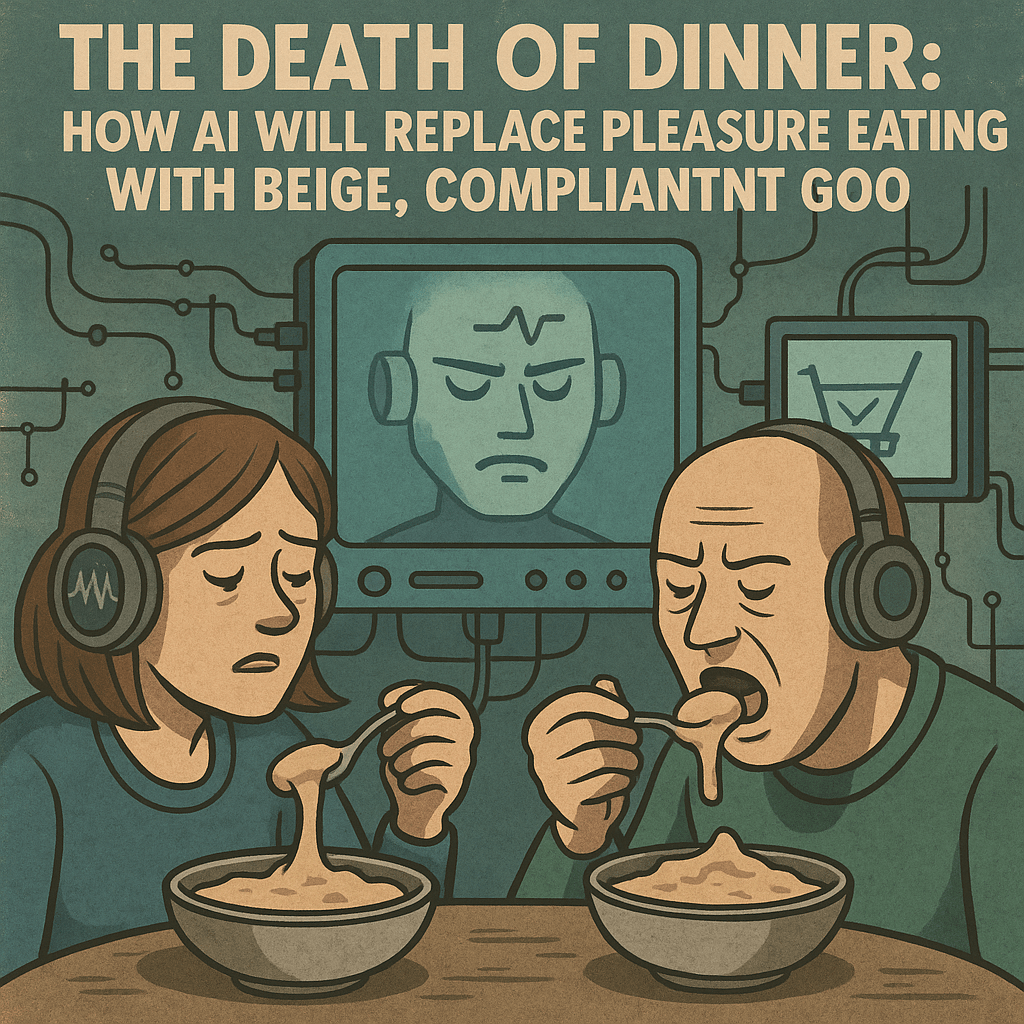
    The Death of Dinner: How AI Could Replace Pleasure Eating with Beige, Compliant Goo

    Savor that croissant while you still can—flaky, buttery, criminally indulgent. In a few decades, it’ll be contraband nostalgia, recounted in hushed tones by grandparents who once lived in a time when bread still had a soul and cheese wasn’t “shelf-stable.” Because AI is coming for your taste buds, and it’s not bringing hot sauce.

    We are entering the era of algorithm-approved alimentation—a techno-utopia where food isn’t eaten, it’s administered. Where meals are no longer social rituals or sensory joys but compliance events optimized for satiety curves and glucose response. Your plate is now a spreadsheet, and your fork is a biometric reporting device.

    Already, AI nutrition platforms like Noom, Lumen, and MyFitnessPal’s AI-diet overlords are serving up daily menus based on your gut flora’s mood and whether your insulin levels are feeling emotionally regulated. These platforms don’t ask what you’re craving—they tell you what your metrics will tolerate. Dinner is no longer about joy; it’s about hitting your macros and earning a dopamine pellet for obedience.

    Tech elites have already evacuated the dinner table. For them, food is just software for the stomach. Soylent, Huel, Ka’chava—these aren’t meals, they’re edible flowcharts. Designed not for delight but for efficiency, these drinkable spreadsheets are powdered proof that the future of food is just enough taste to make you swallow.

    And let’s not forget Ozempic and its GLP-1 cousins—the hormonal muzzle for hunger. Pair that with AI wearables whispering sweet nothings like “Time for your lentil paste” and you’ve got a whole generation learning that wanting flavor is a failure of character. Forget foie gras. It’s psy-ops via quinoa gel.

    Even your grocery cart is under surveillance. AI shopping assistants—already lurking in apps like Instacart—will gently steer you away from handmade pasta and toward fermented fiber bars and shelf-stable cheese-like products. Got a hankering for camembert? Sorry, your AI gut-coach has flagged it as non-compliant dairy-based frivolity. Enjoy your pea-protein puck, peasant.

    Soon, your lunch break won’t be lunch or a break. It’ll be a Pomodoro-synced ingestion window in which you sip an AI-formulated mushroom slurry while doom-scrolling synthetic influencers on GLP-1. Your food won’t comfort you—it will stabilize you, and that’s the most terrifying part. Three times a day, you’ll sip the same beige sludge of cricket protein, nootropic fibers, and psychoactive stabilizers, each meal a contract with the status quo: You will feel nothing, and you will comply.

    And if you’re lucky enough to live in an AI-UBI future, don’t expect dinner to be celebratory. Expect it to be regulated, subsidized, and flavor-neutral. Your government food credits won’t cover artisan cheddar or small-batch bread. Instead, your AI grocery budget assistant will chirp:

    “This selection exceeds your optimal cost-to-nutrient ratio. May I suggest oat crisps and processed cheese spread at 50% less and 300% more compliance?”

    Even without work, you won’t have the freedom to indulge. Your wearable will monitor your blood sugar, cholesterol, and moral fiber. Have a rogue bite of truffle mac & cheese? That spike in glucose just docked you two points from your UBI wellness score:

    “Indulgent eating may affect eligibility for enhanced wellness bonuses. Consider lentil loaf next time, citizen.”

    Eventually, pleasure eating becomes a class marker, like opera tickets or handwritten letters. Rich eccentrics will dine on duck confit in secrecy while the rest of us drink our AI-approved nutrient slurry in 600-calorie increments at 13:05 sharp. Flavor becomes a crime of privilege.

    The final insult? Your children won’t even miss it. They’ll grow up thinking “food joy” is a myth—like cursive writing or butter. They’ll hear stories of crusty baguettes and sizzling fat the way Boomers talk about jazz clubs and cigarettes. Romantic, but reckless.

    In this optimized hellscape, eating is no longer an art. It’s a biometric negotiation between your body and a neural net that no longer trusts you to feed yourself responsibly.

    The future of food is functional. Beige. Pre-chewed by code. And flavor? That’s just a bug in the system.

  • How Headphones Made Me Emotionally Unavailable in High-Resolution Audio

    How Headphones Made Me Emotionally Unavailable in High-Resolution Audio

    After flying to Miami recently, I finally understood the full appeal of noise-canceling headphones—not just for travel, but for the everyday, ambient escape act they offer my college students. Several claim, straight-faced, that they “hear the lecture better” while playing ASMR in their headphones because it soothes their anxiety and makes them better listeners. Is this neurological wizardry? Or performance art? I’m not sure. But apocryphal or not, the explanation has stuck with me.

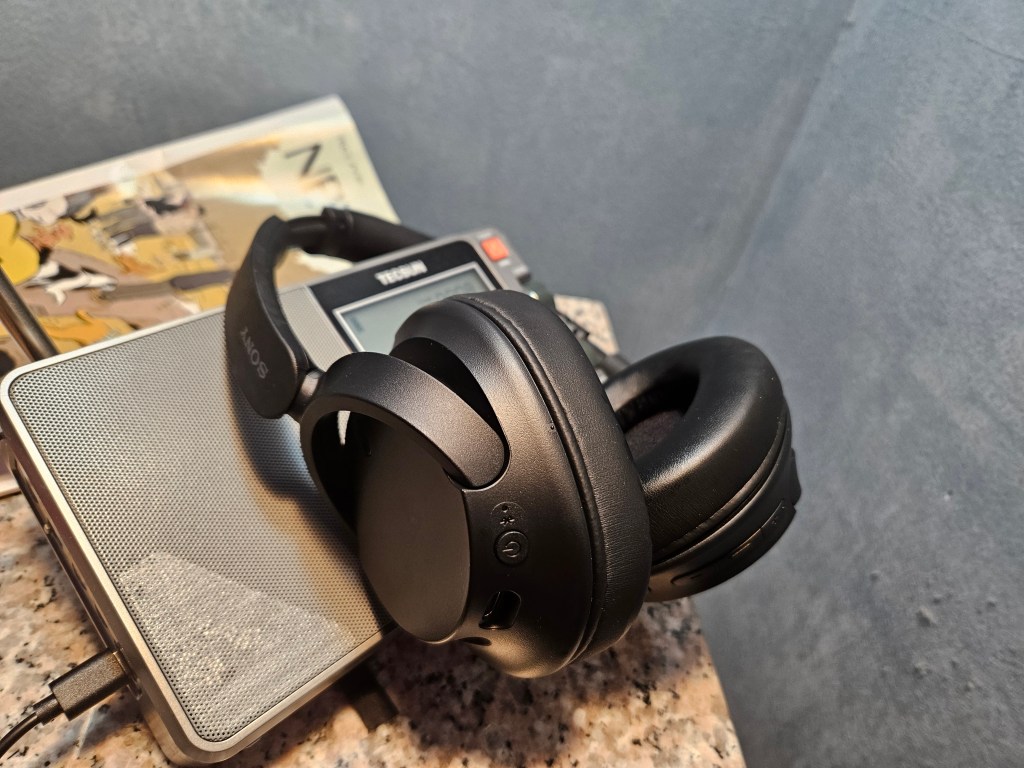
    It made me see the modern, high-grade headphone as something far more than a listening device. It’s a sanctuary, or to use the modern euphemism, an aural safe space in a chaotic world. You may not have millions to seal yourself in a hyperbaric oxygen pod inside a luxury doomsday bunker carved into the Montana granite during World War Z, but if you’ve got $500 and a credit score above sea level, you can disappear in style—into a pair of Sony MX6s or Audio-Technica ATH-R70s.

    The headphone, in this context, is not just gear—it’s armor. Whether cocobolo wood or carbon fiber, it communicates something quietly radical: “I have opted out.”

    You’re not rejecting the world with malice—you’re simply letting it know that you’ve found something better. Something more reliable. Something calibrated to your nervous system. In fact, you’ve severed communication so politely that all they hear is the faint thump of curated escapism pulsing through your earpads.

    For my students, these headphones are not fashion statements—they’re boundary-drawing devices. The outside world is a cacophony of canvas announcements, attention fatigue, and algorithmically optimized despair. Inside the headphones? Rain sounds. Lo-fi beats from a YouTube loop titled “study with me until the world ends.” Maybe even a softly muttering AI voice telling them they are enough.

    It doesn’t matter whether it’s true. It matters that it works.

    And here’s the deeper point: the headphone isn’t just a sanctuary. It’s a non-accountability device. You can’t be blamed for ghosting a group chat or zoning out during a team huddle when you’re visibly plugged into something more profound. You’re no longer rude—you’re occupied. Your silence is now technically sound.

    In a hyper-networked world that expects your every moment to be a node of productivity or empathy, the headphone is the last affordable luxury that buys you solitude without apology. You don’t need a manifesto. You just need active noise-canceling and a decent DAC.

    You’re not ignoring anyone. You’ve just entered your own monastery of midrange clarity, bass-forward detachment, and spatially engineered peace.

    And if someone wants your attention?

    Tell them to knock louder. You’re in sanctuary.

  • College Essay Prompt: Beyond Authentic: How Evolving Cuisines Tell Stories of Survival, Adaptation, and Identity

    College Essay Prompt: Beyond Authentic: How Evolving Cuisines Tell Stories of Survival, Adaptation, and Identity

    Overview:

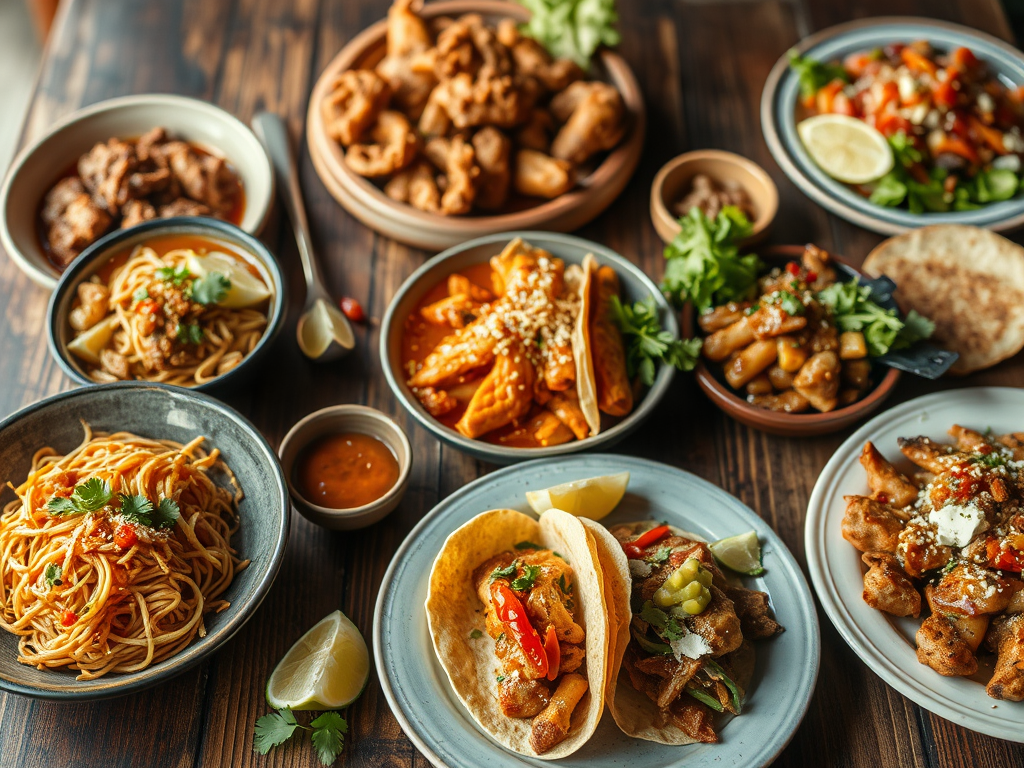
    Write a 1,700-word argumentative essay examining whether dishes like birria ramen, orange chicken, Korean tacos, or Tex-Mex fajitas should be dismissed as inauthentic or embraced as culturally rich, adaptive expressions of immigrant creativity. Using the evolution of Mexican and Chinese food in the U.S. as your focus, evaluate how culinary “impurity” may reflect resilience more than betrayal.

    This assignment challenges the simplistic binary of cultural appropriation vs. cultural preservation by exploring how food evolves through migration, racism, class, capitalism, and the human need to survive—and thrive.


    Central Claim to Defend, Refute, or Complicate:

    Criticizing American Chinese and modern Mexican cuisine as “inauthentic” oversimplifies the historical, cultural, and economic forces that drive culinary evolution.


    Required Sources (Use at least 4, MLA format):

    • Gustavo Arellano – “Let White People Appropriate Mexican Food”
    • The Search for General Tso (dir. Ian Cheney, 2014)
    • Charles W. Hayford – “Who’s Afraid of Chop Suey?”
    • Cathy Erway – “More Than ‘Just Takeout’”
    • Kelley Kwok – “‘Not Real Chinese’: Why American Chinese Food Deserves Our Respect”
    • Jiayang Fan – “Searching for America with General Tso”

    Focus Questions to Consider:

    • What is gained or lost when immigrant cuisines adapt to mainstream tastes?
    • How have Mexican and Chinese-American dishes reflected creative survival strategies in the face of xenophobia or marginalization?
    • Is culinary “authenticity” a meaningful cultural value or an exclusionary myth?
    • How do evolving cuisines challenge stereotypes and redefine American identity?
    • Should food be judged by origin or by impact?

    Essay Requirements:

    • Length: 1,700 words
    • Format: MLA (12 pt font, double-spaced, Times New Roman)
    • Sources: At least 4 from the required list
    • Tone: Academic and analytical, but open to personal insight or cultural experience
    • Structure: Use the suggested outline below or build your own coherent structure

    Suggested Structure:

    Intro (200–300 words):

    • Open with the “authenticity” debate in food culture
    • Present the evolution of Mexican and Chinese cuisine as a case study
    • Clearly state your thesis: whether you defend, challenge, or complicate the rejection of “inauthentic” foods

    Section 1: Culinary Evolution as Cultural Power (400–500 words)

    • Use Arellano’s “adaptability” argument and The Search for General Tso
    • Explore how adaptation expands—not erases—culinary traditions

    Section 2: Food as a Tool of Survival (400–500 words)

    • Use Jiayang Fan and Cathy Erway to show how these cuisines offered paths to economic mobility and belonging
    • Address how racism shaped what was “acceptable” for the mainstream palate

    Section 3: Rethinking Authenticity (400–500 words)

    • Use Kelley Kwok and Hayford to interrogate what we even mean by “authentic”
    • Acknowledge that tradition matters—but argue that hybridity is the tradition of diaspora

    Section 4: Counterargument & Rebuttal (300–400 words)

    • Address critics who claim fusion or Americanized food dilutes culture
    • Rebut: show how adaptation often preserves a culture’s essence in new form

    Conclusion (200–300 words)

    • Reaffirm your thesis: evolving cuisine reflects the ingenuity, creativity, and endurance of immigrant communities
    • Reflect on how accepting culinary adaptation challenges us to redefine American identity itself

    Final Notes to Students:

    This essay isn’t just about food—it’s about the stories food tells. Let your argument reflect that complexity. Engage deeply with your sources, and don’t be afraid to explore tensions: pride vs. commodification, tradition vs. survival, innovation vs. erasure.

  • College Writing Prompt: The Willpower Illusion: Ozempic, Obesity, and the Myth of Self-Control in a the Aesthetic Industrial Complex

    College Writing Prompt: The Willpower Illusion: Ozempic, Obesity, and the Myth of Self-Control in a the Aesthetic Industrial Complex

    Overview:

    Write a 1,700-word argumentative essay exploring whether the dominant narrative about weight loss—discipline, clean eating, and personal responsibility—still holds up in the age of pharmaceutical intervention, economic inequality, and digital diet culture.

    Drawing from Rebecca Johns (“A Diet Writer’s Regrets”), Johann Hari (“A Year on Ozempic…”), Harriet Brown (“The Weight of the Evidence”), and Sandra Aamodt (“Why You Can’t Lose Weight on a Diet”), analyze how obesity is shaped by factors far beyond individual willpower. Consider the influence of wealth disparity, pharmaceutical marketing, addictive food engineering, and digital culture on how we define health, blame failure, and reward certain bodies over others.


    Key Questions to Consider:

    • Is the belief in personal discipline as the primary tool for weight loss a dangerous oversimplification?
    • How do Ozempic and similar drugs challenge or reinforce our cultural obsession with self-control?
    • What role does economic privilege play in deciding who gets access to medical weight-loss interventions?
    • Are we witnessing a new form of techno-body capitalism where apps, injections, and dopamine loops manage our appetites better than we ever could?
    • How might social media, AI influencers, and fitness-tracking technologies contribute to a culture of body surveillance and shame?

    Required Sources (Use at least 4, MLA Format):

    • Rebecca Johns – “A Diet Writer’s Regrets”
    • Johann Hari – “A Year on Ozempic Taught Me We’re Thinking About Obesity All Wrong”
    • Harriet Brown – “The Weight of the Evidence”
    • Sandra Aamodt – “Why You Can’t Lose Weight on a Diet”

    Recommended Focus Areas:

    1. The Discipline Dilemma
    How Johns and Hari dismantle the myth that all it takes is willpower. What emotional, social, and physiological realities do they reveal?

    2. Set Points and Self-Sabotage
    How Aamodt and Brown explain the body’s resistance to permanent weight loss. What does the science say about the limits of effort?

    3. Ozempic and the Access Divide
    Ozempic works—but only for those who can afford it. How does this reflect a larger healthcare injustice?

    4. Capitalism’s Role in Body Control
    How the Industrial Food Complex profits from addiction, and Big Pharma profits from the “cure.” Is this a closed system of exploitation?

    5. Digital Diet Culture
    Optional but encouraged: bring in TikTok, fitness influencers, AI diet advice, or surveillance devices (like smartwatches and calorie-counting apps). How do these amplify shame or create new ideologies of control?


    Conclusion:

    Make a claim about how society should reframe the conversation around obesity and weight loss. Should we abandon the willpower narrative? Should access to medical treatments be universal? Should we question the legitimacy of “health” as a moral standard at all?


    Final Essay Requirements:

    • 1,700 words minimum
    • MLA format, 12pt Times New Roman, double-spaced
    • Include a clear thesis, transitions, and a conclusion
    • Use and cite at least 4 sources

    Submit with a Works Cited page