Category: Health and Fitness

  • The Sapphire Frogman Temptation: Is the Final Watch the Cure—or the Disease?

    The Sapphire Frogman Temptation: Is the Final Watch the Cure—or the Disease?

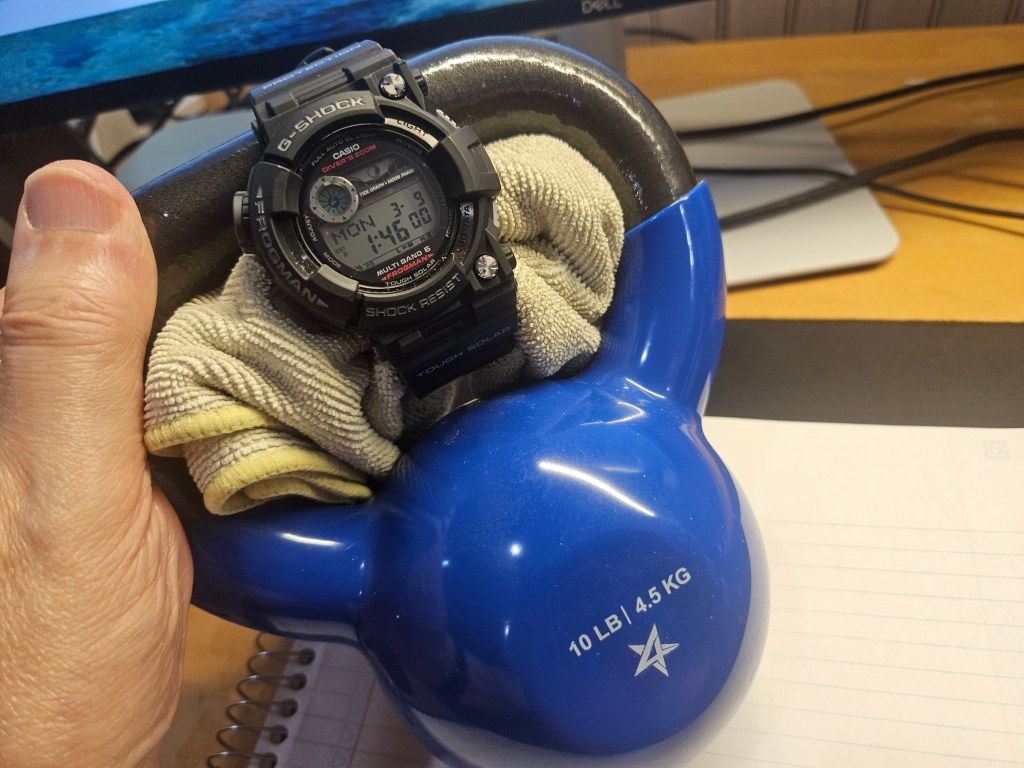
    I recently sold a few mechanical divers and, as a result, committed a small but dangerous financial act: I created enough liquidity to purchase the sapphire G-Shock Frogman—the DLC-armored Holy Grail of the G-Shock cult. The beast sits there on the internet, gleaming like a jeweled idol, whispering promises of final satisfaction. It might be magnificent in my collection. Or it might behave like every other supposed “final watch,” which is to say it will bring three weeks of exhilaration followed by a fresh outbreak of neurosis.

    That is the problem. I’m beginning to suspect the hobby itself is the neurosis. At my age, accumulating watches no longer feels like curating a collection; it feels like feeding a psychological raccoon that keeps rummaging through my brain at night. The raccoon never says, “Good work. Eight watches is enough.” It says, “Interesting… but have you considered one more?”

    If the sapphire Frogman truly represented an Exit—a gleaming DLC-coated door marked Freedom From Horological Madness—I would buy it without hesitation. Swipe the card. Close the chapter. Walk away a healed man. But experience suggests a darker possibility: the real exit may not be a thousand-dollar watch at all. The real exit might be something far less glamorous—stopping now, accepting the modest dignity of an eight-watch collection, and quietly moving on with the rest of my life.

  • Life Is Uncertain. Porridge Is Not

    Life Is Uncertain. Porridge Is Not

    For the past week my appetite has surged like a rogue wave. That could mean several things, none of them particularly flattering. Perhaps I’m medicating stress with food. Perhaps there are subterranean stress triggers rumbling beneath the surface that I haven’t identified yet. Life, after all, provides a constant background hum of anxiety, and it’s difficult to distinguish ordinary daily strain from something more corrosive.

    Retirement is hovering in the distance like a financial fog bank. I’ve been emailing HR about the price of keeping my Kaiser coverage after I retire versus moving to my wife’s more modest plan. Her school pays less than mine, which means we’re staring at something in the neighborhood of $1,500 a month once dental and vision enter the scene. Retirement, which is supposed to represent liberation, suddenly looks like a complicated negotiation with spreadsheets, identity, and self-worth. And apparently my body’s response to this existential accounting exercise is simple: eat more chicken.

    There is, at present, a dangerous quantity of takeout chicken in this house. Fried chicken. Roasted chicken. Greasy, seductive chicken lounging in the refrigerator like a gang of edible hoodlums. I open the fridge intending to take a small, respectable bite. Five minutes later I’m standing there gnawing through a drumstick like a raccoon that has discovered civilization. The aftermath is predictable: gluttony followed immediately by anxiety.

    The anxiety, unfortunately, does not arrive alone. It brings a surveillance drone. I watch myself overeating as if my consciousness has sprouted a third eye hovering above the scene like a judgmental security camera. I am both the criminal and the detective. The more I watch myself eat, the more anxious I become. The more anxious I become, the more I eat. I have achieved what behavioral psychologists might politely call a closed loop of misery.

    Action is required.

    My proposed solution is radical in its simplicity: three meals a day, no snacking. Breakfast will be steel-cut oatmeal or buckwheat groats fortified with protein powder. Lunch will be rolled oats with yogurt and more protein powder. Dinner will consist of a sensible portion of protein, vegetables, and an apple. It is not glamorous, but glamour is precisely the problem.

    Oatmeal comforts me. It possesses the mild, reassuring neutrality of something that has no ambitions beyond keeping you alive. Perhaps it is a kind of surrogate baby food. Perhaps the approach of retirement has triggered a mild regression in which my brain seeks the emotional equivalent of warm porridge and a quiet afternoon nap. As I drift deeper into my mid-sixties, it is entirely possible that my culinary philosophy is reverting to something suitable for a kindly monastery.

    Life is uncertain. Porridge is not.

    I like the predictability of three meals a day involving some form of oatmeal. I like the idea of owning a Lenovo ThinkPad, which is the oatmeal of computers. I like the Honda Accord and Toyota Camry, which are the oatmeal of the automobile world. And I like my solar atomic G-Shocks, which are the oatmeal of timepieces—durable, accurate, incapable of drama.

    If possible, I would like to swim inside a large industrial vat of oatmeal, floating peacefully while the chaos of the modern world clangs harmlessly against the outside of the tank.

    Unfortunately, hostile forces surround the vat.

    My daughters campaign relentlessly for takeout: Dave’s Hot Chicken, Wingstop, Panda Express. Holiday gatherings appear with enough pies and brownies to launch a regional bakery franchise. A man can only resist these temptations for so long before the walls of discipline begin to buckle.

    Meanwhile, medical costs continue their relentless ascent, and retirement funds tremble nervously as global markets perform their daily interpretive dance of geopolitical uncertainty.

    Under such circumstances I find myself clinging to a personal doctrine I’ve begun to call The Porridge Principle: the instinct to confront anxiety by retreating into humble, reliable technologies and routines that promise frictionless predictability. Oatmeal breakfasts. ThinkPad laptops. Honda sedans. Solar atomic watches. These objects do not thrill, but they do not betray.

    When the world becomes chaotic, the mind begins searching for tools and rituals that behave exactly the same way every day.

    So that is the plan.

    Trader Joe’s opens in an hour. I will buy groceries for my family and a heroic supply of oatmeal. The campaign against uncertainty has begun.

    Pray for me.

  • Deacon Blues Syndrome and Watch Addiction

    Deacon Blues Syndrome and Watch Addiction

    You felt a flash of embarrassment the other day when a thought arrived that should have been obvious years ago. The tension you carry around your watch collection—the way you analyze every purchase, every rotation, every sale as if it were a decisive move in a championship match—does not come from the watches themselves. It comes from loneliness. In the blunt language of the present moment: you don’t quite have a life.

    On paper, you appear responsible enough. You try to meet the expectations placed upon you. You pay attention to your finances. You maintain your fitness routine. You show up for your marriage and your children. Yet beneath these obligations runs a quieter truth: you spend most of your life inside your own head. You worry. You brood. You sometimes imagine that life has shortchanged you—that the grand parade of glory you expected never arrived. No brass band, no confetti. Just the steady hum of ordinary days.

    In this sense you resemble the narrator of Steely Dan’s “Deacon Blues,” a man who moves through one life while dreaming of another. Your version of that alternate world happens to be your hobby. Watches provide a parallel universe—one filled with purity, precision, and tidy solutions. In that world you can become the connoisseur, the signal hunter, the disciplined curator of perfect instruments. It is a carefully engineered emotional ecosystem, designed to distract you from the messy ambiguities of real life. The danger, of course, is expecting this world to deliver something it was never built to provide.

    Call this condition Deacon Blues Syndrome. Borrowing from the Steely Dan narrator who imagines himself transformed into a romantic alter ego, the term describes the habit of living an ordinary life while mentally inhabiting a heroic or purified version of oneself. The watch obsessive becomes the protagonist of this private mythology. Meanwhile, the real world remains stubbornly ordinary, leaving the hobby to absorb the emotional energy of ambitions that never quite found their stage.

    This realization may sound harsh, but harshness is not the point. It is simply honesty. Just as Rainer Maria Rilke wrote Letters to a Young Poet to encourage solitude, self-examination, and inner clarity, those of us who struggle with watch addiction might benefit from something similar—Letters to Broken Watch Addicts. The purpose of such letters would not be cruelty or ridicule. Their purpose would be clarity: to illuminate the psychological currents that drive the obsession and, perhaps, to open the door to a quieter, more deliberate way of living.

    Such explorations are in my book The Man Who Lost His Mind to Watches.

  • Collector’s Paradox

    Collector’s Paradox

    I sometimes imagine the perfect end state of my G-Shock hobby: four watches rotating peacefully through my week like planets in a stable orbit. The lineup is already clear in my mind. The Frogman GWF-1000. The Rescue GW-7900. The Three-Eyed Triple Graph GW-6900. And the Frogman GWF-D1000B. Four machines, each with a distinct personality, each capable of carrying the entire hobby on its shoulders without needing help from a dozen cousins.

    In theory, that sounds like serenity.

    But there’s a catch.

    A modest four-watch rotation brings peace, but it also brings something else: the end of discovery. And discovery is half the fun. The moment the collection becomes complete, the hunt quietly packs its bags and leaves town.

    This is where the trouble begins.

    Inside my head two different personalities are negotiating, and neither one intends to surrender easily. One personality wants order. The other wants novelty. One wants a finished system; the other wants an endless frontier.

    The first personality is the Curator. The Curator wants a tidy garage with four perfectly chosen machines parked inside. He wants familiarity. He wants mastery. He wants watches whose buttons, modules, and quirks are so well known they stop feeling like gadgets and start feeling like companions. In the Curator’s world, the hobby becomes calm. Predictable. Comfortable.

    But the Curator’s paradise has a downside: once the system is finished, the hunt is over.

    And the hunt is intoxicating.

    That’s where the Explorer enters the picture. The Explorer lives for discovery. He watches reviews. He compares modules. He learns about obscure models produced in tiny Japanese batches fifteen years ago. He imagines how each watch might fit into his life like a missing puzzle piece. The excitement is not really about owning the watch—it’s about the possibility of it.

    Discovery delivers a small dopamine rush.

    But discovery has a hidden clause buried in the contract: every discovery whispers the same seductive suggestion—You should own this.

    When that suggestion is obeyed too often, the collection begins to swell. And when the collection swells, the hobby begins to generate friction. Watches compete for wrist time. Drawers fill up. Decisions multiply. The collection slowly transforms from a playground into an inventory system.

    The very activity that made the hobby thrilling begins to make it stressful.

    This is the Collector’s Paradox.

    Discovery is the fuel that powers the hobby. But discovery also leads to accumulation. Accumulation eventually produces clutter, decision fatigue, and the creeping sense that the watches are managing the collector instead of the other way around.

    To escape that stress, the collector dreams of a small, perfectly balanced collection—four watches rotating peacefully like a well-tuned engine.

    But here’s the paradox: the moment the collection feels complete, the discovery that made the hobby exciting begins to disappear.

    Discovery creates excitement but leads to accumulation.
    Restraint creates peace but risks boredom.

    And the collector finds himself standing between two competing instincts: the Curator, who wants a finished system, and the Explorer, who wants endless possibility.

    One way out of this trap may be to admit that I’m actually practicing two different hobbies at the same time.

    One hobby is ownership—the watches I actually live with. The small rotation that occupies my wrist and my watch box.

    The other hobby is exploration—the endless universe of watches I can study, admire, and analyze without needing to buy them.

    Separating those two activities may be the key to keeping the hobby alive without letting it metastasize.

    This is not easy in the world of G-Shock. G-Shock culture is a discovery machine. Hundreds of models. Endless colorways. Limited editions popping up like mushrooms after rain. The watches are affordable enough that buying one rarely feels catastrophic, and the community itself celebrates acquisition like a team sport.

    The Explorer inside a collector can run wild in that environment.

    But the fact that I’m even imagining a four-watch rotation suggests something interesting about where I am psychologically. The Curator inside me is gaining strength. Many collectors never reach that stage. They remain permanently trapped in the thrill of acquisition.

    The anxiety I’m feeling may actually be a sign that I’m trying to bring the hobby under control rather than letting it control me.

    And that leads to a possible next stage of the hobby: Observational Collecting.

    In Observational Collecting, curiosity and acquisition finally separate. Watches are still studied. Still admired. Still discussed. But they are no longer automatic candidates for purchase.

    The central question of the hobby quietly changes.

    Instead of asking, “Should I buy this watch?” I begin asking, “Isn’t that an interesting watch?”

    The curiosity remains alive, but the compulsion to acquire loosens its grip.

    Discovery doesn’t disappear. It simply stops demanding ownership as the price of admission.

    And if that shift finally takes hold, the hobby may achieve something collectors rarely experience.

    Peace.

  • The G-Shock Multiband 6 Salvation Fantasy

    The G-Shock Multiband 6 Salvation Fantasy

    Pascal once observed that man cannot sit quietly in his room. Leave him alone with his thoughts and he begins to itch. Mortality looms. Meaning feels slippery. Silence becomes unbearable. So he reaches for distraction—baubles, upgrades, shiny mechanical companions that promise significance if only he can tighten one more screw or polish one more bezel.

    Call this Pascalian Gadget Panic: the modern expression of Pascal’s insight that when faced with the vague terror of existence, a man will anesthetize himself with objects. Radios. Cameras. Knives. Mechanical divers. G-Shocks. The object rotates through the years like a carousel horse, but the agitation underneath remains faithfully employed.

    Consider a suburban man in reasonably good health who nonetheless struggles with discipline, boundaries, and the mild chaos of his inner life. Spiritual philosophy eludes him. Self-knowledge feels slippery. Relationships are uneven terrain. Faced with this fog, he does what many modern men do.

    He buys toys.

    In his case, the toys are watches.

    For twenty years he labors happily in the vineyards of mechanical divers—Seikos mostly—fine steel contraptions that tick like tiny diesel engines beneath sapphire glass. The collection eventually reaches a comfortable plateau: curated, restrained, almost dignified.

    And then, inexplicably, he loses interest.

    The mechanical divers are quietly retired to their watch box like aging prizefighters. In their place emerges a new obsession: G-Shocks, but only of a very specific species—digital, solar-powered, atomic-synchronized, strapped in rubber armor like tiny tanks.

    Four commandments define the new religion:
    Tough Solar.
    Multiband 6 Atomic.
    Digital-only display.
    Rubber straps.

    One madness has been replaced with another, though the patient insists this is progress.

    To maintain psychological order, he compartmentalizes. The mechanical divers remain sealed in their box like museum artifacts. The G-Shocks, however, require their own ecosystem.

    Enter the Industrial Pipe Shrine.

    This object began life as a two-tier industrial pipe jewelry stand, the sort of thing normally used to hang headphones or necklaces. But in this household it has been promoted to sacred architecture. It sits reverently on a windowsill each night so the watches may commune with the atomic time signal emanating from Fort Collins, Colorado.

    To the uninitiated, it looks like plumbing hardware assembled by a bored welder.

    To the devotee, it is a receiving station of cosmic precision.

    Each night the G-Shocks dangle from the steel arms like metallic fruit awaiting revelation. Somewhere in Colorado a radio transmitter hums. Somewhere in the suburban night a man sleeps. And somewhere between them invisible time signals pass through drywall and glass until they arrive inside the tiny ferrite antenna hidden in a digital watch.

    When the signal locks in, the man experiences what can only be called the Multiband-6 Salvation Fantasy.

    For a brief moment the universe feels orderly. Accurate. Aligned. The watch has synchronized itself with atomic time. Solar cells sip daylight. Precision has been achieved.

    The feeling of control is intoxicating.

    Unfortunately, it lasts about as long as the next YouTube review.

    When members of the G-Shock community encounter this newly converted soul, they greet him with cheerful recognition.

    “Congratulations,” they say. “You’ve been G-Shocked.”

    The phrase functions like a baptism. The initiate is welcomed into a brotherhood of people who understand the deep satisfaction of armored watches, radio synchronization, and the quiet glow of solar charging indicators.

    At this moment the man realizes something unsettling: his geekdom has intensified

    Part of him embraces the absurdity. The watches are inexpensive. The hobby is harmless. Why not laugh at himself and enjoy the ride?

    But another part of him wonders whether something darker is unfolding.

    Is this, perhaps, the arrival of the Jungian Shadow—the neglected, obsessive part of the psyche now expressing itself through tactical wristwear?

    Will the Shadow politely stop at three G-Shocks?

    Or will it grow ambitious—multiplying into a monstrous collection that colonizes dresser drawers, nightstands, gym bags, glove compartments, and every horizontal surface in the home?

    Disturbed by these questions, the man attempts a strategic retreat. He throws himself into his other pursuits: bodybuilding, physical culture, literature, television, film.

    These distractions provide temporary relief.

    But the G-Shock Shadow is patient.

    Soon he is back on YouTube watching reviews of obscure Japanese models. He is compiling wish lists. He is studying signal reception strategies.

    Late at night he imagines the watches hanging from the steel arms of his T-bone pipe stand.

    And in darker moments he sees them differently.

    Not as tools.

    But as vampire bats—black, armored creatures dangling upside down, waiting for him to drift into sleep so they can descend silently and drink his blood.

    When he wakes in the morning, they will still be there on the windowsill.

    Perfectly synchronized.

    And waiting.
  • Frogman Monstrosity Acceptance

    Frogman Monstrosity Acceptance

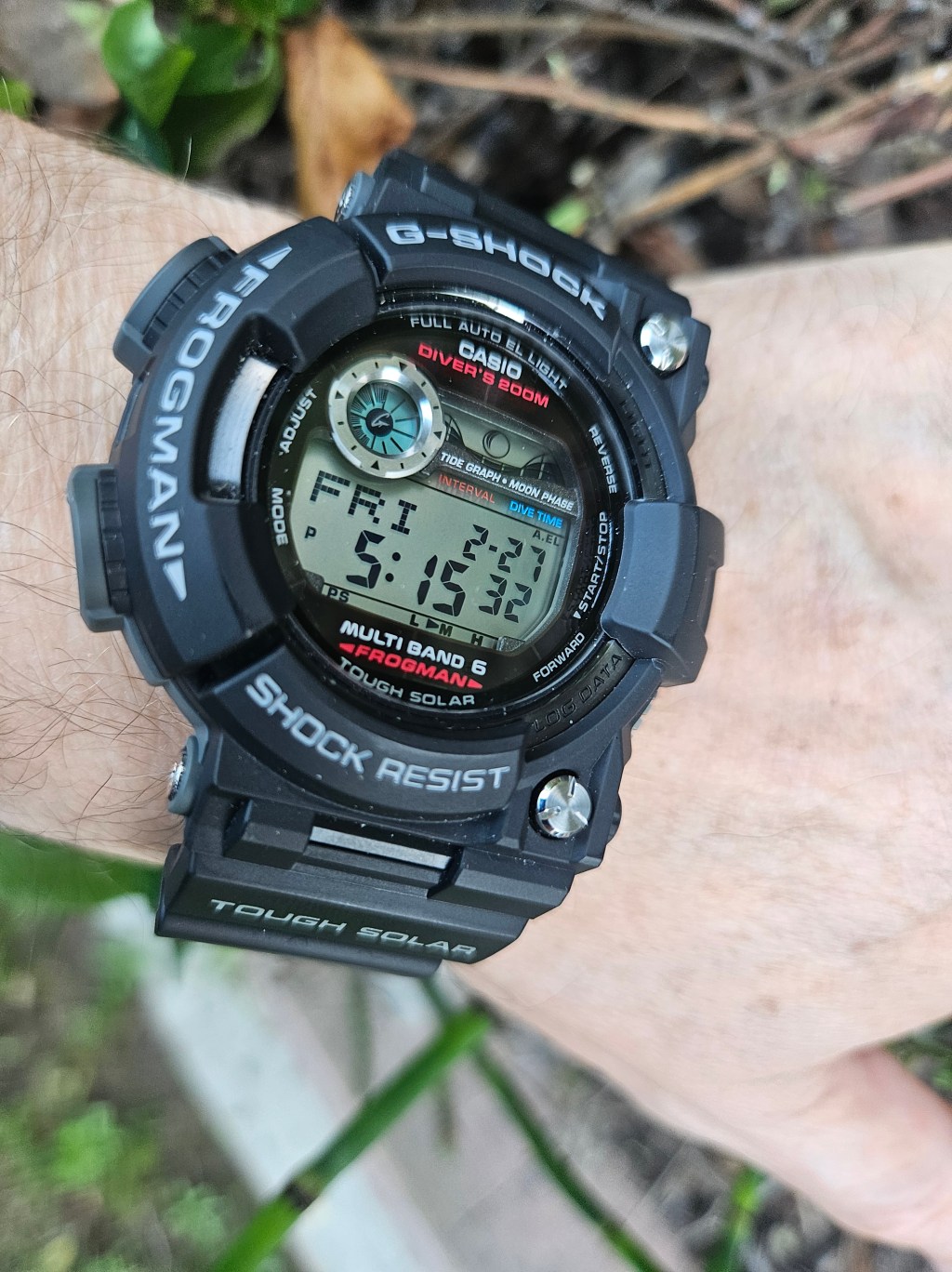
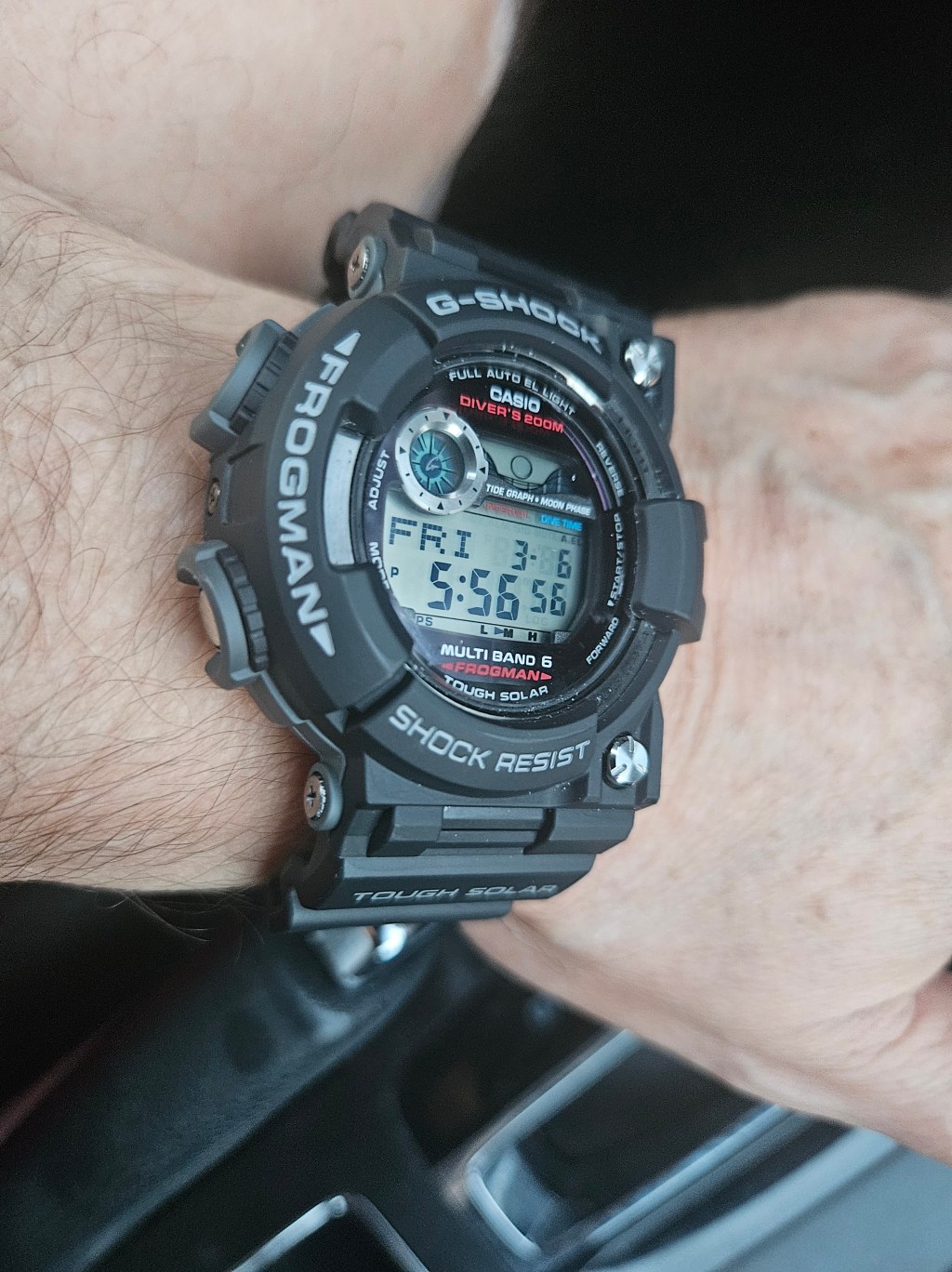
    I’ve tried to be candid about where my watch hobby is headed. For years I lived in the land of mechanical divers—those charming little machines that require winding, adjusting, and periodic visits to a watchmaker who looks at you the way a veterinarian looks at a sick horse. Lately, however, I seem to be drifting toward a different ecosystem: Multiband 6 atomic time delivered by my G-Shock Frogman, a watch that feeds on sunlight and quietly synchronizes itself with atomic clocks while I sleep. It is difficult to compete with a device that performs its duties with the calm efficiency of a Swiss train conductor who never needs coffee. The responses to this confession have been varied. Some readers nod knowingly and say they went through the same conversion. Their mechanical watches now sit motionless in drawers like retired prizefighters who once thrilled crowds but now spend their days remembering the old days. One friend is currently wandering around Thailand with a GW-5000U on his wrist and reports a level of contentment normally associated with Buddhist monks. Others have taken the opposite path and begun collecting Frogman models the way medieval villagers stockpiled shields before a siege, as if surrounding themselves with these massive amphibious contraptions might repel the chaos of modern life.

    And then there are the critics. They inform me—sometimes gently, sometimes with theatrical alarm—that I have lost my mind, contracted a disease, and strapped a grotesque monstrosity to my wrist. I concede every point. I am indeed crazed with enthusiasm, and the Frogman is unquestionably a monstrosity. But it is the most magnificent monstrosity I have ever encountered. I appear to have entered what might be called Frogman Monstrosity Acceptance: the psychological stage in which the owner stops apologizing for the watch’s outrageous proportions and instead embraces them with pride. Yes, it is enormous. Yes, it looks like a small amphibious armored vehicle designed by engineers who distrust gravity. But once you surrender to its scale, the Frogman ceases to be embarrassing and becomes something far better—a gleefully excessive titan among polite timepieces.


  • The Frogman Fidelity Oath

    The Frogman Fidelity Oath

    Dear God, hear the humble prayer of a watch addict who is trying—heroically, if imperfectly—to stay faithful to his G-Shock Frogman. Grant me the strength to appreciate the magnificent amphibious creature already on my wrist and to resist coveting other G-Shocks, especially the cheaper ones that whisper seductive promises of practicality and convenience. Protect me from the restless itch that sends me wandering through YouTube at midnight, where cheerful reviewers with macro lenses and enthusiastic voices assure me that the next watch will transform my life, my character, and possibly my posture.

    Please quiet the anxious machinery in my brain that insists on researching watches I do not need. Help me understand that the Frogman already fulfills every rational requirement a man could have for a digital timepiece: it is solar, atomic, indestructible, and built like a submarine designed by an engineer with trust issues. Remind me that my obsessive excursions into the G-Shock ecosystem are not noble acts of research but rather neurotic pilgrimages through a desert of comparison charts and unboxing videos.

    And please, dear God, intervene quickly, because the temptation is growing stronger by the hour. I can feel myself drifting toward the purchase of a GW-7900—not because I need it, but because my mind has begun whispering the most dangerous phrase in the collector’s vocabulary: “backup watch.” I tell myself the 7900 would merely protect my Frogman from harsh conditions, as though the Frogman were a delicate orchid rather than an armored amphibian designed to survive the Mariana Trench.

    If this prayer sounds familiar, you already understand the Frogman Fidelity Oath: the solemn pledge made by the watch enthusiast who believes he has finally found the perfect G-Shock and now begs for the strength not to betray it. The oath is heartfelt, sincere, and deeply moving—and it usually lasts right up until the moment the addict watches two enthusiastic YouTube reviews and convinces himself that buying a second watch is not an act of infidelity but an act of responsible stewardship.

  • You Can Squander Your Entire Life on the Review Treadmill

    You Can Squander Your Entire Life on the Review Treadmill

    Over the past twenty years, something subtle but decisive has happened to our brains: we have stopped reading and started watching. The printed page asks for patience and solitude. Video, by contrast, offers a human face. We no longer want arguments delivered in paragraphs; we want a narrator standing before us, explaining the world with hand gestures, eyebrow raises, and the occasional conspiratorial smile. The writer has quietly stepped aside. In his place stands the “creator,” a figure who performs knowledge rather than merely writing it down.

    There are, to be fair, some remarkable creators who produce philosophical video essays—long, thoughtful meditations on culture, politics, or technology. These people still believe ideas deserve oxygen. But they are the minority. For the vast majority of viewers, the preferred form of knowledge is far more practical and far less exalted: product reviews. Comparisons. Rankings. Side-by-side verdicts on the minor differences between things we may or may not ever purchase.

    I am not immune to this gravitational pull. Suppose I want to understand the fine distinctions among solar, atomic G-Shocks—their legibility, antenna performance, charging efficiency, module behavior, and overall build quality. That path leads to a rabbit hole deep enough to swallow a decade of one’s life. I could earn a doctoral degree in G-Shock Studies and still emerge unsure whether the GW-7900 or the GW-9400 possesses the superior atomic reception. Doubt becomes the justification for further research. And further research leads to what might be called the Comparative Infinity Loop: a condition in which every answer breeds another comparison. The 7900 versus the 9400. Module 3193 versus module 3410. One display’s legibility versus another’s contrast. Each conclusion merely opens another door.

    The deeper irony is that the search for “absolute knowledge” can easily replace the experience itself. A person could spend an entire lifetime watching product reviews without ever purchasing the product in question. The mind remains entertained, stimulated, and convinced it is progressing toward certainty. But nothing actually changes.

    The metaphor that best captures this condition is the shark. A shark must keep swimming to force oxygen through its gills. Stop swimming and it suffocates. Our brains now behave the same way. We keep feeding them review after review, comparison after comparison, as if the next video will finally reveal the decisive truth. But we are not swimming toward a destination. We are circling the same patch of ocean.

    In this sense, modern consumer knowledge has become a form of exercise equipment: the Review Treadmill. The viewer burns mental energy at a heroic rate, accumulating ever finer distinctions between products, yet never actually moves forward. The belt keeps turning. The videos keep playing. And the horizon of perfect knowledge remains politely out of reach.

  • After the Fever Dream: Life After Finishing a Book

    After the Fever Dream: Life After Finishing a Book

    You write the book the way a man fights a war—sleepless, exhilarated, slightly deranged. The watch obsession pours out of you in a manic fever dream. Paragraphs multiply. Arguments sharpen. The dragons of doubt are hunted down and slain one by one. The process is violent, cathartic, intoxicating. Then one day the battlefield goes silent.

    The book is finished.

    You resist the temptation to congratulate yourself. You are not a novelist emerging from a mahogany-paneled publishing house. You are a self-publishing writer who lives in the strange modern territory between the written page and the spoken performance. Your books feed your videos. Your videos feed your books. You are part author, part storyteller, part one-man theater troupe trying to keep reading culture alive in an age that prefers the human voice and the glowing screen.

    So the manuscript about your horological madness is uploaded, and the waiting begins.

    Amazon’s machinery now takes possession of your work. Your manuscript passes through a quiet bureaucratic gauntlet. The system inspects your file the way a customs officer inspects luggage. It checks whether the text converts properly into Kindle’s internal formats—the KPF and MOBI skeletons that power the ecosystem. It scans for broken hyperlinks, missing images, corrupted fonts, copyright problems, suspicious passages that resemble plagiarism, and metadata that smells like deception.

    Once the manuscript survives inspection, Amazon manufactures the retail version of your book. A downloadable Kindle file appears. The “Look Inside” preview is generated. Internal indexing is built so readers can search the text. Page locations are mapped so the book behaves properly across Kindle devices. Then the storefront is assembled: title, subtitle, description, keywords, categories, price, royalties. When all of this is complete, the book is pushed into the distribution queue.

    For roughly seventy-two hours, you exist in a peculiar form of creative purgatory.

    You are finished with the book, yet the book does not exist.

    Meanwhile your mind refuses to stop working. New sentences appear uninvited. Fresh paragraphs demand insertion. You sketch revisions for the next edition even though the current one has not yet been born. These are the creative aftershocks—the involuntary spasms that follow the completion of a major piece of work. The engine keeps firing even though the race is over. The sensation resembles a phantom limb: the writer’s brain continues to move muscles that are no longer attached to the task.

    Eventually the tremors subside.

    And then the crash arrives.

    When you were writing, your mind functioned like a soldier in combat—focused, purposeful, rewarded with small chemical bursts every time a paragraph landed cleanly on the page. Once the book is done, the mission vanishes overnight. The brain suddenly finds itself unemployed.

    What follows is the Post-Manuscript Collapse.

    Energy drains. Conversation feels exhausting. The meaning of life becomes suspiciously vague. You stare at walls, wondering whether a medically induced coma might be the most efficient way to pass the time. This stage is unpleasant, but it is not pathological. It is the nervous system resetting after prolonged creative exertion.

    Think of the narrators in Tony Banks’ finest Genesis compositions. In “Mad Man Moon” and “Afterglow,” a man constructs a world around himself only to watch that world age, crumble, and lose its meaning. The collapse is not merely tragic—it is necessary. Something must die so that something else can emerge.

    The writer experiences the same cycle.

    You must shed the identity you inhabited while writing the book. That identity served its purpose, but it cannot follow you into the next chapter. This transitional stage is what might be called the Snakeskin Interval—the quiet, uncomfortable period when the old creative skin peels away.

    Do not mistake this shedding for failure. It is renewal in disguise.

    The only appropriate response is humility. Resist the theatrical temptation to despair. Instead, recognize that this strange melancholy is part of the creative metabolism. Listen again to those Genesis songs. Let their melancholy wisdom remind you that endings are rarely endings at all.

    They are merely the silence that makes the next beginning possible.

  • The Watch You Love Is the One on Your Wrist (The Rest Are Fairy Dust)

    The Watch You Love Is the One on Your Wrist (The Rest Are Fairy Dust)

    I have painful news. We do not gather here to flatter one another’s delusions, so let’s drop the incense and speak plainly: you, me, and our inner watch cyborgs do not love our watches. We love saying we love them. We call them “beloved.” We insist they define our identity. We admire our “curated collections” as if they were doctoral theses in horological self-actualization. We stand before our watch boxes like minor kings surveying a conquered province. It feels noble. It sounds impressive. It is largely fiction.

    How do I know? Because of the evidence you provided. One of you tucked two dozen watches into a hidden trunk. Months passed. No withdrawal symptoms. No late-night longing. No tremor in the wrist. Just silence. These were not impulse purchases from a clearance bin. They were carefully researched, thoughtfully selected, celebrated arrivals. Each one represented taste refined, knowledge deepened, discernment sharpened. And yet, when placed out of sight, they might as well have been holiday decorations in July. That question now hovers over you like an uncomfortable relative at Thanksgiving: Do you love these watches—or do you love the idea of loving them?

    Here is what is happening. The inner watch cyborg is running the show. He is not sentimental; he is strategic. He manufactures urgency. He whispers about grails. He frames purchases as destiny. This is Cyborg Puppetmaster Theory in action: the internal algorithm that thrives on pursuit, not possession. The hunt is intoxicating. The checkout page is a sacrament. The shipping notification is foreplay. But once the box is opened and the novelty metabolized, the cyborg moves on. He feeds on anticipation and starves on contentment. The object was never the point. The chase was.

    And so we arrive at the diagnosis: Collection Delusion Syndrome—the condition in which a collector mistakes the performance of passion for the experience of it. The watches are polished, photographed, insured, cataloged, and then quietly exiled to a trunk where they gather dust without being mourned. The owner declares devotion, yet absence produces no ache. The romance was theatrical. The attachment atmospheric. The only watch that truly exists is the one on your wrist—the one that interrupts your day, absorbs your scratches, accumulates your hours. The rest are fairy dust with serial numbers.

    Let us be honest. This is not a dream. Real money left a real checking account. The fever swamp is funded.

    And now the confessor, staring at his untouched two dozen “prized” watches, considers the unthinkable: Perhaps I should let them go. Perhaps I should move along.

    Yes. Do so—if your inner watch cyborg permits parole.