Category: Health and Fitness

  • “Abandon Ego, All Ye Who Enter Here.”

    “Abandon Ego, All Ye Who Enter Here.”

    Since hitting emotional rock bottom in a Miami hotel—where my subconscious, speaking through a spectral figure named Dangerfeld, lambasted me for my morbid overweight state—I’ve taken up the old, gristly religion of high-protein austerity. No refined carbs, no snacks, no joy. Just eggs, meat, and the low-humming despair of monk-like discipline. And lo, it worked. In 25 days, I descended from 247 to 232 pounds, a veritable shedding of sin through sweat and chicken thighs.

    Each day, I did kettlebells in the garage, then mounted the Schwinn Airdyne—known in the underworld as The Misery Machine—and burned over 900 calories while it shrieked like a mechanical banshee exorcising my demons through cardio. After one particularly grueling ride, I stepped onto the scale, breathless and giddy: fifteen pounds exorcised in under a month. A triumph. A cleansing. A sacrament.

    But then, from the smoky alcove of my brain where melancholy likes to lounge, came a voice. Calm, sorrowful, smug.

    “Sir,” it said, with bureaucratic precision, “I perceive that Mother’s Day is a mere three days away. There will be cake. There will be pastries. There will be family members wondering why you’re eating celery like a punishment stick while everyone else feasts. Surely, your in-laws will expect you to partake in the merriment. Surely, you understand the risk of catastrophic relapse.”

    And just like that, joy curdled into dread.

    How grotesquely narcissistic, I thought, that this sacred holiday devoted to mothers now existed as a threat to my calorie ceiling. How utterly solipsistic that I, the anti-glutton, could twist a moment of familial celebration into an existential crisis about frosting. The very thought of smiling through a family brunch while calculating the caloric impact of a Danish was enough to send me into a spiral of metaphysical nausea.

    I was ready to crucify my Inner Glutton in the name of bodily salvation, only to discover I’d built a second altar to my own dietary narcissism. I wasn’t conquering vice. I was simply trading one obsession for another—an endless, pathetic game of Morality Whack-a-Mole, where each virtue is a vice in disguise wearing protein powder as a wig.

    This, friends, is the loathsome absurdity of the human condition: Man cannot simply enjoy a scone. He must attach his eternal worth to it.

    And so I found myself lost once again—not in the forest, but in the pastry section—searching for a well-lit EXIT sign that read: “Abandon Ego, All Ye Who Enter Here.”


  • Poseidon Can Wait: My Night at the Bodybuilder Carnival

    Poseidon Can Wait: My Night at the Bodybuilder Carnival

    About six months ago around my sixty-third birthday, I dreamed I was at a strange outdoor carnival—equal parts vintage bodybuilding expo and mythological sideshow. Imagine Venice Beach circa 1977 collided with a protein-scented Renaissance fair. Every booth was oiled, bronzed, and flexing. The air reeked of grilled meat and competitive ego.

    I found myself seated at a worn wooden picnic table across from none other than Frank Zane. Yes, the Frank Zane. He appeared cryogenically preserved—shimmering with coconut oil and the kind of disciplined grace that once made garage-dwelling teenagers across America pick up dumbbells in religious awe.

    Mid-bite into a hot dog (which I suspect he chewed with the calculated intensity of a surgeon), Zane leaned in and said, “I’m selling everything. Moving into a luxurious underwater mansion.” He said this with the calm gravity of a monk planning his final pilgrimage.

    No one questioned him. The idea of Frank Zane embracing Poseidon’s lifestyle apparently struck everyone but me as reasonable.

    I didn’t challenge him—this was a man who once ruled the pantheon of iron. But something felt off. Watching him trade barbells for barnacles stirred something protective in me. So I nodded and declared, with biblical authority, that he was one of the top three bodybuilders of all time.

    The crowd reacted like I had spoken in tongues. Gasps. Reverent murmurs. Zane glowed under the praise like a bronzed deity sunbathing in worship.

    Then, I leaned in.

    “Frank,” I said. “Maybe rethink the whole Poseidon thing.”

    “Why?”

    “Well,” I said, summoning the full absurdity of the dreamscape, “I’ve recently discovered—at 63—that I can throw a 100-mile-an-hour fastball.”

    Without delay, a 70-year-old French professor appeared, squatting behind a makeshift mound in catcher’s stance. I wound up and released pitch after blistering pitch, Zeus-style, slicing the air like divine vengeance.

    Zane’s eyes sparkled. His jaw dropped.

    “I can’t miss this,” he said. “Forget Atlantis. I’ll stay. I need to see you pitch.”

    Applause erupted. I had saved Frank Zane from a life of underwater exile. I had become the miracle.

    If the great psychologist Carl Jung were analyzing my dream, he might say this:

    “Frank Zane is not merely an icon of bodybuilding in this dream. He is the archetype of disciplined masculinity—the part of your psyche shaped by idol worship and heroic longing. His desire to retreat underwater speaks to the lure of fantasy, nostalgia, and detachment. But your fastball—that impossible, mythic feat at 63—is the dream’s axis of transformation. You are no longer the boy in awe of muscle-bound gods. You are the figure of agency, of miraculous reinvention. And the professor? He is the intellect, finally catching what the body has thrown.”

    “This dream isn’t a joke. It’s your soul’s comic book. Read it again. And then throw another pitch.”

  • Pillar of Salt: Why I Turned My Back on Bulk

    Pillar of Salt: Why I Turned My Back on Bulk

    As I trudged through the cavernous aisles of Costco, I felt less like a shopper and more like an explorer hacking through a consumerist rainforest with a mental machete. Everywhere I turned, industrial towers of peanut butter jars loomed like ancient ruins, and battalions of quinoa-based snack items assaulted me with their deceptive health halos. I wasn’t shopping—I was spelunking into the subconscious of the American appetite.

    Then came the Free Sample Fairies—syrupy-smiling heralds of indulgence—beckoning me toward thimble-sized offerings of strawberry smoothies, sushi rolls, and the inevitable ostrich jerky. It was a fever dream: a child’s fantasy of Eden where all cravings are granted instantly and without consequence. Except the consequences were vast, and they waited for me at home like angry creditors—an overflowing fridge, a groaning freezer, cupboards stuffed like hoarders’ closets. To make room for the new bounty, I had to speed-eat the old. Thus began the glutton’s loop: buying, bingeing, repenting, repeating. Costco wasn’t a store. It was an engine of expansion—of appetite, of girth, of existential despair.

    And I wept. Not just for myself but for my people. I wept because we worshipped this oversized temple of abundance as if our very worth hinged on how many gallons of mayonnaise we could carry home. We treated the act of bulk-buying like a civic virtue, a weekly pilgrimage that proved we were living the American Dream. But it wasn’t a dream. It was a performance. A flex. A suburban smoke screen designed to conceal the quiet desperation of too much, too often, too fast.

    So I returned home, hollow-eyed and bloated, and declared to my family that I could no longer continue this pilgrimage. Costco, I announced, was my personal Sodom—dangerous, seductive, and destined for dietary doom. I would henceforth shop only at Trader Joe’s: the humble monastery of portion control, the temple of restraint. My salvation, I told them, would be lined with frozen cauliflower gnocchi and 8-ounce jars of almond butter.

    My family wept. Not out of joy or agreement, but out of grief for the Costco bounty they would no longer see. No more colossal trays of croissants or five-pound bags of trail mix. I watched them mourn the death of excess. I saw it in their faces: longing for the Costco of yore. But I warned them—look back, and you become like Lot’s wife: bloated and salty.

    And then a miracle: They adapted. Slowly, painfully, they embraced the modesty of Trader Joe’s, portioned their expectations, and learned to live with less. They traded abundance for love, proving their devotion not with words but with fewer carbs. In their sacrifice, I found my strength.

    As I penned these reflections, a single tear rolled down my cheek. Whether it was sorrow, gratitude, or sodium withdrawal, I couldn’t say.

  • Protein’s Progress: A Pilgrimage through the Valley of Temptation

    Protein’s Progress: A Pilgrimage through the Valley of Temptation

    We’ve all heard the sacred chant of the well-meaning weight-loss evangelists: “It’s not a diet, it’s a lifestyle change.” A phrase so smugly optimistic it should be etched in cursive on a Whole Foods tote bag. These earnest cheerleaders—your friends, your doctor, that co-worker who jogs during lunch—deliver this wisdom as if they’ve just returned from Mount Sinai with the tablets of low-carb enlightenment. What they’re really doing is slapping a bow on a bear trap. Same deprivation, different branding.

    As someone who’s been up and down the scale like a yo-yo on a caffeine bender, let me be clear: no amount of euphemistic jargon will make weight loss feel like a spa day. The tipping point comes when you hate your own fatness more than you love cheddar popcorn and couch inertia. That’s what I call the Snacknnihilation Point—the exact moment your belly button starts to resemble a sinkhole of self-loathing and you realize it’s time to evacuate the disaster zone. There are no affirmations, no kale smoothies, no artisanal detox teas that can sugarcoat this reckoning. It’s a psychological come-to-Jesus via stretch marks and lab results.

    And no, you are not embarking on a seamless “lifestyle change.” You are entering a prolonged tango with productive suffering. There is anguish. There is withdrawal. But there’s also a strange, masochistic joy. Welcome to Pangagement—the evolutionary trick of finding satisfaction in a stomach’s complaint. That slight rumble used to send you diving headfirst into the pantry like a Navy SEAL in search of Oreos. Now? It’s your battle cry. It means you’re winning. It means you’re burning fat like a heretic at the metabolic stake.

    You learn Snaccrifice—the heroic act of denying yourself a sleeve of Chips Ahoy in exchange for a slightly less tragic reflection in the mirror. It’s martyrdom with macros. And soon, you taste Hungerphoria—that monk-like clarity that arrives when your body realizes it’s not dying, it’s detoxing from decades of mindless munching. The hunger stops feeling like an emergency and starts feeling like moral superiority.

    This isn’t some quaint reinvention of your morning routine with lemon water and yoga quotes. This is Protein’s Progress—your odyssey out of the Land of Lazy Indulgence, past the Sirens of Pizza, across the River of Family Potlucks, clutching your meal-prep Tupperware like a sacred relic.

    This isn’t a lifestyle change. It’s a war. And your abs are the battlefield.

  • Kettlebells, Groats, and the Ghost of Cardiac Doom

    Kettlebells, Groats, and the Ghost of Cardiac Doom

    I’m 63, and my body is a museum of movement trends. I’ve done Olympic weightlifting, bodybuilding, power yoga, and for the last 12 years, kettlebells—because nothing says “midlife stability” like swinging a cannonball on a handle five days a week while trying not to herniate a disk. I eat well—if by “well” you mean “like a disciplined wolf at a cheat-day buffet.” Animal products still feature in my diet, usually in portions that would make a cardiologist raise one eyebrow and reach for their prescription pad. I’m a good 30 pounds overweight and have cut back recently but perhaps not enough. 

    Lately, I’ve started worrying about the future: namely, a heart stent. The idea of threading a balloon through my groin to unclog a bacon-clogged artery isn’t my preferred retirement plan. So I’m contemplating a semi-vegan diet—not for virtue-signaling, but for vascular survival. Greek yogurt and whey powder will stay, though. I refuse to shrivel into a human twig for the sake of purity. Sarcopenia can go pound tempeh.

    My dream breakfast resembles a Pinterest board curated by a monk with delusions of grandeur: steel-cut oats, yogurt, whey, berries, walnuts, and dark roast coffee. Lunch is the same symphony with the oatmeal swapped for buckwheat groats, in honor of my Polish great-great grandmother who, I’m certain, could crush a man’s spirit with one glance and a bowl of groats. Dinner? A nutritional yeast-drenched, spice-blasted tempeh tableau, with beans, roasted vegetables, and maybe a solemn scoop of cottage cheese followed by an apple—the dessert equivalent of a tax deduction.

    Snacks? Don’t speak to me of snacks. They are the sneaky saboteurs of caloric creep, the grinning goblins that ruin otherwise virtuous intentions. Between meals, I’ll drink water, and maybe a diet soda or two to convince myself I’m still living on the edge.

    Of course, this plan risks collapsing under the crushing weight of its own monotony. Worse, I dread becoming that guy at family events—the joyless dietary specter haunting the buffet table with his lentil sermon. I don’t want pity, nor do I want to be admired for abstaining from Costco sheet cake while others live in reckless, frosted bliss.

    To preserve my sanity and prevent my relatives from staging a flavor intervention, I may allow one restaurant meal a week—a carefully sanctioned culinary parole. A sanity-saving bite of indulgence before I return to the tofu mines.

  • The Design Space Is Shrinking: How A.I. Trains Us to Stop Trying

    The Design Space Is Shrinking: How A.I. Trains Us to Stop Trying

    New Yorker writer Joshua Rothman asks the question that haunts every creative in the age of algorithmic assistance: Why even try if A.I. can do it for you?
    His essay  “Why Even Try If You Have A.I.?”unpacks a cultural crossroads: we can be passive passengers on an automated flight to mediocrity, or we can grab the yoke, face the headwinds, and fly the damn plane ourselves. The latter takes effort and agency. The former? Just surrender, recline your seat, and trust the software.

    Rothman begins with a deceptively simple truth: human excellence is born through repetition and variation. Take a piano sonata. Play it every day and it evolves—new inflections emerge, tempo shifts, harmonies stretch and bend. The music becomes yours not because it’s perfect, but because it’s lived. This principle holds across any discipline: cooking, lifting, writing, woodworking, improv jazz. The point isn’t to chase perfection, but to expand what engineers call your “design space”—the evolving terrain of mastery passed from one generation to the next. It’s how we adapt, create, and flourish. Variation, not polish, is the currency of human survival.

    A.I. disrupts that process. Not through catastrophe, but convenience. It lifts the burden of repetition, which sounds like mercy, but may be slow annihilation. Why wrestle with phrasing when a chatbot can generate ten variations in a second? Why compose from scratch when you can scroll through synthetic riffs until one sounds “good enough”? At some point, you’re not a creator—you’re a casting agent, auditioning content for a machine-written reality show.

    This is the creep of A.I.—not Terminator-style annihilation, but frictionless delegation.
    Repetition gets replaced by selection. Cognitive strain is erased. The design space—the sacred ground of human flourishing—gets paved over with one-size-fits-all templates. And we love it, because it’s easy.

    Take car shopping. Do I really want to endure a gauntlet of slick-haired salesmen and endless test drives? Or would I rather ask ChatGPT to confirm what I already believe—that the 2025 Honda Accord Hybrid Touring is the best sedan under 40K, and that metallic eggshell is obviously the right color for my soulful-but-sensible lifestyle?
    A.I. doesn’t challenge me. It affirms me, reflects me, flatters me. That’s the trap.

    But here’s where I resist: I’m 63, and I still train like a lunatic in my garage with kettlebells five days a week. No algorithm writes my workouts. I improvise like a jazz drummer on creatine—Workout A (heavy), Workout B (medium), Workout C (light). It’s messy, adaptive, and real. I rely on sweat, not suggestions. Pain is the feedback loop. Soreness is the algorithm.

    Same goes for piano. Every day, I sit and play. Some pieces have taken a decade to shape. A.I. can’t help here—not meaningfully. Because writing music isn’t about what works. It’s about what moves. And that takes time. Revision. Tension. Discomfort.

    That said, I’ve made peace with the fact that A.I. is to writing what steroids are to a bodybuilder. I like to think I’ve got a decent handle on rhetoric—my tone, my voice, my structure, my knack for crafting an argument. But let’s not kid ourselves: I’ve run my prose against ChatGPT, and in more than a few rounds, it’s left me eating dust. Without A.I., I’m a natural bodybuilder—posing clean, proud, and underwhelming. With A.I., I’m a chemically enhanced colossus, veins bulging with metaphor and syntax so tight it could cut glass. In the literary arena, if the choice is between my authentic, mortal self and the algorithmic beast? Hand me the syringe. I’ll flex with the machine.

    Still, I know the difference. And knowing the difference is everything.

  • New Yorker’s Remorse Syndrome

    New Yorker’s Remorse Syndrome

    It’s a charming form of cosplay, really — striding around as a “well-informed citizen” while sinking ungodly hours into consumer research. Watches, radios, headphones, laptops, Chromebooks, mechanical keyboards, high-end sweatshirts, orthopedic luxury sneakers, protein powders, protein bars, athletic-grade water bottles — an entire temple of optimized living, curated with clerical devotion.

    Meanwhile, out in the real world, society is fraying like an ancient flag in a hurricane. Yeats’ prophecy is no longer a chilling warning — it’s a project status update.
    The center isn’t holding. The center left the chat months ago.
    But instead of reckoning with the slow dissolve of civil society, it’s so much easier, so much kinder to the blood pressure, to compare toaster ovens with touchless air fryer settings.

    Yes, yes, I know — one must be informed. George Carlin gave us front-row tickets to the Freak Show. We owe it to the species, or at least to our own dim dignity, to bear witness.
    But honestly? Some days, it feels like sanity demands partial withdrawal. A news podcast here. A curated briefing there. Enough to feign civic engagement at parties without having to call a therapist immediately afterward.

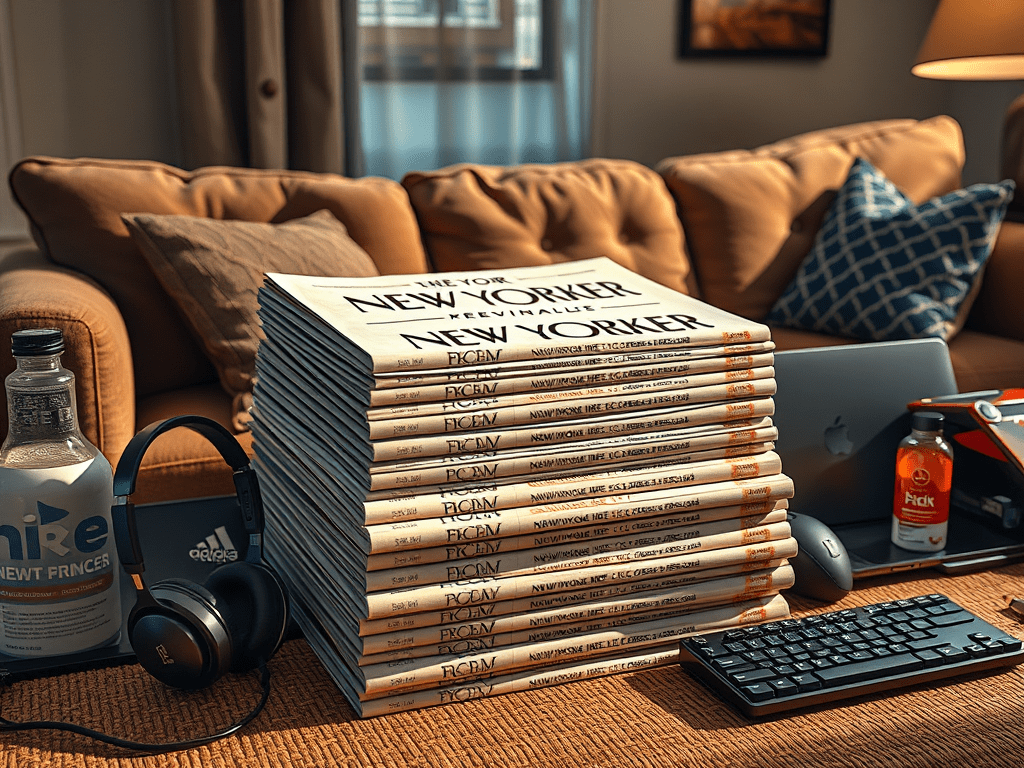
    This brings me to the shrine of guilt at the center of my living room: the great, unread New Yorker stack.
    I have subscribed since 1985, back when Reagan was doing his best kingly impression and nobody had heard of an iPhone.
    The stack now functions less as reading material and more as a kind of grim altar — a silent accusation in glossy print.
    Friends glance at it and nod approvingly, as if my very possession of these magazines implies moral seriousness.
    I let them believe.
    Inside, I know better.
    I know that I am a fallen monk, a heretic of intellectual duty, choosing the velvet lure of consumer escapism over the weighty gospels of sociopolitical collapse.

    I have a diagnosis: New Yorker’s Remorse Syndrome — a condition in which one publicly performs allegiance to Enlightenment values while privately seeking refuge among comparison charts and Amazon star ratings.
    The mind knows what it ought to do.
    The heart, however, prefers shopping for the perfect water bottle while Rome burns quietly in the background.

  • Writing a Blog in the Performative Hangover Era

    Writing a Blog in the Performative Hangover Era

    For over a decade, I ran a YouTube channel — a modest operation born in my late forties. Calling it a channel might be too grand: there were no edits, no soundtracks, no backgrounds, no clever image inserts. Just me, my watches, and a stubborn refusal to pretend I knew anything about video production. It was, in essence, a podcast that forgot it was supposed to be seen.

    I built a small but loyal audience — over 10,000 subscribers, steady commenters, familiar names. Within the narrow but fervent watch community, I was a known entity: a man chronicling the eternal scuffle with watch addiction.

    But now, staring down my sixty-fourth birthday this October, I’m stepping away — and not with a heavy heart, but with something closer to relief.

    First, I have no desire to become an influencer. The idea of monetizing my channel, hawking brands I barely tolerate, feels as alien as joining a boy band at my age. Second, I have zero interest in learning the sacred arts of Final Cut Pro wizardry. The polished, professional YouTuber life was never my ambition. Third — and most importantly — the fire that once drove me is gone. And good riddance. Fire, in my case, has always been another word for addiction — the old need for validation, the parasocial buzz of comment sections and endless watch chatter. I don’t want the fire back. I want peace.

    Does this retreat from YouTube mean a pivot to podcasting?
    No.
    I’m not looking for a new mirror in which to admire or define myself. I don’t need the hustle of relevance, or the 3 a.m. panic about subscriber counts. A podcast requires not just a theme but conviction — a genuine need to say something the world hasn’t already heard. Right now, my life is full of smaller, quieter things: amateur piano practice, kettlebell workouts in my garage, a general interest in health and fitness. None of these scream “launch a weekly show.”

    Sure, I could bang out a fitness video for people over fifty — it would take thirty seconds: Stay active, love people, eat real food, prioritize protein, lay off the booze. There, fitness empire built.
    But combing through the absurdly granular debates of the diet-industrial complex? No thanks.

    Truthfully, most social media feels unbearable to me now — bloated with performative sincerity, vibrating with empty gestures. I’m done performing. Like many, I have full-blown social media fatigue.

    And then there’s the nagging ghost of my old literary ambitions — the dream of publishing memoir, fiction, or some slippery hybrid of the two, the sort of “autofiction” the novelist Emmanuel Carrère perfected. That ghost finds me now, not on YouTube, not on a podcast, but on my blog.

    The blog is where I now quietly reign.
    Not as a digital emperor counting clicks, but as a stubborn craftsman hacking away at the weeds of complacency. I don’t know if my writing will “take off” or “storm the world.” I only know it helps me process the madness, fight entropy, and stay alert to the real battle — the one against mindless consumerism and numbing repetition.

    So here I am, in what I suppose I could call the next chapter.
    The Performative Hangover Years.
    The Post-COVID Malaise.
    The Be Brave in Your Sixties Project.

    I’ll get back to you with the final title once I’ve lived it a little longer.

  • Riding the Misery Machine: How Not Looking Became My Superpower

    Riding the Misery Machine: How Not Looking Became My Superpower

    Sixteen days ago, bloated at a mortifying 247 pounds, I decided enough was enough.
    On April 10th, I gave my calorie binges the boot, hacking my intake down to around 2,400 calories a day while shoving 160 grams of protein down my gullet like a man training for a hostage rescue mission.
    I also added a sixth workout to my weekly five kettlebell sessions: a brutal appointment with what I now lovingly call the Misery Machine.

    What’s the Misery Machine, you ask?
    It’s the Schwinn Airdyne—a sadistic stationary bike crossed with a medieval torture rack.
    It has pedals for your legs and levers for your arms, ensuring that no muscle group escapes unscathed. Your pecs, shoulders, triceps, forearms, glutes, quads—all dragged into the inferno.
    And because Schwinn engineers apparently hate human joy, the faster you go, the more resistance it throws at you.
    It’s not a workout; it’s a trial by fire.

    My first two rides were pathetic: 59 minutes of flailing, barely burning 600 calories.
    Today, though, I hit 706 calories in the same time—an improvement, and not just physically.

    Part of the success came from a psychological gambit: don’t look at the odometer.
    Staring at the screen, counting every miserable calorie and every sadistic second, makes the workout feel endless, like some gym-rat version of waterboarding.
    So today, I swore: I will not look.
    My secret weapon would be ignorance. Eyes forward. Mind blank. Focus on breathing, moving, surviving.

    Did it work?
    Mostly.
    I cheated about six times, sneaking guilty glances at the odometer—still, better than the constant obsessive checking that turns my bike rides into psychological horror shows reminiscent of my endless, soul-crushing drives up the I-5 from Los Angeles to San Francisco.

    But the real goal—the Holy Grail—is zero looks.
    Like Lot’s wife, ordered not to turn back lest she turn into a pillar of salt, I know: if I glance back at the numbers, I’ll be punished with despair.

    Today, post-shower, the scale gave me a small nod: 239 pounds.
    Only 39 pounds to go until I reclaim something resembling dignity.

    Lucky me.
    Nothing but time, pain, and the Misery Machine standing between me and the man I intend to be.

  • The Protein Bar Delusion: My Love Affair with Lies and Graham Crackers

    The Protein Bar Delusion: My Love Affair with Lies and Graham Crackers

    I don’t eat protein bars anymore. Not because I’m virtuous—far from it—but because I finally admitted the obvious: they’re not meal replacements. They’re meal add-ons, sneaky little calorie grenades dressed up in the halo of anabolic health, whispering sweet promises of lean muscle and zero guilt.

    I’ve been chasing that lie since the 1970s.
    Back then, the gold standard of protein bars was the Bob Hoffman Club Sandwich—a peanut butter and graham cracker Frankenstein’s monster that must have clocked in at 500 calories, easy. It wasn’t a snack. It wasn’t a supplement. It was a religious experience.
    If I wanted to recreate it today, I’d just mash a couple of Reese’s between two graham crackers and pray for forgiveness.

    Over the decades, I kept eating protein bars—dense peanut butter bricks, chewy “engineered food” monstrosities—but never to any good effect. These bars didn’t sculpt my physique. They bulked me up like a slow, steady inflation of regret. Eventually, I abandoned them, like a gambler walking away from the slot machine after realizing the house always wins.

    Still, they haunt me.
    Protein bars remind me of Willy Wonka’s cursed 7-course meal gum that turned Violet Beauregarde into a giant blueberry: a miracle product promising the world but delivering only bloat and existential crisis.

    To be fair, the bars have gotten better over the years. There’s even one called David (because apparently even protein bars have minimalist branding now) made with real food, boasting 28 grams of protein at a miraculous 150 calories. It tempts me.
    Wouldn’t it be smarter, simpler, even a bit sexier to chomp down a David bar at breakfast instead of mixing up my daily slurry of yogurt, protein powder, soy milk, and berries? (A concoction that hits 500 calories with depressing reliability.)

    Maybe. But I know myself: I’d be starving by 9:30 a.m., staring into the abyss of a second breakfast. Protein bars have never given me satiety. They’re a snack in drag—a dessert cosplaying as health food.

    And yet… with all the shredded influencers on YouTube slicing open protein bars like they’re sommelier-testing vintage wine, I feel the pull. A little FOMO. A little “Maybe this time it’ll be different.”

    I have to remind myself, again and again:
    I’m not in love with the protein bar.
    I’m in love with the idea of the protein bar—the fantasy that some sweet, tidy, macro-balanced rectangle will solve my problems, sculpt my body, and carry me into some higher, cleaner version of myself.

    Reality tastes different.
    It tastes like mealy, sweet resignation. It tastes like being duped—with a thin layer of whey isolate on top.