Category: Health and Fitness

  • The Futility of Being Ready

    The Futility of Being Ready

    In December of 2019, my wife and I, both lifelong members of the National Society of Worrywarts, stumbled upon reports of a deadly virus brewing in China. Most people shrugged. We did not. I jumped on eBay and ordered a bulk box of masks the size of a hotel mini-fridge. It felt ridiculous at the time—a paranoid lark, like filling a doomsday bunker because you heard thunder on a Tuesday. But three months later, on March 13, 2020, the world shut down, and that cardboard box of N95s felt less like overreaction and more like prophecy.

    These days, I teach college in what I call the ChatGPT Era—a time when my students and I sit around analyzing how artificial intelligence is rewiring our habits, our thinking, and possibly the scaffolding of our humanity. I don’t dread AI the way I dreaded COVID. It doesn’t make me stock canned beans or disinfect door handles. But it does give me that same uneasy tremor in the gut—the sense that something vast is shifting beneath us, and that whatever emerges will make the present feel quaint and maybe a little foolish.

    It’s like standing on a beach after the earthquake and watching the water disappear from the shore. You can back up your files, rewrite your syllabus, and pretend to adapt, but you know deep down you’re stuck in Prepacolypse Mode—that desperate, irrational phase where you try to outmaneuver the future with your label maker. You prepare for the unpreparable, perform rituals of control that offer all the protection of a paper shield.

    And through it all comes that strange, electric sensation—Dreadrenaline. It’s not just fear. It’s a kind of alertness, a humming, high-voltage awareness that your life is about to be edited at the molecular level. You’re not just anticipating change—you’re bracing for a version of yourself that will be unrecognizable on the other side. You’re watching history draft your name onto the roster and realizing, too late, that you’re not a spectator anymore. You’re in the game.

  • Flabnesia and the Fall of the Weight-Loss Hero

    Flabnesia and the Fall of the Weight-Loss Hero

    Congratulations! You’ve shed 47 pounds over 8 months, sliding from a swollen 247 to a sleek, even 200—the numerical promised land. At 247, you weren’t just overweight; you were a walking billboard for metabolic dysfunction. A bloated monument to poor impulse control. Your blood pressure was climbing Mount Everest, your triglycerides were hosting a rave, your fingers cracked like old parchment, and your foot buzzed with the low-voltage horror of neuropathy. Your joints? They screamed in Morse code every time you dared to walk more than half a Target.

    And let’s not forget the existential FOMO—not Fear of Missing Out on parties or vacations, but on the you you were supposed to be. The one who didn’t sound like an old staircase every time he stood up.

    But then, in a moment of uncharacteristic clarity—or maybe rage at your own reflection—you declared war on the fat demon. You slashed your calories to a monk-like 2,300, jacked your protein intake to bodybuilder levels, and banished refined carbs and sugar like they owed you money. Your entire cerebral cortex was repurposed into a fat-loss mission control center. Progress became your dopamine drip. Watching the numbers fall on the scale felt like watching your soul return from exile.

    You were, in the language of gymfluencers, “on a journey.” A phrase so overused it should be banished to a motivational poster graveyard. But cliché or not, the journey gave your life narrative structure. It made you feel heroic. Disciplined. Alive.

    And then—you arrived.

    Two hundred pounds. The exact number. Mission accomplished. Cue the existential silence.

    Because now what?

    With the drama over, meaning slips through your fingers like a protein shake on a sweaty treadmill. You no longer wake up with a fat war to fight. And into that vacuum slithers the ancient enemy of every former fatty: complacency.

    Complacency brings friends. First comes Calorie Creep—just a nibble here, a mindless bite there, a slow but deliberate loosening of your former austerity. Then arrives Flabnesia, that insidious amnesia that erases the memory of how awful 247 felt—how humiliating, how painful, how limited. Your jeans start getting tight again, and you blink in confusion as if the dryer is gaslighting you.

    Next, the cruelest symptom of all: Goalstalgia—a perverse longing for the righteous high of the weight-loss struggle. You miss the purpose, the metrics, the drama. And in a dark twist of psychological masochism, you begin to sabotage yourself, just to start over—to claw your way out of the hole you’re actively digging again.

    And so the cycle begins anew. You are no longer the master of your fate or the captain of your macros. You are a cautionary tale—an Ouroboros in athleisure, endlessly consuming your own progress.

  • Psychedelic Mushrooms and the Art of Saying “Meh”

    Psychedelic Mushrooms and the Art of Saying “Meh”

    People I admire—deep thinkers, seekers, trauma survivors, even that old roommate who once confused a lava lamp for God—swear by magic mushrooms. They describe transcendence, tearful reunions with their inner child, and conversations with the universe where the universe speaks perfect Jungian. Apparently, psilocybin is the shortcut to enlightenment, the divine inbox where angels drop PDFs of your truest self.

    And yet, I remain a bastion of Mushroom Apathy Syndrome (MAS)—a spiritual condition marked by an impenetrable indifference to the fungal fanfare. While others are melting into cosmic unity on some mossy hillside, I’m thinking about whether it’s time to reorganize my spice rack. I don’t want to chew sacred mold to glimpse the divine. If I need an ego death, I’ll just read my old poetry.

    Sure, I’d love to encounter the Divine—maybe Spinoza’s glowing web of pantheistic awe, maybe a seraph with decent taste in jazz. But I just can’t take mystical advice from a guy in a woven beanie yelling about chakras while wearing Crocs. If I want a head trip, I’ll queue up Yes, The Strawbs, or Crosby, Stills & Nash and lie on the floor until my chakras align from sheer harmonic exhaustion. Or better yet, I’ll abstain from sugar for ten months and then unleash nirvana with a single bite of decadent, spice-laced carrot cake.

    My condition is also rooted in a kind of Fungal Nihilism—the belief that no mushroom, no matter how ancient, artisanal, or Amazonian, can fix the howling absurdity of existence. You can’t outrun entropy with a spore. If I want to stare into the abyss and laugh, I’ll binge-watch George Carlin eviscerate modern life with nothing more than a mic, a ponytail, and a pair of skeptical eyebrows.

    Ultimately, I practice Spore Snobbery—a reflexive contempt for the breathless mythologizing of psychedelic fungus. These aren’t sacred portals. They’re glorified mushrooms with a publicist. For some, they offer spiritual clarity. For me, they sound like a gastrointestinal trust fall with no one there to catch you but an ayahuasca-shaman-turned-life-coach named Brad.

  • From Raw to Ruin: The Self-Destruction of a Crashfluencer

    From Raw to Ruin: The Self-Destruction of a Crashfluencer

    To mock Brian Johnson, aka the Liver King, feels like low-hanging fruit off a poisoned ancestral tree. The man is a walking satirical sketch, a steroid-soaked cartoon preaching “natural living” while pumping $11,000 a month of growth hormone into his glutes. He branded himself the King, his wife the Queen, and his sons with names fit for a Mad Max reboot about a paleo militia family eating spleen jerky by moonlight.

    His entire enterprise was Caveman Cosplay with a GoPro: gnawing on cow testicles at a blood-slicked picnic table, barking into the void like a tribal prophet in a trucker hat. He promised salvation to a nation bloated on Cheetos, Twinkies, and Red Bull—offering raw liver as the Eucharist for the metabolically lost.

    Netflix’s Untold: The Liver King makes a flaccid attempt at chronicling his rise and fall. The documentary is weirdly deferential, like it’s afraid he’ll burst through the screen and challenge the viewer to a push-up contest. YouTube, in contrast, has done the real exhumation—countless videos dissecting his addiction to fame, vanity, and unregulated supplements with far more insight and bite.

    Still, the Netflix film does offer one crystalline moment of pathos-turned-parody: Johnson, preparing to repent for the lies and the deception and the overpriced ancestral liver gummies, admits on camera that he’ll need to Google the words “repentance” and “atonement” before proceeding. Imagine Martin Luther, nailing his Theses to the church door—then pulling out his phone to ask Siri what “contrition” means.

    The man is a moral dumpster fire, ablaze with the fumes of self-delusion, influencer marketing, and raw meat. But that dumpster fire casts a telling glow on the cultural cave we all inhabit—where attention is currency, truth is performative, and the algorithm rewards the loudest lunacy.

    So let us name what we’ve seen:

    • Brovangelism – The sacred zeal of gym bros converted to primal living by a shirtless messiah with abs and a coupon code.
    • Swoleblindness – The ability to overlook blatant fraud if the fraudster has veins on his deltoids.
    • Rawthenticity – Mistaking uncooked meat for unfiltered truth.
    • Cloutuary – A public, slow-motion social media death staged for likes and shares.
    • Crashfluencer – He went from virality to liability, taking his followers on a nosedive into madness.
    • Declinefluencer – An influencer whose main content is his own collapse.
    • Brandamaged – A man whose brand has outlived his dignity, but not his desperation.

    Watching Johnson spiral felt eerily familiar. It brought to mind Jaron Lanier’s Ten Arguments for Deleting Your Social Media Accounts Right Now, a book I once assigned to bright-eyed freshmen before they lost their souls to TikTok. Lanier warns that algorithmic performance rewires the brain, dragging us back to our reptilian roots. It doesn’t make us more “authentic”—it makes us worse. Dumber. Meaner. Hungrier for clicks and validation. Johnson is not just a cautionary tale. He’s the caution in full, swollen flesh—drenched in growth hormone and influencer pathology.

  • Perkatory: My Caffeinated Descent into Madness

    Perkatory: My Caffeinated Descent into Madness

    Sumatra coffee is my bad boy of the coffee world—dark, mysterious, and utterly unapologetic. It doesn’t just wake me up; it smacks me across the face, throws me out of bed, and chases me down the street while I’m still in my pajamas. Imagine if a tropical thunderstorm decided to moonlight as a barista, bottling up its fury in a cup. That’s Sumatra—every sip as intense as being caught in a downpour while you’re half-asleep and regretting every life choice that led you to this point.

    Sure, I’m probably guzzling more Sumatra dark roast than is recommended by anyone with a functioning heart, but let’s be real: I’m an overworked college writing professor, buried under an Everest of student assignments that multiply like rabbits on caffeine. Add to that the never-ending demands of an irrational writing obsession with a book titled The Absurdictionary: A Compendium of Comical Curiosities. The result? I keep churning out content until my fingers bleed.”

    But let’s not get ahead of ourselves with the self-pity party. I could give you a long-winded lecture about how the digital age was supposed to bring us more convenience and free time, only to morph into a merciless sociopath that steals our time faster than you can say “work-life balance.” But instead, let me talk about a condition I have from loving coffee too much. 

    Every morning at 6 sharp, like some deranged caffeinated monk, I stagger to the kitchen, where the sacred rite of coffee-making begins. This isn’t just a routine—it’s a holy sacrament that grants me the powers of focus, confidence, and the kind of superhuman alertness that helps me work on one of my best-selling coffee table humor books or grade college essays. The taste of that bitter coffee kissed with a hint of milk and a drop of liquid stevia, is nothing short of ambrosia. By 7 a.m., after downing two 18-ounce cups, I’ve ascended to a higher plane—a realm where I’m not just a man, but a writing, essay-grading, piano-playing, kettlebell-swinging demigod. I go through my day, shower, lunch, nap—rinse and repeat—like a well-oiled machine of productivity, albeit one lugging around a trunkful of neuroses and the social skills of a startled raccoon.

    But there’s this nagging little itch I can’t quite scratch: coffee. It’s more than just a drink at this point; it’s an obsession. Do I love coffee too much? Maybe. Do I worship the ritual a bit too fervently? Definitely. Throughout the day, this thought keeps tiptoeing into my mind like a ninja with a vendetta: “I can’t wait till tomorrow morning when I can make coffee again.” And then, the existential kicker: “Is my life just one endless loop of killing time between coffee sessions?”

    Pat myself on the back: I’ve crossed into a special kind of hell—a hell I’ve christened Perkatory. It’s not quite purgatory, but it’s close. It’s that torturous stretch of time where I’m just existing, dragging myself through the mind-numbing hours between one glorious cup of coffee and the next. It’s a slow-burning obsession that has taken over my life, turning everything else into the dull, gray filler content I’d skip if life had a fast-forward button.

    I remember those bleak, pre-coffee days of my youth—days when Perkatory wasn’t even a thing. Back then, life was simpler, more innocent, and tragically devoid of the caffeinated highs I now chase with the zeal of a junkie trying to recapture that first, glorious hit. But let’s be honest: there’s no going back. Perkatory is here to stay, like that annoying roommate who never does the dishes and steals your leftovers. I’m stuck in this never-ending cycle of waiting, longing, and counting down the hours until I can get my next hit of that sweet, sweet java.

    If you want to suffer like I do, study carefully the meaning of my chosen condition:

    Perkatory (n.): That jittery limbo between your first and fourth cup of coffee, where you’re too caffeinated to sit still but too mentally deranged to function. In Perkatory, time dilates, emails multiply like rabbits, and your heart taps out Morse code against your ribcage while your brain drafts a screenplay, solves climate change, and forgets your Wi-Fi password—simultaneously. It’s a state of spiritual unrest fueled by dark roast and delusion, where productivity feels imminent but never actually arrives. You’re not in hell, exactly—you’re just in line for another cup.

  • The Lie of 70s Bodybuilding

    The Lie of 70s Bodybuilding

    Nostalgia is a bald-faced liar in gold lamé posing trunks. It flexes in the mirror of your mind, oils itself up in false sentiment, and strikes a heroic pose while whispering sweet nothings about “the good old days.” I used to believe the 1970s were the Golden Age of bodybuilding—when men looked like Greek gods instead of mutant action figures, when steroids were used “responsibly,” like a fine wine instead of a meth pipe. I told myself those days were all about balance and aesthetics: a V-taper here, a bit of Arnold’s smirk there.

    But no—this is revisionist fantasy, gym-bro propaganda. The truth is, those bronzed demigods were gulping down more synthetic hormones than a lab rat in a Monsanto trial. “Moderate” steroid use? Please. Some of those guys had liver enzymes that could strip paint. Many didn’t make it to 50, their organs shriveled like sun-dried tomatoes while their biceps ballooned into oblivion.

    Yes, today’s physiques are grotesque parodies of humanity—more Pixar villain than Apollo—but don’t kid yourself that the ‘70s were some golden, health-conscious utopia. Body dysmorphia was already the unspoken sixth station in the posing routine. The mirrors were just less honest, and the delusion smelled faintly of Brut cologne and Joe Weider’s false promises.

  • Waiting for the Angels to Descend and Hand Me the Perfect Book Title on a Velvet Pillow

    Waiting for the Angels to Descend and Hand Me the Perfect Book Title on a Velvet Pillow

    After reading Emmanuel Carrère’s Yoga—a meandering, self-lacerating spiral of spiritual ambition, narcissism, and depressive collapse—I’ve found myself inspired, if not outright possessed, by the urge to write my own autobiographical novel. Not about yoga, of course. I have the flexibility of a rusted lawn chair. Mine would be about my lifelong addiction to exercise. Working title: Kettlebell.

    It has a certain Zen austerity to it. One word. Heavy. Spherical. Monastic. A blunt object and a metaphor all in one. A symbol of focus in a world engineered for entropy. While others turn to wine, weed, or weaponized mindfulness apps, I have turned to iron. Cold, unyielding, mildly concussive iron.

    Of course, I could flirt with cleverness—titles like The Church of Sweat or The Temple of Gains—but those reek of Instagram influencers and overpriced gym merch. Kettlebell is purer. But then again, Dumbbell tugs at me. It’s honest. It’s humiliating. It suggests what I secretly suspect: that I’ve spent a lifetime mistaking pain for virtue and resistance training for redemption. I am a Dumb Bell. A heavy object being swung around in circles, hoping to find peace through repetition.

    Still, perhaps I’m playing into the oldest self-help trap of them all—masquerading self-deprecation as enlightenment. Perhaps the search for the perfect title is simply a glorified avoidance ritual, a form of literary procrastination wrapped in velvet. Because deep down, I know the book isn’t just about fitness. It’s about how I’ve used discipline as anesthesia, reps as prayer beads, and physical exhaustion as a form of epistemology. I don’t know what God looks like, but I suspect He smells like workout chalk and vanilla protein shakes.

    Some mornings I feel like a garage-dwelling mystic, swinging kettlebells under flickering LED light, muttering mantras between sets. Other days I feel like an absurd parody of Sisyphus—except instead of rolling a boulder up a hill, I’m performing goblet squats in my tattered gym shorts, chasing transcendence in 30-second rest intervals.

    And now, on the brink of another workout, I’m wasting precious calories spiraling into a metaphysical title crisis. Maybe the perfect name will descend from the sky, borne aloft by angels in sweatbands and Lululemon, whispering, “This is it. This is your brand.” They will hand me the title on a velvet pillow. Or maybe I’ll figure it out in the middle of a brutal set, when my soul finally detaches from my body like a spent shell casing and whispers, “Just call it Garage Monk and be done with it.”

    One way or another, the iron awaits. And it does not care what the book is called.

  • The Church of Sweat: 50 Years in the Iron Cathedral

    The Church of Sweat: 50 Years in the Iron Cathedral

    By the time I hit fourteen, my sacred sanctuary was none other than Walt’s Gym in Hayward, California—a temple of iron that had started its inglorious life as a chicken coop in the 1950s. The place was a veritable swamp of fungus and bacteria, a thriving petri dish of maladies eager to latch onto the unsuspecting. Members whispered in hushed tones about incurable athlete’s foot, the kind that made dermatologists throw up their hands in defeat. Some swore that the strains of fungus and mold festering in the corners were so exotic they had yet to be classified by the most intrepid of mycologists. Roosting among the fungal shower stalls was an oversized frog that the pro wrestlers had affectionately named Charlie. I never saw Charlie myself, but I often wondered if he was a real creature or a figment of the wrestlers’ imagination, birthed by too many concussions and late-night benders.

    The locker room was perpetually occupied by a rotating cast of characters who looked like they’d been plucked straight out of a grimy noir film. There was always some bankrupt divorcee draped in a velour tracksuit and a gold chain thick enough to anchor a ship, hogging the payphone for marathon sessions with his attorney. He’d discuss his sordid life choices and the staggering attorney fees required to sweep his past under a rug large enough to cover the entire state of California.

    Out back, an unused swimming pool lurked, its water murky and black—a cauldron of plague, dead rats, and God knows what else. Walt, the gym’s owner and part-time crypt keeper, had a peculiar ritual. Every so often, he’d saunter outside, brandishing a pool net like a scepter, and scoop up some unfortunate deceased creature. He’d hold it aloft for all to see, like a demented priest presenting an unholy sacrament. This grim ceremony was invariably met with a thunderous round of applause from the gym-goers, who treated Walt’s rodent exorcisms like a halftime show. Walt would then toss the cadaver into a nearby dumpster with all the flourish of a Shakespearean actor delivering a monologue, bowing deeply as if he’d just conquered a dragon.

    Walt’s Gym showcased a walking fossil named Wally, an octogenarian who swore he was the original model for human anatomy textbooks—perhaps ones etched on cave walls. We all loved Wally. He was a beloved gym fixture even though he could be a pain in the butt. Wally’s routine was the stuff of myth: He’d righteously correct everyone’s form whether they asked for his advice or not. He’d monopolize the gym for hours, his workout punctuated by monologues worthy of an Oscar about his deadbeat relatives who “borrowed” money, his former lovers who once graced the silver screen, and his eternal battle with arthritis. 

    Between sets, he’d often deliver a Ted Talk on muscle inflammation and the sorry state of the national economy. He delivered these soliloquies with the gravitas of a news anchor, then spent an eternity in the sauna and shower, emerging like a phoenix from the ashes only to douse himself head-to-toe in talcum powder, turning into a spectral beacon of gym dedication. When Wally spoke, he was engulfed in such a thick talcum haze you’d swear a lighthouse was about to blare its foghorn warning.

    The radio played the same hits on a relentless loop, as if the DJ had been possessed by the spirit of a broken record. Elvin Bishop’s “Fooled Around and Fell in Love,” The Eagles’ “New Kid in Town,” and Norman Connors’ “You Are My Starship” echoed through the gym like a soundtrack to my personal purgatory. As a kid navigating this adult world, the gym was my barbershop, my public square, where I eavesdropped on conversations about divorces, hangovers, gambling addictions, financial ruin, the exorbitant costs of sending kids to college, and the soul-sucking burdens of caring for elderly parents.

    It dawned on me then that I was at fourteen the perfect age: old enough to start building biceps like bowling balls, yet young enough to be spared the drudgery and tedium of adult life. Being a teenage bodybuilder, I realized, was all about sidestepping the real world entirely. Why bother with mortgages and 401(k)s when I could disappear into my true paradise, the gym? As Arnold himself wrote in Arnold: The Education of a Bodybuilder, the gym was the ultimate Happy Place: “The weight lifters shone with sweat; they were powerful looking. Herculean. And there it was before me—my life, the answer I’d been seeking. It clicked. It was something I suddenly just seemed to reach out and find, as if I’d been crossing a suspended bridge and finally stepped off onto solid ground.”

    Half a century later, I still have my version of Walt’s Gym—but now it’s a dimly lit garage filled with kettlebells and echoes. For the last ten years, it’s been my sanctuary, my forge, my private dojo where I swing iron spheres like a monk practicing some ancient, sweat-soaked ritual. No mirrors, no peacocks, no pop music—just me, gravity, and the stubborn pulse of something that refuses to quit.

    At nearly 64, I still wake up with the twitchy vigor of a teenager mainlining pre-workout, though now it’s fueled by habit and existential resolve rather than hormones and vanity. Friends—well-meaning, gray-templed philosophers—remind me that we’re each born with a finite reservoir of Life Force, that it burns down like a fuse, and that it’s only sensible to bow to biology, show gratitude, and pace ourselves. All true. But I also know that left unchecked, my own Life Force has a history of going rogue—dragging me into self-destructive spirals like a moth to a Molotov cocktail. So I remind myself, daily, that power without purpose is a demolition derby in my own skull.

    Still, when I think of Walt’s Gym, I remember that giddy, foolish optimism of youth—that belief that life was nothing but expansion, growth, and muscle gains. And weirdly, I still feel that same charge now. Same source, different vintage. That current is still flowing through me, unruly and alive. The only real difference? I no longer try to bottle it. I just hold on and let it do its work.

  • From Sweat Temple to Spa Prison: My Gym Breakup Story

    From Sweat Temple to Spa Prison: My Gym Breakup Story

    There was a time, back in the sepia-toned haze of the 1970s, when the gym was my church and iron was my sacrament. I was a teenage bodybuilder, baptized in sweat and testosterone, and the gym was a crude sanctuary—part locker room, part gladiator pit—where you could grunt, curse, and lift until your eyeballs threatened to pop like grapes. No frills, no air freshener, no nonsense. Just clang, bang, and the occasional chest-pounding primal scream.

    Then came the 1980s, when gyms got a makeover. They went corporate. The rusted barbells got swapped for chrome. The boom boxes were silenced in favor of syrupy pop music so chirpy it made your teeth ache. Suddenly, everyone wore genie pants and strutted between machines like peacocks dipped in glitter. I soldiered on, of course, slogging through the artificial sweetness and protein-powdered small talk. But the joy had drained from the dumbbells.

    By 2005, I snapped. The gym had become a perfume counter with resistance bands. I fled to the one place where the spirit of muscle still breathed: my garage. I bought a set of kettlebells and never looked back. No waiting for equipment. No toe fungus lurking in communal showers. No ex-frat boys flexing in front of mirrors while discussing their smoothie macros. Just me, my iron cannonballs, and the relentless clang of salvation.

    As I reflect on my exile from Gym Nation, I’ve made peace with my reasons. Let me count the ways:

    I like people. I enjoy storytelling, especially if it involves morally questionable behavior and a dash of scandal. But I can’t dish gossip and deadlift at the same time. I’m not that talented. The gym wants you to be a social butterfly with deltoids, but I want solitude and sweat.

    I used to catch colds with the regularity of a school nurse—four times a year like clockwork. Every cardio machine was a petri dish disguised as fitness equipment.

    And don’t get me started on the showers. You haven’t known dread until you’ve seen a septuagenarian air-drying his nether regions for forty-five minutes like a puffy white heron. Showering was a biohazard. Not showering meant marinating in my own musk, turning my car into a rolling terrarium of mildew and despair.

    Gyms also close for holidays, which is when I need them most—Thanksgiving rage, New Year’s guilt, Fourth-of-July shame. My garage, on the other hand, never takes a day off. It’s always open, always angry, always welcoming.

    And the waiting. Dear God, the waiting. I train fast, like I’m running from the ghosts of carbs past. Having to wait ten minutes for a squat rack while someone scrolls Instagram is a crime against the pump.

    I spent about a thousand bucks on kettlebells, from 10 to 80 pounds. That may sound steep, but compared to a decade of gas, membership fees, and viral exposure? It’s a steal.

    This garage of mine—it’s not just a space. It’s a holy temple of kettlebell discipline. A shrine to simplicity, sweat, and solitude. And I’ll keep swinging those iron orbs until I drop dead—or transcend into Valhalla, kettlebell in hand.

  • The Ascent of Proteinberg: One Man’s Daily Siege Against Carbs and Chaos

    The Ascent of Proteinberg: One Man’s Daily Siege Against Carbs and Chaos

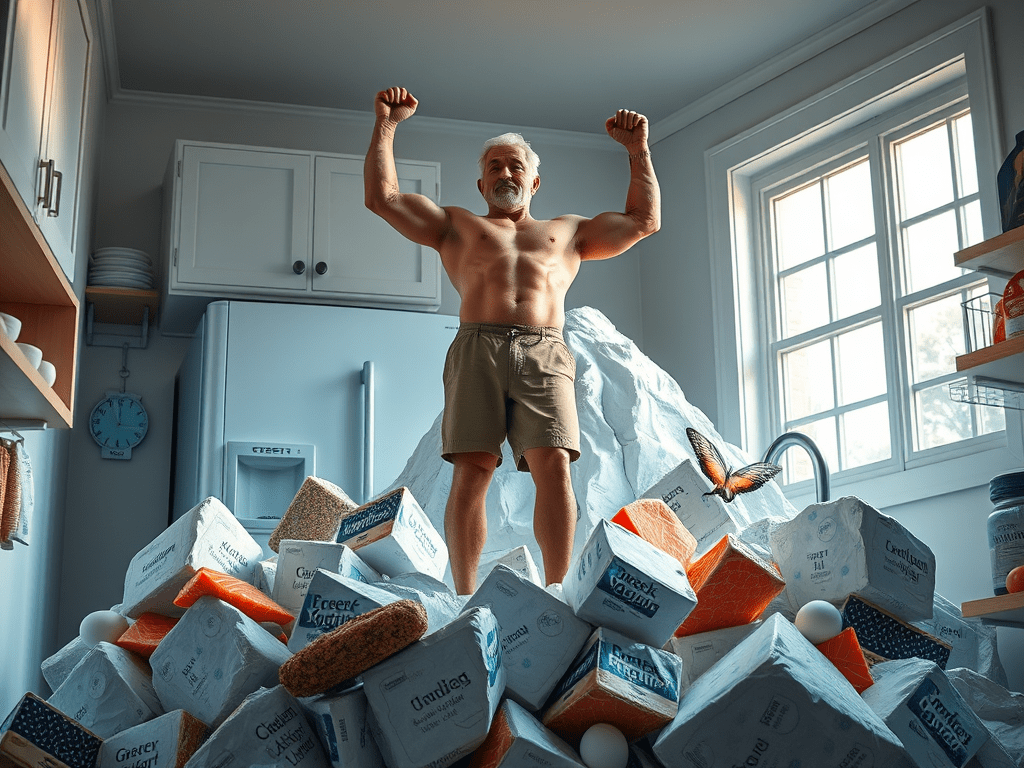
    Each morning begins with a stare-down: me versus Proteinberg, the Everest of self-discipline, rising from my fridge like a smug Nordic god carved from blocks of Greek yogurt and slabs of salmon. It’s a cruel, relentless climb, strewn with the jagged boulders of eggs, tempeh, sardines, cottage cheese, soy milk, and the occasional whey protein landslide. Somewhere near the summit: a dollop of smug self-respect, earned only after choking down what tastes like Poseidon’s bait bucket mixed with barnyard runoff.

    I’m 63, not that you’d guess it from the size of the kettlebells I swing five days a week like I’m auditioning for a reboot of 300: The 63-Year-Old Man Edition. My battle isn’t just with gravity—it’s with the creeping, gelatinous blob of abdominal fat that lurks like a metabolic Grim Reaper, threatening dementia, stroke, and the kind of death that begins with a raspy wheeze and ends in a hospital bed full of regret.

    Climbing Proteinberg is my daily salvation. Miss a day, and the Carb Demons come knocking—those sugar-slick phantoms with snacky grins and buttery claws. They whisper of bagels and donuts, hijack my brain, and leave me sugar-drunk and shame-stained before lunch. But summit the Proteinberg? I walk tall. Satiated. Slightly disgusted, yes, but victorious.

    It’s not just food. It’s ritual. It’s order in the chaos. A daily anchor in the storm of temptations that masquerade as comfort. As my wife brews her potent dark roast each dawn, the scent hits me like a monk’s bell calling me to vespers. I rise. I eat. I fight. I win. There is meaning in the climb, purpose in the discipline, and if not happiness, then at least its lean, unsalted cousin: peace.