Category: Literary Dispatches

  • The Phantom in the Mirror: On Becoming an NPC

    The Phantom in the Mirror: On Becoming an NPC

    The Non-Player Character—or NPC—was born in the pixelated void of video games. It is a placeholder. A background hum. A digital ghost whose job is to stand in a market, repeat a scripted line, or walk in endless circles without complaint. The NPC has no hunger for freedom, no dreams of becoming more. It exists in the half-life of interactivity—a cardboard cutout propped up by code. It’s “there,” but not there. You see it. Then you forget it. And that, in essence, is the horror.

    Somewhere along the way, the term slipped out of the screen and into real life. “NPC” became shorthand for a human who seems hollowed out—emotionally neutralized, culturally sedated, and spiritually declawed. Not stupid. Not evil. Just disengaged. The light behind the eyes? Gone dim. What was once an ironic jab at background characters is now a chilling metaphor for people who’ve surrendered to the most generic, algorithm-approved version of themselves.

    What’s grimly poetic is that NPCs in video games are often controlled by artificial intelligence. And so, too, are many modern humans—nudged by dopamine, entranced by endless scrolls, soothed by the hypnotic rhythms of consumption. The Roman formula of bread and circuses has merely been rebranded. Netflix. DoorDash. TikTok. It’s all the same anesthetic. As therapist Phil Stutz would say, we’re stuck in the “lower channel”—an emotional basement filled with numbing comforts and artificial highs.

    And yet, here’s the twist: even the brilliant can become NPCs. The anxious. The depressed. The overworked. The soul-sick. Sometimes the smartest people are the most vulnerable to emotional collapse and digital retreat. They don’t become NPCs because they’re shallow. They become NPCs because they’re hurting.

    There are, perhaps, two species of NPCs. One is blissfully unaware—sleepwalking through life without a second thought. The other is terrifying: self-aware, but immobilized. The mind remains active, but the body slouches in the chair, feeding on stale memories and reruns of past selves. Think of Lot’s Wife, gazing back at a past she couldn’t let go. She wasn’t punished arbitrarily; she was frozen in time—literally—a statue of salt and sorrow. The original NPC.

    Middle age is particularly fertile ground for NPC-ism. Nostalgia becomes narcotic. We mythologize our former selves—thinner, bolder, brighter—and shrink in the shadow of our own legend. Why live in the present, when the past is easier to romanticize and the future is too much work? Just ask Neddy Merrill from John Cheever’s “The Swimmer,” paddling from pool to pool in a daze, believing in a youth long gone, burning every real connection he had on the altar of delusion. An NPC in swim trunks.

    Today, we’re incentivized to become NPCs. Social media trains us like lab rats, handing out dopamine pellets in the form of likes, follows, and artificial intimacy. The real world—messy, unfiltered, full of awkward silences and genuine risk—is rejected for the smoother contours of algorithmic approval. Our souls are curated, our emotions trimmed to fit the timeline.

    The NPC, then, is not a throwaway gag. It’s a portrait of the modern condition. A spirit trapped in a basement, scrolling for meaning, addicted to memory, afraid of action. A being slowly turning into vapor, still breathing but no longer alive.

    And the true terror? Sometimes I feel it in myself. That quiet moment when I trade meaning for ease, purpose for distraction, vitality for sedation. That’s when I hear the whisper: You’re becoming one of them. That’s when I feel the NPC, not on my screen, but inside my skin.


  • The Loneliness Loop: Meghan Daum and the Limits of Solitude

    The Loneliness Loop: Meghan Daum and the Limits of Solitude

    I’m working my way through The Catastrophe Hour, Meghan Daum’s latest collection of personal essays. Now in her mid-fifties, Daum is unapologetically single and childless by design, having long ago decided that marriage and parenting weren’t roles she could convincingly—or willingly—perform. Much of her work is a dispatch from the front lines of solitude. And she’s damn good at it.

    What Daum does better than most is forge an instant intimacy with her reader. Her essays feel like front porch conversations at dusk—no performance, no agenda, just two adults quietly deconstructing the wreckage of modern life. Her voice evokes the same soulful, offhand brilliance I admire in Sigrid Nunez’s novels: smart without pretense, vulnerable without begging.

    But by the halfway mark, the essays begin to blur. There’s a tonal and thematic sameness that settles in—like the ambient hum of a refrigerator you only notice when it stops. The introspective loop tightens. The sharp lens that once turned mundane moments into epiphanies starts to feel like someone narrating their week out loud after too many days alone.

    There’s the grief over dead dogs. The endless parsing of domestic minutiae. The architectural dream house that never quite materializes. And those fragmented, overstimulated city-life encounters that feel less like essays and more like repurposed Substack entries. It’s not that these topics lack merit—it’s that, in aggregate, they start to feel like what happens when no one interrupts you for too long.

    Now, I say this as a card-carrying member of the Navel-Gazers Guild. I recognize the signs. I know the thrill of dissecting one’s inner weather systems for an imaginary audience. So I don’t say this to judge Daum, but to observe that the limitations of a fully interior life—however self-aware—do begin to show.

    Still, dismissing Daum’s collection as mere navel-gazing would be both lazy and wrong. Her prose is laced with hard-earned wisdom and an acid wit that’s as refreshing as it is unsparing. When she hits, she hits hard—and truthfully. And that, more than novelty or plot, is why I keep turning the pages.

  • Solitude Is My Boyfriend (And He Doesn’t Snore)

    Solitude Is My Boyfriend (And He Doesn’t Snore)

    In her essay “Same Life, Higher Rent,” Meghan Daum compares her life in 1997 to her life in 2017 and reaches a deflating, oddly liberating conclusion: nothing has changed. At 47 and freshly divorced, she’s more or less the same person she was at 27. Still single. Still chasing deadlines. Still drinking coffee, poking at takeout sushi, and trying to keep multiple Word docs open on her MacBook while ignoring the siren song of Twitter and low-stakes Amazon purchases.

    There is one glaring difference: her rent has skyrocketed and her cognitive bandwidth has shriveled. She estimates she’s lost 70% of her brainpower to the Digital Distraction Era. So yes—same life, dumber brain, higher rent. It’s a Nabokovian joke with a Billy Collins twist: Picnic, Lightning, but with Seamless orders and browser tabs.

    Like her earlier essay “The Broken-In World,” Daum doesn’t frame divorce as failure but as an act of radical return. Not regression—recognition. The performance is over. She’s stopped cosplaying as someone else’s version of a wife. The single life isn’t a punishment or a holding pattern—it’s her set point. The gravitational center she was orbiting all along.

    Coordinating a calendar with another adult, she admits, feels like a hostage negotiation. She loves living alone. She loves eating whatever she wants, whenever she wants, without anyone asking if they should defrost chicken. She can travel at the drop of a hat without shoving someone else’s life off balance. She’s not anti-love. She just refuses to bulldoze her rhythms for the sake of joint Costco runs.

    Post-divorce, she’s dated—kind, smart, well-meaning men—but none of them stood a chance against the one lover she can’t quit: solitude. She rarely goes on second dates. She doesn’t need romantic sabotage. She’s got peace and a dog. Who needs more?

    And let’s be clear: this position wasn’t won in a raffle. She fought for it. Marriage, divorce, reinvention. She earned this life through blood, paperwork, and self-inventory. She’s not about to crawl back into the foxhole of emotional compromise.

    Reading Daum, I’m reminded of a perfectly-cut line from Rodney Dangerfield: “You’re born a certain way and that’s it. You don’t change.” I think about that more than I should. At 63, I’m not all that different than I was at six. Moody, brooding one day. Goofy and loud the next. There’s a streak of isolato in me too. My family tolerates it. They let me take naps and skip amusement park trips that sound like air-conditioned nightmares.

    I’m probably not a perfect husband. But we make it work—me and this life. Me and my Daum-ian disposition. The marriage lasts, not because I’ve changed, but because we’ve all made our peace with who I am. And who I’ve always been.

  • Divorced, Not Damned: Meghan Daum and the Art of Letting Go

    Divorced, Not Damned: Meghan Daum and the Art of Letting Go

    In The Catastrophe Hour, Meghan Daum’s 2016 essay “The Broken-In World” explores divorce with the same dry clarity one might use to describe cleaning out a fridge: inevitable, necessary, and oddly liberating. At 45, Daum finds herself in the middle of an amicable divorce—the kind without cheating, bruises, or courtroom melodrama. No one threw a lamp. No one stole the dog. Instead, it was just the slow, steady rot of benign neglect. Quirks once considered “charming” metastasized into full-blown repulsions. “Irreconcilable differences,” she concludes, isn’t a cop-out. It’s a dignified admission that entropy won.

    She discovers, to her great relief, that she is significantly less insane living alone. No more haggling over dinner, toothpaste caps, or passive-aggressive silences. Just peace. Divorce, in Daum’s telling, isn’t some tragic unraveling—it’s a grown-up’s fire extinguisher to a low-grade house fire of misery. It’s not weakness. It’s not moral collapse. It’s maturity, quietly slipping the ring off and stepping into air.

    Post-divorce, Daum moves to New York, joins the unofficial cult of the self-rescued, and discovers a radical truth: brokenness is the baseline. Normalcy is a myth. Everyone’s dragging a dented suitcase through life. Divorce just makes it public.

    Her real epiphany, however, isn’t just about divorce—it’s about the overinflated value of marriage itself. To Daum, marriage never felt like the final level of the video game, no Holy Grail behind velvet ropes. Monogamy had already given her a sneak preview. The ceremony, the legal bind—it was all anti-climax. If marriage is the gold standard, Daum suggests, then maybe we need a new currency.

    As a married person reading her work, you’re invited—no, cornered—into imagining a counterlife. The one where you’re single. I thought of the comedian and podcaster (soon to retire) Marc Maron: early sixties, unmarried, encircled by cats, vinyl, artisan boots, and a galaxy of fellow eccentrics. His life is cluttered, creative, obsessive. He has no wife, but he has a world.

    Daum’s point: we will find connection. If not through spouses and children, then through podcasts, group chats, improv classes, dogs, or elaborate hobbies that consume our evenings and fill the fridge of our loneliness with something edible. Marriage isn’t the only valid architecture for a life, and singleness isn’t a synonym for solitude. The real issue is connection. Not how we find it—but that we must.

    Now in her fifties, Daum is single, scraping by with podcast revenue and teaching gigs. No financial safety net. No partner to split the rent or cover her if she breaks a hip. But what she does have is agency. A voice. Essays that hum with intelligence and self-awareness. She doesn’t glamorize her choice. She doesn’t hold it above yours. She simply claims it as hers—and owns the wreckage and wisdom that came with it.

    She’s not superior. She’s just no longer married. And for her, that is enough.

  • Hot Pockets, CliffNotes, and the Death of Deep Reading

    Hot Pockets, CliffNotes, and the Death of Deep Reading

    Before the Internet turned my brain into a beige slush of browser tabs and dopamine spikes, I used to read like a man possessed. In the early ’90s, I’d lounge by the pool of my Southern California apartment, sun-blasted and half-glossed with SPF 8, reading books with a kind of sacred monastic intensity. A. Alvarez’s The Savage God. Erik Erikson’s Young Man Luther. James Twitchell’s Carnival Culture. James Hillman and Michael Ventura’s rant against the therapy-industrial complex–We’ve Had a Hundred Years of Psychotherapy – and the World’s Getting Worse. Sometimes I’d interrupt the intellectual ecstasy to spritz my freshly tanned abs with water—because I was still vain, just literate.

    Reading back then was as natural as breathing. As Joshua Rothman points out in his New Yorker essay, “What’s Happening to Reading?”, there was a time when the written word was not merely consumed—it was inhaled. Books were companions. Anchors. Entire weekends were structured around chapters. But now? Reading is another tab, sandwiched between the news, a TikTok video of a dog on a skateboard, and an unopened Instacart order.

    Rothman nails the diagnosis. Reading used to be linear, immersive, and embodied—your hands on a book, your mind in a world. Now we shuttle between eBooks, PDFs, Reddit threads, and Kindle highlights like neurotic bees skimming data nectar. A “reading session” might include swiping through 200-word essays while eating a Hot Pocket and half-watching a documentary about narco penguins on Netflix. Our attention is fractured, our engagement ritualized but hollow. And yes, the statistics back it up: the percentage of Americans who read at least one book a year dropped from 55% to 48%. Not a cliff, but a slow, sad slide.

    Some argue it’s not worth panicking over—a mere 7% drop. I disagree. As a college instructor, I’ve seen the change up close. Students don’t read long-form books anymore. Assign Frederick Douglass and half the class will disappear into thin air—or worse, generate AI versions of Douglass quotes that never existed. Assign a “safe” book and they might skim the Wikipedia entry. We’ve entered an age where the bar for literacy is whether someone has read more than one captioned infographic per week.

    Rothman tries to be diplomatic. He argues that we’re not consuming less—we’re just consuming differently. Podcasts, YouTube explainers, TikTok essayists—this is the new literacy. And fine. I live in that world, too. I mainline political podcasts like they’re anti-anxiety meds. Most books, especially in the nonfiction space, do feel like padded TED Talks that should have stayed 4,000 words long. The first chapter dazzles; the next nine are a remix of the thesis until you feel gaslit into thinking you’re the problem.

    But now the reading apocalypse has a new beast in the basement: AI.

    We’ve entered the uncanny phase where the reader might be an algorithm, the author might be synthetic, and the glowing recommendation comes not from your friend but from a language model tuned to your neuroses. AI is now both the reader and the reviewer, compressing thousand-page tomes into bullet points so we can decide whether to fake-read them for a book club we no longer attend.

    Picture this: you’re a podcaster interviewing the author of a 600-page brick of a book. You’ve read the first 20 pages, tops. You ask your AI: “Give me a 5-page summary and 10 questions that make me sound like a tortured genius.” Boom—you’re suddenly a better interviewer than if you’d actually read the book. AI becomes your memory, your ghostwriter, your stand-in intelligence. And with every assist, your own reading muscles atrophy. You become fit only for blurbs and bar graphs.

    Or take this scenario: you’re a novelist. You’ve published 12 books. Eleven flopped. One became a cult hit. Your publisher, desperate for cash, wants six sequels. AI can generate them faster, better, and without your creative hand-wringing. You’re offered $5 million. Do you let the machine ghostwrite your legacy, or do you die on the sword of authenticity? Before you answer, consider how often we already outsource our thinking to tools. Consider how often you’ve read about a book rather than the book itself.

    Even the notion of a “writer” is dissolving. When I was in writing classes, names like Updike, Oates, Carver, and Roth loomed large—literary athletes who brawled on live television and feuded in magazines. Writers were gladiators of thought. Now they’re functionally obsolete in the eyes of the market, replaced by a system that values speed, virality, and AI-optimized titles.

    Soon, we won’t pick books. AI will pick them for us. It will scan our history, cross-reference our moods, and deliver pre-chewed summaries tailored to our emotional allergies. It will tell us what to read, what to think about it, and which hot takes to regurgitate over brunch. We’ll become readers in name only—participants in a kind of literary cosplay, where the act of reading is performed but never truly inhabited.

    Rothman’s essay is elegant, insightful, and wrong in one key respect: it shouldn’t be titled What’s Happening to Reading? It should be called What’s Happening to Reading, Writing, and the Human Mind? Because the page is still there—but the reader might not be.

  • Neddy Merrill Disease: Lifting Weights to Outrun the Abyss

    Neddy Merrill Disease: Lifting Weights to Outrun the Abyss

    I take no glory in training through my 60s. At nearly 64, with a lifting life that began in 1974 amid the clang of Olympic barbells and testosterone-choked gyms, I no longer chase records or applause. These days, I chase mobility. I chase not falling apart. A nagging flare of golfer’s elbow—inner right, thank you very much—has made its uninvited return, forcing me to swap kettlebell rows for gentler “lawnmower” pulls and abandon my beloved open-palm curls in favor of reverse curls, the orthopedic equivalent of safe sex.

    There was a time, of course, when I confused self-worth with showing off. I strutted under heavy weights in the ‘70s through the ‘90s like a tragic extra from Pumping Iron, nursing shredded rotator cuffs and wrecked lumbar discs in my quest to impress… well, no one, really. The mirror? My dad? Arnold? These days I tiptoe a tightrope between intensity and injury, trying to silence the reckless ghost of my twenty-year-old self who still believes he’s indestructible.

    This tug-of-war with time reminds me of Neddy Merrill, the doomed protagonist in John Cheever’s “The Swimmer,” who tries to recapture youth by swimming across his neighbors’ pools like a suburban Odysseus, only to arrive at his own foreclosed house—empty, echoing, and final. I see flashes of my own Neddy Merrill alter ego every time I glimpse my neighbor, a sturdy cop in his early 40s, shepherding his twin teenage sons off to jiu-jitsu. I envy them—their youth, their purpose, their untouched joints. But I remind myself that comparison is the mother of misery. I don’t train for glory anymore. I train because the alternative is to surrender to frailty, to collapse into a slow-motion horror film of decay. I train because being strong is still cheaper than therapy, and it’s the only middle finger I can raise at time’s relentless advance.

  • I’ve Become Leery of the Ronnie Coleman Effect in AI Writing

    I’ve Become Leery of the Ronnie Coleman Effect in AI Writing

    My college writing students and I have been collaborating with ChatGPT for over a year now. I’ve often been impressed with this writing platform. Provided I give very specific instructions and make it clear what kind of tone and persona I want, ChatGPT can perform in ways I can’t. It can’t make a turn of phrase and make language sing in ways that dwarf my own solid writing skills. 

    But recently, I’ve been leery of ChatGPT and have been eager to write without it. What I’ve noticed is that it can flex its prose muscles in impressive ways that I call the Ronnie Coleman Effect. Ronnie Coleman was a champion bodybuilder, arguably the best in his era, late 90s to early 2000s. At 290 pounds, his steroidal muscles exploded in ways that made him look impossibly superhuman. I was a natural bodybuilder in my youth. Coleman would blow me off the stage. Coleman’s 290 pounds to my 190 pounds is what my prose is compared to ChatGPT’s: I’m the natural, lean, almost boring bodybuilder while ChatGPT is the flexing, bulging Ronnie Coleman who steals all the attention. I’m simply overpowered by this AI platform. 

    However, there are downsides: AI overwrites, can obscure clarity, can be florid in nonsensical ways, can be grossly inaccurate, and can steal my confidence because it says, “You’re nothing compared to me,” and it can make me lazy because it whispers, “Just jot a few notes. I’ll take care of the rest.” 

    For this reason, I started writing without ChatGPT. I need to get out from under the oppressive Ronnie Coleman Effect and be human again. 

  • I Have No Illusions About Converting My Students to “The Ways of Literacy”

    I Have No Illusions About Converting My Students to “The Ways of Literacy”

    My college students admit that they barely read. They avoid books. They’ll skim an article. Their “cognitive load” is taken up by texting on their phones and watching TikTok and YouTube videos. They don’t have bandwidth for doing deep reading.

    Many of them were in the eighth grade during the pandemic. They lost close to two years of school, spent time on their phones and Chromebooks, and see ChatGPT as a godsend. They can outsource college instructors’ writing assignments and no longer have to worry about grammar or formatting. 

    Teaching college writing, I have to meet students where they are. I have to teach them rhetorical skills, critical thinking skills, and the transforming power of literacy, so I show them powerful arguments, and what makes them persuasive, and people who have found their higher selves through literacy, such as Frederick Douglass and Malcolm X, and the happiness derived from Cal Newport’s notion of “deep work” as an antidote to the despair and nihilism of popular culture’s default setting for cheap dopamine hits, immediate gratification, and meretricious consumer hype. 

    The good news is that my lessons resonate with the students evidenced by their engagement with class discussions. The less than good news is that these philosophical discussions don’t turn them into readers, don’t make them want to trade their phones and social media platforms for a novel or a biography, and don’t make them want to learn the finer points of rhetoric. 

    My students are smart, decent, reasonable, and pragmatic. They learn what they feel is essential to adapt to life’s challenges. Doing a deep dive into reading and writing doesn’t seem that essential to them even though they’ll acknowledge many of the writers and writing samples I present to them are impressive and worthy of admiration. 

    My students seem to appreciate me for giving them an entertaining presentation and for having made the effort to sell literacy as an essential tool for becoming our aspirational selves, but at the end of the day, they focus on getting their homework done as efficiently as possible, working a part-time job to pay the bills, enjoying their friendships, and nurturing their romantic interest. 

    The unspoken agreement between my students and me is that I will be entertaining and enthusiastic about my subject for 90 minutes, but I will not have any delusions about converting them to The Ways of Literacy. That is a teacher’s fantasy, made even more elusive in the AI Age. 

  • The Wellness Racket: Shaming, Scamming, and Selling You Salvation

    The Wellness Racket: Shaming, Scamming, and Selling You Salvation

    In How to Be Well, Amy Larocca vivisects the modern feminine ideal and lays it bare: not the goddess of hearth or harvest, but the “abstracted wellness she-god”—a taut, juiced-up high priestess of turmeric tinctures and lymphatic drainage rituals. This new oracle doesn’t offer wisdom but a curated Amazon storefront. She peddles empowerment with one hand and $128 collagen powder with the other, all while perched atop a Peloton like some neoliberal Delphic seer.

    These wellness influencers don’t just sell products; they sell paranoia dressed in millennial pink. Every scroll of your feed is a sermon in self-improvement with a side of fear: Eat this, not that. Touch this, never that. Microwave? You might as well lick plutonium. Their gospel is a toxic cocktail of pseudoscience, product placements, and shame. You’re not ill, darling—you’re just uninformed and understocked.

    And here’s the trick: they wave the banner of feminism, preaching self-empowerment while quietly mugging you with your own insecurities. They exploit the universal dread that something you ate in 2009 is still lodged in your spleen, slowly killing you. Who doesn’t want to be informed? Who wants to die from an unpronounceable preservative in a childhood granola bar? But the more you try to “be well,” the more you’re trapped in a never-ending scavenger hunt for health hacks, supplements, and contradictions.

    It’s not wellness. It’s a designer panic spiral. And the moment you start shaping your habits, meals, and bank account around their gospel, congratulations—you’re not just a follower. You’ve been converted. And this church doesn’t just ask for tithes. It demands your wallet, your weekends, and your soul.

  • Blessed Are the Gluten-Free: America’s New Spiritual Elite

    Blessed Are the Gluten-Free: America’s New Spiritual Elite

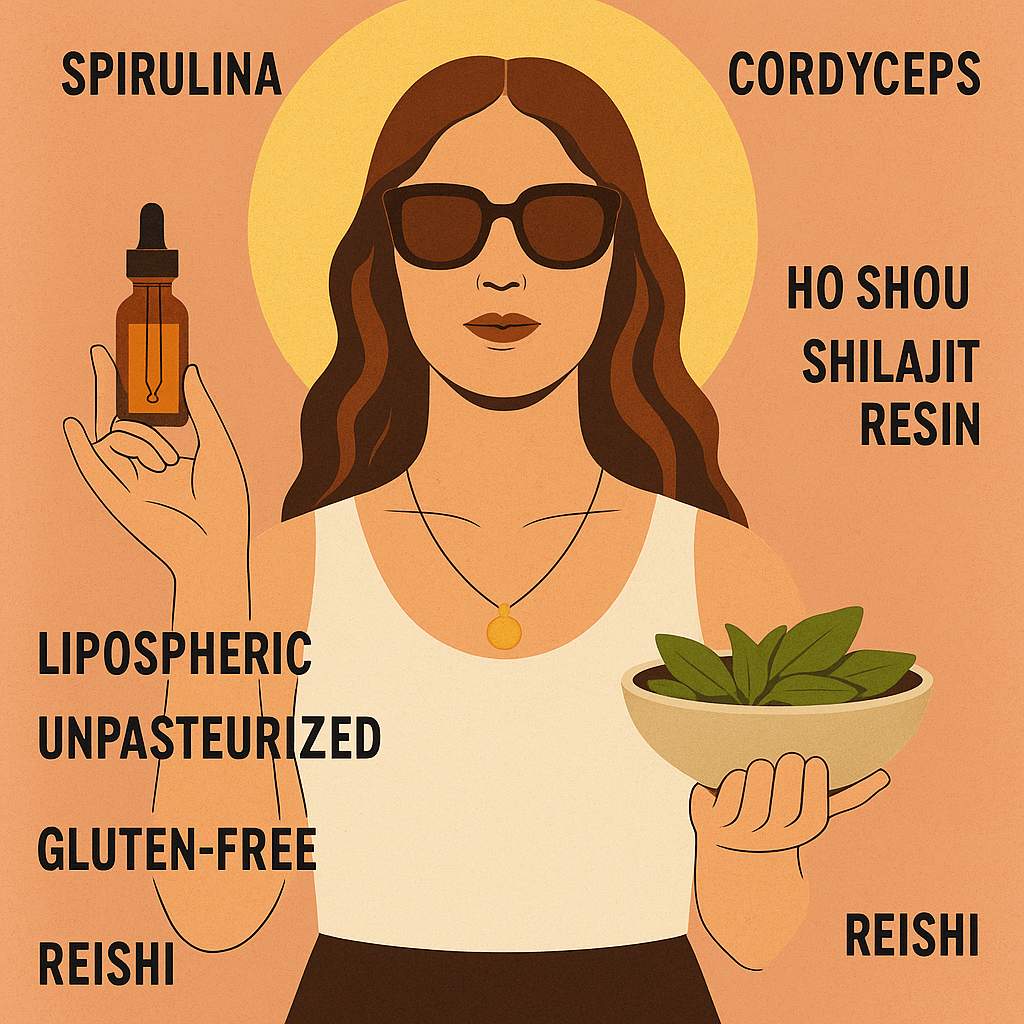
    Reading Amy Larocca’s How to Be Well is like watching Gwyneth Paltrow’s ghost possess a Whole Foods employee mid-mushroom latte. Her book is equal parts riveting and scalpel-sharp, dissecting the strange mutation of fashionistas who’ve traded in Gucci for goop and now drape themselves in wellness jargon like it’s couture. These wellness evangelists don’t just eat clean—they chant it. They speak in tongues made of spirulina, lipospheric vitamin C, Cordyceps, Shilajit resin, and ho shou wu, stringing together syllables like they’re summoning the ghost of Hippocrates.

    What we’re witnessing isn’t self-care—it’s a personality cult with better lighting. The modern wellness priestess has crowned herself a demigod, armed with adaptogens instead of sacraments, waving her magic tincture dropper and pointing lesser mortals toward the True Path of purified, gluten-free, unpasteurized transcendence. It’s not just health—it’s high-performance sanctimony.

    Larocca nails the diagnosis with surgical precision: “I sometimes think of wellness as the project of buying your own body back for yourself.” Translation? Welcome to America’s chicest hostage situation, where the ransom is payable in collagen peptides and oat milk. The goal is to become the luxury-branded version of you—perfect skin, toxin-free bowels, and moral superiority radiating from every overpriced yoga mat. The side effect? It magnifies the gaping inequalities of modern life like a magnifying mirror you didn’t ask to look into.

    Because let’s be honest: none of this comes cheap. These rituals of wellness cost money—bucketloads of it. We’re not talking about a jog around the park and some tap water. We’re talking $12 green juices and $300 infrared saunas. The entire project is rigged to serve the few while gaslighting the many. The wellness priestess doesn’t just ignore that her lifestyle is unattainable for most—she markets that inaccessibility as part of the charm.

    This isn’t health—it’s spiritual cosplay for the affluent.