Category: music

  • Living in the Bottle: A Life Spent Building Cozy Universes

    Living in the Bottle: A Life Spent Building Cozy Universes

    My parents like to remind me that I grew up poor in a cockroach-infested assisted-living situation in Gainesville, Florida. The place was called Flavet Villages—Flavet, if you lived there, which everyone did because there was nowhere else to go. These were not “villages” in any meaningful sense. They were World War II–era Camp Blanding army barracks, uprooted from Jacksonville and dropped into North Florida like surplus history.

    What I love, even now, is the audacity of the name. Flavet Villages. It’s a master class in rebranding: take a barracks crawling with roaches and give it a pastoral plural noun. It’s the real-estate equivalent of dabbing Vicks VapoRub on your neck and calling it Menthol d’Après-Minuit.

    Flavet sat near an alligator swamp and a stretch of forest that felt mythic to me, even then. A Mynah bird lived there—always on the same branch, like a sentry or an oracle—and before bedtime my father and I would walk to the edge of the woods and talk to it. At dusk, the tide dropped, and the swamp revealed itself. Alligator dung, fully expressed. The smell was feral and unmistakable. While most people would recoil, I found it oddly soothing—bracing, even. As if the universe were saying, You’re here. This is real.

    As a native Floridian, I sometimes wonder—with a perverse sense of pride—whether my early exposure to fecal alligator swamps permanently rewired my sensory thresholds in ways outsiders could never understand.

    One evening, as my father and I stood at the forest’s edge, we heard a distant radio playing Juanita Hall’s rendition of “Bali Ha’i” from South Pacific. The song is about an island paradise that seems achingly close yet forever unreachable, and it’s meant to induce longing and melancholy. But I felt none of that. Paradise was already present. I was standing in an enchanted forest with my storytelling father, a talking bird, mythical alligators nearby, and music drifting in like a siren call. This was not longing; this was habitation. I lived in a fairy tale and had no interest in leaving it.

    That same ache—for a magical enclosure—returned when I was five and living in the Royal Lanai Apartments in San Jose. The grounds were landscaped with sunflowers and volcanic rock, and as I walked to the playground I would stare at the flower beds and wish I could shrink myself down to Lilliputian size and live inside them forever. That was my first lesson in coziness: the idea that a small, bounded world could feel safer, richer, and more alive than the vast one surrounding it.

    Then came I Dream of Jeannie. Barbara Eden’s blonde goddess lived inside a genie bottle—a jewel-lined cocoon with a purple circular sofa and pink satin pillows glowing like some erotic reliquary. More than anything, I wanted to live in that bottle with her. The impossibility of that wish crushed me with the same quiet sadness as “Bali Ha’i.” That the bottle was, in reality, a painted Jim Beam decanter only deepened the metaphor. I was intoxicated by fantasy long before I understood the word.

    Flavet Village, the swamp forest, the Royal Lanai flower beds, Jeannie’s bottle—these were all variations on the same theme: cozy ecosystems that stood apart from the real world while quietly shaping how I understood it. Without those parallel universes, reality would have been flatter, harsher, less survivable.

    Now, in my sixties, I’ve built a new ecosystem: my watch world. A watch box holding seven watches that I tend like a mother hen, fretting over straps and bracelets, endlessly optimizing the rotation to extract maximum pleasure from time itself. It’s a controlled universe, one I can enter when the outside world becomes too loud or incoherent. I always come back—but I’m aware of the danger. The pull can be strong. Swapping a Tropic strap for a Waffle may calm me in the moment, but eventually I have to step out of the bottle, leave the forest, and reenter a world that demands attention, judgment, and responsibility.

    The fantasy sustains me. It just can’t replace the world.
  • Chuck Klosterman, Joe Montana, and the Shape of Greatness

    Chuck Klosterman, Joe Montana, and the Shape of Greatness

    I’ve been reading—and now listening to—Chuck Klosterman on music and culture for over a decade. He’s a rare specimen: a true hipster precisely because he has no interest in being cool and too much interest in ideas to waste time polishing his image. His new essay collection, Football, keeps that streak alive. I’m consuming it on Audible while trying to erase myself on the Schwinn Airdyne, pedaling hard enough to regret my life choices. Every so often, Klosterman drops a line that forces me to slow the bike, release the upper-body levers, and frantically thumb notes into Google Docs like a deranged monk copying scripture mid-martyrdom.

    Today’s line stopped me cold: “Greatness is about the creation of archetypes.” He was talking about the Beatles. Not record sales. Not chart dominance. Greatness, he argued, is the act of filling an archetypal mold so completely that everyone who follows can only approximate it. They may be talented, even brilliant, but they’re echoes, not origins. The mold has already been cast.

    That idea made me think of Klosterman as a fourth grader, devastated when the Cowboys lost the 1982 NFC Championship to the 49ers on Joe Montana’s pass to Dwight Clark. I was living in the Bay Area then, and Montana instantly became something more than a quarterback. He wasn’t a flamethrower like Elway or a mythic warhorse like Staubach. He was smaller, calmer, unnervingly steady. He slew the Goliath that had humiliated the Niners for years. Montana wasn’t just great—he was David with a slingshot. That archetype mattered more than his stat line, and for a time it made him the greatest quarterback alive.

    I’m not a Beatles devotee, but I understand why people place them on that pedestal. Archetypes don’t require personal devotion; they require recognition. You can see the mold even if you don’t want to live inside it.

    Earlier in the book Klosterman expressed his genuine, hard-earned contempt for Creed—contempt earned the old-fashioned way, through actually listening—and my mind wandered to the opposite of greatness: a strange kind of cultural infamy where a band becomes a symbol rather than a sound. That’s when I realized I’d mixed up Creed with Nickelback, which led me down a brief but intense psychological spiral when I couldn’t find the documentary Hate to Love: Nickelback on Netflix. That film makes it painfully clear that Nickelback’s “crime” is not incompetence or fraud. They’re talented, professional, and wildly successful at pleasing their audience. Their real achievement is unwanted: they became the most socially acceptable band to hate.

    Nickelback’s loathing isn’t sincere. It’s ritualized. Once social media weaponized contempt for them, sneering became a form of virtue signaling—a low-effort way to broadcast cultural superiority without doing the work of listening. Most of the haters probably couldn’t name three songs. The scorn isn’t about music; it’s about belonging.

    Which is why I’d love to talk this through with Klosterman. He’s the right mind for it. Also, he might help me straighten out my chronic band confusion. This isn’t new. When I was five, I used to confuse the Monkees with the Beatles. Apparently, my brain has always had trouble keeping its mop-tops and punchlines in their proper bins.

  • “Raindrops Keep Fallin’ On My Head” and the Art of Being Nine

    “Raindrops Keep Fallin’ On My Head” and the Art of Being Nine

    When I was nine, in the summer of ’71, my family and three others camped on a tiny island near Mount Shasta—an experiment in frontier optimism that involved water skiing, fishing, and waging daily war against yellow jackets. We built traps from jars and funnels, which is what passes for science when you’re a child and the enemy has wings. Whenever the social noise became too loud, I retreated into a tent with Archie comics and a portable radio, my private bunker of paper jokes and AM static. Outside, the sun blazed and my friends howled with laughter. Inside, I lay on my stomach, flipping pages, while two songs drifted through the thin canvas walls—“Riders on the Storm” and “Uncle Albert/Admiral Halsey.” They were gorgeous. They were devastating. Their beauty did nothing to soften their sadness. They didn’t cheer me up; they baptized me into melancholy.

    I survived that summer gloom by clinging to the holy trinity of comic-book escapism: X-ray vision glasses, Sea Monkeys, and Charles Atlas promising to turn scrawny boys into beach legends. But I had known a better kind of sadness before that—eighteen months earlier, in fourth grade, when B.J. Thomas’s “Raindrops Keep Fallin’ on My Head” became the soundtrack to a winter of biblical rain in San Jose. That rain didn’t feel like inconvenience; it felt like permission. We walked in it. We built forts in it. We sang in it. Wet sneakers were badges of honor. Mud was a small price to pay for enchantment.

    After school, we took the longest possible route home, not because we were lost, but because we didn’t want the day to end. I think children are natural pantheists. We don’t worry about tracking dirt through the house; we worry about missing the miracle. One afternoon, in a downpour that looked like it had been personally arranged by the weather gods, I saw two middle school girls walking arm in arm, kicking their legs and singing like they were auditioning for joy itself. They weren’t performing happiness. They were inhabited by it. I don’t think I’ve seen human beings that unselfconsciously alive since.

    We eventually reached the edge of Anderson Elementary, where a park spilled into trees and bushes and, hidden like contraband, our cardboard fort waited. I crawled underneath it, stared through a gap in the walls at the rain-swollen sky, and sang “Raindrops Keep Fallin’ on My Head” to no one in particular. I remember feeling drunk on the depth of that sky, stunned by the sheer extravagance of being alive. I wasn’t happy because something good had happened. I was happy because everything had happened—and I was inside it. For a moment, I felt infinite. And, at nine, infinite felt the same as immortal.

  • Flashback to Tony Banks’ “Afterglow”

    Flashback to Tony Banks’ “Afterglow”

    The podcast conversation between Andrew Sullivan and George Packer left me with a kind of Boomer melancholia: the sense that the world is shifting beneath our feet while we stand rooted in place. The young don’t believe in our institutions, our democracy, or our economic promises. We no longer share a common reality; instead, we inhabit digital bunkers curated by conspiracy brokers who can elevate grifters to national power. Boomers—myself included—feel sidelined, stunned, and a little ghostlike as a new world rises and shrugs us off. I carry that heaviness alongside the throb of my torn rotator cuff, which still jerks me awake at two in the morning. My shoulder and my generation feel similarly compromised: stiff, unreliable, and unable to perform the way they once did.

    These thoughts ambushed me this afternoon as I walked into my bedroom to grab my things before picking up my daughters from high school. Out of nowhere, a song from my teens surfaced—Genesis’s “Afterglow,” written by Tony Banks. It appears on A Trick of the Tail, but the definitive version is Phil Collins’s live performance on Seconds Out, where the ache in his voice makes the song feel like a confession. The narrator wakes from a spiritual coma to realize the world he trusted is gone and he’s broken along with it. In that ruin, he yearns to surrender himself to something higher—love, purpose, the purifying clarity of devotion. It reminded me of Nick Cave’s conversation on Josh Szeps’s Uncomfortable Conversations, where Cave describes his own devotional temperament and his hunger for transformation. “Afterglow” feels like the soundtrack to that kind of awakening.

    But not everyone hungers for that kind of epiphany. I’m not sure my heroes Larry David, George Carlin, or Fran Lebowitz would ever have an Afterglow Moment, and I don’t think they should be judged for it. Some people thrive without chasing transcendence. I know that I, like Nick Cave, feel broken in a broken world and remain open to whatever cleansing revelation might come. But I don’t mistake that for a universal template. If I ever had an Afterglow Moment and found myself at dinner with Fran Lebowitz, I’d keep the whole thing to myself. There’s no reason to evangelize the converted—or the happily unconcerned.

  • Thanksgiving Heart Attack

    Thanksgiving Heart Attack

    Thanksgiving Day, 2025. My wife and twin daughters were applying their final cosmetic and sartorial flourishes before we drove to Los Alamitos for the obligatory family pageant, and I had a half-hour window of solitude. I sat at my Yamaha piano, eager to play a song I’d written years ago—“The Heartbreak of Micky Dolenz”—a melancholic tribute to a Monkees episode that shattered my five-year-old psyche. In it, Micky pumps iron to steal a blonde beach goddess from a sun-bleached bodybuilder, only to discover she has evolved into a Proust-reading aesthete and now prefers intellectuals who collect first editions. It was my first lesson in the absurdity of desire: you can train, sweat, and transform yourself into a bronze Adonis only to watch beauty run away with a man who hides behind Remembrance of Things Past. That moment was my first crack in the façade of childhood—when I faintly understood life might be crueler and more ambiguous than birthday cake and Saturday morning cartoons.

    Halfway through the song, I felt a stabbing pressure in my left chest—an alarm bell that whispered, “heart attack.” It was the kind of pain you ignore for twenty seconds until the fear gets loud. Maybe it was simple anxiety: I am sixty-four, three semesters from retirement, and just endured Sam Harris complimenting Christian fundamentalist Doug Wilson for possessing the courage of his biblical barbarities. As an agnostic torn between admiration and nausea, I crave certainty the way addicts crave relapse—but God gives me ambiguity, Paul gives me guilt, and the afterlife gives me indigestion.

    Ethics don’t spare me, either. I eat yogurt and whey protein while pretending I don’t hear the screams behind factory-farmed supply chains. My “plant-leaning” diet is a moral performance piece—vegan cosplay with a dairy chaser. Every spoonful tastes like cognitive dissonance.

    The day before, a sports doctor diagnosed my left shoulder with rotator cuff syndrome and biceps tendinopathy. She promised I might avoid surgery if I did her rehab exercises. She printed out eleven medieval torture movements, most of which lit my shoulder up like a Roman candle. Should I push through the pain, I wondered, or was I already guilty of kettlebell blasphemy—retracting the tendon until I doomed myself to the orthopedic gulag?

    So I sat there, convinced the pain in my chest was an omen. But when my wife stepped into the living room and asked me—without ceremony—whether her boots matched her dress, the pain evaporated. The piano, the Monkees, Sam Harris, Paul, vegan sins, and torn tendons all vanished. Her question grounded me. It was the kind of mundane interruption that reminds you the world is still here, indifferent to your melodramas. My imaginary heart attack surrendered to domestic reality.

  • Thou Shalt Remember: Swagger Fades, But Authenticity Endures

    Thou Shalt Remember: Swagger Fades, But Authenticity Endures

    In the summer of 1977, my church was Cull Canyon Lake, and tanning oil was the sacrament. Every Saturday, I’d anoint myself in Hawaiian Tropic Dark Tanning Oil—zero SPF, 100 percent hubris. It smelled of coconuts and artificial paradise. When I think back to the hormonal heat haze of youth, I can still smell it: the scent of lust, vanity, and skin damage baking in the California sun.

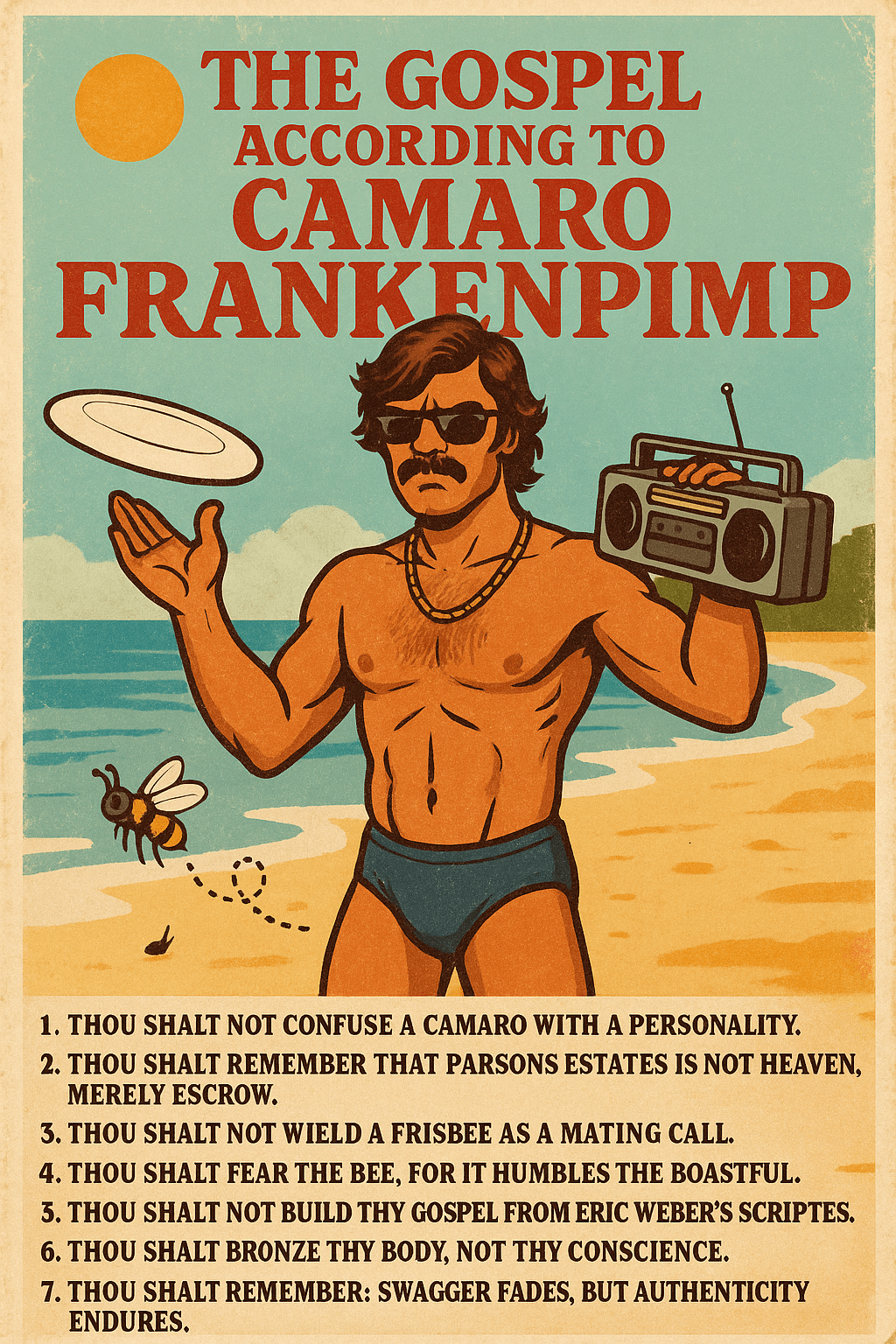
    That’s when I first saw him—the apostle of artificial cool. I didn’t know his name, so I christened him Camaro Frankenpimp. Late twenties, brown wavy hair, gold chain, Speedo so tight it threatened constitutional rights. His black ’76 Camaro—with its white racing stripes and glassy arrogance—glimmered in the parking lot like a totem of misplaced masculinity.

    Camaro Frankenpimp strutted across the grass in his blue briefs, boombox blaring, white Frisbee spinning in hand, Playboy cooler close behind. He had perfected his entrance and rehearsed his lines. Every Saturday, I’d hear the same monologue:

    He’d paid five hundred bucks for that custom paint job. His dad owned a chain of clothing stores in the Bay Area. He’d managed them since high school. He was waiting to hear from a Hollywood studio about a small part in a martial arts movie. And, the pièce de résistance, he owned a home in Parsons Estates. He dropped that name like a holy incantation, as though suburban real estate were the path to transcendence.

    I later realized he’d memorized his script from Eric Weber’s How to Pick Up Girls!—the ur-text of sleaze, which instructed men to approach women like sales prospects: persistence over decency, bravado over authenticity. I’d seen the book passed around my high school locker room like contraband scripture. Camaro had apparently underlined every commandment.

    He was successful, at least by his own shabby standards. Each Saturday, he had new blondes—interchangeable apostles in bikinis—tossing his Frisbee back like he was the messiah of mediocrity.

    Then came the reckoning.

    One afternoon, I watched from my towel as Camaro held court on his grassy knoll, his tanned body gleaming under the sun, boasting to two bikini-clad disciples. Suddenly, he howled like a wounded wolf.

    “You stepped on a bee!” one girl cried.

    The bee twitched in the grass, mission accomplished. Within seconds, Camaro was sweating, limping, and insisting he was fine. His skin shone like varnish; his foot ballooned to the size of a Christmas ham.

    “I’m fine,” he kept saying, though panic had already claimed his eyes.

    Moments later, he collapsed, chest heaving, mouth foaming. His body convulsed, the boombox still playing Fleetwood Mac’s “Dreams” in surreal counterpoint. By the time the ambulance arrived, Camaro Frankenpimp—the self-anointed prophet of Parsons Estates—was gone.

    I went home shaken. My hero, the sun god of Cull Canyon, slain by a bee. That night, I sought counsel from Master Po.

    “Why, Master,” I asked, “did such a magnificent man die so suddenly?”

    “Choose your heroes wisely, Grasshopper,” said Po. “The man was no hero. He was a hollow idol, built of vanity and insecurity. He was all surface and no soul, all pose and no power. His death was not tragic—it was poetic. For it is written: he who cannot conquer himself will be conquered by the smallest of creatures.”

  • Thou Shalt Find Beauty in Freakishness—or Die Trying

    Thou Shalt Find Beauty in Freakishness—or Die Trying

    By high school, I had fully accepted that I was not designed for the mainstream assembly line. Master Po—the blind sage from Kung Fu—had become my imaginary spiritual adviser, reminding me that I was a misfit, “a brooding soul misaligned with this world.” I wore that label like a second skin. While the cool kids air-guitared to Aerosmith and Led Zeppelin, I was hypnotized by the twelve-minute prog-rock epics of Yes, King Crimson, The Strawbs, and Genesis—bands that required liner notes and a calculator to appreciate.

    Football was for the square-jawed; I preferred curling iron plates in the garage, sculpting myself into a protein-powered statue of misplaced purpose. Worse, I wasn’t just eccentric—I was evangelical. At parties, I arrived armed with Genesis LPs, a blender, and the self-righteous zeal of a macrobiotic missionary. While everyone else chugged beer, I lectured them on amino acid assimilation. “Beer tastes like horse piss!” I declared, mid-flex, clutching a protein shake like a chalice. Girls scattered like pigeons from a lawn sprinkler. “Come back!” I shouted after them. “I’m the only one here with abs!”

    Later, alone in my room, my biceps and I sulked together under the blue glow of my bedside lamp.
    “Master Po,” I sighed, “why am I such a freak?”
    “Because you throw banana peels in people’s path to keep them from getting close to you,” he said.
    “And why would I do that?”
    “To protect yourself.”
    “From what?”
    “Everyone is broken, Grasshopper—but you are cracked to the core. Yet remember: beauty can be found even in freakishness. If you don’t draw that beauty out, it will turn inward and destroy you.”
    “How so?”
    “Because if you keep throwing banana peels for others, you’ll eventually slip on them yourself.”
    I sighed. “I think it’s already happened.”

  • Your Tears Won’t Change the World

    Your Tears Won’t Change the World

    When I was thirteen, I decided the path to popularity ran straight through Soul Train. I spent months studying the dance troupe Captain Crunch and the Funky Bunch, who could pivot from the robotic precision of the Funky Robot to doing splits so fast you’d think they were animated. I practiced every night in front of my bedroom mirror until my limbs clicked like clockwork and my expression was as vacant as a mannequin’s. I was ready to unleash my Funky Robot at the Earl Warren Junior High dance.

    The playlist that night was pure chaos. Whoever the DJ was, he seemed to be drawing songs from a hat. “Free Bird” dragged like a eulogy, “Walk This Way” felt like cardiac arrest, and “Midnight at the Oasis” was exactly what it sounded like—a languid romp in the desert. But when Stevie Wonder’s “Living for the City” came on, I sprang into motion. My body jerked and popped with righteous purpose. I was a mechanical deity in Adidas, a human jukebox powered by insecurity.

    By some miracle of social physics, I ended up dancing all night with Cheryl Atkins—the prettiest girl there—because her boyfriend Rick hated to dance. While we funked and twirled under the mirrored ball, I noticed the misfits pressed against the gym walls like condemned prisoners. They’d ask for dances, get shot down, and limp back to their corner of despair. Watching them, I felt an unexpected pang—an ache sharper than any muscle burn.

    Meanwhile, the popular eighth-graders were perfecting a ritual called “getting wasted,” which apparently involved puking and maintaining high social standing at the same time. As a Junior Olympic weightlifter, I found this baffling. I could clean and jerk my body weight, but I couldn’t comprehend how vomiting could make you cool.

    By the end of the night, Cheryl and I won the dance contest. Vice Principal Gillis handed me a trophy, but instead of basking in my Funky Robot glory, I felt hollow. The faces of the wallflowers haunted me. That night, I dreamed of a beach where a giant elephant seal handed each lonely misfit a beautiful radio, and as they tuned it, they glowed and vanished into the horizon. I woke up certain of one thing: radios were holy.

    “Master Po,” I said, “the world is cruel. I can’t be happy knowing people like those misfits suffer.”
    “Spare me your tears, Grasshopper,” he said. “Sadness feels noble, but it’s an addiction. It comforts the ego while changing nothing.”
    “But what can I do?” I asked. “Darwin was right—the strong thrive, and the weak pay the price.”
    “Indeed,” he said. “And in case you haven’t noticed, you’re one of the weak. So tend your own garden, Grasshopper. The misfit must save himself before he can save the world.”

  • The Heartbreak of Micky Dolenz (piano excerpt)

    The Heartbreak of Micky Dolenz (piano excerpt)

    When I was five, I watched The Monkees episode “I Was a 99-Pound Weakling.” Micky Dolenz, tired of sand in the face, starts lifting to steal back his dream girl from beach tyrant Dave Draper—Bulk himself. He returns a walking bicep, ready for triumph, and finds the blonde beauty arm hooked through a new idol: a skinny intellectual reading Proust’s Remembrance of Things Past. Micky’s expression does the math—pecs don’t beat paperbacks—and the lesson welded itself to my skull. Many years later, I’d write a piano composition, “The Heartbreak of Micky Dolenz.” What follows is an excerpt from that longer work. 


  • Comparison Is the Mother of Misery

    Comparison Is the Mother of Misery

    The mother of misery is comparison. In fourth grade I plunged into despair because I couldn’t draw like Joseph Schidelman, the illustrator of Charlie and the Chocolate Factory. About the same time, baseball humbled me: my bat speed wasn’t in the same galaxy as Willie Mays, Dick Allen, or Henry Aaron. In my teenage bodybuilding years, I had muscles, but nothing like that of Arnold Schwarzenegger, Sergio Oliva, and Frank Zane; I wisely retired the fantasy of becoming Mr. Universe and managing a gym in the Bahamas. In college, as an aspiring intellectual, I flogged myself for lacking Vladimir Nabokov’s wit and velocity. My chances of becoming a famous novelist were equal to my odds of winning Mr. Olympia. Later, when I flirted with composing and singing, I heard Jeff Buckley’s soul pour through the speakers and realized my voice would mainly trigger a neighborhood dog-barking contest and a chorus of angry neighbors. Decades passed. My classroom persona faced a generation handcuffed to smartphones and ChatGPT. I scrambled for “edutainment” tricks to dodge irrelevance, but the gap widened no matter how I danced.

    The sting doubled when I watched Earthquake (Nathaniel Stroman) flatten an audience with a preacher’s cadence and bulletproof wisdom. His special Joke Telling Business left me muttering, “If I had Earthquake’s power, I could resuscitate my teaching career and stroll into old age with a shred of dignity.”

    Meanwhile, fresh incompetencies arrived like junk mail. I broke two Samsung TVs in one day. I failed to sync my new garage door opener to my phone. My wife had to rescue me from my own maladroit tech spiral. The result was predictable: I was condemned to the Shame Dungeon.

    Down in the basement of depression, I noticed another casualty: my YouTube channel. I usually post once a week and have for over a decade—mostly about my obsession with diver watches. But as sanity demanded I stop flipping watches, I ran out of new divers to discuss. I tried pivoting—open with a little watch talk, then segue to a wry misadventure with a morsel of human insight. If I nailed the landing, I’d get a few thousand views and enough comment energy to believe the enterprise mattered.

    But with my sixty-fourth birthday closing in, the doubts got loud. I don’t want to do “watch talk,” and I’m too mortified to perform a perky, self-deprecating monologue about my misalignment with the universe.

    I keep hearing Mike Birbiglia in my head: you must process your material before you present it; the set has to be a gift, not your live catharsis. The healing happens before you step onstage. You speak from the far shore, not mid-drowning. Otherwise, you’re asking the audience to be your therapist.

    So I’m stuck at a fork: Will this current fear and anxiety about age and disconnection pass through the refinery of my psyche and emerge as something worthy? Or will I remain in the Shame Dungeon, comparing myself to Earthquake, and decide that with talent like his prowling the earth, my best move is to hide under a rock?

    Here’s the dilemma plain: Hiding isn’t viable; it starves the soul. But serving the world a plate of unprocessed mediocrity is just as unforgivable. If I’m going to tell a story about breaking two TVs and my garage-opener meltdown, I have to deliver it with Earthquake’s power and confidence. Otherwise I’ll stay home, mope on the couch, and binge crime documentaries—losing myself in bigger, cleaner tragedies than my own.