Category: philosophy

  • The Church of Sweat: 50 Years in the Iron Cathedral

    The Church of Sweat: 50 Years in the Iron Cathedral

    By the time I hit fourteen, my sacred sanctuary was none other than Walt’s Gym in Hayward, California—a temple of iron that had started its inglorious life as a chicken coop in the 1950s. The place was a veritable swamp of fungus and bacteria, a thriving petri dish of maladies eager to latch onto the unsuspecting. Members whispered in hushed tones about incurable athlete’s foot, the kind that made dermatologists throw up their hands in defeat. Some swore that the strains of fungus and mold festering in the corners were so exotic they had yet to be classified by the most intrepid of mycologists. Roosting among the fungal shower stalls was an oversized frog that the pro wrestlers had affectionately named Charlie. I never saw Charlie myself, but I often wondered if he was a real creature or a figment of the wrestlers’ imagination, birthed by too many concussions and late-night benders.

    The locker room was perpetually occupied by a rotating cast of characters who looked like they’d been plucked straight out of a grimy noir film. There was always some bankrupt divorcee draped in a velour tracksuit and a gold chain thick enough to anchor a ship, hogging the payphone for marathon sessions with his attorney. He’d discuss his sordid life choices and the staggering attorney fees required to sweep his past under a rug large enough to cover the entire state of California.

    Out back, an unused swimming pool lurked, its water murky and black—a cauldron of plague, dead rats, and God knows what else. Walt, the gym’s owner and part-time crypt keeper, had a peculiar ritual. Every so often, he’d saunter outside, brandishing a pool net like a scepter, and scoop up some unfortunate deceased creature. He’d hold it aloft for all to see, like a demented priest presenting an unholy sacrament. This grim ceremony was invariably met with a thunderous round of applause from the gym-goers, who treated Walt’s rodent exorcisms like a halftime show. Walt would then toss the cadaver into a nearby dumpster with all the flourish of a Shakespearean actor delivering a monologue, bowing deeply as if he’d just conquered a dragon.

    Walt’s Gym showcased a walking fossil named Wally, an octogenarian who swore he was the original model for human anatomy textbooks—perhaps ones etched on cave walls. We all loved Wally. He was a beloved gym fixture even though he could be a pain in the butt. Wally’s routine was the stuff of myth: He’d righteously correct everyone’s form whether they asked for his advice or not. He’d monopolize the gym for hours, his workout punctuated by monologues worthy of an Oscar about his deadbeat relatives who “borrowed” money, his former lovers who once graced the silver screen, and his eternal battle with arthritis. 

    Between sets, he’d often deliver a Ted Talk on muscle inflammation and the sorry state of the national economy. He delivered these soliloquies with the gravitas of a news anchor, then spent an eternity in the sauna and shower, emerging like a phoenix from the ashes only to douse himself head-to-toe in talcum powder, turning into a spectral beacon of gym dedication. When Wally spoke, he was engulfed in such a thick talcum haze you’d swear a lighthouse was about to blare its foghorn warning.

    The radio played the same hits on a relentless loop, as if the DJ had been possessed by the spirit of a broken record. Elvin Bishop’s “Fooled Around and Fell in Love,” The Eagles’ “New Kid in Town,” and Norman Connors’ “You Are My Starship” echoed through the gym like a soundtrack to my personal purgatory. As a kid navigating this adult world, the gym was my barbershop, my public square, where I eavesdropped on conversations about divorces, hangovers, gambling addictions, financial ruin, the exorbitant costs of sending kids to college, and the soul-sucking burdens of caring for elderly parents.

    It dawned on me then that I was at fourteen the perfect age: old enough to start building biceps like bowling balls, yet young enough to be spared the drudgery and tedium of adult life. Being a teenage bodybuilder, I realized, was all about sidestepping the real world entirely. Why bother with mortgages and 401(k)s when I could disappear into my true paradise, the gym? As Arnold himself wrote in Arnold: The Education of a Bodybuilder, the gym was the ultimate Happy Place: “The weight lifters shone with sweat; they were powerful looking. Herculean. And there it was before me—my life, the answer I’d been seeking. It clicked. It was something I suddenly just seemed to reach out and find, as if I’d been crossing a suspended bridge and finally stepped off onto solid ground.”

    Half a century later, I still have my version of Walt’s Gym—but now it’s a dimly lit garage filled with kettlebells and echoes. For the last ten years, it’s been my sanctuary, my forge, my private dojo where I swing iron spheres like a monk practicing some ancient, sweat-soaked ritual. No mirrors, no peacocks, no pop music—just me, gravity, and the stubborn pulse of something that refuses to quit.

    At nearly 64, I still wake up with the twitchy vigor of a teenager mainlining pre-workout, though now it’s fueled by habit and existential resolve rather than hormones and vanity. Friends—well-meaning, gray-templed philosophers—remind me that we’re each born with a finite reservoir of Life Force, that it burns down like a fuse, and that it’s only sensible to bow to biology, show gratitude, and pace ourselves. All true. But I also know that left unchecked, my own Life Force has a history of going rogue—dragging me into self-destructive spirals like a moth to a Molotov cocktail. So I remind myself, daily, that power without purpose is a demolition derby in my own skull.

    Still, when I think of Walt’s Gym, I remember that giddy, foolish optimism of youth—that belief that life was nothing but expansion, growth, and muscle gains. And weirdly, I still feel that same charge now. Same source, different vintage. That current is still flowing through me, unruly and alive. The only real difference? I no longer try to bottle it. I just hold on and let it do its work.

  • The Gospel According to Dad: A Parable of Rocks, Regret, and Cabernet

    The Gospel According to Dad: A Parable of Rocks, Regret, and Cabernet

    I was sixteen. My parents were recently divorced. Once a month, I’d visit my father at his swanky apartment and we’d discuss my future.

    One night, my father stared at me across the dinner table, a slab of rare steak leaking its red juices into a mountain of mashed potatoes. He squinted, as if trying to determine whether I was his son or a lost philosophy major who’d wandered in from a patchouli-scented commune.

    “So,” he said, carving off a bloody corner, “what are your career plans?”

    I gave him the truth. “Not totally sure, but I’m leaning toward philosophy.”

    He dropped his knife like I’d just confessed to joining a nudist circus. “Why in the hell would you want to do a thing like that?”

    “The search for meaning,” I said.

    He snorted and chased his chew with a gulp of red wine, as if meaninglessness required lubrication. “Don’t waste your time.”

    “Meaning is a waste of time?”

    He wiped his mouth like he was preparing to deliver a TED Talk from the underworld. “Let me tell you a little story.”

    And then came one of Dad’s home-brewed parables—equal parts whiskey, cynicism, and divine apathy:

    “A young man, about your age, stood on a beach and looked up at the heavens. ‘God,’ he said, ‘help me find meaning.’ And God, being the cosmic wiseass that He is, replied, ‘Look at all the rocks around you. One of them has the meaning of life written on it. Go find it.’ The young man looked around—millions of rocks—and said, ‘But God, that’ll take forever.’ And God said, ‘That’s your problem, not mine.’”

    I already regretted everything.

    “Decades passed. The man turned over every rock. He aged like a leather shoe abandoned in the desert. No inscription. He grew sunburned, brittle, and spiritually constipated. Finally, in his nineties, he looked up at the sky, trembling with rage, and shouted, ‘God! I’ve been faithful! No pleasure, no joy, no Netflix—just rock-flipping! And I found nothing!’”

    Dad leaned in, eyes gleaming.

    “And God said: ‘That’s right, you dumb shit. Now die.’”

    There was a silence. Even the mashed potatoes seemed stunned.

    I blinked. “Where in the hell did you hear that story?”

    He leaned back, smug as a snake on a warm rock. “Made it up. For your benefit.”

    “My benefit? What am I supposed to take from this bleak little fable?”

    He ticked the lessons off like commandments: “One, God doesn’t give a shit. Two, there is no meaning. Three, stop thinking so damn much and just live your life.”

    “Easy for you to say,” I muttered. “Cruising around in your fancy car, living in your swanky bachelor pad, drinking overpriced wine.”

    “Worry not, my son,” he said, swirling his cabernet like it owed him rent. “You’ll get yours someday.”

    “So you’ve found paradise?”

    He shrugged. “Far from it. But it’s got central air. And that’ll have to do.”

  • Trapped in the Sauna: When Bro Talk Becomes Brain Fog

    Trapped in the Sauna: When Bro Talk Becomes Brain Fog

    I’m 63, I live in the suburbs, and I like to sweat, laugh, and think—ideally all in the same day. I’ve got a soft spot for health and fitness talk, well-produced comedy, and podcasts where the ideas land harder than the punchlines. Back in the day, I gave Joe Rogan some ear time—especially when he had guests like Michael Pollan who could string together a sentence without referencing elk meat or hallucinogens. The show scratched a certain male itch: that longing for a tribal fire pit where you could grunt, swap kettlebell routines, and talk nonsense without getting side-eyed.

    I got it. I really did. There was a certain charm in the early years—the man cave as refuge, not bunker. A place for unapologetic masculinity that wasn’t trying to sell you a four-pack of testosterone supplements and a tactical flashlight.

    But then something changed. The man cave didn’t evolve—it ossified. It turned into a walled-off compound of grievance, smug anti-intellectualism, and half-baked conspiracy theories passed around like a tray of stale edibles. What once felt like a mixed bag of bro-science and genuine curiosity devolved into a middle-aged lunch table where the same unfunny comedians riff about whiskeys, bow hunting, and whether they’d survive a bear attack armed only with sarcasm and nicotine gum.

    So when I stumbled across Ghost Gum’s YouTube essay “The Collapse of the Joe Rogan Verse,” I hit play with morbid curiosity—and found it eerily validating. Turns out, I wasn’t alone in sensing that Rogan’s podcast had turned into a predictable, self-congratulatory echo chamber, where counterarguments go to die and every guest seems contractually obligated to flatter the host.

    The video’s roast of Tom Segura was especially brutal—and fair. Once the chubby, relatable everyman, Segura now floats in orbit around Planet Rogan, sneering at the unwashed masses like a guy who did keto once and now thinks he’s better than you. His comedy used to punch up; now it just punches down and preens.

    Comedy rooted in tribal loyalty becomes fan service, then becomes boring, then becomes embarrassing. What began as a countercultural clubhouse has curdled into a locker room thick with stale air and self-importance.

    Maybe Joe Rogan was once a necessary irritant to polite discourse, a reminder that the man cave had value. But too much time in that space without fresh air—and you forget it was never meant to be a throne room.

    Perhaps Joe Rogan’s unraveling podcast is just another cautionary tale of what happens when someone marinates too long in their own echo chamber and starts mistaking the sound of agreement for the sound of wisdom. Spend enough time surrounded by yes-men and protein powder, and eventually, you’re just getting high on your own supply—delirious with self-importance and blind to the rot setting in.

  • The Jungle, the Bigfoot, and the Fan Man Cometh

    The Jungle, the Bigfoot, and the Fan Man Cometh

    Last night I dreamed I was deep in the jungle—not metaphorically, mind you, but the kind you’d find on a Nature Channel special narrated by a vaguely concerned Brit. I wasn’t alone. Beside me stood a woman zookeeper in full khaki safari cosplay, complete with binoculars and a steel gaze. We weren’t observing wildlife—we were at war. The prize? A sprawling jungle compound. The opponent? A hulking, glowering Bigfoot-like brute who looked like he’d crawled out of my Neanderthal ancestry with unresolved issues and a gym membership.

    It was a reality show, naturally. Cameras everywhere. High stakes. Death possible. Maybe probable.

    What shocked me wasn’t the premise—it was me. I watched myself morph from suburban dad into a primal tactician, a creature with cunning in his marrow and bloodlust behind his bifocals. The zookeeper and I didn’t stand a chance physically, but we were shrewd, dirty-fighting strategists. While the beast snorted and stomped like a sentient linebacker, we set a trap—an elegant, jungle-engineered booby trap. And it worked. Bigfoot fell. Cue commercial break. Cue confetti.

    Victory was ours.

    But I, ever the responsible homeowner, sold my half of the prize to the zookeeper in exchange for a wad of cash and a sense of capitalist purpose. I left the jungle compound behind and made my triumphant return not to glory—but to shopping.

    I hit the beachside bazaar with missionary zeal, eyes blazing, nostrils flaring with sea air and consumer ambition. My quarry: fans. Tower fans. Desk fans. Oscillating fans. Fans with remotes, timers, and multi-speed whisper motors. Each vendor pitched their product like they were auditioning for Shark Tank. I nodded sagely as an assistant loaded box after box into a truck like I was provisioning for the end times—but with superior airflow.

    I had ventured into the heart of darkness, found my inner beast, won the battle, and returned not with enlightenment or moral clarity—but with high-performance climate control.

    In the dream’s strange logic, it made perfect sense. I had confronted the savage within, and now, armed with cutting-edge ventilation, I would cool the tempers of suburban life.

    This, apparently, is my idea of spiritual integration.

  • The Vegan Martyr of Suburbia

    The Vegan Martyr of Suburbia

    This is a story soaked in irony, clucking with heartbreak. It’s the tale of Ned Pearlman, a 63-year-old man whose conscience became his personal executioner.

    Ned was a lifelong weightlifter, a barrel-chested patriarch with calloused hands and a back catalog of deadlift anecdotes. When egg prices began to flirt with the absurd, his family took the Depression-era route and bought chickens. Backyard livestock as economic strategy.

    They started with a humble flock—a few hens, a rooster, and one poorly socialized silkie that pecked at everyone’s ankles. But something shifted in Ned. The hens began following him around the yard like starstruck interns. The rooster started presenting Ned with tributes: gum wrappers, pocket change, ornamental twigs. It was clear—Ned was the alpha.

    At night, the chickens would nestle beside him in bed, each with its own green velvet pillow like feathery courtiers in a royal suite. Ned, a man once fueled by steaks and protein shakes, looked into their beady eyes and saw innocent souls. Souls that changed him. He went vegan overnight.

    Not just vegan—missionary vegan. He researched. He supplemented. He downed algae-based omega-3s and pea protein smoothies that tasted like damp cardboard soaked in guilt. He clocked in 180 grams of protein a day, but his body, unimpressed by numbers, absorbed barely a fraction. The mighty Ned began to shrink.

    He became fatigued, confused. The barbell mocked him. His once-proud biceps began to resemble disillusioned baguettes. Despite his family’s desperate pleas—“just some yogurt, Ned, or a scoop of whey!”—he remained unwavering. This was a moral epiphany, not a diet. Animal products were betrayal. Flexibility was sin.

    Soon, the man who once bench-pressed lawn furniture was bedridden and showing signs of rapid cognitive decline. His doctor called it malnutrition-induced dementia. Ned called it sacrifice.

    His family, feeling abandoned, visited him rarely—guilt-visitations sprinkled in between Facebook posts and emotional exhaustion. But the chickens stayed. Loyal. Soft. Slightly judgmental. And the geriatric facility, either out of mercy or lack of clear policy, let them roost near him.

    One sunny afternoon, Ned was wheeled onto the grass. The chickens gathered around him, forming a feathered perimeter. In a rare moment of clarity, he looked to the sky and muttered, “Why, dear God, did my health not align with my ethics? Why must my clean conscience kill me and alienate those I love?”

    He received no reply. The clouds rolled by in soft indifference. Ned closed his eyes and died, flanked by his beaked apostles, surrounded by the warm, gentle souls that had rewritten his values—and slowly drained his life.

  • The Shop Foreman of My Own Dysfunction and Other Life Chapters

    The Shop Foreman of My Own Dysfunction and Other Life Chapters

    At 63, I now divide my life into chapters—not by achievements or milestones, but by bone density, hormone decay, and the gradual hardening of the frontal cortex. Think of it as an anatomical calendar, where each page curls with protein shakes, pretension, and the occasional existential crisis.

    Chapter One: The Barbara Eden Years.
    Childhood wasn’t about innocence—it was about Cap’n Crunch. Bowls of it. Oceans of sweetened corn rubble. I dreamed not of firetrucks or baseball cards but of living inside Barbara Eden’s genie bottle—a plush, velvet-lined fever dream of satin pillows and cleavage. If Barbara Eden wasn’t beaming into my imagination, there was always Raquel Welch in fur bikinis or Barbara Hershey smoldering her way across a screen. This was hormonal awakening served with a side of sugar coma.

    Chapter Two: The Strength Delusion.
    By twelve, I was slamming Bob Hoffman’s bulk-up protein like it was communion wine. At Earl Warren Junior High, I became a Junior Olympic Weightlifter—a gladiator-in-training who wanted pecs like dinner plates and the gravitas of a Marvel origin story. This was the age of iron worship and adolescent mythology: I wasn’t building muscle—I was forging armor.

    Chapter Three: The Intellectual Flex.
    In my late teens, I realized I had all the social charm of a wet gym sock. So I went cerebral. I buried myself in Kafka, Nabokov, and classical piano, amassing a CD library of Beethoven and Chopin that could rival the Library of Congress. I worked in a wine shop where I learned to pronounce “Bordeaux” with a nasal twang and described Chablis as “crisp with notes of existential regret.” I didn’t just want to be smart—I wanted to be the human embodiment of a New Yorker cartoon.

    Chapter Four: The Shop Foreman of My Own Dysfunction.
    Marriage and employment hit like a cold bucket of reality. Suddenly, I had to function around other human beings. My inner demons—once delightfully antisocial—were now liabilities. I had to manage them like a foreman supervising a warehouse of unruly toddlers armed with crowbars. Turns out, no one wants to be married to a psychological landfill. I had to self-regulate. I had to evolve. This wasn’t personal growth; it was preventative maintenance, or what other people simply call adulthood.

    Chapter Five: Diver Cosplay.
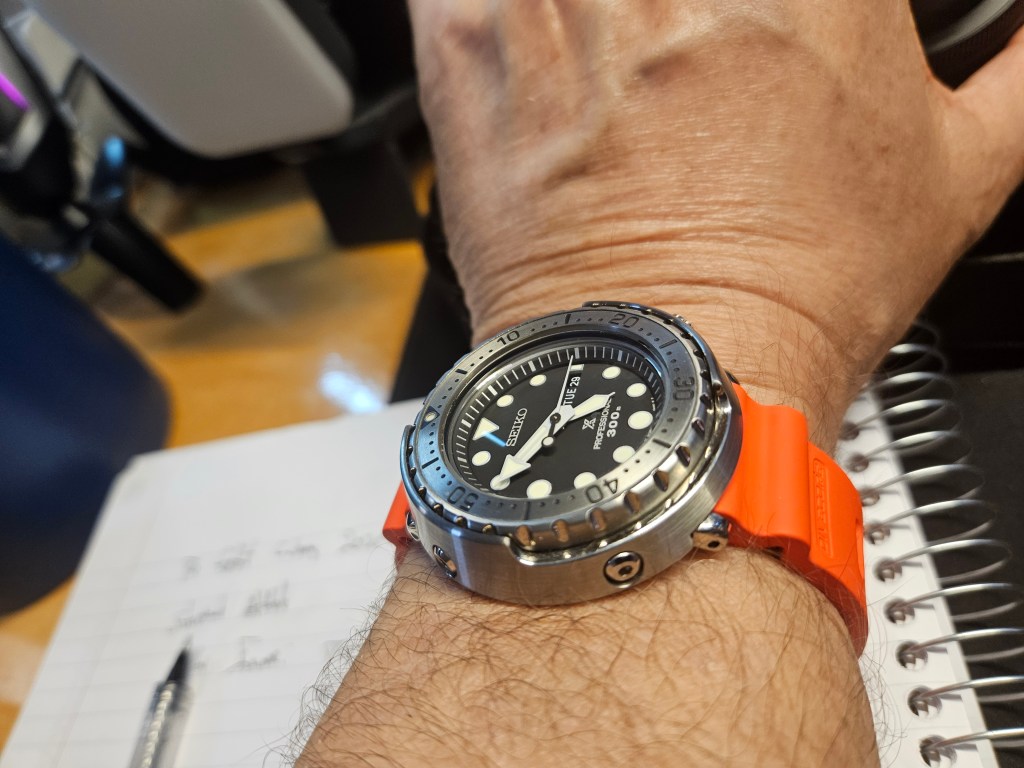
    In my forties, I had just enough disposable income and suburban ennui to start collecting dive watches. Not just one or two. A flotilla. I wanted to be the hero of my own fantasy—a rugged diver-explorer-adventurer who braved Costco parking lots with a Seiko strapped to his wrist. This was less about telling time and more about clinging to the idea that I was still dangerous, or at least interesting. Spoiler: I was neither.

    Chapter Six: The Age of Denial and Delusion.
    These days, the watches still gleam, but now I’m staring down the barrel of cholesterol, visceral fat, and the slow betrayal of my joints. I swing kettlebells five days a week like a garage-dwelling warlock trying to ward off decay. I track my protein like a Wall Street analyst and greet each new biomarker like a hostile corporate audit. Am I aging gracefully? Hardly. I’m white-knuckling my way through geriatric resistance and calling it “wellness.” If I’m Adonis, then somewhere in the attic there’s a Dorian Gray portrait of my pancreas in open revolt.

    I know what’s coming: Chapter Seven. The reckoning. The spiritual compost heap where I either make peace with my body’s betrayal or turn into a bitter relic that grunts through foam-rolling sessions like it’s trench warfare. It’ll be the chapter where I either ascend or unravel—or both.

    And while our chapters differ in flavor, I suspect we’re all reading from the same book. Different fonts, same plot twist: we start with fantasies, build identities, fight the entropy, and eventually, we all kneel before the mirror and ask, “Was that it?

  • It’s Time to Replace the Manoverse

    It’s Time to Replace the Manoverse

    The Manoverse—if we’re still calling it that—is less a universe and more a glorified bachelor pad of delusion: part weight room, part cigar lounge, part bunker of arrested development. It’s where middle-aged men cosplay as lone wolves, though most couldn’t survive a weekend without their chiropractor, their wireless earbuds, or the approval of a group chat titled “Legends Only.”

    Here, masculinity is curated like a Spotify playlist: heavy on Joe Rogan and conspiracy theories, light on self-awareness. It’s a world built on protein powder, podcast epistemology, and the sacred belief that buying another tactical flashlight will somehow repair one’s crumbling sense of purpose. These men aren’t villains. They’re just… tired. Tired of being told to open up and tired of not knowing how. So instead, they talk about cigars and bourbon like it’s therapy and do deadlifts until their emotions herniate.

    It’s not toxic masculinity—it’s post-traumatic stoicism, sprayed with Axe and monetized via affiliate links. A more accurate word for Manoverse is Brocosytem–a thriving ecosystem of protein, posturing, and podcast quotes or Testosterzone– where men go to reclaim their abs, autonomy, and adolescent values.

    We need a wholesome place for masculinity–a place for strength and stewardship. We need a Manstead–a homestead of character; a grounded place where strength meets responsibility or a Mantlehood–which suggests taking up a mantle: carrying responsibility with humility and grace. Or we need a Manhaven–a sanctuary of stable, nurturing masculinity. Protective, not possessive.

    The self-satisfied podcasters of the so-called Manosphere have officially jumped the shark. Their recycled rants and tired performances have lost whatever relevance they once had. It’s clear they’ve outlived their cultural moment. What we need now are new voices—embodied, grounded examples of healthy masculinity—men who lead with integrity, vulnerability, and actual wisdom instead of volume and vanity.

  • Smoke, Sheets, and the Spectacle of Faith

    Smoke, Sheets, and the Spectacle of Faith

    This morning, I was deep in the ritual of pre-cleaning for the cleaning ladies. Yes, the Marías—both of them named Maria, as if summoned from a 1960s sitcom or a Vatican registry. I was stripping beds, scrubbing dishes, and hoisting laundry baskets like I was auditioning for a domestic CrossFit competition. Because as every self-deluded homeowner knows: your house must be cleaned before the cleaners arrive, lest they judge you and your sloth.

    In the background, Larry Mantle’s AirTalk droned dutifully on LAist 89.3. Then, mid-sentence, the broadcast was interrupted—an old-school news bulletin, the kind that makes you expect a war or a celebrity scandal. But no. Something rarer: a new pope had been chosen. The signal? White smoke rising from the chimney of the Sistine Chapel.

    I had never heard of this protocol before. My first thought? Not theology. Not history. But the shared aesthetic DNA between this and the Golden Globes. The Oscars. The artificial wonder of Peter Pan’s Flight at Disneyland. If you want transcendence, baby, you’d better stage it.

    The Catholic Church, whatever its flaws, understands showmanship. They know airtight theological arguments are no match for spectacle. You don’t capture the masses with hermeneutics—you hook them with enchantment. Thus: white smoke. Bells. Angels singing in Dolby surround. The Vatican doesn’t inform you a pope’s been picked. They stage it like a cosmic halftime show.

    Religion, in its enduring wisdom, knows austerity is a losing brand. Dry dogma doesn’t sell. You need magic. Mystery. A sense that the universe has backstage lighting and a fog machine.

    Because man does not live on bread alone.

    No, man also lives on bells, incense, pageantry, and the theatrical flourish of divine appointment announced via rooftop smoke signals. What’s the metaphysical takeaway? That God, like Hollywood, knows how to build suspense.

  • The Design Space Is Shrinking: How A.I. Trains Us to Stop Trying

    The Design Space Is Shrinking: How A.I. Trains Us to Stop Trying

    New Yorker writer Joshua Rothman asks the question that haunts every creative in the age of algorithmic assistance: Why even try if A.I. can do it for you?
    His essay  “Why Even Try If You Have A.I.?”unpacks a cultural crossroads: we can be passive passengers on an automated flight to mediocrity, or we can grab the yoke, face the headwinds, and fly the damn plane ourselves. The latter takes effort and agency. The former? Just surrender, recline your seat, and trust the software.

    Rothman begins with a deceptively simple truth: human excellence is born through repetition and variation. Take a piano sonata. Play it every day and it evolves—new inflections emerge, tempo shifts, harmonies stretch and bend. The music becomes yours not because it’s perfect, but because it’s lived. This principle holds across any discipline: cooking, lifting, writing, woodworking, improv jazz. The point isn’t to chase perfection, but to expand what engineers call your “design space”—the evolving terrain of mastery passed from one generation to the next. It’s how we adapt, create, and flourish. Variation, not polish, is the currency of human survival.

    A.I. disrupts that process. Not through catastrophe, but convenience. It lifts the burden of repetition, which sounds like mercy, but may be slow annihilation. Why wrestle with phrasing when a chatbot can generate ten variations in a second? Why compose from scratch when you can scroll through synthetic riffs until one sounds “good enough”? At some point, you’re not a creator—you’re a casting agent, auditioning content for a machine-written reality show.

    This is the creep of A.I.—not Terminator-style annihilation, but frictionless delegation.
    Repetition gets replaced by selection. Cognitive strain is erased. The design space—the sacred ground of human flourishing—gets paved over with one-size-fits-all templates. And we love it, because it’s easy.

    Take car shopping. Do I really want to endure a gauntlet of slick-haired salesmen and endless test drives? Or would I rather ask ChatGPT to confirm what I already believe—that the 2025 Honda Accord Hybrid Touring is the best sedan under 40K, and that metallic eggshell is obviously the right color for my soulful-but-sensible lifestyle?
    A.I. doesn’t challenge me. It affirms me, reflects me, flatters me. That’s the trap.

    But here’s where I resist: I’m 63, and I still train like a lunatic in my garage with kettlebells five days a week. No algorithm writes my workouts. I improvise like a jazz drummer on creatine—Workout A (heavy), Workout B (medium), Workout C (light). It’s messy, adaptive, and real. I rely on sweat, not suggestions. Pain is the feedback loop. Soreness is the algorithm.

    Same goes for piano. Every day, I sit and play. Some pieces have taken a decade to shape. A.I. can’t help here—not meaningfully. Because writing music isn’t about what works. It’s about what moves. And that takes time. Revision. Tension. Discomfort.

    That said, I’ve made peace with the fact that A.I. is to writing what steroids are to a bodybuilder. I like to think I’ve got a decent handle on rhetoric—my tone, my voice, my structure, my knack for crafting an argument. But let’s not kid ourselves: I’ve run my prose against ChatGPT, and in more than a few rounds, it’s left me eating dust. Without A.I., I’m a natural bodybuilder—posing clean, proud, and underwhelming. With A.I., I’m a chemically enhanced colossus, veins bulging with metaphor and syntax so tight it could cut glass. In the literary arena, if the choice is between my authentic, mortal self and the algorithmic beast? Hand me the syringe. I’ll flex with the machine.

    Still, I know the difference. And knowing the difference is everything.

  • If You Only Watch One Black Mirror episode, Let It Be “Joan Is Awful”

    If You Only Watch One Black Mirror episode, Let It Be “Joan Is Awful”

    If you only watch one episode of Black Mirror, let it be Joan Is Awful—especially if you have a low tolerance for tech-dystopian fever dreams involving eye-implants, social scores, or digital consciousness uploaded to bees. This one doesn’t take place in a dark tomorrow—it’s about the pathology of right now. It skewers the Curated Era we already live in, where selfhood has been gamified, privacy is casually torched, and we’re all trapped in the compulsion to turn our lives into content—often awful, but clickable content.

    Joan, the title character, is painfully ordinary: a mid-level tech worker trying to swap out one man (her manic ex) for another (her milquetoast fiancé) and coast into a life of retail therapy and artisanal beverages. Her existence—Instagrammable, calibrated, aggressively average—is exactly the kind of raw material the in-universe Netflix clone Streamberry is looking for. They turn her life into a show called “Joan Is Awful,” starring a CGI deepfake Salma Hayek version of Joan, who reenacts her life with heightened melodrama and algorithmically-optimized awfulness.

    This isn’t speculative fiction. It’s just fiction.
    Streamberry’s vision of a personalized show for everyone—one that amplifies your worst traits and pushes them out for mass consumption—is barely an exaggeration of what Instagram, TikTok, and YouTube are already doing. We’ve all become our own showrunners, stylists, and publicists. Every TikTok tantrum and curated dinner plate is an audition for relevance, and the platforms reward us for veering into the grotesque. The more unhinged you become, the more “engagement” you earn.

    “Joan Is Awful” works both as a laugh-out-loud satire and as a metaphysical gut-punch. It invites us to contemplate the slippery nature of selfhood under surveillance capitalism. At its core is the concept of “Fiction Level 1”: the dramatized version of Joan’s life generated by AI, crafted from data scraped from her phone, her apps, her browsing history. Joan doesn’t write the script. She doesn’t even get to protest. She’s just the original dataset—fodder for narrative extraction. Her real self is mined, exaggerated, and repackaged for mass appeal.

    Sound familiar?

    In the real world, we all star in our own low-budget version of “Joan Is Awful,” plastered across social media feeds. These platforms don’t need deepfakes. We willingly create them, editing ourselves into marketable parodies. We offer up a polished persona while our actual selves starve for air—authenticity traded for audience, spontaneity traded for algorithmic approval.

    You can enjoy “Joan Is Awful” as slick satire or you can unpack its metafictional mind games—it rewards both approaches. Either way, it’s easily one of Black Mirror’s top-tier episodes, alongside “Nosedive,” “Rachel, Jack and Ashley Too,” and “Smithereens.” It’s not science fiction. It’s just a very well-lit mirror.