Category: philosophy

  • Why the Word “Stress” Has Outlived Its Usefulness

    Why the Word “Stress” Has Outlived Its Usefulness

    The word stress has been talked into exhaustion. It shows up everywhere—therapy sessions, productivity podcasts, corporate memos—until it becomes a kind of verbal white noise. Everything is stressful. Traffic is stressful. Email is stressful. Existence itself is apparently one long panic attack. The result is not clarity but numbness. A word that once pointed to something real now floats, bloated and imprecise, over every inconvenience and calamity alike. It needs to be stripped down, cleaned up, and returned to service.

    Start by dividing what we lazily call “stress” into three distinct experiences.

    First, there is what we might call existential friction—the strain that comes from living a life that actually matters. Sartre described it as getting your hands dirty. It is the tension of responsibility, of choosing action over comfort. Think of Viktor Frankl, who could have escaped a concentration camp but stayed to tend to the suffering around him. To say he was “stressed” is to trivialize the moment. He was engaged in a moral confrontation with evil. The discomfort was not a malfunction; it was the price of meaning. A bodybuilder tears muscle to grow stronger. A moral person strains against life’s conflicts to become more fully human. This is not pathology. It is construction.

    Second, there is narcissistic agitation—the counterfeit version of stress, self-generated and corrosive. This is the anxiety of the addict chasing relief, the restless paranoia of the status-obsessed, the brittle ego that reads every room as a threat. Here the individual is both the engine and the victim of the distress. It is not the friction of purpose but the turbulence of misalignment. To confuse this with existential friction is not just sloppy; it is morally obtuse. One builds character. The other erodes it.

    Finally, there is existential overload—the strain that arrives uninvited and exceeds your capacity to absorb it. This is not heroic and not self-inflicted. It is what happens when life stacks too many weights on the bar at once. Divorce, illness, financial collapse—events that don’t ask for your permission before they rearrange your nervous system. In this state, the body begins to narrate what the mind cannot contain. Appetite disappears. Sleep fractures. Symptoms bloom. There is no lesson neatly packaged inside it, no redemptive arc guaranteed. It is endured, not chosen.

    I think of my brother in 2020. His marriage collapsed. He was suddenly alone during the pandemic, financially strained, disoriented. Then came the diagnosis: Burkitt lymphoma. Two months to live. That is not “stress.” That is existential overload in its purest form. And yet, against those odds, he found a narrow corridor of hope—a CAR T-cell therapy trial at UCSF. He took it. He survived. He is in remission. The word stress does not belong anywhere near that story.

    This is why the word needs to be retired from serious use. It flattens distinctions that matter. It places the inconvenience of a crowded inbox on the same plane as a confrontation with mortality. Better to replace it with terms that carry weight: existential friction, narcissistic agitation, existential overload. Precision is not pedantry; it is navigation. If you’re trying to find your way out of the dark, you don’t need a vague feeling. You need a compass that actually points somewhere.
  • Social Capital and the Art of Not Being Chosen

    Social Capital and the Art of Not Being Chosen

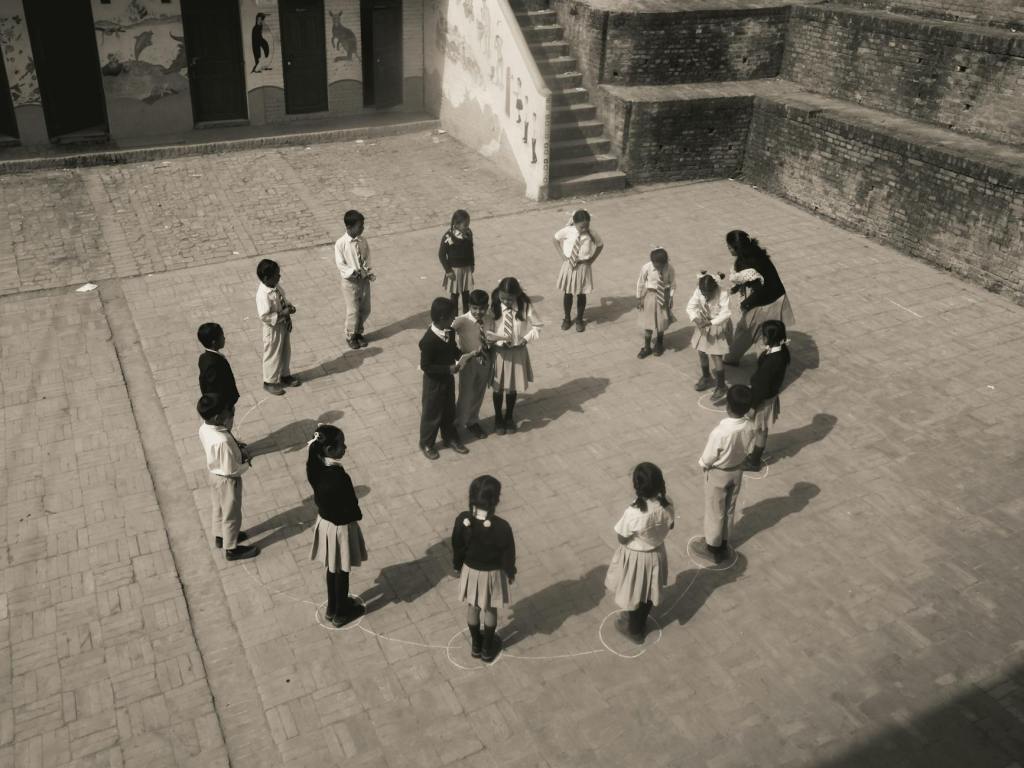
    Not all rejection deserves to be filed under the same heading. Romantic rejection—the operatic kind—arrives with violins, moonlight, and a certain built-in alibi. You fall hard, you overestimate your odds, and when the other person declines to co-star in your fantasy, you can console yourself with the obvious: the whole thing was inflated from the start. You were auditioning for a role that rarely gets cast.

    But the quieter rejections—the ones that occur under fluorescent lighting and polite conversation—cut deeper. They lack drama but not consequence. In fact, they feel more diagnostic, as if they’ve been administered by a committee.

    Consider friendship rejection. You meet someone, exchange a few promising signals, and then—nothing. Or worse, a friendship that once had momentum slows, then stalls, then disappears entirely. This is not a stranger declining your advances; this is someone who had enough data to make a decision and chose, calmly, not to proceed. The verdict feels less like bad luck and more like a character assessment.

    Then there is colleague rejection, which operates with corporate efficiency. Alliances form. Cliques crystallize. You are not invited into the warm circle of inside jokes and informal influence. You do your work—flawlessly, even—but without the buoyancy that comes from being wanted. You become competent but peripheral, visible but not included. This is where you begin to suspect you suffer from what might be called Social Capital Deficit Syndrome: a condition marked by a shortage of the invisible currency that makes social and professional life glide instead of grind.

    And here is the uncomfortable truth: social capital is not a luxury; it is infrastructure. Without it, you are left to interpret every silence, every omission, every polite deflection. The temptation is to diagnose yourself—too blunt, too quiet, too something—and then to launch a campaign of correction. This is where things get worse. Self-blame mutates into paranoia. Self-improvement becomes performance. You start sanding down your edges in public, hoping to emerge as a more acceptable version of yourself, and end up as a less convincing one.

    At some point, a harsher but cleaner realization presents itself: your personality comes with a certain gravitational pull, and not everyone will orbit it. No amount of forcing will change that. Trying to wedge yourself into every available opening only advertises the mismatch.

    The more durable response is less theatrical and more disciplined. Accept that people respond rather than decide. They are not conducting formal evaluations of your worth; they are reacting to chemistry, timing, and preference—most of which lie outside your control. This does not excuse cruelty, but it does eliminate the fantasy that everyone owes you affinity.

    So you take the higher road—not as a moral performance, but as a practical strategy. You remain courteous when ignored, steady when excluded, and restrained when slighted. You refuse to become the bitter man who proves his critics right simply by reacting exactly as expected.

    This runs counter to a culture that treats every problem as fixable with the right toolkit. You can, of course, pursue therapy, charisma workshops, confidence training—the whole catalog of self-upgrades. Some of it may help. Some of it may turn you into a louder version of the same problem. There is a fine line between improvement and overcorrection, and many people sprint past it.

    What remains, then, is a quieter ambition: to live without rancor. To accept your limits without turning them into grievances. To maintain a sense of integrity that does not depend on applause. The chip on your shoulder may feel like armor, but it is really a signal—confirmation to others that their instincts about you were correct. Let it go.

    You may lose the small comforts of self-pity. In return, you gain something sturdier: a life not governed by who did or did not choose you.

  • The Psychological Mess of Wanting Things We Neither Need Nor Intend to Use

    The Psychological Mess of Wanting Things We Neither Need Nor Intend to Use

    One of the strangest features of materialism is the spectacular mismatch between what we imagine an object will do for us and what it actually does. In the mind, the object arrives polished, transcendent—an emblem of taste, discipline, even identity. In reality, it often sits there, unnecessary and faintly ridiculous, like a prop waiting for a performance that never begins. 

    I own an eight-year-old Accord with fewer than 30,000 miles on it—a statistic that quietly announces I neither drive much nor particularly enjoy driving. And yet I can picture, with embarrassing clarity, a brand-new Accord or Camry resting in my garage, gleaming like a sacred artifact I would prefer not to disturb by actually using it.

    Watches operate under the same spell. I can easily imagine owning a Tudor Black Bay or a Tudor Pelagos, each one promising a kind of quiet authority on the wrist. But my habits betray me. I’m not roaming public spaces, not projecting presence, not leveraging this object as a social signal. The watch would sit, admired in theory, unused in practice. I know dozens—no, hundreds—of watch enthusiasts who live in this same contradiction, accumulating pieces they rarely wear because the idea of ownership is more intoxicating than the act of use.

    This gap between having and being is hardly new. I was reminded of it while thinking about Erich Fromm and his book To Have or To Be?, which argues that materialism quietly erodes the possibility of a meaningful life grounded in connection and experience. The argument is persuasive—almost obvious once stated. And yet, knowing this changes very little.

    That’s the part that unsettles me. You can understand the critique, agree with it, even teach it, and still find yourself browsing for the next unnecessary object with the focus of a predator. Clarity does not neutralize desire. It merely observes it, like a detached narrator watching the same old plot unfold. There’s something almost comical about it—this split between the thinking self and the acquisitive impulse. If you wanted to document the absurdity of human behavior, you could dedicate an entire season of Dirty Jobs to it: not the grime of physical labor, but the psychological mess of wanting things we neither need nor intend to use.

  • When Writing Stops You From Lying to Yourself

    When Writing Stops You From Lying to Yourself

    Kafka called writing a form of prayer. Not as piety, but as precision. Prayer, properly understood, is the act of stepping out of ordinary time—the noisy, transactional churn—and entering a space where attention is no longer scattered but gathered. Writing does the same. It refuses the chaos of profane time and insists, however briefly, on the discipline of the sacred.

    The sacred is not mystical fog. It is clarity stripped of dopamine. It is the quiet room where you examine the state of your own soul without distraction or performance. It is where you test whether your words can survive contact with your actions. It demands humility because it exposes how often they don’t. And it offers a kind of nourishment the chronophage—the great time-eating machine—cannot provide, because it cannot be consumed passively. It must be earned.

    To live thoughtfully is to move between two worlds: the sacred and the profane. You cannot remain in either one. You must descend into the ordinary—work, errands, obligations—but carry with you the standards forged in that quieter space. Otherwise, the sacred becomes theater, and the profane becomes drift.

    So the question arrives, unwelcome but necessary: Do my actions align with my ideals? No. Not yet.

    If they did, my life would contract, not expand. I would eat with intention—three meals, no grazing—and call the absence of snacks what it is: a fast, not a deprivation. I would step away from the digital carnival that thrives on FOMO, because I know its rewards are counterfeit—brief spikes followed by longer, duller lows.

    I would stop buying watches. I already own more than I can meaningfully wear. Two G-Shocks tell perfect time. The rest sit like artifacts of former appetites. Rotation is not variety; it is indecision dressed as sophistication.

    And I would reconsider what I make. If my videos exist to chase attention, to measure my worth in clicks and spikes of approval, then they are extensions of the same problem. The medium is different; the mechanism is identical. But if a video can carry an idea forward—if it can clarify rather than agitate—then it earns its place.

    Writing, then, is not an escape. It is a reckoning. It is the act of bringing the sacred into contact with the profane and asking, without flinching, whether they agree. Most days, they don’t. The work is to narrow that distance.

  • Seven Watches Have Made Me Contemplate the Tyranny of Want

    Seven Watches Have Made Me Contemplate the Tyranny of Want

    I was raised to believe that wanting something was reason enough to have it.

    Not a suggestion. Not a temptation. A principle.

    In the 60s and 70s, appetite was rebranded as intelligence. If you knew how to indulge—food, gadgets, experiences—you weren’t weak. You were evolved. The man who said no looked like a malfunction: tight-lipped, joyless, possibly afraid of his own shadow.

    The rest of us were out there chasing pleasure like it was a civic duty.

    And I didn’t just participate—I specialized.

    I built a life around calibrated indulgence. Watches, food, stimulation. I didn’t impulse-buy; I strategized. I had rotations, hierarchies, justification frameworks. I could explain any purchase with the calm authority of a man who had already made the purchase.

    Which is why it’s unsettling—borderline alarming—that I now feel relief that my watch collection is down to seven.

    Seven.

    At one point, seven watches would have been the warm-up act. Now it feels like silence after a fire alarm. Manageable. Contained. Almost peaceful.

    Out of curiosity, I tried to imagine adding just one more watch.

    Not buying it—just imagining it.

    Within seconds, I felt the familiar anxiety spool up: Where does it fit? When do I wear it? What does it replace? What problem is it solving that doesn’t exist?

    That’s when the illusion cracked.

    What I used to call “expanding the collection” was actually expanding the burden.

    Which led to a thought I’ve spent most of my life avoiding:

    What if self-denial isn’t deprivation?
    What if it’s relief?

    This idea runs against decades of conditioning. My instincts are trained like a high-performance lab animal: stimulus, response, reward. See it. Want it. Acquire it. Repeat until the dopamine system starts filing complaints.

    And yet the results are undeniable.

    The next watch doesn’t calm me—it destabilizes me.
    The next meal doesn’t satisfy me—it expands me.
    The next YouTube video doesn’t enlighten me—it hooks me into a slot machine where the jackpot is always one more spin away.

    Different behaviors. Same engine.

    I’ve spent years obeying impulses that don’t know how to stop—and calling that freedom.

    Now I’m starting to see it for what it is: a feedback loop that promises satisfaction and delivers agitation.

    So I’m experimenting with a radical intervention.

    Not buying the watch.
    Not eating the extra food.
    Not clicking the next video.

    It sounds trivial. It feels trivial. But it isn’t.

    Because when you interrupt the impulse—even once—you discover something unexpected: nothing collapses. The urgency fades. The world keeps spinning. You’re still here.

    And in that small gap between wanting and doing, something rare appears.

    Control.

    Self-denial, it turns out, is not a punishment. It’s leverage.

    It’s the ability to step between impulse and action and say, “Not this time.” It’s the quiet refusal that breaks the loop. It doesn’t feel dramatic. It feels almost boring. But it works.

    Which raises a question I can’t quite shake:

    Why did no one make this case to me when I was younger?

    Or did they—and I dismissed it because it sounded like the philosophy of people who weren’t having any fun?

    Would I have listened? Or would I have reacted the way anyone reacts when you threaten their favorite addiction—with polite skepticism covering a deeper hostility?

    Tonight, the old circuitry is still humming.

    There’s hunger—not real hunger, but the kind that shows up after dinner with a marketing pitch.
    There’s restlessness—the urge to check something, watch something, consume something.
    There’s the gravitational pull toward the kitchen and the screen.

    I know how this ends.

    Stay up late, and discipline dissolves. You eat something unnecessary while watching something forgettable and go to bed slightly disappointed in both.

    So I try something different.

    Go to sleep.

    End the day before the impulses take over.

    It’s not heroic. It won’t trend. No one is going to applaud the man who defeated temptation by becoming unconscious.

    But it might be the smartest move I make all day.

    And still—because habits don’t die quietly—the voice is there, smooth as ever:

    I’ll deny myself.

    Just not yet.

  • The Multi-Headed Dopamine Monster

    The Multi-Headed Dopamine Monster

    Any halfway attentive observer eventually stumbles upon a depressing but unmistakable truth: modern life is a carnival of pleasures engineered to be irresistible and endlessly repeatable. Physical indulgence, consumer toys, and the shimmering applause of social media metrics arrive every day like trays of free samples at a supermarket. The problem is not their existence. The problem is their limitless availability. When gratification can be summoned instantly—one click, one swipe, one purchase—the temptation to pursue it with manic dedication becomes nearly impossible to resist.

    The results are rarely noble. Self-discipline dissolves. Organization frays. Focus collapses like a folding chair under a heavy guest. In their place arrives a nervous state of agitation accompanied by a dull, persistent suspicion: You are wasting your life on trinkets. The realization is humiliating because it is so obvious. Hedonism, convenience, consumerism, and the intoxicating glow of digital approval are not spiritual achievements. They are simply the brain chasing dopamine like a lab rat pounding a reward lever.

    At first the dopamine feels marvelous. A new gadget, a flattering comment, a few hundred views, the pleasing geometry of a purchase confirmation page. But like all stimulants, the effect fades. The rewards grow thinner. The hits arrive faster but satisfy less. Eventually a quiet despair creeps in. You feel oddly disconnected—from other people, from yourself, from the adult you imagined becoming. You begin asking dangerous questions. Is there anything meaningful enough to lift you out of this quicksand of micro-pleasures? Is there any pursuit capable of competing with the relentless ease of cheap gratification?

    You remember that you possess other faculties—creativity, curiosity, philosophical struggle, the ability to tell a story that might illuminate something about the human condition. These pursuits possess real dignity. Yet they struggle to survive in the same ecosystem as frictionless entertainment and effortless affirmation. The brain, like a spoiled monarch, prefers velvet pillows to hard chairs.

    Eventually the interrogation becomes more specific. The real engine of this predicament is not merely pleasure but technology. Your phone and computer function as a many-headed dopamine creature sitting permanently on your desk. Slaying the monster would be satisfying—but impossible. Unlike alcohol, which the addict can abandon entirely, the digital world is inseparable from modern survival. You need the machine to work, communicate, pay bills, manage life, create things, and occasionally attempt to think.

    So you continue to live beside the creature.

    You read the tidy aphorisms offered by productivity gurus: Be mindful. Stay disciplined. Follow your North Star. But these slogans feel faintly ridiculous when the dopamine cauldron sits inches away—one browser tab from ignition. The advice begins to sound less like wisdom and more like a variety of motivational wallpaper.

    And so you arrive at a strange emotional position.

    You do not yet possess a solution. But you possess something useful: anger. Anger at the machinery of distraction. Anger at the cheapness of digital applause. Anger at your own willingness to accept the bargain.

    It is not a cure, but it is a beginning.

    You can see the problem clearly now.

    The only remaining question is what you intend to do about it.

  • The Stoic’s Watch: Time Without Drama

    The Stoic’s Watch: Time Without Drama

    A true Stoic would not own a watch for the same reason he would not carry a barometer for his feelings: he refuses to outsource his inner life to a device. He already understands the only clock that matters—mortality—and that one keeps perfect time whether he wears a tourbillon, a quartz, or nothing at all. To strap a machine to his wrist to measure passing hours would seem redundant, like bringing a flashlight to high noon. The Stoic does not ask, “What time is it?” He asks, “Am I using this moment well?” The watch obsessive counts seconds; the Stoic counts attention. One fears being late. The other fears arriving at the end of life having spent it checking the time.

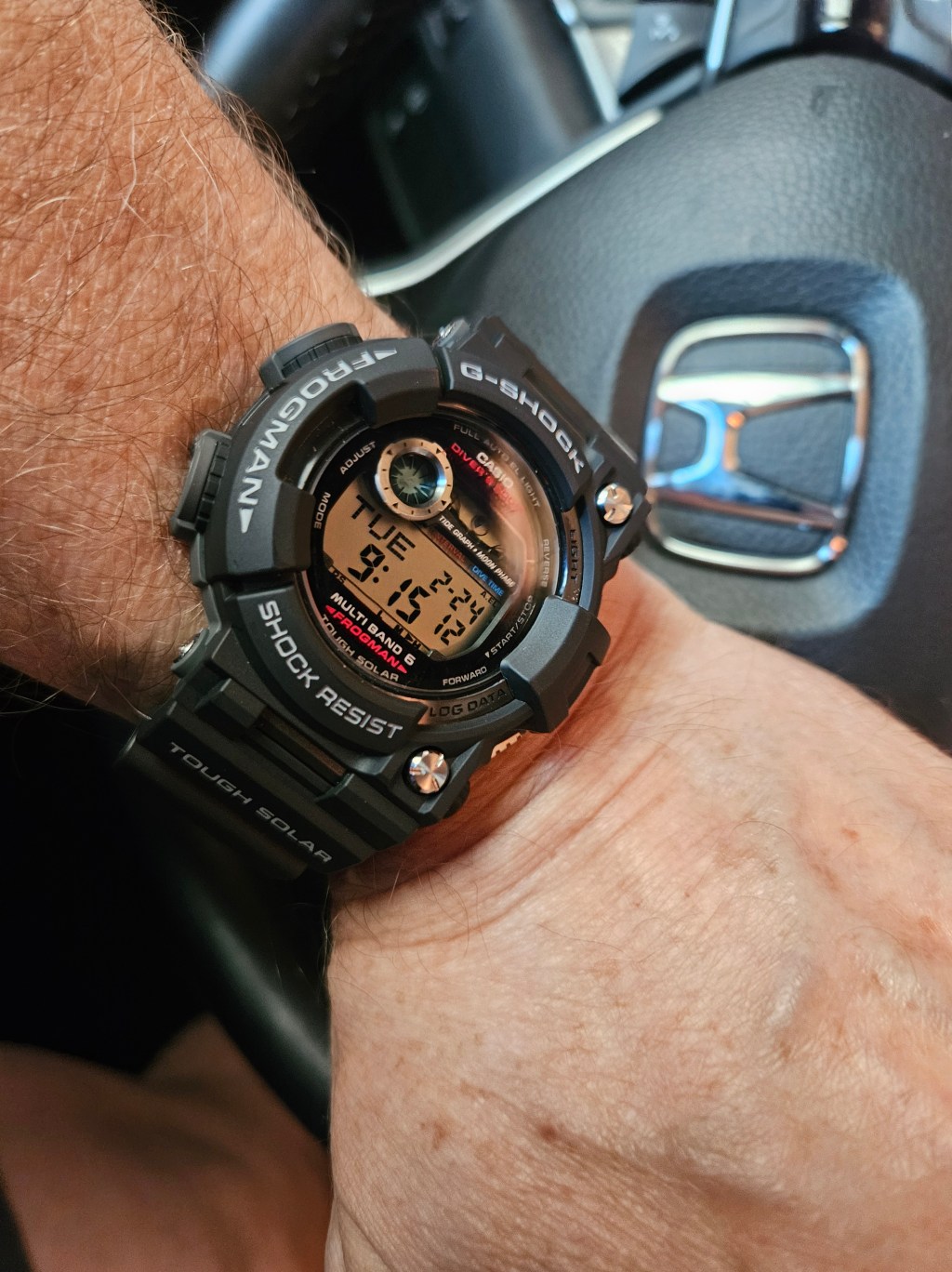
    But if the Stoic were compelled—by work, social expectation, or some bureaucratic indignity—to wear a watch, he would choose the Casio G-Shock GW-5000U without hesitation. It is austere, precise, and immune to vanity. Solar-powered, radio-synchronized, shockproof, and quietly overbuilt, it asks nothing and requires nothing. No winding. No setting. No polishing. No emotional relationship. It neither gains nor loses time, attention, or dignity. Most important, it attracts no interest from others. The Stoic does not want a watch that expresses his identity; he wants one that removes the subject entirely. The GW-5000U does what the Stoic tries to do himself: endure without complaint, perform without drama, and refuse the temptation to turn function into theater.

    This philosophy can be called Instrumental Minimalism: the discipline of choosing tools that perform their function completely while imposing zero psychological, aesthetic, or maintenance burden. A proper tool should disappear into the background of life. The moment an object asks to be admired, discussed, or emotionally managed, it has already failed its purpose. The Stoic does not wear a watch to feel something. He wears it so he can forget about it—and return his attention to the only instrument that matters: how he spends his time.

  • The Watch Ninja and The Great Deepening

    The Watch Ninja and The Great Deepening

    If you stay in the watch hobby long enough, you must accept a hard truth: your identity will betray you.

    One morning you wake up and the mechanical divers—the watches that once defined your taste, your discipline, your personality—feel distant. Cold. Decorative. In their place sits a small, efficient triumvirate of atomic, solar G-Shocks that refuse to leave your wrist.

    You feel guilty. Disloyal. Untethered. Who are you if the romance of gears and springs no longer moves you? What kind of man replaces craftsmanship with digital certainty?

    This is not a question for forums.

    This requires the Watch Ninja.

    The fee is $1,000. Nonrefundable. Trusted members of the community blindfold you and load you into an unmarked van, because enlightenment, like limited editions, requires exclusivity.

    When the blindfold comes off, you find yourself in the stone-walled basement of a respectable hotel. Above you, restaurant workers clatter through the dinner rush. Below, time slows.

    The Watch Ninja sits on a high stool.

    He wears a white chef’s jacket, a wide-brimmed cavalry Stetson pulled low, dark aviators, and a G-Shock Frogman. The hat’s high crown gives him the posture of authority; the brim throws his eyes into shadow. He does not occupy the room. He commands it.

    Then the realization lands.

    He looks exactly like Robert Duvall as Lt. Col. Kilgore in Apocalypse Now—a man who would order helicopters for the sound alone.

    You confess your crisis. The abandonment of mechanical divers. The seduction of atomic precision. The creeping sense that you have betrayed your former self.

    He listens, stroking his chin like a man evaluating air support.

    Then he speaks.

    “There is no such thing as a single conversion,” he says. “There are only conversions within conversions. Your life as a watch obsessive is not defined by loving watches. It is defined by the subconversions that follow.”

    He leans forward.

    “A man builds a collection of mechanical divers. He exhausts their enchantment. Then he pivots—to G-Shocks, to atomic time, to solar autonomy. This is not betrayal. This is the Great Deepening.”

    He lets the words settle.

    “You did not lose your passion. You accelerated it. When one category is worn out, the serious enthusiast expands. You are not unstable. You are evolving.”

    He pauses.

    “Do not mourn the divers. Become the Expanding Man.”

    You leave the basement changed. Lighter. Forgiven. Your G-Shocks no longer feel like a betrayal. They feel like destiny.

    The Watch Ninja has taught you the central doctrine of serious collecting: The Great Deepening.

    This is the phase when the easy pleasure of broad collecting gives way to excavation. “I like dive watches” becomes metallurgy analysis, bezel resistance debates, production-year archaeology, and solemn arguments about whether the 2018 lume possessed greater emotional warmth than the 2020 revision.

    And somewhere in that tunnel, many collectors encounter an unexpected chamber: G-Shocks.

    What once looked crude now reveals its own austere beauty—atomic accuracy, solar independence, tool-first design, the moral clarity of a watch that does its job without pretending to be art.

    To outsiders, the Great Deepening looks like fixation.

    To the enthusiast, it feels like refinement.

    In truth, it is the hobby’s survival instinct.

    When breadth stops thrilling, depth takes over. When one identity fades, another emerges. And if the process works as intended, there is always one more layer to study, one more doctrine to adopt, and one more watch that finally—this time—feels exactly right.

  • When the Search Stops: Life After the Frogman

    When the Search Stops: Life After the Frogman

    After I posted my video, I Am the Frogman, the comments came in like evangelists at a revival.

    “I have to buy one now.”
    “McMahon, welcome to G-Shock. This won’t be your last.”
    “Once you taste the G-Shock glory, you can’t go back.”

    Those voices were still echoing in my head this morning—Day Three of my Frogman conversion.

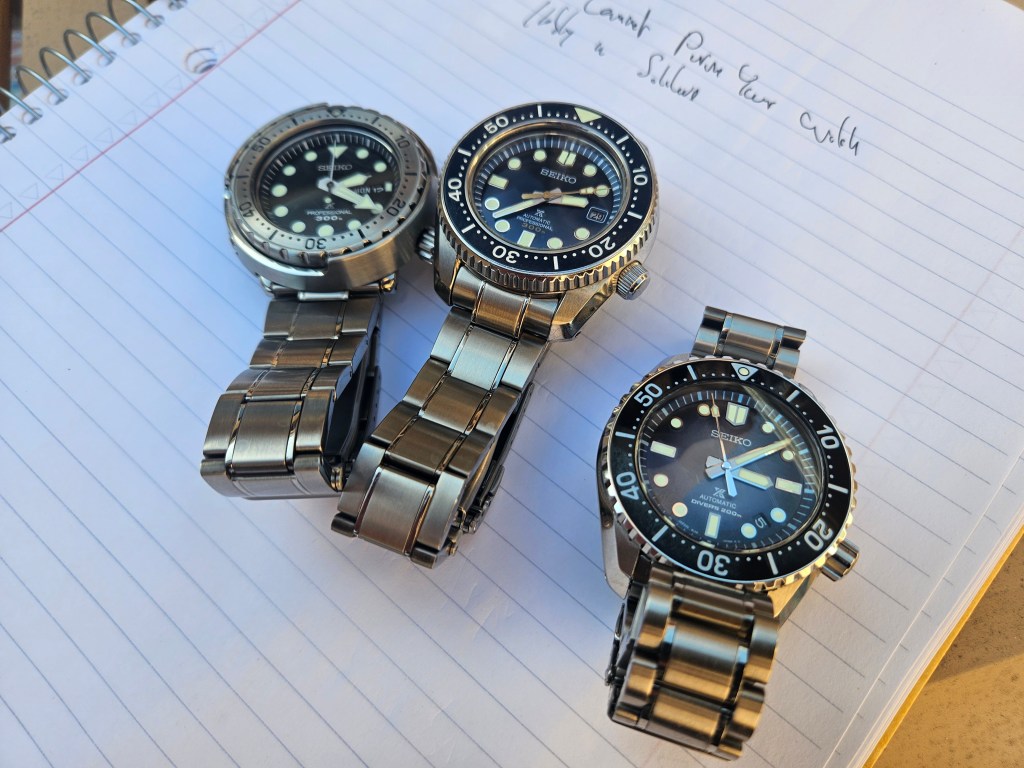
    I opened the watch box. Seven magnificent Seiko divers stared up at me, polished, dignified, loyal. I looked at the Frogman on my wrist.

    Swap?

    Not a chance.

    The Frogman stays.

    That moment clarified something uncomfortable: the true watch obsessive isn’t chasing watches. He’s chasing a bond. Not a collection—a connection. At the center of the hobby is a private hope: one day, a watch will quiet the search.

    It’s too early to declare the Frogman The One, but something has shifted inside me. The mental vibration has changed. The noise is down.

    Imagine this: a collector buys a watch that silences his cravings—not only for new pieces, but for the ones he already owns. The wishlists lose their gravity. The forums lose their pull. The late-night browsing sessions evaporate.

    In medical terms, GLP-1 drugs reduce “food noise” by recalibrating the brain’s reward system. The Frogman appears to do something similar.

    Atomic precision. Brutal legibility. Tool-watch authority.

    The brain looks at the wrist and says: Enough.

    I seem to be in a state of Horological Appetite Suppression—a condition in which one watch satisfies the reward circuitry so completely that desire goes quiet. No hunting. No fantasizing. No itch.

    Just calm.

    The analogy isn’t perfect. GLP-1 kills pleasure. The Frogman is pleasure. It’s lean protein and cheesecake at the same time—pure function wrapped in outrageous fun.

    Still, the result is the same.

    The noise is gone.

    Of course, my fellow obsessives issued a warning: maybe the Frogman hasn’t cured your watch addiction. Maybe it’s just moving you into Phase Two–G-Shock addiction. 

    So I surveyed the landscape.

    The GW-5000: perfect, but too polite.
    The red Frogman: dramatic, but too dramatic.
    The Poison Dart: spectacular—on a 22-year-old influencer.
    The Rangeman: impressive, but not my watch.
    Titanium Frogmen: beautiful, but dangerously redundant.
    Full-metal Square: disqualified—bracelet violation.

    After careful consideration, I arrived at a radical conclusion:

    One Frogman is enough.

    Now comes the unsettling question.

    If the search is over—if the appetite is quiet—what happens next?

    Seven mechanical divers sitting idle.
    Fewer reasons to buy.
    Possibly fewer stories to tell.

    Has the Frogman cured the madness?

    Or refined it?

    Because here’s the strange part: if this is insanity, it’s the best version I’ve ever had.

    Maybe no one escapes obsession. Maybe the real task is wardrobe selection—choosing the madness that hurts least.

    There is the madness of endless rotation, endless comparison, endless hunger.

    Or there is the madness of devotion.

    Between the two, I’ll take the one that lets me sleep.

    Because when I look down at the Frogman, it doesn’t whisper.

    It delivers a verdict.

    “I am the time,” it says.

    “Your search is over.”

  • The Sweet Tooth Age: How We Traded Depth for Dopamine

    The Sweet Tooth Age: How We Traded Depth for Dopamine

    In “The Orality Theory of Everything,” Derek Thompson makes a striking observation about human progress. One of civilization’s great turning points was the shift from orality to literacy. In oral cultures, knowledge traveled through speech, storytelling, and shared memory. Communication was social, flexible, and immediate. Literacy changed everything. Once ideas could be recorded, people could think alone, think slowly, and think deeply. Writing made possible the abstract systems—calculus, physics, modern biology, quantum mechanics—that underpin the technological world. The move from orality to literacy didn’t just change communication. It changed the human mind.

    Now the concern is that we may be drifting in the opposite direction.

    As social media expands, sustained reading declines. Attention fragments. Communication becomes faster, louder, and more performative. Thompson explored this shift in a conversation with Joe Weisenthal of the Odd Lots podcast, who draws heavily on the work of Walter Ong, the Jesuit scholar who wrote Orality and Literacy. Ong’s insight was simple but profound: when ideas are not recorded and preserved, people think differently. They rely on improvisation, memory shortcuts, and conversational instinct. But when ideas live in texts—books, essays, archives—people develop interiority: the capacity for reflection, precision, and layered analysis.

    It would be too simple to say we now live in a post-literate society. We still read. We still write. But the cognitive environment has changed. Our brains increasingly gravitate toward information that is fast, simplified, and emotionally stimulating. The habits required for what Cal Newport calls “deep work” now feel unnatural, even burdensome.

    A useful analogy is food. Literacy is like preparing a slow, nutritious meal. It requires time, effort, and attention, but the nourishment is real and lasting. The current media environment offers something else entirely: intellectual candy. Quick hits. Bright packaging. Strong flavor. Minimal substance. We have entered what might be called the Sweet Tooth Age—a culture that prefers pre-digested, entertaining fragments of ideas over sustained, solitary engagement. The concepts may sound serious, but they arrive in baby-food form: softened, sweetened, and stripped of complexity.

    After forty years of teaching college writing, I’ve watched this shift unfold in real time. In the past six years especially, many instructors have adjusted their expectations. Reading loads have shrunk. Full books are assigned less often. In an effort to get authentic, non-AI responses, more teachers rely on in-class writing. Some have abandoned homework entirely and grade only what students produce under supervision.

    This strategy has practical advantages. It guarantees original work. It keeps students accountable. But it also reflects a quiet surrender to the Sweet Tooth Age. The modern workplace—the environment our students are entering—runs on the same quick-cycle attention economy. Their exposure to slow thinking may be brief and largely confined to the classroom. When they transition to their careers, they may find that on-demand writing is no longer required or relevant. 

    Not just education but politics and culture are being swept by this new age of dopamine cravings. The Sweet Tooth Age carries a cost, and the bill will come due.

    The content that wins in the attention economy is not the most accurate or thoughtful. It is the most stimulating. It is colorful, simplified, emotionally charged, and designed to produce a quick surge of interest—what the brain experiences as a dopamine reward. But reacting to stimulation is not the same as thinking. Performance is not analysis.

    Performance, in fact, is the preferred tool of the demagogue.

    When audiences lose the habit of slow reading and critical evaluation, they become vulnerable to what might be called Kayfabe personalities—figures who are larger than life, theatrical, and emotionally compelling, but who operate more like entertainers than honest brokers. The message matters less than the performance. Complexity disappears. Nuance becomes weakness. Certainty, outrage, and spectacle take center stage.

    In such an environment, critical thinking doesn’t merely decline. It becomes a competitive disadvantage.

    This is why the Sweet Tooth Age is more than an educational concern. It is a political and cultural risk. A public trained to consume stimulation rather than evaluate evidence becomes easy to mobilize and difficult to inform. Emotion outruns judgment. Identity replaces analysis. The center—built on patience, evidence, and compromise—struggles to hold.

    When literacy weakens, the consequences do not remain confined to the classroom.

    They spread outward—into public discourse, institutional trust, and civic stability. The shift back toward orality is not simply a change in media habits. It is a shift toward immediacy over reflection, reaction over reasoning, spectacle over substance.

    And when a culture begins to prefer performance to thought, chaos is not an accident.

    It is the logical outcome.