Category: religion

  • The Demon Named Part X

    The Demon Named Part X

    To show my students the power of negative thinking, I tell them how I lost my first girlfriend. Convinced she was dissatisfied, I kept asking every ten minutes, “You’re leaving me, aren’t you?” or “Are you leaving me?” After three days of this, she finally did. My paranoia became prophecy, and I smugly congratulated myself: “Nothing gets past me!”

    In Lessons for Living, therapist Phil Stutz explains how negative thinking snowballs into catastrophe, giving paranoia the illusion of truth. This is the self-fulfilling prophecy, the negative feedback loop. “Your mind is broken,” he writes. “If you bought an appliance that worked this poorly you would be at the store demanding a refund. But there is no return policy for your brain.”

    Repair, Stutz insists, begins by naming your adversary: a virus lodged in your psyche he calls Part X. This “inner demon,” he writes, “is part of your psyche, and it has an agenda all its own.” Its goal is to stop you from living in reality, to trap you in stillness, fixation, and spiritual death. The universe is always in motion; Part X hates that. It wants stagnation, dullness, nihilism.

    Here lies the trap: nihilism flatters you into thinking you’re special—outside the flux of life, aloof from change. You cling to helplessness, self-pity, resentment. The deeper you sink, the more Part X convinces you that your paralysis proves your uniqueness. You become skilled in negative thinking until, as Stutz puts it, “You no longer respond to the world, you merely react to what X tells you about the world. Spiritually blinded, you are totally alone.”

    How to break free? Gratitude. “You must find a force in your soul that is even stronger than the power of negative thinking. The force is gratefulness.” Gratitude anchors you in reality; it cuts through the fever swamp of negativity. Addicts illustrate the opposite: whether it’s cocaine, alcohol, or endless Internet porn, their obsession isolates them from the universe and community. Addiction is the triumph of Part X. Negative thinking itself is a kind of addiction.

    The antidote is connection—to reality, to others, to the larger universe. Gratitude means humility: admitting you’re not an island. Unlike “positive thinking,” which projects fantasies into the future, gratitude keeps you rooted in the present. Stutz urges immediacy: “Try this. For about thirty seconds, think of things for which you’re grateful. Not just the big things; focus on everyday things we often take for granted.”

    I’m grateful for organic coffee beans, for my morning ritual of brewing coffee beside my radio tuned to classical music. I’m grateful I can digest my buckwheat groats and protein powder before my hour-long kettlebell workout, then shower, shave with fragrant cream, eat a clean lunch, and nap before “Part 2” of my day. These are not small things. They are the fabric of a life.

    The more gratitude you practice, the stronger your defenses against Part X. Gratitude trains your mind into motion, aligned with the universe’s own flux. Stutz even calls it prayer: “Independent of your personal spiritual beliefs and practices, you have led the mind beyond itself, making it a bridge into a higher place.”

    Here Stutz blends psychology with the language of religion—gratitude, humility, prayer, liberation from Jonah-like isolation inside the belly of the Leviathan. His message: escape the solitary prison of negative thought by opening yourself to a reality larger than you.

    I write about Stutz with ambivalence. His wisdom feels real, his tools practical. Yet part of me suspects a New Age sleight of hand: a watered-down religion that borrows sin (Part X), prayer, and humility while dodging the harsher demands of faith—judgment, accountability, sacrifice. Is his system merely the good parts of religion without the bite? Or am I letting my own negative thinking sneak in through the back door, looking for reasons to resist his wisdom?

  • From Dopamine to Divinity: The Case for Transmutational Motivation

    From Dopamine to Divinity: The Case for Transmutational Motivation

    In Lessons for Living, Phil Stutz recounts his refusal to prescribe Prozac to a patient. The patient wanted the pill as he wanted everything else—romance, fame, applause, alcohol: all shortcuts to happiness. Stutz wasn’t buying it. He writes:

    “Believing that things outside you will make you happy is a false hope. The Greeks considered it the ‘doubtful gift from the gods.’ In reality, there can only be two outcomes. Either the hoped-for thing does not happen, or it does and its effect quickly wears off. Either way, you are worse off than before because you have trained yourself to fixate on outer results.”

    When the outer world filters through imagination, it becomes a chimera. We don’t pursue things for what they are, but for what we fantasize they’ll be. I feel this pull myself: I’m nearly sixty-four, inching toward retirement, and browsing real estate in Orlando—dreaming of a second life in a faux-tropical paradise. A $600K “mansion” with a community pool, an hour from the beach, safe from hurricanes (mostly). Yet what I imagine as paradise may in fact be a barcalounger-sized sarcophagus—3,000 square feet of embalmed leisure.

    Stutz warns against such chimeras. They must be replaced by action—behavior that connects us to our true nature: the spiritual self. He writes:

    “We are spiritual beings and can be emotionally healthy only when we are in touch with a higher world. We need higher forces just as we need air. This is not an abstract philosophy, it is a description of our nature.”

    But here’s the rub: staying in touch with higher forces requires constant work, and it’s in our nature to avoid work. Life, then, is a perpetual battle with ourselves. Stutz’s description amounts to the purpose of religion: the angel conquering the demon. Yet in our therapeutic age—where religion is dismissed as a fairy tale—misalignment between spiritual thirst and materialist fixation manifests as depression. Conventional psychiatry treats depression with drugs. Stutz reframes it as a teacher, a reminder that the answer is spiritual life:

    “This awareness is the first step in overcoming depression.”

    His point calls to mind Katie Herzog’s mention of Laura Delano’s memoir Unshrunk, a story of misdiagnosis and drug therapy that deepened rather than cured suffering. It also echoes Philip Rieff’s famous distinction in The Triumph of the Therapeutic:

    “Religious man was born to be saved; psychological man is born to be pleased.”

    Stutz insists that pleasing ourselves with material trinkets is a false and destructive path. Real responsibility means behaving in ways that connect us with our spiritual core. Judaism frames this as God meeting us halfway; Pauline Christianity insists we are helpless, depraved, and must be remade entirely. I’d be curious to know where Stutz lands on this divide.

    Either way, his therapy unsettles his patients. A man clinging to Prozac, money, and fame stares at Stutz as though he’s lost his mind. Why? Because society has brainwashed us into believing happiness comes from external outcomes.

    So what’s the alternative? Relentless self-monitoring. Stutz writes:

    “Taking responsibility for how you feel isn’t an intellectual decision. It requires monitoring yourself every moment. This is the most freeing thing a person can do, but also the most tedious. Your connection to the higher world must be won in a series of small moments. Each time you become demoralized, depressed, or inert, you must counteract it right then.”

    This isn’t entirely secular advice. Proverbs tells us to hang wisdom notes around our necks. Today, that might be post-its urging us to choose virtue over distraction. Still, Paul’s lament in Romans—that his darker nature sabotages his noblest intentions—remains apt. If Paul were not a Christian convert, would he be able to successfully use Stutz’s tools to connect with his Higher Powers, or would his dark side undermine the mission over and over? 

    Stutz’s counsel is pragmatic: notice when you sever your connection to the higher world, and fight back. If I’m meant to write or practice piano but instead scroll the Internet’s dopamine-drenched rabbit holes, that’s the moment to act. As Stutz puts it:

    “If your habit is to look outside yourself for stimulation or validation, then each time you fail to get it, you’ll become depressed. But if you assume inner responsibility for your own mood and take action to connect yourself to higher forces at the moment you feel yourself going deep into a hole, you will develop habits that put you on a new level of energy and aliveness.”

    In darkness, we don’t have to surrender. The “inner tools” give us armor. Stutz writes:

    “The only way to achieve this confidence is to take a tool and actually experience how it works. Only then will you be willing to do what is required, which is to use it over and over, sometimes many times within one day.”

    One such tool is “transmutational motivation.” The exercise: picture yourself demoralized after indulging temptation. Then imagine a higher power above you. Visualize yourself taking forward motion—meditation, writing, exercise—and rising into “the jet stream.” Stutz writes:

    “Now you are going to fly straight up into this picture by feeling yourself take action and imagining this feeling causes you to ascend. Tell yourself that nothing else matters except taking the action. As you feel yourself rise, sense the world around you falls away. There is nothing except the action itself. Rise high enough to enter the picture. Once inside, tell yourself that you have a purpose. You will feel a powerful energy. To end the exercise, open your eyes and tell yourself that you are determined to take the pictured action. This time you will feel the picture above you pull you effortlessly up into itself. You will feel expanded and energized.”

    With practice, the ritual takes fifteen seconds. Done daily, it rewires despair into life force.

    But is this just Part X renamed? Steven Pressfield’s Resistance? Pauline sin? Or all of the above? Does Christianity accuse Stutz of diluting prayer into self-help? Do secularists argue his method is religion without the dogma? The questions multiply.

    Anna Lembke’s Dopamine Nation frames it as neuroscience. Charles Duhigg’s The Power of Habit frames it as cognitive-behavioral reprogramming. Stutz straddles both: science and soul. And looming above it all is the Internet—the Great Temptor of our age. A bottomless pit of pornography, consumerism, and status-chasing, piped directly into our dopamine circuits.

    And here’s the meta-question: what’s the point of rewiring your habits without a greater frame of meaning? Is Stutz peddling spirituality without religion—or is he smuggling in a stripped-down religion we secretly crave? Would Sam Harris nod approvingly at this secularized toolkit? Or would Dale Allison, the careful Christian scholar, recoil and insist that while Stutz offers clever strategies for habit change, he misses the essence of true spirituality—the self-giving sacrifice patterned after Christ in Philippians?

    Unanswered questions aside, Stutz’s message is stark: life is high-stakes. We are fighting, every day, between dark and light forces. We don’t just change habits to “optimize” our brains. We change them to keep our souls alive.

  • Stepford Dreams and Other Diseases

    Stepford Dreams and Other Diseases

    “Our culture denies the nature of reality,” therapist Phil Stutz declares in one of his chapters from Lessons for Living. In denial, we drift through a fantasy world—a frictionless utopia where everything turns out perfectly with minimal effort, unpleasantness is airbrushed away, and immediate gratification flows like tap water. If you fail to thrive in this Instagram-ready Eden, well, clearly it’s your fault.

    Reading Stutz’s dissection of this mythical paradise—one that entitlement and cleverness supposedly guarantee—I’m reminded of family vacations to Hawaii. The trip’s curated perfection feels ripped straight from pop culture’s catalog of false realities. I start imagining myself as a minor Polynesian god, which makes returning home to laundry, bills, and chores feel like divine demotion.

    Stutz’s mission is to break our addiction to the idea that life is a permanent Hawaiian vacation. His blunt truth: life is pain and adversity, the future is uncertain, real accomplishments require sweat and discipline, and—brace yourself—you are not special enough to escape these rules. These principles don’t expire.

    This is not, Stutz insists, a gospel of misery. Love, joy, surprise, transcendence, and creativity are woven into life’s fabric—but so are conflict, loss, and uncertainty.

    Why, then, do we cling to the fantasy? In part, because the media keeps showing us people who appear to have escaped reality’s terms. Movie stars and influencers are lit like Renaissance portraits, perfectly curated, radiating supreme happiness. Their romances are operatic, their sex lives cinematic. They seem universally adored and gracious enough to share the “secrets” of their bliss. They look as if they’ve broken free of pain, adversity, and doubt—and they promise we can do the same if we just buy the right products and mimic their lifestyle.

    It doesn’t matter where you sit in the social pecking order; the fantasy assures you can ascend to the influencer’s Olympus.

    This is a mass delusion. Stutz writes, “When everyone acts as if a fantasy is real, it begins to seem real.” But for you, it never arrives. Your bank account wheezes. Your waistline ignores your best intentions. Your body refuses to flatter you. Your parenting is a gamble at best. Your life often feels like it’s running you.

    Because you believe in the fantasy, you think you’re defective. You look in the mirror and mutter, “Loser.”

    That’s the invoice for believing in perfection: when it inevitably collapses, you’re left with self-loathing. Stutz warns, “The problem is that the other group has become the standard, and self-esteem starts to depend on being like them. An adverse event feels like something is happening that is not supposed to be happening. The natural experiences of living make you feel like a failure.”

    His solution? Total reorientation. Replace the static images of perfection—what I call “Magical Moments Frozen in Time”—with the truth: life is a messy, moving process. Stutz explains: “The ideal world with the superior people is like a snapshot or a postcard. A moment frozen in time that never existed. But real life is a process; it has movement and depth. The realm of illusion is an image, dead and superficial. Still, these images are tempting. There is no mess in them.”

    If media has brainwashed us into aspiring to be perfect Stepford spouses, how do we reject these static ideals and embrace life in its raw, dynamic, and inconvenient fullness? Stutz says we must accept this: “Life is made up of events. The only real way to accept life is to accept the events that comprise it. And the flow of events never stops. The driving force of the universe reveals itself via the events of our lives.”

    This flow connects us to life’s energy, making us fully alive. The downside? It leaves us feeling small, exposed, and out of control. The false paradise promises to free us from that vulnerability, but in doing so, it severs our connection to life’s current and leaves us in “spiritual death.”

    Mental health, Stutz argues, depends on accepting this unstoppable flow of events. He compares it to good parenting: “It is not good enough to just show up. You need a point of view and a set of tools. It is impossible to deal with events constructively without being prepared.” If you’re clinging to Magical Moments Frozen in Time, you’re unprepared when reality slaps you.

    The preparation, he says, is a philosophy—one that lets you redefine negative events. Stutz writes, “Preparing yourself with a philosophy enables you to change the meaning of a negative event. With a specific philosophy, you can aggressively change your perception of events.” That philosophy rests on three pillars:

    • Adverse events are supposed to happen; they don’t mean you’re broken.
    • Every negative event is a growth opportunity.
    • Spiritual strength matters more than positive outcomes.

    When you accept life as a series of crises, you stop throwing toddler-level tantrums every time something goes wrong. People addicted to Magical Moments tend to overreact to challenges—often making their reaction worse than the original problem.

    Reading this, I recall when my wife and I had twins fifteen years ago. She handled meltdowns with calm; I met a child’s tantrum with one of my own. A therapist told me, “When you get angry, you go zero to ten in under a second, and your body chemistry changes in a way that fills the room with toxic energy. That escalates your children’s tantrums. Your wife, on the other hand, stays calm. She has a calming effect on the twins. You need to learn how to calm down in a crisis.”

    Stutz is right. Being a spiritual person means maturing as a parent. Being a devotee of Magical Moments Frozen in Time means being a spoiled child yourself—an extra in Idiocracy. A society enthralled by fake perfection can’t sustain itself; it’s destined for regression, chaos, and entropy.

  • The Warm Bath and the Higher Forces

    The Warm Bath and the Higher Forces

    Therapist Phil Stutz, in Lessons for Living: What Only Adversity Can Teach You, identifies the most insidious adversity we face daily: the lure of immediate gratification. This dopamine-charged, compulsive, addictive pull consigns us, he says, to “the lower channel,” the “Warm Bath,” the comfort zone. Its source is the inner saboteur he calls Part X.

    In Steven Pressfield’s The War of Art, the same force appears as “The Resistance,” the invisible enemy that diverts us from lives of creativity and meaning. Sometimes it takes the form of “unwholesome activities”—scouring the internet for smut or indulging in materialistic temptations that pull us away from hard work. Cal Newport warns that when we return from such addictive detours, our brains are still coated in “lower channel” residue—mental detritus that dulls our clarity and compromises our work.

    Confronting Part X—or the Resistance—is not a one-time victory. We never ascend to a nirvana where the demon vanishes; it is always nearby, waiting for an opening.

    Rejecting the endless circuit of traditional talk therapy, Stutz arms his patients with Tools—practical methods to counter the bad habits born of Part X. His patients are often “either trapped in a past that no longer existed or living in fantasy about a future that hadn’t arrived yet—and might never.” The Tools, he says, “open the door to the infinite wisdom of the present.”

    His therapy hinges on three elements:

    1. Homework—daily exercises outside of sessions.
    2. Forward Motion—steps away from the past and repetitive stagnation toward a new life.
    3. Connection to Higher Forces—a necessary change, not an optional one, to avoid the self-destruction that leads to death.

    “We are only a tiny part of an infinite universe,” he writes. “On our own we can do nothing. But, in a silent miracle, the universe puts its energies at the service of human evolution.” Higher Forces help us escape personal hell and learned helplessness. When his patients connect with them, they find hope and the power to change—here, in the present.

    Before going further, I have to pause and unpack this. First, I believe Stutz’s framework offers a real way out of the wide path to self-destruction and onto the narrow path of meaning. Second, I can’t help but think of Christianity, Judaism, and A.A.

    In Christianity, especially Pauline theology, we are compulsive creatures, helpless before our sinful drives. Only surrendering to Higher Powers—in this case, the cosmic Christ—can break our demonic impulses. Paul spells this out in the Epistle to the Romans.

    Judaism, at least as Rabbi Hyam Maccoby describes it in The Mythmaker: Paul and the Invention of Christianity, rejects this helplessness. We do have self-agency. When we cry to God for rescue from our self-destruction and abasement, He meets us halfway—we move toward Him, and He moves toward us.

    In A.A., the principle is stripped to its core. Comedian Marc Maron has spoken about his recovery from substance abuse: every day, he got on his knees and told a Higher Power he could not free himself from addiction alone.

    Across these three traditions, I see more similarities than differences. I’m confident that anyone who sincerely applies these principles will improve.

    But here’s the sticking point: belief in a Higher Power without religious baggage is not the same as belief in a specific deity. The Jewish God—open to debate, vague about the afterlife—is quite different from the Christian God who, under Pauline influence, recasts Judaism into a universal religion for gentiles, condemns Jews as cut off from the vine, and adopts Augustine’s stark vision of eternal paradise or eternal damnation.

    Three notions of deity—each with profound implications.

    As an addict and an agnostic, I wonder: am I letting these theological questions distract me from the urgent need to connect with Higher Powers so I can face my own demons? This question burns in me. Will these Higher Powers help me navigate my dense jungle of doubts? Will they help me find clarity?

    Stutz notes that many of his patients backslide. Why? Because they stop using the Tools. Why stop? Complacency. Or disbelief in the stakes.

    Which brings me to the core of my own struggle: faith in a doctrinal God versus a personal God without doctrine. The doctrinal God comes with teachings—eternal perdition, the Virgin Birth, a literal resurrection—that can be difficult to swallow. For a fuller exploration of the problems with doctrine, see Elizabeth Anderson’s essay “If God Is Dead, Is Everything Permitted?”

    The personal God without doctrine might be more palatable, but perhaps lacks the high-stakes edge that some people need to stay committed to their daily battle with Part X, the Resistance, or whatever name we give this destructive force.

    So what’s the path forward? Should I call life a nihilistic joke and live recklessly? Certainly not. Even with my doubts, I must press ahead, use the Tools, and seek communion with Higher Powers. I can only hope such a life will yield answers—and remind myself that giving in to immediate gratification only strengthens the lower channel, leading, inevitably, toward darkness, confusion, and death.

  • Trees Bent by the Wind

    Trees Bent by the Wind

    In An Abbreviated Life, Ariel Leve recounts the shadow her mother cast across her existence—a narcissistic, volatile presence who trailed her daughter across continents. Her mother blurred boundaries, confiding adult affairs, romantic escapades, and private fantasies to her child, then lacing those disclosures with guilt trips and psychological sabotage.

    At eleven, Ariel was told she was going blind—a lie without evidence, a mix of cruelty and madness. This was not an isolated cruelty but the common cadence of her mother’s speech. At six, Ariel’s caretaker, Kiki, died of a stroke mid-flight, with Ariel in the cabin. Ariel stopped speaking for six months; a psychiatrist prescribed Valium.

    Her mother, often wearing a nightgown even to school functions, could deliver barbed declarations without breaking her routine. “When I’m dead, you’ll be all alone because your father doesn’t want you,” she told her young daughter, pausing only to reapply makeup. “Just remember that and treat me nicely.”

    Her father, in Bangkok, refused to take her in. Ariel lived in grief that he wouldn’t rescue her from the chaos. Decades later, a therapist told her that growing up with such a mother caused neurological damage—her brain, shaped by constant stress, had developed like a tree twisted by relentless wind. Trauma was not a lightning strike; it was climate. The result: a life stripped of adventure, self-acceptance, and trust. Ariel’s default mode became hypervigilance and retreat.

    Her partner, Mario, an Italian with no literary ambitions, no awareness of New York publishing, and no taste for bagels, embodies the opposite—balanced, unselfconscious, open to life. He steadies her, if only temporarily.

    In one conversation, her father asked if she could let go of the past. Could she destroy her demons? Ariel was unsure. A novelist told her discipline could harden one’s “emotional arteries,” making childhood wounds less decisive. Ariel countered: some are “front-loaded with trauma,” not victims but soldiers—scarred, but still standing.

    Neuroscientist Martin Teicher affirmed her point: childhood abuse alters brain wiring. Adaptive coping mechanisms in childhood turn maladaptive in adulthood, creating an adult mismatched to their world. The traumatized blunt emotion not with a scalpel, but a sledgehammer—shielding themselves from joy as well as pain.

    For Ariel, this explains a life “within brackets.” She sees herself in the patterns Janet Woititz described in Adult Children of Alcoholics: mistrust, emotional volatility, self-loathing, and a skewed sense of normalcy.

    Her chosen remedy: EMDR therapy for PTSD. Nine months of “the light saber”—eyes tracking a green light, headphones delivering sound, memories replayed until they lose their grip. Sessions leave her exhausted. There is progress, measured in patience with Mario’s daughters, in small openings toward joy. But she does not present herself as cured—only as a permanent convalescent.

    Her memoir probes the ethics of trauma. How accountable are the wounded for maladaptive behavior? Can faith or philosophy save them, or does failure deepen self-blame? Are they sinners, soldiers, or something in between?

    Leve’s life raises a tension between two extremes: the nihilist’s surrender—“nothing can be done, so I’ll live recklessly”—and the motivational credo—“discipline and positivity conquer all.” The truth lies somewhere in the messy middle.

  • The French Toast Zone and Other Dangerous Places

    The French Toast Zone and Other Dangerous Places

    Recently, I watched the new King of the Hill, where the gang has aged into the gentle patina of later life. In one scene, Hank, Peggy, and Bobby are seated at the kitchen table, devouring what looked like French toast or chocolate chip pancakes—something golden, sweet, and unapologetically bad for you. It was an ordinary family breakfast, the kind you imagine smelling from three houses away. Watching it felt like slipping into a warm bath of contentment. These were normal people, enjoying themselves, at ease in the sacred space I call the French Toast Zone.

    The French Toast Zone is the place where life is easy, breakfast is decadent, and you’re at peace with your waistline, your arteries, and your eventual mortality. But step into the biomarker minefield—calories counted, protein ratios calibrated, insulin spikes plotted like military campaigns—and you’re in the Restriction Zone. The mood shifts. Every bite is an act of negotiation with your cholesterol, your bathroom scale, and the grim actuarial math of your lifespan.

    Real life, of course, is not an all-inclusive stay in either zone. Most of us shuttle back and forth—half saint, half sinner—forever bargaining between the delights of German chocolate cake and the promise of three extra years of foggy-eyed longevity. Too much denial, and you die having lived as a monk in a bakery you never entered. Too much indulgence, and you’re trapped on the hedonic treadmill, sprinting after pleasures that get smaller the closer you get.

    Some people manage this dance effortlessly. They live in homeostasis, exercising moderation as naturally as breathing. I have never been one of these blessed creatures. As a teenage bodybuilder who saw biceps as salvation from low self-esteem, I learned early that moderation was for other people. My internal wiring is a one-way circuit from obsession to burnout and back again. I am, in short, Extreme Man.

    Extreme Man has his own archetype—a tragic, sweaty figure charging at his chosen folly until he mutates into something grotesque. Then comes the epiphany, the Damascus jolt that scrambles his molecules and sends him hurtling into a new life mission. It could be religion, music, bodybuilding, stamp collecting—doesn’t matter. Once the lightning strikes, moderation becomes an obscenity. He must convert the world.

    When I was a teenage Olympic weightlifter, I preached squats with the fervor of a street-corner prophet, convinced proper form could change lives. My audience—bewildered, politely nodding—failed to share my revelation. Some Extremes get written off as harmless cranks. Others, gifted with charisma, build religions followed by millions.

    The homeostatic types are often immune to these evangelists. They are already content. But for those of us who never knew balance, the siren call of radical change is intoxicating. We cling to the hope that the right transformation will lift us out of our malaise.

    Neither camp is wholly admirable. The balanced can model moderation—or smug mediocrity. The Extremes can inspire reinvention—or display unhinged egotism. The truth is in the messy middle, where both tendencies collide, and if you’re lucky, you learn from both without being consumed by either.

  • This Is the Life You Have Chosen

    This Is the Life You Have Chosen

    I’ve never forgotten a story one of my college students told me back in the fall of 1998. She was a re-entry student—a nurse in her early forties—juggling coursework at UCLA with overnight hospital shifts. The kind of woman who sticks in your memory: short, sturdy, glasses perched low on her nose, with the weary, perceptive eyes of someone who’d seen too much and lips that knew how to pace a punchline.

    Most afternoons, after class let out, she’d linger by my desk and recount episodes from her Louisiana backwoods childhood or from the fluorescent netherworld of her hospital’s VIP wing. Her stories ricocheted between absurdity and horror—tales told with the calm authority of someone who could handle arterial spray with one hand and chart notes with the other.

    But one story gripped me by the spine and never let go. It wasn’t about dying celebrities or ER gore. It was about something far worse. A visitation. A monster.

    She and her cousin Carmen were feral children, raised in the lawless heat of rural Louisiana, where school attendance was optional and adult supervision was more myth than fact. Left to their own devices, the two girls invented what she called “mean games”—they tortured frogs, pulled wings off insects, and hinted at darker cruelties she refused to name. Lord of the Flies in sundresses.

    And then one afternoon, the visitor arrived.

    They were holed up in a decaying house, conspiring over their next cruelty, when the porch door creaked open and something stepped inside. It looked like a man. But it wasn’t. It had a tail—thick, muscled, and disturbingly animate. It moved with a will of its own, curling and flicking behind him like a fleshy metronome. His body was bristled with wiry hair. His voice? Low, hoarse, and calm in the most terrifying way. He didn’t threaten. He simply listed.

    Sitting in a rocking chair, the creature described, in brutal detail, everything the girls had done—every frog mutilated, every insect dissected. Nothing vague. He named the acts like he had them on file. And then he made his offer: Keep going, he said, and I’ll recruit you.

    He stayed for three hours. Just sat there. Breathing. Flicking that tail. Describing their path toward damnation with the steady tone of a bureaucrat explaining retirement benefits. When he finally left, dissolving into the heat shimmer of the Louisiana dusk, the girls were too stunned to move. Carmen whispered, “Did you see that?” My student just nodded.

    They never spoke of it again. But they changed. Overnight. Sunday school. Prayer. Kindness, enforced not by conscience but by fear. The kind that settles in your bones and never leaves. Whatever that thing was, it did its job.

    And this is the part that haunts me: she wasn’t a kook. She wasn’t mystical, manic, or given to exaggeration. She was a nurse—clear-eyed, grounded, more familiar with death than most people are with taxes. She wasn’t telling a ghost story. She was giving a deposition.

    To this day, I see those two girls, wide-eyed and paralyzed, staring down a thing that knew them intimately and promised them a future in hell’s apprenticeship program. Whether it was a demon, a shared psychotic break, or some mythological construct formed by childhood guilt and Southern humidity, I don’t know. But I do know what it meant.

    The creature’s message was brutal in its simplicity: Keep practicing cruelty, and you’ll lose the ability to stop. You’ll become it.

    That’s not just folklore. That’s biblical. The idea that if you repeat your wickedness long enough, God—or whatever you believe in—stops interrupting you. He doesn’t smite you. He simply steps aside and says, Go ahead. This is the life you’ve chosen.

    No wonder Kierkegaard was obsessed with working out your salvation with fear and trembling. There’s nothing more terrifying than the idea that damnation is self-inflicted, not by a thunderbolt, but by repetition. That the road to hell is paved with muscle memory.

  • Kierkegaard in a Gold’s Gym Tank Top

    Kierkegaard in a Gold’s Gym Tank Top

    During my junior year of high school, I spent a weeknight cruising East Fourteenth—the gritty artery that runs through San Leandro and Hayward—until one in the morning. I was in the passenger seat of Martino’s tomato red Ranchero, the two of us flexing imaginary muscles and real teenage bravado. Martino was my bodybuilding partner, my brother-in-biceps, and together we patrolled the boulevard like suburban centurions on a mission to kill time. And we succeeded.

    When I finally crept back into my house under the cover of darkness, I wasn’t met by a parent’s scolding. No raised voices. No lectures. Just a deafening moral hangover. A private throb of guilt that came from inside—the inner thermostat dialed to “waste detected.”

    That night, the dissonance hit me hard: I had thrown away hours of my finite life, not with rebellion or passion, but with asphalt apathy. 

    Some people never feel that throb. For them, life is a sandbox without rules. Morality is performative, calculated just enough to avoid arrest or awkward silences. These are the functional nihilists—those for whom nothing is sacred, so nothing is squandered. There are no stakes, no salvation, no damnation. No trembling because there’s nothing to tremble about.

    But Kierkegaard wouldn’t have cruised East Fourteenth. He’d have stayed home, in existential dread, kneeling before the void, trying to work out his salvation with fear and trembling. Not a metaphor. A mandate. A gun-to-the-temple kind of urgency.

    And that gun? I’ve felt it every morning. Not the literal kind, but a cold steel thought pressing behind the eyes: Work or be worthless. Create or decay. Hustle or rot. I didn’t coast through college because I loved knowledge. I ground through it because I feared poverty, failure, and the humiliation of becoming a soft tomato with four toothpicks sticking out—Kierkegaard in a Gold’s Gym tank top.

    Fear built my body. But can fear build a soul?

    That’s the hard part, isn’t it? Muscles are visible. Measurable. The soul, by contrast, is a ghost that flinches from mirrors. What makes a good soul? Is it, as philosopher Elizabeth Anderson suggests, acts of reciprocal kindness—a kind of moral evolution, godless but decent? Or do we still need to shake in our boots, to feel that Kierkegaardian quake that says tend to the soul or become monstrous?

    Then there’s modern self-care, the secular sacrament of our time. Meditation, hydration, positive affirmations—pampering routines dressed up as spiritual growth. But is self-care just aromatherapy for the abyss? What if the soul needs something harder than scented candles?

    And what of the artist, the compulsive maker? Is the act of creating a form of salvation—or just another idol, a beautiful golden calf carved in your own image?

    Forgive me. I’m in my sixties now. The questions don’t resolve; they just echo louder. I know indulgence makes me miserable and discipline brings fleeting peace. But that’s not the kind of salvation Kierkegaard meant. That’s just emotional maintenance.

    So I remain agnostic, trembling not from conviction, but from having more questions than answers. 

  • Memoirs of a Tanned Narcissist

    Memoirs of a Tanned Narcissist

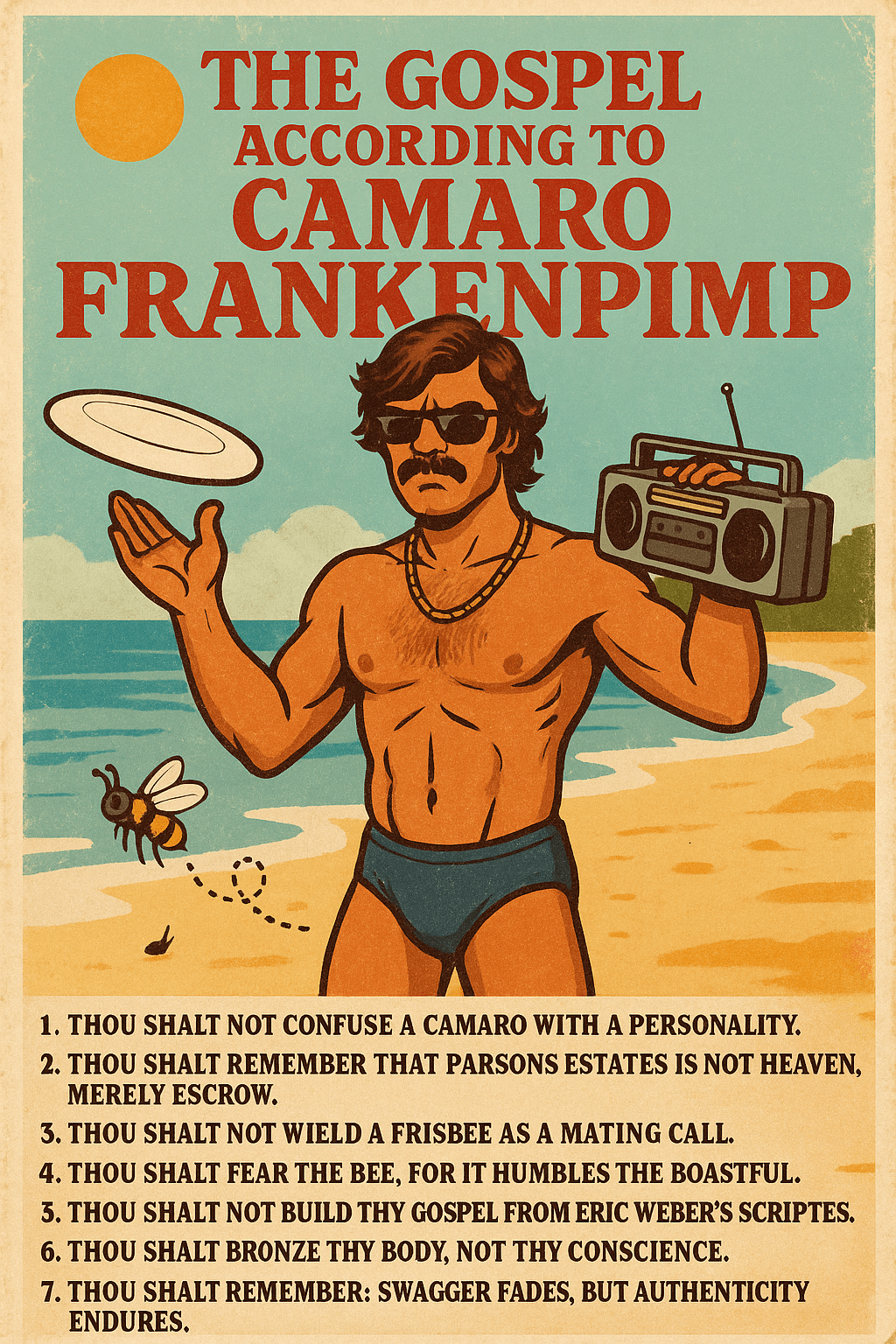
    The summer of 1977: I was fifteen, half-boy, half-bicep, bronzing my delusions at the Don Castro Swim Lagoon. I lay stretched across the sand like a sacrificial offering to the gods of narcissism, a dog-eared paperback of The Happy Hooker tucked inside my gym bag like contraband scripture. My nose, my skin, my hormonal soul were all baptized in the collective perfume of that era—banana-scented cocoa butter and coconut oil sizzling on sunbaked flesh.

    It wasn’t just a swim lagoon; it was a sensory bacchanal. My eyes devoured the parades of bikini-clad girls, but it was the scent—the olfactory gospel of the ’70s—that tattooed itself onto my brainstem. The decade fused with my adolescence to form a perfect cocktail of lust, leisure, and delusion. That was Me Time before “me time” became a self-help cliché. This was Me Time as a birthright. An ecstatic creed. A half-naked mission statement.

    I hoarded that fragment of the 70s like a holy relic, a sweaty teenage talisman that whispered, You are entitled to this pleasure. And for decades, I believed it. I ritualized it. I salted it into the marrow of my daily habits. Self-indulgence wasn’t a guilty pleasure; it was as essential as cod liver oil and calf raises.

    But now, older, less tanned, and with only traces of Adonis left in my rearview mirror, I wonder if that Me Time ethos has become a prison disguised as a spa. What began as a teenage philosophy of sacred sensuality now feels like a rerun of Fantasy Island with worse lighting. The coconut oil that once anointed me has turned rancid with nostalgia.

    Am I frozen like Lot’s wife, looking back too long at the sun-glazed glory of the past and turning to salt—one of the many malformed, glittering relics trapped in the Salt Mines of my own mythology? Have I confused my emotional scrapbook for a roadmap?

    I don’t want to kill the boy inside me. I just don’t want him running the show.

    I’m not aiming to become some dried-out stoic spouting bromides about detachment and virtue while chewing flaxseed in silence. I still want pleasure. Complexity. Shadow. Laughter. Sweat. But I want to carry my memories like a man, not drag them around like a stunted boy still snorting the ghost of Hawaiian Tropic in the Rite Aid aisle.

    So I ask—how do you love the Me Time Era less? How do you put the suntan oil back in the bottle?

  • Carrère’s Kingdom: Faith, Madness, and the Will to Survive

    Carrère’s Kingdom: Faith, Madness, and the Will to Survive

    In The Kingdom, Emmanuel Carrère recounts the strange, fevered period of his life when he became a practicing Catholic—a conversion that lasted three years and hovered somewhere between epiphany and breakdown. During that time, he rose each morning to take meticulous notes on the Gospel of John, scribbling like a man possessed. He now looks back at that period in the early 1990s with bewilderment, even embarrassment. What surprises him most isn’t that he converted—it’s that, years later, while immersed in researching the origins of Christianity, he failed at first to connect that research to his own religious episode. When he finally does, the realization is so jarring he feels compelled to dig out the old notebooks. And yet the thought of reading them fills him with dread.

    The last time he looked at them, in 2005, he was deep in depression and under the care of a psychiatrist. At the height of his religious zeal, Carrère had been suicidal. He was prescribed antidepressants—ones whose warning labels included the possibility of “erroneous beliefs,” a caveat that made him laugh darkly at his own conversion. He’s careful not to reduce religious yearning to a single cause, but it’s hard to miss the pattern: a man desperate to avoid self-destruction turning toward a story of rebirth, redemption, and divine rescue. Perhaps, instead of ending his life, he baptized it into another.

    As he flips through the old pages, he’s confronted by a younger self who no longer believed in free will or personal resolve as meaningful paths to goodness. He saw human beings as hopelessly frail and himself as incapable of rescuing his own life. At the time, he clung to God and marriage with equal desperation, hoping both would serve as anchors to prevent him from drifting into the abyss. But the notebooks also reveal a darker truth: his marriage to Helene was deeply unhappy. They loved each other, but they drank too much, blamed each other for their suffering, and fed each other’s neuroses. His writing—once the purpose of his life—had stalled completely. He hadn’t written anything in three years. He was a man sinking.

    Carrère eventually crawled out of that pit, but not through faith. What saved him wasn’t a god, but a set of daily disciplines: yoga, martial arts.

    A spiritual system that promised absolutes had failed him. A life that combined a focus on mind and body resulting in relaxation and clarity of thoughts, helped empty his anxieties and depression. With a strong mind and body, he was able to be productive as a writer. He eventually made lots of money from his craft, and he became the least likely to become religious: He became the rich man for who is about as ripe for salvation as the camel walking through the eye of a needle.