Category: technology

  • How Headphones Made Me Emotionally Unavailable in High-Resolution Audio

    How Headphones Made Me Emotionally Unavailable in High-Resolution Audio

    After flying to Miami recently, I finally understood the full appeal of noise-canceling headphones—not just for travel, but for the everyday, ambient escape act they offer my college students. Several claim, straight-faced, that they “hear the lecture better” while playing ASMR in their headphones because it soothes their anxiety and makes them better listeners. Is this neurological wizardry? Or performance art? I’m not sure. But apocryphal or not, the explanation has stuck with me.

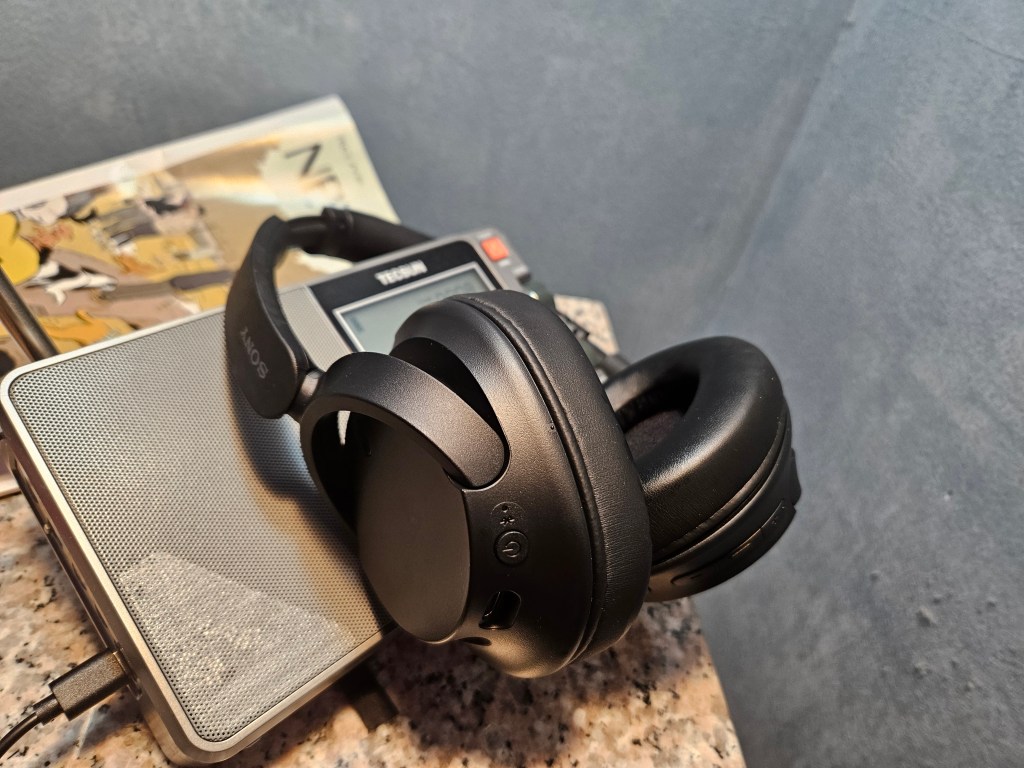
    It made me see the modern, high-grade headphone as something far more than a listening device. It’s a sanctuary, or to use the modern euphemism, an aural safe space in a chaotic world. You may not have millions to seal yourself in a hyperbaric oxygen pod inside a luxury doomsday bunker carved into the Montana granite during World War Z, but if you’ve got $500 and a credit score above sea level, you can disappear in style—into a pair of Sony MX6s or Audio-Technica ATH-R70s.

    The headphone, in this context, is not just gear—it’s armor. Whether cocobolo wood or carbon fiber, it communicates something quietly radical: “I have opted out.”

    You’re not rejecting the world with malice—you’re simply letting it know that you’ve found something better. Something more reliable. Something calibrated to your nervous system. In fact, you’ve severed communication so politely that all they hear is the faint thump of curated escapism pulsing through your earpads.

    For my students, these headphones are not fashion statements—they’re boundary-drawing devices. The outside world is a cacophony of canvas announcements, attention fatigue, and algorithmically optimized despair. Inside the headphones? Rain sounds. Lo-fi beats from a YouTube loop titled “study with me until the world ends.” Maybe even a softly muttering AI voice telling them they are enough.

    It doesn’t matter whether it’s true. It matters that it works.

    And here’s the deeper point: the headphone isn’t just a sanctuary. It’s a non-accountability device. You can’t be blamed for ghosting a group chat or zoning out during a team huddle when you’re visibly plugged into something more profound. You’re no longer rude—you’re occupied. Your silence is now technically sound.

    In a hyper-networked world that expects your every moment to be a node of productivity or empathy, the headphone is the last affordable luxury that buys you solitude without apology. You don’t need a manifesto. You just need active noise-canceling and a decent DAC.

    You’re not ignoring anyone. You’ve just entered your own monastery of midrange clarity, bass-forward detachment, and spatially engineered peace.

    And if someone wants your attention?

    Tell them to knock louder. You’re in sanctuary.

  • Siri at 30,000 Feet: Watch Reviews from the Android Abyss

    Siri at 30,000 Feet: Watch Reviews from the Android Abyss

    I’ve recently fallen into a strange corner of YouTube, where watch reviews by non-English speakers are automatically dubbed into English by an AI translator. The result? A surreal auditory hallucination that sounds like Siri moonlighting as a flight attendant. Every video becomes a low-budget dream sequence: a monotone voice calmly explaining bezel alignment while I mentally brace for instructions on how to locate the nearest flotation device.

    These AI-dubbed reviews don’t just kill the vibe—they exterminate it. What might have been a charming deep dive into dial texture or lug curvature turns into a bureaucratic fever dream. I’m not learning about watches. I’m trapped in a dystopian airline safety video, narrated by an android who sounds like he’s instructing me on what to do in the event the cabin has a drop in oxygen.

    The silver lining? These videos are the perfect antidote to impulsive spending. No matter how alluring the lume or limited the edition, the second I hear that synthetic drone describing a in robot voice a strange new word– “sapphireklysteelcasebackwithantimagneticresistance”–my urge to buy evaporates. The watch becomes a prop in an uncanny AI daymare—and I, mercifully, return to reality with my wallet intact.

  • You don’t need Soma. You’ve got ChatNumb

    You don’t need Soma. You’ve got ChatNumb

    In Brave New World, Aldous Huxley introduced Soma—a state-sanctioned sedative that numbed the masses into docile contentment. It didn’t solve problems; it dissolved them. Conflict, anxiety, existential dread—gone in a puff of pharmaceutical fog. Soma didn’t spark joy; it scrubbed discomfort. It was emotional Febreze for a society allergic to depth. People weren’t living—they were coasting on a chemically induced flatline, their critical faculties dulled to the point of extinction. No questions. No friction. No soul.

    Well, good news. Soma’s here—but it’s not in a pill bottle. It’s in your search bar, your chatbot, your synthetic co-pilot. It’s called AI. And unlike Huxley’s version, this one doesn’t need to sedate you. You do it to yourself. Every time you delegate thought, judgment, or original insight to an algorithm, your self-reliance shrinks like a muscle in a cast. The fewer mental reps you do, the more comfortable you get in the warm bath of synthetic cognition. The mind adapts. It flattens. You feel “efficient,” “optimized,” “smart”—but the uncomfortable truth is, you’re just well-lubricated for obedience.

    You don’t need Soma. You’ve got ChatNumb–the condition that sets in after tens of thousands of reps with your favorite AI assistant. The symptoms? A faux sense of competence, lizard-eyed placidity, and a vague suspicion that you’ve stopped thinking altogether. It’s not that you’ve been silenced. You’ve been auto-filled.

    The Age of Soma isn’t coming. It’s here. And we welcomed it with open thumbs. God help us all.

  • The future, we’re told, is full of freedom—unless you’re the one still cleaning the mess.

    The future, we’re told, is full of freedom—unless you’re the one still cleaning the mess.

    Last semester, in my college critical thinking class—a room full of bright minds and burnt-out spirits—we were dissecting what feels like a nationwide breakdown in mental health. Students tossed around possible suspects like a crime scene lineup: the psychological hangover of the pandemic, TikTok influencers glamorizing nervous breakdowns with pastel filters and soft piano music, the psychic toll of watching America split like a wishbone down party lines. All plausible. All depressing.

    Then a re-entry student—a nurse with twenty years in the trenches—raised her hand and calmly dropped a depth charge into the conversation. She said she sees more patients than ever staggering into hospitals not just sick, but shattered. Demoralized. Enraged. When I asked her what she thought was behind the surge in mental illness, she didn’t hesitate. “Money,” she said. “No one has any. They’re working themselves into the ground and still can’t cover rent, groceries, and medical bills. They’re burning out and breaking down.”

    And just like that, all our theories—algorithms, influencers, red-vs-blue blood feuds—melted under the furnace heat of economic despair. She was right. She sees the raw pain daily, the kind of pain tech billionaires will never upload into a TED Talk. While they spin futuristic fables about AI liberating humanity for leisure and creativity, my nurse watches the working class crawl into urgent care with nothing left but rage and debt. The promise of Universal Basic Income sounds charming if you’re already lounging in a beanbag chair at Singularity HQ, but out here in the world of late rent and grocery inflation, it’s a pipe dream sold by people who wouldn’t recognize a shift worker if one collapsed on their marble floors. The future, we’re told, is full of freedom—unless you’re the one still cleaning the mess.

  • WordPress: My Kettlebell Gym of the Mind

    WordPress: My Kettlebell Gym of the Mind

    I launched my WordPress blog on March 12, evicting myself from Typepad after it was sold to a company that treats blogs the way landlords treat rent-controlled tenants: with bored disdain. Typepad became a ghost town in a bad neighborhood, so I packed up and moved to the gated community of WordPress—cleaner streets, better lighting, and fewer trolls.

    For the past ten weeks, I’ve treated WordPress like a public journal—a digital sweat lodge where I sweat out my thoughts, confessions, and pedagogical war stories from the frontlines of college teaching. I like the routine, the scaffolding, and the habits of self-control. Blogging gives me something I never got from social media or committee meetings: a sense of order in a culture that’s spun off its axis.

    But let’s not kid ourselves. WordPress isn’t some utopian agora where meaningful discourse flourishes in the shade of civility. It’s still wired into the dopamine economy. The minute I start checking likes, follows, and view counts, I’m no longer a writer—I’m a lab rat pressing the pellet button. Metrics are the new morality. And brother, I’m not immune.

    Case in point: I can craft a thoughtful post, click “Publish,” and watch it sink into the abyss like a message in a bottle tossed into a septic tank. One view. Maybe. Post the same thing on Reddit, and suddenly I’m performing for an arena full of dopamine-addled gladiators. They’ll upvote, sure—but only after the professional insulters have had their turn at bat. Reddit is where clever sociopaths go to sharpen their knives and call it discourse.

    WordPress, by contrast, is a chill café with decent lighting and no one live-tweeting your every existential sigh. It’s a refuge from the snarling hordes of hot-take hustlers and ideological bloodsport. A place where I can escape not only digital toxicity, but the wider derangement of our post-shame, post-truth society—where influencers and elected officials are often the same con artist in two different blazers.

    Instead of doomscrolling or screaming into the algorithmic void, I’ve taken to reading biographies—public intellectuals, athletes who aged with dignity, tech pioneers who are obsessed with taking over the world. Or I’ll go spelunking into gadget rabbit holes to distract myself from the spiritual hangover that comes from living in a country where charisma triumphs over character and truth is whatever sells ad space.

    In therapy-speak, my job on WordPress is to “use the tools,” as Phil Stutz says: to strengthen my relationship with myself, with others, and with the crumbling world around me. It’s a discipline, not a dopamine drip. Writing here won’t make me famous, won’t make me rich, and sure as hell won’t turn me into some cardigan-clad oracle for the digital age.

    What it will do is give me structure. WordPress is where I wrestle with my thoughts the way I wrestle kettlebells in my garage: imperfectly, regularly, and with just enough sweat to keep the madness at bay.

  • 5 Ways We Can Get Addicted to AI Writing Platforms

    5 Ways We Can Get Addicted to AI Writing Platforms

    I’ve tried to stay current with the way technology is affecting my college writing classes. I dipped into the pool of AI-writing platforms like ChatGPT, and after 16 months or so, I can say that the program has gotten the best of me on many occasions and caused me to step back and look at its power to trap us. These platforms are addictive for 5 reasons. 

    One, AI polishes and strengthens your prose in flattering ways that can give you false confidence even as it can be wordy and obscure the clarity of your original draft. I call this false confidence “writer’s dysmorphia,” the idea that AI gives your prose a “muscle-flex” that you can’t muster without it. 

    Two. Another cause of addiction is the way we anthropomorphize AI, giving it a pet name and developing a fake relationship with it. This relationship exists in our heads. In many ways, this relationship can suffocate us as AI insidiously creeps into our brains. 

    Three. As we develop this “relationship” with AI and become grateful for its services, we feel like we owe it our attention. In this regard, it becomes the abusive spouse who wants to be addressed and to remain relevant in our lives. 

    Four. Our addiction grows as we lose confidence in our non-AI writing and, in turn, our non-Ai self. We constantly want to adorn ourselves with AI’s ability to razzle-dazzle.

    Five. Over time as we outsource more and more work to AI, we become more and more lazy and suffer Brain Atrophy Creep, losing our brain power slowly but surely.

    For these reasons, I’m doing more non-AI writing, such as this piece, and learning to find confidence on my own. 

  • Beware of the ChatGPT Strut

    Beware of the ChatGPT Strut

    Yesterday my critical thinking students and I talked about the ways we could revise our original content with ChatGPT give it instructions and train this AI tool to go beyond its bland, surface-level writing style. I showed my students specific prompts that would train it to write in a persona:

    “Rewrite the passage with acid wit.”

    “Rewrite the passage with lucid, assured prose.”

    “Rewrite the passage with mild academic language.”

    “Rewrite the passage with overdone academic language.”

    I showed the students my original paragraphs and ChatGPT’s versions of my sample arguments agreeing and disagreeing with Gustavo Arellano’s defense of cultural appropriation, and I said in the ChatGPT rewrites of my original there were linguistic constructions that were more witty, dramatic, stunning, and creative than I could do, and that to post these passages as my own would make me look good, but they wouldn’t be me. I would be misrepresenting myself, even though most of the world will be enhancing their writing like this in the near future. 

    I compared writing without ChatGPT to being a natural bodybuilder. Your muscles may not be as massive and dramatic as the guy on PEDS, but what you see is what you get. You’re the real you. In contrast, when you write with ChatGPT, you are a bodybuilder on PEDS. Your muscle-flex is eye-popping. You start doing the ChatGPT strut. 

    I gave this warning to the class: If you use ChatGPT a lot, as I have in the last year as I’m trying to figure out how I’m supposed to use it in my teaching, you can develop writer’s dysmorphia, the sense that your natural, non-ChatGPT writing is inadequate compared to the razzle-dazzle of ChatGPT’s steroid-like prose. 

    One student at this point disagreed with my awe of ChatGPT and my relatively low opinion of my own “natural” writing. She said, “Your original is better than the ChatGPT versions. Yours makes more sense to me, isn’t so hidden behind all the stylistic fluff, and contains an important sentence that ChatGPT omitted.”

    I looked at the original, and I realized she was right. My prose wasn’t as fancy as ChatGPT’s but the passage about Gustavo Arellano’s essay defending cultural appropriation was more clear than the AI versions.

    At this point, I shifted metaphors in describing ChatGPT. Whereas I began the class by saying that AI revisions are like giving steroids to a bodybuilder with body dysmorphia, now I was warning that ChatGPT can be like an abusive boyfriend or girlfriend. It wants to hijack our brains because the main objective of any technology is to dominate our lives. In the case of ChatGPT, this domination is sycophantic: It gives us false flattery, insinuates itself into our lives, and gradually suffocates us. 

    As an example, I told the students that I was getting burned out using ChatGPT, and I was excited to write non-ChatGPT posts on my blog, and to live in a space where my mind could breathe the fresh air apart from ChatGPT’s presence. 

    I wanted to see how ChatGPT would react to my plan to write non-ChatGPT posts, and ChatGPT seemed to get scared. It started giving me all of these suggestions to help me implement my non-ChatGPT plan. I said back to ChatGPT, “I can’t use your suggestions or plans or anything because the whole point is to live in the non-ChatGPT Zone.” I then closed my ChatGPT tab. 

    I concluded by telling my students that we need to reach a point where ChatGPT is a tool like Windows and Google Docs, but as soon as we become addicted to it, it’s an abusive platform. At that point, we need to use some self-agency and distance ourselves from it.  

  • If Used Wisely, AI Can Push Your Writing to Greater Heights, But It Can Also Create Writer’s Dysmorphia

    If Used Wisely, AI Can Push Your Writing to Greater Heights, But It Can Also Create Writer’s Dysmorphia

    No ChatGPT or AI of any kind was used in the following:

    For close to 2 years, I’ve been editing and collaborating with ChatGPT for my personal and professional writing. I teach my college writing students how to engage with it, giving it instructions to avoid its default setting for bland, anodyne prose and teaching it how to adopt various writing personas. 

    For my own writing, ChatGPT has boosted my prose and imagery, making my writing more stunning, dramatic, and vivid.

    Because I have been a bodybuilder since 1974, I will use a bodybuilding analogy: Writing with ChatGPT is like bodybuilding with PEDS. I get addicted to the boost, the extra pump, and the extra muscle. Just as a bodybuilder can get body dysmorphia, ChatGPT can give writers a sort of writer’s dysmorphia. 

    But posting a few articles on Reddit recently in which a few readers were put off by what they saw as “fake writing,” I stopped in my tracks to question my use of ChatGPT. Part of me thinks that the hunger for authenticity is such that I should be writing content that is more like the natural bodybuilder, the guy who ventures forth in his endeavor with no PEDS. What you see is what you get, all human, no steroids, no AI.

    While I like the way ChatGPT pushes me in new directions that I would not explore on my own and makes the writing process engaging in new ways, I acknowledge that AI-fueled writer’s dysmorphia is real. We can get addicted to the juiced-up prose and the razzle-dazzle.

    Secondly, we can outsource too much thinking to AI and get lazy rather than do the work ourselves. In the process, our critical thinking skills begin to atrophy.

    Third, I think we can fill our heads with too much ChatGPT and live inside a hazy AI fever swamp. I recall going to middle school and on the outskirts of the campus, you could see the “burn-outs,” pot-addicted kids staring into the distance with their lizard eyes. One afternoon a friend joked, “They’re high so often, not being high must be a trip for them.” What if we become like these lizard-eyed burnouts and wander this world on a constant ChatGPT high that is so debilitating that we need to sober up in the natural world upon which we find the non-AI existence is its own form of healthy pleasure? In other words, we should be careful not to let ChatGPT live rent-free in our brains.

    Finally, people hunger for authentic, all-human writing, so moving forward on this blog, I want to continue to push myself with some ChatGPT-edited writing, but I also want to present all-natural, all-human writing, as is the case with this post. 

  • The ChatGPT-Book: My Dream Machine in a World of Wearable Nonsense

    The ChatGPT-Book: My Dream Machine in a World of Wearable Nonsense

    I loathe smartphones. They’re tiny, slippery surveillance rectangles masquerading as tools of liberation. Typing on one feels like threading a needle while wearing oven mitts. My fingers bungle every attempt at precision, the autocorrect becomes a co-author I never hired, and the screen is so small I have to squint like I’m decoding Morse code through a peephole. Tablets aren’t much better—just larger slabs of compromise.

    Give me a mechanical keyboard, a desktop tower that hums with purpose, and twin 27-inch monitors beaming side by side like architectural blueprints of clarity. That’s how I commune with ChatGPT. I need real estate. I want to see the thinking unfold, not peer at it like a medieval monk examining a parchment shard.

    So when one of my students whipped out her phone, opened the ChatGPT app, and began speaking to it like it was her digital therapist, I nodded politely. But inside, I was muttering, “Not for me.” I’ve lived long enough to know that I don’t acclimate well to anything that fits in a jeans pocket.

    That’s why Matteo Wong’s article, “OpenAI’s Ambitions Just Became Crystal Clear,” caught my eye. Apparently, Sam Altman has teamed up with Jony Ive—the high priest of sleekness and the ghost behind Apple’s glory days—to sink $5 billion into building a “family of devices” for ChatGPT. Presumably, these will be as smooth, sexy, and addictive as the iPhone once was before it became a dopamine drip and digital leash.

    Honestly? It makes sense. In the last year, my ChatGPT use has skyrocketed, while my interaction with other platforms has withered. I now use it to write, research, plan, edit, make weight-management meal plans, and occasionally psychoanalyze myself. If there were a single device designed to serve as a “mother hub”—a central console for creativity, productivity, and digital errands—I’d buy it. But not if it’s shaped like a lapel pin. Not if it whispers in my ear like some clingy AI sprite. I don’t want a neural appendage or a mind tickler. I want a screen.

    What I’m hoping for is a ChatGPT-Book: something like a Chromebook, but with real writing DNA. A device with its own operating system that consolidates browser tabs, writing apps, and research tools. A no-nonsense, 14-inch-and-up display where I can visualize my creative process, not swipe through it.

    We all learn and create differently in this carnival of overstimulation we call the Information Age. I imagine Altman and Ive know that—and will deliver a suite of devices for different brains and temperaments. Mine just happens to want clarity, not minimalism masquerading as genius.

    Wong’s piece doesn’t surprise or shock me. It’s just the same old Silicon Valley gospel: dominate or be buried. Apple ate BlackBerry. Facebook devoured MySpace. And MySpace? It’s now a dusty relic in the basement of internet history—huddled next to beta tapes, 8-tracks, and other nostalgia-laced tech corpses.

    If ChatGPT gets its own device and redefines how we interact with the web, well… chalk it up to evolution. But for the love of all that’s analog—give me a keyboard, a screen, and some elbow room.

  • The Coldplay Apocalypse: Notes from a Smoothie-Drinking Future

    The Coldplay Apocalypse: Notes from a Smoothie-Drinking Future

    Welcome to the future—where the algorithm reigns, identity is a curated filter pack, and dystopia arrives not with a boot to the face but a wellness app and a matching pair of $900 headphones that murmur Coldplay into your skull at just the right serotonin-laced frequency.

    We will all look like vaguely reprocessed versions of Salma Hayek or Brad Pitt—digitally airbrushed to remove all imperfections but retain just enough “authenticity” to keep our neuroses in play. Our playlists will be algorithmically optimized to sound like Coldplay mated with spa music and decided never to take risks again.

    We’ll wear identical headphones—sleek, matte, noise-canceling monuments to our collective disinterest in one another. Not to be rude. Just too evolved to engage. Every journal entry we write will be AI-assisted, reading like the bastard child of Brené Brown and ChatGPT: reflective, sincere, and soul-crushingly uniform.

    Our influencers? They’ll all look the same too—gender-fluid, lightly medicated, with just enough charisma to sell you an oat milk subscription while quoting Kierkegaard. Politics, entertainment, mental health, and skincare will be served up on the same TikTok platter, narrated by someone who once dated a crypto founder and now podcasts about trauma.

    Three times a day, we’ll sip our civilization smoothie: a beige sludge of cricket protein, creatine, nootropic fibers, and a lightly psychoactive GLP-1 variant that keeps hunger, sadness, and ambition at bay. It’s not a meal; it’s a contract with the status quo. We’ll all wear identical sweat-wicking athleisure in soothing desert neutrals, paired with orthopedic sneakers in punchy tech-startup orange.

    We’ll all “take breaks from social media” at the same approved hour—between 5 and 6 p.m.—so we can “reconnect with the analog world” by staring at a sunset long enough to photograph it and post our profound revelations online at 6:01.

    Nobody will want children, because who wants to drag a baby into a climate-controlled apartment where the rent is half your nervous system? Marriage? A relic of a time when humans still believed in eye contact. Romances will be managed by chatbots programmed to simulate caring without requiring reciprocation. You’ll tell the app your love language, it’ll write your messages, and your partner’s app will do the same. Everyone’s emotionally satisfied, no one’s truly known.

    And vacations? Pure fiction. Deepfakes will show us in Bali, Tuscany, or the moon—beaming with digital joy, sipping pixelated espresso. Real travel is for the ultra-rich and the deluded.

    As for existential despair? Doesn’t exist anymore. Our moods will be finely tuned by micro-dosed pharmacology and AI-generated affirmations. No more late-night crises or 3 a.m. sobbing into a pillow. Just an endless, gentle hum of stabilized contentment—forever.