Category: TV and Movies

  • Resurrecting the Narrative: Why Some Stories Won’t Die

    Resurrecting the Narrative: Why Some Stories Won’t Die

    In The Kingdom, Emmanuel Carrère’s sly, genre-mutating novel, the narrator—an aging screenwriter with a history in French television and a grudge against his own irrelevance—ponders the cultural staying power of zombie stories. Zombies, after all, are the walking dead: viral, contagious, unsettlingly lifelike in their mindless hunger. While consulting on a TV show saturated with post-apocalyptic gore, Carrère’s narrator growls at younger writers, quits in a fog of midlife disdain, and watches from the sidelines as the series becomes a global phenomenon. Bitter and brooding, he studies the success with the sulky fascination of someone who just broke up with their ex and can’t stop checking their Instagram. “I stopped writing fiction long ago,” he mutters, “but I can recognize a powerful fictional device when I see it.”

    Carrère then executes a narrative judo move, flipping from zombie melodrama to the Apostle Paul in 50 A.D., an itinerant zealot-turned-mutation vector. Paul, in Carrère’s retelling, doesn’t just preach the resurrection of a crucified prophet—he unleashes a viral narrative that spreads through Corinth like spiritual malware. Paul doesn’t need a production team or a streaming platform. He has a loom, a message, and an uncanny ability to hijack human consciousness. As Carrère writes, belief in the resurrection becomes “the portent of something enormous, a mutation of humanity, both radical and invisible.” Early Christians, in this telling, are infected—mutants hidden in plain sight, walking among neighbors with a secret that rewires their sense of reality.

    Carrère’s language—mutation, contagion, infection—is no accident. He draws a direct line from Paul’s religious storytelling to the psychological mechanics behind marketing, ideology, and modern myth-making. Yuval Noah Harari makes a similar argument in Sapiens: civilization is held together not by laws or gods, but by collective fictions powerful enough to convince strangers to cooperate. Religion, like branding, spreads through the bloodstream of the culture until it feels like fact. Carrère takes this one step further: religion doesn’t just organize civilization—it haunts it, like a beautiful, persistent hallucination that refuses to die.

    Consider Madison Avenue’s version of salvation. I recall a 1990s Mercedes-Benz commercial where a man, lost and panicked in a shadowy forest, emerges onto a mountaintop. Above him, the stars align into the Mercedes logo. Transcendence is achieved. No need for Damascus Road—just a lease and decent credit. The brand has become a kind of secular gospel. No one cares that Mercedes flunks reliability scores; the emblem still gleams like a divine seal. In this light, Carrère’s Paul isn’t just a religious visionary—he’s the original brand strategist. His resurrection story had better legs than the competition. It caught on. It mutated. It endured. And Carrère, the self-professed unbeliever, is too entranced—and too honest—to dismiss it. Carrere’s novel The Kingdom is the story of a narrator marveling at how the world got infected by a story so powerful, it continues to raise the dead.

  • Not Just the Way You Are: The Untold Grit of Billy Joel

    Not Just the Way You Are: The Untold Grit of Billy Joel

    In high school, I was a sap for Billy Joel’s “Just the Way You Are”—a sentimental earworm that lodged itself in my adolescent chest like a slow-burning ember of longing. But it was “The Stranger,” with its eerie whistle intro, that truly haunted me. That mournful melody had the same desolate magic as “The Lonely Man Theme” from The Incredible Hulk—the tune that played whenever Bruce Banner had to hitchhike into oblivion with nothing but his duffel bag and repressed rage.

    Aside from that one album, though, I had little use for Billy Joel. His music struck me as sonic white bread—palatable, inoffensive, nutritionally empty. I still recall a vicious takedown in The San Francisco Chronicle where a critic dismissed Joel as a budget-bin Beatles knockoff. That assessment dovetailed nicely with my own smug teenage sneer. When a cousin of mine announced in the early ’80s that he was driving to L.A. to see Joel live, I smiled politely and thought, Enjoy your night of mediocrity, friend.

    Then the decades rolled by, as they do. Billy Joel fell off my radar completely. Not a note, not a thought, not a twitch of nostalgia. The man might as well have joined Jimmy Hoffa in the cultural vault. But recently, a few podcasters I trust raved about a five-hour documentary—Billy Joel: And So It Goes—streaming on HBO Max. Out of curiosity (and procrastination), I pressed play.

    And damn if it didn’t pull me in.

    Joel’s life story is a full-blown psychodrama with the pacing of a prestige miniseries. He falls in love with his bandmate’s girlfriend, gets punched in the face when the betrayal surfaces, spirals into suicidal depression, checks himself into a psychiatric hospital, emerges emotionally bruised but determined, and—naturally—marries the very same woman. She becomes his manager. They hit the road. That alone is a screenplay waiting to happen.

    The documentary then charts his wreckage-strewn romantic path: four marriages, battles with booze, perfectionism bordering on pathology, and the slow, soul-bruising realization that having half a billion dollars doesn’t guarantee someone to watch movies with on a Sunday night.

    Much of Joel’s pain seems to flow from a frigid relationship with his father—a classical pianist who fled Nazi Germany only to land in the capitalist circus of America, which he promptly came to despise. He left for Vienna and left Billy with an emotional black hole for a torso. Joel wrote songs, not for fame, but to fill that void—to wring something warm from cold keys.

    His mother didn’t help. She was likely bipolar, and Joel suspects he inherited some version of it—his life a pendulum swing between euphoric crescendos and basement-floor depressions. This emotional volatility didn’t soften him. If anything, Joel is grittier than I ever gave him credit for: a pugnacious Long Islander with a boxer’s jaw and the soul of a saloon poet.

    That famously mushy ballad “Just the Way You Are”? He hated it. Thought it was soggy sentimentalism unworthy of an album slot. Only when the band added a Bossa Nova beat did he reluctantly agree to let it stay. And that song, of course, became his most iconic.

    I came away from And So It Goes with a new view of Billy Joel—not as a sentimental hack or a Beatles Xerox machine, but as a bruised, brilliant craftsman. He’s not just a hitmaker. He’s a man on fire, trying to warm himself with melodies pulled from the wreckage of his life.

  • Welcome to Kayfabe Nation: A Field Guide for Curious Aliens

    Welcome to Kayfabe Nation: A Field Guide for Curious Aliens

    This morning, somewhere between my second cup of coffee and the fourth grim scroll through the news, I found myself pondering a hypothetical: If a space alien—curious, polite, perhaps with a clipboard—landed in my front yard and asked me, a nearly 64-year-old American, “What’s it like living in your country right now?,” I wouldn’t start with the Constitution or the national parks. I’d hand them a copy of James B. Twitchell’s Carnival Culture: The Trashing of Taste in America, a book I read back in 1992 when I was thirty and still believed things might get better.

    Twitchell’s argument was that television had ushered in a golden age of vulgarity—mainstreaming spectacle, flattening culture, and celebrating the lowest common denominator. What was once fringe now strutted center stage. That was 1992. It feels almost quaint now.

    This week, I’ve been soaking in evidence that Twitchell was merely outlining the overture.

    This morning, I read Tyler Foggatt’s New Yorker piece, “‘South Park’ Skewers a Satire-Proof President,” which examines how Trey Parker and Matt Stone are still hacking away at American grotesquery with their chainsaw of satire. 

    After watching Season 27, Episode 1, I found myself genuinely wondering how they haven’t yet been exiled to some kind of digital gulag. The episode’s venom is so precise, so nihilistically cheerful, it left me staring at the screen with a mixture of admiration and dread. How do you parody a culture that’s already parodying itself?

    That same night, my wife and I watched Shiny, Happy People: A Teenage Holy War—Season 2, Amazon Prime. Enter Ron Luce, a religious demagogue who recruits teenagers into his personal holy war by dressing them in camo and screaming at them through bullhorns as they crawl through canals full of hissing cockroaches. I turned to my wife and said what I now believe is the most accurate possible take: “Ron Luce is the Vince McMahon of religion.”

    Because here’s the thing: Vince McMahon isn’t just a wrestling promoter. He’s the high priest of American kayfabe—the architect of performative outrage, cosplay masculinity, and spectacle-for-spectacle’s-sake. He’s built an empire on screaming, sweating, soap opera buffoonery, and somehow, that aesthetic now defines everything: politics, YouTube, fringe churches, presidential rallies, TikTok evangelists. 

    McMahon didn’t just influence culture—he became it. If aliens really want a crash course in America, forget Mount Rushmore. Start with Mr. McMahon, the Netflix docuseries. Then draw a direct line to our histrionic politics, our teen-traumatizing spiritual boot camps, our screaming demagogues who mistake performative frenzy for moral clarity.

    The real problem with cosplay—whether it’s in the ring, the pulpit, or the Senate—is that eventually, the performers forget they’re performing. They fall into kayfabe coma. They live the lie so long they forget how to take off the mask, and eventually, they become the mask. What starts as theater curdles into delusion.

    I used to mock the NPR crowd—those genteel sippers of Bordeaux and tote-bagged reason—but I’ve come around. The quiet, the moderate, the civil? They may be our last tether to sanity. Watching Parker and Stone slap their thighs in manic glee may give us a few much-needed laughs, but it’s not curing anything. It’s not even slowing the spiral. It’s gallows humor on a tilt-a-whirl.

    If the aliens ask me what America’s like, I’ll tell them: It’s a deeply unserious country drunk on its own cosplay, where the line between performance and reality has vanished, and where kayfabe is our national religion.

    And then I’ll offer them a donut and a copy of Carnival Culture.

  • The Voice of Glum: Watch Addiction, Loudermilk, and the Daily Battle Within

    The Voice of Glum: Watch Addiction, Loudermilk, and the Daily Battle Within

    The TV show Loudermilk is part sitcom, part group therapy, and part existential smackdown. Ron Livingston plays Sam Loudermilk, a grizzled music critic and recovering alcoholic with the face of a hungover basset hound and the social graces of a man allergic to kindness. He barrels through life offending everyone within a five-foot radius, insulting his fellow addicts with toxic flair. But beneath the wreckage lies a strange tenderness—a story not just about addiction, but about people trying to survive themselves.

    Loudermilk lives in a halfway house with a cast of human tire fires, and the comedy burns hot: irreverent, profane, and deeply affectionate. The show loves its damaged characters even as it roasts them alive. Naturally, I love Loudermilk. Love it like a convert. I’ve become a low-key evangelist, promoting it to anyone within earshot—including the assistant at my local watch shop.

    This isn’t just any watch shop. I’ve been going there for 25 years. The Owner and the Assistant know me well—well enough to have witnessed the slow, expensive progression of my watch addiction, including the day I came in twice because the first bracelet adjustment “didn’t feel quite right.” It’s my barbershop. My confessional. My dopamine dispensary.

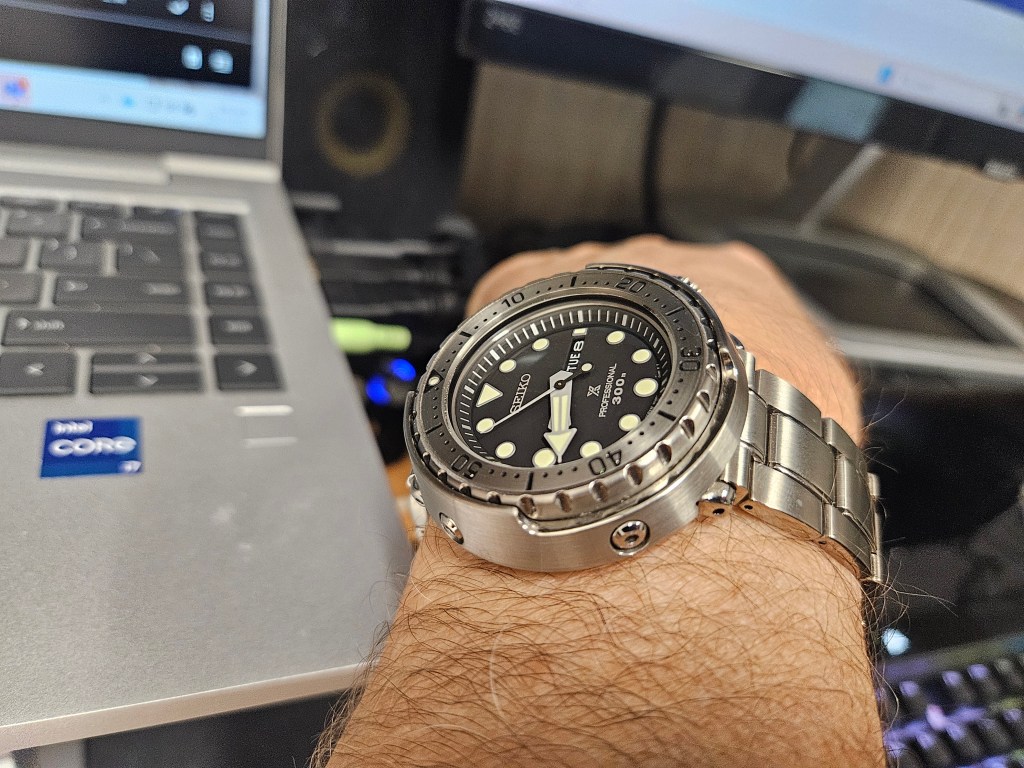
    So one afternoon, I’m there getting a link removed from my Seiko diver and I bring up Loudermilk. I describe the show’s gallery of screwups—addicts clawing toward redemption by way of insults, setbacks, and semi-functional group hugs. The Assistant looks up from his tools and tells me something personal. He watches Loudermilk too. And he gets it. He’s thirteen days sober and goes to five meetings every morning—not because he’s a morning person. He tells me that in his culture, drinking into one’s eighties is just called “living.” But for him, it was a slow-motion self-immolation. Now, he’s trying to claw his way back.

    Before I can respond, a woman with a chihuahua tucked under her arm chimes in from across the shop. She too is a Loudermilk fan. “What a shame it got canceled after three seasons,” she laments. The Assistant counters—there’s still hope for a revival. They argue lightly, both fully engaged, two strangers momentarily bonded over their shared love of a comedy about pain.

    I say goodbye and step out of the store. That’s when it hits me.

    I love Loudermilk because I see myself in it. I am an addict. Not just of watches, but of distraction, validation, control—whatever lets me delay the moment when I must confront the snarling voice inside me.

    Writers like Steven Pressfield and Phil Stutz describe this inner saboteur with chilling clarity. Pressfield calls it Resistance, the destructive force that undermines your better self. Stutz names it Part X, the anti-you that wants you to abandon meaning and pursue comfort. Both insist the enemy must be fought daily.

    And I know that voice. It’s lived in my head for decades.

    Once, at an English Department Christmas party, a colleague called me “Captain Comedown.” I don’t remember what I said to earn the nickname, but it tracks. I’ve got that bleak edge, the voice that sees futility everywhere and calls it wisdom. But a better name than Captain Comedown comes from my childhood: Glum, the joyless little pessimist from The Adventures of Gulliver, whose go-to phrase was: “It will never work. We’ll never make it. We’re doomed.”

    That’s my inner monologue. That’s my Resistance. That’s my Glum.

    Every day I wrestle him. He tells me not to bother, not to try, not to hope. That joy is a scam and effort is for suckers. And some days, I believe him. Other days, I don’t. But the battle is constant. It doesn’t end. As Pressfield says, the dragon regenerates. My job is to keep swinging the sword.

    And maybe, just maybe, buying a new watch is my way of telling Glum to shut up. It’s a shiny, ticking middle finger to despair. A symbolic declaration: The world still contains wonder. And precision. And brushed stainless steel.

    But there must be cheaper ways to silence Glum. A walk. A song. A friend. A laugh. Even a half-hour with Loudermilk.

    Because, irony of ironies, what addicts like me really want isn’t the next hit. It’s relief from the craving.

  • Uncut Bezels: Watch Addiction and the Cult of Chaos

    Uncut Bezels: Watch Addiction and the Cult of Chaos

    Watch obsessives have more in common with Howard Ratner than we care to admit. Yes, that Howard Ratner—the unhinged gem pusher played with twitchy brilliance by Adam Sandler in the Safdie brothers’ cinematic panic attack, Uncut Gems. Ratner operates in the Diamond District behind bulletproof glass, drowning in sparkle and debt. We operate behind the bulletproof delusions of horological obsession, buried in brushed steel and moonphase complications.

    Like Ratner, we gamble—not at sportsbooks, but with FedEx tracking numbers. We tell ourselves, this is the one as we refresh the delivery status of the next “grail” watch. The package might as well be glowing, Pulp Fiction-style. And like Ratner chasing a cursed Ethiopian black opal mined from the bloodied crust of the Earth, we twist ourselves into financial and emotional pretzels to score that one special piece—the wrist-mounted miracle that will finally quiet the voices.

    Spoiler: it never does.

    Ratner is a man who thinks more is the cure. More bets. More jewels. More chaos. The watch obsessive runs the same play. We soothe our midlife despair not with therapy or silence, but with spring drives, meteorite dials, and limited edition bronze cases. Our collections don’t grow—they metastasize.

    Like Ratner, our problem isn’t the world. Our problem is internal. The call is coming from inside the skull. He can’t stop because he doesn’t want to stop. The thrill is the point. Every acquisition, every wrist shot, every gushing forum post—just another hit of synthetic joy to distract from the gnawing void. We call it a hobby. Let’s not kid ourselves. It’s dopamine addiction disguised as design appreciation.

    Uncut Gems is a cinematic espresso shot laced with panic. My wife and brother couldn’t sit through thirty minutes. Too stressful, they said. Too jittery. I’ve watched it three times.

    But of course I have. I’m a watch addict.

    I live in Ratner’s world. The caffeinated chaos? That’s not discomfort. That’s home.

  • Watch What Implodes: Andy Cohen’s Domestic Cinematic Universe

    Watch What Implodes: Andy Cohen’s Domestic Cinematic Universe

    As Stephen Colbert’s tenure winds down on CBS—another headstone in the graveyard of “Late Night”—one might conclude that the talk show format, with its recycled monologues and tepid celebrity banter, is quietly expiring in a corner somewhere, clutching its blue cards and mug. But while traditional television gasps for relevance, the Andy Cohen Empire on Bravo is not merely surviving—it’s reproducing. Rapidly. Like reality TV kudzu.

    Welcome to the Bravo Matrix, where the camera never blinks and no martini goes unslurped. This isn’t scripted television, not officially. But let’s not be naïve—these shows are engineered with the precision of a Swiss watch, albeit one dipped in rosé and glitter. The “reality” may be cooked, but it’s a soufflé audiences devour by the season.

    Each cast member, whether they’re a Botoxed real estate maven, a Charleston trust-fund Casanova, or a spiritual advisor with a skincare line, is cast not for depth but for maximum combustion. These people may or may not be exceptional, but they do one thing very well: live out their personal chaos on camera while clawing for love, status, clarity, and closet space. We watch, transfixed, as they spiral, rebound, or occasionally evolve—all in HD.

    And let’s not forget the ambiance. These shows are drenched in lifestyle pornography: rooftop bars, poolside lounges, candlelit dinners served with sizzling gossip and artisanal side-eye. If television is the new hearth, Bravo is the scented candle flickering at its center—equal parts relaxing and mildly toxic.

    The producers, ever mindful of narrative drag, inject chaos agents—new cast members with just enough lip filler and latent sociopathy to blow up the group chat. This keeps the plot moving and the blood-pressure elevated. If a character becomes too boring or too stable, they’re exiled with the same indifference one might apply to expired yogurt.

    But for the chosen few—those rare personalities who deliver madness with consistency—tenure is real. A Bravo veteran can live a decade on screen, morphing from wide-eyed ingenue to meme-fodder matriarch, all while cultivating their social media following like a side hustle with God-complex benefits. We watch them grow, or don’t. We root for them, or we don’t. Either way, we’re still watching.

    And then there’s Watch What Happens Live, where Cohen himself presides like a smirking Zeus on a pleather throne, guiding reunion specials, feuds, and audience thirst with a cocktail in hand. What started with The Real Housewives of Orange County in 2006 has mushroomed into 75 interwoven shows, with spin-offs, reunion shows, and cameos that make the Marvel Universe look like a provincial theater company.

    In the end, what Vince McMahon did for wrestling—turning it into a steroidal psychodrama of spectacle and tribal allegiance—Andy Cohen has done for domestic warfare. And if the ratings are any clue, Cohen’s steel-clad battalion of brunch brawlers and dinner-party divas is winning.

  • How Your Flintstones Moment Made You Pursue Higher Education

    How Your Flintstones Moment Made You Pursue Higher Education

    Charlene’s office had been a shrine to immaculate control—gleaming surfaces, aligned papers that looked like they’d been measured with a laser level, and an air of clinical precision that could make a Swiss watchmaker weep tears of admiration. But that day, the outside world was doing its damnedest to breach her fortress. A dust storm had rolled into Hobcallow with all the subtlety of a biblical plague. It was mid-afternoon, but you wouldn’t have guessed it. The sky was choked in an apocalyptic shade of brown, casting the office in a bruised sepia tone. The overhead lights flickered like they’d given up hope. Dust smeared the windows like greasy fingerprints on a crime scene, and Charlene—who waged holy war against dirt—cringed at every grain that dared defile her glass.

    If anyone could stare down Mother Nature and win on points, it was Charlene. You’d have bet your last protein shake on it.

    She tried to tune it all out and focus on her latest mission: turning you into some kind of intellectual demigod for her next newspaper feature. She tapped her pen on her notepad with the kind of sharp, deliberate rhythm that could cut glass. Then she leaned in, smiling like a predator who’d just cornered a wounded animal. “Tell me,” she said, “what were the defining moments that led you to pursue higher education?”

    The wind screamed outside like a banshee in heat, but you leaned back and let yourself drift. “There was this bouncer gig I had at seventeen,” you began. “Maverick’s Disco in San Ramon. Three bucks an hour—ten cents above minimum wage. Free soda, free peanuts. I thought I was rich.”

    You could still picture it: a swirling disco inferno of polyester pantsuits, platform shoes, and hair sculpted into helmet-grade updos. The Bee Gees were on loop, the dry ice fog never cleared, and the lights pulsed like a migraine. It was paradise—until it wasn’t.

    “At first,” you said, “I thought I’d struck gold. I got to flex my lats and mingle. But after a while, it all started blending together. The same couples, the same fights, the same sweaty desperation. One night, mid-shift, I had this epiphany—Fred and Barney cruising in their Flintstone-mobile, but the background just repeated: tree, rock, house, tree, rock, house. That loop ruined the cartoon for me. And suddenly, it was ruining my life, too.”

    Charlene’s pen was flying. You could tell she was high on narrative gold.

    “Maverick’s became my Flintstones moment,” you said. “Week after week, the same loop: wide-eyed people chasing magic and leaving with hangovers and broken heels. And I realized I was part of it—punching the clock, buying into the monotony. I needed something more unpredictable. So I chose college. I needed to break the loop.”

    Charlene looked like she was about to levitate from her chair. The dust storm outside didn’t matter—she was in a state of pure journalistic ecstasy.

    And then you got honest.

    “But look at me now,” you said, and your voice had that creeping bitterness you couldn’t quite stifle. “Degrees? Check. Stable career in higher ed? Check. And what have I built? A life of structure and repetition. Same workouts, same egg whites, same damn protein shakes, same naps, same Angels game every night. I wrapped myself in the very loop I thought I’d escaped. The Flintstones background just changed colors.”

    Charlene’s pen froze mid-air. Her gaze snapped to you with a gleam of ice behind it. That calculating smile returned—sleek, practiced, a smile that had shut down board meetings and ended more than one marriage. “We won’t tell them that part,” she said sweetly. “That’s just between us.”

    You felt the temperature drop, despite the swirling storm outside. It was the smile of someone who took pleasure in control—over narrative, over outcomes, over people.

    You glanced toward the window. The storm was still there, clawing at the glass like a desperate thing. But Charlene’s smile? That was the real weather system in the room.

  • “This Is the Other Place”: Twilight Zone Parenting and the Parking App of Doom

    “This Is the Other Place”: Twilight Zone Parenting and the Parking App of Doom

    Of all the Twilight Zone episodes that have taken up residence in my psyche, none clings more tenaciously than “A Nice Place to Visit.” A petty crook named Rocky Valentine gets gunned down during a botched robbery and wakes up in what appears to be paradise. He’s greeted by Pip, a genial, rotund guide played by Sebastian Cabot, who grants him everything his larcenous heart ever wanted: money, women, luck, luxury. No struggle, no stress. Every desire fulfilled on command.

    At first, Rocky revels in this frictionless dreamscape. It’s Vegas without losing streaks, heaven without requirements. But gradually, pleasure without purpose curdles into a thick, syrupy dread. He realizes that gratification without resistance is just another form of punishment. Bored out of his mind and desperate for meaning, Rocky pleads with Pip to send him “to the other place.”

    Pip laughs and delivers the gut punch: “Heaven? Whatever gave you the idea that you were in Heaven, Mr. Valentine? This is the other place!” And then, with glee, Pip cackles like the well-fed devil he is.

    Which brings me to paid parking.

    There is a hell, and it lives in the infrastructure of modern urban parking. It’s a realm of QR codes, license plate entries, and apps that want your soul—or at least your email and billing zip code. Some kiosks accept coins, others demand smartphone apps, two-step verification, and an MFA code just to stand still without being ticketed. My wife, tech-literate and cool-headed, usually handles this logistical hellscape while I loiter nearby, pretending to study the map of downtown like it’s a sacred text.

    But this week she’s out of town at a teaching convention, and I’m taking our twin daughters to Laguna Beach. This means I have to drive, find a parking structure, and—here’s the true horror—navigate the digital rigmarole of paid parking without her guidance. The thought of it has me sweating harder than Rocky in his silk suit.

    The absurd part? It’s not the traffic, the tides, or the teenagers that unnerve me. It’s the parking meter. The existential shame of standing in front of a digital payment kiosk, poking at it like a confused ape while my daughters wait patiently (or impatiently) beside me. I don’t fear the unknown. I fear looking like an idiot in front of my kids.

    But here’s the deeper, darker realization: this is just a symptom. My wife, through years of effort and mental load, has become the de facto logistics commander of our household. She knows which airport lines move faster. She’s the one strangers approach at terminals, sensing her Jedi-level calm. Meanwhile, I shuffle behind her like an NPC in a bad video game—directionless, frictionless, practically translucent.

    Frictionless living has a cost. It breeds detachment. It robs you of engagement, resilience, and presence. And like Rocky Valentine, I’ve grown too used to being served instead of showing up.

    Ironically, I’m obsessed with watches—those exquisite tools designed to remind you where you are in time. And yet, I’ve spent years drifting, distracted, floating outside the dial. It takes a solo day trip with my daughters—an hour drive, some shopping, a good lunch, and possibly a tantrum or two—to pull me back into the present.

    When my wife heard about my plan, she said, “You don’t know how happy this makes me.” And I believed her. She wasn’t just relieved that I was giving her a break. She was glad to see me step into the friction. To stop spectating and start parenting in real time.

    No, I don’t want to be Rocky. I don’t want a life where every parking spot is perfect, every line is short, and every meal arrives on time. I want the chaos. I want the curveballs. I want the real thing.

    Even if it means downloading the stupid parking app.

  • The Cult of Cool: How Fashion Brands Turned Insecurity Into Gold

    The Cult of Cool: How Fashion Brands Turned Insecurity Into Gold

    Three documentaries—White Hot: The Rise & Fall of Abercrombie & Fitch, Brandy Hellville and the Cult of Fast Fashion, and Trainwreck: The Cult of American Apparel—reveal a sobering truth: some of the most iconic youth fashion brands haven’t just sold clothes; they’ve trafficked in identity, manipulated insecurity, and run full-scale psychological cons dressed up as marketing.

    These brands built empires on seductive illusions—creating tight-knit aspirational worlds where beauty, desirability, and social status were pre-packaged into a logo and sold at a premium. The catch? Entry required blind conformity to a narrow aesthetic, behavioral uniformity, and uncritical loyalty. This wasn’t fashion—it was Groupthink in skinny jeans. And behind it all pulsed the emotional engine of modern consumer culture: FOMO, the fear of being left out, unseen, unchosen.

    White Hot, reviewed by Ben Kenigsberg, focuses on Abercrombie’s marketing of “aspirational frattiness”—a euphemism for white exclusivity wrapped in khaki shorts and cologne. It was a smug, muscular nostalgia trip to a sanitized, all-white upper-class fantasy where thinness, wealth, and preppy arrogance were the unspoken requirements for membership.

    At the helm was CEO Mike Jeffries, a marketing savant whose obsession with aesthetic purity bordered on cultic. Under his reign, the company embraced racist T-shirts, discriminatory hiring practices, and a toxic definition of “cool.” His executive team mirrored his vision so fully they might as well have been in a bunker, smiling and nodding as the walls caught fire. Groupthink didn’t just enable the brand’s rise—it ensured its blindness to its own downfall.

    Why revisit Abercrombie now? Because its story is a pre-Instagram case study in the mechanics of cult marketing: how insecurity is mined, branded, and sold back to consumers at 400% markup. My students in the 90s already saw through the ruse—complaining the shirts fell apart in the armpits within a week. What mattered wasn’t the clothing but the illusion of status sewn into every threadbare seam.

    Ultimately, White Hot offers a rare glimpse of justice: a cool brand undone by its own arrogance, its aesthetic no longer aspirational but pitiful. The Abercrombie collapse isn’t just a business story—it’s a warning. When branding becomes religion and coolness becomes a weapon, consumers become disciples in a theology of self-erasure.

  • Dancing with Predators: The Myth and Madness of Ocean Ramsey

    Dancing with Predators: The Myth and Madness of Ocean Ramsey

    The Shark Whisperer, a Netflix documentary about the striking and fearless Ocean Ramsey, follows her as she glides through open water with tiger sharks and even Great Whites. Ramsey doesn’t just swim with these apex predators—she bonds with them, believing her connection will help rebrand sharks as sentient, misunderstood beings worthy of conservation, not fear.

    Her mission is both mesmerizing and deeply unsettling.

    There’s no denying her courage. Her grace underwater and near-superhuman lung capacity—she can hold her breath for over six minutes—allow her to move in the sea like one of its native creatures. She believes this makes the sharks see her not as prey, but as a fellow traveler. And maybe they do. For now.

    But I can’t shake the unease. Her physical gifts may grant her a temporary immunity, but it feels like borrowed time. There’s a streak of fatalism in her interviews—a recurring idea that a life fully lived is more valuable than a long one. She speaks openly of her depression. It’s hard not to wonder whether her deep emotional affinity for sharks is also a kind of escape, a seductive alternative to human connection or terrestrial stability. Her quest for intimacy with creatures that could kill her seems less like education and more like myth-making.

    Still, her life is extraordinary. A viral sensation and oceanic daredevil, Ramsey rides the backs of sea monsters with a kind of pagan grace. The documentary captures her power and beauty, her magnetism, and her commitment—but it also sidesteps the emotional terrain that might explain why she keeps going back into the water, again and again, as if trying to disappear into something wilder and more dangerous than life on land.