Category: TV and Movies

  • WAITING FOR THE TV SIGNAL TO RETURN IN THE EXISTENTIAL WASTELAND

    WAITING FOR THE TV SIGNAL TO RETURN IN THE EXISTENTIAL WASTELAND

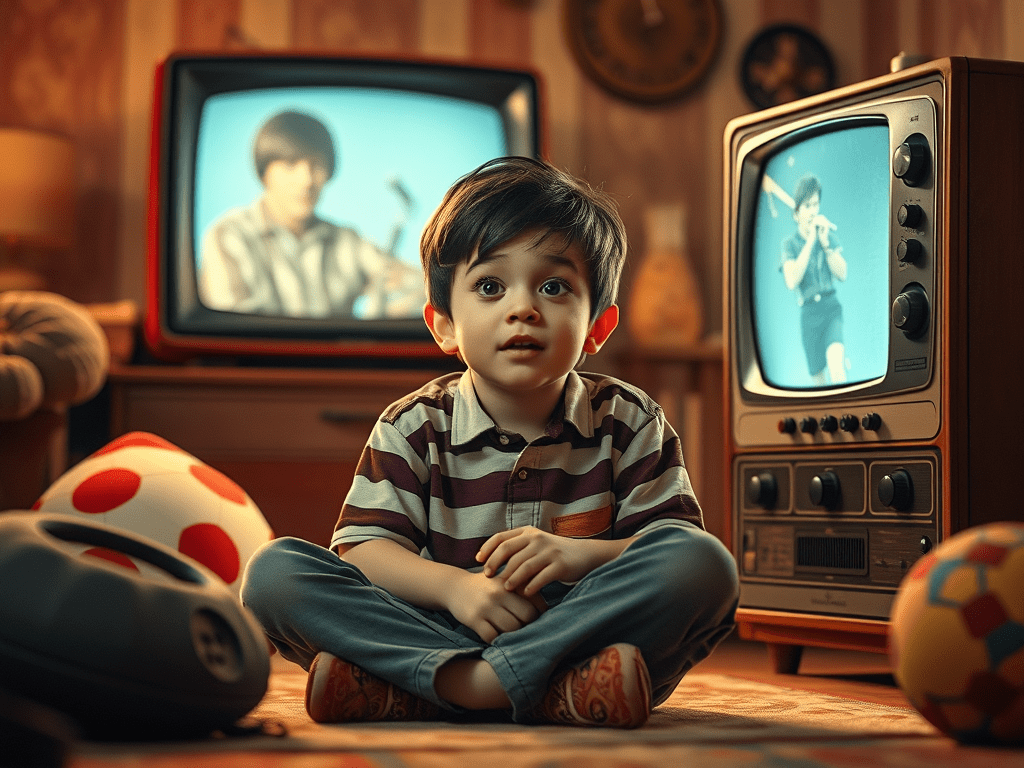
    Back in the 60s, television had the audacity to shut down for the night, leaving me stranded in an existential wasteland. It always ended the same way: a schmaltzy, patriotic ballad swelling over footage of the American flag waving in slow motion, as if Uncle Sam himself were tucking us in with a condescending pat on the head. Then, the screen would fade to an ominous test pattern—either those eerie vertical bars or, even more unsettling, the stoic, unblinking face of an American Indian chief, as if he alone were left to guard the void. Accompanying this visual purgatory was the sound—a relentless, high-pitched electronic hum that felt less like white noise and more like the auditory embodiment of cosmic abandonment. This was the twilight zone of childhood, the precise moment when the world lost all structure, and I was left floating in a limbo where the only certainty was that television would eventually return in the morning, reborn like a phoenix of mediocre sitcoms and local news.

    Fast forward to today, and I find myself in a similar purgatory—except this time, it’s digital, and it wears the face of an online watch retailer that has long since abandoned its post. Seiya Japan, once a temple of horological obsession, has been in an alleged “temporary closure” for years, a phrase now about as reassuring as an airline’s promise that your delayed flight will board “shortly.” Instead of a haunting test pattern, I am met with a pastel-green square floating in cyberspace, within which a lone white cloud drifts aimlessly, adorned with clip-art relics of some forgotten vacation brochure: ice cream cones, airplanes, umbrellas. And the word—TRAVEL—mocking me like a fortune cookie prediction scribbled by a sadist.

    Above this static dreamscape, a message attempts to soothe: “We will be suspending the site temporarily to take a break for refreshing our minds and bodies.” Years have passed. No updates. No relaunch. Just the same passive-aggressive “We’ll be back when we feel like it” hostage note. Was Seiya lost to the siren call of endless leisure, his days now a blur of mai tais and infinity pools? Or was this all an elaborate long-con, a digital ghost story designed to keep obsessive collectors like me trapped in an endless cycle of clicking, hoping, refreshing?

    Much like that childhood moment of staring at a lifeless TV screen, waiting for the world to reboot, I keep returning to Seiya Japan, desperate for signs of life. But nothing changes. It’s an airport departure board flashing DELAYED in perpetuity, a cruel exercise in futility. And yet, I linger. Because much like the test pattern of my youth, I still believe—against all reason—that one day, the signal will return.

  • THE TRIUMPH OF CAPTAIN KANGAROO

    THE TRIUMPH OF CAPTAIN KANGAROO

    I was five years old when I learned my first brutal lesson about the arms race of dominance. It happened in the treacherous, high-stakes jungle of the Flavet Villages Apartments in Gainesville, Florida—more specifically, in my treehouse. It wasn’t much, just a few wooden slats nailed to an old tree, but I ruled it like a king. One day, hoping to impress Tammy Whitmire, I dangled before her what I believed to be the ultimate prize: a box of Sun-Maid Raisins.

    And not just any raisins—these came in that iconic red box featuring the beaming Sun-Maid girl, her cherubic face framed by a halo of golden light, a bonnet perched on her head like a saintly crown. She cradled a bounty of grapes in her arms, promising sweetness, purity, and divine nourishment. I flashed that box like a high roller showing off a wad of cash. “Come up,” I told Tammy, “and these are all yours.”

    She was halfway up the wooden slats, eyes locked on my offering, when the unthinkable happened. From a rival treehouse, Zane Johnson’s smug little face emerged from a cluster of leaves. “Raisins?” he scoffed. “I’ve got Captain Kangaroo Cookies.”

    And just like that, I was dethroned. Tammy froze mid-climb, her expression shifting from hopeful delight to naked contempt. My raisins, once a gleaming beacon of temptation, now looked like a sad handful of shriveled failure. I watched, helpless, as she abandoned my tree and scrambled toward Zane’s perch with the urgency of a stockbroker chasing a hot tip. Within minutes, she and Zane were nestled together, giggling and feasting on his double-fudge, cream-filled cookie sandwiches—confections so decadent they made my raisins look like rations for an ascetic monk.

    As they licked chocolate from their fingers and cast pitying glances in my direction, I slumped in my treehouse, a rejected monarch in exile. At some point, I drifted into the sleep of the vanquished, only to be jolted awake by a fiery agony. Red ants—drawn, no doubt, by the scent of my untouched raisins—had swarmed my body, turning my sanctuary into a writhing hellscape. Screaming, I fled to my apartment, where my mother plunged me into a scalding bath, drowning dozens of ants still clinging to my welt-covered skin.

    As I soaked in that tub, covered in welts and drowning in existential despair, the brutal truth smacked me harder than a Captain Kangaroo cookie to the face: I was a loser. Not just in the Tammy Sweepstakes, but in the grander, merciless war of seduction and social dominance. The game wasn’t about charm, wit, or even strategic treehouse placement—it was about bait. And I had shown up to the high-stakes poker table of childhood courtship with a pathetic handful of raisins, while Zane waltzed in with a royal flush of double-fudge, cream-filled supremacy.

    That was the day the cold, reptilian logic of the universe seared itself into my brain: Raisins are for chumps. Cookies are for kings. And in the arms race of attraction, Captain Kangaroo doesn’t just win—he conquers.

  • THE ALPHA MALES OF COLD WAR TV

    THE ALPHA MALES OF COLD WAR TV

    As a small child, I had a surprisingly sharp grasp of the Cold War, thanks in no small part to my relentless viewing of The Rocky and Bullwinkle Show. Russian spies Boris Badenov and Natasha Fatale were my first introduction to geopolitical villainy, their cartoonish skullduggery revolving around stealing U.S. military secrets and pilfering jet fuel for nefarious purposes. These two Soviet saboteurs lurked on American soil, risking their lives for the Motherland, making it clear to me that the United States and Russia were locked in a high-stakes global chess match—one where espionage, sabotage, and suspiciously bad Russian accents were the order of the day.

    But it wasn’t just Rocky and Bullwinkle feeding my young mind a steady diet of American military might. TV shows across the board hammered home the same lesson: the true Goalkeepers of Dominance weren’t politicians or businessmen; they were highly decorated military officers, soaring through the skies and beyond. Exhibit A: I Dream of Jeannie.

    Major Anthony Nelson, astronaut, and all-American heartthrob, was living the dream—piloting spacecraft, rubbing shoulders with generals, and, most importantly, stumbling upon a genie in a bottle who just happened to be Barbara Eden in a sheer harem outfit. As far as my prepubescent brain was concerned, this was a direct confirmation of how the universe worked: the smartest, most disciplined men—those with military and scientific prowess—got the most beautiful women. If you weren’t a decorated officer or a NASA golden boy, good luck summoning a blonde bombshell out of a lamp.

    This hierarchy of Alpha Males wasn’t just something television taught me—it was practically family doctrine. My father, an infantryman turned engineer, was living proof. In fact, without his sheer resourcefulness and competitive streak, I wouldn’t exist.

    In the early 1960s, my father was stationed in Anchorage, where he and another army suitor, a certain John Shalikashvili (who would later become a U.S. General and Chairman of the Joint Chiefs of Staff), found themselves locked in a battle for the romantic affections of my teenage mother. Their duel was temporarily paused over Christmas—Shalikashvili went home to Peoria, Illinois, while my father visited his family in Hollywood, Florida. But my father, ever the tactician, decided to cut his holiday short, determined to beat Shalikashvili back to Alaska and win the girl.

    The problem? His cream-colored 1959 Morris Minor was suffering from a faulty Lucas fuel filter, and the auto parts store was fresh out of replacements. Undeterred, my father—who would later become a top engineer at IBM—rigged a temporary fix using a prophylactic and a paperclip, fashioning a makeshift spring to keep the fuel pump from locking up. It was a ludicrously desperate, MacGyver-esque solution, but somehow, it worked. He made it to Seattle, caught the ferry to Alaska, and reunited with my mother a full 48 hours before Shalikashvili arrived.

    Nine months later, I was born. In the great Cold War of romance, my father had won the ultimate victory—not through military rank, but through sheer ingenuity, timing, and, apparently, latex-based automotive engineering.

  • BREAKING BAD: AN ADDICTION TO BEAUTIFUL SADNESS

    BREAKING BAD: AN ADDICTION TO BEAUTIFUL SADNESS

    Watching Breaking Bad twice isn’t just recommended—it’s a moral obligation. It’s also required to declare it the greatest TV show of all time, even if it’s only in your top three, because the fanboys won’t tolerate anything less. And, honestly, they might be right. I devoured Breaking Bad in the full religious fervor its converts describe, an experience that felt almost biblical in scope. Yes, the show is a masterclass in plotting, character arcs, reversals, and edge-of-your-seat suspense. But at its core, Breaking Bad isn’t about meth, morality, or even power. It’s about Walter White’s eyes—those cavernous, haunted wells of defeat. Without them, the show collapses.

    What makes those eyes so tragic? A single, crushing word: demoralization. Walter White begins as a good man, fighting tooth and nail to support his family, only to be rewarded with a Job-like curse—a terminal illness and a society that treats educators like disposable placeholders. Stripped of dignity, forced to work a humiliating second job washing cars for the very students who mock him, he finally breaks bad—cashing in his chemistry genius for a descent into meth-laced perdition. Breaking Bad is a tragedy in the classical sense, charting the fall of a man who was never evil, just desperate, and in his desperation, damns his own soul.

    But here’s the thing: Breaking Bad isn’t just about whether Walter White loses his soul. It’s about whether we can bear to watch him do it. And that takes me back to those eyes—deep pools of melancholy that remind me of another doomed wanderer from TV history: Bill Bixby’s Dr. David Banner in The Incredible Hulk. Like Walter White, Banner is a man crushed under the weight of a world that doesn’t understand him. Like Walter, he transforms into a monster, not because he wants to, but because he must. And like Walter, he walks alone.

    Nothing captures that loneliness quite like The Incredible Hulk’s “Lonely Man” piano theme, composed by Joe Harnell—a piece so heartbreaking, so drenched in sorrow, it practically seeps through the screen. Every episode ends the same way: Banner, shoulders slumped, hitchhiking down an endless road to nowhere, forever exiled from a world that fears him. Swap out Banner’s tattered duffel bag for Walter White’s grim smirk in the show’s final scene, and you’ll see they’re walking the same road.

    Looking back, I realize that my love for The Incredible Hulk in my teens and Breaking Bad in my middle age isn’t a coincidence. It’s an addiction—to beautiful sadness. I’m drawn to characters whose sorrow is so vast, so overwhelming, that it takes on a tragic elegance. They aren’t just suffering; they’re symphonies of suffering, played in minor keys. And I can’t stop listening.

  • THE BEEKEEPER: ALPHA MALE COSPLAY AT ITS FINEST

    THE BEEKEEPER: ALPHA MALE COSPLAY AT ITS FINEST

    Every so often, a movie swaggers onto the screen with such unshakable confidence in its own purpose—an unspoken contract between filmmakers and audience—that I can’t help but admire the sheer bravado. The Beekeeper, an Amazon Prime testosterone spectacle starring Jason Statham, is precisely that kind of film: a brutal ballet of vengeance so perfectly engineered for maximum chest-thumping satisfaction that it practically deadlifts itself.

    Our hero, Adam Clay, is a man of few words and many well-placed punches. His backstory? Nonexistent—because real action heroes don’t need exposition. They exist in a realm where stoicism equals strength, silence signals imminent violence, and full sentences are for the weak. Clay has chosen a life of peace, tending to bees on the estate of a kindly old woman, harvesting honey, and bestowing jars of liquid gold upon her as an act of gratitude. How exactly beekeeping prepares a man for high-level assassination remains a mystery, but the implication is clear: Adam Clay would rather live in the Edenic tranquility of clover honey, but if you disturb the hive, you will suffer his wrath.

    And, predictably, the hive is disturbed. A predatory phishing scam wipes out his landlady’s life savings, pushing her to despair and suicide. In that moment, Clay transforms from beekeeper of bees to beekeeper of vengeance, waging a holy war against smirking tech bros and their cabal of government-protected elites. His righteous fury catapults the audience straight back to the glory days of 1970s revenge-fueled ass-kickery, when heroes like Billy Jack and Buford Pusser solved systemic corruption with sheer brute force.

    The film’s producers deserve a standing ovation for their keen understanding of the bottomless demand for Alpha Male cosplay. This is pure cinematic pre-workout, a high-octane fantasy designed to spike aggression, validate every grueling hour in the weight room, and keep disaffected young men hypnotically tethered to their gym memberships. You, too, can be Jason Statham, if you only commit to your macros and the “warrior’s path.”

    Which brings us to the real fantasy at play here: the Monk Bro mythos—that lone, protein-fueled ascetic who carves himself into a Greek statue through sheer discipline and disdain for the modern world. The Monk Bro isn’t just a guy who lifts; he’s an ideology. He renounces traditional paths to adulthood—homeownership, relationships, emotional depth—and instead devotes himself to the only thing he can control: his body, his regimented diet, and his simmering resentment toward a world that doesn’t recognize his sacrifice.

    And here’s where The Beekeeper becomes more than just another revenge thriller: it’s a full-throated endorsement of the Monk Bro ideal. Statham’s character is the Platonic ideal of monkish masculinity—solitary, disciplined, lethal, utterly uninterested in romance, and powered entirely by righteous fury and lean proteins. This is not just an action movie; it’s a recruitment poster for every disaffected young man who has ever traded human connection for a relentless pursuit of muscle definition.

    Which brings me to the question I can’t shake: Why the bees? The movie is called The Beekeeper, yet the titular occupation has virtually nothing to do with the plot. Yes, “Beekeepers” is the name of an elite shadow organization of ex-special-ops agents, but that hardly explains the lovingly shot sequences of Statham methodically tending to his apiary. Why the rustic honey jars? Why the solemn reverence for beekeeping as a metaphor for… what, exactly? It’s as if someone spliced together John Wick and a National Geographic special on pollinators. Pooh Bear goes Punisher.

    And yet, for all its bizarre choices, the movie delivers exactly what it promises: a masterclass in stoic masculinity, a symphony of shattered bones, and a power fantasy where the hive is safe, the villains are obliterated, and every gym bro watching goes home dreaming of their own righteous war against the smug, tech-savvy forces of evil.

  • ROAD HOUSE IS A 2-HOUR INFOMERCIAL FOR TESTOSTERONE

    ROAD HOUSE IS A 2-HOUR INFOMERCIAL FOR TESTOSTERONE

    My pride as a lifelong bodybuilder took a glorious nosedive one recent evening when, sprawled on the couch like a man who had long abandoned ambition, I decided to indulge in the cinematic opus that is Road House. This film—if we must use that term generously—stars a Jake Gyllenhaal so sculpted he looks like Michelangelo, midway through carving David, got bored and said, Screw it, let’s make him a UFC fighter instead.

    Gyllenhaal plays a brooding, sinewy bouncer in Key West, grinding out a living by doing what all action heroes must—protecting a bar and its stunning owner, played by Jessica Williams, from the looming threat of corrupt mob bosses. Naturally, this leads to an inevitable showdown with their number-one enforcer: Conor McGregor, sporting the physique of a shaved grizzly bear on clenbuterol, his veins bulging like he’s one flex away from detonating. His performance lands somewhere between rabid pit bull and man who hasn’t blinked since 2019, and frankly, it’s magnificent.

    The plot? Barely there—thinner than a gas station receipt and about as consequential. It’s the classic Western trope: a stranger rides into town, cleans up the mess, and leaves behind a trail of broken bones and smoldering stares. But let’s not kid ourselves—the storyline exists solely as an excuse to showcase glistening, heaving slabs of muscle in slow motion. The camera caresses each bicep, each rippling lat, with the kind of reverence usually reserved for Renaissance art. It’s not an action movie so much as a two-hour infomercial for pre-workout supplements, high-intensity interval training, and whatever unregulated substance has been making its way through underground fight gyms.

    Somewhere between Gyllenhaal’s 47th shirtless moment and McGregor snarling like a man whose only source of hydration is pure testosterone, I found myself reaching for my phone—not to check the time, but to Google Conor McGregor’s diet plan. Because Road House isn’t just a film—it’s a flashing neon sign reminding you that you are, at best, a sentient pudding cup compared to these granite-hewn demigods. This isn’t entertainment; it’s an intervention. And the message is clear: drop the remote, pick up a kettlebell, and try to reclaim your dignity before it’s too late.

    When the credits finally rolled and I peeled myself off the couch, I had a revelation—if I wanted my memoir, Cinemorphosis: How I Become the Hero of Every Show I’ve Ever Watched, to thrive in today’s ruthless marketplace, it too needed a marketing tie-in. Just as Road House is a Trojan horse for fitness supplements and gym memberships, my book needed its own branded merchandise. But considering my subject matter—living vicariously through TV characters—the only viable promotional tie-in would be a chain of Self-Flagellation Chambers™, where disillusioned TV addicts could atone for their wasted lives. Or perhaps a TV Watcher’s Repentance Kit, complete with a burlap sack, an artisanal cilice, and a deluxe “discipline” whip for those long, dark nights of the soul.

  • I Am The Pitt

    I Am The Pitt

    I got my measles shot back in 1964, back when people still trusted medical science and didn’t take health advice from sweaty conspiracy theorists livestreaming from their car. But now, with measles making its triumphant comeback in Texas—because history isn’t just repeating itself, it’s staging a full-blown Vegas residency—my doctor wants proof that my immunity is still holding up. So off I went to get my blood drawn.

    As the nurse cinched the tourniquet around my arm, she casually rattled off a list of diseases clawing their way back from the medical graveyard: “Oh yeah, everything’s coming back—measles, tuberculosis, mumps, whooping cough.” Fantastic. We used to relegate these horrors to history books, but apparently, we’re now living in the age of Plague Nostalgia, where the anti-science crowd rejects vaccines but will happily chug raw milk like it’s a magic elixir and cure their imaginary parasites with oregano oil. Welcome to modern America: a nation where sniffing essential oils is considered cutting-edge disease prevention and a YouTuber with a GED can convince millions that the polio vaccine is a government psyop.

    I get it, though. I really do. The internet makes it easy to cosplay as an expert. I myself recently became a self-taught emergency room doctor—not through years of grueling medical training, mind you, but by watching Noah Wyle command the chaos of The Pitt. Ten episodes in, and I was so immersed in this high-octane Pittsburgh ER drama that I began to believe I could handle a mass casualty event with nothing but a Swiss Army knife and a strong cup of coffee. Through Wyle’s weary, seen-it-all eyes, I absorbed the fine art of managing crises, mentoring frazzled interns, suppressing the entirely human urge to faint at the sight of flayed flesh, and—most importantly—barking orders with just the right mix of exhaustion and authority.

    By the time the season finale rolled around, I wasn’t just watching The Pitt—I was The Pitt. At this point, if someone collapsed in front of me, I was convinced I could MacGyver an intubation using a drinking straw and a ballpoint pen. Never mind that I can’t handle a paper cut without Googling “how much blood loss before hospital.” Medical school takes a decade, sure, but I had clocked at least ten hours of Noah Wyle boot camp, and I was feeling dangerously confident. Step aside, real doctors—I’ve got this.

    This happens a lot when I watch a show I like. I become the main character, a metamorphosis, or Cinemorphosis, if you will. 

    Of course, once the credits rolled and I returned to my mortal state, I had to admit that I probably shouldn’t be allowed within ten feet of an actual medical emergency. I checked my email, saw that my lab results were in, and—miracle of miracles—my measles immunity was still intact. Looks like I get to live another day, at least until the next preventable disease makes its grand return.