Category: Uncategorized

  • The danger of misunderstanding Steely Dan’s “Deacon Blues”

    The danger of misunderstanding Steely Dan’s “Deacon Blues”

    Reading Why We Write and seeing the world’s elite authors dissect the process that made them flourish forced me to confront a brutal truth: I am not a real writer.

    All those decades of grinding out abysmal, unreadable novels weren’t acts of literary craftsmanship—they were performance art, a cosplay so convincing that even I fell for it. I played the role of “the unappreciated novelist” with such dazzling commitment that I actually believed it. And what was my proof of authenticity? Misery and failure.

    Surely, I thought, only a true genius could endure decades of rejection, obscurity, and artistic suffering. Surely, my inability to produce a good novel was simply a sign that I was ahead of my time, too profound for this crass and unworthy world.

    Turns out, I wasn’t an undiscovered genius—I was just really, really bad at writing novels.

    Misery is a tricky con artist. It convinces you that suffering is the price of authenticity, that the deeper your despair, the more profound your genius. This is especially true for the unpublished writer, that tragic figure who has transformed rejection into a sacred ritual. He doesn’t just endure misery—he cultivates it, polishes it, wears it like a bespoke suit of existential agony. In his mind, every unopened response from a literary agent is further proof of his artistic martyrdom. He mistakes his failure for proof that he is part of some elite, misunderstood brotherhood, the kind of tortured souls who scowl in coffee shops and rage against the mediocrity of the world.

    And therein lies the grand delusion: the belief that suffering is a substitute for talent, that rejection letters are secret messages from the universe confirming his genius. This is not art—it’s literary cosplay, complete with the requisite brooding and self-pity. The unpublished writer isn’t just chasing publication; he’s chasing the idea of being the tortured artist, as if melancholy alone could craft a masterpiece. 

    Which brings us to the next guiding principle for Manuscriptus Rex’s rehabilitation: 

    The belief that the more miserable you are, the more authentic you become. This dangerous belief has its origins in a popular song–none other than Steely Dan’s brooding anthem, “Deacon Blues.”

    Like any good disciple, I’ve worshiped at this altar without even realizing it. I, too, have believed I’m the “expanding man”—growing wiser, deeper, more profound—while simultaneously wallowing in self-pity as a misunderstood loser. It’s a special kind of delusion, the spiritual equivalent of polishing a rusty trophy.

    To fully grasp this faith, I point you to The Wall Street Journal article, “How Steely Dan Created ‘Deacon Blues’” by Marc Myers. There, Donald Fagen and Walter Becker peel back the curtain on the song’s narrator—a man who could’ve just as easily been named Sad Sack Jones. He’s a suburban daydreamer, stuck in a dull, mediocre life, fantasizing that he’s a hard-drinking, sax-blowing rebel with women at his feet.

    Fagen admits the character was designed as a counterpoint to the unstoppable juggernaut of college football’s Crimson Tide—a gleaming machine of winners. In contrast, Deacon Blues is the anthem of the losers, crafted from a Malibu piano room with a sliver of Pacific Ocean peeking through the houses. Becker summed it up best: “Crimson Tide” dripped with grandiosity, so they invented “Deacon Blues” to glorify failure.

    And did it work. “Deacon Blues” became the unofficial patron saint for every self-proclaimed misfit who saw their own authenticity in his despair. He was our tragic hero—uncompromising, self-actualized, and romantic in his suffering.

    But then I read the article, and the spell broke. We were all suckered by a myth. Like the song’s narrator, we swallowed the fantasy of the “expanding man,” not realizing he was a con artist in his own mind. This isn’t a noble figure battling the world’s indifference—it’s a man marinating in his own mediocrity, dressed up in fantasies of scotch, saxophones, and self-destructive glamour.

    Walter Becker wasn’t subtle: the protagonist in “Deacon Blues” is a triple-L loser—an L-L-L Loser. Not a man on the cusp of greatness, but a man clutching a broken dream, pacing through a broken life. Fagen sharpened the knife: this is the guy who wakes up at 31 in his parents’ house and decides he’s suddenly going to “strut his stuff.”

    That sad, self-deluded basement dweller? That was the false prophet I’d built my personal religion around. A faith propped up by fantasies and self-sabotage.

    The man who inspired me wasn’t a misunderstood genius. He was a cautionary tale. A false path paved with jazz, liquor, and the comforting hum of failure.

    The slacker man-child isn’t just a tragic figure crooning in Steely Dan’s “Deacon Blues.” No, he walks among us—lounges among us, really—and I knew one personally. His name was Michael Barley.

    We met in the late 1980s at my apartment swimming pool while I was teaching college writing in Bakersfield, a place that practically invents new ways to suffocate ambition. A failed musician who had dabbled in a couple of garage bands, Michael was in his early thirties and bore such a stunning resemblance to Paul McCartney that he could’ve landed a cushy gig as a Vegas impersonator if only ambition hadn’t been a foreign concept to him. He had it all: the same nose, the same mouth, the same melancholy eyes, even the same feathered, shoulder-grazing hair McCartney rocked in the ’70s and ’80s. Sure, he was shorter, stockier, and his cheeks were pockmarked with acne scars, but from a distance—and, really, only from a distance—he was Paul’s sad-sack doppelgänger.

    Michael leaned into this resemblance like a man squeezing the last drops from a dry sponge. At clubs, he’d loiter near the bar in a black blazer—his self-anointed “Beatles jacket”—wearing a slack-jawed half-smile, waiting for some starry-eyed woman to break the ice with, “Has anyone ever told you…?” His pickup strategy was less a plan and more a form of passive income. The women did all the work; he just had to stand there and exist. The hardest part of the night, I suspect, was pretending to be surprised when they made the McCartney connection for the hundredth time.

    And then he disappeared. For six months, nothing.

    When Michael resurfaced, he wasn’t Michael anymore. He was Julian French—an “English musician” with a secondhand accent and thirdhand dreams. He had fled to London, apparently thinking the UK was clamoring for chubby McCartney clones, and when that didn’t pan out (shocking, I know), he slunk back to Bakersfield to live in his parents’ trailer, which, in a tragicomic twist, was attached to an elementary school where his father worked as the janitor and moonlit as a locksmith.

    But Michael—excuse me, Julian—was undeterred. He insisted I call him by his new British name, swore up and down that his accent was authentic, and we returned to our old haunts. Now, at the gym and in nightclubs, I watched him work the crowd with his faux-charm and faux-accent, slinging cars and cell phones like a man with no Plan B. His Beatles face was his business card, his only sales pitch. He lived off the oxygen of strangers’ admiration, basking in the glow of almost being someone important.

    But here’s the truth: Michael—Julian—wasn’t hustling. He was coasting. His whole life was one long, lazy drift powered by the barest effort. He never married, never had a long-term relationship, never even pretended to have ambition. His greatest challenge was feigning humility when people gushed over his discount McCartney face.

    Time, of course, is undefeated. By middle age, Julian’s face began to betray him. His ears and nose ballooned, his jowls sagged, and the resemblance to Paul McCartney evaporated. Without his one-note gimmick, the magic died. The women, the friends, the sales—they all disappeared. So, back to the trailer he went, tail tucked, learning the locksmith trade from his father, as if turning keys could unlock the door to whatever life he’d wasted.

    And me? I didn’t judge him. I couldn’t.

    Because deep down, I knew I was just as susceptible to the same delusion—the myth of the “Expanding Man.” That romantic fantasy of being a misunderstood artist, swaddled in self-pity, wandering through life with the illusion of authenticity. Like the anti-hero in “Deacon Blues,” Julian wasn’t building a life; he was building a narrative to justify his stagnation.

    And wasn’t I doing the same? By the late ’90s, I was approaching 40, professionally afloat but personally shipwrecked—emotionally underdeveloped, the cracks in my personality widening into canyons. I, too, was toeing that fine line between winner and loser, haunted by the possibility that I’d wasted years buying into the same seductive lie that trapped Julian.

    That’s the genius of the “Deacon Blue’s” Doctrine—a religion as potent as opium. It sanctifies self-pity, addiction, and delusions of grandeur, repackaging them into a noble code of suffering. It convinces you that stewing in your own misery is a virtue, that being a failure makes you authentic, and that the world just isn’t sophisticated enough to appreciate your “depth.”

    But here’s the truth no one tells you: eventually, life hands you your ass on a stick. That’s when you find out which side of the line you’re really on.


  • Authenticity or Evolution? The Cultural Legacy of Mexican and Chinese Food in America

    Authenticity or Evolution? The Cultural Legacy of Mexican and Chinese Food in America

    This is the third essay prompt for my critical thinking class:

    Authenticity or Evolution? The Cultural Legacy of Mexican and Chinese Food in America

    For many, food is more than sustenance—it is tradition, identity, and history. But what happens when traditional dishes evolve to fit new cultural landscapes? Should Americanized versions of Mexican and Chinese cuisine—from General Tso’s chicken to Tex-Mex burritos—be embraced as a vibrant contribution to culinary history, or dismissed as inauthentic imitations?

    This 1,700-word argumentative essay (MLA format required) invites you to examine how cultural adaptation and survival shape food traditions. Using Gustavo Arellano’s essay “Let White People Appropriate Mexican Food” and Ian Cheney’s documentary The Search for General Tso as key references, along with additional essays on the subject, you will defend, refute, or complicate the claim that labeling these cuisines as “inauthentic” ignores the deeper realities of immigration, adaptation, and resilience.

    Key Questions to Explore:

    • How do American Chinese and modern Mexican cuisines reflect adaptation and survival rather than cultural betrayal?
    • In what ways have these culinary shifts helped immigrant communities overcome economic and social adversity?
    • Does the concept of “authenticity” erase the ingenuity and history behind these evolving dishes?
    • How does food innovation expand cultural influence, making ethnic cuisines more accessible and desirable to broader audiences?

    Required Sources:

    Use a minimum of four sources from the following list, cited in MLA format:

    • Gustavo Arellano – “Let White People Appropriate Mexican Food”
    • Ian Cheney’s documentary – The Search for General Tso
    • Charles W. Hayford – “Who’s Afraid of Chop Suey”
    • Cathy Erway – “More Than ‘Just Takeout’”
    • Kelley Kwok – “‘Not Real Chinese’: Why American Chinese Food Deserves Our Respect”
    • Jiayang Fan – “Searching for America with General Tso”

    Suggested Essay Structure:

    I. Introduction (200-300 words)

    • Introduce the debate over culinary authenticity and how it applies to Mexican and Chinese food in America.
    • Present your thesis—whether you believe these evolving cuisines should be celebrated, criticized, or viewed with a nuanced perspective.
    • Briefly mention the key sources you will use to support your argument.

    II. The Case for Culinary Evolution (400-500 words)

    • Use Arellano’s claim that Mexican cuisine thrives on adaptability to explore how tacos, burritos, and other dishes have been reshaped by cultural influences.
    • Reference The Search for General Tso to highlight how Chinese immigrants adapted their cuisine to American tastes while maintaining entrepreneurial success.
    • Use Erway’s essay to examine how evolving cuisines serve as a source of creativity and pride for immigrant communities.

    III. Overcoming Racism and Economic Hardship (400-500 words)

    • Draw on Jiayang Fan’s argument that Chinese food’s popularity in America is inseparable from immigrant struggles, where adaptation was a tool for survival.
    • Explore how Tex-Mex and Chop Suey—despite being dismissed as “inauthentic”—helped immigrant communities establish visibility and economic stability.

    IV. Challenging the Authenticity Argument (400-500 words)

    • Use Kelley Kwok’s essay to challenge the myth that American Chinese food is “not real Chinese food” and explore what “authentic” really means.
    • Argue that cuisine is never static—traditions themselves were once innovations, influenced by migration and cultural blending.
    • Acknowledge the importance of preserving traditional dishes but emphasize how adaptation allows for survival and cultural expansion.

    V. Counterargument and Rebuttal (300-400 words)

    • Address critics who argue that Americanized versions of ethnic cuisine dilute culture or exploit culinary traditions for profit.
    • Rebut by emphasizing that adaptation does not erase tradition but extends its cultural reach, making food a dynamic part of identity.

    VI. Conclusion (200-300 words)

    • Reaffirm your thesis, reflecting on how evolving cuisines shape multicultural identity and bridge cultural divides.
    • Highlight how food tells a larger story of resilience, creativity, and the blending of cultures in an interconnected world.

    Final Thoughts:

    This essay challenges you to rethink the definition of authenticity in cuisine. By exploring how food evolves through necessity, survival, and creativity, you will craft an argument that goes beyond simplistic debates and acknowledges both the importance of tradition and the power of adaptation.

  • Ozempification: The Illusion of Instant Transformation in Literature and Life

    Ozempification: The Illusion of Instant Transformation in Literature and Life

    Here is my second essay prompt for my critical thinking class:

    Ozempification: The Illusion of Instant Transformation in Literature and Life

    In an age obsessed with quick fixes and instant gratification, the term “Ozempification” captures the growing trend of using external interventions—like weight-loss drugs, social media, or material possessions—to achieve rapid personal transformation. But what happens when these transformations fail to deliver lasting fulfillment? This question is at the heart of both Nikolai Gogol’s “The Overcoat” and F. Scott Fitzgerald’s “Winter Dreams.” Just as modern individuals turn to Ozempic to reshape their bodies overnight, Akaky and Dexter chase external symbols of success—the overcoat and Judy Jones—believing these will complete them. Instead, they are confronted with the fleeting, fragile nature of their illusions.

    For this 1,700-word essay (MLA format required), analyze how Akaky’s overcoat and Dexter’s infatuation with Judy Jones reflect the desire for instant validation, social mobility, and self-worth—and how these pursuits ultimately lead to disillusionment. Drawing comparisons to the modern phenomenon of Ozempic and similar quick-fix solutions, explore the deeper implications of transformation, identity, and ambition.

    Key Focus Areas:

    1. Rapid Change and Dependence – How do Akaky’s overcoat and Dexter’s obsession with Judy parallel society’s reliance on instant solutions, such as Ozempic, to achieve dramatic personal change?
    2. Validation and Social Mobility – How do both characters seek approval and status through external transformations, believing that a single change will secure their place in the world?
    3. Hunger for Identity and Wholeness – What does their fixation on an object (a coat) or a person (Judy) reveal about deeper insecurities and alienation?
    4. Consequences of Transformation – How does the theft of Akaky’s overcoat or Dexter’s loss of Judy expose the fragility of basing identity on external factors?
    5. The Illusion of Fulfillment – What do these stories suggest about the dangers of believing that external markers—whether material wealth, beauty, or status—can provide lasting happiness?

    Assignment Requirements:

    • Length: 1,700 words
    • Format: MLA (Modern Language Association)
    • Sources: Minimum of 3, including:
      • “The Overcoat” by Nikolai Gogol
      • “Winter Dreams” by F. Scott Fitzgerald
      • Class lectures or Canvas materials (optional)

    Conclusion:

    Consider what these literary cautionary tales reveal about modern anxieties surrounding self-improvement, ambition, and personal reinvention. Is Ozempification a path to self-betterment, or does it reflect a deeper cultural tendency to seek shortcuts to fulfillment? By comparing Akaky and Dexter’s downfalls to contemporary struggles with instant transformation, your essay should explore whether true change comes from within—or if the chase for external validation is doomed to fail.

  • The Weight of the System: Rethinking Willpower, Obesity, and the Economics of Weight Loss

    The Weight of the System: Rethinking Willpower, Obesity, and the Economics of Weight Loss

    Here is the first essay prompt for my critical thinking class:

    The Weight of the System: Rethinking Willpower, Obesity, and the Economics of Weight Loss

    For decades, society has preached the same mantra: weight loss is a matter of willpower, personal responsibility, and discipline. But what if that narrative is flawed, oversimplified, or even deliberately misleading? In reality, obesity is not just about individual choices—it is shaped by biology, economics, corporate interests, and healthcare disparities. The diet industry thrives on promising easy fixes, while the pharmaceutical industry profits from expensive weight-loss drugs like Ozempic. Meanwhile, processed foods—engineered for addiction—ensure that millions remain locked in an endless cycle of weight gain and dieting.

    For this 1,700-word argumentative essay (MLA format required), analyze the misconceptions surrounding weight loss and explore the deeper forces at play. Use the following sources to challenge the idea that weight management is simply about eating less and exercising more:

    • Rebecca Johns – “A Diet Writer’s Regrets”
    • Johann Hari – “A Year on Ozempic Taught Me We’re Thinking About Obesity All Wrong”
    • Harriet Brown – “The Weight of the Evidence”
    • Sandra Aamodt – “Why You Can’t Lose Weight on a Diet”

    Key Questions to Consider:

    • Is personal responsibility a fair framework for understanding obesity, or does it obscure the role of systemic barriers?
    • How do economic privilege and the availability of weight-loss drugs like Ozempic create a divide between those who can afford to manage their weight and those who cannot?
    • What role does the food industry play in promoting processed, addictive foods while pharmaceutical companies profit from treating the consequences?
    • Does the concept of “self-discipline” in dieting ignore scientific realities about metabolism, set points, and the long-term difficulty of maintaining weight loss?

    Focus Areas for Analysis:

    1. Personal Responsibility vs. Systemic Barriers – Johns and Hari challenge the traditional belief that dieting is a matter of willpower, exposing the emotional and physical toll of long-term weight struggles.
    2. Economic Disparity in Weight Loss Solutions – Hari’s critique of Ozempic highlights the ethical concerns surrounding healthcare access and the commercialization of weight loss.
    3. The Science of Set Points and Metabolism – Aamodt and Brown explain how biology resists sustained weight loss, complicating the simplistic “calories in, calories out” narrative.
    4. Capitalism and the Food Industry – Examine how the Industrial Food Complex profits from processed foods while the pharmaceutical industry monetizes weight-related health conditions.

    Conclusion:

    Is the weight-loss narrative fed to the public based on reality, or is it a distraction from larger economic and corporate interests? Consider how acknowledging these systemic influences could reshape our understanding of obesity and lead to more effective and compassionate solutions.

  • The Cost of Constant Approval: Lacie Pound’s Breakdown in a Social Media-Obsessed World

    The Cost of Constant Approval: Lacie Pound’s Breakdown in a Social Media-Obsessed World

    This is the third prompt in my freshman composition class:

    The Cost of Constant Approval: Lacie Pound’s Breakdown in a Social Media-Obsessed World

    In the Black Mirror episode “Nosedive,” Lacie Pound lives in a world where every social interaction is rated, and one’s digital reputation dictates real-world success. As she obsessively chases approval, her life unravels spectacularly. But what truly caused Lacie’s downfall? Was it the suffocating influence of social media, or did her collapse expose deeper psychological fragilities that existed long before the ratings system amplified them?

    For this 1,700-word essay (MLA format required), analyze Lacie’s psychological and emotional breakdown, evaluating whether social media directly caused her downfall or merely revealed an inevitable unraveling. Use insights from:

    • The Social Dilemma (Netflix documentary)
    • Jonathan Haidt’s essay “Why the Past 10 Years of American Life Have Been Uniquely Stupid”
    • Sherry Turkle’s TED Talk “Connected But Not Alone”
    • The Black Mirror episode “Nosedive” (as a primary reference)

    Key Focus Areas for Analysis:

    1. The Role of Social Media in Shaping Identity – How does Lacie’s obsession with external validation mirror real-world patterns of social media influence, as explored in The Social Dilemma?
    2. Mental Health and the Validation Culture – Use Haidt’s analysis to examine how constant ranking, comparison, and digital pressure contribute to anxiety and emotional distress.
    3. Authenticity vs. Performance – Discuss Turkle’s argument that technology fosters curated personas rather than genuine connection. How does this performative pressure accelerate Lacie’s mental decline?
    4. The Inevitability of Lacie’s Breakdown – Was her collapse truly caused by the rating system, or did social media merely amplify existing insecurities and psychological struggles?

    Essay Requirements:

    • Length: 1,700 words
    • Format: MLA (Modern Language Association)
    • Sources: Minimum of 4, cited in MLA format
    • Required Texts:
      • The Social Dilemma (Netflix documentary)
      • Jonathan Haidt’s “Why the Past 10 Years of American Life Have Been Uniquely Stupid”
      • Sherry Turkle’s TED Talk “Connected But Not Alone”
      • Black Mirror: “Nosedive” (episode reference)

    Conclusion:

    What does Lacie’s downfall reveal about our relationship with digital validation? Is her story a cautionary tale about social media’s psychological grip, or does it expose a deeper human vulnerability that would exist with or without technology? Through this analysis, explore whether Nosedive serves as a critique of social media itself—or if it’s ultimately a reflection of something far more personal and timeless: the human craving for approval.

  • Essay Prompt: Should You Follow Your Bliss?

    Essay Prompt: Should You Follow Your Bliss?

    The following is my freshman composition class’ first essay:

    Prompt Title: Passion or Pragmatism? Debunking the Myth of “Do What You Love”

    We’ve all heard the advice: Follow your passion, and success will follow. It’s the rallying cry of commencement speeches, self-help gurus, and LinkedIn influencers. But what if this well-intentioned mantra is actually terrible career advice? Computer science professor and bestselling author Cal Newport argues that blindly chasing passion can lead to frustration, stagnation, and even failure. Instead, he champions an approach based on deliberate skill-building, deep work, and career craftsmanship.

    For this 1,700-word argumentative essay (MLA format required), your task is to evaluate Newport’s critique of passion-driven career advice by drawing from the following sources:

    • Newport’s YouTube video: “Core Idea: Don’t Follow Your Passion”
    • His article: “The Passion Trap”
    • His manifesto: “The Career Craftsman Manifesto”
    • Ali Abdaal’s counterpoint video: “Follow Your Passion Is Bad Advice. Here’s Why.”

    Do you side with Newport’s pragmatic, skill-first approach, or do you believe passion still plays a crucial role in career success? Perhaps the truth lies somewhere in between—requiring a more nuanced perspective that accounts for economic realities, job market trends, and personal fulfillment.

    Your essay should defend, refute, or complicate Newport’s claim by incorporating evidence from the provided sources, applying logical reasoning, and considering real-world implications. This is your opportunity to challenge conventional wisdom, sharpen your analytical skills, and weigh in on one of the most persistent debates in career development.

    So, should we follow our hearts, or should we master our craft and let passion emerge along the way? Make your case.

  • It’s Never Been a Worse Time to Write a Book

    It’s Never Been a Worse Time to Write a Book

    Looking at Paul’s literary success—a man whose brief collection of letters has been on history’s all-time best-seller list—I can’t help but feel I bet on the wrong horse. Here I was, grinding away at novels, when I should have been an epistle-wielding scrivener, maybe even the founder of my own religion. Paul understood something I clearly did not: the world wasn’t clamoring for door stopper novels the size of The Count of Monte Cristo—it wanted sharp, incendiary tracts that could shake the foundations of belief. His instincts were dead-on, and two millennia later, his work is still in print, while my manuscripts remain in purgatory.

    And let’s be honest—there’s never been a worse time to write a book. We inhabit a post-literate wasteland, where the next generation’s idea of reading is squinting at subtitles while scrolling TikTok. The written word is being replaced by 15-second dopamine jolts, and syntax is being butchered faster than a hog in a slaughterhouse. Meanwhile, AI-generated prose is turning human creativity into an optional relic—why agonize over writing when you can plug a prompt into ChatGPT and get a grammatically competent, if soulless, 2,000-word essay faster than it takes to microwave a Hot Pocket? Argument structure, rhetorical flourish, actual thought? Who needs those when the algorithm can produce a sterile, citation-laden monstrosity with all the passion of an instruction manual? Paul saw the writing on the wall—literally. And I? I spent five decades wrestling with novels that no one wanted to read. Maybe it’s time to rethink my approach before I, too, become just another artifact of a bygone literary era.

    And yet, when you’re possessed by the writing demon, as I am, none of this matters. Reality bends around the obsession. Practical concerns slide off me like water off a duck’s back—or more accurately, like rejection letters into my trash bin. The demon doesn’t care about markets, trends, or the creeping irrelevance of books. No, the demon is hell-bent on proselytizing, convinced that I’ve stumbled upon the elixir of life, and that the world must hear my truth, whether it wants to or not. It’s not just enthusiasm—it’s derangement, the kind of fevered compulsion that outs you as a hopeless fanboy for your own ideas. People start calling you “touched” or “special,” which is just polite society’s way of saying, “You are utterly unhinged, and we wish you would stop.”

    You’re ashamed of your writing obsession, yet powerless to stop because the impulse isn’t tethered to reality—it’s pure pathology. You’re a self-appointed evangelist, convinced the world needs your message, your perspective, you. If only people would listen, if only your words took root in the collective consciousness, then maybe—just maybe—you’d finally feel the validation that’s eluded you your entire life.

    And yet, you’re no fool. You see the absurdity of your crusade. You know the odds, the futility, the sheer delusion of it all. But you’re a divided soul—the rational part watches in horror as the compulsive part keeps writing into the void, hoping someone, somewhere, will care.

  • How Eddie Murphy’s Advice Pushed Tiffany Haddish’s Career in the Right Direction

    How Eddie Murphy’s Advice Pushed Tiffany Haddish’s Career in the Right Direction

    If I was indeed possessed by a misguided writing demon in the mid-’80s—courtesy of reading A Confederacy of Dunces on repeat and subsequently squandering decades chasing a fool’s errand to capture some fraction of Toole’s novelistic splendor—then one could argue, with a certain tragic flair, that A Confederacy of Dunces ruined my life. Of course, that’s a spectacular oversimplification, but it has a nice literary ring to it, the kind of statement that cries out for a memoir deal. A perfect hook for a writing addict who, in theory, is supposed to have sworn off writing books but is secretly mainlining one on the side. It’s theatrical, adolescent, irresistibly neat. But let’s indulge the idea for a moment: a novel ruined a young man’s life. Decades later, the question remains—what do we do with this squandered life? Do we ignore it, dismiss it as a useless souvenir, or can something be salvaged from the wreckage?

    If there’s anything worth extracting from my own literary misadventures, it’s a warning to younger, equally deluded souls who might be possessed by the same demon of ambition. And make no mistake—ambition alone will not get you anywhere worth going. Yes, it will drag you through years of toil, ensure you hit your daily word count, and convince you that sheer willpower equals literary success. But ultimately, ambition alone will lead you into a tunnel with no exit. You’ll work hard—but not the right way. You’ll write, but without joy, without connection, without meaning. You will produce, but you will not matter.

    So instead of chasing the illusion of grandeur, you should be asking yourself four crucial questions. First, are you having fun with the creative process? If not, why are you doing this? The comedian Tiffany Haddish once said that Eddie Murphy pulled her aside and told her that if she wasn’t having fun on stage, the audience would sense it—and once she embraced that, her career took off. The same applies to writing. If your joy doesn’t translate onto the page, don’t expect anyone else to find it. Ambition will get words onto the page, but it won’t make them worth reading. Second, are you the only person in the world who could write this book? What unique gifts, obsessions, or quirks of personality make you the best person to write this, or are you forcing an idea simply because you think it’s marketable? If the demon of ambition is blinding you to your weaknesses, rest assured that agents and editors will see them clearly—and they will tell you to go home. The demon, of course, won’t listen. He never does.

    Third, why this book? Can you articulate—persuasively—why your book matters? Will it survive in an attention economy where a two-minute TikTok can go viral while your ten-year opus sells six copies? Do you know what your book is competing against? Can you justify its existence? 

    Imagine, for a moment, that you’ve never been published and have no social media following to catapult your debut novel into relevance. How exactly do you think this book is going to survive? Picture a horde of baby sea turtles, freshly hatched, flopping their way toward the ocean. Before they even touch the surf, they’re picked off by seagulls, crabs, raccoons, foxes, coyotes, frigatebirds, herons, egrets, snappers, jacks, barracudas, dolphins, sharks—the list of assassins is endless. The ones that do make it into open water face even worse odds. And yet, statistically, they still have a better shot at survival than your novel has at flourishing into a living, breathing piece of art that embeds itself in millions of imaginations.

    So before you get too deep into your literary fever dream, you need to ask yourself a sobering question: Is there enough juice for the squeeze? Best-selling author Sam Harris certainly asked himself that before shifting his focus away from books to his wildly successful Making Sense podcast. I remember him breaking it down with ruthless efficiency: writing a book can take five grueling years—writing, editing, publishing, book tours—and even after all that, sales might not justify the effort. Meanwhile, he can record a podcast in a few hours and reach millions instantly. No torturous rewrites, no endless editing loops, no begging the world to care.

    And that’s a best-selling author speaking. You’re not one. You’re a nobody with a dream, convinced that your fragile little hatchling of a book will somehow defy the gauntlet and fulfill your delusions of literary immortality. You have lost your mind. More than likely, the book won’t be read. Which brings us to your final, painful reckoning.

    Will your book actually connect with anyone? Or will it be yet another tree falling in the forest with no one around to hear it? Failure to connect isn’t bad luck—it’s bad writing. If your prose exists in a silo of delirious echoes, unread and unloved, then it isn’t literature—it’s literary vapor, ghostly and weightless, doomed to drift into oblivion. And here’s the cruelest truth of all: your writing demon won’t make this distinction. He’ll tell you that writing is writing, that piling up pages is progress, that if you just keep going, success is inevitable.

    It isn’t.

    Had I asked myself these questions before chasing my writing demon down every blind alley, perhaps I would have written with purpose instead of compulsion. But I was too busy obeying the demon to pause and think. If you’re an aspiring writer, don’t make the same mistake. Ambition can drive you forward, but only if it’s tethered to something real—joy, originality, necessity, and connection. Otherwise, you’re just manufacturing words, filling pages with the sound and the fury, signifying nothing.

  • Kenny G Is Not Jazz

    Kenny G Is Not Jazz

    I recently watched Listening to Kenny G, Penny Lane’s documentary on the world’s most famous saxophonist. It left me in a knot of conflicting emotions. Here’s a man, decent and diligent, who built a global empire of “smooth jazz”—a genre that, to my ears, is the musical equivalent of baby food: cloying, textureless, and aggressively inoffensive. And yet, millions worship him. The crowds at his concerts glow with unfiltered joy, their faces alight as if they’re receiving communion through the smooth, syrupy notes of his soprano sax.

    Who am I to sneer at them—or at him? I’m just a guy recovering from influenza, after all, with no musical empire to my name. But damn if I didn’t feel the urge to reach for some cultural antacid to settle my aesthetic nausea while judging him and his fans.

    And judge, I did. Kenny G, with his chirpy demeanor and ornithological cheer, seems blissfully detached from the rich, complex history of jazz that his music pretends to embody. He comes across as a musical solipsist, spinning out saccharine, Cliff Notes versions of jazz—an imitation so shallow it feels like he’s never ventured beyond the surface. His long, flowing hair and darting, eager eyes bring to mind a medieval court musician, strumming cloying pavane tunes to lull a bloated king into a post-feast stupor. Listening to Kenny G isn’t an artistic experience; it’s being spoon-fed emotional mush, a cheap confection disguised as depth. This is jazz devoid of soul, grit, or struggle—a hollow desecration of the genre’s essence, delivered with a smile so unrelenting it borders on the surreal.

    And yet, the guilt creeps in. Kenny G himself is disarmingly likable, a man seemingly immune to the venom of critics. He’s successful, and so are many of his fans, who are undoubtedly smart and decent people. Does that make their taste in music immune to critique? Hardly. Popularity is not an arbiter of artistic merit, and Kenny G’s music remains, to me, a vulgarity—saccharine and soulless, a betrayal of jazz’s improvisational brilliance. But the fact that his audience finds bliss in his syrupy melodies leaves me grappling with a larger question: Is artistic taste a bastion of universal truth, or just another playground for our pretensions?

    Am I so obsessed with Kenny G that I feel the need to join the ranks of his detractors, delivering a fiery diatribe like Pat Metheny’s infamous takedown? Not quite. But am I endlessly fascinated that something so blatantly saccharine, so clearly an abomination of music, can bring others to the brink of elation and transcendence? Absolutely. Kenny G’s music strikes me as the sonic equivalent of New Age spirituality: the kind where you pay for a weekend retreat only to be serenaded by a guru with Kenny G’s hair, who doles out self-help clichés like they’re sacred mantras. It’s the auditory version of being flattered into blissful mediocrity, a soothing appeal to one’s narcissism wrapped in smooth sax tones. And let’s face it: the appetite for such cloying bromides is insatiable—and always has been.

    I can’t help but feel a twinge of guilt for roasting Kenny G. I’m clearly afflicted with Sax Shamer’s Syndrome—the nagging unease of mocking a man whose soprano sax has brought legions of fans genuine joy, even if it makes me wince. I try to rationalize my disdain, reminding myself that I, too, have been guilty of infantile pleasures. As a child, I devoured Cap’n Crunch like it was manna from heaven, exalting its sugary crunch as the pinnacle of culinary achievement. The difference? I outgrew Cap’n Crunch. Meanwhile, Kenny G fans seem eternally devoted, treating his smooth jazz like the apotheosis of music. Does that make me a snob for pointing this out, or am I just calling it as I see it?

    The guilt gnaws at me. By deriding Kenny G, I’m effectively sneering at millions of perfectly decent, hard-working people who find solace in his musical equivalent of high-fructose corn syrup. But who am I to judge? I have my own guilty pleasures. I still scroll Instagram for black-and-white photos of 70s bodybuilders, sighing nostalgically for a golden age that was never mine. I still revel in childhood comfort foods—pigs-in-a-blanket dunked in mustard and barbecue sauce, as if I’m at a suburban soirée circa 1982.

    So really, what separates me from the Kenny G crowd? Not much. Scorning his fans isn’t a declaration of superior taste; it’s an act of hubris. We’re all creatures of indulgence, clinging to the things that soothe us. The real sin isn’t enjoying Kenny G or Cap’n Crunch—it’s forgetting that, at the end of the day, we’re all just looking for something to hum along to as we float through life.

  • DEATH BY SNACKS

    DEATH BY SNACKS

    After dinner, my wife and I luxuriated in a couple of Arrested Development reruns, marveling at the genius of Mitchell Hurwitz and Ron Howard. The show, an absurdist ode to familial dysfunction, felt decades ahead of its time—sharp enough to leave paper cuts on your brain. During the opening credits, I rose from the couch with noble intentions: I was off to fetch my so-called “satiety apple,” a modest, virtuous snack that allegedly curbs my post-dinner cravings without derailing my calorie count.

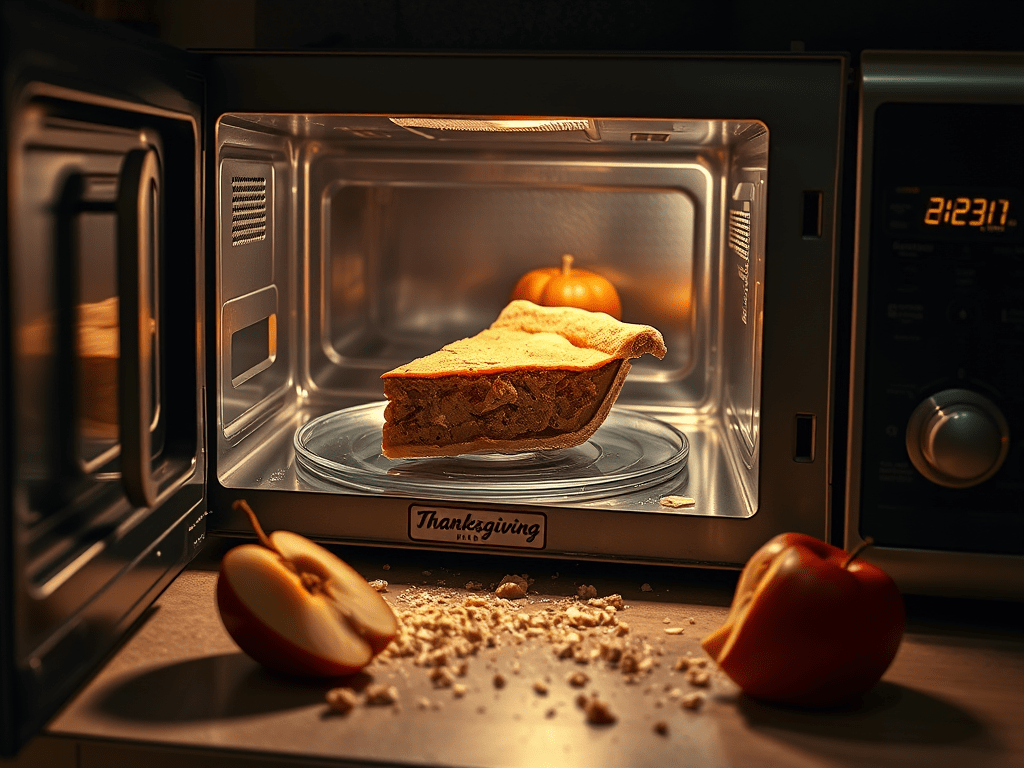
    But as I crossed the kitchen, fate—or treachery—beckoned me toward the microwave. There it sat: a pie box, faintly glowing, practically humming a siren song of buttery crust and spiced filling. One peek inside, and there it was—the last slice of Thanksgiving pie, radiating the kind of allure that no apple could ever muster.

    Before I knew it, I was hunched over the sink, inhaling that pie like a feral animal who’d just discovered civilization’s baked goods. Crumbs flew. Filling dripped. I was mid-bite, fully in beast mode, when my daughter Alison walked in. She stopped, surveyed the scene, and with surgical precision, dropped her line: “When’s the last time you were on a diet?”

    I froze mid-chew, my cheeks puffed out like a chipmunk caught in a raid. “A single slice of pie hardly merits such harsh judgment,” I said, wiping a smear of whipped cream off my chin.

    “Don’t be so defensive,” she said, her voice carrying the kind of condescension only a teenage girl can master. “I’m just asking—when was the last time you were on a diet?”

    “I didn’t realize you were the official historian of my weight management strategies,” I shot back, trying to maintain some shred of dignity.

    “What strategy?” she deadpanned, her tone as flat as the pie tin now sitting empty in the sink.

    I opened my mouth in an exaggerated display of mock offense, as if her words had wounded me so deeply that I could only respond with silence. We laughed, but the truth landed like a sucker punch: despite my heroic kettlebell workouts and high-protein meal plans, my daughter saw me for what I really was—a fat slob, undone by my inability to resist the siren song of leftover pie.

    My conversation with my daughter hit a nerve: my relationship with food is less of a partnership and more of a chaotic entanglement worthy of a reality show. I’m living with a chronic condition others have dubbed food noise—the relentless, mind-consuming obsession with food. It’s not just a passing craving; it’s a full-time occupation. Food noise is that little gremlin in your head planning tomorrow’s breakfast while you’re still wiping pie crumbs off your shirt from dinner. It’s exhausting, intrusive, and, frankly, a massive pain in the ass.

    I’ve tried all the supposed solutions. High-protein meals? Check. Fiber-packed fruits and veggies? Done. Permission to eat favorite foods to deflate their psychological power? Sure, why not. Listening to my so-called “hunger cues”? Please, those cues have been drowned out by a symphony of appetite louder than a Wagner opera. The truth is, my love of food has nothing to do with hunger. This isn’t about survival—it’s about passion.

    I crave food the way a musician craves music, except instead of performing Beethoven’s Ninth, I’m inhaling pie and serenading a protein bar like it’s my muse. Eating isn’t just sustenance; it’s a full-body euphoria, a never-ending sonata of chewing that I never want to end.

    So here I am, a helpless Snack Serenader, crooning over every dish like it’s the centerpiece of my magnum opus. Pie, pasta, cereal, or steak—it doesn’t matter. They’re all part of the eternal love song I sing to food, even as it steamrolls my willpower and expands my waistline. And while it may sound romantic, let’s be honest: it’s less about joy and more about imprisonment. I don’t just eat food; I worship it. I’m not hungry for a meal; I’m desperate for an encore. Just as a Beethoven superfan can lose themselves in the ninth symphony on repeat, I want to marinate in a bottomless jacuzzi of flavor, chewing my way through life’s buffet like a one-man marching band of mastication.

    As a Snack Serenader, I croon love songs to everything from pie to chicken shawarma. That Thanksgiving slice of pie wasn’t dessert; it was a crescendo. A bag of chips isn’t a snack; it’s an aria. And here I am, the tragic hero, swooning over leftovers as my waistline rolls its eyes and mutters, “You’re killing me.”

    The irony isn’t lost on me that I began this post with Arrested Development while chronicling my sink-side pie binge—a man-child devouring apple pie like it was the elixir of life, all under the unimpressed gaze of my daughter. Uncontrolled eating, it seems, is less about hunger and more about a deep-seated infantilization for which there’s no cure, just a lifetime subscription.