Blog

  • Blogging in the Belly of the Whale Has Its Perils

    Blogging in the Belly of the Whale Has Its Perils

    For those of us who can’t shell out $150 a week for therapy—and who would rather confess our shadow selves to strangers on the Internet than to a licensed professional—blogging becomes a kind of bargain-bin psychoanalysis. We know it’s not perfect, but it’s cheap, available, and gives us the illusion that we’re sorting out the world’s madness and our own with nothing more than sentences on a glowing screen.

    But there’s a catch. When we talk only to ourselves long enough, the echo becomes comforting. Too comforting. We stop listening to other voices and drift into a form of digital solipsism, a state where we’re the sole inhabitant of our private universe. It’s Jonah in the whale—except the whale has Wi-Fi and ergonomic seating. We settle into the warm bath of a frictionless existence, the kind of life where nothing challenges us, nothing interrupts us, and nothing demands that we grow.

    My students write about this same seduction when discussing AI and the Black Mirror episode “Joan Is Awful,” where the promise of absolute control mutates into the loss of identity. The frictionless life—everything tailored, curated, predictable—slowly erodes our individuality until we’re no longer people but users. And blogging can slip into that same trap: so cozy, so insulated, that we begin sipping our own Kool-Aid and calling it intellectual hydration.

    So what’s the antidote? Certainly not brawling on social media. Those aren’t arguments; they’re moral-outrage bacchanals dressed up as discourse. Trading the frictionless void of a blog for the poisoned well of tribal rage is not an upgrade—it’s simply chaos with a comment section.

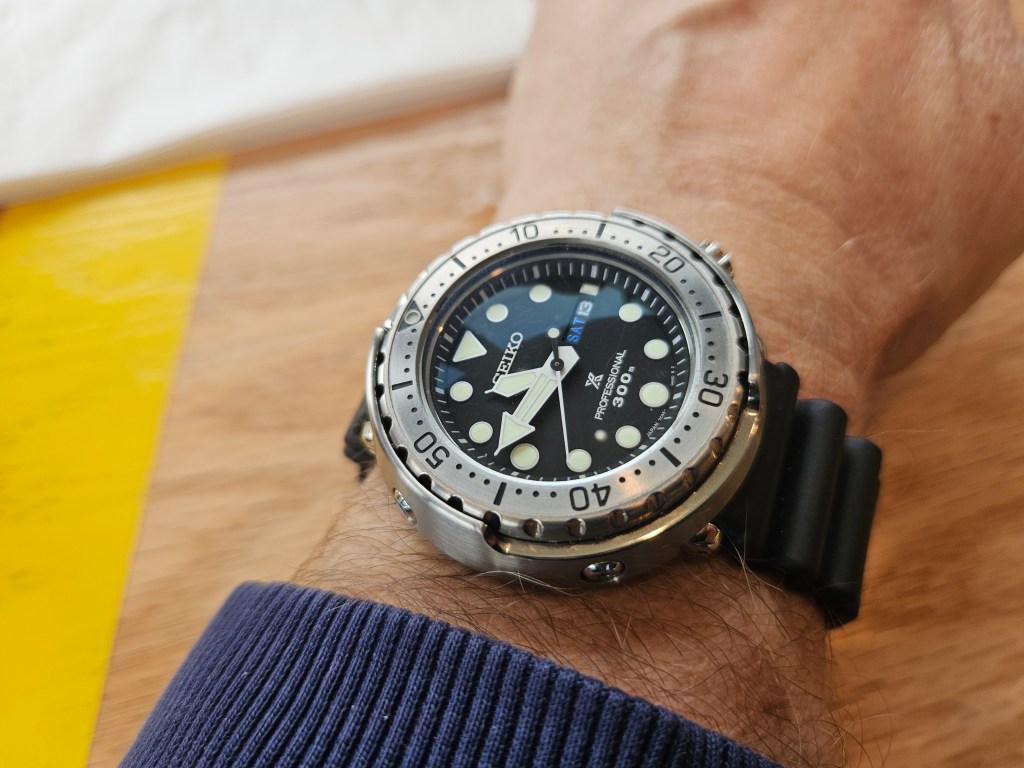
    There is a kind of healthy friction, though—the ordinary back-and-forth you get between two friends arguing about life over coffee. The Internet can mimic that if we’re deliberate. My YouTube channel has taught me as much. For over a decade, I’ve posted videos about watch obsession, addiction, identity, and everything connected to them. Making those videos demands more from me than a blog ever could. I have to generate compelling content, communicate clearly, keep people engaged, and then face their responses—praise, critique, confusion, all of it. It forces rigor. It forces presence. It won’t let me get lazy.

    That’s why I’m reluctant to quit. Yes, I’m 64. Yes, mental health matters. Yes, I worry that staying in the YouTube world might stir up my watch addiction and pressure me to flip watches just to feed the algorithm. But abandoning the channel completely in favor of the blog feels like retreating into the frictionless void I’m trying to escape.

    So I’ll keep experimenting with “video essays,” starting with a brief nod to my watch collection before pivoting into whatever topic is actually on my mind. Fortunately, viewers seem willing to follow me into this new territory. And for now, that’s enough. Because I’m tired of the soft trap of writing into silence. I need the friction. I need the challenge. I need the reminder that I’m not alone in the whale.

  • Fiona Hill and the Art of Clear Seeing

    Fiona Hill and the Art of Clear Seeing

    Fiona Hill stunned me on Andrew Sullivan’s Dishcast—not with theatrics or self-branding, but with something rarer: unvarnished intelligence. She spoke for more than an hour, weaving global politics, history, and sober analysis together without even a hint of schtick. No sales pitch. No influencer glow. Just clarity and competence. Listening to her felt like opening a window in a stale room. I’m now on track to read both of her books, if only to spend more time in the presence of a mind that refuses mediocrity.

    A few moments hit me squarely. She explained that she has never been drawn to social media, which she sees as a global time sink—an interactive void where people argue about nothing as if it were everything. Then she broadened the frame: we are living through a massive transition in politics, work, education, and culture, and we’d be naïve to pretend we understand it. She argued for humility—an acknowledgment that we can’t yet grasp the scale or direction of the upheaval we’re living through. We are, she suggested, walking into the unknown whether we like it or not.

    Sullivan agreed, calling this moment a “liminal” period in history. I hadn’t heard that word in years and had to remind myself that it means transitional—the uneasy space between what was and what will be. Hill embraced the term. She and Sullivan compared our moment to the Hundred Years’ War. No one living through the 14th century knew they were participants in a century-long conflict. They only knew that the ground was shifting.

    That’s where we are now. Nations wrestling for dominance, AI upending national security and labor markets, globalization rewiring identity and culture, political leaders who behave like pranksters with nuclear codes—this is our chaos. And like medieval villagers, we have no idea how long this period will last. Are these volatile leaders a temporary fever, or will they define an entire era? Are we living through a Hundred-Year Grifter Period? No one knows.

    Strangely, the conversation felt therapeutic. Hearing two sharp, grounded people speak honestly about uncertainty made me feel less panicked and less isolated. My anxiety and existential dread aren’t signs of unraveling—they’re signs of being alert during a liminal age that refuses easy explanations.

  • Self-Pity Is Its Own Sunken Place

    Self-Pity Is Its Own Sunken Place

    I’d been teaching Jordan Peele’s Get Out to my college students for six years—long enough to map every dark corner of the Sunken Place, that abyss where shame, paralysis, and despair fuse into one mute scream. It’s the emotional equivalent of being duct-taped to a chair while your soul tries—and fails—to clear its throat.

    The film, of course, locates the Sunken Place in a specific American ecosystem: those well-meaning liberals who talk like allies but behave like landlords of Black pain. They distribute microaggressions with the confidence of people handing out hors d’oeuvres at a garden party, all while enjoying the fruits of a system engineered to elevate them and drain everyone else. But Peele has insisted, in interviews and on stages, that the Sunken Place isn’t confined to racial oppression. For him, the first Sunken Place arrived in childhood, sitting slack-jawed in front of the TV. He felt like an NPC long before that acronym took over the internet—passive, programmed, invisible—while the creators on the screen radiated life, wit, and agency. He wanted to join them, and he did: stand-up, sketch comedy, screenwriting, filmmaking, cultural canonization. The man refused to stay sunken.

    After half a decade of teaching Peele’s masterpiece, a disquieting thought dawned on me: I wasn’t immune to the Sunken Place either. I had my own trapdoors. Too much internet bickering left me feeling hollow. My appetite—always several sizes larger than my actual caloric needs—dragged me downward. My talent for being obnoxious, selfish, and occasionally unbearable didn’t help. Neither did the small carousel of addictions and compulsions I’ve wrestled like a part-time zookeeper tending unruly beasts. Some days the labor of managing myself left me feeling like a broken machine, grinding out self-pity by the pound.

    Then I noticed something worse: self-pity is its own Sunken Place. It feeds on the original misery and creates a second pit under the first. And if you’re not careful, a third pit opens beneath that one. Before long, you’re living like a subterranean nesting doll of despair—each layer a reaction to the last—buried so deep you need spelunking gear just to find your own pulse.

    One morning, while playing piano, I drifted into one of my indulgent daydreams. I imagined myself back in the early 1980s, performing a private recital at the Berkeley wine shop where I used to work. In my fantasy, the customers lounged around me, gently swirling their glasses as my music washed over them. When I finished, they begged for encores—one, then another—until their brains were so marinated in endorphins that they thanked me for resurrecting their spirits from the doldrums. It was a pleasing vision, a warm hand pulling me briefly out of the Sunken Place.

    But after the fantasy evaporated, something clearer emerged: the way out—my way out, and maybe everyone’s—has nothing to do with grand performances or imaginary applause. The escape hatch begins with rejecting the velvet-lined coffin of self-pity and recognizing that everyone else is fighting their own Sunken Place too. And if I could help lift someone else out of their emotional quicksand, I might just rescue myself in the process.

    The final irony? I realized it wouldn’t be the piano that helped me do this. It would be humor. I could expose my flaws like specimens under bright light—my misfires, my vanities, my slapstick disasters—and let people laugh at them. Not cruelly, but with the relief that comes from recognizing themselves in another person’s foolishness. If my folly made someone else ease up on their own self-condemnation and offer themselves a small measure of grace, then maybe that, at long last, would be my encore.

  • Rising From the Sunken Place: Heroism, History, and the Evolution of the Black Quarterback

    Rising From the Sunken Place: Heroism, History, and the Evolution of the Black Quarterback

    Essay Prompt: 

    Drawing on Jordan Peele’s concept of the Sunken Place in Get Out, write a 1,700-word essay examining the heroic effort required not only to lift oneself out of the Sunken Place, but to help others rise as well—an arc vividly captured in the three-part docuseries The Evolution of the Black Quarterback. What does it mean for Black quarterbacks to break the race barrier in the NFL? What forces tried to hold them back, and how do these forces echo the Sunken Place? Consider also the story of Wilbur Dungy—Tony Dungy’s father—who served as a war hero only to return home to the indignities of Jim Crow. How did his dignity, endurance, and moral clarity shape his son’s rise as both an athlete and a coach?

    Your essay will be divided into two major sections.

    Part I (Four Paragraphs): Define the Sunken Place
    Write a four-paragraph definition of the Sunken Place, with each paragraph offering a different lens:

    1. The Sunken Place as depicted in Get Out
    2. The Sunken Place through the writings of Frederick Douglass
    3. The Sunken Place as represented in the Jim Crow Museum, curated by David Pilgrim
    4. The Sunken Place as reflected in The Evolution of the Black Quarterback

    Each paragraph should show how the Sunken Place functions as a metaphor for psychological confinement, social domination, and the struggle for agency.

    Part II (Four Paragraphs): Rising From the Sunken Place
    After your definition section, pivot to your thesis. Explain how early Black quarterbacks in the NFL rose from the Sunken Place and built a legacy that opened doors for future generations. In four paragraphs, analyze their courage and composure in the face of rejection, demoralization, racist taunts, structural exclusion, and even death threats. Show how their resilience and excellence expanded the possibilities for Black athletes who followed.

    Conclusion:
    Close by addressing the broader implications. What life lessons can we draw from these trailblazing quarterbacks? How does their story speak to endurance, leadership, and the ongoing work of lifting others out of the Sunken Places they confront?

    Include a Works Cited page in MLA format with at least four sources.

  • Mature Passion vs. Adolescent Passion: A Contrast Essay on Work, Identity, and the Myth of “Follow Your Bliss”

    Mature Passion vs. Adolescent Passion: A Contrast Essay on Work, Identity, and the Myth of “Follow Your Bliss”

    For years, my freshman composition students wrote an argumentative essay critiquing Cal Newport’s “Passion Hypothesis”—the breezy mantra that if you follow your bliss, success will obediently fall into line. Newport dismantles this fantasy with blunt clarity. Most people don’t actually know what their passion is. Some “passions” amount to grounded purpose, while others are the daydreams of adolescence dressed up as destiny. And, he argues, genuine passion usually blooms only after someone has spent thousands of hours developing real skill and mastery. In that light, personality tests and “job alignment” quizzes reveal almost nothing. What matters, Newport insists, is work ethic and character—qualities that let people seize opportunity when it finally cracks open.

    My dilemma is that the assignment itself lacks controversy. Newport’s critique is sensible, and few students push back. Without real tension, the essay drifts: there’s no argument to wrestle into shape.

    Still, I don’t want to abandon the topic. College freshmen should confront the uncomfortable gap between the passions they romanticize and the careers the job market will actually reward.

    Maybe the solution is to reframe the assignment entirely. Instead of forcing an argument where none exists, the students could write a contrast essay. They could define mature passion and adolescent passion in clean, single-sentence terms; explain their defining traits; and examine real people who embody each version. In that format, the assignment keeps its intellectual weight without pretending there’s a genuine debate where there isn’t one.

    With that in mind, here is the essay prompt rewritten as a contrast, not an argument: 

    Essay Prompt (Approx. 1,700 Words)
    Mature Passion vs. Adolescent Passion: A Contrast Essay on Work, Identity, and the Myth of “Follow Your Bliss”

    College students are often surrounded by a cultural chorus that sings the same reassuring tune: Follow your passion, and everything else will fall into place. This idea appears in commencement speeches, self-help books, career counseling pamphlets, and the nebulous motivational fog of social media. It is a comforting narrative, but also a suspiciously easy one. The message promises agency without sacrifice, destiny without drudgery, and meaning without the slow grind of real development. In other words, it encourages students to build an entire life on a slogan that collapses under scrutiny.

    Computer scientist and writer Cal Newport identifies this seductive slogan as “The Passion Hypothesis.” The claim is simple: find your bliss and success will obediently trail behind. For years, my freshman composition students wrote argumentative essays challenging Newport’s critique of this idea. Newport’s counterargument has a tough, pragmatic edge: passion is not a pre-made, glowing inner truth waiting to be discovered; it is more often the result of discipline, time, and mastery. According to Newport, most people don’t actually know what their passion is. Even worse, many confuse fleeting fantasies with purpose. A true passion—something worth building a professional life around—is rarely the glamorous daydream that clicks instantly into place. Instead, it emerges slowly, often after someone has invested thousands of hours acquiring a deep skill set. For Newport, personality tests and job-alignment quizzes are little more than parlor tricks compared to the importance of developing work ethic, character, resilience, and the kind of competence that opens doors.

    The problem I’ve encountered over the years is that Newport’s argument makes so much sense that students rarely disagree with it. And when no one disagrees, an argumentative essay falls flat. There’s no tension for students to wrestle with, no friction to sharpen their analysis. The assignment, while intellectually rich, has begun to lose its edge.

    Still, I don’t want to abandon the topic altogether. College freshmen deserve—perhaps even need—to examine the gap between the passion narratives they’ve absorbed and the economic realities that shape their opportunities. They should reflect on the difference between the fantasies they carried through adolescence and the work they will need to undertake in adulthood. They need a clearer lens for distinguishing between a passion that grows through discipline and a passion that evaporates under pressure. This is where reframing the assignment can restore its power.

    Instead of asking students to argue for or against Newport’s position—an argument too one-sided to yield strong papers—this assignment will invite students to write a contrast essay. Your job will be to contrast two sharply different types of passion: mature passion and adolescent passion. These are not mere labels; they are categories that reflect deeper psychological, emotional, and developmental differences. Understanding these differences can help you think more clearly about your own aspirations, your academic path, and the professional life you hope to build.

    This contrast essay will ask you to think carefully, define your terms clearly, and support your analysis with real-world examples. It will encourage you to replace slogans with insight, and daydreams with reflective evaluation. Instead of forcing a debate where there isn’t one, you will trace a meaningful distinction—one with lifelong implications.

    Your Task

    Write a 1,700-word contrast essay in which you develop a clear, thoughtful distinction between mature passion and adolescent passion. You will define each term, describe their key characteristics, and analyze concrete examples of individuals—people you know personally, public figures, fictional characters, or even different versions of yourself—who embody each type of passion.

    Your essay should demonstrate that you understand the essential difference between a passion grounded in discipline, purpose, and skill development, and a passion rooted in excitement, fantasy, and wishful thinking. Use these distinctions to help your reader understand how one form of passion can support a meaningful career, while the other may hinder or distort it.

    What Is Mature Passion?

    Before writing, consider the traits that define mature passion. Mature passion is not a lightning bolt. It grows slowly and often quietly. It is less about being “meant” for something and more about discovering meaning through practice. A person with a mature passion may not start with enthusiasm; the enthusiasm develops after they become good at something, after they see how their abilities create opportunities for contribution, competence, or creativity. Mature passion aligns with Newport’s claim that passion is cultivated rather than discovered.

    Think about the people in your life who have developed expertise through patience and consistency. Maybe you know someone who didn’t fall in love with their field immediately, but grew into it over time. Perhaps a family member or mentor who built a career the way a craftsman builds a table—piece by piece, with steady hands and commitment. Consider athletes, musicians, engineers, business owners, teachers, or healthcare workers who have spent years refining their craft. What distinguishes their passion from a passing interest?

    Reflect also on the emotional maturity required to handle setbacks. Mature passion can survive boredom, frustration, or failure. It doesn’t disappear when the work becomes difficult. It may even grow stronger because of difficulty.

    What Is Adolescent Passion?

    Adolescent passion, by contrast, often thrives on excitement but collapses under pressure. It tends to be immediate, romanticized, and untested. It is fueled by fantasy rather than process. Someone with adolescent passion often imagines the rewards—the fame, the lifestyle, the applause—while ignoring or minimizing the work necessary to get there. It’s not that adolescent passion is childish; it’s simply undeveloped. It has not yet been made real by discipline.

    Consider people you’ve known who bounce from one dream to another: “I want to be a YouTuber,” “I want to be a professional gamer,” “I want to be a neurosurgeon,” “I want to start a clothing brand,” “I want to be a film director,” “I want to be a crypto millionaire.” The dreams are bold, but the follow-through is thin. Adolescent passion tends to burn bright but briefly. The person abandons the dream as soon as boredom or difficulty appears.

    Adolescent passion also thrives on external validation. It may be driven by trends, social media influencers, or the desire to appear impressive rather than the desire to master a craft. It can feel powerful, but it is fragile.

    Your Definitions

    Your essay must begin with clean, single-sentence definitions of each type of passion. These definitions should be clear enough that a stranger could read them and instantly understand the distinction. Avoid vague, poetic language. Your definitions should operate like the thesis of a dictionary entry: precise, purposeful, and unfuzzy.

    Here is a structural guideline you may use:

    1. Definition of mature passion (one sentence)
    2. Definition of adolescent passion (one sentence)
    3. A brief explanation of why distinguishing between the two is essential for students preparing to enter the professional world.

    Your Analysis

    Once you define your terms, you will devote the body of your essay to contrasting the two forms of passion in depth. Use the following guiding questions to develop your paragraphs. You do not need to answer them in order, nor do you need to answer every single one, but they should spark lines of exploration:

    • How does mature passion develop over time?
    • How does adolescent passion behave when it meets difficulty or boredom?
    • What emotional traits support mature passion—patience, resilience, humility, adaptability?
    • Which emotional traits undermine adolescent passion—impulsiveness, insecurity, fantasy, impatience?
    • How do people with each type of passion respond to setbacks?
    • How do they talk about their goals?
    • How do they make decisions?
    • How do they manage their time?
    • What role do mentors, teachers, or workplaces play in shaping each type of passion?
    • Which form of passion leads to long-term growth, responsibility, and contribution?
    • Which form of passion tends to collapse into disappointment, cynicism, or constant reinvention?

    As you write, avoid turning the essay into a list. Instead, build a sustained contrast. Your goal is to make the reader feel the difference—not just understand it intellectually. The contrast should reveal how these two forms of passion shape lives differently.

    Your Examples

    You must include examples of real people or fictional characters who illustrate each type of passion. The examples should help clarify your distinctions. Good examples include:

    • A relative who developed a mature passion through steady work
    • A friend who chased an adolescent passion that fizzled
    • A public figure whose career reflects mature passion (e.g., a musician who refined their craft over decades, not someone who went viral once)
    • A celebrity or influencer whose adolescent passion flared brightly but collapsed quickly
    • A fictional character who embodies either type of passion
    • A version of yourself at a different stage of life—past, present, or imagined future

    The examples should serve your analysis rather than distract from it. Explain how each example illustrates the traits you have identified. Don’t simply tell a story. Instead, use the example to deepen the reader’s understanding of the contrast.

    Your Purpose

    This essay is not merely an academic exercise. It is a chance to examine your assumptions about what a meaningful life requires. The cultural advice to “follow your bliss” is too easy, too vague, too romantic. If you take it literally, it may mislead you. But if you learn to distinguish between adolescent passion and mature passion, you gain a better sense of how to direct your energy in college and beyond. You gain a more realistic view of what it means to grow into competence, purpose, and self-respect.

    What you write here may influence the decisions you make in the next few years—your major, your work ethic, your expectations, and the way you evaluate opportunities. You are not simply contrasting two abstract ideas; you are constructing a clearer map of your future.

    Your Requirements

    Your final paper must:

    • Be approximately 1,700 words
    • Include single-sentence definitions of mature passion and adolescent passion
    • Develop at least five distinguishing characteristics for each type of passion
    • Use specific, concrete examples of individuals who represent each type
    • Maintain a clear contrast throughout
    • Demonstrate careful reasoning and a strong writing voice
    • Be revised for clarity, precision, and logical flow

    The Goal

    By the end of this essay, your reader should understand not only the surface-level difference between mature passion and adolescent passion, but the deeper psychological and practical implications of aligning oneself with one or the other. You are writing to illuminate—not to preach, lecture, or scold. Your job is to show your reader how these two kinds of passion operate in real life and what is at stake in choosing one path over the other.

    If you execute this well, you won’t merely be writing a contrast essay. You’ll be developing the kind of reflective, disciplined judgment that Newport argues is the true foundation of a meaningful and successful life.

    BUILDING BLOCK 1: Definitional Paragraph
    Goal: Produce clear, single-sentence definitions of mature passion and adolescent passion, then expand those definitions into a short paragraph that clarifies the stakes of the distinction.

    Instructions:
    Write a paragraph in which you:

    1. Create a one-sentence definition of mature passion.
    2. Create a one-sentence definition of adolescent passion.
    3. Follow those definitions with 4–6 sentences explaining why distinguishing between the two matters for college students facing decisions about majors, careers, and long-term goals.
    4. Include at least one observation drawn from your lived experience—something you have seen in yourself, your peers, or your family.

    Purpose:
    This paragraph becomes the opening anchor of your essay. It establishes the core concepts and clarifies why the reader should care about the contrast.


    BUILDING BLOCK 2: Characteristics and Analysis Paragraph
    Goal: Identify and analyze the defining traits of each type of passion.

    Instructions:
    In a detailed paragraph (8–10 sentences):

    1. Identify three defining characteristics of mature passion (examples: resilience, patience, incremental skill-building).
    2. Identify three defining characteristics of adolescent passion (examples: fantasy-driven goals, quick burnout, validation-seeking).
    3. For each pair of characteristics (one mature, one adolescent), show how they contrast in real-life behavior—how they handle setbacks, boredom, or responsibility.
    4. Use brief mini-examples (1–2 sentences at most) to illustrate the contrast.

    Purpose:
    This paragraph provides the conceptual foundation of your essay’s body section. You’re defining the landscape before exploring individual case studies.


    BUILDING BLOCK 3: Case Study Paragraph
    Goal: Analyze a real person (or fictional character) who embodies either mature passion or adolescent passion.

    Instructions:
    Choose one person—a friend, family member, public figure, or fictional character—and write an 8–12 sentence paragraph in which you:

    1. Identify whether the person represents mature or adolescent passion.
    2. Describe a specific moment or pattern from their life that reveals their type of passion.
    3. Explain how their habits, decisions, setbacks, and motivations illustrate the characteristics you identified in Building Block 2.
    4. Offer one brief evaluative reflection on what students can learn from this example, either as a model to follow or a cautionary tale.

    Purpose:
    This paragraph becomes one of your essay’s body examples—your most vivid evidence for how passion operates in real life.

  • The Afterlife My Grandmother Didn’t Need

    The Afterlife My Grandmother Didn’t Need

    When I was eight, my grandmother Mildred told me she didn’t believe in an afterlife. We were watching television in the guest room of my parents’ San Jose house when the topic of God drifted into the conversation. She said, with a calm that bordered on sorrow, “I don’t believe in heaven or hell. This is the only life we have.” There was no sermon in her tone, no attempt to recruit me into her worldview. She simply believed that convictions worth having have to be arrived at, not imposed.

    Her disbelief never softened her sense of right and wrong. She carried a moral gravity that had nothing to do with celestial rewards or punishments. She spent three decades as a social worker in Long Beach and, before that, taught in the public schools of San Pedro. Her family had fled the pogroms in Poland in the early twentieth century; she grew up in Los Angeles with the hardened clarity that comes from survival. Mildred proved, without ever saying so, that you don’t need the promise of heaven or the fear of hell to live a principled life.

    I never became as mature spiritually as my beloved grandmother. I am someone who struggles with temptation on a daily basis and need to imagine being judged for my misdeeds as an incentive to clean up my act. I think about my grandmother’s strong moral health and wonder if morality is something you’re born with. You can learn this and that lesson but the core of morality is something you either have or you don’t.

  • The Age of Kayfabe Outrage

    The Age of Kayfabe Outrage

    Writers like Robert Kaplan and Jaron Lanier have observed that society has traded analysis for outrage, swapping measured thought for emotional spectacle. I left Twitter—sorry, X—years ago to escape that hurricane of indignation, only to find the same moral theater thriving on Threads. Outrage, it turns out, is social media’s cash crop.

    This made me think of the Old and New Testaments, where prophets, Paul, and even Jesus in the temple showed no shortage of righteous fury. But their outrage was different—it was rooted in moral clarity and the courage to confront hypocrisy, not in the dopamine mechanics of public performance.

    Today’s outrage is a knockoff. It mimics the moral fire of the prophets but burns with cheaper fuel: vanity, self-branding, and the need to belong to a digital mob. It’s not the world of moral outrage we inhabit—it’s the world of fake outrage, a kind of performative fury that convinces even its actors of its authenticity. Like professional wrestlers in Vince McMahon’s ring, we’ve forgotten how to remove the mask.

    This is kayfabe morality: outrage as entertainment, conviction as cosplay. And unlike the prophetic anger of George Carlin or Isiah, which illuminated hypocrisy, ours merely monetizes it.

  • When Buying a New Computer Results in an Existential Crisis

    When Buying a New Computer Results in an Existential Crisis

    A computer is never just a computer. It’s a mirror of who you think you are — your ambitions, your identity, your delusions of purpose. If you fancy yourself a “power user” or “content creator,” you don’t want a flimsy piece of plastic gasping for air. You want a machine that hums with confidence — a gleaming altar to your productivity fantasies. You crave speed, efficiency, thermal dominance, at least 500 nits of blinding radiance, and a QHD or OLED screen that flatters your sense of destiny. The machine must look sleek and purposeful, the way a surgeon’s scalpel looks purposeful, even if it’s mostly used to slice digital cheesecake.

    That’s the mythology of computing. Now let’s talk about me. I’m 64, a man whose “power user” moments consist of reading an online article on one screen while taking notes on the other — a thrilling simulation of intellectual heroism. In these moments, I feel like an epidemiologist drafting a breakthrough paper on respiratory viruses, when in truth I’m analyzing a 900-word essay about AI in education or the psychological toll of protein shakes. I could do this work on a Chromebook, but that would insult my inner Corvette driver — the middle-aged man who insists on 400 horsepower for a trip to the grocery store, just to know it’s there.

    My setup hasn’t changed in seven years: an Acer Predator Triton 500 with an RTX 2080 (a $3,200 review model, not my dime), an Asus 4K monitor, and a mechanical keyboard that clicks like an old newsroom. The system runs flawlessly. Which is precisely the problem. Not needing a new computer makes me feel irrelevant — like a man whose life has plateaued. Buying one, however, rekindles the illusion that I’m still scaling great heights, performing tasks of vast cosmic significance rather than grading freshman essays about screen addiction.

    So yes, I’ll probably buy a Mac Mini M4 Pro with 48 GB of RAM and 1 TB of storage. Overkill, absolutely. “Future-proofing”? A sales pitch for gullible tech romantics. But after seven years with the Acer, I’ll have earned my delusion. The real problem is not specs — it’s time. By the time I buy a new computer, I’ll be 66, retired, and sitting before a computer whose lifespan will exceed my own. That realization turns every new purchase into an existential audit.

    I used to buy things to feel powerful; now I buy them to feel temporary. A computer, a car, a box of razors — all built to outlive their owner. The marketing says upgrade your life; the subtext whispers your warranty expires first.

    Maybe that makes me a miserabilist — a man who can turn even consumer electronics into meditations on mortality. But at least I’ll have the fastest machine in the cemetery, writing The Memoirs of a Miserabilist in 4K clarity, with perfect thermal efficiency and 500 nits of existential dread.

  • Confessions of a Mediocre Flosser

    Confessions of a Mediocre Flosser

    I’ve been getting my teeth cleaned for over fifty years, which means I’ve sat through half a century of post-cleaning sermons about proper brushing angles, gumline vigilance, and the sacred art of flossing. Every visit follows the same liturgy: I nod piously, vow to reform, perform my dental penance for about a week, and then relapse into plaque-friendly mediocrity. It’s a ritual as predictable as the changing of seasons—scrape, polish, scold, repent, repeat.

    After yesterday’s cleaning, I shared this confession with the office manager as she booked my next appointment. “Be honest,” I said. “Aren’t most of your patients professional bums who show up expecting you to do all the work? I mean, no one actually earns an A in brushing and flossing. We’re all dental delinquents with F averages, right?”

    She glanced at the waiting room, smiled the way a diplomat smiles before denying a scandal, and said, “No comment.”

    I pressed on. “So… that’s a yes.”
    Again, she said, “No comment,” which, of course, confirmed everything.

    Righteous and vindicated, I strutted out with my little goodie bag of guilt—floss, travel toothpaste, and the latest ergonomic toothbrush engineered to fail against human laziness. I tossed it onto the passenger seat and drove home to take a nap, exhausted from an hour of scraping, moral instruction, and the eternal truth that no one—absolutely no one—flosses as much as they say they do.

  • Raising Teens in the Age of Doritos and Doom

    Raising Teens in the Age of Doritos and Doom

    In Food Intelligence, Julia Belluz and Kevin Hall deliver a bleak data point: since 2018, ultra-processed foods—UPFs, the junk with marketing degrees—account for 60 percent of the calories consumed by American adults and nearly two-thirds of what children eat. These edible Frankensteins are now being linked to depression, type 2 diabetes, and early-onset colorectal cancer.

    I have twin daughters in high school who live on donuts, chips, energy drinks, and iced coffees that taste like dessert in a cup. This is their food pyramid of joy. I tread carefully: I don’t want to sound like a puritan in a lab coat or a prophet of intestinal doom. I just want to help without becoming the household killjoy.

    But what is “helpful” when their entire social ecosystem runs on UPFs? If I had to guess, 75 percent of their peer group’s calories come from things that never met a farm or field. Processed food isn’t just addictive—it’s tribal. Sharing snacks is a social contract; refusing one is like rejecting friendship itself.

    Convincing teenagers to stop eating UPFs is about as effective as warning them about “too much screen time.” They’ll nod politely, roll their eyes invisibly, and continue scrolling while demolishing a bag of Flamin’ Hot somethings. Still, I’ll try. I’ll cite the studies, stock the fridge with hummus, guacamole, nut butters, whole-grain crackers, chickpea puffs, trail mix, and protein shakes—an arsenal of virtue they’ll likely ignore.

    Because youth isn’t about balance or moderation. It’s about belonging—through food, fashion, memes, and caffeine. Their need for connection will always outweigh my nutritional sermons. So I’ll do what I can: lay out the facts, offer alternatives, and accept that fighting pop culture is a noble but largely hopeless act of parental theater.