Blog

  • Do Not Assume There Is a Bridge Between Life and Death

    Do Not Assume There Is a Bridge Between Life and Death

    When I was ten, I made the catastrophic decision to watch an ABC Movie of the Week called The Screaming Woman, based on a Ray Bradbury short story. The premise was simple: a woman buried alive, screaming for help. But to a ten-year-old with an overactive imagination, it was psychological napalm. For two weeks I couldn’t sleep. Every creak of the floorboards, every gust of wind was the muffled plea of a mud-caked corpse clawing her way out from under my bed.

    One night, trembling in a sweat-damp cocoon of sheets, I turned to my imaginary Zen tormentor, Master Po, and asked, “Why am I so stupid, Master? Why did I watch a movie designed to murder my sleep?”

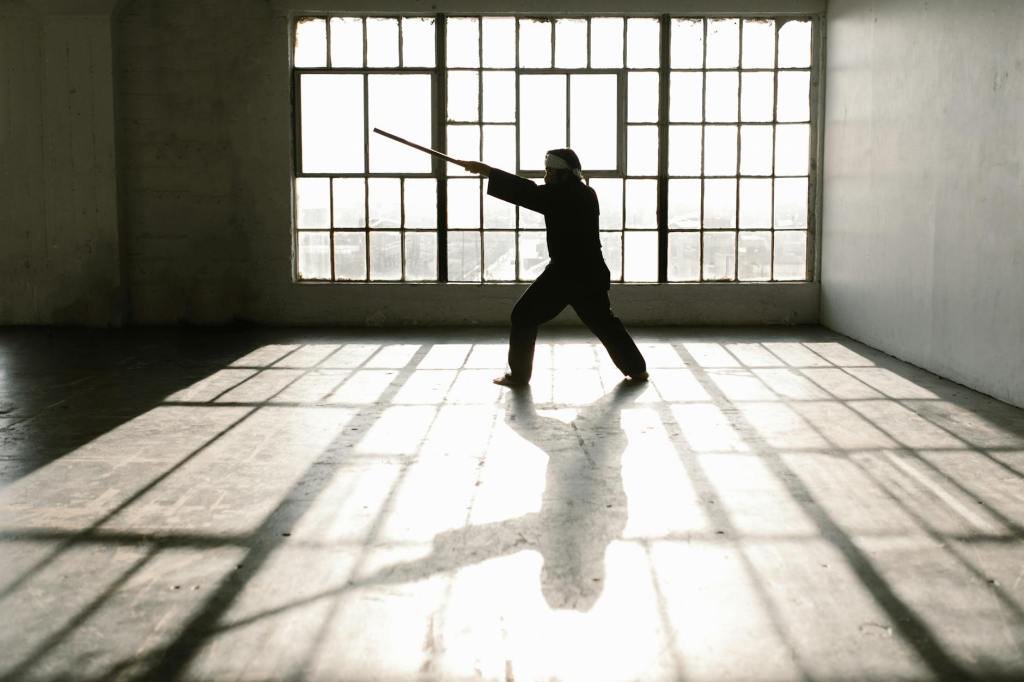
    “Ah, Grasshopper,” he said, with the unhurried calm of someone who’s never paid a utility bill, “the woman buried in a shallow grave is not your enemy. She is your teacher. She shows you the short bridge between life and death. You imagine the bridge as long, but in truth it is a nub, barely the length of a thought. Horror films remind you that you are always one bad turn from the dirt nap.”

    “That’s profound, Master, but I still can’t sleep.”

    “You mustn’t flee from the woman under your bed,” he said. “You must reach into the grave and pull her out. In saving her, you save yourself.”

    “I’m not going near a grave,” I said. “I have claustrophobia.”

    “Life and death,” he replied, “are the same thing seen from opposite sides of the same coin.”

    “I prefer the life side, thank you.”

    “You cling to your vantage point because you think it’s fixed,” he said, with the patience of a man lecturing a doorknob. “But it will shift. When you accept change, death will no longer frighten you—and once that fear is gone, nothing can stop you.”

    “Nothing? Like I could hit a baseball five hundred feet like Reggie Jackson?”

    Master Po sighed. “No, Grasshopper. You will stop wanting to be Reggie Jackson. And that will be your home run.”

  • It’s Better to be Smart Than Right

    It’s Better to be Smart Than Right

    Sitting in the classroom at Independent Elementary, I’d burned through Mrs. Eckhart’s reading questions and had an hour to kill, so I launched a silent mutiny on a sheet of white art paper. I drew a submarine the size of a small nation—portholes lined up like pearls, each framing a tiny soap opera. In one, a guy flipped pancakes and invited the crew to “swing by my cabin.” In another, a woman in curlers refused to be seen “in this condition.” A cereal enthusiast raged about a missing prize. A hammock napper protested the racket. A girl clutched a shred of apple skin like it was a ticking bomb in her molar. A dozen noisy lives, each complaining, boasting, living. My plan was obvious: practice now so I could write for Mad Magazine later.

    Enter Mrs. Eckhart, patrolling the aisles like customs at the border. Red bouffant immaculate, eyebrows stepped out of a Hitchcock film. She stopped at my desk and stared down at the sub—my U.S.S. Bad Timing.

    “Is this how you spend your time in my class?”

    “I finished the assignment. I’m working quietly.”

    She read my dialogue bubbles aloud, pitch-perfect sarcasm, the kind that knives you with your own words. The class erupted. I was roast beef, she was the carving knife. Then the verdict: “Your parents should know this is how you spend classroom time.”

    She scrawled a note on the back of my masterpiece and demanded signatures before I returned it. At home, Dad examined the evidence like a prosecutor smelling a plea bargain.

    “You pissed off your teacher,” he said.

    “I don’t know why. I finished my work. I was quiet.”

    “It doesn’t matter. You insulted her.”

    “How?”

    “By finishing early and doodling, you told her the work was too easy. You disrespected her.”

    “I kept quiet. That’s hardly a crime.”

    “In life, it’s better to be smart than to be right.”

    “I thought they were the same thing.”

    “Not always. Today you were technically right and strategically stupid. Go to your room and think about it.”

    In exile, I summoned my emergency therapist: Master Po, Shaolin sage of my imagination.

    “Master Po, why am I the villain for drawing a submarine? And what does ‘be smart, not right’ even mean?”

    “Grasshopper,” he said, voice like wind across stone, “the world is full of educated people who know nothing. Wisdom is entering another’s mind, seeing as they see. Your father is correct. Choose smart over right.”

    “If being right doesn’t count, why learn right from wrong at all?”

    “Model yourself on Heaven’s righteousness,” he said, “but travel the earth with tact. Know what you do not know.”

    “Know what I don’t know? That feels like a riddle you give to people you want to confuse.”

    “You strain at my words as muddy water through a sieve. Clarity will come.”

    “Meanwhile, I’m grounded and missing Hogan’s Heroes.”

    “Unfortunate,” he said, not sounding remotely sorry.

    “Life is a riddle I can’t solve.”

    “You try too hard. Relax. Let go. Answers fall like rain.”

    “I could relax more if Dad paroled me to the television.”

    “Sitting quietly is perfect. With no intention and no movement, you will, like the perfect traveler, arrive.”

    I stared at the ceiling, the paint a milky ocean, my submarine rolled into evidence on the desk. Maybe Dad was right. Maybe Mrs. Eckhart wasn’t grading my drawing so much as my social intelligence—and I’d failed the pop quiz. The adult world prized two currencies: accuracy and tact. I had exact change for the first and lint for the second.

    Still, some small part of me refused to shred the sub and plead guilty to artistic misconduct. Those porthole people—pancake guy, curler lady, apple-skin girl—were ridiculous, yes, but they were also alive, chattering in their cramped circles under a thousand fathoms of routine. Maybe the problem wasn’t that I drew a submarine; maybe the problem was I’d launched it in the wrong harbor.

    Fine. Next time I’d finish late, or pretend to. I’d ask one question with the tone of a pilgrim seeking wisdom. I’d keep the submarine for after school, where editors at Mad Magazine would understand that sometimes the only way to survive a classroom is to build your own vessel and sail beneath the noise.

    For now, I sat still, practicing the advanced art of “no intention, no movement.” If arrival meant living through this night without losing my sense of humor—or my drawing—I could live with that. Smart over right, sure. But right over silent? Not always. Sometimes you keep the submarine.

  • Master Po vs. My Perfect Alibi

    Master Po vs. My Perfect Alibi

    In 1972, on the dust-choked battlefield otherwise known as the Independent Elementary playground, Miguel Torres and I were locked in a holy war over an alleged clipping penalty. Gary Kauffman—self-appointed referee, rules committee, and prophet of doom—had flagged me during tag football, a call that would hand my team the loss. Words got hot. “Cheater” ricocheted between us like a stray bullet. Then Miguel’s fists did the talking—left, right, a percussion solo on my jaw.

    I cried—not because I stood there like a department-store mannequin while his knuckles composed a sonata on my face, but because I was blind. I hadn’t read the storm system building in my friend—barometric pressure falling, hostility rising—and I was stunned that my protest could yank that much fury out of someone who’d traded Twinkies with me at lunch.

    The recess bell shrieked. We jogged back to class, me sniffling, my face a throbbing geography lesson. Mrs. Eckhart opened My Side of the Mountain, but I heard only the drumbeat in my skull and the soft crush of my pride underfoot. I retreated inward to the place my imagination had been furnishing for months: a quiet stone courtyard outside the Shaolin Temple, the same one that glowed from our black-and-white TV. The river whispered nearby. Incense drifted like daydreams. And there stood my spiritual guide, Master Po—blind as justice, sharp as a scalpel.

    “Master Po,” I said, still tasting the copper of humiliation, “you once taught me that weakness prevails over strength and gentleness conquers. Yet my team lost, my friend rearranged my face, and I stood there helpless. Where was gentleness then?”

    “Grasshopper,” he said, “you mistake stubbornness for virtue. You are the rigid branch that neither sees the distant hills nor hears the cooling wind—and so you snap. Begin by seeing. Begin by listening.”

    “What am I not seeing? What am I not hearing?”

    He tilted his head. “For one, you did not hear the expletives cannoning from your mouth—shrapnel of spit landing on your friend’s cheeks. For two, you did not see your own finger spearing his chest, drilling his solar plexus as if mining for a confession.”

    “So I was ticking off Miguel without even knowing it?”

    “Precisely, Grasshopper. You cherry-pick facts to star in your favorite film—You, the Noble Victim—while everyone else auditions for Villain. Myth-making is a miraculous tool for preserving self-esteem. It is also the shortest road away from The Way.”

    “I don’t myth-make.”

    He raised an eyebrow in the patient way only the blind can. “When you were six, you slept at your aunt and uncle’s and wet the bed. Instead of accepting the weather report from your own bladder, you blamed…the Pee Fairy.”

    I winced. “I remember. It was quick thinking.”

    “What else do you remember?”

    “That I repeated the lie until it became embroidered truth. I argued anyone who doubted me into silence. The Pee Fairy did it. Obviously.”

    “Exactly,” he said. “When you muddle truth long enough, you lose your own outline. You become your costume.”

    “How do I follow The Way?”

    “Do not costume yourself. Do not curate a personality for the world like outfits for the first day of school. Let time carve you. Emerge by erosion, not construction.”

    “I’m eleven,” I said. “Time carves slowly. Also, if I don’t finish my social-studies questions by sixth period, I’ll be carving them in detention.”

    He smiled. “By doing nothing, everything is done.”

    “Try that on Mrs. Eckhart.”

    “You have much to learn, Grasshopper.”

    Back in the fluorescent glare of fifth grade, Mrs. Eckhart’s voice returned, turning pages into wind through trees. I pressed a cool palm to my cheekbone, felt the ache, and wondered if wisdom always arrived late—long after the bell, after the punch, after you realize you were yelling at a friend and mistook your echo for righteousness. Maybe gentleness isn’t an instant shield; maybe it’s a habit you grow, a small current under the noise, the kind that keeps a rigid branch from snapping when the playground becomes a courtroom and you’ve already sentenced yourself to innocence.

  • What My Online Students Think of Online Education

    What My Online Students Think of Online Education

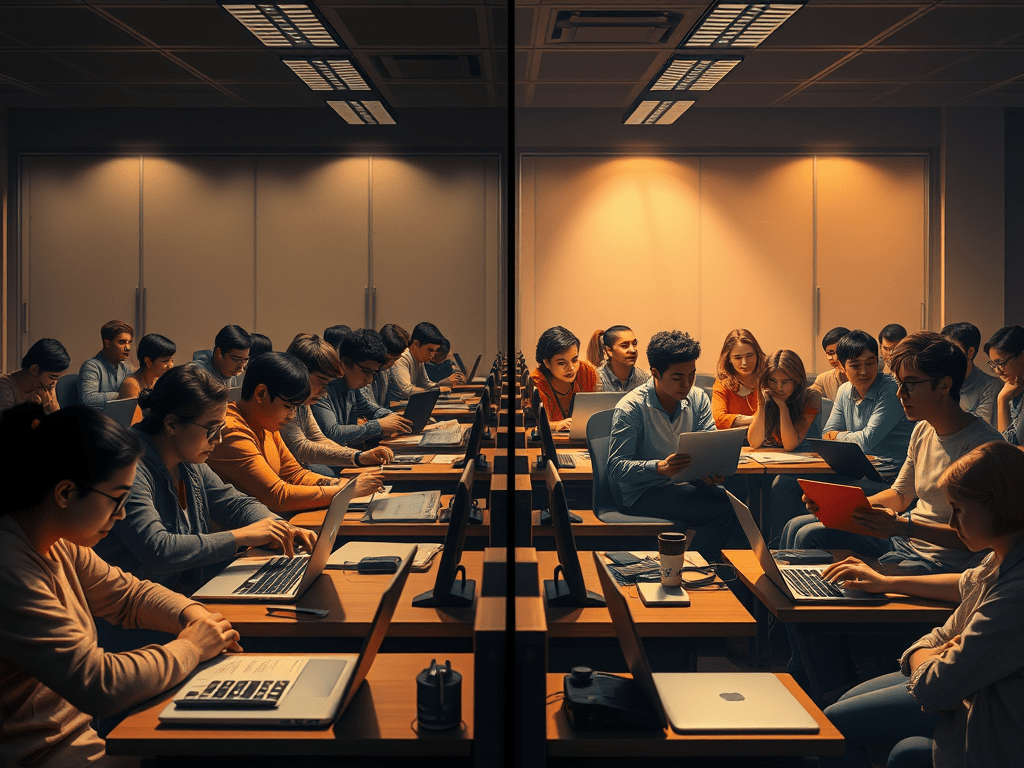
    In my Canvas discussions, I asked my online students to compare digital learning with face-to-face classes, focusing on engagement. Their responses revealed a consistent theme: engagement is welcome only when it feels meaningful. They don’t mind interacting if the instructor gives them authentic, purposeful tasks—not the mechanical grind of busywork disguised as “participation.” 

    Several admitted that the steady stream of Canvas notifications feels like digital nagging, while others said they’ve grown fluent in navigating the platform. 

    Many praised the control and solitude of online courses, saying they prefer working alone to enduring the awkward silences, small talk, and clock-watching of in-person classes.

    A number of students described their lives as an intricate juggling act—full-time jobs, parenting, long commutes—and called online education “a lifeline.” Without it, they said, college simply wouldn’t be possible. 

    What I took from these exchanges is that my students crave efficiency and purpose. They want online courses that are streamlined, clearly organized, and free from filler. They appreciate the focus that comes with studying privately, without the distractions and logistics of campus life.

    While pass rates in online courses can be up to fifteen percent lower than in-person ones, that statistic misses the larger truth: online education isn’t a luxury—it’s a necessity. For many working adults and parents, it’s not just another mode of learning; it’s the only door still open.

  • My Doppelganger in Dark Sweats

    My Doppelganger in Dark Sweats

    Last night I dreamed that a baby had been abandoned in the flower garden outside my San Francisco apartment. His thin wail rose above the city hum, but no one seemed to hear it but me. The world went on—cars passing, neighbors coming and going—while I alone stood transfixed by that cry. I lifted the baby from the dirt, his skin warm and impossibly soft, and held him against my chest. Standing at the threshold of the apartment I rented with my wife and our stray orange cat, I prayed for holiness and wept, as though the infant had been dropped from heaven for me alone to fail or redeem.

    Inside, the apartment felt like an expensive tomb—luxurious, dim, deliberately shadowed, as if light itself were rationed. I fed the child and watched him feed, marveled at the smallness of his breaths. When his parents arrived, both scientists, I confronted them. They were calm, rational, and convinced me of their legitimacy with clinical precision. Their excuse was airtight, their affect detached, and in the end, I surrendered the baby, though my faith in their explanation felt paper-thin.

    Then the parents and the baby were gone. At this point, my role inside the apartment was clear: My wife and I were educators using the apartment to host seminars on DNA and algorithms for college students. The air smelled faintly of coffee and ozone. During one of these sessions, the true apartment owner appeared: my thirty-year-old doppelgänger, tall, lean, dressed in the sleek anonymity of wealth—dark designer sweats, minimalist sneakers. He admired the apartment I had borrowed as though validating his own taste: the kitchen gadgets gleamed like relics, the food neatly arranged, the DVDs alphabetized. His presence was eerie—a reflection of my own mind rendered in a sharper resolution. We talked about the future buyer of the apartment, another iteration of us—older, familiar, running on the same mysterious algorithm encoded in our shared DNA.

    When the lecture ended, my wife and I returned the keys to my younger self and walked hand in hand along the apartment’s tennis courts. The sky had the bruised hue of evening. I told her that everything—the baby, the double, the science lectures—had overwhelmed me. I broke down, crying again for the purity I had felt when I prayed over the abandoned child. That moment at the doorstep remained the still point of the dream: holiness in the act of holding something utterly helpless, something untouched by algorithm or ownership.

  • Will Online Education Expose the Class Divide?

    Will Online Education Expose the Class Divide?

    I began teaching online composition in March 2020, when the world suddenly went remote. Like everyone else, I adapted out of necessity, not preference. Since then, I’ve taught both online and face-to-face courses, and the contrast has been eye-opening. I never realized how physically demanding in-person teaching was until I experienced the frictionless ease of the online classroom. Behind the Canvas wall, I am a disembodied voice, orchestrating discussion like the Wizard of Oz. In person, I am on stage—reacting, performing, fielding energy and questions in real time. It is exhilarating and exhausting, proof that teaching in the flesh demands more than intellect; it requires stamina.

    Today, I discussed this with a friend and colleague nearing seventy, a man who has been teaching full-time for nearly forty years. Despite the fatigue of in-person instruction, he refuses to teach online. His reasoning is both moral and practical. He doesn’t like the lower pass and retention rates of online classes, but his deeper concern is social. “The more we move online,” he told me, “the worse the class divide gets. Only rich students will take face-to-face classes and get a real education. Poor students—working long hours and pinching gas money—will settle for online. Don’t you see, McMahon? It’s an equity issue.”

    He had a point. “So what you’re saying,” I replied, “is that the wealthy can afford genuine engagement—real classrooms, real conversation—while online education offers a simulation of that experience for everyone else.” I paused, thinking about my own students. “But it’s not just an equity issue,” I added. “It’s an engagement issue. We talk endlessly about ‘student engagement’ in online learning, but that word is often misplaced. Many students choose online classes precisely to disengage. They’re working parents, caretakers, exhausted employees. They don’t want a full immersion—they want survival. They want the credential, not the communion.”

    Later that morning, I brought this conversation to my freshman composition class. When I asked if they wanted “student engagement” in their online courses, they laughed. “Hell no,” one said. “It’s like traffic school—you just get through it.” Another, a bright fire science major, confessed that after eight weeks of an online class, she’d learned “absolutely nothing.” Their expectations were low, and they knew it. Online education, for them, was not a journey of discovery but an obstacle course—something endured, not experienced. Still, as someone who teaches writing online, I can’t accept that entirely. I want my courses to be navigable and meaningful—to raise enduring questions that linger beyond the semester. Like Dorothy on the yellow brick road, I want students to follow a clear path, one step at a time, until they reach their own version of Oz. And while I know online learning will never replicate the immediacy of face-to-face teaching, I don’t think it should. Each has its own logic, its own measure of success. Forcing one to imitate the other would only flatten them both.

  • Flexing My Wrist Presence Against the Dying of the Light

    Flexing My Wrist Presence Against the Dying of the Light

    In my early forties, I was drunk on “wrist presence.” I wanted watches so large they could double as signal mirrors for rescue helicopters. The bigger the case, the smaller my self-esteem. These oversized monstrosities weren’t badges of taste; they were distress flares of insecurity and a middle-aged identity crisis. Even as my horological palate matured, the vanity remained. I wasn’t trying to tell time—I was trying to tell the world I mattered.

    Yet my vanity was oddly selective. I didn’t care if my car was plain as Melba toast or if my wardrobe screamed “laundry day.” All I wanted was a clean Honda Accord, a passable body, a pair of jeans, a T-shirt, and a watch that did the heavy lifting of my entire identity. For two decades, that formula felt like equilibrium—a minimalist shell hiding a maximalist ego.

    Then, late in my sixty-third year, the vibe shifted. The thrill curdled. My so-called “signature watch” no longer filled me with adrenaline and dopamine. 

    I still love my divers, but wearing them now feels less like conquest and more like quiet companionship. The fire has cooled. No amount of flexing on Instagram or brooding on YouTube can resurrect that manic gleam. The truth is brutally simple: every tick of the watch is a memento mori. I’ve aged out of the performance. Time, the final minimalist, has stripped me down and humbled me in the face of my mortality. 

  • AI—Superpower for Learning or NPC Machine?

    AI—Superpower for Learning or NPC Machine?

    Essay Assignment:

    Background

    Students describe AI as a superpower for speed and convenience that leaves them with glossy, identical prose—clean, correct, and strangely vacant. Many say it “talks a lot without saying much,” flattens tone into AI-speak, and numbs them with sameness. The more they rely on it, the less they think; laziness becomes a habit, creativity atrophies, and personal voice is lost and replaced by AI-speak. Summaries replace books, notes replace listening, and polished drafts replace real inquiry. The result feels dehumanizing: work that reads like it was written by everyone and no one.

    Students also report a degradation in their education. Higher learning has become boring. Speed, making deadlines, and convenience are its key features, and the AI arms race pushes reluctant students to use AI just to keep pace. 

    The temptation to use AI because all the other students are using it rises with fatigue—copy-paste now, promise depth later—and “later” never arrives. Some call this “cognitive debt”: quick wins today, poorer thinking tomorrow. 

    Some students confess that using AI makes them feel like Non Player Characters in a video game. They’re not growing in their education. They have succumbed to apathy and cynicism as far as their education is concerned. 

    Other students admit that AI has stolen their attention and afflicted them with cognitive debt. Cognitive debt is the mental deficit we accumulate when we let technology do too much of our thinking for us. Like financial debt, it begins as a convenience—offloading memory, calculation, navigation, or decision-making to apps and algorithms—but over time it exacts interest in the form of diminished focus, weakened recall, and blunted problem-solving. Cognitive debt describes the gradual outsourcing of core mental functions—attention, critical reasoning, and creativity—to digital systems that promise efficiency but erode self-reliance. The result is a paradox: as our tools grow “smarter,” we grow more dependent on them to compensate for the very skills they dull. In short, cognitive debt is the quiet cost of convenience: each time we let technology think for us, we lose a little of our capacity to think for ourselves. 

    Yet the picture isn’t purely bleak. Several students say AI can be a lifeline: a steady partner for collaborating, brainstorming, organizing, or language support—especially for non-native speakers—when it’s used as a tutor rather than a ghostwriter. 

    When used deliberately rather than passively, AI writing tools can sharpen critical thinking and creativity by acting as intellectual sparring partners. They generate ideas, perspectives, and counterarguments that challenge students to clarify their own reasoning instead of settling for first thoughts. Rather than accepting the AI’s output, discerning writers critique, refine, and reshape AI writing tools—an exercise in metacognition that strengthens their analytical muscles. The process becomes less about outsourcing thought and more about editing thought—transforming AI from a shortcut into a mirror that reflects the quality, logic, and originality of one’s own mind.

    When used correctly, AI jump-starts drafts and levels the playing field; leaned on heavily, it erases voice, short-circuits struggle, and replaces learning with mindless convenience

    Question You Are Addressing in Your Essay

    But can AI be used effectively, or does our interaction with it, like any other product in the attention economy, reveal that it is designed to sink its talons into us and colonize our brains so that we become less like people with self-agency and more like Non Player Characters whose free will has been taken over by the machines? 

    Writing Prompt

    Write a 1,700-word argumentative essay that answers the above question. Be sure to have a counterargument and rebuttal section. Use four credible sources to support your claim. 

    Suggested Outline

    Paragraph 1: Write a 300-word personal reflection about the way you or someone you know uses AI effectively. Show how the person’s engagement with AI resulted in sharper critical thinking and creativity. Give a specific example of the project that revealed this process. 

    Paragraph 2: Write a 300-word personal reflection about the way you or someone you know abuses AI in a way that trades critical thinking with convenience.  How has AI changed the brain and the person’s approach to education? Write a detailed narrative that dramatizes these changes. 

    Paragraph 3: Write a thesis with 4 mapping components that will point to the topics in your supporting paragraphs.  

    Paragraphs 4-7: Your supporting paragraphs.

    Paragraphs 8 and 9: Your counterargument and rebuttal paragraphs.

    Paragraph 10: Your conclusion, a dramatic restatement of your thesis or a reiteration of a striking image you created in your introduction. 

    Your final page: MLA Works Cited with a minimum of 4 sources. 

  • Discontinued at the Light

    Discontinued at the Light

    At a red light yesterday, ferrying my daughters home from school, my car-spotter’s radar pinged. I scan traffic the way birders scan treelines, always hoping for the rare specimen with that elusive look. Something unusual flashed past—and in a beat I clocked it: a 2023 Nissan Maxima, the model’s final year. A voice in my head muttered, “Discontinued.” The word tolled like a small funeral bell, as if it weren’t about the Nissan at all but about me. You’re nearly sixty-four. You are discontinued.

    I refuse to go out like that. Aging is one thing; embalming yourself in morbid commentary is another. I don’t want to spend the next twenty years muttering “discontinued” at traffic, toast, or mirrors. That’s not wisdom. That’s a tantrum with better vocabulary.

    Let’s call morbidity what it is: the childish whining of a narcissist. Who escapes aging? Only the people who don’t get the privilege. Getting old means you’ve been alive for a long time and you’re still here. The refrain—“Discontinued,” “You’re washed up,” “It’s all over”—isn’t just bleak; it’s lugubrious, a mental ailment missing from the DSM-5-TR. Fine, I’ll name it myself: narcissistic morbidity. You moan about your age until you bore everyone around you, including the poor soul trapped inside your skull. You act like you invented birthdays.

    What makes my case extra ridiculous is that I’m in decent shape. I work out. I eat a high-protein diet. Yes, I’m fifteen pounds over fighting weight, but I don’t look like a cautionary tale. I should be grateful, robust, hearty, glad. And yet the diseased little sportscaster in my cranium keeps calling the game: I’ll be driving my daughters, spot a car out of production, and use it as my cue to point at myself—“Discontinued.”

    If I were a comedian, this would be a layup: a man in his sixties drowning in self-pity, heckled by his own internal voice. There’s material for days. But punchlines only work if you know your heckler’s origin story.

    Here’s the reveal: the voice isn’t new. I’ve had it since childhood, a fog machine that kept me holed up drawing and reading while calamity forecasts scrolled across my mind. “The circus will be closed. A lion will escape. There’ll be a riot. Let’s not go. Don’t worry about me; I’ll entertain myself.” “The ice-cream place won’t have my flavor. Let’s stay home; I’ll eat cereal.” “If I throw a party, no one will come. Cancel my birthday this year—and the years after. Who needs a birthday anyway?”

    My gloomy companion even had a cartoon avatar: Glum, the tiny pessimist from The Adventures of Gulliver, late ’60s. Dressed in green, eternally peckish, and permanently resigned—“It’s hopeless.” “We’ll never make it.” “It’ll never work.” “We’re doomed.” He was my first soulmate: snack-oriented, catastrophe-forward.

    Back then TV specialized in a certain archetype—the Dead Weight Character—the one who drags the mission, sandbags morale, and sabotages the plan by simply existing. Land of the Giants fielded Commander Alexander Fitzhugh, a selfish criminal who once gnawed a giant scientist’s rabbit pellets and urged his tiny crew to feast with him because of “nutrition,” a word he repeated over and over as he consumed rabbit pellets. They saw humiliation; he saw survival. Dead Weight comes in many flavors.

    And then there was the greatest Dead Weight of them all: Dr. Zachary Smith of Lost in Space, immortalized by Jonathan Harris, patron saint of theatrical dread. His alliterative insults aimed at the Robot taught me that language could purr, hiss, and bite. Dr. Smith is, frankly, the reason I went to college and became an English major. If you’re going to sabotage a mission, at least do it with diction.

    So if I must live with an inner prophet of doom, I might as well upgrade his elocution. If the voice insists on heckling—calling me discontinued at stoplights and breakfast tables—then give it rhetorical muscle and meter. Let it speak in crafted sentences, not groans. Aging will still arrive right on schedule, but at least the narration won’t be dead weight.

  • The Heartbreak of Micky Dolenz (piano excerpt)

    The Heartbreak of Micky Dolenz (piano excerpt)

    When I was five, I watched The Monkees episode “I Was a 99-Pound Weakling.” Micky Dolenz, tired of sand in the face, starts lifting to steal back his dream girl from beach tyrant Dave Draper—Bulk himself. He returns a walking bicep, ready for triumph, and finds the blonde beauty arm hooked through a new idol: a skinny intellectual reading Proust’s Remembrance of Things Past. Micky’s expression does the math—pecs don’t beat paperbacks—and the lesson welded itself to my skull. Many years later, I’d write a piano composition, “The Heartbreak of Micky Dolenz.” What follows is an excerpt from that longer work.