Blog

  • The Watch That Squatted in My Brain

    The Watch That Squatted in My Brain

    Six weeks ago I flirted—briefly, innocently—with an all-black Citizen Attesa. I ogled it on Sakura Watches, skimmed a few YouTube reviews, and rendered a tidy verdict: Handsome? Yes. Would I wear it in the wild? No. A museum piece for other people’s wrists. I closed the tabs and returned to my life. Or so I thought. Because the Attesa didn’t move on. It began stalking me with the devotion of a stray that has chosen its human. I’d open the Times, the Post, the Atlantic, the New Yorker—and there it was again, gleaming like a prom queen locking eyes across the gym, smiling just enough to suggest destiny and just enough to feel dangerous.

    That’s when the questions got weird. Why is this watch tailing me? Is it cosmic—my own horological North Star? A nudge from fate? Or something less celestial and more diabolical? Are marketing engineers quietly installing this thing in my skull, the way my engineer friend once installed competence on my computer during a Zoom rescue mission? I remember giving him full control and watching, slack-jawed, as he ninja-glided through my settings like a man who had memorized the machine’s dreams. Now I wonder if the Attesa has done the same to my mind—deleted entire neighborhoods of thought and rezoned them for luxury steel.

    Because let’s be honest: the watch isn’t just appearing on my screen; it’s squatting in my head. I no longer “think about” the Attesa—the Attesa thinks inside me. This is Cognitive Squatting: when a marketed object occupies prime mental real estate long after rational interest has expired. It pays no rent, ignores the lease, and refuses eviction. It replaces memory with mirage and turns coincidence into choreography. Do I still own my brain? Of course not. I’m a tenant now.

    So if one day you spot me wearing that all-black Attesa, don’t congratulate me on my taste. Call the authorities. I won’t be human anymore. I’ll be a converted unit—property of the algorithm—walking the earth as a watch-wearing android, ticking obediently to a rhythm I no longer chose.

  • Notes from a Man Who Almost Quit

    Notes from a Man Who Almost Quit

    A couple of days ago I posted a video that wandered—cheerfully and without a map—through two connected ruins: the normalization of male anger among boys raised by furious fathers in the 1970s, and the era’s larger faith in the Cult of Self. The seventies didn’t just give us flared jeans and shag carpets; they gave us a theology in which personal desire was holy and self-fulfillment was the promised land. If it felt good, it must be true. If it felt restrictive, it must be oppression. The problem, of course, is that this gospel of indulgence didn’t liberate anyone. It detached people from reality—its dangers, its obligations, its stubborn insistence that meaning comes from service, not worship of the mirror. Happiness, in adult life, is a side effect of using your talents to serve others. In adolescent mythology, it’s supposed to arrive through nonstop self-adoration. One path leads to purpose. The other leads to addiction, loneliness, and a master class in self-inflicted insanity.

    I was nervous about posting the video because it rambled like a drunk uncle at Thanksgiving. Structurally, it was a mess. Spiritually, I loved making it. Instead of delivering a pinch-faced lecture, I told stories—about my younger days as a glutton disguised as a bodybuilder, an aspiring hedonist loitering with my surfer-bro friend, both of us chasing pleasure like it owed us money. To my surprise, the audience didn’t flinch. The comments came back warm. The themes—male anger, Boomer dislocation in a world that moved on without us, the tragic comedy of self-indulgence—landed. Apparently, people still have an appetite for conversations that don’t flatter them.

    What made the whole thing sweeter is that I had been flirting with the idea of quitting YouTube altogether. My excuse was noble-sounding: I’ve already said everything worth saying. But underneath that was a quieter truth—I was retreating. Folding inward. Slipping toward a comfortable, well-furnished silence. Then a louder voice cut in: Don’t confuse retirement with wisdom. Don’t confuse exhaustion with completion. The video became a small rebellion—my living self telling my future fossilized self to take a hike. Life won the argument.

    Now I face the classic writer’s hangover: the fear that I’ve set a standard I can’t meet again. After a piece feels honest, everything that follows looks trivial, trite, or terminally lame. But that fear is the job. Writing isn’t a vending machine that spits out brilliance on command. It’s excavation. You dig and dig and learn to tell the difference between ore and dirt. If you can’t live with that grind, you’ll anesthetize yourself with Netflix and hero sandwiches until despair arrives—far uglier than the honest struggle you tried to avoid. Creation is hard. Avoiding it is harder.

  • “Yes, Kumail. Lift in anger. Lift in truth.”

    “Yes, Kumail. Lift in anger. Lift in truth.”

    On Friday night I sat in a theater watching my daughter’s dance performance—hundreds of high-schoolers, mostly girls, moving with athletic grace, precision, and fearless confidence—and I felt… bored out of my skull. Not proud of that. Not even neutral about it. Guilty bored. The worst kind. But after the fifth song with no narrative thread, no arc, no reason for existing beyond “vibes,” the whole experience started to feel like doom-scrolling a TikTok feed in human form. One glittering routine after another, all spectacle and no story. The sum effect wasn’t inspiration. It was sensory overload with a faint whiff of algorithmic numbness. Too much content. Too little meaning. Call it the aesthetic of “too much AI.” 

    To complete the sensory assault, the dry-ice fog machines gave my wife a headache—apparently carbon dioxide is not a love language. Being the saint she is, she went back for the Saturday recital while I stayed home and committed an act of mild rebellion: I made my first YouTube video in a month. I rambled about watch addiction, being a Boomer in a household that is aggressively not Boomer, and somehow braided all of it into my existential admiration for Rob Lowe’s memoir Stories I Only Tell My Friends. I assumed my subscribers would be polite and puzzled. Instead, they were enthusiastic. They seemed grateful for the mess. Which only confirms my long-standing suspicion that coherence is overrated if the tone is honest enough. Still, I hedged my bets and linked to the more disciplined essay version, just in case anyone wanted their chaos with footnotes.

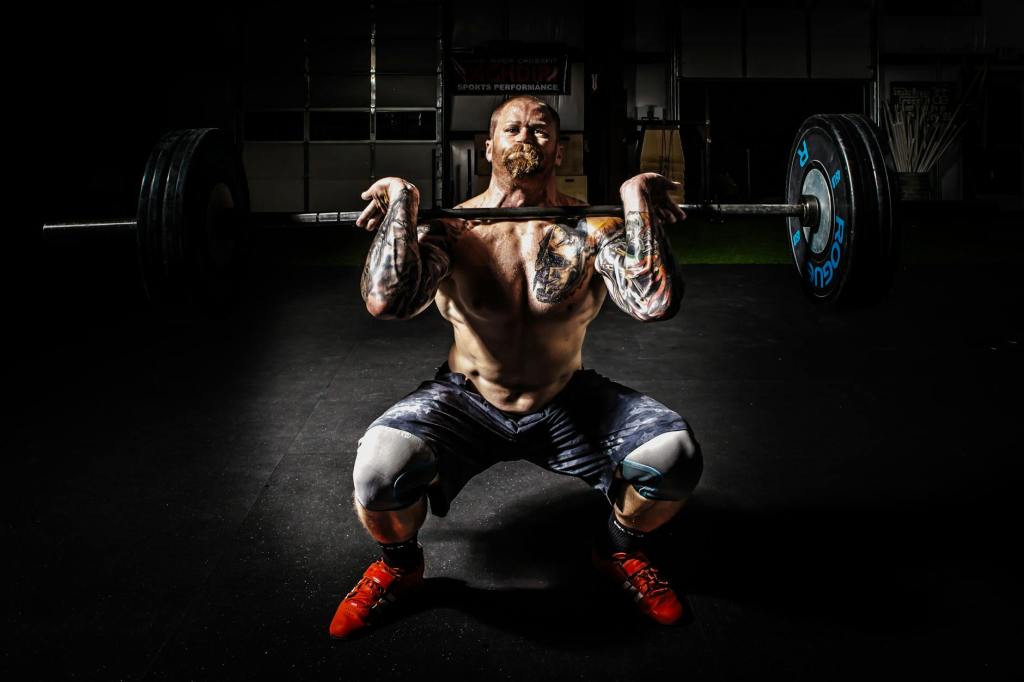
    When my wife and daughters came home, I was sprawled on the couch watching the opening minute of Kumail Nanjiani’s stand-up special Night Thoughts. My wife sat down, we kept watching, and by the end I was applauding at the television like a deranged theater patron. I never do that. But there I was, fist in the air, cheering as Kumail—now built like a Marvel side quest—talked about being publicly scolded for daring to get jacked. His response? He’ll get even more jacked out of spite. I yelled encouragement at the screen as if I were his life coach. “Yes, Kumail. Lift in anger. Lift in truth.”

    I was jealous of his talent, of course. That’s part of the contract when you watch someone that good. But mostly I was happy for him. He’s just getting started, and it shows. Some people peak early. Some people arrive right on time. Watching him, I felt the rare pleasure of witnessing momentum in real time.

  • Seven Watches, Fifteen Grand, and One Hard Lesson About Growing Up

    Seven Watches, Fifteen Grand, and One Hard Lesson About Growing Up

    People always ask why I started focusing on watches ten years ago on my YouTube channel. The honest answer is awkward: I love watches—but I love food more. Obsessively more. Food has been my lifelong religion. In the early ’90s, when I lived in a bachelor pad that smelled like basil and ambition, my Navy SEAL friend Mike used to call and say, “McMahon, I can hear you chewing through the phone again. Every time I call you, you’re eating. What is it now, Fat Face?”
    “Angel hair pasta with pesto.”
    “Sounds dangerous. I’m coming over, Fat Face.”
    And he would—just in time to demolish everything I’d made. His appetite was powered by military drills and endless surfing sessions in Huntington Beach and Ventura. The man burned calories like a forest fire burns pine needles.

    One day he called again. “I’m heading to Santa Barbara to surf. Come with me.”
    “I can’t surf, Mike.”
    “I know you can’t surf, genius. My girlfriend Nicole will be there. She wants to set you up with her friend, Michelle, from Newport Beach. Now can you surf?”
    That’s how I ended up tagging along on adventures that had nothing to do with waves and everything to do with spectacle.

    Mike lived with his dad, Bob, a former Marine with a voice like a foghorn and a temper to match. Their daily ritual involved shouting matches over lawn mowing, garage messes, and grocery duties—two barrel-chested men poking each other like rival roosters while spittle flew. Five minutes later, the war would end, and we’d be off on a Mongolian beef run with Social Distortion blasting in Mike’s Toyota four-wheeler. Back at the house, they’d watch John Wayne movies, and Bob would open his gun safe “just in case the Duke needs backup.” This was not dysfunction to me. This was home.

    I’m a Boomer. I grew up in a world where anger was normal—where fathers barked orders and discipline came with a belt. When rage becomes your baseline, it’s like living with your brain permanently tuned to a Death Metal station. After a while, you stop hearing the noise. You just call it life. But it isn’t life. I know that now because I’m married to a woman fourteen years younger than me, and we have twin teenage daughters. They do not accept Death Metal Dad. They want something closer to Smooth Jazz—Bach, Earth, Wind & Fire, anything that doesn’t rattle the walls of the house. And they’re right. Rage is not masculinity. It’s a form of intoxication. A dangerous one.

    For me, sobriety isn’t about alcohol or drugs. It’s about anger. That means I have to watch my triggers like a hawk. One of the biggest? New watches. Shiny new objects flip the switch in my brain. Suddenly the Death Metal station is humming again, and I’m spiraling into desire, anxiety, and self-reproach. I know feeding my watch addiction makes me miserable, and when I do something that makes me miserable, I get angry at myself. Then I become a joyless human being—Grandma Sour Pants in sneakers. My family doesn’t want to be around me, and frankly, neither do I.

    The irony is that money isn’t the problem. I’m at a stage in life where I could buy any watch I want. But sanity is expensive. I own seven watches worth about fifteen grand in total, and even that feels like mental labor—keeping the rotation straight, remembering what I have, managing the noise in my head. If I owned twelve, I’d lose my grip entirely. My watch friends tell me, “Life is short. Buy what you want.” Those are words of indulgence, not wisdom. Indulgence has never made me happy. Indulgence is just infantilism in a tuxedo. A man-child with a credit card is still a man-child—and no man-child is happy. He buys things to outrun loneliness, and the things always lose the race.

    Ninety-five percent of my watch purchases were impulsive. Which means ninety-five percent of them were evidence of my own immaturity. I sold most of them at a loss—not because I needed the money, but because I needed my dignity back.

    I come from the Me-Generation, raised in California in the ’70s on a steady diet of self-worship. Rob Lowe’s memoir Stories I Only Tell My Friends nailed it for me. He described the Counterculture as the Worship of the Self—whatever the Self wants, the Self gets. No brakes. No compass. He watched people overdose, vanish, and destroy themselves in Malibu’s sunlit fantasyland. The message was simple: when desire becomes sacred, reality becomes optional—and disaster becomes inevitable.

    I am a watch freak. When I see a watch I love, my brain lights up like I’ve just taken a hit of something illegal. Desire surges. Anger follows. The loss of control is what really enrages me. Rob Lowe had to go to rehab to escape his fantasy life. I don’t want rehab for watches. I want a hobby that fits inside reality instead of dragging me out of it. I want pleasure without compulsion. Enjoyment without obsession. A life without permanent FOMO.

    And here’s the final joke on me: even talking about this makes me nostalgic for being fifteen in Santa Monica and Malibu in 1976. I start looking backward like Lot’s wife, and I can feel myself turning into a pillar of salt. The Death Metal station is warming up again. That’s my cue. I need to change the channel—before I buy another watch and call it happiness.

  • Bland Is My Brand: Confessions of a Simplicity Addict

    Bland Is My Brand: Confessions of a Simplicity Addict

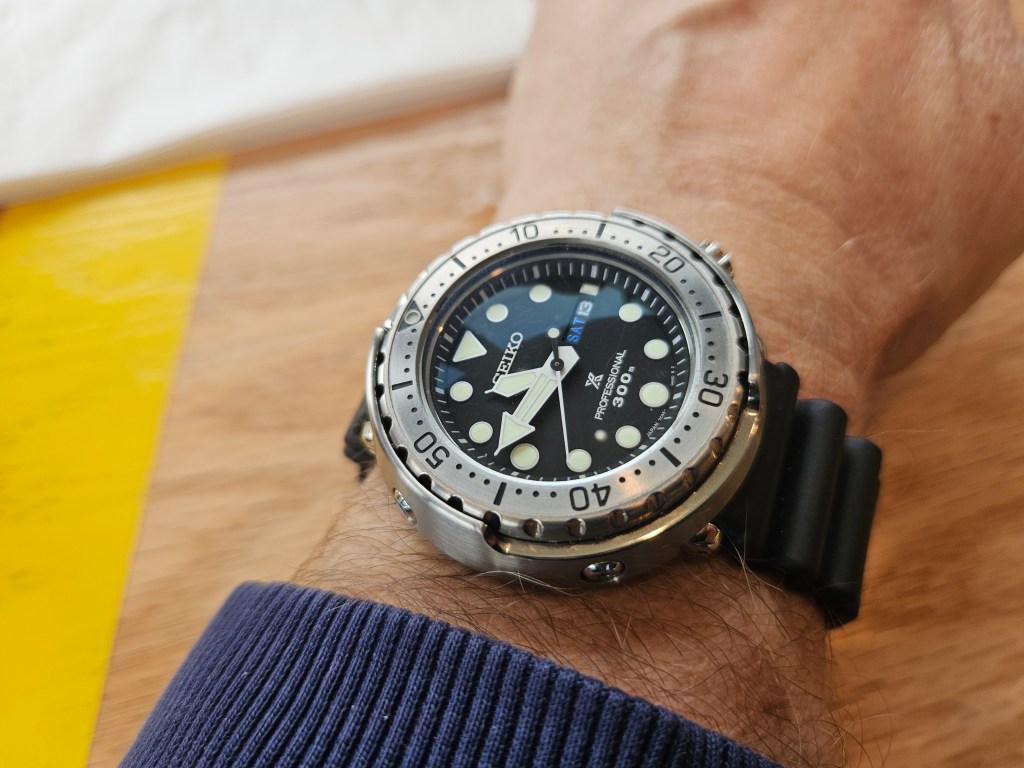
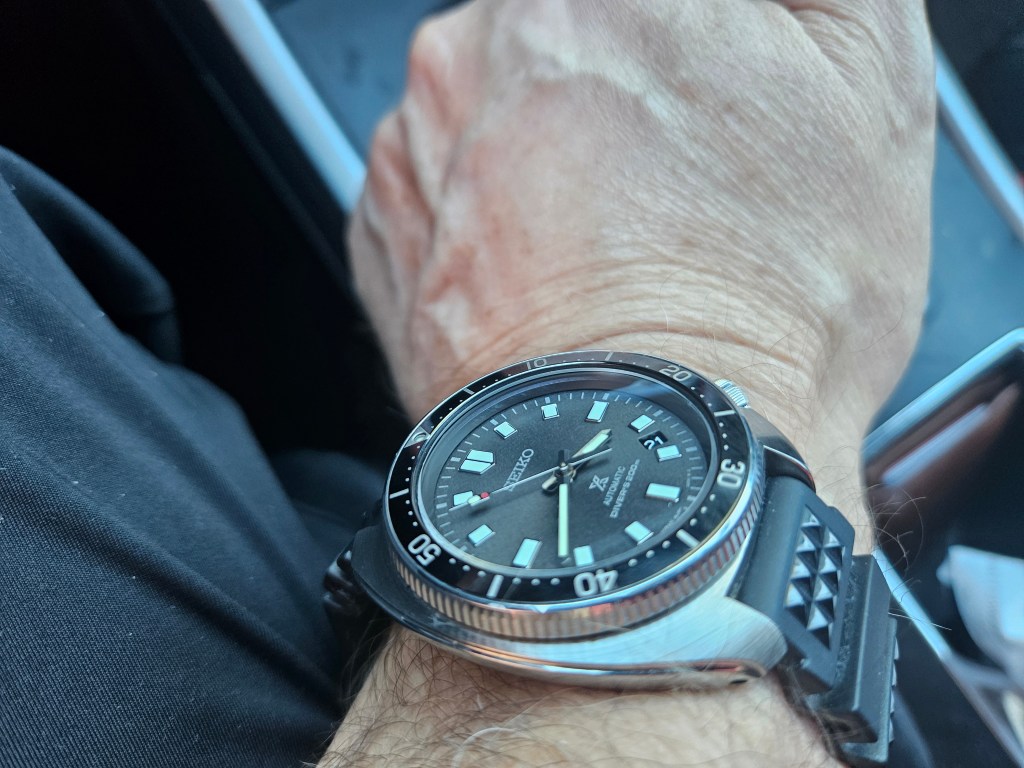
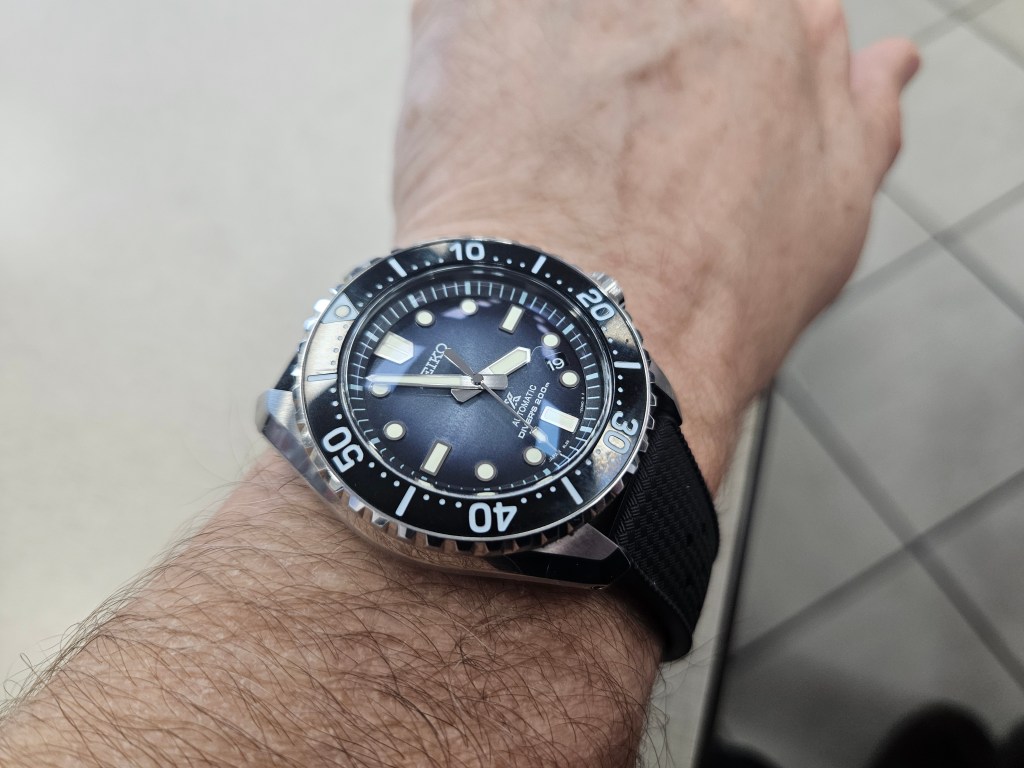
    All I want is a simple life. Not monk-on-a-mountain simple—just orderly, disciplined, and quietly adult. The kind of life where the tools around me signal that I’ve stopped auditioning for chaos. My shaving ritual is a 1959 Gillette Fatboy and cheap double-edge blades. My coffee comes from freshly ground dark roast, brewed slow enough to qualify as a character-building exercise. On my wrist: a diver on rubber, because I value function over flash. My workouts happen in the garage with kettlebells. My wardrobe is a uniform—black athletic pants, dark T-shirts, sherpa sweatshirts when the temperature drops. My car is a Honda Accord: bland, boring, and unkillable. People mock its white-bread styling. I embrace it. Bland is my brand.

    Food, however, is where simplicity turns into a group project. My own diet dreams of sweet potatoes, steel-cut oats, buckwheat groats, millet, tofu sautéed in Trader Joe’s curry or peanut sauce, nutritional yeast sprinkled like the Parmesan of moral superiority. I’ll toss in tuna or salmon a few nights a week for variety. My family, meanwhile, wants chicken tenders and taco meat—organic, sure, but flown in from Australia and Argentina like first-class beef. I made a sincere pitch for a mostly plant-based household. It failed spectacularly. Democracy has spoken, and it wants ground beef.

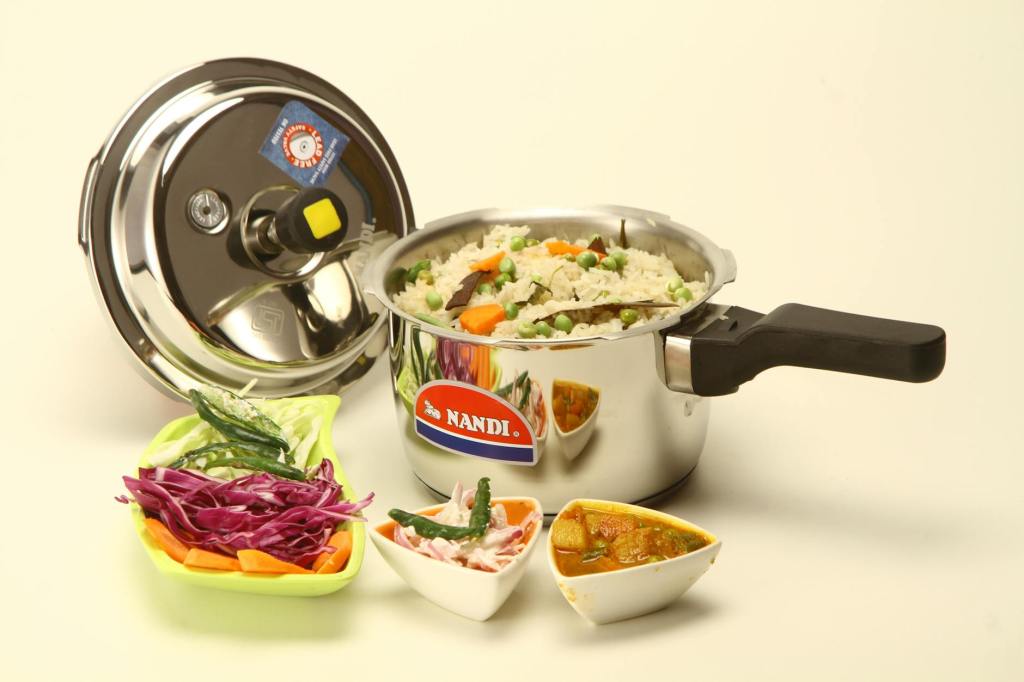
    Appliance-wise, I’m at a crossroads of excess. I own a rice cooker I never use and a giant Instant Pot I never use. They sit there like bulky monuments to abandoned ambition. I could use them for oats, groats, rice, and millet—or I could do what my soul really wants: get rid of both and buy one small pressure cooker that doesn’t hog the counter. Two out, one in. The math thrills me. My wife has approved the purchase. Now comes the real drama: do we donate the old machines, exile them to the garage, or perform the ritual drive to Goodwill? These are the kinds of ethical dilemmas that define modern minimalism.

    Of course, I feel a pang of guilt every time I buy something in the name of owning less. Nothing complicates a simplicity quest like consumer remorse. Forgive me my first-world angst. I suspect this whole project—paring down razors, beans, watches, and appliances—is really a coping mechanism. It’s easier to optimize your oatmeal workflow than confront the madness of the world. So here I am, scrolling Reddit, reading debates about rice cookers versus pressure cookers, pretending that the right appliance might finally bring me peace. Spoiler: it won’t. But it might make better millet.

  • The Masculinity of Noise: How I’m Learning to Retire Anger

    The Masculinity of Noise: How I’m Learning to Retire Anger

    I was born in 1961, late enough in the Boomer generation to miss its mythic highs, but early enough to inherit its emotional weather. In the houses many of us grew up in, male anger wasn’t treated as a problem; it was treated as policy. Fathers were allowed to be unhinged. Discipline arrived with belts and eruptions, not explanations. If you disappointed him—by being slow, gloomy, or merely inconvenient—you didn’t get correction; you got rage dressed up as authority. And if your father was military, as mine was, that rage came with extra starch and sharper edges. Of course, he could also be funny, generous, even heroic in flashes, which made the whole experience confusing. You loved him. You feared him. You absorbed him.

    Now I’m in my sixties with teenage daughters and a wife fourteen years younger than me. I have to stay awake to the fact that I was raised in a culture where anger passed for masculinity. Today, I see anger differently—not as a right, not as a release, but as a liability. Anger is not power. It’s panic. It’s what happens when you mistake control for dignity and then lose both. The world refuses to cooperate. People remain unpredictable. You don’t get to be calm only when conditions are “frictionless.” That bargain never existed.

    Lately, after finishing a semester’s worth of teaching and another book that will probably never see a publisher’s desk, my mind feels oddly clear. In that clarity, one old companion stands out: inherited anger. I no longer treat it as a personality trait. I treat it as a relic—something to be handled carefully and put away for good. 

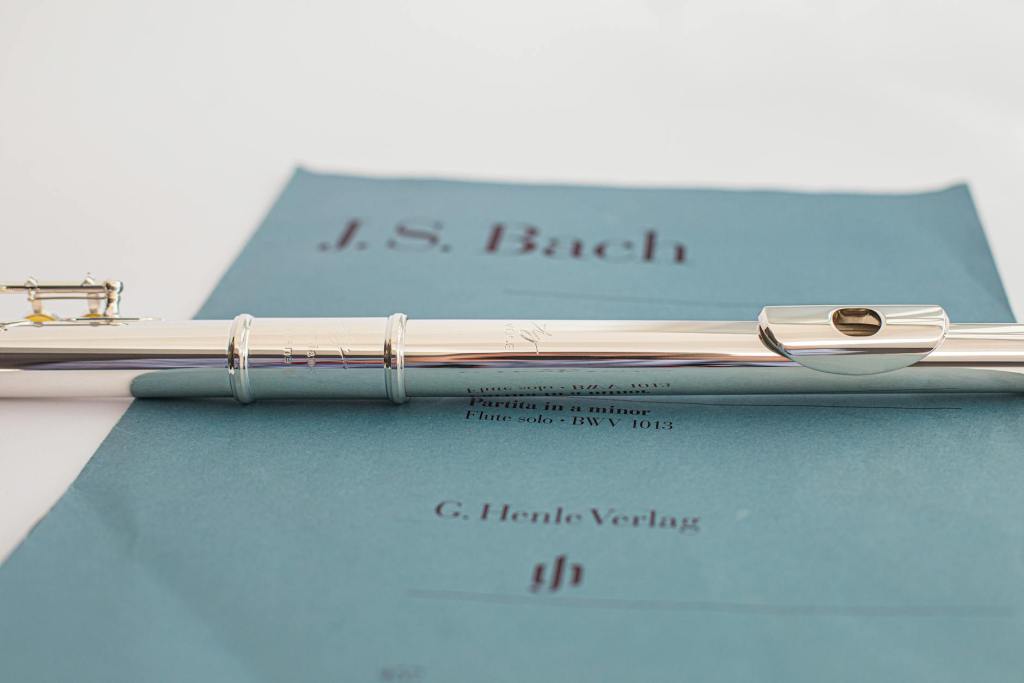
    I say this because I’ve spent most of my life marinating my brain in anger, and I can report back from the experiment: it’s like being trapped on a radio station that only plays sonic punishment. Call it Death Metal—endless noise, endless tension, no silence to think in. When I make a disciplined effort to meet my family and the world with humility instead of heat, the dial shifts. Suddenly it’s Bach. Space. Order. Breathing room. And here’s the practical wisdom I’ve earned the hard way: if you’re living with people you love, or steering a three-thousand-pound vehicle through public space, you want your mind tuned to Bach, not Death Metal. One soundtrack makes life survivable. The other just makes everything louder while you quietly fall apart.

    Growing up, real growing up, means choosing one radio station over another and accepting that you don’t run the variables of life. You don’t command outcomes. That is the default setting. Anger should not be. Anger belongs to toddlers and tyrants. Maturity begins when you retire it.

  • The Watch I Want vs. the Life I Actually Live

    The Watch I Want vs. the Life I Actually Live

    For the past month I’ve been circling the black titanium Citizen Attesa CC4055-65E the way a moth circles a very handsome, very unnecessary flame. It’s not even obscenely priced—roughly the cost of a Lenovo mini business PC with an Ultra 7—so my brain keeps pitching it as “reasonable.” I picture it on my wrist: sleek, dark, stealthy, broadcasting a silent message of confidence, competence, and maybe a little controlled menace. The fantasy version of me wears it everywhere. The honest version of me pauses and asks a less flattering question: where, exactly, am I going that requires this level of cinematic wrist presence?

    That’s when the self-audit begins. Would I really wear it, or would I merely own it—like one of those tasteful paintings people hang in their living rooms to prove they have a soul, then never look at again? But that analogy collapses on contact. A painting is for the wall. A watch is for the wrist. One is meant to be admired from across the room; the other is meant to live on your body, accumulating scuffs and stories. When I buy watches, what I’m really buying is a version of myself in motion—someone who leaves the house, enters public life, and performs a coherent aesthetic identity in the wild. The problem is that most days, I don’t need a public uniform. I need something comfortable while I work, run errands, and live in my own cave like a reasonably civilized hermit.

    That’s why my divers live on straps and not bracelets. Straps belong to real life—coffee runs, grocery aisles, desk time. Bracelets belong to fantasy life—the version of me who is being interviewed on late-night TV or starring in a tasteful indie film about male regret. Since those scenarios remain stubbornly fictional, the idea of strapping on a glossy black titanium showpiece starts to feel like costume drama. And here’s the punchline I can’t dodge: even if I became that public figure tomorrow, it wouldn’t make me happier or more whole. That life is a mirage. Which means the Citizen Attesa, for all its beauty, risks becoming one too—a chimera in black titanium, promising a transformation I no longer believe in.

  • “Raindrops Keep Fallin’ On My Head” and the Art of Being Nine

    “Raindrops Keep Fallin’ On My Head” and the Art of Being Nine

    When I was nine, in the summer of ’71, my family and three others camped on a tiny island near Mount Shasta—an experiment in frontier optimism that involved water skiing, fishing, and waging daily war against yellow jackets. We built traps from jars and funnels, which is what passes for science when you’re a child and the enemy has wings. Whenever the social noise became too loud, I retreated into a tent with Archie comics and a portable radio, my private bunker of paper jokes and AM static. Outside, the sun blazed and my friends howled with laughter. Inside, I lay on my stomach, flipping pages, while two songs drifted through the thin canvas walls—“Riders on the Storm” and “Uncle Albert/Admiral Halsey.” They were gorgeous. They were devastating. Their beauty did nothing to soften their sadness. They didn’t cheer me up; they baptized me into melancholy.

    I survived that summer gloom by clinging to the holy trinity of comic-book escapism: X-ray vision glasses, Sea Monkeys, and Charles Atlas promising to turn scrawny boys into beach legends. But I had known a better kind of sadness before that—eighteen months earlier, in fourth grade, when B.J. Thomas’s “Raindrops Keep Fallin’ on My Head” became the soundtrack to a winter of biblical rain in San Jose. That rain didn’t feel like inconvenience; it felt like permission. We walked in it. We built forts in it. We sang in it. Wet sneakers were badges of honor. Mud was a small price to pay for enchantment.

    After school, we took the longest possible route home, not because we were lost, but because we didn’t want the day to end. I think children are natural pantheists. We don’t worry about tracking dirt through the house; we worry about missing the miracle. One afternoon, in a downpour that looked like it had been personally arranged by the weather gods, I saw two middle school girls walking arm in arm, kicking their legs and singing like they were auditioning for joy itself. They weren’t performing happiness. They were inhabited by it. I don’t think I’ve seen human beings that unselfconsciously alive since.

    We eventually reached the edge of Anderson Elementary, where a park spilled into trees and bushes and, hidden like contraband, our cardboard fort waited. I crawled underneath it, stared through a gap in the walls at the rain-swollen sky, and sang “Raindrops Keep Fallin’ on My Head” to no one in particular. I remember feeling drunk on the depth of that sky, stunned by the sheer extravagance of being alive. I wasn’t happy because something good had happened. I was happy because everything had happened—and I was inside it. For a moment, I felt infinite. And, at nine, infinite felt the same as immortal.

  • Doing Everything, Feeling Nothing: The Age of Engagement Dilution

    Doing Everything, Feeling Nothing: The Age of Engagement Dilution

    In “Ebooks Are an Abomination,” Ian Bogost delivers a needed slap across the face of our collective reading habits. His charge is simple and devastating: ebooks haven’t expanded reading—they’ve hollowed it out. People believe they’re reading because their eyes are sliding across a screen, but most of what’s happening is closer to grazing. The scandal isn’t that we skim; it’s that we’ve started calling skimming “reading” and don’t even blush. Bogost nails the fraud when he points out that the word reading has become a linguistic junk drawer—used to describe everything from doomscrolling Instagram captions to actually wrestling with dense prose. If the same word covers both scanning memes and grappling with Dostoevsky, then the word has lost its spine.

    It reminds me of people who announce they’re going to the gym to “work out.” That phrase now covers a heroic range of activity—from Arnold-style flirtations with death to leaning on a treadmill while watching Jeopardy! and gossiping about coworkers. Same building, radically different realities. One is training. The other is loitering with athletic accessories.

    Reading and working out have this in common: they are not activities so much as states of engagement. And the more soaked we become in technology, the more that engagement drains away. Technology sells convenience and dependency—the kind where you feel faintly panicked if you’re five feet from a device and not being optimized by something. But being a reader is the opposite of that nervous dependence. It’s happy solitude. It’s the stubborn pleasure of being absorbed by a book, of sinking into hard ideas—the epistemic crisis, substitutionary atonement, moral ambiguity—without needing an app to pat you on the head and tell you how you’re doing. Real readers don’t need dashboards. Real lifters don’t need Fitbits. If you’re truly engaged, you feel the work in your bones.

    And yet technology keeps whispering the same seduction: optimization. Track it. Measure it. Quantify it. But what this gospel of efficiency often delivers is something uglier—disengagement dressed up as progress, laziness rebranded as smart living. The name for this decay is Engagement Dilution: the slow thinning of practices that once demanded effort—reading, training, thinking—into low-grade approximations that still wear the old labels. What once meant immersion now means mere exposure. We haven’t stopped doing these things. We’ve just stopped doing them seriously, and we’re calling that evolution.

    To help you interrogate the effects of Engagement Dilution, you will do the following writing prompt.

    600-Word Personal Narrative That Addresses Engagement Dilution

    We live in an age where everything looks like participation—but very little feels like engagement. We “read” by skimming. We “work out” by standing near machines. We “study” by copying and pasting. We “connect” by reacting with emojis. The actions remain, but the depth is gone. This condition has a name: Engagement Dilution—the process by which practices that once demanded sustained attention, effort, and presence are thinned into low-effort versions that keep the same labels but lose the same meaning.

    For this essay, you will write a 600-word personal narrative about a time when you realized you were going through the motions without being truly engaged. Your story should focus on a specific experience in which you believed you were participating in something meaningful—school, work, fitness, relationships, creativity, reading, faith, activism, or personal growth—only to later recognize that what you were doing was a diluted version of the real thing.

    Begin with a concrete scene. Put the reader inside a moment: a classroom where you nodded but didn’t think, a gym session where you scrolled more than you lifted, a relationship where you listened with your phone in your hand, a book you “read” but can’t remember, a goal you claimed to care about but never truly invested in. Use sensory detail—what you saw, heard, felt, avoided—to make the dilution visible. Don’t explain the idea yet. Show it happening.

    Next, introduce the realization. When did it dawn on you that something essential was missing? Was it boredom? Frustration? Guilt? Emptiness? Did someone confront you? Did you fail at something you thought you had prepared for? Did you suddenly notice how different real engagement feels—how tiring, how uncomfortable, how demanding it is compared to the easy version you had settled for?

    Then widen the lens. Reflect on why engagement diluted in the first place. Was it technology? Fear of failure? Desire for comfort? Pressure to appear productive? Lack of confidence? The culture of optimization? Be honest here. Avoid blaming abstract forces alone. This essay is not about what society did to you; it is about the choices you made within that environment.

    Finally, confront the cost. What did engagement dilution take from you? Skill? Confidence? Meaning? Relationships? Momentum? And what did it teach you about the difference between looking active and actually being alive inside your actions? End not with a motivational slogan but with clarity—what you now recognize about effort, attention, and the price of avoiding difficulty.

    Guidelines

    • This is a narrative, not a sermon. Let the story do the thinking.
    • Avoid clichés about “finding balance” or “doing better next time.”
    • Do not turn this into a tech rant or a productivity essay. Keep it human.
    • Use humor if it fits—but don’t hide behind it.
    • Your goal is not self-improvement branding. Your goal is insight.

    What this Essay Is Really About

    Engagement Dilution is not laziness. It is the quiet substitution of comfort for commitment, convenience for courage, motion for meaning. Your task is to show how that substitution happened in your own life—and what it revealed about what real engagement actually costs.

    Write the essay only you could write. The more specific you are, the more universal the insight becomes.

  • Obsolescence With Benefits: Life in the Age of Being Unnecessary

    Obsolescence With Benefits: Life in the Age of Being Unnecessary

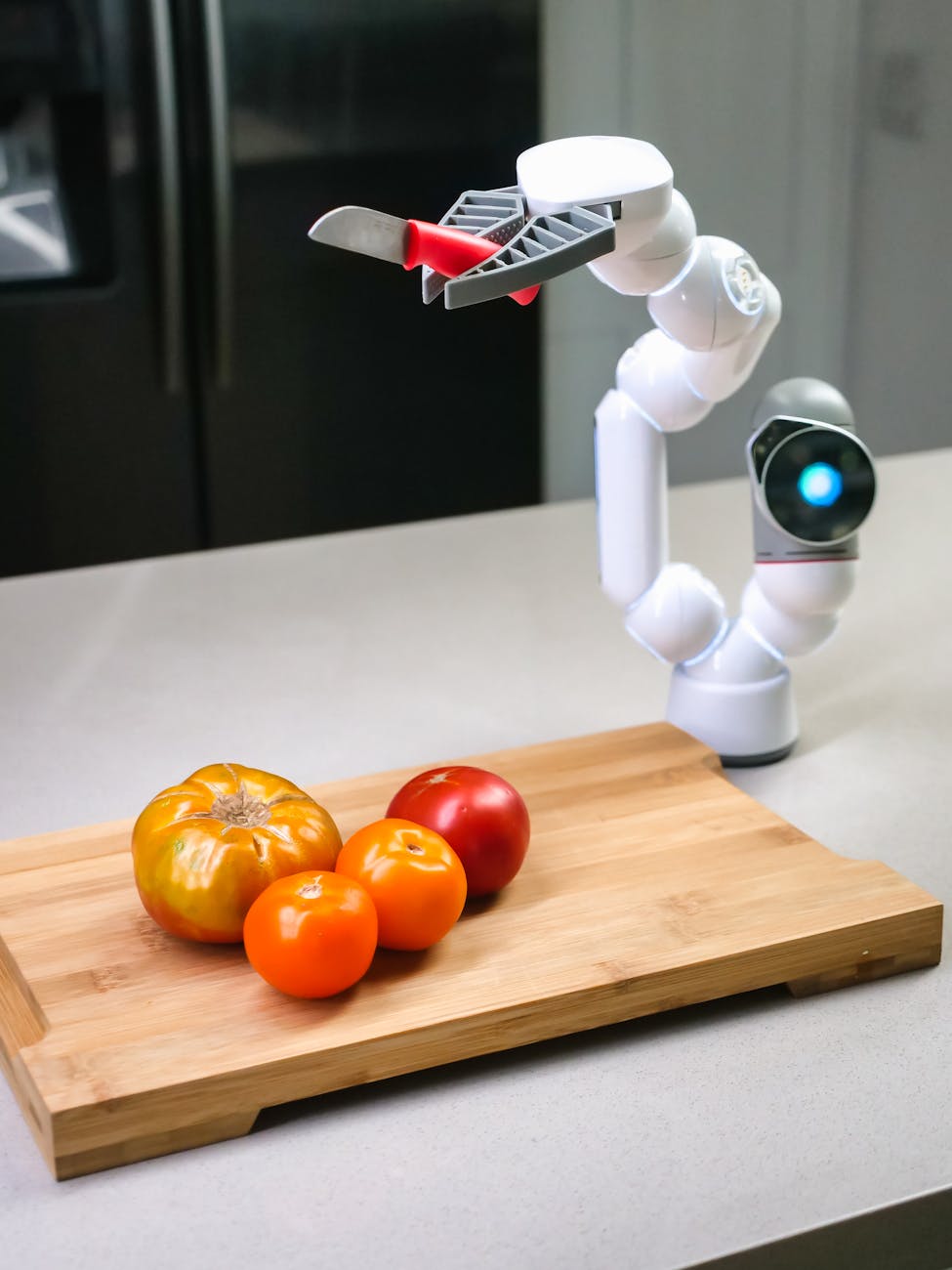
    Existential Redundancy is what happens when the world keeps running smoothly—and you slowly realize it no longer needs you to keep the lights on. It isn’t unemployment; it’s obsolescence with benefits. Machines cook your meals, balance your passwords, drive your car, curate your entertainment, and tuck you into nine hours of perfect algorithmic sleep. Your life becomes a spa run by robots: efficient, serene, and quietly humiliating. Comfort increases. Consequence disappears. You are no longer relied upon, consulted, or required—only serviced. Meaning thins because it has always depended on friction: being useful to someone, being necessary somewhere, being the weak link a system cannot afford to lose. Existential Redundancy names the soft panic that arrives when efficiency outruns belonging and you’re left staring at a world that works flawlessly without your fingerprints on anything.

    Picture the daily routine. A robot prepares pasta with basil hand-picked by a drone. Another cleans the dishes before you’ve even tasted dessert. An app shepherds you into perfect sleep. A driverless car ferries you through traffic like a padded cell on wheels. Screens bloom on every wall in the name of safety, insurance, and convenience, until privacy becomes a fond memory you half suspect you invented. You have time—oceans of it. But you are not a novelist or a painter or anyone whose passions demand heroic labor. You are intelligent, capable, modestly ambitious, and suddenly unnecessary. With every task outsourced and every risk eliminated, the old question—What do you do with your life?—mutates into something colder: Where do you belong in a system that no longer needs your hands, your judgment, or your effort?

    So humanity does what it always does when it feels adrift: it forms support groups. Digital circles bloom overnight—forums, wellness pods, existential check-ins—places to talk about the hollow feeling of being perfectly cared for and utterly unnecessary. But even here, the machines step in. AI moderates the sessions. Bots curate the pain. Algorithms schedule the grief and optimize the empathy. Your confession is summarized before it lands. Your despair is tagged, categorized, and gently rerouted toward a premium subscription tier. Therapy becomes another frictionless service—efficient, soothing, and devastating in its implication. You sought human connection to escape redundancy, and found yourself processed by the very systems that made you redundant in the first place. In the end, even your loneliness is automated, and the final insult arrives wrapped in flawless customer service: Thank you for sharing. Your feelings have been successfully handled.