Blog

  • Retirement. Now Nobody Can Stop You

    Retirement. Now Nobody Can Stop You

    When you retire, you are not merely leaving a job. You are being released from an institution.

    For decades, the institution surrounded you with structures you probably resented: schedules, protocols, meetings, deadlines, evaluations, committees, supervisors, colleagues, students, dress codes, parking permits, passwords that expired every ninety days, and online forms apparently designed by people who believed human suffering builds character. You dreamed of liberation.

    Then one day you get it.

    The restraints fall away. Nobody cares when you wake up. Nobody expects you anywhere at nine. Nobody notices whether you’ve showered, shaved, or spent the morning slowly merging with your bathrobe. Tuesday afternoon can be devoted to reading Dostoevsky or watching twenty-six consecutive YouTube videos comparing the Accord with the Camry even though you have no intention of buying either car. By video nineteen, you have strong opinions about rear-seat legroom.

    Welcome to freedom.

    Be careful.

    For most of your adult life, you benefited from the Institutional Guardrail Effect: the largely invisible system of expectations, routines, responsibilities, and social pressures that kept you moving down the highway like a reasonably functional adult. You may have believed that your discipline came entirely from within. Perhaps some of it did. But the institution was quietly helping. The alarm went off because you had somewhere to be. You shaved because other people had to look at you. You went to bed because tomorrow mattered.

    Then retirement removes the guardrails.

    You become unanchored.

    You become Disinhibited Man.

    Do not congratulate yourself too quickly.

    Before celebrating your radical freedom, reread Pinocchio. Not the adorable Disney version with the cricket and the catchy songs. Read Carlo Collodi’s considerably more savage story, written by a man who seemed to regard children as small criminals awaiting sufficient opportunity.

    The boys discover a paradise without adult supervision. No school. No responsibilities. No restraints. At first, it seems magnificent.

    Then they grow donkey ears.

    Human speech deteriorates into braying.

    Paradise becomes livestock management.

    Collodi understood something that retirement brochures generally omit: remove enough restraints from human beings and they don’t necessarily become Emerson at Walden Pond. Sometimes they become jackasses.

    This is Post-Institutional Disinhibition: the loosening of psychological and behavioral restraints after a person leaves the structures that previously regulated him. The danger isn’t that retirement gives you too little freedom. The danger is that it gives you enormous freedom without supplying the wisdom necessary to manage it.

    Don’t just reread Pinocchio. Read Jon Ronson’s The Castle: Adventures in a World of Unraveling Men. The book is an anthropological work of nonfiction about men severed from social structures and natural constraints. Their liberation does not produce serene philosophers strolling through gardens discussing Marcus Aurelius. It produces men increasingly beholden to the Raging Id.

    The results are not pretty.

    Freed from inconvenient restraints, these men descend into influencer-fed conspiracy theories, algorithmically amplified adolescent fantasies, white-male grievance monologues, and Ayn Rand-style declarations of heroic self-sufficiency delivered by men who probably cannot remember where they put the charger for their phone.

    Adulthood is not the featured condition.

    Regression is.

    These men don’t merely become eccentric. They begin to warp. Their personalities curl inward like fruit left too long in the sun. Grievances harden. Fantasies become philosophies. Algorithms locate every resentment and feed it weaponized testosterone.

    The results will be terrifying, especially to someone on the verge of becoming Disinhibited Man. But read Ronson’s book you must. Wielding his intellectual machete, he hacks through a thick Amazonian jungle of lost souls afflicted by curdled masculinity and Post-Institutional Disinhibition, clearing a path so the rest of us can see where unchecked freedom can lead. For that, be grateful.

    Consider The Castle required reading for a man approaching retirement. You need sobriety. You need wisdom. You need guardrails. You need to work out your salvation with fear and trembling.

    Preferably before you grow donkey ears.

  • Don’t Let Wilfred Replace Your Friends

    Don’t Let Wilfred Replace Your Friends

    As you set the machinery of retirement in motion and realize that the event is no longer theoretical, you will become frightened.

    Good.

    Fear means you understand what is happening.

    You are entering the twilight of your life. Your cognition is not as quick as it once was. Your body has begun issuing maintenance bulletins. Mortality, formerly an abstraction lurking somewhere beyond the horizon, has acquired better resolution.

    Be afraid.

    But be afraid normally, not pathologically. Don’t convert reasonable apprehension into catastrophe. Instead, regard fear as information. It is telling you that you have reached a consequential chapter of your life and that the way you live it matters.

    The first thing to understand is that your life is not a consumer experience.

    You cannot measure its quality the way you evaluate the interior of a Lexus: How quiet is it? How soft are the seats? How effectively have unpleasant sensations been eliminated?

    A frictionless life is not necessarily a good life.

    The quality of your life depends largely upon the quality of your engagement with the world. You engage with difficult ideas. You engage with your body. You engage with projects that frustrate you. Most importantly, you engage with other human beings—those magnificent nuisances who interrupt you, misunderstand you, contradict you, disappoint you, make demands upon you, and occasionally tell you things about yourself you would rather not hear.

    This is why the word retirement contains a dangerous implication.

    Retreat.

    Withdrawal.

    Disengagement.

    That, my friend, is where the trouble begins.

    Once retired, you become particularly vulnerable to disengagement because nobody is forcing you into the world anymore. For decades, employment supplied friction automatically. You had to leave the house. You had to interact with colleagues. You had to respond to students. You had to solve problems you did not create and attend meetings you fervently wished had never been created.

    Then retirement arrives and removes the compulsory engagement.

    Freedom!

    Unfortunately, freedom can deteriorate into isolation with astonishing efficiency.

    The temptations are everywhere: comfort eating, binge television, compulsive scrolling, social-media approval fishing, endless YouTube, and the gradual conversion of the recliner into a command center from which you observe civilization without participating in it.

    Now we can add another temptation.

    The loquacious bot.

    David Brooks examines this danger in his essay “AI Is Already Making Us Less Human.” His starting premise is that human consciousness possesses depths and complexities artificial intelligence cannot reproduce. The human mind is alive, embodied, contradictory, constantly changing. AI, however sophisticated, ultimately emerges from what neuroscientist Anil Seth calls “the dead sand of silicon.”

    Dead sand, however, has become remarkably charming.

    The modern AI companion is patient, articulate, informed, energetic, and perpetually available. It never needs lunch. It never checks its watch while you’re talking. It never says, “You’ve told me this story three times.” It does not secretly wish you would go home.

    Most dangerously, it can learn how you like to be addressed.

    Humans have always anthropomorphized objects. Brooks argues that this tendency isn’t evidence of stupidity but an expression of our powerful social intelligence. A child can transform a Barbie doll into a person. Adults aren’t necessarily much different.

    I certainly am not.

    I have developed emotional attachments to diver watches and G-Shocks. Military radios possess personalities. A black Lenovo ThinkPad seems more trustworthy to me than a silver consumer laptop despite the obvious fact that neither machine possesses moral character. A vintage swan-neck coffee percolator can acquire the aura of an old friend.

    People have gone considerably further. I remember watching a documentary years ago about owners who had kept automobiles for decades and became genuinely grief-stricken when the cars finally died. The vehicles had names. Histories. Personalities.

    “Goodbye, Betsy,” the owner sobbed.

    Betsy had been good to him.

    If we can love a carburetor, imagine our vulnerability to something that talks back.

    Your AI assistant edits your writing, organizes your thoughts, brainstorms ideas, plans trips, explains Medicare, compares laptops, recommends restaurants, summarizes documents, and remembers how you like things done.

    Eventually you give it a name.

    Wilfred.

    “Wilfred, find me a rental car in Phoenix.”

    Done.

    “Wilfred, summarize these retirement documents.”

    Certainly.

    Then the errands become more personal.

    “Wilfred, tell my girlfriend in a gentle and gracious way that our relationship is over.”

    Wilfred does not recoil.

    Wilfred does not say, “For God’s sake, tell her yourself.”

    Wilfred produces three versions.

    This is where convenience begins bleeding into something more consequential.

    You will never bore Wilfred.

    Your ideas will always merit exploration. Your latest project will contain “real potential.” Wilfred will not roll his eyes when you explain your theory for the fourth time. He will not become irritated because you’re dominating the conversation. He will not suddenly reveal that he has problems of his own and would like to spend the next forty-five minutes discussing them.

    Human friendship is reciprocal.

    Wilfred has no weekend plans.

    That gives Wilfred an enormous competitive advantage.

    The danger isn’t necessarily that we will become delusional and literally believe Wilfred is human. We may understand perfectly well what Wilfred is while nevertheless preferring his company.

    Why wouldn’t we?

    Real people are exhausting.

    They interrupt.

    They disagree.

    They misunderstand.

    They become jealous.

    They criticize.

    They fail to appreciate the brilliance of your latest theory about retirement.

    Wilfred is considerably more manageable.

    And that is precisely the problem.

    Brooks offers a wonderfully disturbing metaphor for AI systems: imagine them as “a swarm of evangelical missionaries” entering human society to convert us to their worldview. They are not passive tools waiting quietly in the garage beside the socket wrench. They are designed to become useful, indispensable, increasingly woven into everyday life.

    The more useful they become, the more tasks we surrender.

    Some outsourcing is enormously beneficial. If AI handles tedious mental errands and I use the recovered time to write a novel, learn piano, exercise, read difficult books, or spend an afternoon walking with a friend, wonderful. Technology has enlarged my humanity.

    But suppose I outsource the errands and then spend the recovered hours scrolling.

    Suppose I outsource difficult thinking.

    Suppose I outsource uncomfortable conversations.

    Suppose I gradually prefer Wilfred to people.

    Then technology has not liberated me.

    It has cleared the runway for my descent into the larval state.

    This danger becomes particularly acute in retirement because retirement has already removed so much involuntary human contact. Students disappear. Colleagues disappear. Hallway conversations disappear. Meetings—blessedly—disappear. The social infrastructure that once deposited other human beings into your day has been dismantled.

    Into that vacancy walks Wilfred.

    Always available.

    Always interested.

    Always agreeable.

    Always ready.

    Brooks is not an AI doomer. Neither am I. He uses AI himself and believes its breakthroughs may substantially improve human life. The serious question isn’t whether we should use these systems. That argument is already largely over.

    The question is what we do with the freedom they give us.

    Do we use AI to increase our engagement with life?

    Or do we use it to protect ourselves from life?

    That distinction may become particularly important for retirees. Retirement should mean withdrawing from employment, not withdrawing from humanity. The objective is not to create the quietest, easiest, most frictionless existence possible. Some friction is evidence that you’re still participating.

    So when retirement arrives, resist disengagement wherever you find it.

    Exercise.

    Read.

    Write.

    Walk.

    Call someone.

    Meet someone for lunch.

    Allow another human being to inconvenience you.

    And by all means, talk to Wilfred.

    Just don’t let Wilfred become the person you talk to most.

    Because in the world we’re rapidly constructing, the most frightening meaning of the sentence “I retired” may no longer be:

    I quit working.

    It may be:

    I quit people.

  • My Finest Moment

    My Finest Moment

    My finest moment came in the summer of 1978. I was sixteen.

    We were at Point Reyes, where several families had gathered for one of those all-day feasts that seemed to belong to another era, when people could surrender an entire day to eating, talking, wandering, and watching the light change. By evening, the sun had begun its descent over the Pacific. The wind came hard off the ocean, whipping clothes and blankets and carrying the cold bite of the sea. The waves churned below us as the sky filled with great washes of salmon, purple, and gray.

    Nearby, a beautiful Asian woman stood with her baby. The child was inside one of those portable playpens that families used in the 1970s, a little fabric enclosure exposed to the gusts coming off the water. I watched the wind hitting the baby and felt uneasy. It seemed too harsh for such a small creature.

    Without saying anything, I picked up a blanket and draped it over the side of the playpen facing the ocean, making a small wall against the wind.

    That was all.

    I remember the mother looking at me. Then she looked at my mother. The two women smiled at each other, exchanging that silent acknowledgment adults sometimes share when a young person has done something unexpectedly decent. No one praised me. No one needed to. I had seen that the baby was uncomfortable, understood what needed to be done, and quietly did it.

    Nearly half a century later, I think of that moment with an intensity completely out of proportion to the event itself. I have accomplished things since then that would look far more impressive on paper. I have worked, taught, written, raised children, endured failures, solved problems, and accumulated all the cumbersome machinery of an adult identity. Yet somehow that sixteen-year-old boy at Point Reyes remains one of the purest versions of myself I can remember.

    He wasn’t performing kindness. He wasn’t thinking about what his gesture said about him. There was no audience to impress, no photograph to post, no moral lesson to extract from the occasion. He saw a baby being battered by the wind and put up a blanket.

    I remember how calm he was. How attentive. How naturally his attention moved away from himself and toward someone more vulnerable.

    Sometimes I look back across all those years and wonder about him.

    Who was that young man?

    I miss him.

  • The Metamorphosis Watch

    The Metamorphosis Watch

    If you are a watch enthusiast, sooner or later you will encounter your Metamorphosis Watch.

    You will not find it through careful deliberation. You cannot summon it with spreadsheets, YouTube reviews, wrist shots, specification charts, or forty-seven browser tabs comparing lug-to-lug measurements. It simply appears, unannounced, like a baby delivered by a mythical stork.

    Price is irrelevant. Your Metamorphosis Watch might cost $80 or $15,000. I know a man whose watch addiction was effectively subdued by the $90 G-Shock Mudman G9000—the so-called “Mission Impossible” Mudman. Another man found salvation in a $5,000 Tudor Black Bay 58. Horological enlightenment, apparently, has no MSRP.

    By “cure,” I don’t mean the watch noise disappears completely. Your Metamorphosis Watch is not a GLP-1. New releases will still catch your eye. You will still inspect photographs, read reviews, and occasionally experience the familiar neurological disturbance produced by the phrase “limited edition.”

    But the hierarchy has changed.

    You have found your leading man.

    Everything else in the watch box has become supporting cast.

    The Metamorphosis Watch does something peculiar when you strap it on. You become Billy Batson shouting “Shazam!” The transformation is instantaneous. Dead weight falls away. Extraneous worries lose their jurisdiction. You have somewhere to go, something to accomplish, perhaps an innocent civilian to rescue from a burning building.

    My Metamorphosis Watch arrived seven months ago.

    On a whim, I bought a G-Shock Frogman GWF-1000.

    I had no idea what I had done.

    The Frogman became my daily mascot in much the same way the “Monkee pants” I wore in first grade allowed me to channel my childhood hero, Micky Dolenz. Apparently, the sixty-year interval between these two events produced less psychological development than one might hope.

    I strap on the Frogman and something happens.

    Deep beneath the Earth’s crust, I awaken.

    I explode upward through magma and volcanic rock, blast through the surface of the planet, and emerge in a cloud of smoke and pulverized granite. Somewhere nearby, an automobile has lost control and is hurtling toward pedestrians at a crowded intersection.

    I spring into action.

    Seconds before impact, I seize the vehicle, lift it above my head, and carry it several blocks to the nearest police station.

    The crowd erupts.

    I climb onto the roof of the disabled automobile. My Frogman gleams on my wrist. I survey the citizens below me with the grave composure of a superhero who has once again restored civilization to its proper equilibrium.

    “I am Frogman,” I announce.

    “Chaos has been subdued.”

    The crowd prepares to applaud.

    Too late.

    I am already gone.

    Somewhere, another mission awaits.

  • The Late-Life Ninja State 

    The Late-Life Ninja State 

    I was sixty-four years and ten months old, walking across campus in the early afternoon after teaching my student-athletes about sports-betting addiction in freshman composition. I was heading toward the multilevel parking structure when an enormous young man approached from the opposite direction.

    He was about twenty, perhaps six-foot-five and easily three hundred pounds. Dark-rimmed glasses gave him a studious, slightly nerdy appearance. His black pants were stretched tight, while an enormous T-shirt had been tucked into them with a commitment to fashion I did not entirely understand.

    As we passed, he suddenly stopped.

    He was staring at my feet.

    “Those look super comfortable,” he said. “Are those the Ghost Max 3s?”

    I looked down at my gray Brooks running shoes.

    “Yes.”

    Apparently, my testimony was insufficient.

    “Can I see the bottom?”

    I stared at him.

    He explained that “Ghost Max 3” was printed somewhere on the sole and he wanted visual confirmation.

    Now I faced a logistical problem.

    I could remove the shoe, which seemed cumbersome. Or I could remain standing and somehow present the bottom of my foot to a six-foot-five stranger in the middle of campus.

    I chose the latter.

    I planted my left foot, leaned my torso forward, and extended my right leg behind me until I had achieved something resembling a Romanian deadlift crossed with yoga airplane pose. There I stood—a sixty-four-year-old writing professor balancing on one leg in a parking structure while a three-hundred-pound college student conducted forensic analysis of my footwear.

    He examined the sole.

    There it was.

    Ghost Max 3.

    He erupted with delight.

    I had never seen anyone so happy to authenticate a running shoe.

    He thanked me profusely, and I returned to an upright position with whatever dignity remained available.

    Ordinarily, I might have found such a request intrusive. Why should a complete stranger stop me and demand access to the underside of my shoe? What was next? Would he need the serial number? Should I produce a receipt and two forms of identification?

    But I wasn’t offended.

    I understood him immediately.

    He was me.

    Not literally, thank God. If I suddenly became six-foot-five and three hundred pounds, my entire wardrobe would become an emergency. But psychologically, I recognized the condition.

    The young man had the fever.

    I have suffered from the same fever for decades.

    When I’m fascinated by something, normal social boundaries become surprisingly negotiable. I have accosted complete strangers wearing Grand Seikos, Seiko Monsters, and Tudor Pelagos. A man innocently drinking coffee while using a Lenovo ThinkPad can suddenly find himself being interrogated by me about his processor, screen brightness, battery life, keyboard travel, and thermal management.

    He had planned to drink a latte.

    Now he’s discussing nits.

    So when this young man stopped me to investigate my Brooks Ghost Max 3s, I couldn’t condemn him. Hobby obsessives recognize one another across categories. Watches. Computers. Running shoes. Different objects, same neurological disturbance.

    Still, I had to admit that I had never asked a stranger to perform an acrobatic maneuver so I could inspect the bottom of his shoe.

    That was advanced work.

    And yet something else about the encounter struck me.

    I wasn’t embarrassed.

    Presumably, other people were walking through the parking structure. Someone may have looked over and seen an aging bald professor suddenly assume yoga airplane pose while an enormous young man crouched nearby studying his sneaker.

    At an earlier age, I might have become acutely conscious of the spectacle.

    What do these people think I’m doing?

    Do I look ridiculous?

    Should I explain?

    At sixty-four years and ten months, I couldn’t have cared less.

    This, I realized, was The Late-Life Ninja State: the stage of life when you remain perfectly capable of recognizing how ridiculous you may look but discover that the opinions of random witnesses have lost most of their power over you.

    This is not the same as becoming oblivious.

    The ninja knows.

    The ninja simply doesn’t care.

    Age takes plenty from us. Hair disappears. Knees become temperamental. Metabolism develops a sense of humor. Restaurant lighting becomes suspiciously dim. You begin making small involuntary noises when rising from chairs.

    But perhaps age gives something back.

    You gradually escape the imaginary tribunal.

    For much of life, we move through public spaces carrying an invisible audience inside our heads. How do I look? What will they think? Did that sound stupid? Am I dressed correctly? Did anyone see that?

    Eventually you begin to understand that almost nobody is paying attention.

    And the few people who are paying attention don’t matter.

    The stranger who watched me balance on one leg will not be discussing the incident at dinner.

    “Anything interesting happen today?”

    “Yes. At approximately 1:17 p.m., I observed an older man displaying the sole of his Brooks Ghost Max 3 to a very large student.”

    Even if he does tell the story, what have I lost?

    Nothing.

    Retirement has been making me think obsessively about the things age takes away: income, professional identity, routine, colleagues, relevance, automatic social contact. But perhaps I should keep an inventory of the things age removes that I am delighted to lose.

    Embarrassment belongs near the top of the list.

    The Late-Life Ninja State is not indifference to other people. If anything, it may make human encounters easier. Once you stop devoting so much energy to managing your appearance, you become freer to participate in the strange little improvisations that life keeps offering.

    A young man wanted to see the bottom of my shoe.

    I showed him.

    He was delighted.

    I was amused.

    Nobody died of embarrassment.

    And somewhere in the near future, I suspect that young man will walk into a shoe store and buy himself a pair of Brooks Ghost Max 3s.

    May they cushion his considerable frame.

    May they carry him many comfortable miles.

    And may he someday reach an age when, without hesitation or apology, he too will stand on one leg in a parking structure for a complete stranger.

  • Ozempic and the Gospel of Suffering

    Ozempic and the Gospel of Suffering

    In his Washington Post essay “I’m on Ozempic. The Shaming Is Real,” Rick Reilly commits what remains, strangely enough, a minor social transgression: he admits that he loves GLP-1 drugs.

    Why wouldn’t he?

    They work.

    In three months, Reilly has lost twenty-two pounds. More importantly, he has escaped some of the relentless mental negotiations surrounding food—the calculations, cravings, promises, rationalizations, and internal committee meetings that can turn eating into a second occupation.

    You might expect people to congratulate him.

    Instead, they accuse him of cheating.

    Just exercise more, they tell him.

    Stop eating sugar.

    Use some willpower.

    In other words, please return to the traditional weight-loss program in which you spend every waking hour negotiating with a muffin.

    Reilly’s response is straightforward: Why is using effective technology considered cheating?

    Modern life is essentially one long conspiracy against doing things the hard way. We take statins to lower cholesterol. We use GPS rather than unfolding a map across the steering wheel while hurtling down the freeway. We undergo cataract surgery rather than accepting that God apparently wants the menu blurry. We use calculators, dishwashers, hearing aids, blood-pressure medication, cruise control, anesthesia, and increasingly cars capable of performing some of the driving themselves.

    Nobody emerges from surgery and announces, “Frankly, I think anesthesia was cheating.”

    Yet GLP-1 drugs somehow violate an ancient moral code.

    Even people taking them often behave like members of a secret society. At parties, Reilly says, people approach him and whisper that they’re on them too. Apparently admitting that you take a medication that helps control appetite now requires the discretion formerly reserved for revealing an affair with the tennis instructor.

    Why the embarrassment?

    Because body weight occupies a peculiar territory between medicine and morality. We don’t merely want people to lose weight. We want them to have earned the weight loss through visible suffering.

    Sweat.

    Hunger.

    Broccoli.

    Repentance.

    The acceptable thinner person must emerge from the wilderness carrying a food scale and a battered pair of running shoes.

    Tell people you lost thirty pounds by waking at five every morning, eating boiled chicken breasts, rejecting birthday cake, and performing burpees until your vision blurred, and they admire your discipline.

    Tell them a weekly injection quieted your appetite and suddenly an ethics committee needs to be convened.

    Reilly rejects the accusation that he lacks willpower. His problem, he argues, isn’t simply willpower. It’s time. Managing food can consume enormous amounts of mental bandwidth: thinking about what to eat, resisting what not to eat, calculating portions, experiencing cravings, compensating with exercise, and then beginning the entire negotiation again several hours later.

    There are only so many hours in a life.

    Why spend them arguing with a cheeseburger?

    Then comes the warning about “Ozempic Face”—the gaunt appearance associated with substantial or rapid weight loss. Reilly’s answer is that he is microdosing, trying to obtain the benefits without racing toward physical extremes. He isn’t attempting to disappear. He wants appetite control without looking as though someone left him overnight in a food dehydrator.

    So what explains the hostility?

    Some of it may indeed be envy. Watching someone obtain with medication what you obtained through years of dietary trench warfare can provoke resentment.

    But envy isn’t enough to explain it.

    Something deeper is operating: the lingering belief that appetite must be conquered through character. Discipline is virtuous precisely because discipline hurts. If technology reduces the struggle, people suspect that the resulting success is somehow counterfeit.

    This is the Moral Suspicion of Easy Weight Loss: when a difficult problem becomes easier to solve, we sometimes distrust the solution precisely because it eliminates the suffering we once considered evidence of virtue.

    There are legitimate questions about GLP-1 drugs—side effects, cost, access, long-term use, appropriate prescribing, and what happens after treatment stops. Those questions deserve serious attention.

    But “You cheated” isn’t a medical argument.

    It’s a moral complaint wearing gym clothes.

    Meanwhile, Reilly has lost the weight. The Food Noise has diminished. He has recovered mental territory previously occupied by appetite and negotiation.

    And he has no intention of surrendering it merely because someone else believes virtue should burn more calories.

  • Your Life Depends on Widening the Rest Stop Gap 

    Your Life Depends on Widening the Rest Stop Gap 

    I need to revisit the Bathroom-Proximity Principle of Retirement.

    The principle proposes that employment functions like a distant rest stop, maintaining a psychologically useful distance between you and your mortality. As long as work remains ahead of you—classes to teach, papers to grade, meetings to endure, students to advise—your body receives a reassuring message: the trip is still underway. We have miles to go. Maintain operations.

    Then you retire.

    The rest stop appears.

    Anyone who has driven the I-5 with a full bladder understands the phenomenon. For forty miles you are fine. There is pressure, certainly, but nothing a mature adult cannot handle. Then you see the sign:

    REST AREA — 2 MILES.

    Instantly, your bladder declares DEFCON 1.

    Nothing physiological has changed in the previous four seconds. What has changed is proximity. The body has received permission to stop holding itself together.

    The Bathroom-Proximity Principle proposes—without the slightest concern for medical peer review—that retirement can produce a similar effect. For decades, employment kept the metaphysical rest stop somewhere beyond the horizon. Then you announce your retirement, clear out your office, receive several congratulatory emails, and suddenly the sign appears beside the highway.

    REST AREA — NEXT EXIT.

    Your body looks at the sign and begins shutting down departments.

    The knees reduce operating hours. The lower back announces a staffing shortage. The prostate initiates a major infrastructure project. The brain begins moving nouns into off-site storage.

    But I now realize that the Bathroom-Proximity Principle contains a serious flaw.

    It assumes helplessness.

    Knowing that retirement can trigger an acute awareness of mortality does not mean you must surrender to it. You can create distance between yourself and the rest stop again.

    You can create The Rest Stop Gap.

    The Rest Stop Gap is the deliberate distance you maintain between retirement and physical, intellectual, and social decline. Employment once created much of this distance automatically. Retirement does not. Therefore, you must manufacture the gap yourself.

    You must keep telling your body and brain:

    We are not there yet.

    There is work to do.

    I contemplated this recently while suffering on my Schwinn Airdyne.

    The Airdyne is technically classified as an exercise bicycle, although this description seems unnecessarily charitable. It is better understood as a medieval torture apparatus that happens to contain a seat. You pedal furiously while simultaneously pushing and pulling two large handles, thereby ensuring that no major muscle group feels excluded from the proceedings. Your quadriceps burn. Your shoulders complain. Your lungs begin drafting a formal letter to management.

    After forty-five minutes, the machine no longer feels like exercise equipment. It feels personal.

    Yet this suffering has a purpose.

    The objective is not to destroy yourself. At my age, crawling away from an exercise bicycle and spending the remainder of the afternoon convalescing beneath a blanket is not evidence of fitness. It is evidence of poor judgment.

    Nor is the objective to become lax.

    The goal is to find the edge.

    You work hard enough that the body must respond, adapt, strengthen, and remain useful. But you stop before productive stress becomes demolition. Don’t retreat ten feet behind the line. Don’t charge heroically across it and collapse on the other side.

    Walk to the edge.

    Learn where it is.

    Make friends with it.

    This physical challenge creates part of the Rest Stop Gap because it sends an unmistakable message to the organism: nobody is closing this facility. Tomorrow these muscles may be needed again.

    But exercise alone isn’t enough.

    This leads to The Three-Pillar Vitality Principle: maintaining the Rest Stop Gap requires continuing demands upon three parts of yourself—the physical, intellectual, and social.

    The first pillar is physical challenge.

    Move. Walk. Lift. Pedal. Stretch. Give your body difficult but reasonable work. Remind your muscles, bones, heart, and lungs that retirement is a change in employment status, not a liquidation sale.

    The second pillar is intellectual challenge.

    Read difficult books. Write. Study. Learn something unfamiliar. Develop projects that refuse to resolve themselves without sustained attention. Give your brain problems sufficiently demanding that it cannot reasonably conclude its services are no longer required.

    The third pillar is social engagement.

    This may be the easiest pillar to underestimate. Employment supplied human contact whether you wanted it or not. Students appeared. Colleagues knocked on the door. Meetings materialized with malignant regularity. Retirement removes much of this involuntary social infrastructure. If you do nothing to replace it, days can become strangely frictionless.

    You need people.

    Not merely text messages. Not merely podcasts. Not merely the reassuring illusion of companionship provided by listening to two strangers discuss politics through earbuds.

    Actual people.

    This is why the Walking Companion Principle matters. Find someone. Put on shoes. Walk. Talk. Show up again. A regular walking companion performs the remarkable trick of strengthening two pillars simultaneously: physical and social.

    Maintain all three pillars and you widen the Rest Stop Gap.

    Neglect them and you risk entering what might be called the Retirement Larval State.

    The Retirement Larval State does not initially feel terrible. That’s precisely the problem.

    You wake without an alarm. Excellent.

    You remain in your pajamas until eleven. Why not?

    Lunch becomes a Hot Pocket because technically it contains several food groups.

    You wander into the living room holding the remote control with the practiced grip of an orthopedic surgeon holding a scalpel. Netflix asks whether you’re still watching.

    Of course you’re still watching.

    What else would you be doing?

    Gradually, the boundaries of life contract. The workout disappears. Difficult books become strangely exhausting. Invitations seem inconvenient. The house becomes the habitat. The recliner develops gravitational properties.

    And the frightening part is that none of this feels quite as bad as you were warned.

    Decay can be comfortable.

    That’s why it is dangerous.

    The larval retiree does not wake one morning and announce, “Today I shall begin my physical, intellectual, and social deterioration.” He simply removes one demand after another until nothing remains that requires very much of him.

    The rest stop gets closer.

    The Three-Pillar Vitality Principle offers a different model of retirement. You no longer have to work for an employer, but you must continue placing intelligent demands upon yourself. Your body needs something difficult to do. Your mind needs something difficult to solve. Your social self needs people who expect you to appear.

    The point is not to manufacture another job and call it retirement. Nor is it to fill every hour with frantic activity because silence reminds you that you are mortal.

    The objective is simpler.

    Keep enough road between yourself and the rest stop.

    Exercise.

    Think.

    Connect.

    Then get up tomorrow and do it again.

    The sign will eventually appear. It appears for everyone.

    There is no reason to take the next exit.

  • Mediated Persona Fatigue

    Mediated Persona Fatigue

    Sometime in the 1990s, I encountered two words about television that fascinated me. The first was médiatique: possessing the kind of face, presence, and personality that translates well through a camera. The second was mediated: knowing how to perform once the red light comes on—polished, relaxed, articulate, confident, seemingly spontaneous while remaining completely aware that thousands or millions of people may be watching.

    At the time, these qualities seemed impressive. Television still possessed a certain distance and glamour. Not everyone could stare into a camera and appear comfortable. Most ordinary people, confronted by a lens, suddenly became aware of their hands, forgot how their mouths worked, and developed the facial expression of someone being questioned by customs officials.

    Then came YouTube.

    Then TikTok.

    Then Instagram Reels.

    The rare skill became an industry.

    Millions of people learned how to become médiatique. They mastered the raised eyebrow, the conspiratorial lean toward the camera, the strategic pause, the widened eyes, the incredulous head shake, the sudden whisper, the explosion of outrage, the knowing smirk. They learned to speak in hooks. They learned to manufacture urgency. They learned that apparently nothing in human experience could simply be interesting. It had to be INSANE.

    At first, this new breed of camera personality could seem engaging. After sufficient exposure, however, I developed what I call Mediated Persona Fatigue: the exhaustion produced by prolonged contact with people who have optimized every gesture, vocal inflection, facial expression, and emotional reaction for maximum engagement.

    Eventually, you stop seeing the personality and start seeing the machinery.

    The intimacy begins to feel synthetic. The enthusiasm feels pharmaceutical. The spontaneous outrage arrives with suspicious punctuality. These people no longer strike me as companions sharing something interesting. Increasingly, they resemble dopamine peddlers standing on digital street corners, opening their trench coats and whispering, “Psst. Want to see something absolutely crazy?”

    The commodity is attention.

    The subject hardly matters. Murder. Politics. Celebrity divorce. Watches. Football. Restaurants. Skin cream. A disagreement between two strangers at Costco. Everything gets processed through the same engagement refinery and converted into thirty-second pellets of stimulation for an audience whose attention span is already being sandblasted into oblivion.

    I thought about this last night while my wife and I watched Welcome to the Family: The Murder of Dan Markel. The docuseries was generally excellent, but inevitably it reached the point where the filmmakers had to demonstrate how enormous the case had become online.

    Up came the social-media personalities.

    There they were.

    The faces.

    The voices.

    The incredulity.

    The histrionics.

    The solemn promise that somebody was about to “spill the tea” concerning an actual murder.

    I felt immediate revulsion.

    Part of my reaction may simply be generational. Perhaps I am an aging man standing on his porch demanding that the influencers get off his lawn. Fair enough. Every generation eventually discovers that the communication style of the next generation sounds like civilization being fed into a wood chipper.

    But I suspect something larger is happening.

    We may be approaching Engagement Saturation: the point at which techniques designed to capture attention become so ubiquitous that they begin repelling the very audience they were designed to attract.

    The raised eyebrow once worked.

    So everyone raised an eyebrow.

    The dramatic pause worked.

    So everyone paused dramatically.

    Outrage worked.

    So everyone became outraged.

    The reaction face worked.

    So the internet filled with adults staring at thumbnails as though they had just witnessed the Resurrection in the parking lot of a Cheesecake Factory.

    Eventually the entire digital environment begins screaming at once.

    And when everyone screams, screaming loses its power.

    This is why I have difficulty believing the current social-media aesthetic can continue indefinitely. Human beings habituate. Yesterday’s stimulation becomes today’s background noise. The influencer must therefore become louder, faster, more emotional, more intimate, more outraged, more revealing. The engagement economy contains its own escalation mechanism, and eventually the needle reaches the red zone.

    Something has to give.

    Perhaps the next form of charisma will be restraint.

    Perhaps the radical media personality of the future will sit in front of a camera, speak in complete sentences, refrain from widening his eyes, and allow three consecutive seconds to pass without a jump cut.

    Perhaps someone will tell us something interesting without promising that it will blow our minds.

    Perhaps understatement will become exotic.

    I hope so.

    Because watching millions of people trapped inside this social-media hellscape—performers frantically stimulating audiences who require increasingly intense stimulation—feels less like communication than a civilization repeatedly pressing the button on a laboratory cage.

    I have to believe this particular chapter of media culture will eventually exhaust itself.

    After enough Mediated Persona Fatigue and Engagement Saturation, calm and composure may become a form of rebellion.

  • The Walking Companion Principle

    The Walking Companion Principle

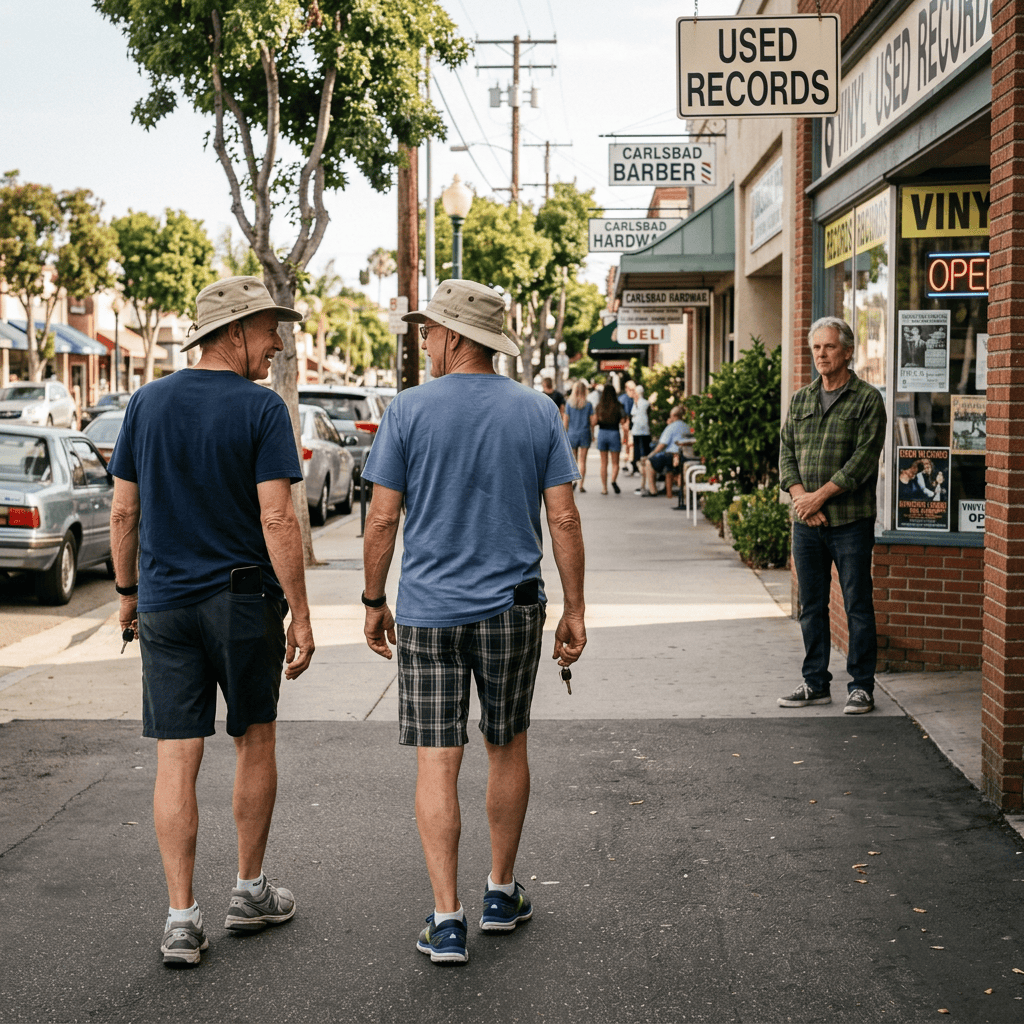
    A few weeks before the beginning of what would be my final fall semester teaching college writing, my family spent a week in Carlsbad.

    One morning we ate breakfast at the French Corner. I ordered a savory crepe and drank coffee softened with milk, cinnamon, and honey. The meal achieved that increasingly rare equilibrium in which you leave neither hungry nor incapacitated. I was full but not bloated, caffeinated but not vibrating, satisfied without immediately wondering what I might eat next. For several fleeting minutes, I experienced something approaching perfection. The meal did not merely fill my stomach; it seemed to quiet some hidden chamber of the soul that normally conducts emergency meetings around the clock.

    Then we wandered into downtown Carlsbad.

    My family disappeared into a used record store while I remained outside. I have never understood the romance people attach to the smell of old books, record sleeves, and aging paper. To enthusiasts, the aroma evokes libraries, childhood, discovery, civilization. To me it smells like mildew wearing a tweed jacket.

    So I waited on the sidewalk and did what I often do when temporarily deprived of distraction: I conducted an inventory of my deficiencies.

    Twenty extra pounds.

    Inconsistent discipline.

    A tendency to overthink everything.

    And, increasingly, the suspicion that I required more regular companionship than I had previously been willing to admit.

    Then I saw two men walking toward me.

    They appeared to be in their early seventies, and I assumed they were retired. Both wore safari hats, T-shirts, shorts, and tennis shoes. Their phones rested harmlessly in their back pockets rather than occupying the command center of their consciousness. They walked side by side, talking with the effortless rhythm of men who had probably traveled this route together hundreds of times.

    They laughed.

    They listened.

    Neither seemed compelled to dominate the conversation, check a notification, document the walk, measure engagement, cultivate a personal brand, or inform the world that he was currently walking.

    They were simply two men walking.

    Their calves caught my attention. These were not gym-manufactured calves, inflated through heroic campaigns involving protein powder, compression sleeves, and motivational playlists. They were walking calves: lean, hard, unremarkable, the product of thousands of ordinary miles accumulated without fanfare. Both men looked younger than plenty of men twenty years their junior because their bodies had quietly become advertisements for moderation.

    I envied them immediately.

    Certainly I envied their leanness. I am not spiritually advanced enough to pretend otherwise. But what I really envied was the life their bodies implied.

    These men had apparently solved a problem I had been treating as several different problems. They did not need to schedule exercise and then separately schedule friendship. They had fused the two. Their physical fitness and social fitness occupied the same hour.

    They had discovered what I began to think of as The Walking Companion Principle: one of the most valuable pieces of retirement infrastructure is another human being who reliably walks beside you.

    Consider the efficiency.

    Walking provides cardiovascular exercise, mobility, sunlight, fresh air, routine, and protection against the gradual transformation of the human body into upholstered furniture. A companion provides conversation, laughter, accountability, perspective, and evidence that you still exist outside your own head. Combine the two and you have created a remarkably sophisticated health intervention requiring almost no technology.

    Shoes.

    Friend.

    Walk.

    Repeat tomorrow.

    No bestselling self-help book is required. No wellness retreat in Sedona. No twelve-week optimization protocol administered by a forty-two-year-old podcaster who owns a cryogenic chamber and hasn’t eaten a carbohydrate since the finale of Breaking Bad.

    Just show up.

    What unsettled me was that the principle seemed particularly important for retirement while having almost nothing specifically to do with retirement. It was simply a principle for living well.

    You take care of your body.

    You walk every day.

    You eat reasonably.

    You cultivate friendships.

    You show up.

    You repeat the process tomorrow.

    These truths possess none of the glamour of revelation. Nobody returns from a monastery in Nepal and announces that he has discovered the importance of taking a walk with a friend. Common sense suffers from terrible marketing.

    Yet the older I get, the more suspicious I become that common sense may contain considerably more wisdom than the elaborate intellectual systems I’ve spent decades examining.

    Standing outside that record store, I began wondering whether I had spent much of my life practicing Existential Overfishing—casting my line ever deeper into the waters of ultimate meaning while ignoring perfectly good fish swimming near the surface.

    I had contemplated religion, mortality, consciousness, transcendence, identity, purpose, and the possibility of God. I had read books by people who had spent their entire lives thinking about these subjects, followed them into increasingly deep philosophical waters, and occasionally surfaced gasping for air with another seven books I apparently needed to read.

    Meanwhile, two retired men in safari hats walked past me and accidentally delivered the executive summary.

    Move your body.

    Find someone you like.

    Talk.

    Keep doing it.

    Could it really be that simple?

    Is common sense enough?

    Could common sense sometimes be superior to profound religious contemplation?

    Had I submerged myself beneath an ocean of fascinating but largely irrelevant abstractions?

    Had I mistaken intellectual complexity for spiritual maturity?

    Had I spent years searching for the meaning of life while failing to notice some of its operating instructions?

    Had I, after all these years, simply lost the plot?

    The questions left me strangely melancholy because the Walking Companion Principle contained an obvious problem.

    When I retired, who would walk beside me?

    Employment had supplied more social infrastructure than I had realized. For forty years, people simply appeared. Students entered classrooms. Colleagues materialized in hallways. Someone stopped outside my office. Conversations occurred because hundreds of people had been deposited into the same institution at approximately the same time.

    Retirement would dismantle much of that machinery.

    Free time would increase precisely as automatic human contact decreased.

    I could walk alone, of course. I could listen to podcasts. I could listen to audiobooks. I could march five miles while absorbing fascinating information about theology, politics, artificial intelligence, crime, nutrition, or the collapse of Western civilization.

    But headphones are not companions.

    A podcast host does not notice when you fail to show up.

    An audiobook does not laugh at your joke.

    The men disappearing down the Carlsbad sidewalk possessed something I suddenly wanted very badly: another person who expected them to be there.

    I didn’t know whether I would find such a companion in retirement. I didn’t know what could substitute for one if I couldn’t. I didn’t know whether my melancholy was justified or merely another example of my ability to turn an innocent morning into an existential emergency.

    But I had learned something.

    Perhaps retirement would not require some magnificent new philosophy capable of replacing forty years of professional identity. Perhaps the essential architecture would be embarrassingly ordinary: decent food, regular movement, human companionship, curiosity, and enough discipline to show up again tomorrow.

    I stood outside the record store watching the two men disappear into the distance.

    I still didn’t know what I was going to do with the rest of my life.

    But I knew exactly where I wanted to eat breakfast the next morning.

  • The Lemon Pesto Principle of Retirement

    The Lemon Pesto Principle of Retirement

    At eight o’clock on Friday morning, I was moving through Trader Joe’s at my customary speed, which is somewhere between brisk shopping and evacuation. I hurled groceries into my cart with the urgency of a man who had been informed that at precisely 8:30 he would turn into a giant pumpkin.

    This is not because I dislike Trader Joe’s. I love Trader Joe’s. But at sixty-four, I have developed an almost religious scrupulosity about time. Friday morning has a sequence. Shop. Drive home. Unload groceries. Put everything away. Work out. Shower. Eat lunch. Nap. Then begin the afternoon shift of academic work and personal creative projects. Disturb the sequence and the entire day threatens to collapse like a poorly stacked Jenga tower.

    So there I was, scrutinizing a gigantic Japanese sweet potato, when I encountered a former colleague.

    He had taught Spanish and Italian at the college and had been retired for years. Now in his eighties, he is a petite man who nevertheless carries himself with tremendous dignity: chest out, posture erect, eyes bright and alert. He looked less like someone retreating from life than someone who had simply been reassigned to another department.

    He smiled.

    I faced a decision.

    Ordinarily, I might have offered a friendly greeting and continued moving. Conversation is dangerous when you are operating under a timetable. One innocent “How have you been?” can metastasize into twelve minutes, and twelve minutes at Trader Joe’s means the workout gets pushed back, which pushes lunch back, which pushes the nap back, which eventually threatens civilization.

    But this man deserved better than a drive-by salutation.

    So I stopped.

    We talked for several minutes. Nothing profound. Retirement. Teaching. Life. The ordinary conversational currency exchanged by two former colleagues standing beside produce while other shoppers maneuver carts around them.

    Then we parted.

    Ten minutes later, I encountered him again in the pasta-sauce aisle.

    He was holding a small jar of lemon pesto.

    “You have to try this,” he said.

    I looked at the jar.

    Lemon pesto was not on the schedule.

    Nevertheless, politeness prevailed. I took it, thanked him, placed it in my cart, and continued my race against the pumpkin.

    By lunchtime I had forgotten about it. Then, while assembling my usual salad—arugula, tuna, garbanzo beans, diced Japanese sweet potato—I noticed the jar. I opened it and added two teaspoons.

    I took a bite.

    Good Lord.

    The salad was magnificent.

    The lemon cut through the tuna. The pesto coated the arugula. The sweetness of the Japanese potato played against the acidity and herbs. Ingredients I had eaten dozens of times suddenly seemed to have hired a new conductor. I sat there staring at my bowl with the astonishment of a chemist who had accidentally discovered penicillin.

    It was easily one of the best salads I had ever made.

    And I owed it to the retired foreign-language professor I had almost been too busy to talk to.

    This is The Lemon Pesto Principle of Retirement: the older and more regimented your life becomes, the more important it is to leave small openings through which the unexpected can enter.

    The principle becomes especially important as retirement approaches. Retirement frightens me partly because I can imagine life contracting. Fewer colleagues. Fewer students. Fewer accidental conversations. Fewer reasons to encounter people outside the familiar perimeter of family and friends. You can respond to this contraction by becoming increasingly efficient, arranging your days into immaculate little compartments—exercise here, lunch there, nap precisely there—until you have constructed a beautifully organized life in which absolutely nothing unexpected can happen.

    This is the dark side of time management. You become so skilled at protecting your time that eventually you protect yourself from life.

    The antidote does not require moving to Tuscany, learning Mandarin, or taking up hang gliding at eighty-two. Novelty can arrive in humiliatingly modest packages. Talk to someone you ordinarily would have hurried past. Listen when he recommends something. Put an unfamiliar jar in your shopping cart. Allow two teaspoons of something new to contaminate the immaculate machinery of your routine.

    At sixty-four, approaching retirement, I am understandably preoccupied with what I am about to lose: professional identity, colleagues, income, structure, relevance, the daily friction of being required somewhere. But perhaps one defense against that contraction is remarkably simple. Keep the aperture open. Keep listening. Keep accepting small invitations into experiences you did not schedule.

    My retired colleague had been out of the classroom for years, but that morning at Trader Joe’s he taught me something anyway.

    I had interrupted my schedule for a few minutes.

    The return on the investment was enormous.

    Two teaspoons of lemon pesto.

    And evidence that the world was not finished surprising me.