Blog

  • The Matryoshka Form Principle

    The Matryoshka Form Principle

    If you have never applied for Medicare before—and by definition, most people applying for Medicare have not—you immediately encounter the remarkable assumption that you already understand the system you are attempting to enter. This would be difficult enough if there were, in fact, a system. There isn’t. There are systems inside systems, agencies inside agencies, programs whose names differ by a few letters but whose purposes differ completely, each connected to the others by administrative tunnels whose existence becomes apparent only after you have crawled halfway through them.

    Think of applying for Medicare as opening a bureaucratic matryoshka doll.

    You begin with what appears to be one large, friendly, manageable doll: Sign Up for Medicare. Fine. You are turning sixty-five. Medicare is health insurance for people sixty-five and older. You go to Medicare to sign up for Medicare.

    Already you have made your first mistake.

    You open the Medicare doll and discover Social Security inside, because apparently the place where you apply for Medicare is not Medicare. It is Social Security. So you create or enter your Social Security account, open that doll, and discover—there it is!—your Medicare application.

    Now the fun begins.

    Inside the Medicare application is a checklist asking about your Group Health Plan. Open that doll and you discover that you need the precise dates of your employment and the precise dates of your employer-sponsored health coverage, two periods you had innocently assumed were essentially the same thing. You started working for your employer on a certain date. Your employer provided your health insurance. What else is there to know?

    Plenty.

    Does your Group Health Plan begin on the day you started working? The day your benefits became effective? The year you switched insurance carriers? The date your current policy began? Somewhere in the administrative sediment of the past thirty years lies the correct answer, and Medicare would now like you to excavate it.

    Open another doll.

    Inside you discover Medicaid, an entirely separate government health program whose appearance on your Medicare checklist causes a momentary existential crisis. Do you have Medicaid? Were you supposed to have Medicaid? Did you acquire Medicaid at some point without noticing? Is there a Medicaid number sitting in a government database with your name attached to it, waiting for you to remember a relationship you never knew existed?

    By now, the cheerful wooden woman you started with has multiplied into an entire Russian peasant village scattered across your desk.

    Call this the Matryoshka Form Principle: every bureaucratic task that appears to be a single task contains another bureaucratic task inside it, which contains another task, which requires another account, another password, another document, another telephone call, and eventually another pleasant employee who informs you that before you can complete Form A, you will need information from Form B, which can be obtained only after establishing an account with Department C.

    You keep opening dolls.

    The dolls keep getting smaller.

    The bureaucracy does not.

    The closer you get to the smallest doll, the more you begin to suspect that there is no smallest doll.

    Congratulations. You have now discovered the first of two essential truths about retirement paperwork: the nesting may be infinite.

    The second truth is even more impressive. Every time you open one of these bureaucratic dolls, you are asked a question whose answer requires knowledge of the bureaucracy you are only now attempting to understand. This brings us to the Bureaucratic Foreknowledge Paradox: to enter an unfamiliar bureaucratic system, you must demonstrate knowledge of the system that could reasonably be acquired only after entering it.

    The paradox explains one of the peculiar psychological transformations of retirement. You may have spent forty years making consequential professional decisions without breaking into a sweat. Now a blank field labeled GROUP HEALTH PLAN START DATE can leave you staring at your computer as though you have been asked to select which wire to cut on a bomb.

    This is not necessarily a bad thing. The Matryoshka Form Principle and the Bureaucratic Foreknowledge Paradox protect you from the most dangerous condition a prospective retiree can develop: complacency. Once you understand these laws, you approach every application with the scrupulosity of a medieval monk illuminating a manuscript. You read every sentence twice. You hesitate before clicking Submit. You preserve confirmation numbers. You photograph screens. You maintain folders containing documents whose existence would have embarrassed your younger self.

    Most important, you learn never to celebrate prematurely.

    You may think you have finished the application.

    You have merely opened another doll.

  • The Mariano Rivera Principle of Retirement

    The Mariano Rivera Principle of Retirement

    Do not wake up one morning, pour yourself a cup of coffee, crack your knuckles, and announce, “Today I’m going to fill out my Medicare application.” This is the kind of statement made by people who have not yet attempted to fill out a Medicare application. You might as well wake up and announce that before lunch you intend to learn Mandarin, replace your transmission, and negotiate peace in the Middle East. Medicare is not something you knock off between breakfast and your trip to Costco. You will not finish it in one sitting. You may not finish it in three. Accept this now and spare yourself the humiliation of watching your cheerful morning agenda disintegrate by 10:17.

    Think of yourself as stepping into the batter’s box against Mariano Rivera.

    For nearly two decades, major-league hitters faced Rivera knowing what was coming. He was going to throw the cutter. There was no elaborate mystery, no carnival assortment of twelve pitches requiring Sherlock Holmes to decipher the clues. Rivera stood on the mound, stared toward home plate, and essentially announced: Here comes the cutter.

    Then he threw it.

    And some of the finest hitters on earth swung at the thing as it darted away from the sweet spot of the bat, leaving them jammed, bewildered, or trudging back toward the dugout carrying the splintered remains of their dignity.

    This brings us to The Rivera Principle: no major retirement bureaucracy can be defeated in a single sitting, even when you know approximately what is coming.

    Medicare is Mariano Rivera standing sixty feet, six inches away.

    You know there will be questions about health insurance. You know there will be dates. You know Social Security will somehow be involved. You know there will be usernames, passwords, authentication codes, employment records, Group Health Plans, and mysterious terminology. You have studied the scouting report. You have stretched. You have brought your reading glasses.

    None of this means you are going to make contact.

    The first pitch asks for a password you thought you had. Swing and miss.

    The second asks for the precise date your Group Health Plan began, forcing you to wonder whether that means the year you started your job, the year your health benefits began, or the year you switched insurance carriers. Swing and miss.

    The third sends you from Medicare to Social Security, causing you to wonder why you are applying for Medicare somewhere other than Medicare. Strike two.

    Then Medicaid appears on a Medicare checklist, and for several bewildering seconds you wonder whether you have Medicaid, whether you were supposed to have Medicaid, or whether Medicaid has been quietly following you for years like a government surveillance van.

    Foul ball.

    Now HR must be contacted.

    Step out of the box.

    The rookie retiree interprets these interruptions as failure. He becomes agitated. He pounds the desk. He begins attacking dropdown menus with the desperate aggression of a hitter protecting the plate with two strikes. This is precisely how Mariano gets you. You become impatient. You expand the strike zone. You swing at pitches you should never have touched.

    The experienced retiree develops Administrative Plate Discipline. He understands that surviving the bureaucracy requires knowing when not to swing. If you don’t know the Group Health Plan start date, don’t guess. Step out of the box. Call Benefits. If you don’t understand whether a question refers to your employment or your insurance coverage, don’t click whatever answer seems approximately correct because you would like to be finished before lunch. Put down the bat. Save the application. Walk back to the dugout.

    Have lunch.

    Take a nap.

    Come back tomorrow.

    Rivera will still be there.

    This is the deeper meaning of The Rivera Principle. Your objective is not to conquer Medicare in one glorious at-bat. Your objective is to remain in the game. Foul off the difficult pitches. Take the ones you don’t understand. Get the information you need. Step out of the box when your nerves begin to fray. Return the next morning with your documents, your passwords, your HR representative’s email, and whatever remains of your self-respect.

    Then dig your heels into the dirt and look toward the mound.

    Rivera looks very tall from sixty feet, six inches away.

    If you’re intimidated, good. You’re alive.

    If you’re not intimidated, you haven’t seen the cutter yet.

  • The Final-Season Principle of Retirement

    The Final-Season Principle of Retirement

    There I was, deep in the weeds of retirement, hacking my way through forms, passwords, security codes, pension calculations, Medicare applications, and all the other administrative vegetation that grows between a working person and his freedom. Retirement was still two semesters away, but I had already learned that you cannot begin preparing for it too early. I had finally obtained what I had come to think of as my revenue-stream number—the monthly pension figure that answered the most fundamental question of retirement planning: Would I be rich? No. Would I be homeless? Also no. This struck me as excellent news.

    I called my best friend and colleague, Tom, to tell him.

    Tom is seventy-five, a wrestling coach and physical-education instructor, and he has no intention of retiring. For him, leading students through weight training, tennis, pickleball, and wrestling is as natural as breathing. You do not wake up one morning and announce that after careful consideration you have decided to stop respiration. Why, then, would you stop coaching? As long as there are students to train, weights to lift, balls to hit, and wrestlers to instruct in the ancient art of folding another human being into an ottoman, Tom sees no compelling reason to leave.

    I told him that my situation was different. My retirement was approaching. In June 2027, at sixty-five years and eight months, I planned to finish my final semester, turn in my grades, close the office door, and walk away.

    Tom rejected this immediately.

    I couldn’t retire, he told me. I was the only writing instructor teaching the athletes in a face-to-face freshman composition class every fall. The students trusted me. The counselors trusted me. The coaches trusted me. I was loved. I was valued. I was useful. Most important, I was apparently irreplaceable, a status every employee spends forty years secretly craving and then discovers at retirement to be administratively inconvenient.

    Tom offered a solution.

    “If you retire, I can make sure you still teach that one class. It’ll be easy. You drive to campus one day a week, teach the athletes for two hours, and do the rest online. Everyone loves you—the students, the counselors, the coaches. We can’t lose you. Think about it.”

    I did.

    At first, I thought it was a wonderful idea.

    Why wouldn’t I? The arrangement offered nearly everything flattering about work while eliminating much of what I disliked. I could retire while remaining partially unretired. I could keep the class I loved, work with people who appreciated me, maintain my connection to campus, collect some additional income, and preserve the pleasant fiction that an institution of higher education might collapse if I failed to appear on Tuesday morning.

    It was enormously seductive.

    But over the next several days, something became clear.

    I didn’t want another season.

    I began thinking about careers the way I think about television series. The best ones know when to stop. Breaking Bad ended. The Sopranos ended. The Wire, The Americans, and Succession ended. Their creators understood something that television networks, aging rock bands, professional athletes, and tenured professors sometimes have difficulty accepting: the existence of an audience does not obligate you to continue performing.

    There is dignity in recognizing the endpoint.

    Call this the Final-Season Principle: the best time to end a successful career is while the audience still wishes there were another season.

    This sounds obvious until someone offers you another season.

    Then the ego gets involved.

    People still love you. They still laugh at your jokes. Students still tell you that you’re their favorite professor. Coaches tell you nobody can replace you. Counselors want you back. Your friend calls and offers you the professional equivalent of a victory lap: one class, one day a week, two hours on campus. Come on. Just six more episodes.

    This is how shows get into trouble.

    The great television series end while we are still arguing that they could have continued. The unfortunate ones mistake affection for infinite demand. They survive on reputation, nostalgia, and the emotional capital accumulated during their prime years. Nobody wants to insult them. Viewers speak respectfully about what the show once meant to them. They praise the original cast. They reminisce about the magnificent third season.

    They just don’t watch anymore.

    A career can end the same way.

    I have seen professors remain on campus beyond their natural final season. Nobody tells them. Academia is too polite for that. Colleagues praise their extraordinary service. Former students express affection. Administrators present plaques. Everyone behaves with appropriate reverence.

    But something has changed.

    The professor is still standing at the front of the classroom, but the performance has lost some electricity. The material hasn’t changed much in years. Grading has become heavier. Preparation feels more burdensome. Technology becomes increasingly irritating. Meetings that were once merely tedious now feel like violations of the Geneva Conventions. The professor may still be perfectly competent, but competence is no longer the issue.

    The season has ended.

    There can be sadness in watching someone refuse to acknowledge this. After decades of being Professor, Doctor, Coach, Director, or Dean, retirement threatens something more frightening than lost income. It threatens relevance. If students no longer wait outside your office, if colleagues no longer ask your opinion, if your name disappears from the schedule of classes, an unsettling question presents itself: Who am I when the institution no longer needs me?

    So you sign up for another semester.

    And then another.

    You tell yourself the students need you. Perhaps they do. You tell yourself the department needs you. Perhaps it does. But somewhere beneath these noble explanations lurks another possibility: you need them to need you.

    That is precisely the ending I want to avoid.

    I am not leaving because I dislike my students. I love working with them. I am not leaving because I dislike the coaches and counselors. Their affection makes leaving harder. Nor am I pretending that I am incapable of teaching another composition class. I could do it.

    But I can feel the wear.

    My cognitive machinery does not turn quite as effortlessly as it once did. Grading feels heavier. Creating fresh material requires more energy. Performing in front of a classroom takes more out of me. And my tolerance for administrative absurdity—particularly the contemplation of Student Learning Outcomes inside the Byzantine catacombs of Nuventive—has declined to levels that may soon require medical intervention.

    More important, I want that energy for something else.

    Retirement isn’t merely the absence of work. It is the transfer of a finite resource. Every hour I spend grading an essay is an hour I cannot spend reading, writing, exercising, traveling, being with my family, or discovering what life looks like when it is no longer organized around an academic calendar. Energy becomes more precious as you age. Eventually you have to decide where you want to spend it.

    And at the moment, I need a considerable portion of mine merely to retire.

    There are still Medicare forms to complete, pension systems to coordinate, insurance dates to excavate, passwords to resurrect, documents to locate, appointments to schedule, and websites to enter with the grim concentration of a bomb technician approaching the red wire. I cannot fight the retirement bureaucracy while simultaneously grading freshman essays, creating engaging classroom content, and analyzing Student Learning Outcomes for a website apparently designed by the imperial bureaucracy of Emperor Justinian.

    Something has to give.

    It will be the job.

    So I will call Tom and disappoint him.

    I will tell him how much his offer meant to me. I will tell him that being wanted at the end of a career is an extraordinary gift. I will tell him that I love the athletes, the coaches, the counselors, and the peculiar little community we built together. And then I will tell him no.

    Because the Final-Season Principle contains a truth that becomes harder to understand precisely when people are begging you to stay: being loved is not a reason to keep working forever. Sometimes being loved is evidence that you have reached the perfect moment to leave.

    The show had a good run.

    It wasn’t canceled.

    I ended it.

  • How the Bureaucratic Self-Preservation Principle Hijacks Your Retirement

    How the Bureaucratic Self-Preservation Principle Hijacks Your Retirement

    Do not assume that when you apply for retirement there are bureaucratic safeguards protecting your money. There are no guardrails, no kindly pension shepherd watching over your flock, no government employee in Sacramento studying your file at midnight and whispering, “We’d better make sure this fellow gets every dollar he earned.” You have entered the Wild West. Think of yourself as a rancher guarding a herd from rustlers, wolves, coyotes, and anyone else who has noticed that cattle are valuable and ranchers occasionally fall asleep.

    Consider what happens when you spend seven years working at a university covered by CalPERS and then move to a college covered by CalSTRS. A reasonable person might assume that your retirement benefits would somehow follow you. After all, you are still you. You have merely changed employers. Both pension systems operate in California. Computers exist. Databases exist. The state knows your Social Security number, your salary, your address, your employment history, and probably what you had for breakfast. Surely CalPERS and CalSTRS can figure out that the person who worked at the university is the same person who now works at the college.

    That assumption reveals a touching faith in civilization.

    Your CalPERS pension remains in CalPERS. Your CalSTRS pension accumulates separately in CalSTRS. The two systems do not simply merge because doing so would be convenient for you. Convenience, after all, is the natural enemy of bureaucracy. Efficiency eliminates procedures. Eliminated procedures eliminate departments. Eliminated departments eliminate jobs. Bureaucracies therefore possess an evolutionary interest in complexity.

    Call this the Bureaucratic Self-Preservation Principle: the tendency of administrative systems to resist simplification because every eliminated procedure, redundant department, and overlapping jurisdiction diminishes the bureaucracy’s reason for existing. Efficiency solves problems. Bureaucracy survives by administering them.

    Unfortunately, the Bureaucratic Self-Preservation Principle is not aligned with your quest for a smooth retirement. It is a noose around your neck.

    You discover this when you finally decide to retire and learn that your two pension systems must be coordinated according to something called reciprocity and concurrent retirement. At first, the rules can leave you with the impression that you must notify CalPERS and CalSTRS at precisely the same atomic second or a trapdoor will open beneath your pension, the government will seize your house, and you will spend your golden years living beneath an overpass eating beans from a can.

    This is not technically true.

    It merely feels true.

    What you have actually encountered is the exquisite bureaucratic pas de deux known as the Laws of Reciprocity and Concurrence. Because you have benefits in both CalPERS and CalSTRS, you cannot simply retire, an act you may have naively imagined consisted of ceasing to work. You must coordinate your departure with two enormous pension systems that have developed different terminology for related arrangements. CalPERS speaks of reciprocity. CalSTRS speaks of concurrent retirement. Each maintains its own applications, regulations, representatives, websites, definitions, deadlines, and little administrative tripwires hidden beneath the leaves.

    Yet somehow you must make these two bureaucratic kingdoms acknowledge that the same human being is retiring from both.

    The safest approach is generally to coordinate the effective retirement dates, ordinarily using the same retirement date, although CalSTRS permits different dates under certain circumstances if you perform no creditable service between them. Apparently even the date on which you stop working requires interpretive scholarship.

    The penalty for getting this wrong is not necessarily that a tactical unit of pension officers arrives before dawn, kicks down your front door, and confiscates your retirement, although by this stage of the process you may find such a scenario psychologically plausible. The actual danger is less cinematic and therefore more frightening: you may lose financial advantages available through proper coordination, including potentially favorable treatment of your final compensation. After decades of accumulating pension benefits, you arrive at a point where an incorrectly chosen date or misunderstood rule can affect money you expected to receive for the rest of your life.

    Call this the Reciprocity Paradox: two retirement systems agree to recognize each other, provided you possess sufficient administrative competence to make them recognize each other.

    And here is the part nobody explains when you begin dreaming about retirement. No sheriff rides onto your ranch to announce the Reciprocity Paradox. No pension guardian appears at your door with a checklist and says, “I noticed you worked under two retirement systems. Before you file anything, we need to talk.” You have to discover the danger yourself, preferably before you make the mistake the rules were apparently designed to punish.

    This is one of the central lessons of retirement: the closer you get to never working again, the more terrified you become of making a clerical error.

    So put on your hat and climb onto your horse. You are the cowboy on the pension frontier. Take out your binoculars and scan the horizon. Look for predators. Look for contradictions. Look for deadlines. Look for the form that generates another form. Look for the rule buried on page forty-seven of a PDF that contradicts what you thought you read on the website. Count your cattle. Mend your fences. Check them again.

    You’re on your own, my friend.

    Welcome to retirement.

  • The Cruelty of Retirement No One Warned You About

    The Cruelty of Retirement No One Warned You About

    Growing old and planning your retirement provide a cruel education in the merciless nature of bureaucracy. You spend forty years imagining retirement as an escape from work, only to discover that before you’re permitted to stop working, you must complete an enormous amount of additional work.

    Most of it involves paperwork.

    Except we don’t call it paperwork anymore because there is no paper. Paper would be too easy. Paper sits obediently on a table. You can hold it in your hands, read it, scribble notes in the margins, and return to page one whenever you get confused. Modern bureaucracy has improved upon this primitive system by replacing paper with websites, portals, passwords, security questions, verification codes, drop-down menus, disappearing screens, and online forms that occasionally erase everything you’ve entered because you spent too long looking for your Social Security number.

    This technological revolution arrives at precisely the right moment in your life: when your eyes are tired, your patience is gone, and your facility with navigating government websites is approaching that of a manatee attempting to operate an ATM.

    No matter. The gauntlet begins.

    First, Medicare.

    You arrive at the Medicare website expecting to encounter something resembling a large button that says START HERE.

    Instead, you are greeted by photographs of radiant senior citizens experiencing levels of happiness rarely observed outside pharmaceutical advertisements. Silver-haired couples stroll along beaches. Healthy retirees embrace grandchildren. Everyone appears recently moisturized. Nobody is squinting at a computer monitor wondering whether he needs to fill out Form B.

    Meanwhile, the website offers you an enormous quantity of information. There are links explaining insurance packages. Links answering frequently asked questions. Links explaining other links. You can learn almost anything you want about Medicare except the answer to the one primitive question pounding inside your skull:

    Where the hell do I start?

    You become a rat in a digital maze.

    Perhaps you need Form B. Perhaps you don’t. Perhaps you need it eventually but not now. Perhaps filling it out now will create a problem later. Make sure you have all your information handy, although you’re not entirely sure what “all your information” means until the website requests a number you’ve never heard of that apparently governs your destiny.

    There is no benevolent angel sitting beside you saying, “You’re doing fine. Click that button.”

    There is just you, growing visibly older in the blue light of your monitor while a seventy-two-year-old stock-photo model smiles at you from a sailboat.

    I call this Portal Despair: the distinctive psychological state produced by staring at a beautifully designed institutional website containing enormous quantities of information but no obvious answer to the question, Where do I start?

    The happier the people on the website appear, the worse Portal Despair becomes.

    Once Medicare has softened you up, you move on to CalPERS and CalSTRS.

    Years ago, before our Human Resources coordinator retired during COVID, she warned me that there was some peculiar rule governing the timing of retirement when CalPERS and CalSTRS are involved. The dates have to align correctly. There is a sequence. Something has to happen before something else happens.

    I don’t remember the details.

    I only remember receiving the distinct impression that if I retire on the wrong Tuesday, my pension will turn into a pumpkin.

    So now I must contact the new HR person and ask her to reconstruct this ancient knowledge. My goal is to get CalPERS and CalSTRS working together in perfect harmony so that my retirement proceeds like a smooth stone skipping across a still lake.

    I fully expect instead to discover that one agency requires a document from the other agency, which cannot produce that document until the first agency verifies that I have requested it.

    Then comes health insurance.

    Because I’m leaving my employer’s health plan and moving onto my wife’s, her employer requires official documentation showing that she has “lost coverage.”

    Lost coverage.

    The phrase sounds apocalyptic. It suggests that our family has been cast onto the American healthcare tundra wearing burlap sacks and searching the horizon for a free clinic.

    We haven’t lost anything. We’re changing insurance.

    But the bureaucracy has declared this a loss, and therefore someone must produce an official document certifying the loss. My wife will then present this sacred parchment to her employer, which will presumably inspect the seal, consult the oracle, and permit us to purchase health insurance through her job.

    Then we have to investigate dental and vision coverage. My wife reports that the dental insurance offered through her employer sucks, a technical assessment I trust completely. Perhaps we should continue purchasing dental and vision coverage through my former employer. Perhaps not.

    And although her job will keep us with Kaiser, we don’t yet know exactly what version of Kaiser we’re getting. Perhaps it will be essentially the same. Perhaps it will be Kaiser Lite, with higher copays and subtle degradations that reveal themselves only after you’re sitting in an examination room wearing a paper gown.

    You won’t know until you’re inside the belly of the beast.

    Good luck.

    Then there’s the pension.

    A CalSTRS representative tells you the amount you’ll receive every month, and for approximately eleven seconds you feel rich.

    Do not enjoy those eleven seconds.

    That number is gross income.

    Taxes still exist.

    The government, having spent decades taxing your salary, does not shake your hand at retirement and say, “You’ve done enough. Keep the rest.”

    So when the pension representative gives you that beautiful monthly number, mentally shrink it immediately. Do not start pricing Viking cruises. Do not buy a Porsche. Do not inform your children that Daddy has entered the leisure class.

    You’re not rich.

    You’re simply receiving taxable income while wearing sweatpants.

    By this point you begin to believe you’re making progress. You’ve completed several forms. You’ve spoken to HR. You’ve created accounts. You’ve written down passwords. Somewhere in the distance, you think you can see light.

    You are delusional.

    There are more forms.

    Forms beget forms.

    One form requires an attachment. The attachment requires certification. The certification requires proof. The proof must come from another institution, which requires you to complete another form before it will provide the proof required by the first form.

    Eventually there are subforms attached to larger forms and subforms attached to the subforms. You begin with the innocent objective of changing your health insurance and find yourself three weeks later downloading a PDF called “Verification of Qualifying Event Supporting Documentation Supplemental Certification.”

    Chefs have an expression for reaching this condition:

    You’re in the weeds.

    I prefer Form Metastasis: the tendency of one bureaucratic form to generate additional forms, certifications, attachments, proofs, and follow-up requests. Form A requires Form B. Form B requires verification from Institution C. Institution C cannot provide verification until Institution D processes Form E.

    Nobody designed the entire system.

    That’s what makes it terrifying.

    I could have retired three years ago.

    I didn’t.

    You want to know one reason?

    I hate paperwork.

    I hate paperwork with such intensity that I would rather get dressed in the morning, drive to work, attend tedious meetings, answer emails, listen to administrators explain exciting new initiatives, and grade thousands of student assignments every year than confront the administrative machinery required to stop doing those things.

    Work, at least, I understand.

    Retirement requires training.

    But I’ve finally made the decision. I’ll be sixty-five in a couple of months. I’m retiring.

    Except “retiring” now strikes me as a fraudulent description of what is happening.

    I’m not retiring.

    I’ve changed jobs.

    I used to be a college instructor. Now I am an unpaid administrative assistant assigned exclusively to the Jeffrey McMahon account.

    My responsibilities include Medicare enrollment, pension coordination, health-insurance transitions, dental and vision decisions, tax withholding, beneficiary elections, document retrieval, password management, deadline compliance, and maintaining good standing with an assortment of institutions that possess the power to interfere with my money or healthcare.

    There will be no salary.

    There will be no vacation.

    There will be no administrative assistant because I am the administrative assistant.

    This is Bureaucratic Retirement Capture: the process by which institutions ostensibly designed to facilitate your retirement instead colonize your time and attention. You leave your employer expecting liberation from schedules and administrative obligations, only to discover that Medicare, pension systems, insurance companies, tax agencies, and benefits departments have inherited you.

    Which brings me to the cruelest discovery of all.

    The Retirement Paradox.

    Leaving the workforce requires taking on another job: the administration of leaving the workforce.

    Instead of meetings and grading, you get Medicare enrollment, CalSTRS, CalPERS, HR documentation, health-insurance transitions, dental and vision decisions, tax withholding, beneficiary elections, deadlines, passwords, portals, forms, subforms, supplemental forms, and forms verifying that you have completed other forms.

    For decades, I imagined retirement as a great exhalation. I would finish my final semester, turn in my grades, clean out my office, drive home, and feel the enormous machinery of employment finally release me.

    Instead, the machinery has merely transferred me to another department.

    How stupid am I?

    Why didn’t I just keep working?

    It would have been so much easier.

  • The Acquisition Readiness Principle of Certain Watch Enthusiasts

    The Acquisition Readiness Principle of Certain Watch Enthusiasts

    Six months ago, I bought a G-Shock GW-6900 and quickly convinced myself that it wasn’t for me. I already owned two G-Shocks—the Frogman and the Rescue—and two, I decided, were enough. I had achieved that mythical state every watch collector claims to desire and almost none can tolerate: contentment.

    There was also the 6900 strap. It was just a little too short. Once I buckled the watch around my wrist, I had only two holes remaining. The watch fit perfectly well, but in the fevered jurisprudence of watch collecting, two unused holes constituted evidence for the prosecution.

    So I put the 6900 back in its box, requested a return from Amazon, drove to my local UPS Store, and rid myself of the offending object within ten minutes. I felt enormous relief. Order had been restored. I owned exactly two G-Shocks. The collection was disciplined, coherent, complete.

    Naturally, I then bought three more.

    Over the ensuing months, the Mudman GW-9500 arrived, followed by the Mudman G-9300 and the King GXW-56. My austere two-watch collection had swollen to five, and I happily rotated among them while apparently forgetting the solemn principles of restraint that had compelled me to return the 6900.

    Then, about a month ago, the 6900 began haunting me.

    I started looking at photographs. I read discussions. I watched videos. I studied that strange face with its three circular indicators staring back at me like the instrument panel of a tiny Cold War submarine. Enthusiasts call the GW-6900 “The Three-Eyed Monster,” which is a perfectly good nickname. I prefer my own: the Triclops.

    Soon the Triclops was everywhere. I couldn’t get it out of my mind. The watch I had dispatched to UPS with the efficiency of a man returning a defective toaster had somehow acquired an aura in its absence.

    So I bought it again.

    It is now in transit and should arrive in a few days.

    I don’t remember whether the first GW-6900 I owned was the older version with the greenish electroluminescent backlight. I do know that the incoming watch is the newer GW-6900U-1, with its bright white LED. More important, I am strangely confident that this time I am going to connect with it.

    I’ve experienced this phenomenon before: a watch leaves me cold the first time and captivates me later, even though the watch itself has barely changed. Other collectors have experienced it too. It’s tempting to dismiss the whole business as fickleness. We buy something, reject it, romanticize it, and buy it again. From the outside, this resembles the behavior of someone who should have his credit card frozen inside a block of ice.

    But I think something more interesting is going on.

    Collectors like to imagine that our reactions reside entirely in the objects themselves. A watch either speaks to us or it doesn’t. The dimensions are right or wrong. The dial works or it doesn’t. The strap fits or it doesn’t. We behave as if we were laboratory instruments registering objective measurements.

    We’re not.

    Timing matters. Mood matters. The condition of the existing collection matters. Most of all, our willingness to admit another object into that collection matters. Sometimes we encounter the right watch at the wrong time.

    This is what I call the Acquisition Readiness Principle: the psychological state in which a collector becomes genuinely receptive to incorporating a new object into an established collection.

    The first time the GW-6900 arrived, I was defending the sufficiency of my Frogman and Rescue. I wanted a small collection. I was guarding my wrist rotation like a suburban homeowner defending his property line. The 6900 wasn’t merely another watch; it was an intruder. Its slightly short strap gave me the excuse I needed to evict it.

    Six months later, the watch is essentially the same. I am not.

    Now there is a vacancy waiting for the Triclops.

    This raises an obvious question: How can anyone possibly be “not ready” for a wristwatch?

    The question itself exposes the magnificent lunacy of the hobby. We don’t merely buy watches. We audition them. We assign them roles. We decide whether they overlap with existing members of the collection. We worry about whether they will receive enough wrist time. We speak of watches “connecting” with us, as though a 50-millimeter lump of resin containing a quartz module were an emotionally complicated rescue dog.

    A new watch therefore requires a certain receiving mode. We have to lower the drawbridge. We have to stop protecting the existing collection long enough to imagine another member belonging there. The object has not changed. The collector has.

    Does this sound nuts?

    Of course it does.

    The most honest watch enthusiasts have long since abandoned the pretense that this is an entirely rational hobby. But perhaps the watches aren’t making us crazy. We’re doing that perfectly well ourselves. We take harmless little machines designed to tell us the time and burden them with identity, nostalgia, status, memory, personality, tribal affiliation, and elaborate theories of Acquisition Readiness.

    Then we give the hobby a bad name.

    It’s one of the things we’re most proud of.

  • How 10,000 Students Ruined My Misanthropy

    How 10,000 Students Ruined My Misanthropy

    In 1984, when I was in college, I was knocked sideways by A Confederacy of Dunces, John Kennedy Toole’s great comic novel about the picaresque adventures of Ignatius J. Reilly, a bloated, know-it-all misanthrope who regards nearly every human being he encounters as evidence of civilization’s decline. The title comes from Jonathan Swift: “When a great genius appears in the world you may know him by this sign; that the dunces are all in confederacy against him.”

    I never considered myself a genius, but the second half of Swift’s proposition appealed to me enormously. Perhaps the world really was a confederacy of dolts. Some of my favorite comedians seemed to agree. George Carlin surveyed humanity and found an inexhaustible supply of idiots. David Letterman arrived on television with the weary expression of a man who had already heard your story and regretted it. His grumpy deadpan seemed perfectly suited to the beginning of a new decade. Disco was departing. Good riddance. Disco was for dunces. Deadpan irony was for people who understood things.

    At least that was how I saw it.

    Misanthropy struck me as a form of intellectual street cred. If you were disgusted with humanity, presumably you had seen through it. Optimists were rubes; cynics had X-ray vision. I imagined becoming a comic novelist with a misanthropic edge, skewering the fools who wandered into my field of vision.

    Unfortunately, contempt is a lousy substitute for insight.

    My fictional characters tended to be flat and two-dimensional because I had already convicted them before they entered the story. They existed to be mocked, not understood. The expression “punching down” wasn’t part of the cultural vocabulary of the 1980s, but I would have benefited enormously from understanding the concept. Satire without empathy can quickly deteriorate into a bully standing over his victims and congratulating himself on his wit.

    Then, through a sequence of accidents that hardly resembled career planning, I stumbled into teaching college writing at twenty-four. In 1987, a friend’s father needed instructors for a Merritt College bridge program at Skyline High School and couldn’t find enough people to teach the classes. I agreed to help.

    That temporary job lasted thirty-nine years.

    I taught for two years in the Bay Area, seven in Bakersfield, and thirty in Los Angeles. Somewhere along the way, nearly 10,000 students passed through my classrooms.

    They ruined my misanthropy.

    It is difficult to maintain a sweeping contempt for humanity when humanity keeps arriving in your classroom every semester with names, families, jokes, ambitions, insecurities, talents, disasters, and complicated histories. My students were too intelligent, contradictory, funny, wounded, resilient, exasperating, and generous to fit inside the crude categories of my younger imagination. The closer I looked at people, the less useful my caricatures became.

    Perhaps I am biased. An absurdly high percentage of my students treated me with kindness. They forgave me when I arrived with mediocre material and rewarded me extravagantly when I brought something worthwhile. On good days, the room crackled. Students argued, laughed, challenged me, and occasionally produced that rare classroom electricity when everyone seemed to understand that something interesting was happening.

    They also discovered that my tortured soul was an excellent source of entertainment.

    The more lugubrious I became, the funnier they found me. I could enter class burdened by some private catastrophe, convinced that existence was a bleak corridor leading toward oblivion, and within minutes twenty-five students would be laughing at me. I found this strangely therapeutic. If my despair could become somebody else’s comedy, perhaps despair wasn’t quite as formidable as I imagined. My students taught me, among other things, not to take my suffering entirely at face value.

    My empathy deepened again in 2010 when I became the father of twins. Parenthood rearranged my vision. Suddenly, when a student struggled, I could imagine one of my daughters sitting in that chair. The exhausted student, the confused student, the student who had fallen behind and was embarrassed to ask for help—each became somebody’s child in a way I had understood intellectually but not viscerally.

    I wish I had possessed that parent-vision when I began teaching. It would have made me a better instructor from the first day. I undoubtedly mistook confusion for laziness, immaturity for indifference, and struggle for lack of character more often than I would like to remember. I cannot travel backward and repair those failures. I can only recognize them.

    Now I am retiring.

    I will miss my students—all 10,000 of them, give or take a few hundred victims of my arithmetic. The overwhelming majority were kind, intelligent, curious, and hungry for the same things human beings have always wanted: connection, dignity, purpose, and some reasonable measure of happiness.

    I ask their forgiveness for the days when my selfish, surly self commandeered the classroom. And I thank them for the laughter, generosity, and encouragement they gave me on the days when my better self managed to show up.

    One thing I know after nearly forty years: sustained contact with actual human beings makes serious misanthropy difficult. You can despise “people” in the abstract. It becomes harder when people acquire faces.

    I still love A Confederacy of Dunces. I still love Ignatius J. Reilly. But after spending four decades in classrooms, I suspect I understand something that Ignatius never did. The confederacy of dunces is largely an illusion produced by distance. Get close enough to the supposed dunces, listen to their stories, watch them struggle, and allow them to laugh at you for a few decades, and the confederacy begins to dissolve.

    Had Ignatius J. Reilly been sentenced to forty years of teaching college writing, even he might have been cured.

    Although I suspect his student evaluations would have been spectacular.

  • My Thoughts and Grading Policy Regarding Students Using Generative AI

    My Thoughts and Grading Policy Regarding Students Using Generative AI

    I know too many professionals and academics—including myself—who use generative AI as a writing and thinking tool for me to tell students that AI is somehow forbidden in my class. Apart from being virtually impossible to enforce, such a prohibition would be the apotheosis of hypocrisy.

    Instead, I want to distinguish between effective and ineffective uses of generative AI and explain how I grade assignments that amount to AI slop: an effluvium of smooth, competent-sounding prose that says remarkably little, relies on hackneyed AI expressions, and substitutes verbal polish for actual analysis.

    I think of generative AI as a performance-enhancing drug and the AI user as a bodybuilder. A natural bodybuilder has difficulty competing against athletes using PEDs because the drugs provide enormous advantages in size, strength, muscularity, and recovery. Generative AI creates a similar imbalance. A student or professional who completely goes off the AI grid may struggle to match the speed, volume, and polish of someone who knows how to use these tools effectively.

    But here’s the rub: the bodybuilder still has to get in his reps. He has to drag himself into the gym, lift the weights, eat properly, consume enough protein, and hit his macros. The drugs cannot perform the workout for him.

    Imagine instead someone sprawled on the couch all day watching Netflix, surviving on Hot Pockets, Doritos, and chocolate pudding, while taking PEDs. He will not magically wake up looking like Mr. Olympia. He will remain a tomato with four toothpicks sticking out of it.

    Writers are no different. They have to get in their reps and hit their intellectual macros. That means doing the heavy lifting: reading carefully, thinking deeply, developing arguments, gathering evidence, writing drafts, confronting counterarguments, and rewriting weak passages. Once that work has been done, generative AI can become an extraordinarily useful tool for questioning ideas, identifying weaknesses, improving clarity, reorganizing material, editing prose, and assisting with revision.

    The problem begins when the student skips the intellectual workout and treats AI like a genie in a bottle: type in a prompt, rub the lamp, and watch a finished essay materialize.

    When I encounter an assignment like this, I am not interested in playing detective and arguing with a student about whether a particular sentence was generated by AI. I can simply grade the work in front of me. If the essay consists of generic observations, canned transitions, predictable arguments, inflated language, and smooth paragraphs without substantive analysis, then it fails to demonstrate the Student Learning Outcomes. It may be grammatically pristine and rhetorically lifeless at the same time.

    So my policy is simple: use generative AI, but do not outsource your education to it.

    Do the reading. Do the thinking. Develop the argument. Wrestle with the evidence. Write and rewrite. Then use AI where it can genuinely help you—as an editor, critic, brainstorming partner, and revision tool.

    AI can enhance the work. It cannot replace the work.

  • How Moral Rot Gets a Corporate Takeover

    How Moral Rot Gets a Corporate Takeover

    As my writing students and I explore McKay Coppins’s “Sucker: My Years as a Degenerate Gambler,” I realize that sports betting does not lead to a single research question. It opens the door to at least four distinct arguments:

    1. Is sports betting designed to function as a harmless hobby, or does its business model depend on cultivating addictive behavior?
    2. Will the growing alliance between professional sports and gambling eventually produce enough corruption and suspicion to destroy fan trust—and, with it, the sports business model?
    3. Is sports betting so structurally tilted toward the house that a rational understanding of the system should compel us to avoid it altogether?
    4. What does the astonishing normalization of sports betting teach us about the dangers of the Overton Window?

    The fourth question interests me most. Sports betting was once associated with bookies, organized crime, ruined families, fixed games, and moral decay. Now the same basic enterprise arrives on a glowing smartphone, endorsed by Hall of Fame athletes, promoted during broadcasts, and wrapped in the cheerful language of bonus bets, profit boosts, and enhanced fan engagement. A platform capable of exploiting addiction, encouraging corruption, and monetizing human weakness has been repackaged as wholesome mainstream entertainment.

    That transformation may be the most disturbing lesson of the entire unit. The Overton Window shows us that social pathology does not have to defeat our moral resistance in a frontal assault. It can simply change its clothes. Give vice enough celebrity endorsements, corporate partnerships, technological convenience, and relentless exposure, and eventually we may stop seeing vice at all. If my students and I can watch that transformation occur without becoming deeply unsettled by it, then perhaps the normalization is already doing its work.

  • The Price of Admission

    The Price of Admission

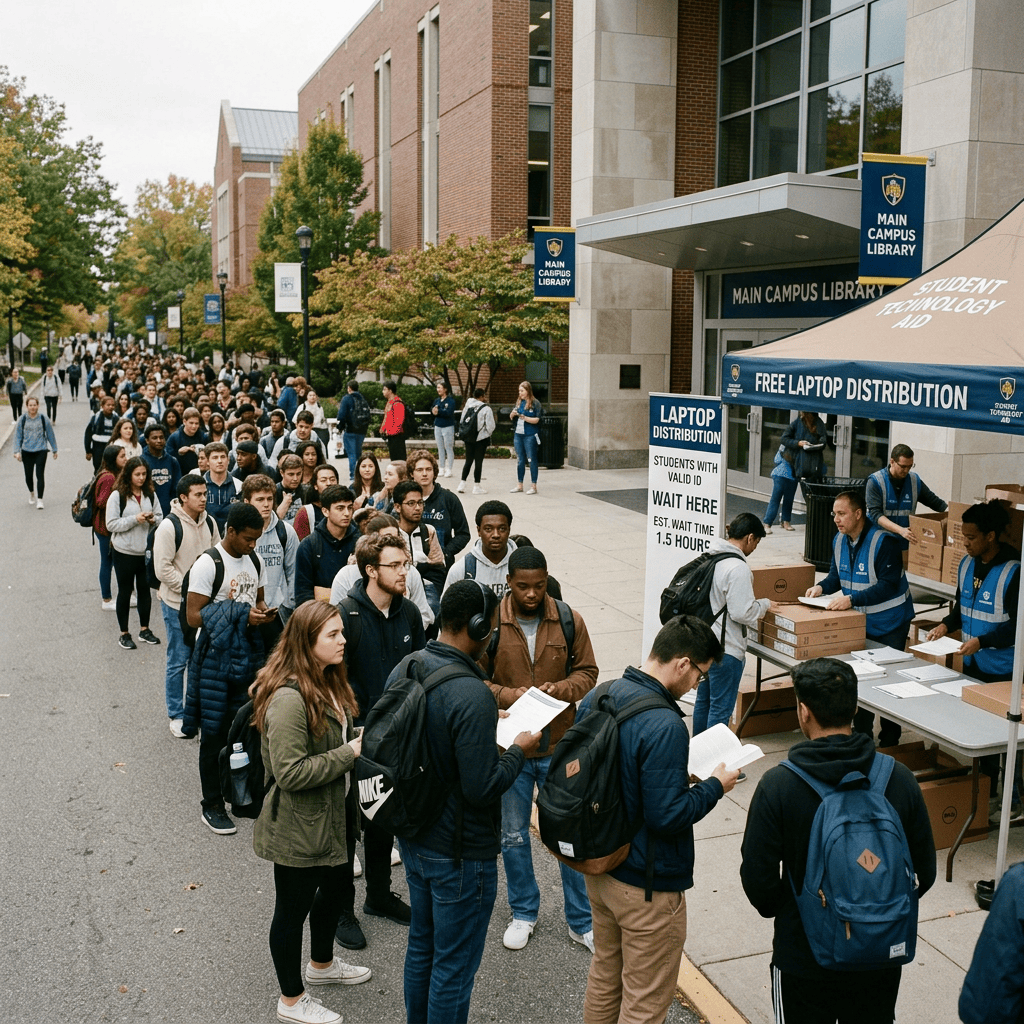
    Walking to my office this morning on the first day of the semester, I came upon a sight I had never seen before. A line of students curled around the library lawn, hundreds of them standing shoulder to shoulder in the morning sun. I estimated more than four hundred.

    I stopped and asked one of the students what everyone was waiting for.

    “Laptop loaners,” he said.

    The answer caught me off guard. These weren’t students lining up for concert tickets, free food, or some first-week campus giveaway. They were waiting to borrow the basic piece of equipment required to function as a college student in 2026.

    I looked at the line again, and it suddenly appeared different. I had to assume that many of these students simply couldn’t afford to spend even $300 on a Chromebook. They needed a computer to write papers, access Canvas, conduct research, communicate with professors, and complete the daily machinery of college life, yet purchasing one was beyond what their budgets could absorb.

    The sight humbled me because I spend an embarrassing amount of time thinking about computers. I research processors, RAM, displays, keyboards, battery life, and the microscopic differences between one generation of hardware and the next. I can become genuinely excited about a new chip or convince myself that some incremental specification represents a meaningful technological event. Meanwhile, four hundred students were wrapped around the library lawn waiting to borrow a machine that could run a browser and open a word processor.

    Standing there, I also confronted the enormous difference between the economic world in which I attended college and the one my students inhabit. My generation had its struggles, and nostalgia can easily airbrush them away. But college was cheaper. Housing consumed a smaller portion of ordinary incomes. The job market was more forgiving of young people trying to find their footing. The financial penalties for making a few wrong turns were not always so severe.

    My students have entered adulthood in a different economy. Tuition, rent, food, transportation, and nearly every other necessity compete for money many of them simply don’t have. Even the laptop that college now quietly assumes every student owns can become a luxury.

    I continued walking toward my office, carrying an uncomfortable awareness of the distance between my college experience and theirs. I had always known that distance existed. But abstract knowledge is bloodless. It is one thing to read about economic inequality and another to see it materialize in front of you as four hundred young people standing in a line, waiting for a computer.