Blog

  • The Frogman Won’t Let the World Forget Me

    The Frogman Won’t Let the World Forget Me

    No one pulls you aside and says it plainly, so you discover it the hard way: approaching your mid-sixties is not a dignified procession but a slow-motion loss of fluency. Not in language—you still speak English—but in the dialect of the present. You drop references like breadcrumbs—Danish Go-Rounds, Screaming Yellow Zonkers, Tooter Turtle, Super Chicken, All in the Family—and watch them land with the soft thud of irrelevance. Blank faces greet you like unresponsive kiosks. You begin to understand that your cultural currency has been quietly demonetized.

    The misalignment spreads. You assume appliances are built with the stubborn dignity of the past, only to discover they’re engineered like disposable cutlery. You touch them wrong and they sulk; you look at them sternly and they fracture. Somewhere along the way, durability became a nostalgic rumor.

    Then the body joins the conspiracy. You can ingest oceans of omega-3s, lecture yourself about triglycerides, and still your short-term memory leaks like a cracked vessel. You misplace socks—on the couch. You forget the final episode of the crime series you were definitely going to finish. You overlook the Costco-sized battalion of trash bags stationed in the garage. You grind tomorrow’s coffee beans and wake up convinced you didn’t. Each lapse is trivial; together they assemble a quiet indictment. The evidence accumulates like unopened mail—thick, accusatory, impossible to ignore.

    At some point you recognize the composite image: a man slightly out of phase with the world, blinking as if the lighting has changed without notice. You flash your senior discount at the box office with a strange mix of pride and disbelief, like a badge you didn’t apply for but now must wear.

    Of course, you resist. You lift. You count protein with monastic zeal—two hundred grams a day, as if amino acids can negotiate with time. You clang kettlebells in the garage and polish your physique into a version that might pass for forty-four under forgiving conditions. It’s a valiant performance—convincing in daylight, flattering in mirrors.

    Then night driving happens.

    Depth perception turns traitor. Headlights arrive as surgical instruments. Streetlamps slice into your retinas with the precision of interrogation. The illusion collapses in a single commute. Biology, unimpressed by your discipline, resumes control of the narrative.

    And so you become, whether you like it or not, a public artifact of time passing—a walking reminder to the young that the clock is not theoretical. To them, you are the human equivalent of a neighbor’s dog barking at six in the morning: persistent, a little unnerving, impossible to mute. You do not mean to be instructive, but you are.

    Faced with this, I did what any reasonable man would do: I recruited a muse. The narrator of “Deacon Blues”—that suburban alchemist who turns disappointment into velvet—became my companion. I gave him a name, because a man like that demands one: Deacon. Each night he reinvents himself as a nocturnal artist, steeped in jazz and whiskey, sustained by the elegance of his own delusions.

    I don’t drink. I don’t haunt smoky rooms. My vice is different, and it is, in its own way, just as theatrical. I cosplay.

    My chosen persona is Action Man—the British cousin of G.I. Joe, the hero of my childhood in Nairobi, where toy stores stocked imperial variations of American fantasies. In those days, I directed epics in the backyard. I rigged a clothes hanger to a fishing line strung between trees and sent my plastic hero ziplining into danger, rescuing hostages from villains who existed only because I needed them to. The yard teemed with chameleons and carpenter bees; it might as well have been a jungle. I was the director, the stunt coordinator, the audience. Action Man never hesitated. Action Man did not forget where he put his socks.

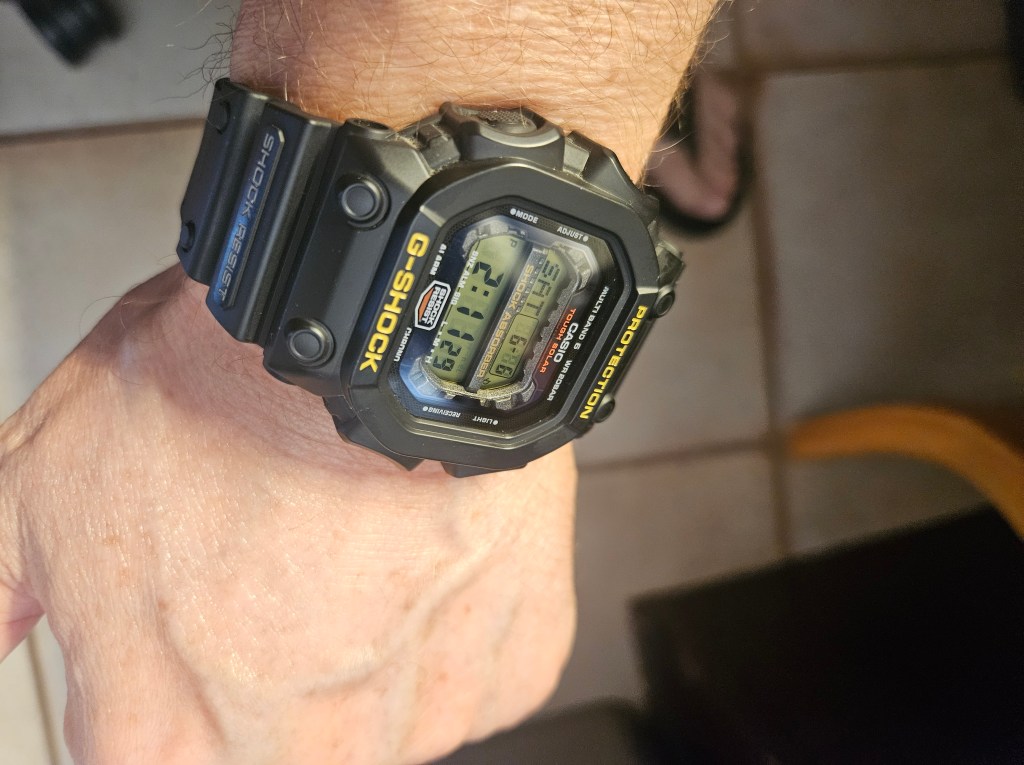
    Now I find myself wondering whether my recent conversion to the G-Shock Frogman is less a purchase than a recall notice from that earlier life. A resin watch, oversized and unapologetic, arrives like a toy that learned how to tell time with atomic authority. Five hundred dollars for a device that looks like it escaped a childhood—but feels, on the wrist, like a command.

    The timing is suspicious. Irrelevance looms. Retirement whispers. The culture shrugs. And my unconscious, unimpressed by all of it, reaches backward and drags something forward. I did not want to dim. I wanted ignition. I wanted to be in my prime, or at least in the vicinity of it. I wanted, absurdly and sincerely, to be a man of action.

    So here I am, somewhere between Deacon’s barstool and a backyard zipline, imagining a descent into danger, hostages to save, a purpose that announces itself clearly and requires no explanation. The ravine is imaginary. The urgency is not.

  • From Analog Watch Devotee to Digital Convert

    From Analog Watch Devotee to Digital Convert

    For decades I carried a tidy prejudice: digital time was vulgar—soulless, phone-adjacent, a betrayal of my analog faith. I was a man of brushed steel and sweeping seconds, a parishioner in the Church of the Diver. Quartz was for commuters. Resin was for children.

    Then I strapped on the G‑Shock Frogman and looked down.

    The numbers were unapologetic—big, bright, exact. No squinting, no interpretive dance with minute hands. Just time, delivered with atomic certainty. It wasn’t charming. It was correct. And I found myself loving it in the way you love a tool that does not negotiate.

    The comparison arrived uninvited: the muscle cars of my youth—Mustangs, Barracudas—beautiful, yes, but also squeaking relics with climate control that felt like a rumor. You don’t drive them so much as you endure them. Then you slide into a modern car and the world seals itself around you—quiet, precise, obedient. That’s what the Frogman felt like. I hadn’t upgraded my watch; I had defected to a better century.

    Here’s the heresy: I now resent my analog watches. I resent the squint, the guesswork, the artisanal inaccuracy sold at luxury prices. Why, exactly, is it acceptable that a watch costing thousands loses minutes while this rubberized amphibian syncs itself with the sky?

    I don’t know what’s happening to me, and I no longer pretend to be in charge of it. What I do know is this: the Frogman isn’t leaving my wrist.

    Colleagues of the watch faith, witness a Tribal Migration Event: the moment a collector crosses a border he swore was permanent—mechanical to quartz, analog to digital—and discovers he prefers the other side. It begins as a fling, a novelty purchase, a “let’s see.” It ends as a relocation. The shock is not the watch; it’s the realization that your identity was a costume with good lighting.

    The casualties are lined up in a box. My high-end Seiko divers—polished, dignified, expensively nostalgic—sit like former lovers who’ve been ghosted without explanation.

    “How could you?” they seem to ask.

    “You’re dead to me,” I reply, with a briskness that surprises us all.

    At this point the relationship is no longer metaphorical. It has crossed into the psychological, possibly the spiritual. There may be paperwork.

    Let me concede the obvious: on a man my age, the Frogman is not flattering. It doesn’t whisper style; it shouts evidence. It looks like something a concerned relative might mention to a professional. And yet—there it remains, immovable.

    Because something happened.

    Not a gentle drift. Not a tasteful adjustment.

    A break.

    I felt it first in small betrayals of habit. My appetite tightened its belt. Three meals, no raids. No twilight foraging expeditions in the kitchen under the pretense of “just checking.” Focus sharpened. Discipline, that elusive houseguest, unpacked its bags.

    Then the house itself changed.

    No announcements were made, but the atmosphere shifted. The eye-rolling ceased. The quiet demotion—from patriarch to eccentric roommate—reversed itself without ceremony. I had, somehow, acquired gravity. Decisions began to look like decisions rather than impulses in costume.

    And then—this is the part that refuses explanation—my nightmares stopped.

    Not improved. Not reduced.

    Stopped.

    For years they ran nightly, a private cinema of dread with excellent attendance. Then the Frogman arrived and the theater closed. Lights out. Eviction. Now I sleep. I dream in color. I jog through fields of berries and, in a voice suspiciously like John Lennon, I sing, “I am the Frogman.”

    Explain that.

    A resin watch—battery, rubber strap, digital readout—accomplished what therapy, discipline, and time politely declined to do. Part of me wants to accept the miracle without inquiry. When something rescues you from overeating, ridicule, and nocturnal terror, you don’t interrogate it. You nod. You say thank you. You keep the artifact close and your questions at a respectful distance.

    If it isn’t broken, don’t fix it.
    If you don’t understand the blessing, don’t analyze it.

    Unfortunately, I’m not built for reverence without curiosity. I want mechanisms. I want causes. I want a diagram that explains how a mass-produced object rewired my habits, upgraded my household rank, and shut down my night terrors like a switch.

    That investigation is what lies ahead—the study of what I can only call the Frogman Elixir Effect: a transformation so complete the purchaser no longer quite exists.

    I am not wearing the watch.

    The watch is wearing me. I am the Frogman.

    The migration is complete.

  • The Frogman Conversion: When Lightning Strikes

    The Frogman Conversion: When Lightning Strikes

    One of the great American confessions disguised as a groove, “Deacon Blues” by Steely Dan, is not really about jazz or whiskey or late-night dignity. It’s about a suburban man who has quietly accepted his own smallness and now anesthetizes himself with a cinematic fantasy: he is, in his mind, an outlaw artist—unbought, ungoverned, beautifully doomed. In reality, he’s a man in a cul-de-sac rehearsing rebellion between errands.

    The song doesn’t mock him; it does something crueler and more elegant—it turns his self-deception into something hauntingly beautiful, a melody so smooth you almost miss the fact that it’s scoring a life half-lived. That’s why it lingers. It flatters the listener even as it exposes him.

    The song’s narrator is what we might call a Pinot Noir Outlaw: a man who performs a life of danger and artistic defiance through carefully curated indulgences—jazz, late-night drinks, vague melancholy—while remaining safely embedded in routine and privilege.

    And I’m not exempt. I recognize the man immediately because I am another citizen pacing the enclosure of my own habits, staging elaborate internal revolutions that never quite breach the walls. I don’t crave improvement; improvement is bureaucratic. I crave demolition. I want the current version of myself revoked, replaced, struck by lightning and rewritten. Spare me the incremental victories—slightly better blood pressure, a more respectable triglyceride count, LDL nudged into compliance. That’s not transformation; that’s paperwork.

    What I want is upheaval. I want to molt like something ancient and impatient. I want to peel off the familiar skin—cowardice, inertia, the soft compromises I’ve negotiated with mediocrity—and step out of it raw and newly assembled. Someone decisive. Someone difficult to bargain with. A man who doesn’t soften at the edges when it matters. A man who doesn’t flinch.

    But because that kind of transformation rarely arrives—no lightning bolt, no divine summons—we improvise. We cosplay. We assemble identities the way children assemble Halloween costumes: a prop here, a posture there, a new narrative stitched together from objects that flatter us. We don’t become new men; we accessorize the old one and call it progress.

    If you’re a watch collector, the illusion is particularly seductive. For twenty years, I lived inside a very specific mythology: polished steel, mechanical divers, the ritual of winding and setting, the quiet romance of gears and springs. I told myself I belonged to a certain tribe—men of discernment, men of patience, men who appreciated craft. It was a pleasing fiction.

    Then, in February of 2026, at sixty-four—an age when one is expected to consolidate, not detonate—I betrayed my own aesthetic. I bought the watch I had resisted for over a decade: the G-Shock Frogman. I had dismissed it for years as a resin aberration, a digital eyesore, a violation of everything I claimed to value. And yet, in a moment that felt less like a decision and more like possession, I ordered it from Sakura Watches in Japan.

    The acquisition was not elegant. It was a bureaucratic gauntlet. Emails. Texts. Tracking updates that read like dispatches from a stalled expedition. A sudden hostage situation in a Long Beach DHL facility until I paid a $100 ransom dressed up as an import fee. By the time the box arrived, I assumed the experience had poisoned the well. Surely the watch would arrive tainted by annoyance.

    It didn’t.

    I strapped it on, and something immediate and irrational occurred. Not admiration—bonding. A click deeper than preference. It triggered a memory I hadn’t summoned in years: the 1970s TV show Shazam!, where a boy named Billy Batson speaks a word—Shazam!—and a bolt of lightning splits the sky, transforming him into Captain Marvel. Child becomes hero. Hesitation becomes action.

    The Frogman was my word. Not spoken, but worn.

    And here is the part that resists tidy explanation: I did not feel like a man who had purchased a watch. I felt like a man who had crossed a threshold. As if some internal lever had been pulled without my consent. The old aesthetic, the old loyalties—they didn’t argue; they receded. Something else advanced.

    Call it delusion if you want. Call it consumer theater. But the experience had a force to it, a momentum that mocked the idea of careful, rational choice. It felt like being drafted by a version of myself I hadn’t authorized.

    I don’t know what comes next. I only know this: the change did not ask permission, and I did not resist it.

  • The Business Model of Suffering and Abuse on Reality TV

    The Business Model of Suffering and Abuse on Reality TV

    We were discussing their current essay assignment: an excavation of cruelty masquerading as inspiration in the TV show The Biggest Loser. The facts alone read like satire written by a misanthrope: contestants more than 200 pounds overweight were pushed through eight-hour training days, incinerating close to 8,000 calories while being rationed roughly 800. Add caffeine pills, a chorus of screaming trainers, and the steady drip of public humiliation, and you have less a fitness program than a stress test for organ failure. That none of the contestants died feels less like good management and more like statistical luck. That millions watched—enthusiastically—says something unflattering about us.

    I show them Fit for Life documentary, which functions as a kind of aftermath report. Former contestants speak with the clarity that only distance provides. They describe trauma, yes, but also something more complicated: the show gave them structure, purpose, a narrative. It brutalized them and, perversely, steadied them. Most gained the weight back. Some now lean on GLP-1 drugs, their appetites chemically negotiated into submission. But all of them remember the same thing—the mercilessness was not incidental; it was the engine.

    I asked my students why I had assigned this essay. What, exactly, were they supposed to uncover?

    At the micro level, we peeled back the familiar myths. The cult of self-discipline—so comforting in its simplicity—lets us ignore biology, environment, and the sheer stubbornness of appetite. Bodies become symbols: power or failure, virtue or laziness, depending on who’s looking. We noted the obvious but rarely confronted statistic—most Americans are overweight—and the uncomfortable reality that GLP-1 drugs may be the only intervention that consistently works at scale.

    Then the room shifted. One student volunteered that she was on a GLP-1. The first weeks were a gauntlet of nausea and vomiting, but now the drug—Mounjaro—had quieted her hunger to a whisper. Thirty pounds gone in two months. Another student offered a counterpoint that landed harder: her father had been one of the exceptions. The drug didn’t help him lose weight. It helped him lose kidney function. As she spoke, she mentioned he was now on dialysis. The room absorbed that in silence. Miracle and risk, side by side, no clean narrative available.

    So we zoomed out.

    To design a show that courts physical danger and guarantees humiliation—for ratings, for merchandise, for the grotesque satisfaction of watching someone crack—is not an accident. It’s a business model. That’s the first kind of evil: deliberate, calculated, fully aware. Cynical evil. The producers know exactly what they’re doing. They understand the cruelty, and they monetize it.

    The second kind is quieter and more common. It belongs to the audience. Viewers sense the moral problem—on some level they know this is exploitation—but they file that knowledge away so it won’t interfere with their evening entertainment. They watch, they flinch, they keep watching. Call it willed ignorance. A cultivated habit of not asking questions that might ruin the pleasure.

    I told them, half-serious but not really joking, that if we were ranking things, cynical evil is a ten. Willed-ignorant evil sits comfortably at a seven—less flamboyant, more pervasive.

    Something clicked. The word evil—unfashionable, blunt, almost embarrassing in academic settings—cut through the fog. The discussion woke up. Students leaned in, argued, confessed discomfort, revised their positions in real time. The assignment stopped being an exercise and became a lens.

    That was the moment worth noticing. Sometimes you have to pull the camera back. Stop pretending the essay is about structure and sources and let students see the larger architecture: what the topic reveals about us, what it demands we confront, and why it matters that we do.

  • Sandwich Serendipity and the Futility of Bloodwork

    Sandwich Serendipity and the Futility of Bloodwork

    My doctor wants bloodwork—a full panel: PSA, lipids, liver function, hemoglobin—the entire bureaucratic inquisition, designed to convert my bloodstream into a tidy Excel file. I concede the PSA; no one wants to play roulette with prostate cancer. But the rest feels like an elaborate confirmation of what I already know. At 230 pounds—twenty over my fighting weight—my numbers will behave themselves, with the lone exception of LDL, which will arrive slightly smug and slightly elevated. Twenty extra pounds always leaves a trace, like fingerprints at a low-stakes crime scene. At 210, those same labs would glow with moral rectitude, the biochemical equivalent of a pressed shirt and a firm handshake.

    What I need is not diagnostics but discipline. The blood test will not reveal anything that a mirror and a waistband haven’t already disclosed. When the results come back, I’ll receive the ritual “plan of action,” translated from medical into plain English: lose twenty pounds. A reasonable directive. Also a promise I cannot make. I eat clean. I eat whole foods. I load up on protein. I’ve exiled alcohol. None of it matters. My appetite has the temperament of a teenager in shoulder pads, pacing the sidelines and waiting for the next snap.

    Spare me the reminder that I’m approaching sixty-five. My hunger did not get the memo. Last night, after dinner, after I had sworn a blood oath to stop eating at six, I began clearing out my daughter’s lunch bag and discovered it: an untouched turkey and cheese sandwich, wrapped in quiet indifference. There was no debate, no moral tribunal. I ate it immediately, reverently, savoring the soft, faintly sweet Trader Joe’s porridge bread as if it had been prepared for me by a benevolent deity with a sense of humor. It was, without exaggeration, the best moment of my day.

    You can dress this up as weakness, but that misses the phenomenon. This is Sandwich Serendipity—the electric, unearned joy of finding an uneaten sandwich where none should exist. It is not leftovers; it is treasure. It is the culinary equivalent of discovering cash in an old jacket or rubbing a lamp and having lunch appear. The afflicted man does not pause to assess freshness, provenance, or caloric impact. He does not negotiate with his better angels. He consumes. The sandwich is accepted as a gift from the universe, a brief amnesty from restraint, a shining interruption in an otherwise disciplined life.

    This is the man sitting across from the doctor, nodding politely at the mention of triglycerides and lifestyle modification. This is the man being asked to promise weight loss. And the honest answer—the only answer worth giving—is this: I will try. But somewhere, in some forgotten lunch bag, a sandwich is waiting. And when it calls, I will answer.

  • The Man Who Never Asked

    The Man Who Never Asked

    My wife has been sending me comedy skits about a subject that isn’t remotely funny: the epidemic of friendless adult men. The message arrives dressed as humor but lands as indictment—get off your ass and build a life that includes other human beings. Not for entertainment. For survival. For the family.

    The problem is I don’t know how.

    My friendships didn’t end with a bang; they evaporated. One by one, they thinned out, like hair in a drain, until nothing remained. I haven’t met a friend for a movie and a meal in nearly twenty-five years. Solitude didn’t ambush me; it settled in and redecorated. It became my default setting. Worse, it feels justified. I operate under a quiet but tyrannical assumption: no one would willingly spend that kind of time with me. Why would they? Friendship requires an investment, and I’ve already decided I’m not worth the return. Rejection is neatly avoided by never making the ask. A preemptive surrender disguised as dignity.

    When I think about how this calcified, I go back to 2005. My cousin and I met for dinner in downtown Los Angeles. Afterward, he wanted to extend the evening—drive twenty minutes to a coffee shop, linger, talk. I felt the anxiety rise like a fever. Dinner had been the contract; anything beyond it felt like trespass. I went along, reluctantly. He noticed. He never asked again. He moved on to a life crowded with friendships, a calendar he has to prune. I perfected the art of leaving early.

    I come by this honestly. My parents spent the last three decades of their lives without friends. My father borrowed social contact through his second wife but never rebuilt what he lost. My mother claimed friendships the way a customer claims familiarity with a waiter—pleasant, transactional, imaginary. Loneliness wasn’t diagnosed in our household; it was modeled. It looked normal. It felt inevitable.

    My parents weren’t bad people. They were self-involved, chemically compromised, and emotionally unavailable. My father once told me that if he could do it over again, he wouldn’t have children. People recoil when they hear that. I didn’t. It had the ring of truth I had already lived with. My mother, meanwhile, oscillated between warmth and collapse. Her depressions were so severe she disappeared into hospitals, and I disappeared into my grandparents’ house. Childhood became something to endure rather than inhabit.

    So I adapted. I became self-contained. I entertained myself. I eliminated the need for others before they could eliminate me. Being alone wasn’t a failure; it was a system.

    In my twenties, desire disrupted that system. I wanted relationships, so I built a version of myself that could get them. I became talkative, confident, funny—an actor with good timing and a decent script. It worked. Women believed in the character. So did I. But the performance had no depth. It couldn’t sustain love because it wasn’t built on vulnerability, only on impression. The relationships collapsed under the weight of my anxiety and selfishness. I could attract; I could not attach.

    That hasn’t entirely changed. I can still be charming in controlled environments. My colleagues enjoy me in passing. I can generate conversation the way a barista generates foam—pleasant, temporary, nonbinding. But conversation is not friendship. Friendship requires escalation, risk, the unthinkable act of asking someone to step outside the script and spend time with you. That’s where I freeze. I assume the answer will be no, and so I never pose the question. It’s a tidy system: I protect myself from rejection by guaranteeing isolation.

    This morning, sitting in my car waiting to take my daughters to school, I almost performed another ritual of avoidance. I reached for my watch, ready to photograph it for Instagram—a small offering to the gods of trivial validation. For a moment, I considered it. Then the idea repulsed me. The absurdity of it. As if a watch photo could compensate for a hollow social life. As if attention could substitute for connection. It felt like feeding a hunger with sugar and calling it nourishment.

    So I sat there instead, thinking about those videos my wife keeps sending me. They’re funny in the way a diagnosis can be funny—because it’s accurate. She’s worried. She should be.

    The truth is simple and unflattering: I’ve built a life that minimizes risk and, in doing so, minimizes connection. If I want to be less of a burden to my family, I have to become someone who can love beyond the walls of his own habits. That means doing the one thing I’ve spent decades avoiding.

    It means asking.

  • Famous for Nothing: The Rise of Validation Maximalism

    Famous for Nothing: The Rise of Validation Maximalism

    In the early 2000s as the media landscape was changing, Paris Hilton was known to be famous for being famous. Her appeal wasn’t the substance behind the glitter but the glitter itself, to borrow a metaphor from F. Scott Fitzgerald’s short story “Winter Dreams.” This condition of being famous for being famous created FOMO in a new generation who wanted to follow Hilton’s path. This desire to be famous for being famous is a pathology, an infantile dream of instant validation and attention without having any substance. A life of meaning is disdained while a life of confectionary hype becomes the dopamine hit for a child. 

    This desire for fame without doing anything other than being famous became part of a new era, the Age of Validation Maximalism: the compulsive pursuit of attention, recognition, and social proof as ends in themselves, where the quantity of admiration replaces the quality of accomplishment.

    What Hilton embodied as a cultural anomaly has since been industrialized by platforms like Instagram and TikTok. Their algorithms do not reward substance; they reward engagement velocity—clicks, likes, shares, watch time. In this system, meaning is irrelevant unless it can be measured, and what can be measured is almost always surface-level reaction. 

    Validation Maximalism becomes not just a personal pathology but a structural inevitability. The algorithm functions like a slot machine for attention: it amplifies whatever triggers the quickest response, whether that is outrage, titillation, or empty spectacle. Over time, users internalize this logic, optimizing themselves for visibility rather than substance. The result is a feedback loop in which the pursuit of validation reshapes identity itself, producing a generation that doesn’t just seek attention—it is engineered to depend on it.

    Because content creators emphasize Validation Maximalism over intellectual rigor, we consume “information” in the realm of fitness, consumer goods, culture, and politics that is seriously compromised because it is fine-tuned to the algorithm more than accuracy and nuance. Consuming this compromised content, we exist in a symbiotic relationship with the content creators. We exist in a sort of algorithmic co-dependency: a feedback loop in which creators optimize content for engagement metrics while audiences reward that optimization with clicks and attention, locking both parties into a system where visibility outranks truth. Such a co-dependency impedes our growth and infantizes us.

    Infantilization is the predictable outcome of this arrangement: a steady shrinking of our cognitive and moral range until we prefer ease over effort and reaction over reflection. When information is engineered for instant reward, we lose the habit of sustained attention; nuance feels like friction, and we avoid it. Our judgment softens into reflex—likes, shares, quick takes—while the harder work of weighing evidence and tolerating ambiguity atrophies. We become dependent on external cues to tell us what to think and feel, outsourcing discernment to the feed.

    Over time, this produces a citizen who is easily steered, impatient with complexity, and suspicious of anything that doesn’t deliver a fast emotional payoff. The result isn’t just weaker thinking; it’s a diminished self—one trained to consume rather than to understand, to react rather than to reason.

    Wanting to be famous for being famous looks harmless at first—a glossy ambition, a shortcut to attention—but it functions like a cultural solvent. When visibility becomes the highest good, every other standard—truth, craft, character—gets thinned to fit the feed. Institutions begin to mirror the metric: news chases clicks, fitness chases spectacle, politics chases virality. Individuals follow suit, curating selves for applause rather than substance, measuring worth in impressions rather than impact. The result is a society that knows how to amplify but not how to evaluate, quick to react and slow to understand. Treating fame as an end in itself isn’t just a personal quirk; it’s a pathology that scales, replacing meaning with metrics and leaving us loud, visible—and curiously empty.

  • How It Feels to Grade 60 Original Essays Edited by AI

    How It Feels to Grade 60 Original Essays Edited by AI

    I assigned my students an essay that asked them to describe a place both ugly and formative—a crucible that hurt them and, in the same breath, made them. The submissions came back like a map of pressure points: a high school classroom that felt like a courtroom, a gym that smelled of rubber and dread, a mental health ward lit like an aquarium, a pre-op room where the clock ticked louder than courage, a soccer field that taught hierarchy and grace, a family home in El Salvador, a Korean farm where labor spoke in blisters. The content was theirs—specific, unborrowed, alive. But the sentences often arrived wearing a suspicious polish, the prose lacquered to a showroom shine. You could feel the editor in the room, invisible and tireless.

    I keep returning to a metaphor I can’t shake: AI is like a bodybuilder taking steroids for writing. Go in “natty,” and you present a muscular physique that is honest–well defined, maybe even impressive. Add the chemical assist and you step onstage thirty percent larger, veins penciled in, every line exaggerated into spectacle. 

    After sixty of these eye-popping essays, I felt the same deadening I get at a bodybuilding show. At first you admire the craft; then the sameness creeps in. The poses change; the effect doesn’t. Everything looks like everything else.

    This is my ambivalence, and it refuses to resolve. On one hand, AI hands students a language upgrade that would make a New York editor nod—clarity, rhythm, a vocabulary that lands. It’s as if they’ve been fast-tracked to a professional register. On the other hand, that very upgrade dilutes the experience. When strong language grows out of a human mind, it carries the friction of effort—the faint grit that makes it feel earned, inhabited. When it arrives laundered through a machine—the “stochastic parrot” Emily M. Bender warned us about—it can be dazzling and hollow at once, a chandelier with no wiring. The sentences glitter; the room stays dark.

    I’ve graded hundreds of essays for years and thought I knew the terrain—the tells of struggle, the leap from draft to draft, the moment a voice becomes unmistakably its own. Now I’m reading in a new jurisdiction with no settled law. I’m less a judge than a border agent, inspecting passports that all look freshly printed. Welcome to the literary Wild West: the gold is real, the essays are suspect, and every nugget asks the same question—where did you get this?

  • Tragedy Laundering in the Age of Vibes

    Tragedy Laundering in the Age of Vibes

    Shirley Li takes aim at what she calls the CliffNotes treatment of classic films—works shaved down, sweetened up, and repackaged for audiences who want the aura of culture without the burden of confronting it. Shakespeare, once a blood-soaked anatomist of ambition and ruin, now gets rinsed through the aesthetic of Taylor Swift. In this new register, tragedy doesn’t end in death; it stalls just long enough for a handsome savior to materialize on cue. Consider “The Fate of Ophelia,” where despair is airbrushed into rescue, and consequence dissolves into a soft-focus finale. The title lingered with me because I’d joked to my students a month earlier that I’d heard the song on Coffee House and found it embarrassingly overwrought—an avalanche of sentiment masquerading as profundity.

    Hollywood, never one to miss a profitable dilution, has joined the exercise. Emerald Fennell’s take on Wuthering Heights and Maggie Gyllenhaal’s reworking of Bride of Frankenstein into The Bride! arrive pre-softened, their rough edges filed down to avoid drawing blood. The originals demanded something of the audience—patience, discomfort, moral stamina. The remakes offer a tour: quick, glossy, and politely unchallenging.

    Li names the trend with surgical accuracy: “the rise of CliffNotes Cinema—watered-down transformations that offer glossy but thin summaries of the originals and strip away the challenging material that helped turn them into cultural mainstays in the first place.” That sentence does the autopsy. What’s left after the procedure is a body that looks intact from a distance but has been emptied of organs.

    Should we be alarmed? Yes, because the sweetness isn’t accidental; it’s diagnostic. These remakes signal a culture inching toward infantilization—hungry for reassurance, allergic to ambiguity, and convinced that gravity can be outsourced to wardrobe. Give the audience a fairy tale that flatters its appetites, but dress it in canonical clothing so it can pretend it just attended a seminar. Call this Tragedy Laundering: the conversion of moral difficulty into marketable comfort, where death becomes a scheduling inconvenience and ambiguity a branding problem.

    A culture marinated in TikTok loops, cute-animal dopamine, and the immaculate emotional arcs of Taylor Swift’s pop maximalism will predictably resist the adult weather systems of the classics. It wants its cod liver oil chased with honey—and increasingly, it wants the honey first, the oil omitted. The result is a literature of safety: all vibe, no verdict; all sheen, no sting.

  • The Yahtzee Test of a Meaningful Life

    The Yahtzee Test of a Meaningful Life

    People like to ask, “Does your life have meaning?” as if the answer can be retrieved from a drawer and presented with confidence. Most of us reach for an answer polished and forgettable: family, work, the usual suspects. But these answers have the texture of wallpaper—present everywhere, saying nothing.

    You can refine the answer and still miss the mark. You might say, “Playing the piano gives me more meaning than bingeing on confectionary pleasures online.” True enough. There is a difference between sitting at a piano and sitting in a stupor. One engages discipline, attention, and a relationship with beauty; the other numbs you into a soft, glazed anonymity. But even this comparison mistakes elevation for meaning. Music may lift you above the gutter, but altitude alone is not purpose.

    The real question is not what you do, but who you are while doing it. Do you become the man who scrolls at expensive watch listings while his daughter waits with a box of Yahtzee and you dismiss her because you’re “too busy”? Or do you close the laptop and recognize, in that moment, that time with her is not an interruption but the point? Meaning reveals itself not in our hobbies but in our reflexes.

    This is where Viktor Frankl, the author of Man’s Search for Meaning, enters the conversation with uncomfortable authority. Writing out of the concentration camps, he did not theorize meaning from a leather chair. He embodied it under conditions designed to strip it away. His account carries weight because of his moral posture—his insistence that even in degradation, one could orient oneself toward service, toward others, toward something beyond the self. Meaning, for Frankl, was not a feeling or a hobby. It was an orientation.

    By contrast, selfishness corrodes everything it touches. A man may possess a thriving career and a loving family, but if he approaches both as instruments for his own gratification, he drains them of significance. Push that far enough and you arrive at nihilism—the quiet conviction that nothing matters, not because nothing exists, but because nothing is allowed to matter. Nihilism is not a philosophy so much as a habit of disregard.

    Stories, whether drawn from sacred texts or fairy tales, understand this intuitively. They pit the nihilistic malcontent against the purpose-driven hero. But they do not deliver meaning as a reward, neatly wrapped and handed over. Meaning is not an external prize; it is the byproduct of character—of attention, sacrifice, and the refusal to treat other people as disposable.

    The traditions diverge on how that character is formed. In Judaism, one cultivates it through action, with God’s help, through law and discipline. In Christianity, the diagnosis is harsher: we are too compromised by original sin to generate virtue on our own and must throw ourselves on divine mercy, hoping for transformation. Which account is closer to the truth remains an open question. What is not in doubt is this: meaning is not something you acquire. It is something you become.