Blog

  • The Dos and Don’ts of Being Flabbergasted

    The Dos and Don’ts of Being Flabbergasted

    If I had to pick my favorite word from the English language, it would be flabbergasted. It’s officially a word for a state of shock or astonishment, but as I’ve heard it used over the years, there are some important caveats. Usually people are not flabbergasted by a tragedy like an earthquake or a remarkable display of cruelty. The word is usually reserved to describe a human failing that goes beyond the realm of normal expectations. This failing could be surprising because of the specific skillset and character of the person who surprised us. Or the failing could simply be so large on scale that regardless of the person’s character, we are left flabbergasted. 

    Another use of flabbergasting is when a person commits a moral inconsistency that contradicts their spoken beliefs so that the irony behind their hypocrisy is simply flabbergasting. It is somewhat flabbergasting to me, for example, that many of us love dogs and cats so much but we compartmentalize so that we eat cows and pigs, savoring these dishes, while being blissfully unaware of our inconsistency. 

    Another use of flabbergasting is when we witness someone’s obtuseness that is so lame that it strains our credulity. For example, I called Kaiser to get an appointment to discuss switching a prescription because my current one had left me extremely exhausted for twelve hours. I told the member services rep my symptoms, but assured her I was fine. The incident was five days ago. I had been working out intensely every day since then and felt fine. As if not hearing a word I said, she seemed to be reading from a script: “Do you have shortness of breath? Can you stand on your own?” Flabbergasted, I interrupted her. “As I just told you, I am physically fine. I am exercising with great intensity, and I feel great.” I wanted to add, “Please put down your script and listen to what I actually have to say.” I was flabbergasted.

    One of the appeals of the word flabbergasted is that it seems made up of the words flab and blubber to create the hybrid “flabber,” which I love because “flabber” jiggles and vibrates like the elephantine upper arms of the cafeteria ladies of my youth. Such jiggling and vibration is part of the body’s paroxysms that occur when one is flabbergasted.

    If I had a rock band, I would call it Flabbergasted. If I were to have a nom de plume, it would be Flabber Gasted. 

    I suspect that to be in a flabbergasted state can be dangerously addictive. I’m thinking of Tom Colicchio, one of the principals of the reality show Top Chef. I have a theory as to the one reason above all others the show is successful. It’s Tom Colicchio’s flabbergasted face when he cannot believe how crappy the food is that was prepared for him by one of the world-class chefs. No other judge can make such a severe expression. I don’t know if Colicchio is authentically flabbergasted or if his facial contortions are performative for the ratings. What I do know is that his flabbergasted expression has begun to chafe at me. For many seasons, I took his expression for granted, but after he started taking GLP-1s and losing forty pounds, his flabbergasted TV face looks more extreme. He has eaten a dish that is so egregious that he is in a state of shock and strained credulity. He can’t believe anyone, let alone a successful chef, could make such an abomination. The implication is that surely he could never be so incompetent. And this is where I get annoyed. These chefs have been taken out of their environment, they are working in time constraints, and are working with remarkable pressure from the competition, the TV apparatus, and the judges. That they could stumble or let anxiety get the best of them is completely understandable and is not a situation that calls for being flabbergasted. Therefore, Colicchio’s is out of line. He is disrespecting good, talented people, and I take offense to it. I am flabbergasted.  

  • Confessions of a Reluctant G-Shock Convert

    Confessions of a Reluctant G-Shock Convert

    Yesterday I put bracelets back on four of my Seiko divers, restoring them to their native steel—links clicking into place with the confidence of expensive machinery. They looked the part. Between one and three thousand dollars’ worth of brushed surfaces and tight tolerances, the watches radiated competence. On the wrist, though, the spell broke. The weight announced itself immediately, a small, insistent gravity that felt less like substance and more like obligation. I admired them the way you admire a well-made chair in someone else’s house: respect without attachment.

    I had hoped the bracelets would add some pizzazz—some latent charisma waiting to be unlocked by the right configuration. Instead, they exposed a mismatch. The watches belonged to a former version of me, a man who equated heft with meaning and steel with seriousness, a man I barely recognize. That man, it turns out, has been quietly replaced.

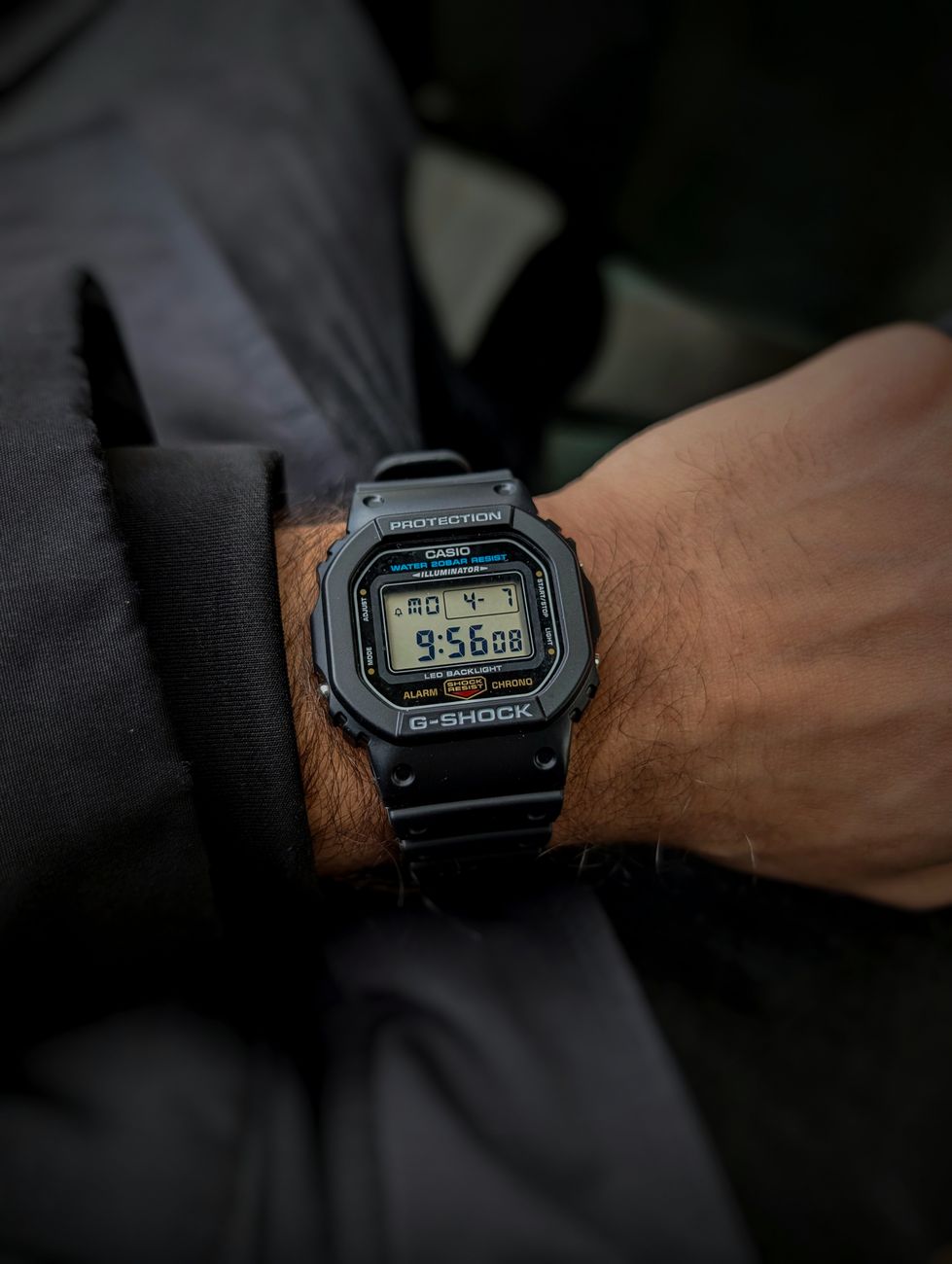
    In his place stands a convert to G-Shock—not the entire circus, but a very specific order of monks: the Frogman, the Mudman, the Rescue. Resin instead of steel. Solar instead of ritual. Atomic time instead of romance. These watches don’t ask for admiration; they deliver accuracy and get out of the way. After them, the Seikos feel like cufflinks with pretentiousness.

    I’m aware this confession offends the faithful. Mechanical devotion runs deep, and there’s a certain etiquette to pretending you still feel it. I don’t. The G-Shocks have recalibrated my wrist. They’ve made lightness feel honest and precision feel sufficient. The Seikos now read as formalwear—appropriate, occasionally necessary, but fundamentally performative. I’ll wear them when a formal event demands it, the way one wears a jacket in an expensive restaurant to satisfy a dress code no one quite believes in anymore.

    Call it heresy if you like. I call it clarity. In my head I’m a collector; on my wrist, I’m a G-Shock guy.

  • Leanmaxxing and the New Fantasy of Frictionless Medicine

    Leanmaxxing and the New Fantasy of Frictionless Medicine

    As a boy watching Star Trek, I was transfixed by the Tricorder–that tidy slab of certainty doctors waved over a body the way a priest might wave incense over a mystery. No scalpels, no tubes, no anxious waiting rooms with their stale magazines and fluorescent despair. A quick scan, a soft chirp, and the problem surrendered. The body, usually so coy and uncooperative, became a readable document–its secrets itemized, its fate clarified. It was medicine without friction, diagnosis without drama. In that universe, ignorance lasted seconds.

    For decades, the Tricorder sat where all good fantasies sit: just out of reach, gleaming with impossible efficiency. But reality has a way of cheating. The future did not arrive as a handheld scanner; it arrived as chemistry–specifically, a class of drugs that seems to negotiate directly with the body’s most stubborn impulses. If the Tricorder promised instant knowledge, GLP-1 drugs promise something more unnerving: the quiet rewriting of appetite, metabolism, and behavior from the inside out.

    In her New York Times essay “The Great Ozempic Experiment,” Julia Belluz catalogs the early returns, and they read less like a drug profile than a wish list that forgot to edit itself. Yes, there’s weight loss–the headline act–but the understudies keep stealing the show: concussion recovery, addiction dampening, relief from menopause symptoms, long COVID, alopecia, inflammation, arthritis, IBS, anxiety, brain fog. The list grows with the confidence of a rumor that keeps being confirmed. By the time you finish reading, you suspect the drug might also fix your credit score.

    The catch, for now, is almost comically modest: nausea and paperwork. The body may revolt briefly; the insurance company may revolt permanently. Yet demand surges, fueled by users who report not just slimmer bodies but upgraded lives–better mood, sharper focus, revived social calendars, improved fertility. It’s less a medication than a lifestyle intervention with a prescription pad.

    Clinicians, watching this unfold, have begun to reach for a new framework–the “root-cause” theory–because the old boxes no longer hold. These drugs don’t respect the tidy borders between endocrine, cardiovascular, and neurological disease; they trespass, improve, and move on. Even more disorienting, benefits appear in patients who don’t lose weight at all: better heart, liver, and kidney function, as if the drug were quietly tuning systems we didn’t know were connected.

    And here is where the story turns from miracle to question mark. As GLP-1 use spreads–along with the culture’s sudden enthusiasm for “leanmaxxing”–we risk trading one distortion for another: the cartoon body, now achieved pharmacologically rather than cosmetically. It is far too early to crown these drugs the real-world Tricorder, and just as premature to condemn them as a Faustian bargain. Like AI, they are moving faster than our ability to narrate them. We are watching a technology outrun our categories, and the only honest response, for now, is attention without prophecy.

  • Anorexification: How Thinness Became a Prerequisite for Social Currency

    Anorexification: How Thinness Became a Prerequisite for Social Currency

    On the The Unspeakeasy Podcast, Meghan Daum and Hadley Freeman–whose book Good Girls: A Story and Study of Anorexia reads like a field report from the edge–describe a culture quietly training itself to prefer bones to bodies. GLP-1 drugs have not merely entered the conversation; they’ve re-scripted it. In certain corners of entertainment, especially for women, thinness is no longer a trait—it’s a prerequisite. Not healthy thinness, but the spectral kind, the look of a person who has edited herself down to the bare minimum required for visibility.

    Enter the “thought leaders,” a title now worn loosely by a cadre of Bro Influencers, many featured on the documentary Louis Theroux: Inside the Manosphere, who speak about female bodies with the confidence of men who have never had to inhabit one. They circulate images so detached from biological reality that the result is less aspiration than hallucination. At some point, distortion becomes epistemology. When the standard is a body no one can sustain, we are no longer debating beauty; we are misinforming ourselves about what a human being is.

    The culture, meanwhile, doesn’t drift—it polarizes. On one end, the affluent micro-dose themselves into disappearance, refining their silhouettes into something that looks engineered rather than lived in. On the other, those with fewer resources are funneled toward ultra-processed foods—cheap, engineered, irresistible—and then displayed as cautionary spectacle on shows like My 600-lb Life. The result is a grotesque symmetry: the privileged vanish; the poor are made hyper-visible. Both outcomes are profitable. Both are distortions. Call it cartoonification—the body flattened into extremes, rendered legible for screens but unrecognizable as life.

    This is not an accident. It’s a market. Social media influencers curate a simulated aesthetic—filters, angles, pharmacology—and the entertainment industry distributes it at scale. Between them, they have manufactured a reality that looks persuasive from a distance and collapses on contact. Commerce thrives on the gap between what people are and what they are told to want.

    I listened with a teacher’s ear. In my critical thinking class I teach two units: first, the mythology of “consequence culture,” which reduces body weight to a moral ledger and blames individuals while ignoring the machinery that shapes their options; second, the role of ultra-processed foods—villain, convenience, or something more complicated. The classroom becomes a courtroom where agency and structure argue their cases, and neither gets to plead simplicity.

    After this conversation, the syllabus needs a sharper blade. I’ll have to put the Bro Influencers on the screen and examine their claims as arguments rather than vibes. I’ll have to trace how the ultra-processed food economy finds its customers—often the ones with the fewest alternatives—and how that targeting is dressed up as choice. If there’s an epistemic crisis here, it isn’t abstract. It’s embodied. It walks into the room every day, filtered, curated, and quietly misinformed.

  • The Seduction of Self-Cancellation

    The Seduction of Self-Cancellation

    You may have reached the unflattering clarity of seeing yourself as a Broken Misfit Toy. Strip away the syrup of self-pity and the diagnosis might hold. You’ve audited your habits, your relationships, your blind spots, and the balance sheet isn’t pretty. Fine. Accuracy is not the problem.

    The problem is what you do with it next.

    The moment you stamp yourself BMT, a seductive logic appears: If I’m damaged, I’m disqualified. Who am I to speak? Why should anyone listen? What could I possibly offer besides a cautionary tale? This is the mind trying to turn honesty into a muzzle.

    Let’s dispense with the melodrama. Self-pity is a terrible strategist. It doesn’t help you act; it helps you narrate your inaction with a certain tragic flair.

    Now the real question: Does a Broken Misfit Toy have anything to offer? The answer is a qualified yes—qualified by one thing only: insight. If you can look at your fractures without flinching, you can extract something from them. Loneliness, alienation, the habit of substituting art for connection, the long improvisation of living slightly out of tune—these are not rare conditions. They are common currencies.  What feels like private damage becomes public language.

    That doesn’t redeem the damage. It repurposes it.

    So call yourself a Broken Misfit Toy if you must. Just don’t use the label as a permission slip to sit out your own life. Idleness will not preserve you; it will concentrate the very defects you claim to recognize.

    And beware the neatest trap of all: the Broken Credential Fallacy–the belief that your flaws revoke your right to think, speak, or contribute. It’s a clever maneuver. It dresses up as humility while quietly ensuring you never risk being heard. It turns self-knowledge into silence and files your experience under “inadmissible.”

    You’re not disqualified. You’re on the record. The question is whether you’ll say anything worth hearing.

  • The Clean Split: Seiko Romance vs. G-Shock Precision

    The Clean Split: Seiko Romance vs. G-Shock Precision

    For more than two decades, I lived inside the cathedral of Seiko divers—mechanical, muscular, faintly mythic. Then, without warning, I developed a taste for G-Shock. Not the entire sprawling catalog—just a narrow, almost doctrinal subset: Tough Solar, Multiband-6, digital display. Precision without ceremony. Time as a solved problem.

    Strangely, this new fixation didn’t dethrone the old one. If anything, it refused to engage it. My Seikos–SLA051, SLA023, SLA055, SBDC203, the Tuna SBBN049–continue their analog romance, ticking away with artisanal stubbornness. The G-Shocks, by contrast, operate with cold, atomic certainty. They don’t drift; they don’t charm; they don’t ask for admiration. They simply tell the truth. I find myself wearing them more often, yet the two categories never compete. They inhabit parallel realities, each complete unto itself.

    What used to be a single, coherent hobby has split into two clean domains. Not a conflict–more like a continental drift. The G-Shocks don’t diminish the Seikos, and the Seikos don’t dignify the G-Shocks. They coexist without conversation. The complication, if it can be called that, has the feel of an upgrade: a second language acquired late in life, one that doesn’t replace the first but sharpens your sense of what each can do.

    And once you see the line, you want to ink it in.

    I’ve started returning my Seikos to their bracelets, restoring them to their native uniform—steel on steel, no ambiguity. Only the Seiko SLA051 gets a pass; it belongs on a waffle strap the way certain truths belong in plain speech. The rest will click back into their bracelets like soldiers resuming formation. The goal isn’t function; it’s taxonomy. I want the collection to declare itself in two voices, not one muddled chorus.

    This is the quiet compulsion at work: the need to clarify, to separate, to keep categories from bleeding into one another. Call it Horological Bifurcation Syndrome–the clean split of a once-unified obsession into two ecosystems with incompatible logics and equal appeal. On one side, mechanical romance: weight, history, the seduction of imperfection. On the other, digital precision: light-powered, atom-synced, immune to drift. They don’t compete. They refuse to integrate. And the more I indulge them, the more I prefer it that way.

  • The Perpetual Convalescence of a Stolen Childhood in Ariel Levy’s Memoir “An Abbreviated Life”

    The Perpetual Convalescence of a Stolen Childhood in Ariel Levy’s Memoir “An Abbreviated Life”

    At the age of six, Ariel Leve’s mother said, “When I’m dead, you will be all alone because your father doesn’t want you. You know that, right?” This was a warning her mother gave her to ensure that her daughter would treat her nicely. That same year Ariel was so traumatized from the death of her caretaker that she could not speak for six months. This was the effect of Existential Hostage Conditioning: a form of psychological manipulation in which a parent binds a child’s survival and identity to their own approval, issuing threats of abandonment (“you will be all alone”) to manufacture obedience. The child is not merely disciplined but conscripted into an emotional hostage role, where love is contingent, fear is instructional, and autonomy feels like a life-threatening gamble.

    Writing about the effects her mother had on her in her memoir An Abbreviated Life, Leve chronicles the desperation to free herself from the shadow of her mother. A manipulative narcissist with no boundaries and treating her daughter’s life with reckless disregard, the mother inflicted the urge in daughter to commit her life to seeking escape from the psychological demons her mother implanted inside of her. 

    Being raised by a narcissist with dramatic mood swings was so chaotic and disorienting that Ariel describes childhood as a scary carnival ride, one of those cages that whirls in circles at a super speed, spins mercilessly, and spits you out so that you’re so dizzy you can’t stand on your feet. The world is still spinning. Up is down. Down is up. You don’t know what reality is anymore. Leve is describing the Narcissistic Gravity Field: the invisible but inescapable force exerted by a boundaryless, self-absorbed parent, pulling the child into a distorted orbit where the parent’s needs eclipse reality. In this field, the child’s inner life is bent, stretched, and often erased, replaced by a constant vigilance to anticipate moods, avoid eruptions, and survive the next shift in emotional weather.

    Leve wasn’t just affected mentally but physically. Her brain actually was warped by her mother’s constant abuse, which she compares to the way the constant winds will disfigure a tree trunk. We could call this the Trauma Topiary Effect: the slow, invisible reshaping of a child’s psyche under relentless stress, much like wind warps a tree over decades. What emerges is not natural growth but survival-shaped architecture—twisted, adaptive, and permanently marked by forces it could not resist.

    As she writes about the trajectory of her life, she realizes her entire existence is a convalescence from her mother. Being in a prolonged convalescence makes it hard to live life as an adventure, to be spontaneous, to embrace change, and to invite new challenges. The inclination in her case is to turn inward, reduce variables, and seek predictability. This turning inward makes intimacy, self-discovery, and living life fully nearly impossible. In many ways, Leve’s memoir is one that captures the misery of Perpetual Convalescence Syndrome: A life condition in which a person is never fully “well” but always recovering—structuring their existence around healing rather than living. Risk is avoided, spontaneity feels reckless, and the future is approached not as opportunity but as something to be managed carefully to prevent relapse.

  • The House at the Edge of the Woods

    The House at the Edge of the Woods

    I dreamed last night that I was lost along the California–Oregon border, swallowed by those lush, overconfident woods that seem to grow not just trees but disorientation itself. Out of that green excess, I stumbled onto a large house. It was too warm, too lit, too certain of its place in the world. Inside were people I hadn’t seen in decades: my old high school acquaintances. They had aged on paper–engineers, doctors, the usual résumé parade–but at the dinner table they wore their adolescent selves like a second skin. The same faces, the same postures, as if time had added credentials but declined to age them physically.

    They kept arriving from side rooms, as if the house were a memory with too many doors. Soon there were a dozen of them seated at a long table, the surface crowded with platters, tureens, and bowls exhaling fragrant steam like a benevolent fog. They welcomed me with an ease that felt rehearsed by kindness itself. Dishes appeared, were passed, insisted upon. They asked what had become of me. The question was polite on its face, but they implicitly felt sorry for me. 

    For a while I occupied the heady seat of attention. Then, as naturally as a tide recedes, their focus shifted back to one another–the practical side of their lives: projects, patients, schedules, mortgages. I felt the small withdrawal and, in that petty reflex one hates to recognize, tried to reclaim the floor. I blurted out a macabre fact about how some ordinary food, under the right conditions, could turn lethal. I pitched it as a funny tidbit, but it landed like a dropped utensil. They didn’t rebuke me; they simply continued, the conversation closing over my interruption as water splashes over a stone.

    Ignored but not injured, I watched them. What struck me wasn’t their success; it was their wholesomeness and innocence. No guile, no ambient spite, none of the low-grade cynicism that passes for sophistication. Their intelligence didn’t sour into cleverness; it steadied into clarity. They had chosen this life—steady, decent, bounded—not because they were naive, but because they had measured the alternatives and declined them. That was the unsettling part: their goodness was not accidental. It was willed.

    I felt a quiet melancholy then, a recognition as clean as it was unwelcome. Between us stood an invisible partition—no hostility, just difference. They were the children of light. I was the man who had wandered out of the woods and discovered, too late, that I was still lost.

  • “Marty Supreme” Is a Rebuttal to Liquid Modernity

    “Marty Supreme” Is a Rebuttal to Liquid Modernity

    I sat through the 2.5-hour sprawl of Marty Supreme with a mix of fascination and dread, the way you watch a man juggle lit matches in a room full of gasoline. It doesn’t take long to diagnose Marty Mauser: no self-awareness, no boundaries, no governor on his appetites. Once you see that, the plot stops being a mystery and becomes a countdown. He treats his life–and everyone else’s–as expendable material in the service of his ego. Chaos isn’t an accident; it’s the operating system. The film runs on a kind of psychological determinism: remove self-knowledge and restraint, and watch the dominoes fall. The difficulty, of course, is that Marty is repulsive in the precise way the movie needs him to be. Some viewers refuse the bargain—why spend hours with a moral vacancy? I’d argue that’s the point. Like Uncut Gems, where Howard Ratner detonates his own life in slow motion, or Boogie Nights, where Dirk Diggler mistakes appetite for identity, this film belongs to a category I’d call the Chaos Agent Antihero: a person so unmoored from self-scrutiny that he turns every room into a hazard zone.

    It’s easy to dismiss these films as nihilistic—two hours of bad decisions dressed up as entertainment, but that reading is too lazy by half. Beneath the wreckage is a stern, almost old-fashioned argument about limits: the necessity of boundaries, the discipline of saying no, the unglamorous virtue of constraint. In that sense, the Chaos Agent Antihero is a rebuttal to what Zygmunt Bauman called liquid modernity—the condition in which everything solid dissolves into options. Careers become gigs, relationships become arrangements, identities become costumes you change between scenes. The promise is freedom; the invoice is fragmentation. In that fluid world, a man like Marty isn’t liberated; he’s uncontained. Without structure, he doesn’t discover himself; he disperses.

    Follow that logic to its end and you get the customary finish for men like Howard Ratner and Dirk Diggler: ugly, terminal, and instructive precisely because it refuses redemption. Marty Supreme flirts with a different exit. Fatherhood appears like a last-ditch intervention, a chance to trade improvisation for obligation, appetite for responsibility. You sense the film asking whether a man can accept the humiliating truth of limits and, in doing so, become something sturdier than a bundle of impulses. The alternative–the radical individualist with no brakes–isn’t freedom. It’s a long fall with excellent lighting.

  • The Rise of Podcast Proxy Consumption

    The Rise of Podcast Proxy Consumption

    A few years ago, best-selling author Sam Harris delivered a blunt verdict on his own profession: writing books no longer makes sense. Not for lack of ability, but for lack of return. He can spend years drafting, revising, and shepherding a manuscript through the publishing machinery, only to reach tens of thousands of readers, many of whom will abandon the book somewhere between page 37 and a vague sense of obligation. Then comes the ritual humiliation of the book tour: airports, polite applause, the same answers to the same questions. The yield is modest; the labor is not.

    Meanwhile, his podcast–assembled in a fraction of the time–pulls in audiences that dwarf his readership. Hundreds of thousands. Sometimes millions. No printing press. No tour. No illusion that anyone needs to finish anything. Just attention, delivered efficiently.

    This wasn’t an isolated complaint. On a recent podcast, Andrew Sullivan and Derek Thompson circled the same conclusion: the book has lost its central function. The old model–write, publish, promote, be read–has been quietly replaced. Today, you don’t tour bookstores; you make podcast appearances. The book itself becomes a kind of ceremonial object, a credential you wave before entering the real arena: conversation.

    In this new arrangement, reading is optional. Talking is essential.

    Helen Lewis echoed the same skepticism in conversation with Katie Herzog. She doubts, with refreshing candor, that many people actually buy her books. What they do instead is spend time with her–listening, nodding along, absorbing the arguments in podcast form. The discussion becomes the experience. The book recedes into the background, a ghost text haunting the conversation that replaced it.

    What these writers are describing is not a decline but a substitution. We have entered an era in which books are no longer endpoints; they are pretexts. The real product is the dialogue orbiting them.

    Call it Podcast Proxy Consumption: a cultural sleight of hand in which audiences outsource the labor of reading to the author’s own commentary, then mistake that secondhand familiarity for mastery. The conversation becomes the consumption, and the book–once the main course–now sits on the table, largely untouched, like an expensive meal photographed but never eaten.