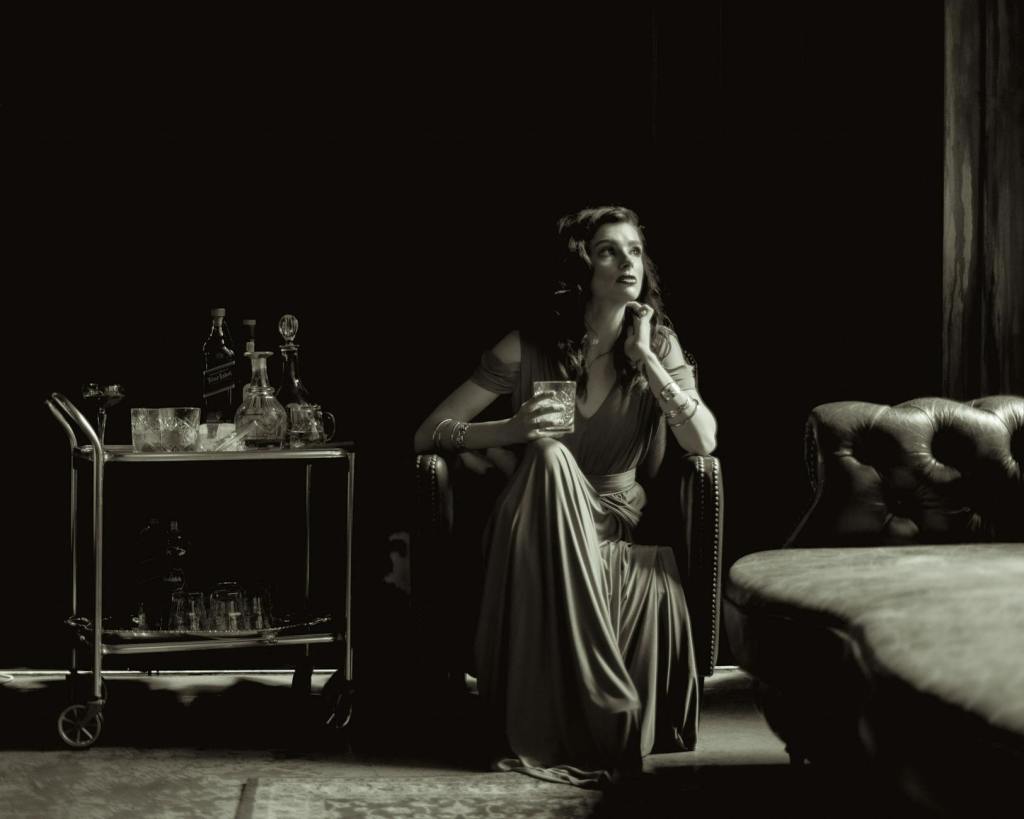
On the The Unspeakeasy Podcast, Meghan Daum and Hadley Freeman–whose book Good Girls: A Story and Study of Anorexia reads like a field report from the edge–describe a culture quietly training itself to prefer bones to bodies. GLP-1 drugs have not merely entered the conversation; they’ve re-scripted it. In certain corners of entertainment, especially for women, thinness is no longer a trait—it’s a prerequisite. Not healthy thinness, but the spectral kind, the look of a person who has edited herself down to the bare minimum required for visibility.
Enter the “thought leaders,” a title now worn loosely by a cadre of Bro Influencers, many featured on the documentary Louis Theroux: Inside the Manosphere, who speak about female bodies with the confidence of men who have never had to inhabit one. They circulate images so detached from biological reality that the result is less aspiration than hallucination. At some point, distortion becomes epistemology. When the standard is a body no one can sustain, we are no longer debating beauty; we are misinforming ourselves about what a human being is.
The culture, meanwhile, doesn’t drift—it polarizes. On one end, the affluent micro-dose themselves into disappearance, refining their silhouettes into something that looks engineered rather than lived in. On the other, those with fewer resources are funneled toward ultra-processed foods—cheap, engineered, irresistible—and then displayed as cautionary spectacle on shows like My 600-lb Life. The result is a grotesque symmetry: the privileged vanish; the poor are made hyper-visible. Both outcomes are profitable. Both are distortions. Call it cartoonification—the body flattened into extremes, rendered legible for screens but unrecognizable as life.
This is not an accident. It’s a market. Social media influencers curate a simulated aesthetic—filters, angles, pharmacology—and the entertainment industry distributes it at scale. Between them, they have manufactured a reality that looks persuasive from a distance and collapses on contact. Commerce thrives on the gap between what people are and what they are told to want.
I listened with a teacher’s ear. In my critical thinking class I teach two units: first, the mythology of “consequence culture,” which reduces body weight to a moral ledger and blames individuals while ignoring the machinery that shapes their options; second, the role of ultra-processed foods—villain, convenience, or something more complicated. The classroom becomes a courtroom where agency and structure argue their cases, and neither gets to plead simplicity.
After this conversation, the syllabus needs a sharper blade. I’ll have to put the Bro Influencers on the screen and examine their claims as arguments rather than vibes. I’ll have to trace how the ultra-processed food economy finds its customers—often the ones with the fewest alternatives—and how that targeting is dressed up as choice. If there’s an epistemic crisis here, it isn’t abstract. It’s embodied. It walks into the room every day, filtered, curated, and quietly misinformed.


Leave a Reply