Category: FOMO and Its Discontents

  • Energy Vampires and the Cost of Desire (college essay prompt)

    Energy Vampires and the Cost of Desire (college essay prompt)

    Write a 1,200-word essay that advances a clear, arguable thesis about time—how it is lost, misused, and quietly drained—by analyzing Winter Dreams and Torch Song. Focus on relationships that operate like “energy vampires”: people who absorb attention, distort priorities, and leave the other person with less time, less clarity, and less life than before.

    In your introductory paragraph, define “energy vampire”–a person who consumes another’s attention, time, and emotional resources while giving little in return. Then illustrate your definition with a paragraph-long personal experience in which you encountered someone who drained your time or energy. 

    The present your thesis that examines the dynamics between Dexter Green and Judy Jones, and between Jack Lorey and Joan Harris. Where do these pairings overlap, and where do they diverge? In what ways do these relationships function as “time vampires,” diverting the protagonists from lives they might otherwise have lived?

    Finally, take a position on responsibility. To what extent are Dexter and Jack victims of these draining relationships, and to what extent do they participate in their own depletion? Support your claims with close textual analysis and specific evidence.

  • In Defense of Gilded Consolation

    In Defense of Gilded Consolation

    Men in their fifties and sixties, catching the faint chill of irrelevance, often reach for a new toy the way a man reaches for a jacket he hopes still fits. The purchase is meant to keep them “in the conversation,” as if relevance were a room you could reenter with the right accessory. Call it Luxury Youth Prosthetics—cars, watches, cameras, gleaming devices strapped on like extensions of a younger self, engineered to suggest vitality even when the signal is weak. The Lexus SUV hums with quiet authority, the Nikon Z8 promises cinematic family memories, and the titanium G-Shock gleams like a tiny declaration that time, at least, is still under control. Yes, the performance can tip into self-parody. We’ve all seen the man trying too hard, his purchases shouting what his presence no longer whispers.

    But it would be cheap to dismiss the entire enterprise as vanity. Not every indulgence is a cry for help; sometimes it’s just a man making his days more agreeable. If the mortgage is paid, the kids are fed, and no one is pawning their future for a dashboard upgrade, then a little luxury can function as a civilizing influence. The Lexus SUV turns a Costco run into a pleasant experience. The Nikon Z8 captures the faces you’re suddenly aware you don’t have forever. The titanium G-Shock tells the time clearly, which is no small mercy when time feels increasingly abstract.

    Strip away the theater, and what remains is something quieter and more defensible. Call it Gilded Consolation: not a performance for others, but a private pact with comfort. The goal is not to look young, but to live well—within reason, within means, and without apology.

  • The Futility of Resisting Chronological Drift Syndrome

    The Futility of Resisting Chronological Drift Syndrome

    Eight years ago, at a funeral—an appropriate venue for truth disguised as humor—my cousin, a retired ophthalmologist and former hospital administrator, told me his greatest challenge in retirement was finding enough time to spend his money. It landed as a joke with a faint echo of confession. Back then, he was still visible—still a man whose time, opinions, and presence registered on the social radar.

    Now, in his mid-seventies, the joke has curdled. He tells me the most striking feature of aging is not pain, not decline, but disappearance. People look past him as if he were a smudge on the lens he once spent a career perfecting. He has entered Graylight Erasure: still present in the room, but no longer illuminated by attention, interest, or acknowledgment. The body remains; the spotlight moves on.

    I’ve tried to account for this vanishing act, and the first culprit is economic. Consumer culture is a young man’s game—desire, impulse, upgrade, repeat. When you fall out of that loop, you don’t just lose purchasing power; you lose narrative value. You become a spectator in a drama that no longer requires your participation. This is Market Exit Obsolescence: the quiet demotion that occurs when you age out of the demographic worth seducing. The ads stop speaking to you, and soon enough, so do people.

    The second cause is more primitive: denial. Aging is bad for morale. It interrupts the fantasy that time is generous and endings are negotiable. Youth is a fever dream in which mortality is a rumor; old age is the nutrition label you avoided reading—the one that ruins the snack. An older person carries inconvenient data: limits, deadlines, the unadvertised fine print of being alive. And no one likes a walking disclosure statement.

    So the culture develops a reflex. Call it the Mortality Contagion Effect—the quiet recoil from those who remind us, without trying, that the clock is not decorative. As if proximity might transmit the condition. As if attention were a kind of exposure.

    My cousin didn’t lose his competence, his intelligence, or his history. He lost his audience. And in a culture that equates attention with existence, that loss feels less like aging and more like erasure.

    Watching my cousin—healthy, financially well-off, and increasingly ignored—I see what aging really delivers: Chronological Drift Syndrome. It’s the moment you realize the culture has shifted into a higher gear while you’re still driving the same well-maintained car. The rhythms change, the references mutate, the priorities rebrand overnight, and suddenly you’re not wrong—you’re just out of sync. You haven’t stopped moving; the world has simply sped past you and called it progress.

    As you age, you may attempt to resist this growing misalignment with youth culture. You may try to make yourself youthful with potions, makeovers, and pharmaceuticals, but these measures will soon backfire. You will find that fighting Chronological Drift Syndrome is a bit like sprinting on a moving walkway that’s headed the other way—you burn calories, attract attention, and end up exactly where you started, only louder and slightly winded. The harder you try to keep up—deploying borrowed slang, auditioning for trends, nodding along to references you Googled ten minutes earlier—the more you resemble a man trying to crash a party he once hosted. 

    Desperation has a smell, and it pairs poorly with youth culture, which detects inauthenticity the way a smoke alarm detects toast. The irony is brutal: the effort to remain relevant is what renders you ridiculous. The more elegant move is to step off the conveyor, plant your feet, and accept the drift with a straight back and a sense of humor. Dignity, unlike trends, ages well.

  • “I Am the Frogman”: The Last Shout Before the Door Seals

    “I Am the Frogman”: The Last Shout Before the Door Seals

    I’ve spent more than a decade documenting my watch obsession on YouTube—a pursuit that begins as hobby and ends, if you’re not careful, as behavioral conditioning. You think you’re making videos. You’re actually being trained. The algorithm dispenses rewards and punishments with clinical indifference: views, comments, silence. You adapt. Of course you adapt. That’s the job now.

    The trouble is that the algorithm has no interest in truth, balance, or restraint. It prefers spectacle. It rewards the emotional range of a teenager who’s just discovered caffeine: hyperbole, dread, euphoria, FOMO, regret—delivered with the urgency of a man announcing the end of civilization via bezel insert. You wake up one morning and discover you’ve succumbed to Algorithmic Persona Drift—a slow mutation in which your public self becomes a louder, shinier, more hysterical version engineered for attention rather than accuracy.

    Feed it, and it feeds you back. The cycle tightens. Every video must be more decisive, more apocalyptic, more “this changes everything.” You produce manifestos. You narrate epiphanies. You analyze your own obsession with the intensity of a man dissecting his own heartbeat. The result is predictable: you become a caricature of yourself—recognizable, marketable, and faintly absurd.

    If you can tolerate that, the system will reward you. The numbers rise. The revenue trickles, then flows. You build a small empire out of controlled exaggeration. But there comes a moment—quiet, unwelcome—when you no longer recognize the man delivering the lines. The performance has outgrown the person. At that point, the decision presents itself with unpleasant clarity: keep feeding the machine and let it finish the job, or step away and salvage what remains of your voice.

    That’s one exit.

    The other is less dignified. You don’t leave; you are expelled. The causes are familiar—burnout, self-disgust, ennui, health—but the most decisive is also the least negotiable: age. You wake up one day and realize the tempo has changed. The rhythms that once animated you now sound distant, like music leaking from another room. The new release, the hyped drop, the celebrity of the week—none of it lands with the old voltage. Mortality has entered the conversation and lowered the volume.

    You try to resist. You tell yourself enthusiasm is a choice. But the gap widens anyway. You find yourself oddly relieved that you no longer care about bracelet articulation or dial gradients or the fever dream that the “perfect collection” is one purchase away. The brotherhood reveals itself for what it always was: half fellowship, half support group. You no longer feel the urge to compare scars from impulse buys, to laugh at the madness, to whisper—half-serious, half-hopeful—that this watch will finally cure you.

    For me, the separation was unmistakable. Twenty years dissolved into a blur of rotating bezels and contingency divers. Then, at sixty-three, something tapped my shoulder. Not a crisis. A correction. The obsession didn’t die; it simply lost its authority. Desire dimmed, replaced by a quiet recognition that watches are exquisitely engineered ways of losing to time.

    The feeling calls to mind a scene from Battlestar Galactica: a traitor sealed behind glass, the airlock hissing, the crew watching with solemn finality. Not melodrama—procedure. That’s aging. Not tragic, not cruel—inevitable. At some point, those still inside the illusion of endless tomorrows begin to edge away from those who have seen the horizon contract.

    A pane descends. It isn’t hostile. It’s accurate.

    You tap the glass, wave, try to rejoin the cockpit of youthful urgency. You even lift your wrist—your hulking G-Shock Frogman—and make your case. “Look,” you want to say, “I’m still in it.” But the seal has set. Reentry is not part of the design.

    What remains is less dramatic and more demanding: dignity. Accept the season you’re in. Build meaning instead of inventory. Offer something useful to those still racing ahead, even if they don’t yet see why it matters. They will. Everyone does, eventually.

    The algorithm fades. The noise recedes.

    And you are left, at last, with a quieter, harder question: not what you want next—but who you intend to be without the applause.

  • Famous for Nothing: The Rise of Validation Maximalism

    Famous for Nothing: The Rise of Validation Maximalism

    In the early 2000s as the media landscape was changing, Paris Hilton was known to be famous for being famous. Her appeal wasn’t the substance behind the glitter but the glitter itself, to borrow a metaphor from F. Scott Fitzgerald’s short story “Winter Dreams.” This condition of being famous for being famous created FOMO in a new generation who wanted to follow Hilton’s path. This desire to be famous for being famous is a pathology, an infantile dream of instant validation and attention without having any substance. A life of meaning is disdained while a life of confectionary hype becomes the dopamine hit for a child. 

    This desire for fame without doing anything other than being famous became part of a new era, the Age of Validation Maximalism: the compulsive pursuit of attention, recognition, and social proof as ends in themselves, where the quantity of admiration replaces the quality of accomplishment.

    What Hilton embodied as a cultural anomaly has since been industrialized by platforms like Instagram and TikTok. Their algorithms do not reward substance; they reward engagement velocity—clicks, likes, shares, watch time. In this system, meaning is irrelevant unless it can be measured, and what can be measured is almost always surface-level reaction. 

    Validation Maximalism becomes not just a personal pathology but a structural inevitability. The algorithm functions like a slot machine for attention: it amplifies whatever triggers the quickest response, whether that is outrage, titillation, or empty spectacle. Over time, users internalize this logic, optimizing themselves for visibility rather than substance. The result is a feedback loop in which the pursuit of validation reshapes identity itself, producing a generation that doesn’t just seek attention—it is engineered to depend on it.

    Because content creators emphasize Validation Maximalism over intellectual rigor, we consume “information” in the realm of fitness, consumer goods, culture, and politics that is seriously compromised because it is fine-tuned to the algorithm more than accuracy and nuance. Consuming this compromised content, we exist in a symbiotic relationship with the content creators. We exist in a sort of algorithmic co-dependency: a feedback loop in which creators optimize content for engagement metrics while audiences reward that optimization with clicks and attention, locking both parties into a system where visibility outranks truth. Such a co-dependency impedes our growth and infantizes us.

    Infantilization is the predictable outcome of this arrangement: a steady shrinking of our cognitive and moral range until we prefer ease over effort and reaction over reflection. When information is engineered for instant reward, we lose the habit of sustained attention; nuance feels like friction, and we avoid it. Our judgment softens into reflex—likes, shares, quick takes—while the harder work of weighing evidence and tolerating ambiguity atrophies. We become dependent on external cues to tell us what to think and feel, outsourcing discernment to the feed.

    Over time, this produces a citizen who is easily steered, impatient with complexity, and suspicious of anything that doesn’t deliver a fast emotional payoff. The result isn’t just weaker thinking; it’s a diminished self—one trained to consume rather than to understand, to react rather than to reason.

    Wanting to be famous for being famous looks harmless at first—a glossy ambition, a shortcut to attention—but it functions like a cultural solvent. When visibility becomes the highest good, every other standard—truth, craft, character—gets thinned to fit the feed. Institutions begin to mirror the metric: news chases clicks, fitness chases spectacle, politics chases virality. Individuals follow suit, curating selves for applause rather than substance, measuring worth in impressions rather than impact. The result is a society that knows how to amplify but not how to evaluate, quick to react and slow to understand. Treating fame as an end in itself isn’t just a personal quirk; it’s a pathology that scales, replacing meaning with metrics and leaving us loud, visible—and curiously empty.

  • The Sovereign Appetite: How Wealth Devours the Soul

    The Sovereign Appetite: How Wealth Devours the Soul

    In “What I Learned About Billionaires at Jeff Bezos’s Private Retreat,” filmmaker Noah Hawley dissects the moral corrosion that accompanies extreme wealth—a corrosion fueled not by scarcity but by excess. The old adage comes to mind: the more you feed the demon, the hungrier it gets. Only now the demon eats without consequence, outside the jurisdiction of any moral law. The rules that bind ordinary people—limits, restraint, accountability—simply dissolve. In their place emerges what can only be called the Sovereign Appetite Doctrine: an unspoken creed in which desire, once backed by sufficient capital, becomes its own justification, rendering restraint unnecessary and morality negotiable.

    Hawley’s invitation to a 2018 Bezos retreat in Santa Barbara offered a front-row seat to this phenomenon. What he encountered was not insight but spectacle: a carousel of TED Talk-style presentations untethered from any coherent theme, a parade of ideas without consequence or urgency. These talks did not enlighten so much as signal—a kind of intellectual flex, as obligatory to the setting as Wagyu skewers and caviar. Surrounded by this polished emptiness, Hawley found himself asking the only honest question available: “Why am I here?”

    The retreat itself bordered on the absurd. His wife slipped on wet grass and broke her wrist; he and his children contracted hand, foot, and mouth disease, their faces erupting in red blisters. It was less a summit of visionaries than a fever dream of excess, where discomfort and decadence coexisted without irony.

    Bezos, at the time, still seemed to believe in performance. Clad in a tight T-shirt, laughing a little too hard, projecting a curated affability, he appeared invested in being seen as morally intact. There was effort in the act—a sense that the audience still mattered. He had not yet fully surrendered to the Sovereign Appetite Doctrine.

    But, as Hawley notes, that restraint has since evaporated. Today, figures like Bezos, Mark Zuckerberg, and Elon Musk no longer perform for approval. They have crossed into something colder and more insulated. In Hawley’s words, “They float in a sensory-deprivation tank the size of the planet, in which their actions are only ever judged by themselves.”

    Here lies the true seduction of wealth. It is not the acquisition of luxury goods but the eerie power of living in a world where everything is “effectively free.” Loss—the very mechanism that gives life weight—disappears. When nothing can be meaningfully lost, nothing can be meaningfully gained. Stakes vanish. Experience flattens. Life becomes curiously hollow, a theater without tension. This is the Infinite Buffer Effect: wealth so vast it absorbs every setback, neutralizing consequence and draining life of narrative shape.

    And yet, this emotional flattening coincides with a grotesque expansion of power. The wealthy, insulated from consequence, begin to experience a counterfeit omnipotence. They act without friction and, in doing so, lose the ability to perceive others as real. As Hawley writes, “If everything is free and nothing matters, then the world and other people exist only to be acted upon, if they are acknowledged at all.”

    At this point, they no longer inhabit the same moral universe as the rest of us. Cause and effect no longer apply in any meaningful way. They have become full converts to the Sovereign Appetite Doctrine.

    The word that clarifies this condition is solipsism—not as an abstract philosophy but as a lived reality. The world contracts until only the self remains vivid. Everything else fades into backdrop. Hawley shows how extreme wealth accelerates this contraction. When “everything is free and nothing matters,” the presence of other people—their inner lives, their suffering—loses its immediacy. Power without resistance breeds a dangerous illusion: that one’s actions carry no moral weight. Others become instruments, props, scenery. Empathy atrophies. Reality itself begins to feel negotiable. The self expands to fill the entire field of meaning, mistaking insulation for sovereignty.

    Hawley closes by contrasting today’s ultra-wealthy with the robber barons of the Gilded Age. However ruthless, those earlier figures “engaged with the world around them.” Today’s elite, by contrast, drift above it, severed from consequence, history, and meaning. They suffer from what Hawley calls “a disassociation from the reality of cause and effect, from meaning, and history.”

    This is not freedom but its grotesque parody—a form of plutocratic dissociation in which the individual floats outside shared reality, unbound not only from constraint but from significance itself.

    It is no accident that Hawley, the creator behind Fargo, can render this psychological landscape with such precision. He has long been fascinated by characters who drift beyond moral gravity. Here, he turns that same lens on the most powerful figures in our world—and what he reveals is not triumph, but a slow and chilling disappearance of the human.

  • Anorexification: How Thinness Became a Prerequisite for Social Currency

    Anorexification: How Thinness Became a Prerequisite for Social Currency

    On the The Unspeakeasy Podcast, Meghan Daum and Hadley Freeman–whose book Good Girls: A Story and Study of Anorexia reads like a field report from the edge–describe a culture quietly training itself to prefer bones to bodies. GLP-1 drugs have not merely entered the conversation; they’ve re-scripted it. In certain corners of entertainment, especially for women, thinness is no longer a trait—it’s a prerequisite. Not healthy thinness, but the spectral kind, the look of a person who has edited herself down to the bare minimum required for visibility.

    Enter the “thought leaders,” a title now worn loosely by a cadre of Bro Influencers, many featured on the documentary Louis Theroux: Inside the Manosphere, who speak about female bodies with the confidence of men who have never had to inhabit one. They circulate images so detached from biological reality that the result is less aspiration than hallucination. At some point, distortion becomes epistemology. When the standard is a body no one can sustain, we are no longer debating beauty; we are misinforming ourselves about what a human being is.

    The culture, meanwhile, doesn’t drift—it polarizes. On one end, the affluent micro-dose themselves into disappearance, refining their silhouettes into something that looks engineered rather than lived in. On the other, those with fewer resources are funneled toward ultra-processed foods—cheap, engineered, irresistible—and then displayed as cautionary spectacle on shows like My 600-lb Life. The result is a grotesque symmetry: the privileged vanish; the poor are made hyper-visible. Both outcomes are profitable. Both are distortions. Call it cartoonification—the body flattened into extremes, rendered legible for screens but unrecognizable as life.

    This is not an accident. It’s a market. Social media influencers curate a simulated aesthetic—filters, angles, pharmacology—and the entertainment industry distributes it at scale. Between them, they have manufactured a reality that looks persuasive from a distance and collapses on contact. Commerce thrives on the gap between what people are and what they are told to want.

    I listened with a teacher’s ear. In my critical thinking class I teach two units: first, the mythology of “consequence culture,” which reduces body weight to a moral ledger and blames individuals while ignoring the machinery that shapes their options; second, the role of ultra-processed foods—villain, convenience, or something more complicated. The classroom becomes a courtroom where agency and structure argue their cases, and neither gets to plead simplicity.

    After this conversation, the syllabus needs a sharper blade. I’ll have to put the Bro Influencers on the screen and examine their claims as arguments rather than vibes. I’ll have to trace how the ultra-processed food economy finds its customers—often the ones with the fewest alternatives—and how that targeting is dressed up as choice. If there’s an epistemic crisis here, it isn’t abstract. It’s embodied. It walks into the room every day, filtered, curated, and quietly misinformed.

  • Why My G-Shock Saga Refuses to Become a YouTube Video

    Why My G-Shock Saga Refuses to Become a YouTube Video

    What follows is the essay that will serve as the basis for my YouTube video explaining why no such video can, in fact, be made from it.

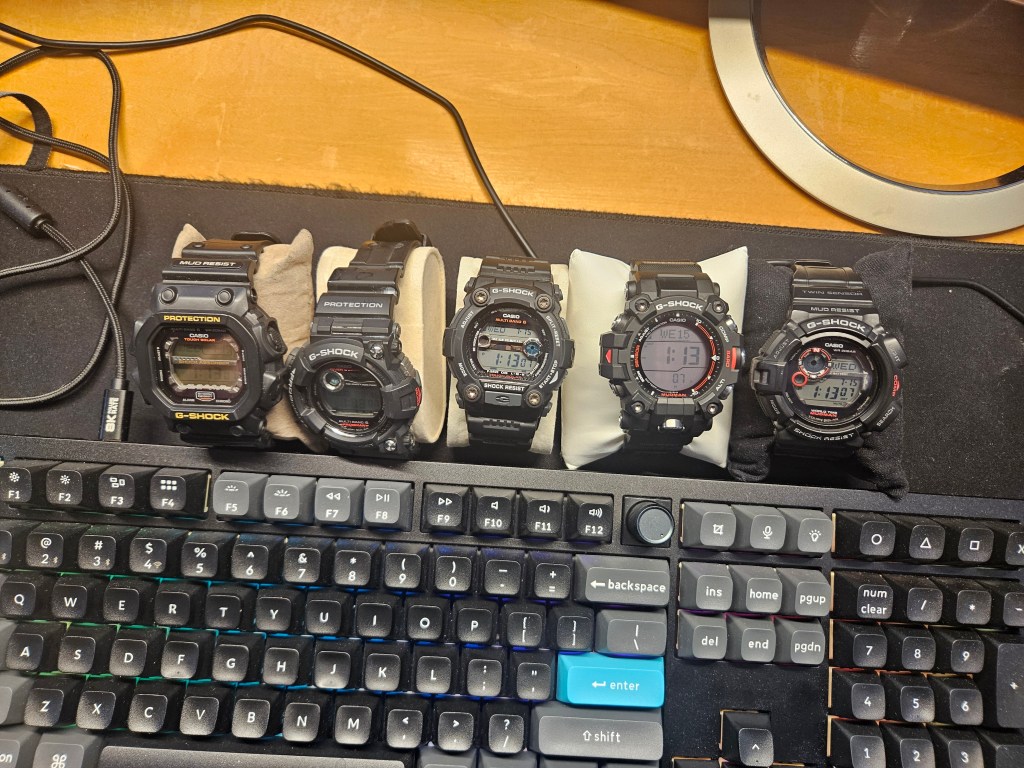
    Six weeks ago, I received my G-Shock Frogman and promptly lost my mind. Not gradually. Not with dignified hesitation. I went down hard. The more I studied its lopsided, industrial architecture, the more I found myself staring at it the way one stares at brutalist buildings—confused at first, then strangely moved. Black resin, thick as a tire wall, sat on my wrist with the quiet confidence of a machine that does not care if you approve of it. No one told me industrial black resin could look so beautiful. 

    This startled me. I had long filed resin under “gym timer” and “Office Space despair”—the sort of material worn by men who have stopped expecting things from life. What kind of man sidelines a stable of expensive mechanical divers—curated, polished, lovingly rationalized—for a slab of molded polymer that costs a fraction of the least expensive piece in the box? The answer, apparently, is me. Something shifted. I can’t explain it. It may take years, or therapy, or both.

    Naturally, I doubled down.

    Intoxicated by the Frogman, I added the GW-7900 Rescue, a watch that costs about one-fifth as much and delivers five times the daily utility. It is padded, legible, and indifferent to my previous standards. Its numerals are large enough to read without squinting, which, at this stage of life, qualifies as a luxury feature. It became my daily wearer within a week, displacing watches that once required white gloves and a sense of occasion.

    Still unsatisfied, I escalated. The Mudman GW-9500 arrived next, with numerals that resemble municipal signage. If the Rescue was readable, the Mudman is unavoidable. Together, the three form what I have come to call—without irony—the Hero Triad.

    All three are Multiband-6 with Tough Solar, which means they spend their nights quietly consulting the atomic clock in Fort Collins and correcting themselves with a level of discipline I have never achieved in any area of my life. The Frogman and Mudman prefer to be placed carefully—on a desk, or hanging from my T-bar like well-behaved instruments. The Rescue, by contrast, syncs wherever it pleases. It has the personality of a straight-A student who does not need supervision.

    These three watches now consume over ninety percent of my wrist time. My mechanical divers sit in their box like retired generals, decorated but irrelevant. When I told my wife this, she paused and asked, “Wrist time? Who uses that term?”

    I do. We do. We count wrist time the way bodybuilders count macros—with vigilance, denial, and occasional self-deception. And lately, my wrist time has been taken over by G-Shock.

    I’ve written about this infatuation on my blog, but my YouTube audience has made something clear: words are no longer enough. We live in an age where ideas must be performed, not merely stated. If I want to be understood, I must produce a video.

    And yet, I cannot make this video.

    First, the landscape is saturated. There are already hundreds of G-Shock videos—reviews, tutorials, warnings about imminent discontinuations delivered with the urgency of a public safety alert. To add my voice would be to echo the chorus, and I have no desire to hear myself harmonizing with better singers.

    Second, I refuse to become an evangelist. I am not here to declare a holy war against Seiko, Tudor, or Omega. This is not a zero-sum game. I have not betrayed mechanical watches with a Judas Iscariot kiss and fled into the desert with a resin accomplice. I still believe in their beauty. I simply no longer rely on them for giving me accurate time. That distinction is subtle, and subtlety does not perform well on YouTube.

    Third, I lack a coherent explanation for my conversion. I cannot tell you whether this shift is driven by age, by proximity to retirement, or by a growing intolerance for approximation in a world already saturated with it. Perhaps I simply escaped Seikotraz—the self-imposed prison of mechanical devotion—and ran toward the first open door. Whatever the cause, I am not yet qualified to narrate it.

    Fourth, my story is not unique. Millions discovered G-Shock long before I arrived, breathless and late, to report that it works. To stand before an audience and announce this would reduce me to a background character—another man discovering electricity and insisting on a press conference.

    Fifth—and most damning—this narrative reads like a watch downgrade. The story people want is ascent: the climb, the conquest, the triumphant pose at the summit. I have done the opposite. I have descended, calmly, into black resin. I have traded filet mignon for a protein bar and now stand before you insisting it is not only sufficient, but superior. This is not a heroic arc. It is a dietary confession. And possibly a sign of a pathology. 

    So no, I cannot make this video. 

    My escape from Seikotraz may or may not be complete. What I can promise is this: when the next chapter reveals itself—and it will—I’ll report back, possibly with less confusion, but no guarantees. Aren’t you glad I didn’t make this video? 

  • Social Capital and the Art of Not Being Chosen

    Social Capital and the Art of Not Being Chosen

    Not all rejection deserves to be filed under the same heading. Romantic rejection—the operatic kind—arrives with violins, moonlight, and a certain built-in alibi. You fall hard, you overestimate your odds, and when the other person declines to co-star in your fantasy, you can console yourself with the obvious: the whole thing was inflated from the start. You were auditioning for a role that rarely gets cast.

    But the quieter rejections—the ones that occur under fluorescent lighting and polite conversation—cut deeper. They lack drama but not consequence. In fact, they feel more diagnostic, as if they’ve been administered by a committee.

    Consider friendship rejection. You meet someone, exchange a few promising signals, and then—nothing. Or worse, a friendship that once had momentum slows, then stalls, then disappears entirely. This is not a stranger declining your advances; this is someone who had enough data to make a decision and chose, calmly, not to proceed. The verdict feels less like bad luck and more like a character assessment.

    Then there is colleague rejection, which operates with corporate efficiency. Alliances form. Cliques crystallize. You are not invited into the warm circle of inside jokes and informal influence. You do your work—flawlessly, even—but without the buoyancy that comes from being wanted. You become competent but peripheral, visible but not included. This is where you begin to suspect you suffer from what might be called Social Capital Deficit Syndrome: a condition marked by a shortage of the invisible currency that makes social and professional life glide instead of grind.

    And here is the uncomfortable truth: social capital is not a luxury; it is infrastructure. Without it, you are left to interpret every silence, every omission, every polite deflection. The temptation is to diagnose yourself—too blunt, too quiet, too something—and then to launch a campaign of correction. This is where things get worse. Self-blame mutates into paranoia. Self-improvement becomes performance. You start sanding down your edges in public, hoping to emerge as a more acceptable version of yourself, and end up as a less convincing one.

    At some point, a harsher but cleaner realization presents itself: your personality comes with a certain gravitational pull, and not everyone will orbit it. No amount of forcing will change that. Trying to wedge yourself into every available opening only advertises the mismatch.

    The more durable response is less theatrical and more disciplined. Accept that people respond rather than decide. They are not conducting formal evaluations of your worth; they are reacting to chemistry, timing, and preference—most of which lie outside your control. This does not excuse cruelty, but it does eliminate the fantasy that everyone owes you affinity.

    So you take the higher road—not as a moral performance, but as a practical strategy. You remain courteous when ignored, steady when excluded, and restrained when slighted. You refuse to become the bitter man who proves his critics right simply by reacting exactly as expected.

    This runs counter to a culture that treats every problem as fixable with the right toolkit. You can, of course, pursue therapy, charisma workshops, confidence training—the whole catalog of self-upgrades. Some of it may help. Some of it may turn you into a louder version of the same problem. There is a fine line between improvement and overcorrection, and many people sprint past it.

    What remains, then, is a quieter ambition: to live without rancor. To accept your limits without turning them into grievances. To maintain a sense of integrity that does not depend on applause. The chip on your shoulder may feel like armor, but it is really a signal—confirmation to others that their instincts about you were correct. Let it go.

    You may lose the small comforts of self-pity. In return, you gain something sturdier: a life not governed by who did or did not choose you.

  • RAMageddon and the Art of Not Buying Another Laptop

    RAMageddon and the Art of Not Buying Another Laptop

    At home, my technology situation is already bordering on the absurd. I own a three-month-old Mac Mini with 32 gigs of RAM—a machine so overqualified for my needs it might file a grievance with HR. I also have a one-year-old Acer Chromebook 516 GE with 8 gigs of RAM and a generous 16-inch display. Around the house lurk a few older laptops assigned to my daughters, though “assigned” is generous. They sit abandoned behind desks like forgotten relics while the real action unfolds on their phones.

    And yet, I find myself eyeing two more 14-inch laptops: the Asus Zenbook Ultra 9 and the Lenovo Chromebook Plus 14.

    Need has nothing to do with it.

    But if I were desperate for a rationalization, I could cite Hana Kiros’ recent Atlantic essay, “If You Need a Laptop, Buy It Now,” which reads less like consumer advice and more like a dispatch from a looming tech famine. According to the piece, RAM demand has gotten so out of hand that “RAM harvesters” are allegedly stripping memory from display units at Costco—a detail so dystopian it sounds like a deleted scene from Mad Max: Silicon Valley. Prices tell the same story: a 64GB stick of RAM that cost $250 in September now flirts with four figures.

    The culprit, of course, is the AI gold rush. As Amazon, Alphabet, Meta, Microsoft, and Oracle collectively torch half a trillion dollars chasing artificial intelligence, a staggering portion of that budget is devoured by memory. The result is a shortage so acute that gamers—never known for understatement—have dubbed it “RAMageddon.”

    The downstream effect is predictable: laptops, phones, anything with memory will creep upward in price. Kiros calls it the “AI tax,” which sounds polite until you realize you’re the one paying it.

    Right now, temptation is priced with surgical precision. The Asus Zenbook 12 OLED Ultra 9—32GB RAM, 1TB SSD—sits at $1,399, practically daring me to mistake desire for foresight. The Lenovo Chromebook Plus 14, with its surprisingly stout 8GB of RAM, hovers at $659, whispering sweet nothings about practicality.

    I could buy one. I could buy both.

    But panic buying has a smell, and I recognize it. It smells like 2020, like empty shelves and people hoarding toilet paper as if civilization were one flush away from collapse. I’ve lived through that particular madness once. I don’t need a sequel starring RAM.

    So I’ll hold the line. The Mac Mini will continue to perform its quiet heroics. The Acer Chromebook will do its job without complaint. And I will resist the urge to confuse market anxiety with personal necessity—at least until the next wave of technological hysteria rolls in.