Category: FOMO and Its Discontents

  • Late to the G-Shock Party

    Late to the G-Shock Party

    Even though I’ve been obsessed with watches for over twenty years, I arrived embarrassingly late to the G-Shock party. I didn’t plan the arrival. It felt more like this: I’m riding in the back seat of an Uber when the driver suddenly pulls up in front of a strange mansion glowing with neon light. The doors swing open. Inside are thousands of loud, jubilant G-Shock devotees who greet me like a long-lost cousin. Champagne appears. Confetti rains down. Someone hands me a microphone and asks for a testimonial.

    I have no prepared remarks. But I can tell the truth.

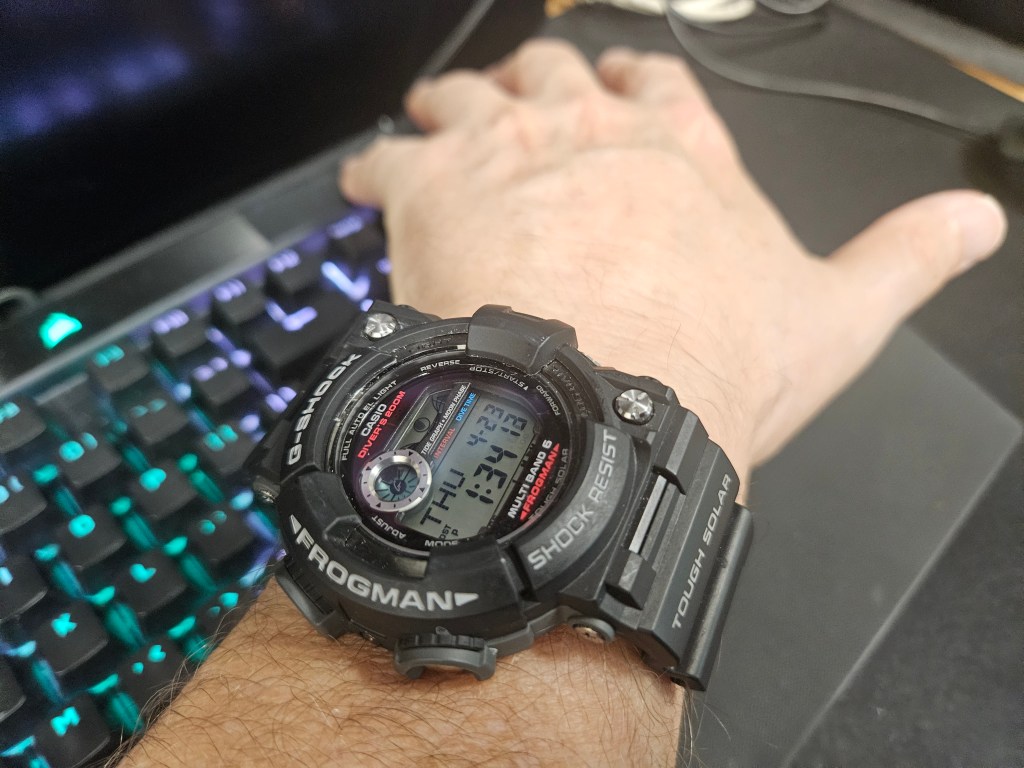
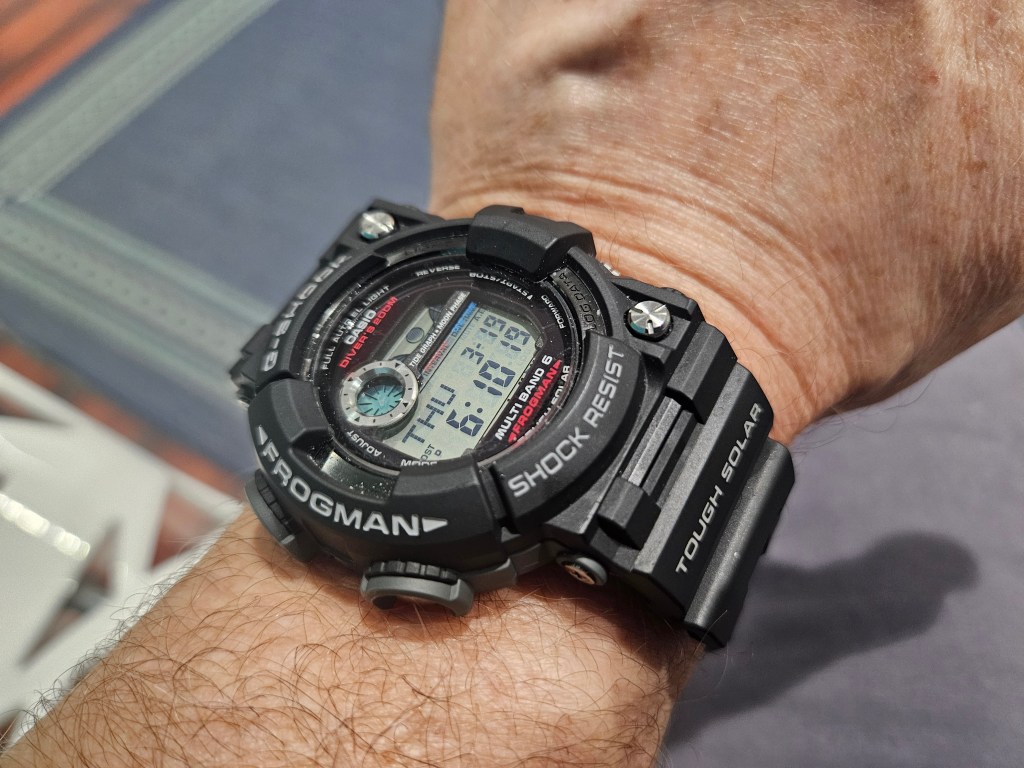
    For two decades I was perfectly happy collecting Seiko mechanical divers. They were my tribe. Yet somewhere in the back of my mind a particular watch kept whispering to me: the G-Shock Frogman. I had admired it on and off for over a decade. Amazingly, the same model was still available, so I finally ordered one from Japan. A watch that once would have cost me $400 now demanded $550, which is the sort of price inflation that causes a small twitch in the eyelid.

    When the Frogman arrived, something strange happened.

    I couldn’t take it off.

    The watch felt uncannily right, as if some committee of Japanese engineers had secretly studied my personality and designed a wrist instrument to match it. It was heroic, absurdly tough, and far more accurate than my mechanical divers. Within weeks I stopped wearing the mechanicals altogether. Three of them quietly left the collection. Whether I’m taking a mechanical hiatus or attending their funeral remains unclear.

    What I do know is that G-Shock has given my watch hobby a strange second life.

    At the moment I own two of them: the Frogman and the GW-7900. Viewers on my YouTube channel insisted the 7900 deserved a proper name. A subscriber named Dave solved the problem immediately. “Call it the Tidemaster,” he said, since the watch tracks tides.

    Perfect.

    So now I have the Frogman and the Tidemaster. One cost me $550. The other cost $110.

    Here’s the truth no luxury marketing department wants to hear: from a purely practical standpoint, the $110 Tidemaster is the better watch. Its numerals are larger, thicker, and darker. The contrast is superior. At night the backlight illuminates big bold digits that practically shout the time. The Frogman, by comparison, requires a small squint and a mild prayer.

    In other words, the cheap watch wins the legibility contest.

    A third watch is arriving next week: the G-Shock GW-6900. Like the 7900, it currently lacks a proper nickname. The watch has three round indicators above the display, which makes it look like a mildly deranged insect. I considered several possibilities. “Triple Graph” sounds like a geometry exam. “Militaire” sounds like a fragrance sold in an airport duty-free shop. So I’m going with the obvious choice:

    The 3-Eyed Monster.

    My goal is simple: settle into a stable Three-Watch G-Shock Trifecta. All three watches share the same genetic code—big heroic cases, atomic timekeeping, solar charging, digital displays, and rubber straps. That combination is my personal sweet spot.

    Now we arrive at the temptation.

    Many of you have suggested I should upgrade to the sapphire-crystal Frogman, a watch that lurks around the $1,000 mark. And believe me, that watch is occupying prime real estate in my brain. But I’d like to present a few rebuttals before I surrender to the credit card.

    First, price. The Tidemaster and the 3-Eyed Monster cost about $110 each. Even the Frogman stayed under $600. Part of the joy of G-Shock is that it delivers durability, accuracy, and ridiculous hero aesthetics without the emotional trauma of a four-figure purchase. Once you push a G-Shock toward a thousand dollars, you start undermining the very spirit that makes the watch fun.

    Second, technical overkill. The sapphire Frogman is loaded with features I will never use. Yes, the display is slightly more legible than my existing Frogman, but that problem is already solved by the Tidemaster and the 3-Eyed Monster.

    Third, rotational anxiety. Two Frogmans would cancel each other out. I doubt I could sell my current Frogman—it has already fused itself to my identity like a stubborn barnacle.

    Fourth, and perhaps most decisive, is age. If I were in my thirties or forties, building a large G-Shock collection might make sense. But I’ll be turning sixty-five this year. I don’t need a museum of watches. Between four Seiko mechanical divers, a quartz Seiko Tuna, and my three G-Shocks, I already have more watches than any reasonable human requires.

    In fact, I could easily imagine a future where I own nothing but the three G-Shocks and feel perfectly content.

    So there you have it.

    Will temptation vanish completely? Of course not. Tonight I may dream about the sapphire Frogman. In a moment of midnight weakness I might even sleep-walk to my computer and hover over the Buy Now button.

    But I like to believe that the reasonable part of my brain will prevail over the dopamine addict who lives next door.

    At least that’s the story I’m telling myself.

  • Power Jewelry Rejection

    Power Jewelry Rejection

    Many of you have written to me about your migration from luxury mechanical watches to G-Shocks. In your telling, it wasn’t a casual shift. It was a renunciation. The grails were sold, the bracelets retired, the safe emptied. The wrist went digital and never looked back.

    Your stories are not universal. They are personal, situational, shaped by your own history with status, money, and identity. But taken together, they reveal a pattern worth examining.

    The turning point for many of you was a growing discomfort with what your watches had become: power jewelry. The grail that once represented achievement began to feel like a performance—an expensive signal broadcast to strangers. What had felt like success started to feel like theater. The watch no longer told time. It told a story about you, and you were tired of telling it.

    That moment marked the beginning of Power Jewelry Rejection.

    Power Jewelry Rejection is the instant a collector looks down and realizes he isn’t wearing a tool—he’s wearing a résumé. The rejection isn’t driven by finances or fashion. It comes from fatigue with the performance itself. The grail is sold. In its place comes something blunt, durable, socially invisible. And with that change comes an unexpected sensation: relief. Not the thrill of acquisition, but the quiet authority of no longer needing to explain yourself. This isn’t anti-luxury. It’s anti-broadcast. The real power is wearing a watch that does its job and asks nothing about your status in return.

    Once the performance ends, something else appears: a different kind of attachment.

    Many of you described a bond with your G-Shocks that never existed with your luxury pieces. Not pride. Not admiration. Something quieter. The watch became a companion rather than a symbol. You wore it hard. You stopped worrying about it. You trusted it. The relationship shifted from ownership to reliance. For the first time, the watch served you instead of representing you.

    Interestingly, this conversion produced very little missionary zeal.

    There was no urge to persuade others, no need to defend the choice. G-Shock Nation, as you quickly discovered, requires no recruitment. The community is vast, stable, and unconcerned with validation. Evangelism felt unnecessary, even absurd. Confidence made persuasion irrelevant.

    But honesty required one more admission.

    Yes, you had abandoned the idolatry of luxury. But you had not escaped devotion. You had simply changed altars. The emotional intensity remained—only the object had become more practical, more affordable, less socially conspicuous. The new attachment felt healthier, but it was still an attachment.

    And here is where the tone of your stories becomes notable: there was no triumphalism.

    You did not claim enlightenment. You did not declare moral victory. You acknowledged the obvious truth: you hadn’t left consumerism. You had changed its form. The new version felt cleaner, quieter, more aligned with your values. Less performance. More use. Less anxiety. More stability.

    No revolution. Just a recalibration.

    And that may be the most honest outcome the watch hobby ever produces.

  • When Enthusiasm Becomes a Sermon

    When Enthusiasm Becomes a Sermon

    Your fellow watch obsessives will tolerate your excitement—up to a point. Enthusiasm is welcome. Testimony is not. There comes a moment when you cross the invisible line from collector to missionary, and that’s when the room cools. The wrist shots multiply. The tone shifts. Conversations begin to sound less like sharing and more like recruitment. That’s when your friends deliver the social equivalent of a gentle intervention: Get a room.

    What they’re reacting to is Acquisition Afterglow—that brief, intoxicating window after a new watch arrives when the purchase doesn’t merely feel satisfying; it feels revelatory. The watch appears flawless. Doubts evaporate. The owner speaks with the calm authority of a man who has solved time itself. Posting frequency increases. Explanations lengthen. The watch stops being an object and becomes a philosophy. The danger isn’t the joy. The danger is the certainty. What feels like permanent clarity is usually just dopamine with a publicist.

    This is especially true when the revelation is G-Shock. You strap on atomic accuracy, solar autonomy, and blunt utility, and suddenly the mechanical world looks theatrical, sentimental, inefficient. It feels like you’ve discovered plutonium. But here’s the problem: millions discovered it before you. Some stayed in G-Shock Fever for life. Others burned hot for a year or two and drifted back to gears and springs. The experience feels revolutionary. Historically, it’s routine.

    So when the community quietly labels you a Watch Evangelist, the correct response is not denial—it’s calibration. Acknowledge the afterglow. Admit the volume got high. Then stop apologizing. Because enthusiasm is honest, and honesty is the only currency that matters in a hobby built on obsession.

    What you must make clear is this: you are not prescribing. You are not declaring a final truth. You are reporting weather conditions from your wrist. Today it’s G-Shock. Tomorrow, who knows. The emotional terrain shifted—that’s the story. The future is not.

    This is the posture of maturity in the hobby. Not certainty. Not conversion.
    You are not a Watch Evangelist.
    You are a Watch Agnostic.

  • The Watch That Doesn’t Need Your Approval

    The Watch That Doesn’t Need Your Approval

    Spend enough time in the comment section of a G-Shock review and you’ll see the same confession repeated with surprising consistency: I own Rolex. I own Omega. I own watches worth thousands. But my G-Shock gives me more satisfaction.

    Most people leave it there, baffled by their own admission.

    The explanation, however, is not mysterious. It has a name: Utility Purity.

    Utility Purity is what happens when a watch does exactly what a watch is supposed to do—accurate time, legible display, solar power, atomic synchronization, shock resistance, dependable alarms and timers—and refuses to turn the experience into anything more complicated than that. The effect feels like truth. No symbolism. No heritage narrative. No prestige hierarchy. Just performance. Luxury watches can be beautiful, but they also carry social meaning. A G-Shock feels like choosing function over theater—and for many people, that choice feels like integrity, especially after years of wearing objects that double as personal statements.

    Utility Purity also delivers something rarer than accuracy: cognitive ease.

    A G-Shock is psychologically light. No winding schedule. No time drift to monitor. No anxiety about door frames, desk edges, or metal bracelets scratching polished surfaces. No constant background calculation about risk and wear. The brain relaxes because the object doesn’t require caretaking. Luxury ownership often includes a quiet layer of vigilance. G-Shock satisfaction comes from the opposite experience—the relief of a tool that refuses to become a relationship.

    There’s another benefit: freedom from social noise.

    Luxury watches speak even when you don’t. They invite attention, assumptions, silent status calculations, and the occasional internal question: What does this say about me? A G-Shock shuts that conversation down. It’s socially neutral. Invisible. The pleasure becomes private. Much of the satisfaction comes from negative space—the absence of being evaluated.

    Then there is the emotional power of reliability.

    Atomic synchronization. Solar autonomy. Shock and water resistance. The message is simple: This will not fail you. Humans attach quickly to dependable systems. The watch becomes a small island of certainty—always correct, always ready, always indifferent to your moods. Mechanical charm offers personality. Utility Purity offers security. For many people, certainty is the deeper comfort.

    Finally, Utility Purity produces a cleaner dopamine cycle.

    Luxury acquisitions often follow a dramatic curve: anticipation, unboxing euphoria, validation, then the quiet descent into worry, justification, and the next rung of the ladder. G-Shocks operate differently. Lower cost. Lower risk. Fewer regrets. You wear them hard, not carefully. The emotional pattern shifts from I need to justify this to I can just use this.

    And that difference matters.

    Because in the end, Utility Purity isn’t about affordability.

    It’s about the rare satisfaction of owning something that asks nothing from you—no protection, no explanation, no performance.

    It just works.

    And after a lifetime of managing objects that carry meaning, status, and expectation, that kind of silence can feel like freedom.

  • Landing the Plane, Buying Another Ticket

    Landing the Plane, Buying Another Ticket

    You’ve just unboxed a mint Tudor Pelagos, and the experience was less retail transaction than controlled detonation. The camera was rolling. The comments were exploding. Someone in the live chat claimed to be calling an ambulance. The algorithm was beginning to circle like a helicopter looking for a landing zone.

    Then the stream ended.

    And now you’re wired.

    Your nervous system is humming like a transformer. You can’t sleep. You can’t think. You’re pacing the room like an athlete who just rode a stationary bike at full resistance for an hour, veins pulsing, heart still racing, body refusing to come down.

    You are experiencing Post-Purchase Aftershock—the overstimulated state that follows a major acquisition, when the adrenaline fades just enough to leave behind restlessness, insomnia, and a dangerous new idea: maybe another watch will stabilize things.

    Fortunately, your mind has a treatment plan.

    What you need, you decide, is a Cool-Down Watch: a modest, supposedly “sensible” timepiece purchased immediately after a major acquisition under the belief that it will calm the nervous system and restore financial and emotional balance. Framed as restraint, recovery, or perspective, the Cool-Down Watch is less a brake than a gentle continuation of the same dopamine cycle—the hobby’s version of ordering a small dessert to recover from the large one.

    Nothing dramatic. Nothing extravagant. Just something small, sensible, emotionally neutral. Something to ease the descent.

    Enter the G-Shock GW5000U.

    Three hundred dollars. Practically invisible in the financial ledger. No one will even notice. This isn’t indulgence—it’s recovery. After the Pelagos surge, you need something calm, quiet, grounding. Something to land the plane.

    So you click “Buy.”

    The shredded Tudor packaging is still on the floor when the G-Shock confirmation email arrives. The Pelagos hasn’t even settled into its watch box, and already its emotional aftercare has been delivered.

    You are now holding your Cool-Down Watch.

    Congratulations. You have not exercised restraint.

    You have invented a new category of permission.

    In the watch world, this maneuver is known as the Cool-Down Rationalization—the elegant self-deception that reframes a second purchase as emotional stabilization rather than continuation. After the dopamine spike of a major acquisition—the luxury unboxing, the comment frenzy, the nervous system buzzing like exposed wiring—the mind prescribes a smaller, “responsible” watch to restore balance.

    It presents the decision as moderation. Discipline. Perspective.

    But chemically, nothing has changed.

    This isn’t a brake. It’s a taper.

    The buyer believes he is descending.

    In reality, he has simply circled the runway and requested clearance for another approach.

  • From Luxury Dreams to G-Shock Atomic Reality

    From Luxury Dreams to G-Shock Atomic Reality

    I made a YouTube video about my G-Shock Frogman and my growing inability to take it off my wrist. The response was immediate and disproportionate. The video drew ten times the comments I typically get when I talk about mechanical watches.

    That told me something important.

    The passion inside the G-Shock world isn’t just strong. It’s combustible.

    What surprised me even more was the pattern many viewers described. It ran directly against the standard collector narrative—the familiar climb from inexpensive watches up the luxury ladder, the gradual refinement that ends with an Omega, a Tudor, and the quiet satisfaction of having “arrived.”

    Many G-Shock owners reported the opposite trajectory.

    They did climb the ladder. They bought the Swiss pieces. They tasted the luxury world. And then something happened.

    They discovered atomic time.

    One comment captured the shift perfectly: the plan had been to move from entry-level divers into Tudor. But after experiencing the precision of a radio-controlled G-Shock, mechanical watches stopped making sense. The Tudors remained—for weddings, formal events, the occasional appearance—but daily life belonged to the digital watch.

    The romance didn’t fade gradually.

    It collapsed.

    What replaced it wasn’t thrift or minimalism. It was something colder and far more powerful: precision, efficiency, optimization. The watch was no longer a story. It was a system.

    This transformation deserves a name: Precision Conversion.

    Precision Conversion is the moment a collector crosses an invisible line. He stops wearing watches for heritage, craftsmanship, or the poetry of miniature machinery and starts wearing them for one unforgiving reason: they are correct.

    It often begins quietly. One morning, the atomic watch has synchronized overnight. No drift. No adjustment. No uncertainty. The time is simply right—down to the second, without effort, without supervision.

    After that, the mechanical watch changes character.

    What once felt soulful now feels approximate. What once felt charming now feels like a pleasant but unreliable narrator. The convert doesn’t lose respect for craftsmanship. He loses tolerance for romance that runs five seconds fast.

    Accuracy begins to feel like moral clarity. Self-correction feels like intelligence. A watch that needs adjusting starts to look less like a companion and more like a hobby that forgot its primary responsibility.

    And here’s the important part.

    Money never came up.

    Not once.

    These comments weren’t about saving cash or avoiding luxury. For true G-Shock converts, the affordability is incidental—almost accidental. The lower price isn’t the motivation. It’s simply a pleasant side effect.

    In this world, G-Shock isn’t the budget choice.

    It’s the rational one.

    The price, as the believers would say, is just icing on the cake.

  • The Hidden Gravity of the Watch Tribe

    The Hidden Gravity of the Watch Tribe

    Take a long, honest look at your fellow watch obsessives. They are not fools. They are intelligent, disciplined, frighteningly attentive to detail. These are people who can debate lume longevity like theologians parsing eternity. But like you, they wandered into the forest of horology and followed the glint of polished steel until the trail disappeared. Now they live among the trees, refreshing forums, studying release rumors, and calling it research.

    Like you, they dream of escape.

    Now imagine the impossible: you wake up one morning and the fever is gone. No urge to browse. No itch to upgrade. No late-night calculations about selling three watches to buy the one that will finally bring peace.

    It feels like ending a bad relationship you tolerated for years. One morning you look at the situation and say, quietly and without drama, “I’m done.”

    And just like that, you are.

    Now ask yourself what happens next.

    Your fellow obsessives will not celebrate your recovery. They will react like crabs in a bucket watching one of their own reach the rim. The moment you start climbing, the pincers come out. Links appear. “Just look at this one.” Wrist shots multiply. Someone whispers that a discontinued Seiko has surfaced — a rare opportunity, possibly your last chance at sanity.

    In the language of addiction, this force has a name: Bucket Gravity.

    Bucket Gravity is the invisible pull of the tribe — the group chats, the incoming posts, the shared excitement, the collective anxiety that turns private desire into social momentum. Addiction rarely operates alone. Community gives it mass, direction, and escape velocity in the wrong direction.

    And make no mistake: the community does not want you gone.

    But don’t mistake this resistance for cruelty. Your fellow collectors are not villains. They are loyal. They are affectionate. They are afraid.

    What they fear is the silence you leave behind.

    Your exit creates an emotional vacuum. Without you, there is one less person to validate the cycle — the buying, the selling, the regret, the recovery, the relapse. You were a witness to their struggle. You were a companion in the late-night rationalizations. You helped turn compulsion into culture.

    Without you, the noise drops. And in the quiet, each person is left alone with an uncomfortable question.

    You will miss them too. The camaraderie is real. The humor is real. The shared obsession creates a strange and powerful intimacy — a fellowship built from equal parts enthusiasm and mutual self-deception.

    But keep climbing.

    Because love that depends on shared compulsion is not healthy love. It is a support group disguised as a hobby and a feedback loop disguised as friendship.

    Get out of the bucket.

    Stand on solid ground. Become someone who enjoys objects without needing them, who appreciates beauty without chasing it, who measures time without being owned by it.

    Then — and only then — you can return to the world with a different kind of affection: not the anxious love of mutual enabling, but the steady kind that comes from being whole, quiet, and finally free.

  • The Horological Crime Scene and the Watch That Cleans It Up

    The Horological Crime Scene and the Watch That Cleans It Up

    Watch addiction is not a hobby. It’s a war zone.

    Sleep is collateral damage. Bank accounts bleed out quietly. Marriages endure the slow drip of “just one more package.” Therapy bills rise. PayPal notifications arrive like ambulance sirens. Somewhere along the way, the language of joy gets replaced by the language of damage control.

    What you’re left with is an Horological Crime Scene—a condition in which the collection no longer looks curated but looks processed. Boxes stacked like evidence. Straps multiplying without explanation. Tracking numbers memorized. A strong smell of financial regret in the air. The collector stands in the middle of it all, insisting everything is fine while whispering the classic defense: “I just need one consolidation piece.”

    To understand the mythical cure for this condition, we need to talk about a man who specializes in cleaning up messes.

    In Pulp Fiction, Winston Wolf doesn’t arrive with empathy. He arrives with order. Vincent and Jules have turned a routine morning into a biological disaster. The Wolf doesn’t discuss feelings. He doesn’t analyze root causes. He doesn’t ask what went wrong. He walks in wearing a tuxedo, drinks their coffee, and converts panic into logistics.

    Towels. Bags. Timeline. Move.

    In a movie full of loud personalities and terrible judgment, The Wolf is something rare: competence without drama. The adult in a room full of armed adolescents.

    Every watch obsessive eventually needs a Wolf.

    That’s where the G-Shock Frogman comes in.

    The Frogman doesn’t seduce. It doesn’t charm. It doesn’t whisper heritage stories about Swiss craftsmen and moon missions. It shows up like a tool that expects you to get back to work.

    Where the watch box is chaos, the Frogman imposes a checklist.

    Accurate.
    Indestructible.
    Always running.
    Nothing to think about.

    The endless internal courtroom—Should I rotate? Should I sell? Should I upgrade? Is this the one?—suddenly feels absurd. The argument collapses under the weight of blunt competence.

    Like The Wolf, the Frogman doesn’t fix your personality. It fixes your situation.

  • When the Search Stops: Life After the Frogman

    When the Search Stops: Life After the Frogman

    After I posted my video, I Am the Frogman, the comments came in like evangelists at a revival.

    “I have to buy one now.”
    “McMahon, welcome to G-Shock. This won’t be your last.”
    “Once you taste the G-Shock glory, you can’t go back.”

    Those voices were still echoing in my head this morning—Day Three of my Frogman conversion.

    I opened the watch box. Seven magnificent Seiko divers stared up at me, polished, dignified, loyal. I looked at the Frogman on my wrist.

    Swap?

    Not a chance.

    The Frogman stays.

    That moment clarified something uncomfortable: the true watch obsessive isn’t chasing watches. He’s chasing a bond. Not a collection—a connection. At the center of the hobby is a private hope: one day, a watch will quiet the search.

    It’s too early to declare the Frogman The One, but something has shifted inside me. The mental vibration has changed. The noise is down.

    Imagine this: a collector buys a watch that silences his cravings—not only for new pieces, but for the ones he already owns. The wishlists lose their gravity. The forums lose their pull. The late-night browsing sessions evaporate.

    In medical terms, GLP-1 drugs reduce “food noise” by recalibrating the brain’s reward system. The Frogman appears to do something similar.

    Atomic precision. Brutal legibility. Tool-watch authority.

    The brain looks at the wrist and says: Enough.

    I seem to be in a state of Horological Appetite Suppression—a condition in which one watch satisfies the reward circuitry so completely that desire goes quiet. No hunting. No fantasizing. No itch.

    Just calm.

    The analogy isn’t perfect. GLP-1 kills pleasure. The Frogman is pleasure. It’s lean protein and cheesecake at the same time—pure function wrapped in outrageous fun.

    Still, the result is the same.

    The noise is gone.

    Of course, my fellow obsessives issued a warning: maybe the Frogman hasn’t cured your watch addiction. Maybe it’s just moving you into Phase Two–G-Shock addiction. 

    So I surveyed the landscape.

    The GW-5000: perfect, but too polite.
    The red Frogman: dramatic, but too dramatic.
    The Poison Dart: spectacular—on a 22-year-old influencer.
    The Rangeman: impressive, but not my watch.
    Titanium Frogmen: beautiful, but dangerously redundant.
    Full-metal Square: disqualified—bracelet violation.

    After careful consideration, I arrived at a radical conclusion:

    One Frogman is enough.

    Now comes the unsettling question.

    If the search is over—if the appetite is quiet—what happens next?

    Seven mechanical divers sitting idle.
    Fewer reasons to buy.
    Possibly fewer stories to tell.

    Has the Frogman cured the madness?

    Or refined it?

    Because here’s the strange part: if this is insanity, it’s the best version I’ve ever had.

    Maybe no one escapes obsession. Maybe the real task is wardrobe selection—choosing the madness that hurts least.

    There is the madness of endless rotation, endless comparison, endless hunger.

    Or there is the madness of devotion.

    Between the two, I’ll take the one that lets me sleep.

    Because when I look down at the Frogman, it doesn’t whisper.

    It delivers a verdict.

    “I am the time,” it says.

    “Your search is over.”

  • The Frogman Effect: When the Algorithm Beats the Essay

    The Frogman Effect: When the Algorithm Beats the Essay

    On a good day, my blog draws between 100 and 150 readers. Each post is labored over like a piece of furniture: sanded, polished, adjusted until the grain of my interior life shows through. I wordsmith. I revise. I try to put something honest on the page.

    My readers appreciate it.

    Then they tell me to make a video.

    To them, the blog is fine—earnest, thoughtful, respectable. But what they really want is the moving version of me: voice, wrist shots, confession, immediacy. When I wrote about my G-Shock Frogman and its disruptive takeover of my watch life, the post attracted the usual slow trickle—perhaps a hundred readers over the course of a month.

    Then I made a video: I Am the Frogman.

    I talked about the asymmetrical case, the atomic precision, the way the digital display had pushed my mechanical divers into temporary retirement. I admitted I would probably oscillate between the two worlds, letting digital utility and mechanical romance take turns running my wrist.

    Within twenty-four hours, the video crossed 2,000 views.

    The message was clear. If I want reach, connection, and conversation, the camera wins. The keyboard, by comparison, is a quiet room at the back of the building.

    And yet, the blog stays.

    Because the difference between video and writing mirrors the difference between my atomic Frogman and my mechanical divers. One is immediate, energetic, communal. The other is slower, quieter, and inward. Moving between them isn’t a compromise. It’s therapy.

    I’ve come to think of this rhythm as Complementary Universe Rotation.

    The high-stimulation world—YouTube, comments, rapid feedback—makes the hobby feel alive. People react. They argue. They confess their own obsessions. The tribe gathers. Energy multiplies. A private fascination becomes a shared event, and that shared energy feeds motivation. It reminds me that this strange fixation on timepieces is, at its core, a social language.

    But energy comes with a tax.

    Too much exposure to opinions, releases, hype cycles, and algorithmic excitement slowly shifts the center of gravity. Comparison creeps in. So does FOMO. Without noticing it, enthusiasm becomes performance. The hobby stops being felt and starts being acted.

    That’s when writing rescues me.

    The blog is the low-stimulation world. No algorithm urgency. No comment storms. Just a blank page and a stubborn question: Why do I actually care about this watch? Writing forces distance. Distance restores perspective. Editing turns noise into narrative. Instead of reacting to the hobby, I interpret it. The page brings me back to myself.

    Moving between these worlds creates a flywheel. Community energy fuels interest. Solitude converts that energy into clarity. That clarity, in turn, makes the next video more grounded, less reactive, less infected by hype. Over time, this rotation produces something rare among collectors: stability. Fewer impulse decisions. Fewer mood swings disguised as strategy. A deeper attachment to the watches that survive the noise.

    The rotation also protects pleasure itself.

    Constant exposure dulls the senses. Too many releases, too many opinions, too much content—it’s palate fatigue. Writing creates absence. Absence restores appetite. When I return to the high-energy world, the excitement feels earned again rather than manufactured. Each universe cleans up the excess of the other: community drains isolation; solitude drains hype.

    This isn’t just a content strategy.

    It’s a survival strategy.

    Video answers the question: What excites people?
    Writing answers the more dangerous question: What actually matters to me?

    If I lived only in the video world, I’d drown in noise. If I lived only on the blog, I’d dry out in isolation. But rotating between them keeps the system balanced. The energy flows without overheating. The interest deepens without drifting.

    In the end, my watch hobby doesn’t thrive in a single environment.

    Like my wrist moving between atomic digital and mechanical romance, it lives best in parallel universes—where the crowd keeps the fire burning, and the quiet keeps it from burning out.