Category: FOMO and Its Discontents

  • Escape from Seikotraz: Starring Jeff McMahon

    Escape from Seikotraz: Starring Jeff McMahon

    This morning I woke up with a small, undeserved victory. My second shingles shot had not flattened me into a feverish heap of aches and regret. No vaccine hangover. No sack-of-muscle soreness. Just a functioning body and a clear head. I glanced down at my Casio G-Shock GW-7900 before swinging my legs out of bed, and as I reached for the coffee ritual, a thought crept in—quiet at first, then strangely intoxicating:

    What if I owned only G-Shocks?

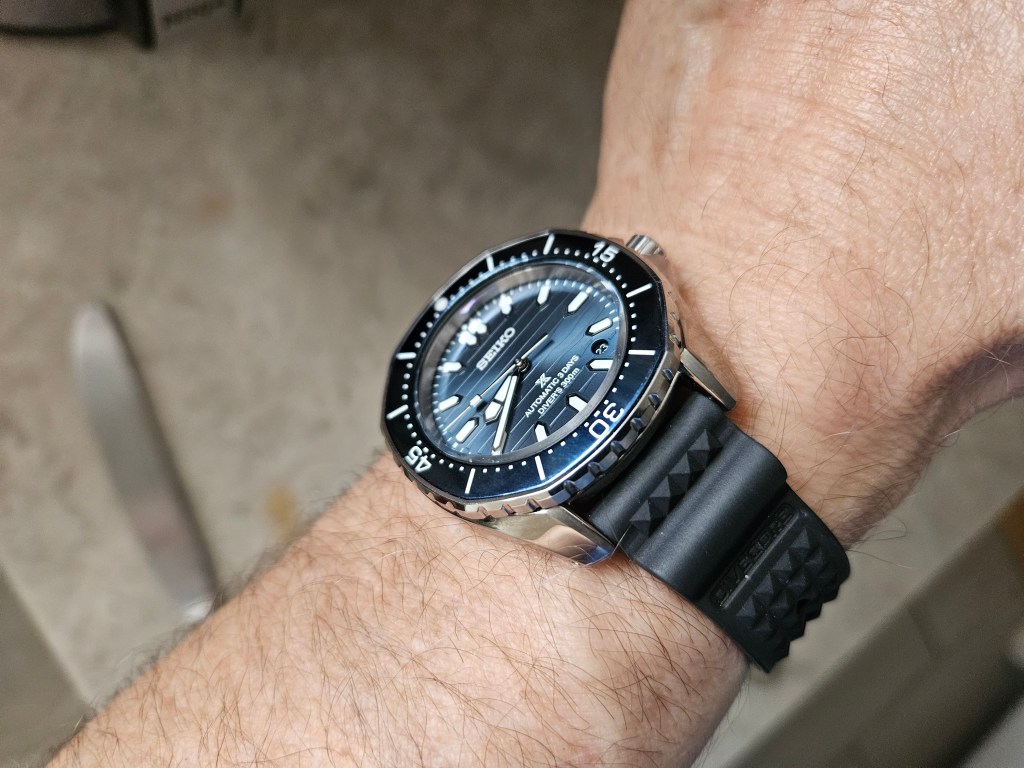
    What if I were free of my Seiko divers?

    Free from what, exactly? That part remains stubbornly undefined.

    Three years ago, the fracture began. I developed an aversion to bracelets—not a mild preference, but a full-blown irritation, as if every metal link were conspiring against my wrist. I moved my Seiko divers onto straps, experimenting like a man searching for ergonomic salvation, until I discovered Divecore FKM. Suddenly, everything clicked. The watches felt right—balanced, secure, almost inevitable. For a brief moment, I thought I had solved the problem.

    Then came the contamination.

    August 2025. A message. A study. PFAS—“forever chemicals”—lurking in FKM. The phrase alone sounded like a villain in a low-budget sci-fi film. Dutifully, almost piously, I removed the straps. The watches went back onto inferior substitutes, and with that small act, something essential drained out of them. They were no longer “just right.” They were tolerable.

    Divecore, to their credit, pivoted—hydrogenated rubber, safer materials, a new Waffle strap on the way. I’m waiting for it now, like a man waiting for a repaired marriage.

    But in that interim, I did something careless. Or revealing.

    On a lark, I bought a Casio G-Shock Frogman GWF-1000.

    And I didn’t just like it. I fell for it immediately.

    Its design wasn’t elegant—it was aggressively industrial, almost defiant. Its timekeeping wasn’t approximate—it was absolute. Atomic. Unquestionable. It didn’t ask for attention; it delivered certainty. One watch became three. The Rescue. The incoming Casio G-Shock GW-9500 Mudman. A quiet shift became a migration.

    This morning, still basking in my vaccine survival, I entertained a more radical thought: eliminate the Seikos entirely. Replace them with two final pieces—the sapphire Frogman D1000 and the GW-5000U Square, my so-called “dress watch,” a term that feels almost satirical in this context.

    At what point does a preference become a slide?

    Was it the PFAS scare that loosened the foundation? Or something deeper? Do the Seiko divers now carry the residue of an older obsession—one tied to acquisition, to the promise that the next watch would finally complete the picture? And if so, what exactly is this new G-Shock phase? Liberation? Or simply addiction in a more utilitarian costume?

    There are a few things I can say with certainty. I prefer atomic time to mechanical approximation. I prefer digital clarity to analog interpretation. Yes, the digital display demands a slight tilt of the wrist, a negotiation with the light, but I’ve made peace with that. It’s a small concession in exchange for precision.

    Maybe there is no grand psychological drama here. Maybe I’ve grown lazy in the most practical sense. I like convenience. I like certainty. I like not having to set the time like a monk tending to a ceremonial clock. Perhaps this is not a crisis of identity but a simple shift toward ease.

    But then I hear from others.

    Men who made this transition years ago. Men who, after watching my videos, bought a G-Shock out of curiosity and quietly abandoned their mechanical collections. No fanfare. No farewell. Just a gradual, almost polite disappearance.

    It suggests something larger. A quiet exodus.

    You could make a documentary about it: aging watch obsessives laying down their expensive mechanical relics and walking into the sunset wearing Squares and Mudmans, relieved, unburdened, and slightly confused about how it happened.

    Meanwhile, my own collection sits in a kind of purgatory. The Seiko divers wait, their fate undecided. Two have already been sold—the Captain Willard Ice Diver and the 62MAS—and their absence has not registered as loss. That’s the unsettling part. Watches that once felt essential have vanished without leaving a dent.

    And here I was, thinking of myself as a careful curator, a man assembling a coherent, meaningful collection.

    The truth is less flattering.

    My hobby is governed not by principle, but by impulse. By shifting preferences, passing anxieties, and the occasional well-timed scare about “forever chemicals.” I would prefer to believe in a deeper logic, a narrative of refinement and evolution.

    But honesty requires a different conclusion.

    I am not curating.

    I am drifting.

    I look into the mirror. “Oh my God,” I scream. “I am a capricious watch collector.”

    Meanwhile, my YouTube subscribers are making cogent remarks in the comment section. A gentleman who goes by the name of MDchaz recently wrote: “Coming to a theater near you “Escape from Seikotraz” starring Jeff McMahon.” I wrote back, “I’ll have to steal your idea for my next YouTube video.”

    And this blog post. 

  • Stop Chasing the Perfect Watch–It Doesn’t Exist

    Stop Chasing the Perfect Watch–It Doesn’t Exist

    I love the digital displays on my Casio G-Shock Frogman GWF-1000 and Casio G-Shock GW-7900. They tell me the time with blunt authority. No interpretation. No ceremony. Just numbers that land in the brain like a verdict.

    And yet, apparently, that isn’t enough.

    Somewhere along the way I developed a new appetite—no, let’s call it what it is, greed. I don’t just want clear numerals anymore. I want absurdly large numerals. I want wrist-mounted billboards. I want a wall clock strapped to my arm so I can read the time from across the room like a man who refuses to participate in subtlety.

    Naturally, the good people of G-Shock Nation pointed me toward the Casio G-Shock GW-9500 Mudman. The Mudman, they said, has the numbers. Big, bold, unapologetic digits that look like they were designed for someone who has lost patience with squinting.

    And they’re right—mostly.

    Mudman owners speak about their watch with a curious mix of affection and confession. They praise the size of the numerals, the rugged build, the sheer presence of the thing. Then, almost sheepishly, they admit that the display can blur at certain angles, that the duplex layering introduces a faint haze, that it’s not quite as clean as they’d like. They dock it a star. Four out of five.

    Then they shrug and say they love it anyway.

    That’s the part that matters.

    Because it raises a question most of us spend years avoiding: is there such a thing as a five-star watch?

    I’ve finally accepted the answer. There isn’t. There are only trade-offs you can tolerate without resentment.

    I’ve been chasing a very specific fantasy: huge numerals, high contrast, perfect viewing angles, and zero cognitive load. A watch that doesn’t need to be read so much as absorbed. A watch that behaves like a wall clock—instant, effortless, undeniable. What I’ve discovered is that watches can deliver three of those qualities with confidence. They just can’t deliver all four at once.

    My GW-7900 comes closest to frictionless clarity. Its display is stable, legible, and immediate. But the digits, while excellent, don’t quite scratch that billboard itch. The Mudman 9500 pushes in the opposite direction. It gives me the numbers—big, thick, impossible to ignore—but introduces a new problem: at certain angles, the display hesitates. Instead of receiving the time, I have to negotiate with it.

    Then there are the Pro Trek models, with their crisp, high-contrast STN displays. Technically superior. Visually disciplined. And yet, in their refinement, they lose that blunt, wall-clock immediacy. They are precise, but not emphatic.

    What fascinates me is how quickly Mudman owners make peace with imperfection. They acknowledge the flaws, subtract a star, and keep wearing the watch. That’s not compromise in the defeated sense. It’s acceptance. They’ve decided which imperfection they can live with, and they’ve moved on.

    That realization forced me to confront what I’m actually chasing. It isn’t a watch. It’s a state of mind—frictionless time perception. I want to glance at my wrist and have the time imposed on me without effort, hesitation, or ambiguity. But a wristwatch isn’t built for that ideal. It’s constrained by size, power, durability, and the stubborn limits of display technology. Something always gives.

    There is, to be fair, a strong case for the Mudman. Bigger numerals do make the time easier to read most of the time. Its toughness invites confidence. Its design has a certain muscular charisma. For many people, that combination outweighs the occasional moment of haze or glare.

    But I’ve had to admit something about myself: I value consistency over peak performance. A watch that is occasionally perfect but intermittently irritating will wear me down. I don’t want to negotiate with my watch. I want to glance and know.

    So the conclusion is both obvious and oddly liberating. There is no perfect watch. Once you accept that, the chase loses its urgency. You stop looking for the mythical five-star object and start making deliberate choices.

    The real question isn’t, “Which watch gets me closest to perfection?”

    It’s this: Which imperfection can I live with—and still enjoy checking the time a hundred times a day?

  • Take a Year Off Buying Watches—And See What’s Left

    Take a Year Off Buying Watches—And See What’s Left

    Daniel Samayoa and I met at several watch meet-ups in Long Beach, just outside Mimo’s Jewelry. We quickly discovered a shared fascination not only with watches themselves, but with the strange ways timepieces take hold of the mind. With that in mind, Daniel offers a guest post for my blog Cinemorphosis, examining the psychology of watch addiction and the habits that keep collectors in its grip:

    At a certain point, the habit stops being a hobby and starts looking like compulsion dressed up as enthusiasm.

    We all like new watches. We also all like taking a good shit. That doesn’t mean you should do it ten times a day and call it a hobby.

    The same principle applies to watch collecting. Just because you feel the urge doesn’t mean you need to act on it. That “great value” diver you just discovered—the one you’re convinced is different this time—will likely be worn twice before it disappears into the padded anonymity of your watch box.

    And that’s the problem.

    You tell yourself you’re building a collection, but what you’re really doing is chasing a small hit of excitement with every purchase. The watch isn’t the point. The transaction is. The anticipation is. The brief illusion of completion is.

    Then it fades, and you’re back where you started.

    It shows.

    Some of you don’t have collections. You have accumulation—watch boxes that resemble clearance racks, full of pieces that once felt essential and now feel optional at best.

    Here’s a simple experiment: stop buying watches for a year. Not a month. Not a “cooling-off period.” A full year.

    A one-year hiatus isn’t punishment; it’s diagnostic. When you remove the option to buy, you strip away the easiest form of self-distraction and force the habit into the open. The itch doesn’t disappear—it sharpens. You start to notice when it shows up: late at night, after a long day, in those idle gaps where boredom masquerades as curiosity. Without the relief of a purchase, you’re left to examine the mechanism itself—the rationalizations, the urgency, the quiet belief that the next watch will complete something that has never quite been defined. Over time, the noise subsides. What remains is clarity: which watches you actually reach for, what you value in them, and how much of your “collection” was built on impulse rather than need. The hiatus doesn’t take anything away. It reveals what was never there to begin with.

    More importantly, you’ll be forced to confront what you actually enjoy wearing. Not what impressed you in a YouTube review. Not what felt like a smart deal. The watches that earn wrist time—the ones that fit your life without effort.

    If you own nineteen watches and rotate through four, then you already have your answer. The rest are noise.

    The next time the urge hits, pause. Ask a direct question: does this watch have a clear role in my collection, or am I just bored and looking for stimulation?

    That question alone will eliminate most purchases.

    Then take it one step further: sell what you don’t wear. Not someday. Not when the market is better. Now.

    What remains won’t just be smaller—it will be coherent. Intentional. Yours.

    Because most people don’t need another watch.

    They need restraint.

    And a watch box that reflects decisions, not impulses.

  • The Man Who Collected Timepieces and Ignored Time

    The Man Who Collected Timepieces and Ignored Time

    For more than twenty years, I lived inside the watch hobby like a man living inside a museum—reverent, obsessive, and curiously uninterested in the exhibits’ stated purpose. I rotated Seiko divers, admired their dials like stained glass, felt their rotors hum like distant machinery—and barely cared what time it was. That’s the joke with teeth: the one function watches exist to perform was never the center of my fixation. I wasn’t tracking time. I was courting it. Romance, nostalgia, the giddy satisfaction of gears responding to my wrist’s movement—those were my currencies. Timekeeping was just the pretext.

    G-Shock, in that world, was vulgar. Too digital. Too close to the smartwatch species I distrust—the glowing, needy devices that feel less like tools and more like supervisors. A G-Shock belonged on a mannequin posed mid-adventure, not on a human being trying to convince himself he possessed taste.

    And yet, sometime around 2010, the Frogman GWF-1000 slipped past my defenses. That asymmetrical case had a crooked charisma, like a boxer with a broken nose who still wins fights. I’d think about it, then shut it down with the usual litany: plastic, digital, not my tribe. I repeated those lines for years, the way a man repeats vows he secretly hopes to break.

    About a month ago, something in me stopped negotiating. The impulse didn’t arrive politely; it landed like a fever. I ordered the Frogman from Japan and watched it crawl through customs as if it were being interrogated for treason. Three weeks later, it showed up. I strapped it on.

    And there it was—presence. Not the polished, self-conscious presence of a luxury diver, but a blunt, physical authority. It didn’t ask for admiration. It assumed compliance.

    Then came the real disruption: Tough Solar and Multiband-6. Set it and forget it—except you don’t forget it, because it quietly corrects you. The watch syncs itself to atomic time, and suddenly you are no longer negotiating with approximation. You are pinned to reality. No drift, no romance, no mechanical shrug. Just accuracy, arriving nightly like a silent auditor.

    I didn’t expect the psychological effect. Being anchored to exact time produced a strange calm, the way a well-balanced diet makes you realize how erratic you’ve been eating. My mechanical divers—beautiful, expensive, lovingly chosen—never gave me that. They gave me narrative. The Frogman gave me certainty.

    The numbers didn’t help the old regime either. Five hundred dollars for the Frogman. A little over a hundred for the GW-7900 Rescue. Both delivered the same atomic truth. Meanwhile, my divers sat there—two, three times the price—offering charm, yes, but also drift, maintenance, and the faint suspicion that I’d been paying for the idea of precision rather than precision itself.

    Before I start sounding like a late-night infomercial for resin and radio signals, I need to detour—briefly, and deliberately—to a song that used to haunt my teenage gym sessions: “You Light Up My Life” by Debby Boone. It would float through the speakers while I benched and curled, all syrup and sentiment, and it filled me with such irritation that I lifted harder just to drown it out. The song wasn’t just bad; it was suffocating in its insistence on emotional purity.

    This matters because the watch hobby is full of that same conversion energy. The language of revelation. The before-and-after testimony. And men, in particular, are suckers for it.

    We don’t adopt hobbies; we convert to them. We don’t adjust our diets; we declare them. We don’t experiment; we renounce and rebuild. One week it’s mechanical purity, the next it’s quartz precision, then solar enlightenment. Each shift arrives with the force of a Damascus-road epiphany, complete with blind spots and overconfidence.

    I know this pattern because I’ve lived it—in watches, in fitness, in every arena where identity can be strapped on, laced up, or swallowed. Men love absolutes. We love the feeling of total overhaul. We love the idea of the metamorphosis so much we may have a figurine on our desk: Thing or Megatron–icons of brute conversion. We mistake intensity for clarity and call it transformation.

    So when I talk about G-Shock, I have to keep one hand on the brake. Because “being anchored to Real Time” has the flavor of conversion, and conversion is intoxicating. It makes you want to declare the past obsolete and the present definitive. It turns a purchase into a philosophy.

    And yet—facts remain stubborn. I’m typing this wearing the GW-7900 Rescue. Tomorrow will be the Frogman. The next day, back to the Rescue. The mechanicals sit in their box a few feet away, arranged with care, untouched—like last year’s tax documents: important, preserved, and no longer consulted.

    That doesn’t make G-Shock a religion. It makes it a correction. Whether I treat it as one or the other will determine whether this is clarity—or just another episode in a long history of well-dressed delusion.

  • When Writing Stops You From Lying to Yourself

    When Writing Stops You From Lying to Yourself

    Kafka called writing a form of prayer. Not as piety, but as precision. Prayer, properly understood, is the act of stepping out of ordinary time—the noisy, transactional churn—and entering a space where attention is no longer scattered but gathered. Writing does the same. It refuses the chaos of profane time and insists, however briefly, on the discipline of the sacred.

    The sacred is not mystical fog. It is clarity stripped of dopamine. It is the quiet room where you examine the state of your own soul without distraction or performance. It is where you test whether your words can survive contact with your actions. It demands humility because it exposes how often they don’t. And it offers a kind of nourishment the chronophage—the great time-eating machine—cannot provide, because it cannot be consumed passively. It must be earned.

    To live thoughtfully is to move between two worlds: the sacred and the profane. You cannot remain in either one. You must descend into the ordinary—work, errands, obligations—but carry with you the standards forged in that quieter space. Otherwise, the sacred becomes theater, and the profane becomes drift.

    So the question arrives, unwelcome but necessary: Do my actions align with my ideals? No. Not yet.

    If they did, my life would contract, not expand. I would eat with intention—three meals, no grazing—and call the absence of snacks what it is: a fast, not a deprivation. I would step away from the digital carnival that thrives on FOMO, because I know its rewards are counterfeit—brief spikes followed by longer, duller lows.

    I would stop buying watches. I already own more than I can meaningfully wear. Two G-Shocks tell perfect time. The rest sit like artifacts of former appetites. Rotation is not variety; it is indecision dressed as sophistication.

    And I would reconsider what I make. If my videos exist to chase attention, to measure my worth in clicks and spikes of approval, then they are extensions of the same problem. The medium is different; the mechanism is identical. But if a video can carry an idea forward—if it can clarify rather than agitate—then it earns its place.

    Writing, then, is not an escape. It is a reckoning. It is the act of bringing the sacred into contact with the profane and asking, without flinching, whether they agree. Most days, they don’t. The work is to narrow that distance.

  • Life Inside the Chronophage

    Life Inside the Chronophage

    You can still read, technically. The eyes move. The words register. But something essential has thinned out. Years inside the chronophage—the great time-eating machine—have rewired the circuitry. You no longer take in ideas; you absorb fragments. You skim life the way you skim a feed. You prefer voices at 1.25 speed, ideas pre-chewed, narratives delivered in twelve-minute installments with thumbnails that promise revelation and deliver stimulation.

    You know what it is. The Internet is not a library—it’s a galactic food court, a neon sprawl of drive-through kiosks serving intellectual fast food. Ninety-nine percent of it is forgettable at best, corrosive at worst. You try to manage your intake. You play the piano. You lift weights. You show up for your family. You perform the rituals of a grounded life. But the residue remains. The machine has had its way with you.

    And then comes the quieter poison: self-pity. No one reads anymore, you tell yourself. Everyone is grazing from the same algorithmic trough. You feel stranded, a refugee from a literate past. You invoke the phrase “post-literate society” not as analysis but as lament. And yet, the only reason you can even diagnose the condition is because you remember something else—an earlier version of attention, slower, deeper, less contaminated. You carry that memory like a fading photograph and call it protection.

    You came across a word last week: chronophage—a system that feeds on your time while convincing you it is nourishing you. It fits too well. The system is not broken; it is functioning perfectly. Its purpose is to consume time, and it does so with industrial efficiency. In the attention economy, attention is not honored—it is harvested. Your mind is not engaged; it is extracted from. There is no mercy in this design. The only consolation is a thin, uneasy solidarity: your mind is not uniquely damaged. It is simply part of a mass casualty you are lucid enough to witness.

  • Chosen by the Frogman

    Chosen by the Frogman

    More than a decade ago, a seasoned watch obsessive told me something I dismissed at the time: you don’t hunt a Holy Grail—you stumble into it. It doesn’t arrive with fireworks or a four-figure invoice. It slips onto your wrist quietly, and then, without asking permission, it takes over. Everything else starts to feel like a costume. You try to rotate, you try to be fair, you give the others their appointed wrist time—but you feel a faint resentment, like you’re cheating on something that actually fits. Eventually the charade collapses. You stop negotiating. You wear the same watch because it works, and because you no longer have the patience for anything that doesn’t.

    When that happens, the chronophage loses its grip. The endless scroll of “must-haves,” the dopamine carnival of releases and reviews, the debates over marginal gains—all of it begins to look like noise generated by people who haven’t found their watch yet. You close the tabs. You ignore the hype. You retire from the rotation economy. Let the others keep spinning the wheel. You’re done. You’ve chosen, or more accurately, you’ve been chosen.

    If you had told me a year ago that a black resin digital watch would be the one to do this, I would have laughed you out of the room. My tastes, I thought, were too refined, too anchored in steel and mechanical romance to be hijacked by a plastic instrument. And yet, a month ago, the G-Shock Frogman GWF-1000 landed on my wrist and quietly began rewriting my habits. It doesn’t leave. The only thing that occasionally displaces it is another G-Shock—the GW-7900—which, if I didn’t have the Frogman, would be my undisputed daily driver. 

    Of course, I know the trap. The honeymoon phase has seduced better men than me. Give it six months, I tell myself. Let time do its work. If the Frogman is still there—if the others still feel like substitutes—then this isn’t infatuation. It’s alignment.

    The grail, it turns out, is not the watch you chase. It’s the one that makes you stop.

  • When the Hobby Becomes a Spectacle of Torment

    When the Hobby Becomes a Spectacle of Torment

    A man in the watch community watched my Frogman video, declared it had caused him “emotional damage,” and proceeded to prove his point by buying Frogman after Frogman in a spree of excess that seemed to be driven more by torment than joy. 

    The watch hobby already carries enough built-in torment. It doesn’t need to be escalated into a public ritual of compulsion. When I share a video about a watch I enjoy, the aim is simple: appreciation, not contagion. Yet in the attention economy, moderation is invisible. What gets rewarded is escalation—bigger reactions, louder confessions, more dramatic spirals. Attention, after all, is a scarce resource, and the surest way to capture it is to weaponize feeling.

    But there is a cost to that performance. When a hobby becomes tethered to the language of “emotional damage,” something has gone wrong. The line between enjoyment and dependency blurs, and what should be a small, contained pleasure metastasizes into something heavier—something that follows you around, nags at you, drains you.

    The only countermeasure is deliberate restraint. We have to regulate our intake of the digital world the way we regulate food—set limits, step away, return to the analog. Read a book. Play the piano. Lift something heavy. Walk outside without a device narrating your existence. Relearn what it feels like to occupy your own life without commentary.

    If someone discovers the Frogman and it brings them genuine satisfaction, that’s a good outcome. But if it becomes another entry point into a cycle of restless acquisition and theatrical distress, then the watch is no longer the problem—it’s the system surrounding it.

    I can’t control what anyone does after watching a video. No one can. The only thing I can do is speak plainly about the effect this environment has on me, and about the boundaries I’ve had to build to keep a hobby from turning into something corrosive. That’s not a solution. It’s a discipline. And it’s ongoing.

  • You Are No Longer Shopping. You Are Being Stimulated

    You Are No Longer Shopping. You Are Being Stimulated

    As a “well-informed consumer,” you may discover—too late, of course—that you’ve built your own cage and furnished it with glowing screens. The hours of scrolling, the endless debates over “the best,” the obsessive rituals designed to avoid buyer’s remorse, the chorus of disembodied voices instructing you what to purchase and what to shun—all of it has rewired your attention. Each swipe delivers a small electric thrill, followed by a quieter, more persistent anxiety. What you call “research” is, in practice, a carefully engineered agitation. You are no longer shopping. You are being stimulated.

    And so the identity of the “well-informed consumer” begins to collapse under scrutiny. You are not informed; you are saturated. You resemble less a discerning buyer and more a laboratory animal, dutifully pressing the lever in hopes that the next pellet will finally satisfy. It never does. The cycle resets. The wheel spins.

    This is Consumer Epistemic Fog: a condition in which the sheer volume of opinions, reviews, rankings, and “definitive guides” does not sharpen judgment but dissolves it. Clarity is replaced by static. Confidence erodes into hesitation. The more you know, the less you trust yourself to act. In the end, the tragedy is not that you might make the wrong purchase—it is that you can no longer make a decision at all.

  • Seven Watches Have Made Me Contemplate the Tyranny of Want

    Seven Watches Have Made Me Contemplate the Tyranny of Want

    I was raised to believe that wanting something was reason enough to have it.

    Not a suggestion. Not a temptation. A principle.

    In the 60s and 70s, appetite was rebranded as intelligence. If you knew how to indulge—food, gadgets, experiences—you weren’t weak. You were evolved. The man who said no looked like a malfunction: tight-lipped, joyless, possibly afraid of his own shadow.

    The rest of us were out there chasing pleasure like it was a civic duty.

    And I didn’t just participate—I specialized.

    I built a life around calibrated indulgence. Watches, food, stimulation. I didn’t impulse-buy; I strategized. I had rotations, hierarchies, justification frameworks. I could explain any purchase with the calm authority of a man who had already made the purchase.

    Which is why it’s unsettling—borderline alarming—that I now feel relief that my watch collection is down to seven.

    Seven.

    At one point, seven watches would have been the warm-up act. Now it feels like silence after a fire alarm. Manageable. Contained. Almost peaceful.

    Out of curiosity, I tried to imagine adding just one more watch.

    Not buying it—just imagining it.

    Within seconds, I felt the familiar anxiety spool up: Where does it fit? When do I wear it? What does it replace? What problem is it solving that doesn’t exist?

    That’s when the illusion cracked.

    What I used to call “expanding the collection” was actually expanding the burden.

    Which led to a thought I’ve spent most of my life avoiding:

    What if self-denial isn’t deprivation?
    What if it’s relief?

    This idea runs against decades of conditioning. My instincts are trained like a high-performance lab animal: stimulus, response, reward. See it. Want it. Acquire it. Repeat until the dopamine system starts filing complaints.

    And yet the results are undeniable.

    The next watch doesn’t calm me—it destabilizes me.
    The next meal doesn’t satisfy me—it expands me.
    The next YouTube video doesn’t enlighten me—it hooks me into a slot machine where the jackpot is always one more spin away.

    Different behaviors. Same engine.

    I’ve spent years obeying impulses that don’t know how to stop—and calling that freedom.

    Now I’m starting to see it for what it is: a feedback loop that promises satisfaction and delivers agitation.

    So I’m experimenting with a radical intervention.

    Not buying the watch.
    Not eating the extra food.
    Not clicking the next video.

    It sounds trivial. It feels trivial. But it isn’t.

    Because when you interrupt the impulse—even once—you discover something unexpected: nothing collapses. The urgency fades. The world keeps spinning. You’re still here.

    And in that small gap between wanting and doing, something rare appears.

    Control.

    Self-denial, it turns out, is not a punishment. It’s leverage.

    It’s the ability to step between impulse and action and say, “Not this time.” It’s the quiet refusal that breaks the loop. It doesn’t feel dramatic. It feels almost boring. But it works.

    Which raises a question I can’t quite shake:

    Why did no one make this case to me when I was younger?

    Or did they—and I dismissed it because it sounded like the philosophy of people who weren’t having any fun?

    Would I have listened? Or would I have reacted the way anyone reacts when you threaten their favorite addiction—with polite skepticism covering a deeper hostility?

    Tonight, the old circuitry is still humming.

    There’s hunger—not real hunger, but the kind that shows up after dinner with a marketing pitch.
    There’s restlessness—the urge to check something, watch something, consume something.
    There’s the gravitational pull toward the kitchen and the screen.

    I know how this ends.

    Stay up late, and discipline dissolves. You eat something unnecessary while watching something forgettable and go to bed slightly disappointed in both.

    So I try something different.

    Go to sleep.

    End the day before the impulses take over.

    It’s not heroic. It won’t trend. No one is going to applaud the man who defeated temptation by becoming unconscious.

    But it might be the smartest move I make all day.

    And still—because habits don’t die quietly—the voice is there, smooth as ever:

    I’ll deny myself.

    Just not yet.