Blog

  • When the Radio Becomes God: Eavesdropping on Despair

    When the Radio Becomes God: Eavesdropping on Despair

    The word “satisfactory” can be a bit of an oxymoron. There’s not much that is satisfying about being satisfactory when the word is a proxy for mediocrity and ennui. To be in life’s sweet spot of income, career, and social status may feel like a prison. To keep your “satisfactory” status, you may be playing house, as they say. You go through the motions of what is considered respectable but feel empty inside. You may find yourself to be the unflattering subject of the famous Talking Heads song “Once in a Lifetime.” The song’s theme is the shock of waking up inside your own life and not recognizing how you got there. David Byrne delivers his lines like a dazed preacher, cataloging the trappings of middle-class success—“a beautiful house,” “a beautiful wife”—yet always undercutting them with the anxious refrain, “Well, how did I get here?” The song captures the disorientation of modern existence, where routines and consumer comforts can feel alien, as if someone else scripted your life while you were sleepwalking through it. Beneath its hypnotic bassline and tribal rhythm, the song is less celebration than existential panic: a reminder that time moves in one direction, that choices pile up invisibly, and that one day you might look around and realize the current has carried you somewhere you never meant to go. The song came out as a video in 1981 and remains one of the most famous videos ever made.

    Cut to 2014 and you’ll find a companion song–Father Misty’s “Bored in the USA.” The song skewers the hollowness of the American Dream by presenting a narrator who has all the trappings of comfort yet feels utterly vacant inside. Over a piano ballad that mimics Springsteen’s Born in the U.S.A. anthem but inverts its spirit, he lists his modern dissatisfactions—student debt, prescription meds, existential malaise—with a deadpan delivery that borders on satire. The song’s title itself is a punchline: in a land of abundance, the greatest affliction is ennui. Misty sharpens the critique by layering laugh-track chuckles over his lament, exposing the absurdity of personal despair as entertainment. The theme is clear: American prosperity doesn’t guarantee purpose, and in a culture that commodifies everything, even boredom becomes a spectacle.

    Perhaps the precursor to the above songs is Malvina Reynolds’ “Little Boxes” (1962).  All three songs wrestle with the discontent lurking beneath middle-class comfort. Reynolds’ folk satire ridicules postwar conformity: rows of identical houses, “ticky-tacky” lives, and the way education, careers, and family structures stamp people into cookie-cutter molds. Byrne picks up this theme two decades later, asking in “Once in a Lifetime” how one can inhabit that prefab life without ever choosing it, caught in the current of routine until bewilderment sets in. Misty, in turn, gives the 21st-century update: not only are the houses still there, but so is the crushing boredom, debt, and medicated detachment that follow from chasing that same ideal. Together, the songs form a lineage of American self-critique—“Little Boxes” mocking the architecture of conformity, “Once in a Lifetime” exposing the existential vertigo inside it, and “Bored in the USA” diagnosing its emptiness in an age of irony and overmedication.

    All three songs—“Little Boxes,” “Once in a Lifetime,” and “Bored in the USA”—resonate with Paula Fox’s masterpiece novella Desperate Characters in their shared critique of middle-class paralysis. Fox’s novel follows Sophie and Otto Bentwood, a couple trapped in a Brooklyn brownstone, surrounded by the comforts of professional success yet gnawed by alienation, decay, and a sense that life has slipped beyond their control. Reynolds’ “Little Boxes” mocks the social machinery that produces people like the Bentwoods—educated, well-off, but indistinguishable. Byrne’s “Once in a Lifetime” channels Sophie’s disorientation, the feeling of waking up one day to a “beautiful house” and a “beautiful wife” yet asking, “How did I get here?” Misty’s “Bored in the USA” pushes the critique further, mirroring the Bentwoods’ emptiness with a 21st-century inventory of malaise: debt, pharmaceuticals, and soul-crushing ennui. Taken together, the songs and Fox’s novella expose the fragility beneath affluence, suggesting that comfort without meaning curdles into desperation.

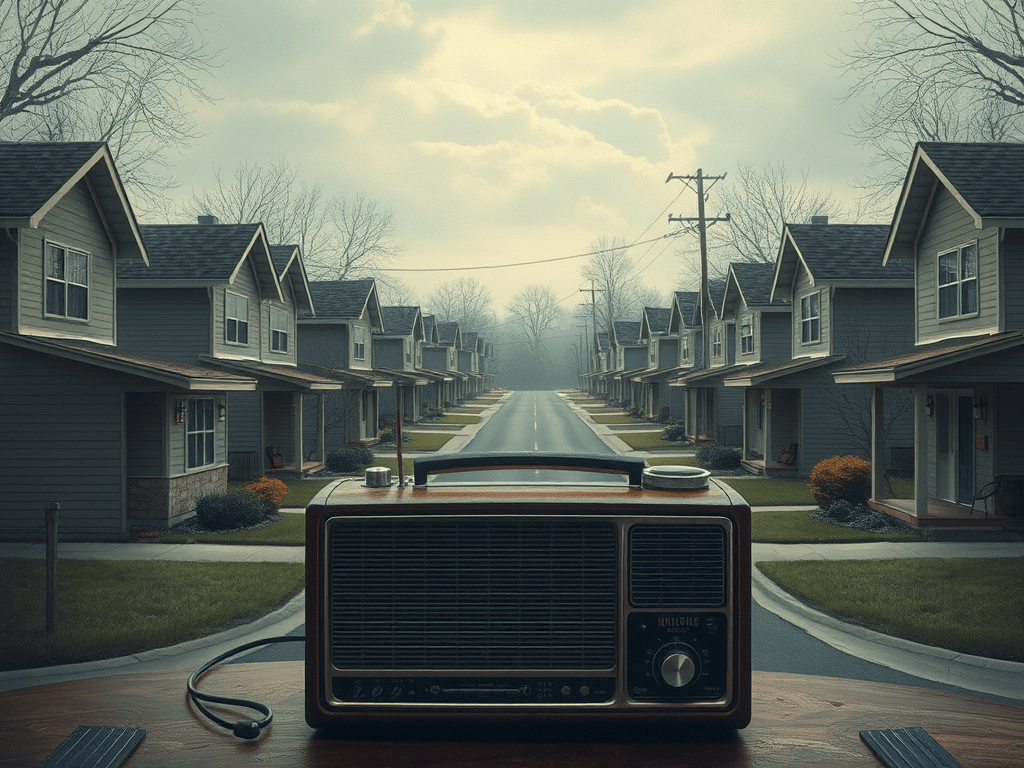
    John Cheever’s “The Enormous Radio” joins the chorus. Jim and Irene Westcott are respectable enough to be alumni-brochure fodder, yet their lives hum with nothingness. Then comes the radio, their supposed luxury upgrade—a hulking gumwood cabinet that looks less like a household appliance and more like a coffin standing on end. At first it malfunctions with grotesque noises, coughing and wheezing like a consumptive beast. But when it “works,” its real gift is supernatural: it picks up not Brahms or Mozart but the raw, unedited conversations of the neighbors. Suddenly Irene is granted an unwanted superpower, the ability to eavesdrop on lives stripped of pretense. Through the radio’s crackle, she overhears quarrels, confessions, betrayals, the bitter sediment of other people’s marriages. Respectable couples she once envied are exposed as small, petty, furious, and miserable. Irene becomes both priest and voyeur, holding court over the private sins of her building. The radio doesn’t merely broadcast sound; it rips open walls, tears down curtains, and forces Irene into an intimacy she never asked for but quickly can’t live without. Jim recoils in disgust, but Irene is entranced, feeding on the poison like it’s oxygen. The radio becomes their third eye, their unwelcome oracle, a device that transforms a bourgeois apartment into a haunted theater of human despair.

    The question Cheever poses—and which Reynolds, Byrne, and Misty circle—is whether too much knowledge of others, or of ourselves, is corrosive. The radio doesn’t merely reveal secrets; it corrupts. Irene begins with curiosity, but soon she’s chained to the cabinet, hypnotized by its stream of confessions and recriminations. What she hears doesn’t just stain her view of others; it infects her own marriage, her finances, even her sense of self. She grows convinced that her life is flimsy, precarious, and wasted, as though the radio is no longer a machine but a judgmental deity, casting its pitiless light on everything she’s tried to keep tidy and respectable. For Irene, the radio becomes both oracle and executioner, transforming her from passive listener into a woman undone by revelation. And that’s the horror Cheever leaves us with: the possibility that self-examination, when magnified by an unblinking device, doesn’t lead to wisdom at all, but to paralysis and despair. Respectability is not protection. The walls are paper-thin. The “satisfactory” life is a coffin with good upholstery.

  • Naked, Unshy, Beautiful: What Happens When the Killjoy Leaves

    Naked, Unshy, Beautiful: What Happens When the Killjoy Leaves

    I screened The Game Changers for my student-athletes, pausing every few minutes like a referee blowing the whistle on another bogus call. The film is a carnival of half-baked studies and overcooked claims about the superiority of a plant-based diet, and I wasn’t about to let it slide. Still, I tried to be generous: a well-planned plant-based diet can be a heart’s best friend. But then we hit my favorite scene, the one I couldn’t resist rewinding. Derrick Morgan, the former Tennessee Titans linebacker, is feasting with teammates on a vegan spread prepared by his wife, Charity. The science was questionable, but the spectacle of love, respect, and camaraderie at that table was undeniable. I told my students, “This—right here—is what eating is about. Not macros, not calculators, not the cold math of nutrition. It’s love.” A volleyball player nodded so hard in agreement, I swear I almost heard her whisper “Amen.”

    Because what is food without community? Nothing but calorie slop shoveled into our mouths like feral beasts at the trough. Food made with love is alchemy: it transforms ingredients into joy, health, and communion. Yet here we are, obsessed with mimicking the hollow thinness of the GLP-1 crowd, mistaking the absence of appetite for virtue. We’ve lost the plot. Food isn’t just fuel; it’s the oldest social technology we have, a medium for bonding, story-telling, and remembering why we bother to sit at a table together in the first place. Strip away the love, and you might as well be gnawing protein paste in solitary confinement.

    Someone with a strong sense of love and bonding is the unnamed Pommeroy brother who narrates the John Cheever short story “Goodbye, My Brother.” He explains that their father was drowned in a sailing accident, which accounts for the family being “very close in spirit.” Their widowed mother taught them that “familial relationships have a kind of permanence” that must be treasured. And so, when the clan gathers at a stately beach house in Laud’s Head, they long for a reunion soaked in sea air and camaraderie. Instead, they get Lawrence—the Puritan gargoyle in their garden party.

    Lawrence is the sort of malcontent who makes wallpaper peel just by standing in a room. He sneers, scolds, and sours the air with his joyless rectitude. A family feast must be stripped of flavor for fear of offending his ascetic palate; a laugh must be stifled, lest he glare with Calvinist disgust. He walks through the beach house like an undertaker taking notes. Even his children, described as thin and timid, seem malnourished by his anti-life, as if he has siphoned out their childhood and replaced it with dour lectures. He is not merely unpleasant—he is a contagion, a slow cancer metastasizing through the family’s shared spirit.

    Cheever’s brilliance is to render Lawrence as the Apollonian impulse run rancid: all order, no play; all restraint, no abandon. The rest of the Pommeroys, by contrast, embody the Dionysian: eager for pleasure, indulgence, the salty joy of swimming naked in the Atlantic. Lawrence cannot let go, cannot laugh, cannot live—and so the family cannot breathe in his presence. Only when the narrator, finally fed up, smacks his brother with a seawater-heavy root, drawing blood, does relief arrive. Lawrence slinks away with his joyless brood, leaving the others to rediscover pleasure, freedom, and even grace. The final image is unforgettable: the narrator’s wife and sister, unencumbered and unclothed, walking out of the ocean like radiant sea-goddesses. It’s as if Lawrence’s exile returned them to the very pulse of life.

    Cheever reminds us that one malcontent can poison the banquet, but also that expelling the killjoy—by violence if necessary—can restore the fragile ecstasy of family. The message is clear: the Dionysian will not be denied, not even by a Puritan scold with a permanent scowl.

  • Food as Storytelling, Not Spreadsheet

    Food as Storytelling, Not Spreadsheet

    I screened The Game Changers for my student-athletes, pausing every few minutes like a referee blowing the whistle on another bogus call. The film is a carnival of half-baked studies and overcooked claims about the superiority of a plant-based diet, and I wasn’t about to let it slide. Still, I tried to be generous: a well-planned plant-based diet can be a heart’s best friend. But then we hit my favorite scene, the one I couldn’t resist rewinding. Derrick Morgan, the former Tennessee Titans linebacker, is feasting with teammates on a vegan spread prepared by his wife, Charity. The science was questionable, but the spectacle of love, respect, and camaraderie at that table was undeniable. I told my students, “This—right here—is what eating is about. Not macros, not calculators, not the cold math of nutrition. It’s love.” A volleyball player nodded so hard in agreement, I swear I almost heard her whisper “Amen.”

    Because what is food without community? Nothing but calorie slop shoveled into our mouths like feral beasts at the trough. Food made with love is alchemy: it transforms ingredients into joy, health, and communion. Yet here we are, obsessed with mimicking the hollow thinness of the GLP-1 crowd, mistaking the absence of appetite for virtue. We’ve lost the plot. Food isn’t just fuel; it’s the oldest social technology we have, a medium for bonding, story-telling, and remembering why we bother to sit at a table together in the first place. Strip away the love, and you might as well be gnawing protein paste in solitary confinement.

  • Triple Lounge Wear: My Magnum Opus of Sloth Couture

    Triple Lounge Wear: My Magnum Opus of Sloth Couture

    When I think of Sigmund Freud, I don’t picture the sober father of psychoanalysis so much as a man presiding over an endless therapy session in which a poor soul reclines on a tufted couch, excavating their psyche with the zeal of a Siberian prisoner digging for coal. I tend to side with podcaster Katie Herzog here: all that navel spelunking doesn’t yield much juice for the squeeze. My mental health cure is more prosaic—get out of my head, do the dishes, help someone else, and remind myself that brooding isn’t a spiritual distinction but simply the human condition, dressed up in self-importance.

    That said, Freud remains a cultural heavyweight, a sort of St. Paul of the psyche. Both men dove into deep, uncharted waters: both charting neurosis and the divided self from different angles. Their remedies were at odds—St. Paul promised redemption; Freud essentially said, “There is no God. Buck up, buttercup.” But there’s always a third way. Perhaps we can podcast our way out of despair. That thought struck me as I read Rebecca Mead’s New Yorker profile of Bella Freud’s “Fashion Neurosis.” Sigmund’s great-granddaughter, Bella isn’t exactly a scholar of the old man’s work, but she leans into his therapy tropes with sly cosplay. Guests flop onto the proverbial couch, confess their quirks, addictions, and philosophies, and tie it all back to their fashion obsessions. Clothes become the psyche’s fabric, quite literally.

    As for me, Bella probably won’t be calling. My claim to fame is enjoying oatmeal for dinner. Still, if she ever asked, I’d come armed with a story. In kindergarten, I had my prized “Monkees pants,” green checkered flares with a radioactive sheen, worn proudly for Show and Tell as I belted out the Monkees’ theme song. Girls swooned, begged for autographs, and I was five going on Micky Dolenz. Then came my Hulk phase: mutilating brand-new jeans so it looked like my swelling muscles had shredded them. My parents adored this use of their clothing budget. Later, the bodybuilding years brought muscle shirts and tight jeans, followed by my “uniform” phase: gray golf shirts, boot-cut jeans, tennis shoes, repeated ad nauseam for three decades.

    My magnum opus, however, is what I call Triple Lounge Wear. A gray tank top and Champion shorts serve as daywear, pajamas, and gym attire—a holy trinity of frictionless fashion. Why cycle through outfits when you can be a one-man capsule collection of sloth and efficiency? 

    Naturally, no discussion of fashion would be complete without confessing my incurable diver watch obsession. My imagination is still shackled to childhood visions of Sean Connery suavely flashing a Submariner on a NATO strap, or Jacques Cousteau backstroking with porpoises while his orange-dial Doxa Sub 300 glowed like a miniature sun. Compared to that, what hope does any outfit of mine have? A diver watch isn’t an accessory—it’s the anchor, the crown jewel, the only thing saving me from looking like a man in oatmeal-stained gym shorts pretending he has style.

    Bella Freud would beam at my ingenuity, then lower her voice and ask, “So Jeff, tell me about your childhood.” And I’d answer, “Well, it started with the Monkees pants…”

  • Radical Boring: The Oatmeal-Based Lifestyle Brand No One Asked For

    Radical Boring: The Oatmeal-Based Lifestyle Brand No One Asked For

    Next month I’ll be 64, which apparently means my taste buds have joined AARP. My diet is now narrower than my tolerance for small talk: buckwheat groats, oatmeal (rolled or steel-cut, because why not keep things spicy), Greek yogurt with berries and honey, and peanut butter-and-honey sandwiches on dark bread. While normal humans dream of steak and champagne on a Paris-bound jet, I fantasize about oatmeal for dinner. Forget first class—I’m on the Oatmeal Express, and my only beverage service is dark roast coffee, soy milk, and sparkling water, which is just soda pretending it went to finishing school.

    I know what’s happening. I’m regressing. I crave mush, porridge, pablum—the kind of food that comes in jars with smiling cartoon fruit. My kettlebell workouts, five days a week, are my only defense. I sweat buckets, swing heavy weights, and imagine I look like a Viking—but in truth, it’s just a grown man clinging to his giant metal pacifier. Exercise has become my lullaby. When I collapse afterward, I feel less like a warrior and more like a sedated infant.

    Of course, at a family birthday party, one cousin reminded me that growth only happens when we leave our comfort zones. I nodded while thinking, No thanks, I’ve had enough character development for one lifetime. At this stage, I don’t want adventure. I want oatmeal. I don’t want novelty. I want predictability. I’m not only becoming a baby—I’m pioneering a whole new lifestyle brand called Radical Boring.

    My big act of rebellion? When my twins turn sixteen in six months, they will take my wife’s 2014 Accord, she’ll inherit my 2018 Accord, and I’ll step into the future—so long as the future, a 2026 Accord that comes in “canyon river blue.” My wife begged me not to get silver or gray again, so this is me living dangerously. Of course, I’ll rarely drive it. I’ll open the garage, admire the shiny paint, then close the door and scuttle back inside for a soothing bowl of oatmeal.

    My family laughs at me. They think I’m absurd, predictable, hopelessly domestic. But at least I’m consistent. And if authenticity means being true to yourself, then yes—I am authentically a 64-year-old content with my porridge, my pacifier workouts, and my canyon river blue Honda. Call it returning to the womb if you want. I call it destiny.

    And now, having confessed this ridiculous self-revelation, I find myself thinking of my literary kindred Ariel Levy and her An Abbreviated Life—a memoir I clearly need to revisit, if only to confirm that my brand of absurdity has precedents.

  • Words of Wisdom in a World of Publishing Hallucinations

    Words of Wisdom in a World of Publishing Hallucinations

    Last night I dreamed I was at the Aspen Institute, where I took the stage as a guest speaker while snowflakes pirouetted past the classroom windows like bored ballerinas. Dozens of young writers—already published, already duped—sat before me, waiting to be enlightened. I told them the truth their publishers had concealed with a smile and a contract: the marketing promises were fairy dust, the royalty checks were jokes, and their “book deals” were little more than elaborate scams. They would earn a pittance, and the betrayal would sting worse than any bad review.

    Some of them glared at me like I’d just blasphemed against their gods, but others—emboldened by rage—shouted the names of their novels and memoirs into the snowy air. A nineteen-year-old tech billionaire from India cried out the title of his memoir: The Gunther Effect. I made him repeat it three times, as if conjuring a spell, so the words wouldn’t slip away. Against my better judgment, I was intrigued.

    By popular demand, I returned for a second sermon. This time, I was flanked by professors and “established” writers who knew the game as well as I did. Their lectures weren’t brilliant, but they didn’t have to be. For me, just focusing on one speaker, narrowing the scattered kaleidoscope of my mind into a single lens, felt like mental hygiene—a purging of the Internet’s endless distractions. I thought, This is what I miss: the monastic joy of being a student, concentrating on one voice instead of chasing dopamine scraps.

    And slowly, the room shifted. The students began to understand that my colleagues and I weren’t cynics but keepers of the ugly gospel. We had the keys to the vault, the passwords to real power. We were the Priests and Priestesses of Light and Success, consecrated by disillusion. Hands shot up like candles in a vigil, their questions burning against the snowfall outside, and we were exalted, gratified, almost holy in the glow of their hunger.

  • The Pee Fairy and Other Family Legends

    The Pee Fairy and Other Family Legends

    Last night I found myself in Studio City, raising a glass to my cousin Pete, who has officially turned 75. His older brother Glenn, still sharp at 77, had flown in from Mercer Island, and the two of them instantly pulled me into a time warp. Suddenly I was no longer a 63-year-old man at a birthday party but a wide-eyed kid again, spending summers with them in the late ’60s on Maryland Street.

    They lived in a Spanish-style home built in the 1920s, the kind of place that looked like it was made for nostalgia: clay tiles, creaky wood floors, and a kitchen that always smelled of coffee, bagels and pumpernickel browning in the toaster. Pete’s Dodgers photos hung in the den, alongside a bobblehead that seemed drunk even before the games started.

    The backyard was Eden in miniature—orange, lemon, and tangerine trees glowed in the California sun, and we’d pedal our bikes past rose-drenched houses while Donovan’s “Sunshine Superman” warbled from my transistor radio. Old ladies waved as if we were celebrities, which of course we believed we were.

    Then came my most infamous contribution to family lore: at six years old, I wet the bed and, unwilling to admit it, blamed the “Pee Fairy.” Pete, Glenn, and their parents—Gladys and Gene—laughed as though I’d landed a Vegas comedy set. Gladys, saintly and unflappable, washed the sheets and hung them out beneath lemon-scented sunshine. That was love, the real thing, not nostalgia’s gauzy counterfeit.

    And last night, as Pete blew out his candles, that same love filled the room—messy, enduring, funny, and fierce. I left grateful to have been part of it, both then and now.


  • Quarterback Hell: America’s Favorite Demigod and the Price of Glory

    Quarterback Hell: America’s Favorite Demigod and the Price of Glory

    In her New Yorker essay “Consider the Quarterback,” Louisa Thomas plunders Seth Wickersham’s American Kings and paints the quarterback not as a football player, but as America’s most tortured mythological beast. Quarterbacks embody our national delusions about leadership and manhood; they manage violence and spectacle at once, parading each week into a gladiatorial hell where one misread or misthrow detonates in front of millions. Actors can flub a line, pop stars can botch a note, tech bros can tank a product and still recover. A quarterback’s mistake, by contrast, is immortalized on ESPN in slow-motion high definition. Surviving this gauntlet elevates him beyond celebrity—he becomes a demigod, but one forged in a furnace that melts sanity along with steel.

    Wickersham’s question—what happens when you achieve the dream of being a star NFL quarterback?—turns out to be a warning label. The answer is grotesque. Yes, genius is displayed on the field: the audibles, the poise, the impossible throws. But the book catalogues the price—alcohol, depression, busted marriages, fatherhood disasters, chronic pain, and, at the core, narcissism metastasized into pathology. “Football, it seems, can unleash the kind of narcissistic personality that normal society might constrain,” Thomas notes. Being a quarterback isn’t a job; it’s a metamorphosis, one that can turn men into monsters.

    That Faustian bargain echoes across sports. Once you buy into a mission of athletic greatness, you accept self-destruction as the down payment. Ronnie Coleman illustrates this truth with brutal clarity. His eight Mr. Olympia titles were purchased with 800-pound squats, deadlifts, and a training style that would make orthopedic surgeons salivate. The bill: spinal fusions, hip replacements, shattered hardware in his back, and a daily life of chronic pain, crutches, and wheelchairs. And yet Coleman, a family man without scandal, smiles through it all. He insists he’d repeat it, no regrets—because the wreckage of his body was, to him, a fair trade for immortality.

    Coleman is a useful counterpoint because, compared to the quarterback, he got off easy. Bodybuilding stripped his mobility but not his humanity. The quarterback, however, inherits the same orthopedic carnage plus something darker: brain trauma, depression, addiction, and the corrosive narcissism required to play the role. Football elevates these men into Olympian figures—half god, half brand—while hollowing out their hearts and souls. To be a quarterback is to win everything the culture worships, and to lose everything that makes life worth living.

  • The Road to Studio City Is Paved with Lane Closures

    The Road to Studio City Is Paved with Lane Closures

    Yesterday I braved my cousin Pete’s 75th birthday blowout in Studio City, dragging my wife and one of my twin daughters along for the ordeal. Like a fool, I skipped the Google Maps pre-check. The punishment: three lane closures on the 405. What should have been a breezy forty-minute jaunt became a 95-minute death march in a metal box. I joked that Pete should’ve hired a therapist specifically for the traumatized survivors of Southern California traffic—“Welcome, let’s unpack your freeway PTSD before the cake is served.”

    The party itself was bigger than I bargained for—150 guests orbiting around a swimming pool, lubricated by a taco bar, hummus hills, pita plains, and charcuterie slabs that could feed a small country. A band of four septuagenarians hacked out Beatles and Stones covers with the enthusiasm of men reliving their garage-band glory years.

    I chatted with cousins and one of the guitarists, but inevitably the conversation veered into my professional life: “So, Jeff, what about AI in the classroom?” I gave them my stock answer: AI is a double-edged sword. It can turn us into lazy bots outsourcing our brains—or, on the bright side, it can make my grading life less of a grammar police beat. I explained that AI gives every student a free grammar tutor, a perk I never thought I’d live to see. And yes, I confessed my own guilty pleasure: I write a sprawling Nabokovian memo, feed it to the machine, and tell it, “Sharpen this. Add acid wit.” What comes back is so tight and sly that I want to light a candle in gratitude.

    Left unsupervised, AI churns out limp, hollow paragraphs—Shakespeare’s “sound and fury, signifying nothing.” But with a solid draft and precise marching orders, it can take my word-bloated gasbaggery and spin it into crisp, surgical prose. The tool is neither angel nor demon; the sin or virtue belongs to the user.

    Of course, I also sinned in the culinary department. My “moderation” consisted of three or four thick slabs of brie smothered with figs and crackers, plus a couple of carne asada tacos. I had a token bite of my daughter’s birthday cake, which was so sweet it could have stripped paint, but that was restraint by default, not discipline. I’m certain I left Pete’s bash two pounds heavier.

    The drive home was mercifully shorter—just an hour—though Google still had the gall to insist the 405 was the “fast” route, lane closures and all. Let’s just say the 405 and I are on a trial separation for at least a year.

  • Farmer’s Walks, Rotator Cuffs, and the Ghosts of TypePad

    Farmer’s Walks, Rotator Cuffs, and the Ghosts of TypePad

    Everyday I try to learn something new, though today’s lessons felt like a report card in masochism. After three weeks of doing the Farmer’s Walk—barefoot, lugging kettlebells across hot pavement like some deranged strongman wannabe—my feet staged a revolt. Now I shuffle around in cushioned flip-flops, praying for pardon from my inflamed soles.

    Lesson two: a rotator cuff tear heals on its own calendar, not mine. Gone are the days of explosive kettlebell theatrics; now I creep through slow, deliberate rows like a man tiptoeing past a sleeping dragon.

    But the real education arrived online. When TypePad collapsed and I ferried a few dozen radio-obsessive posts over to Cinemorphosis, I stared into the abyss of my own archive. What I saw wasn’t noble enthusiasm but neurotic Internet poisoning: the frenzied output of a man hooked on the performance of being “a journalist,” even if only in cosplay. The early 2000s gave me all the symptoms of attention addiction—posting too often, sharing too much, mistaking volume for meaning.

    I’m grateful to have deleted X and demoted Facebook to a ghost town. My writing belongs elsewhere now. On Cinemorphosis I can stretch out, let literature, culture, music, television, even dreams bloom into full color. It feels like stepping through a door into a new world, one I don’t intend to leave.