Blog

  • The Man Who Announced His Freedom—and Proved He Was Still Addicted

    The Man Who Announced His Freedom—and Proved He Was Still Addicted

    It is a curious spectacle: a man announcing, with ceremonial flair, that he has escaped his watch addiction. He uploads the video, writes the post, polishes the proclamation. Freedom, apparently, requires an audience.

    But the performance gives him away. The urge to broadcast his liberation is not evidence of recovery—it is the addiction changing costumes. The watches may be gone, but the craving remains, now dressed as applause. He has traded the bracelet for the comment section, the bezel for the algorithm. Different object, same dependency.

    He insists the talons are gone. Yet the need to be seen announcing their removal reveals the grip is still there. Attention is the fuel that powered the obsession in the first place, and he is still running on it—only now he calls it transformation.

    The man who is actually free does not declare it. He disappears. His watch box gathers dust, his browser history clears, his name fades from forums and feeds. Over time, people notice—not because he told them, but because he stopped needing to be noticed. Silence, in this case, is not absence. It is proof.

    The one who boasts of escape is still inside the cage, narrating his exit to anyone who will listen.

  • You Are No Longer Shopping. You Are Being Stimulated

    You Are No Longer Shopping. You Are Being Stimulated

    As a “well-informed consumer,” you may discover—too late, of course—that you’ve built your own cage and furnished it with glowing screens. The hours of scrolling, the endless debates over “the best,” the obsessive rituals designed to avoid buyer’s remorse, the chorus of disembodied voices instructing you what to purchase and what to shun—all of it has rewired your attention. Each swipe delivers a small electric thrill, followed by a quieter, more persistent anxiety. What you call “research” is, in practice, a carefully engineered agitation. You are no longer shopping. You are being stimulated.

    And so the identity of the “well-informed consumer” begins to collapse under scrutiny. You are not informed; you are saturated. You resemble less a discerning buyer and more a laboratory animal, dutifully pressing the lever in hopes that the next pellet will finally satisfy. It never does. The cycle resets. The wheel spins.

    This is Consumer Epistemic Fog: a condition in which the sheer volume of opinions, reviews, rankings, and “definitive guides” does not sharpen judgment but dissolves it. Clarity is replaced by static. Confidence erodes into hesitation. The more you know, the less you trust yourself to act. In the end, the tragedy is not that you might make the wrong purchase—it is that you can no longer make a decision at all.

  • Seven Watches Have Made Me Contemplate the Tyranny of Want

    Seven Watches Have Made Me Contemplate the Tyranny of Want

    I was raised to believe that wanting something was reason enough to have it.

    Not a suggestion. Not a temptation. A principle.

    In the 60s and 70s, appetite was rebranded as intelligence. If you knew how to indulge—food, gadgets, experiences—you weren’t weak. You were evolved. The man who said no looked like a malfunction: tight-lipped, joyless, possibly afraid of his own shadow.

    The rest of us were out there chasing pleasure like it was a civic duty.

    And I didn’t just participate—I specialized.

    I built a life around calibrated indulgence. Watches, food, stimulation. I didn’t impulse-buy; I strategized. I had rotations, hierarchies, justification frameworks. I could explain any purchase with the calm authority of a man who had already made the purchase.

    Which is why it’s unsettling—borderline alarming—that I now feel relief that my watch collection is down to seven.

    Seven.

    At one point, seven watches would have been the warm-up act. Now it feels like silence after a fire alarm. Manageable. Contained. Almost peaceful.

    Out of curiosity, I tried to imagine adding just one more watch.

    Not buying it—just imagining it.

    Within seconds, I felt the familiar anxiety spool up: Where does it fit? When do I wear it? What does it replace? What problem is it solving that doesn’t exist?

    That’s when the illusion cracked.

    What I used to call “expanding the collection” was actually expanding the burden.

    Which led to a thought I’ve spent most of my life avoiding:

    What if self-denial isn’t deprivation?
    What if it’s relief?

    This idea runs against decades of conditioning. My instincts are trained like a high-performance lab animal: stimulus, response, reward. See it. Want it. Acquire it. Repeat until the dopamine system starts filing complaints.

    And yet the results are undeniable.

    The next watch doesn’t calm me—it destabilizes me.
    The next meal doesn’t satisfy me—it expands me.
    The next YouTube video doesn’t enlighten me—it hooks me into a slot machine where the jackpot is always one more spin away.

    Different behaviors. Same engine.

    I’ve spent years obeying impulses that don’t know how to stop—and calling that freedom.

    Now I’m starting to see it for what it is: a feedback loop that promises satisfaction and delivers agitation.

    So I’m experimenting with a radical intervention.

    Not buying the watch.
    Not eating the extra food.
    Not clicking the next video.

    It sounds trivial. It feels trivial. But it isn’t.

    Because when you interrupt the impulse—even once—you discover something unexpected: nothing collapses. The urgency fades. The world keeps spinning. You’re still here.

    And in that small gap between wanting and doing, something rare appears.

    Control.

    Self-denial, it turns out, is not a punishment. It’s leverage.

    It’s the ability to step between impulse and action and say, “Not this time.” It’s the quiet refusal that breaks the loop. It doesn’t feel dramatic. It feels almost boring. But it works.

    Which raises a question I can’t quite shake:

    Why did no one make this case to me when I was younger?

    Or did they—and I dismissed it because it sounded like the philosophy of people who weren’t having any fun?

    Would I have listened? Or would I have reacted the way anyone reacts when you threaten their favorite addiction—with polite skepticism covering a deeper hostility?

    Tonight, the old circuitry is still humming.

    There’s hunger—not real hunger, but the kind that shows up after dinner with a marketing pitch.
    There’s restlessness—the urge to check something, watch something, consume something.
    There’s the gravitational pull toward the kitchen and the screen.

    I know how this ends.

    Stay up late, and discipline dissolves. You eat something unnecessary while watching something forgettable and go to bed slightly disappointed in both.

    So I try something different.

    Go to sleep.

    End the day before the impulses take over.

    It’s not heroic. It won’t trend. No one is going to applaud the man who defeated temptation by becoming unconscious.

    But it might be the smartest move I make all day.

    And still—because habits don’t die quietly—the voice is there, smooth as ever:

    I’ll deny myself.

    Just not yet.

  • Abducted by My Hygienist, Grounded by Reality

    Abducted by My Hygienist, Grounded by Reality

    My dentist—one year younger than I am, which in our age bracket feels less like a difference and more like a rounding error—peered into my mouth and delivered his verdict with clinical calm: two abrasions, self-inflicted, the result of brushing with the zeal of a man trying to erase his past. They would need fillings. Then, without missing a beat, he pivoted from my dental erosion to his own existential one. At sixty-three, he said, fatigue had begun to collect in the corners of his life. Travel, once a pleasure, had become an ordeal. He had lost interest in vacations altogether.

    He offered evidence. His sister-in-law had been stranded in Dubai while missiles stitched the sky over Iran. When she finally escaped, her flight climbed higher than usual to avoid the problem of being blown out of the sky—a detail that tends to sour the in-flight experience. Twenty hours later she landed in Dallas, dazed and displaced, only to discover she still needed to purchase a separate ticket to get home to Los Angeles. The modern vacation: a geopolitical obstacle course with snacks.

    I told him I understood completely. I, too, have entered the era of strategic energy management. I work out five days a week, yes—but I also schedule two naps a day with the seriousness of board meetings. Europe, at this point, feels less like a destination and more like a test of endurance. Cabo I can handle—two hours, a controlled burst. Miami, perhaps, if I marshal my resources. But a transatlantic flight? The return on investment collapses. The juice is no longer worth the squeeze.

    While we were discussing the slow recalibration of ambition, his technician went to work on my teeth with a collection of instruments that sounded like extraterrestrial diplomats arguing through a metal wall. Half sedated by the hum and whine, I drifted into the plausible conclusion that I had been abducted. Not metaphorically—literally. I was on a ship, somewhere above the atmosphere, being examined by beings who had mastered interstellar travel but still hadn’t figured out how to make dental procedures pleasant.

    Eventually, they released me—back into the chair, back into my life—with instructions to gargle fluoride and abstain from food and water for thirty minutes. The kind of post-op protocol that suggests the aliens, for all their advancements, remain deeply committed to inconvenience.

  • Plastic Detox or Plastic Defeat? Evaluating the Power of Persuasion (college essay prompt)

    Plastic Detox or Plastic Defeat? Evaluating the Power of Persuasion (college essay prompt)

    Watch the documentary The Plastic Detox and write a 1,000-word essay that evaluates how effectively it persuades its audience. Your essay should take a clear position on whether the film motivates meaningful lifestyle changes to reduce plastic exposure or whether it overwhelms viewers into resignation.

    Analyze the rhetorical strategies the documentary uses—such as emotional appeals, scientific evidence, expert testimony, visual imagery, and narrative framing—to shape its argument. Does the film strike a balance between urgency and practicality, or does it risk pushing viewers toward helplessness by emphasizing the scale of the problem?

    In your essay, consider both possibilities: that the documentary empowers viewers to act, and that it may instead produce anxiety or fatalism. Develop a counterargument that challenges your position and follow it with a rebuttal that defends your claim.

    Conclude by reflecting on what the documentary suggests about individual responsibility in a world saturated with plastic.

  • My 57-Minute Relationship with the G-Shock GW-6900

    My 57-Minute Relationship with the G-Shock GW-6900

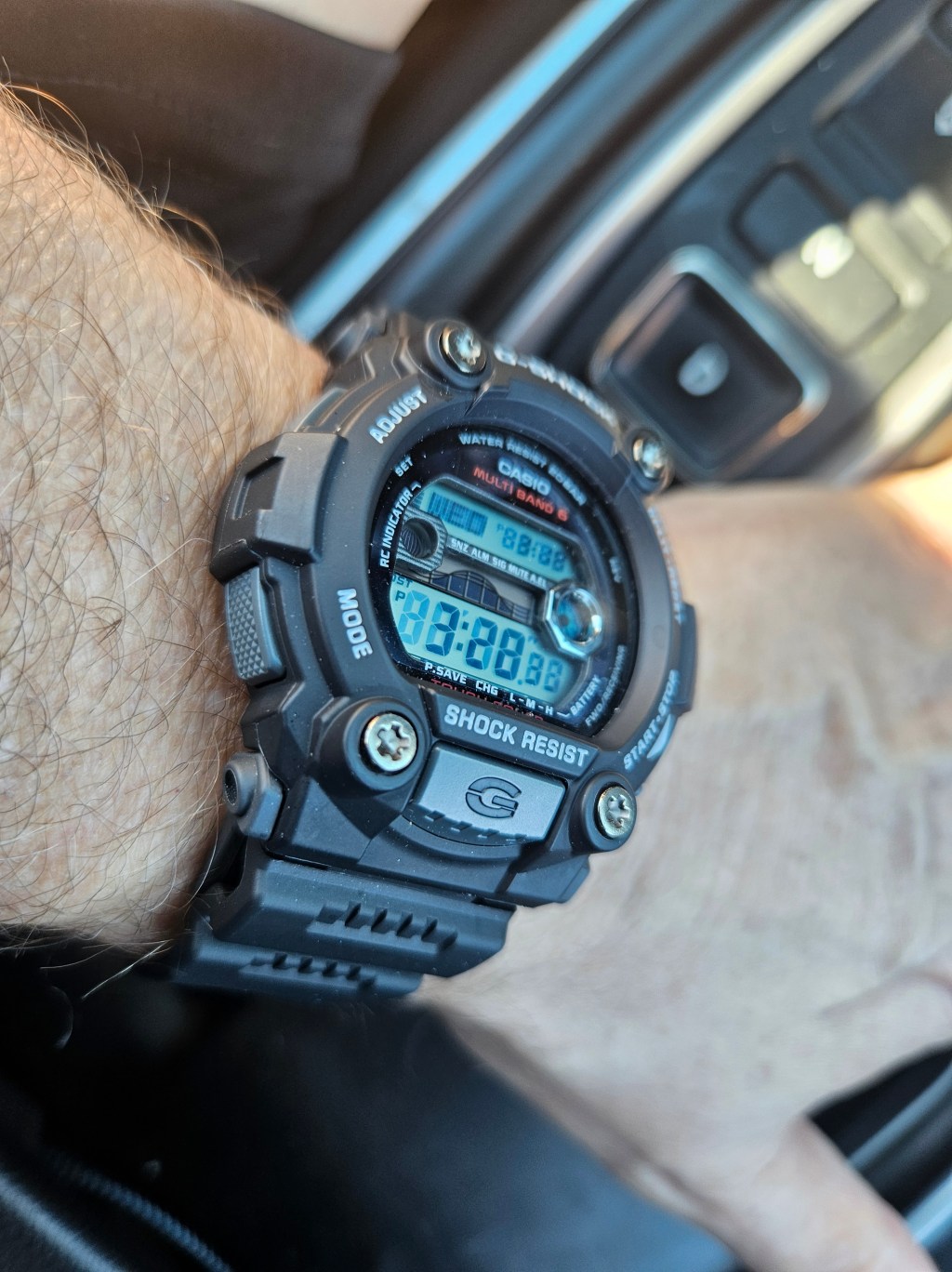
    I got home at 5:00 p.m. to find my Amazon package waiting for me like a promise I didn’t remember making. Inside: the G-Shock GW-6900, the much-celebrated Three-Eyed Monster. I unboxed it, performed the usual initiation rituals—set it to LAX, marched through the modes, customized everything like a man preparing a command center—and then attempted the simplest task imaginable: return to Timekeeping.

    Impossible.

    No matter what I pressed, held, or pleaded with, the watch snapped back to UTC like a bureaucrat rejecting incomplete paperwork. I consulted the manual. I consulted YouTube. I even consulted AI, that modern oracle of last resort. Nothing. The watch refused to cooperate, as if it had been programmed with a small but firm sense of contempt.

    Meanwhile, the physical object itself began to lose its charm under scrutiny. Next to the Frogman and the 7900, the 6900 felt… cheap and underfed. Lighter, cheaper, less resolved. The strap clung to my wrist like it had second thoughts about the relationship—barely long enough, noticeably less comfortable. This wasn’t a heroic tool watch. This was a compromise wearing a reputation.

    The decision arrived with unusual clarity: return it.

    By 5:57 p.m., I had already processed its return on Amazon, dropped it off at the nearby UPS, and said good riddance. It is now on its way back to wherever failed expectations are processed. I had made the round trip—anticipation, confusion, disappointment, rejection—in under an hour. A full consumer arc compressed into a sitcom episode.

    Now the house is quiet again. Seven watches remain. The cognitive clutter has thinned. No more scrolling through modes like a man trapped in a digital maze. No more negotiating with a watch that refuses to tell time on command.

    The 6900 is gone.

    And for the first time today, everything is exactly where it should be, and I can now move forward with my life. 

    Update:

    Two friends messaged me to explain that with the 6900 you don’t press the upper left button to exit UTC and get into Timekeeping. You press the upper right button, so the watch was probably not defective. But it was so inferior to the 7900 in terms of build quality and strap length that I’m glad I returned it.

  • The Discipline of Less: How One Watch and Three Meals Without Snacks Will Save Your Sanity

    The Discipline of Less: How One Watch and Three Meals Without Snacks Will Save Your Sanity

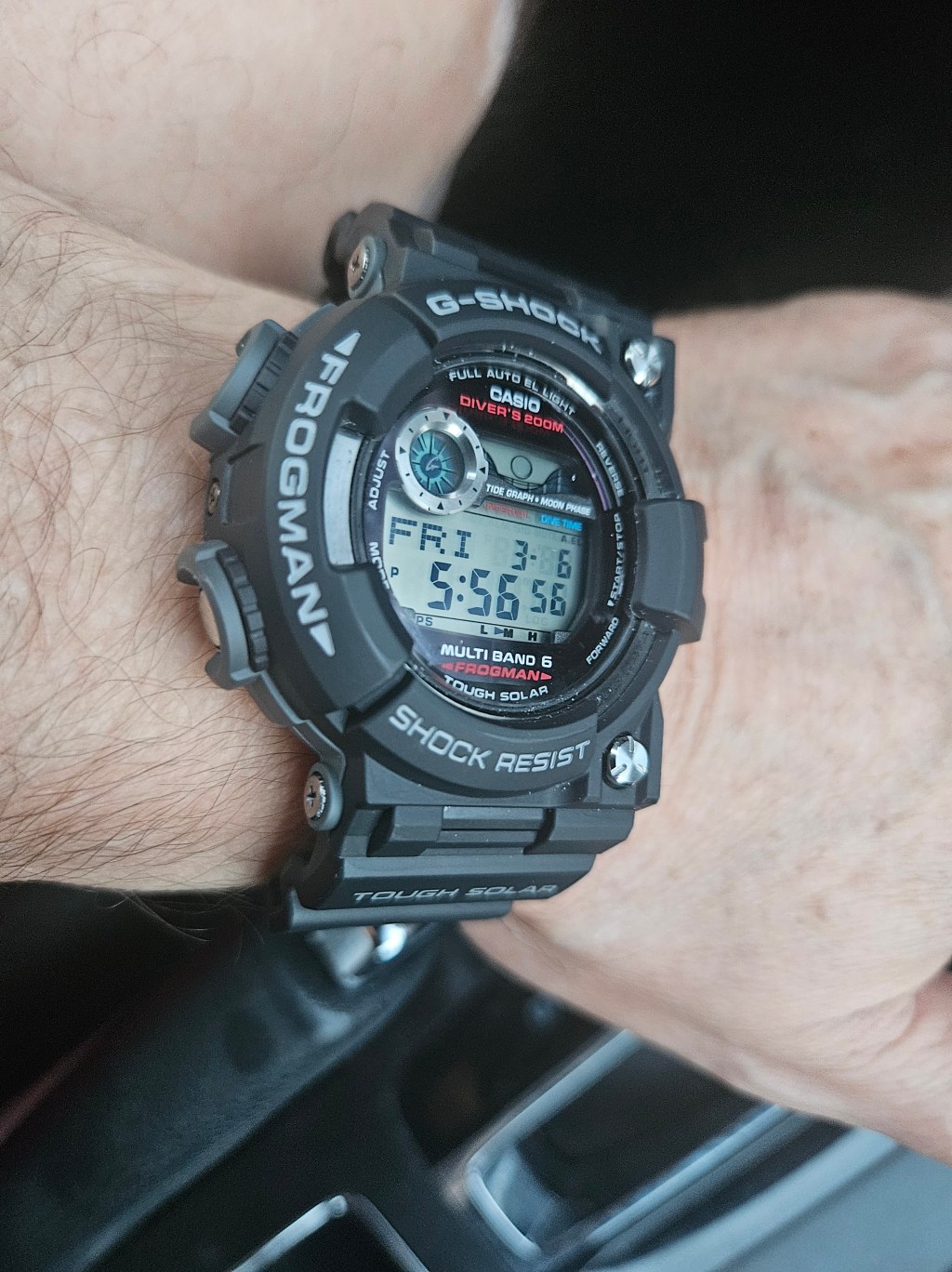
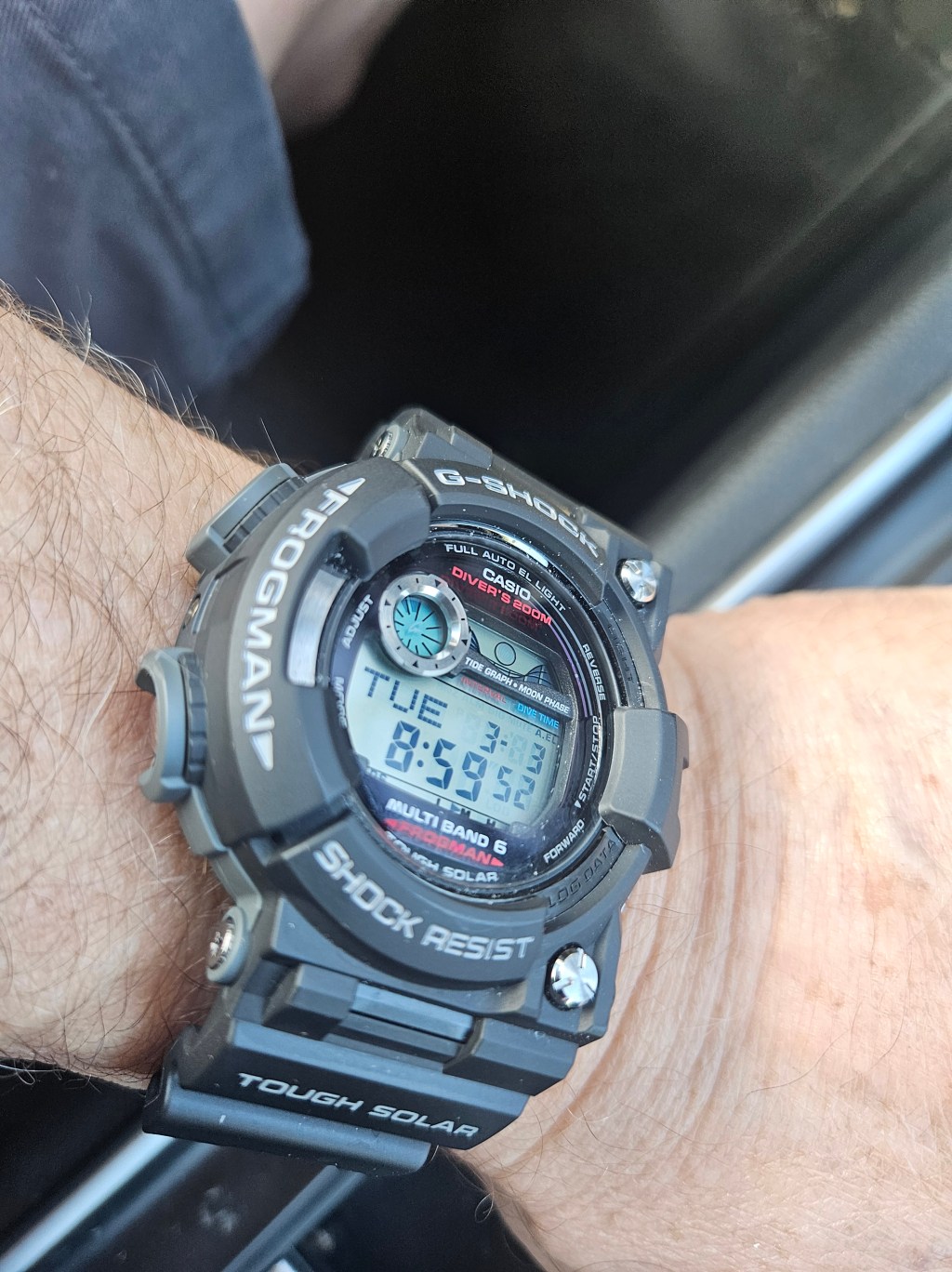
    My G-Shock Frogman has become my horological Holy Grail—the watch that ends the endless tribunal of wrist-rotation decisions. No more standing before the watch box like a minor bureaucrat weighing options no one asked for. The Frogman abolishes the committee. It declares: This is the watch. Proceed with your life.

    The 3-Meals-a-Day Plan performs the same quiet coup in my diet. It eliminates the constant negotiations with the fridge, the whispered justifications for a “quick snack” that metastasizes into a caloric ambush. Three meals. Defined borders. No loopholes. The hunger doesn’t disappear—it files a complaint—but the chaos does.

    Both systems teach the same unfashionable truth: happiness is less about expansion than restriction. The modern instinct is to maximize choice, to curate endlessly, to keep every option alive like a hedge fund of desires. But abundance breeds friction. Every additional option is another small burden, another decision tax. The Frogman removes the tax. The 3-Meal Plan shuts down the snack economy. What remains is not deprivation but clarity.

    Yes, you lose variety. The other watches sit in their velvet purgatory. The snacks call out from the kitchen like minor demons. But something more valuable takes their place: a clean line between decision and action. You stop asking, What should I wear? What should I eat? and start living inside the answer.

    And in that narrowing, something unexpected happens—you bond with the choice you’ve made. The Frogman becomes not just a watch but a fixed point. The 3-Meal Plan becomes not just a diet but a structure that holds you together when appetite tries to scatter you.

    So the command is simple, almost severe:

    Wear the Frogman.
    Eat the three meals.

    Not because you have to—but because without boundaries, everything dissolves into noise.

  • Lecture Drift Syndrome and the Vanishing Classroom

    Lecture Drift Syndrome and the Vanishing Classroom

    My students have been reporting a peculiar academic phenomenon: the two-hour class that contains no discernible lesson. In its place stands a performer—a professor intoxicated by the belief that a self-indulgent monologue is effective teaching. Convinced they possess the sacred “gift of gab,” they proceed to use it like a leaf blower in a library.

    And gab they do.

    They narrate their dreams with the seriousness of a Jungian symposium, decoding every symbol as if the subconscious were filing quarterly reports. They recount contractor disputes with the dramatic tension of courtroom testimony. They offer serialized updates on family feuds, restaurant conquests, tropical vacations, and medical procedures so vivid they border on malpractice to describe. They even resurrect their collegiate glory days, in which they allegedly outwitted professors and classmates alike—a mythos delivered with the confidence of a man who has never been fact-checked.

    Meanwhile, the classroom undergoes a quiet evacuation.

    Not physically—students remain seated, dutiful, nodding at appropriate intervals—but cognitively, the room is abandoned. One student is deep into a novel. Another is solving calculus proofs. Several are toggling between sports highlights and sports betting apps, hedging their attention the way day traders hedge risk. Text messages fly. Homework from other classes gets completed. What was scheduled as instruction has been repurposed into a supervised study hall with a live podcast no one asked to attend.

    The professor, of course, notices none of this.

    This is the defining pathology: two monumental blind spots. First, the inability to recognize that the monologue is not merely irrelevant but actively draining—an intellectual sedative administered over two uninterrupted hours. Second, the delusion that presence equals engagement, that a room full of bodies must also be a room full of minds.

    It is neither.

    What we are witnessing is an academic epidemic: Lecture Drift Syndrome. A condition in which a class session slowly detaches from its stated purpose and floats into the open sea of anecdote, confession, and self-display. The syllabus becomes a relic. Time warps—two hours pass, yet nothing has been learned. Themes dissolve. Structure collapses. The lecture doesn’t end so much as it dissipates.

    In the end, the classroom is no longer a site of instruction.

    It is a stage occupied by one man talking—and thirty students elsewhere.

  • Acid-Washed Jeans and Artificial Intelligence: The Rise and Fall of Instant Cool

    Acid-Washed Jeans and Artificial Intelligence: The Rise and Fall of Instant Cool

    I have a confession that belongs in the Museum of Bad Decisions: I wore acid-washed jeans in the 80s. Not casually. Not ironically. I wore them to teach college writing at twenty-four, convinced I was the cool professor—the kind of man who could annotate a thesis statement and headline a Duran Duran video without changing outfits.

    The problem, of course, is that everyone thought they were that guy. Acid-washed jeans thrived because they delivered instant mythology. You looked like you had lived—hard, fast, dangerously—when in reality you had simply survived a trip to the mall. They were rebellion by chemical treatment, authenticity by rinse cycle. For a brief, glittering moment, that illusion worked. But illusions collapse under mass adoption. When everyone looks distressed, no one looks interesting. The jeans had nowhere to go; they began at maximum volume and stayed there, screaming. Eventually, the culture regained its hearing, glanced downward, and realized it had dressed itself like survivors of a denim-related explosion. Acid wash didn’t fade—it was exiled.

    I think about that rise and fall when I look at my students’ shifting attitude toward AI. In 2022, AI arrived like those jeans: a miracle fabric promising salvation from drudgery, writer’s block, and the existential dread of the blank page. It offered pre-fabricated brilliance—the intellectual version of showing up to the gym already sweating. Students embraced it with the same breathless certainty that this time, finally, the shortcut would make them exceptional.

    Now? They roll their eyes. They call it cringey.

    What changed is not the technology but the perception of authenticity. Factory-installed insight, like factory-installed distress, has become suspect. My students are not naïve; they have finely tuned detectors for fraud. They live in a world saturated with performance—the influencer selling a life they don’t live, the hollow expert recycling borrowed ideas, the unprepared instructor filling class time by sharing his dreams and domestic dramas while they politely tune him out and read Tolstoy’s War and Peace or the entire oeuvre of J.K. Rowling. 

    AI, at its worst, slots neatly into that ecosystem. It produces language that sounds like thinking without the inconvenience of actually thinking. And my students can hear the hollowness.

    This does not mean AI is useless. At its best, it belongs alongside Word, Google Docs, and Grammarly—a tool, not a personality. But tools do not build a self. They do not generate voice, conviction, or the slow accumulation of insight that makes writing worth reading. Lean on them too heavily, and the result isn’t mastery—it’s dependency dressed up as efficiency.

    My students understand this. That’s why the fever has broken. The early hype—the belief that AI would function as a kind of intellectual superpower—has lost its grip. The spell didn’t shatter because AI failed. It shattered because people learned to recognize the difference between something that helps you think and something that pretends to think for you.

    Acid-washed jeans didn’t disappear because denim stopped working. They disappeared because people grew embarrassed of the shortcut.

    AI isn’t going anywhere.

    But the illusion that it can make you interesting just by wearing it?

    That’s already out of style.

  • Why I’m Not Fully G-Shockified (Yet)

    Why I’m Not Fully G-Shockified (Yet)

    A month ago, I fell—hard—for the G-Shock Frogman GWF-1000. Not a mild infatuation. Not a passing curiosity. A full conversion experience. Within days, I recruited two accomplices—the GW-7900 Rescue and the GW-6900 Three-Eyed Monster—and suddenly my mechanical divers, once the crown jewels of my collection, were sitting in the watch box like retired prizefighters telling stories no one asked to hear.

    Let me be clear: I have not renounced them. I still admire the Seiko SLA055. I still regard the quartz Tuna SBBN049 with something close to reverence. But admiration is not the same as use. Once you’ve tasted atomic time—precise, indifferent, quietly superior—it’s difficult to return to the charming imprecision of mechanical watches. You don’t switch back from filtered water to a garden hose unless nostalgia is doing the driving.

    And I’m not alone. Since confessing my condition, I’ve received a steady stream of testimonials. Men who bought a GW-M5610 or a GW-5000U and quietly stopped wearing everything else. Not because they planned to. Not because they declared war on their collections. But because the G-Shock—comfortable, accurate, frictionless—refused to leave their wrist. Their curiosity still wandered, their addiction still whispered, but the watch stayed put. Anchored. Unmoved.

    This phenomenon deserves a name: G-Shockification.

    It is the moment when a watch enthusiast, steeped in the romance of mechanical horology, is overtaken by the brute efficiency of atomic precision. At first, there is resistance. Then rationalization. Finally, surrender. Variety collapses. The rotation dies. The watch box becomes a museum, and the G-Shock becomes the only living artifact. What began as a hobby turns into a single, dominant habit—quiet, practical, and oddly liberating.

    Some resist the change. Some embrace it. Some preach it like a new religion. But they all share one outcome: the mechanical watch, once a daily companion, becomes an occasional guest.

    Which brings me to the uncomfortable question: Have I been G-Shockified?

    The honest answer is: not quite.

    I have my objections. With a G-Shock, I cannot simply glance at the time. I must present the watch to my face like an offering, or press a button and summon light—an act that triggers a faint but persistent anxiety about draining the solar charge. In a dark movie theater, the problem becomes almost philosophical. Do I illuminate my wrist and disrupt the room? Or do I behave like a civilized adult and wear something else?

    This is where the quartz Tuna reenters the story.

    Since my G-Shock conversion began, the Tuna has enjoyed a quiet renaissance. It is as if atomic time granted me permission to appreciate quartz accuracy without guilt. At night, it is flawless—constant lume, instant readability, no negotiation required. It does not ask for a button press. It does not demand a ritual. It simply tells the time, like a professional.

    And so I arrive at a compromise.

    I am not fully G-Shockified because I am not willing to tolerate certain frictions: the angle-sensitive readability, the dependence on backlight, the small social calculations about when it is appropriate to illuminate my wrist. These are minor issues, but they are enough to prevent total surrender.

    What I have instead is something more complicated: Hybridification.

    My collection is now split down the middle—four analog watches, four G-Shocks. This is not harmony. It is a negotiated settlement. The G-Shocks govern precision, durability, and daily utility. The analog watches—especially the Tuna—reclaim territory where immediate readability and luminous clarity matter.

    The result is a managed tension between two philosophies:

    • the digital world of accuracy, convenience, and indifference
    • the analog world of presence, legibility, and quiet satisfaction

    It is not a perfect system. But it is stable.

    For now.