Blog

  • Escaping the G-Shock Dopamine Hamster Wheel

    Escaping the G-Shock Dopamine Hamster Wheel

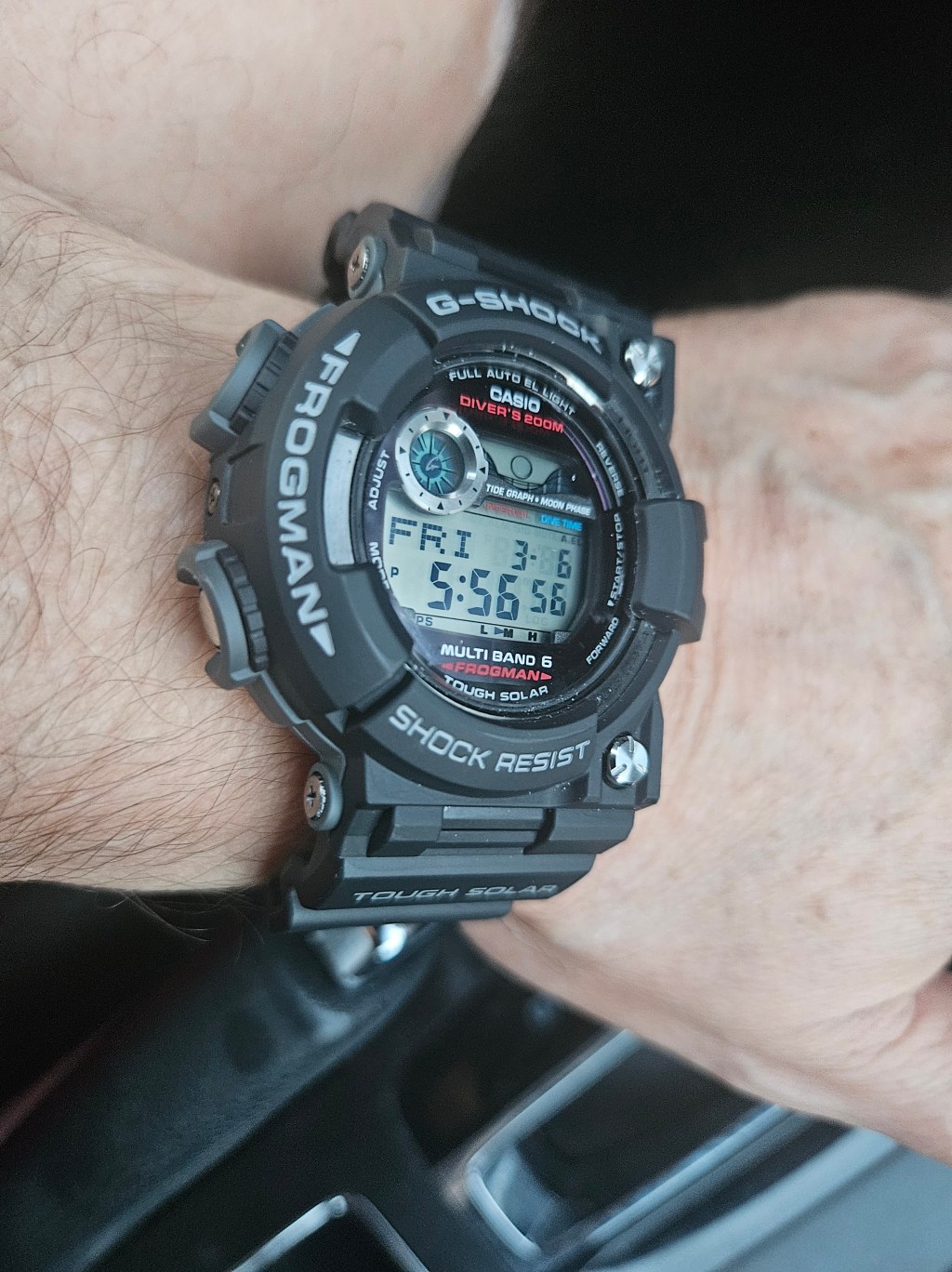
    I offer no apologies for wearing my G-Shock Frogman with the unfiltered delight of a boy kneeling in the sandbox, staging epic battles with a platoon of GI Joes. When I strap that amphibious brick to my wrist, a certain kind of theater begins. I become a heroic caricature of myself—a grizzled football coach barking orders, a deep-sea operative, a cyborg navigator of hostile terrain. It’s ridiculous, yes. But it’s also fun. And fun, when properly contained, is one of life’s few renewable resources.

    The key phrase, of course, is properly contained. Because there’s a difference between fun and desperation, and any hobby that survives long enough eventually reveals the line between the two.

    Right now my G-Shock situation sits comfortably on the side of fun. I own three models: the Frogman, the GW-7900, and the GW-6900. By coincidence—or perhaps by horological fate—each of these watches debuted in 2009. That means the design language on my wrist has survived seventeen years without revision. The 6900, in fact, traces its lineage back to 1995, when the digital watch still believed it might someday conquer the Earth.

    In other words, I have not assembled a museum of the new. I have assembled a small triumvirate of classics. No influencer told me to buy them. No YouTube oracle guided my hand. I simply chose them myself. It’s comforting to believe, even briefly, that one’s consumer decisions were made under the influence of free will.

    And I genuinely enjoy wearing them. When I look down at the wrist, something childish and harmless awakens. The imagination reactivates. Suddenly I’m a spy, a special-ops diver, a space monster, and occasionally a wrestling coach with a suspiciously tactical sense of timekeeping. I accept this man-child energy. I embrace it. There are worse midlife coping mechanisms than a durable plastic watch that makes you smile.

    But every hobby contains traps, and the G-Shock world offers two of them in fluorescent colors.

    The first is the dopamine hamster wheel. This is the stage where watches cease being tools and begin behaving like glazed donuts. One purchase leads to another, then another, until the collector starts foaming with evangelical excitement over limited editions, colorways, and collaborations with Japanese streetwear designers whose names sound like software updates. The language shifts from appreciation to hysteria. FOMO spreads like a rash. Consumer diabetes sets in.

    That spectacle has nothing to do with why G-Shock exists.

    The brand was born to serve people who actually need tough watches—rescue workers, law enforcement officers, soldiers, wilderness guides. It was designed to provide durable, accurate timekeeping to people whose jobs might involve cliffs, oceans, explosions, or at least a very bad Tuesday. It was never intended to become a glittering shrine to hype.

    So I refuse to ride the hamster wheel.

    The second trap is attention hunger. Sharing enthusiasm for a hobby is healthy. Talking about watches with fellow enthusiasts can be joyful. But somewhere along the spectrum, conversation mutates into performance. The watch becomes less about personal enjoyment and more about being seen enjoying it.

    And that distinction reminds me of a film I loved in high school: Saturday Night Fever.

    John Travolta’s Tony Manero dominates the disco floor with effortless charisma. When he dances with Stephanie Mangano, the attention they receive feels earned. Their chemistry produces its own gravitational field. People watch because something authentic is happening.

    But the film also shows another kind of attention.

    Tony’s friend Bobby C., trapped by family shame and a pregnancy he feels powerless to handle, tries desperately to be noticed. Near the end of the film, he asks Tony to look at a new shirt he bought. It’s a small request—a fragile signal that he wants someone to see him. Tony barely registers it. Shortly afterward, Bobby climbs the bridge railing and falls to his death.

    The moment lingers because it exposes the difference between joyful attention and desperate attention.

    When I think about my G-Shocks, I want to remain firmly on the joyful side of that divide. I don’t want to become the collector who escalates endlessly into more extreme watches—bigger, louder, rarer—while begging the internet to notice. In this regard, I want to employ the Contained Fun Principle: the discipline of enjoying a hobby while consciously preventing it from expanding into compulsive acquisition. The Contained Fun Principle recognizes that pleasure remains healthy only when boundaries are enforced—when a collector deliberately limits the size of the collection so the hobby remains play rather than psychological obligation.

    Once containment is gone, the fun is gone.

    Once containment is gone, I’m in the Bobby C. Zone.

    So for now I’ll keep things simple. Three G-Shocks. Three classic designs. All born in 2009. I’ll enjoy the boyish pleasure they bring and try to stay off the dopamine treadmill.

    After all, the whole point of a watch is to tell time—not to consume it.

  • The Multi-Headed Dopamine Monster

    The Multi-Headed Dopamine Monster

    Any halfway attentive observer eventually stumbles upon a depressing but unmistakable truth: modern life is a carnival of pleasures engineered to be irresistible and endlessly repeatable. Physical indulgence, consumer toys, and the shimmering applause of social media metrics arrive every day like trays of free samples at a supermarket. The problem is not their existence. The problem is their limitless availability. When gratification can be summoned instantly—one click, one swipe, one purchase—the temptation to pursue it with manic dedication becomes nearly impossible to resist.

    The results are rarely noble. Self-discipline dissolves. Organization frays. Focus collapses like a folding chair under a heavy guest. In their place arrives a nervous state of agitation accompanied by a dull, persistent suspicion: You are wasting your life on trinkets. The realization is humiliating because it is so obvious. Hedonism, convenience, consumerism, and the intoxicating glow of digital approval are not spiritual achievements. They are simply the brain chasing dopamine like a lab rat pounding a reward lever.

    At first the dopamine feels marvelous. A new gadget, a flattering comment, a few hundred views, the pleasing geometry of a purchase confirmation page. But like all stimulants, the effect fades. The rewards grow thinner. The hits arrive faster but satisfy less. Eventually a quiet despair creeps in. You feel oddly disconnected—from other people, from yourself, from the adult you imagined becoming. You begin asking dangerous questions. Is there anything meaningful enough to lift you out of this quicksand of micro-pleasures? Is there any pursuit capable of competing with the relentless ease of cheap gratification?

    You remember that you possess other faculties—creativity, curiosity, philosophical struggle, the ability to tell a story that might illuminate something about the human condition. These pursuits possess real dignity. Yet they struggle to survive in the same ecosystem as frictionless entertainment and effortless affirmation. The brain, like a spoiled monarch, prefers velvet pillows to hard chairs.

    Eventually the interrogation becomes more specific. The real engine of this predicament is not merely pleasure but technology. Your phone and computer function as a many-headed dopamine creature sitting permanently on your desk. Slaying the monster would be satisfying—but impossible. Unlike alcohol, which the addict can abandon entirely, the digital world is inseparable from modern survival. You need the machine to work, communicate, pay bills, manage life, create things, and occasionally attempt to think.

    So you continue to live beside the creature.

    You read the tidy aphorisms offered by productivity gurus: Be mindful. Stay disciplined. Follow your North Star. But these slogans feel faintly ridiculous when the dopamine cauldron sits inches away—one browser tab from ignition. The advice begins to sound less like wisdom and more like a variety of motivational wallpaper.

    And so you arrive at a strange emotional position.

    You do not yet possess a solution. But you possess something useful: anger. Anger at the machinery of distraction. Anger at the cheapness of digital applause. Anger at your own willingness to accept the bargain.

    It is not a cure, but it is a beginning.

    You can see the problem clearly now.

    The only remaining question is what you intend to do about it.

  • The Seiko Tuna Epiphany: A Late-Night Strategy for Escaping Watch Madness

    The Seiko Tuna Epiphany: A Late-Night Strategy for Escaping Watch Madness

    Last night, while watching television with my wife in a room lit about as brightly as a submarine corridor, I made a small but unsettling discovery: I am not always in the mood to press the G-Shock light button just to see the time. Not because the button is difficult—it isn’t—but because every tap reminds me that I’m siphoning a little solar life from the battery. For a normal person, this would register as trivia. For someone like me, it becomes a moral drama about energy management.

    Earlier that day both my G-Shocks—the Frogman and the GW-7900—were sitting at the dreaded Medium charge level. Medium is technically acceptable, but emotionally intolerable. So I placed them on the windowsill for four hours like two reptiles basking on a warm rock. By evening they had risen to the only status that calms my nervous system: High.

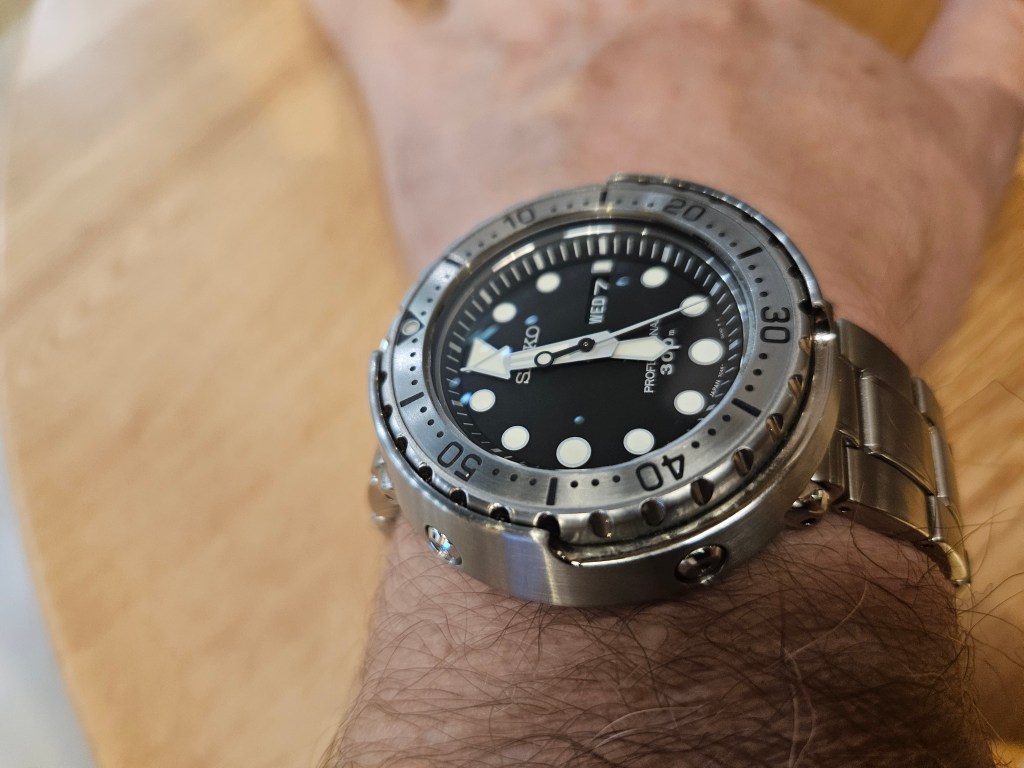
    Wanting to give their solar batteries a night of rest—and perhaps to give my brain a rest as well—I hung the GW-7900 on the industrial T-bar stand so it could quietly chase atomic signals overnight. In its place I strapped on my quartz Seiko Tuna SBBN049. The room was dark, but the Tuna’s lume glowed like a tiny lighthouse. No button pressing. No anxiety about draining solar reserves. Just the quiet satisfaction of luminous markers doing their job without negotiation.

    And something interesting happened: I rediscovered the Tuna.

    While I’ve been cooling off from my mechanical divers, this quartz brute suddenly felt…perfect. Reliable. Legible. Calm. A watch that does not demand emotional supervision.

    Then a second realization arrived.

    The Tuna—already equipped with sapphire—might quietly occupy the exact niche I’ve been trying to justify filling with the sapphire Frogman, the thousand-dollar titanium idol currently whispering to me from the internet.

    If the Tuna fills that lane, several pleasant consequences follow.

    First, I stop the collection at eight watches, a number that still resembles discipline rather than pathology.

    Second, I avoid introducing a sapphire Frogman that would inevitably start competing with my beloved Frogman GWF-1000, turning the watch box into a small arena of amphibious rivalry.

    Third, the Tuna—currently receiving about as much wrist time as a museum artifact—gets to live again.

    Fourth, I avoid spending nine hundred dollars on what is essentially a prestige upgrade: a watch whose improvements amount to slightly clearer digits and bragging rights for social media spectators.

    Fifth, I avoid paying nearly a thousand dollars for a watch that, if I squint hard enough and tilt my head toward the light like a suspicious jeweler, looks almost identical to the one I already own.

    What I’m really saying, ladies and gentlemen, is that I’m searching for an exit ramp.

    Not an exit from watches entirely, but an exit from the compulsion to keep expanding the collection as if the next acquisition might finally calm the storm.

    Because the truth is obvious. My eight watches already do everything a watch can possibly do. Another one at this point isn’t a tool—it’s an additional weight tied to the ankle of enjoyment.

    Another watch becomes an anchor.

    Another watch becomes kryptonite.

    Another watch dilutes the potency of the ones I already love.

    Of course, this is the speech I’m giving myself this morning. Whether I remain faithful to it is another matter entirely. A watch obsessive, after all, is simply a man locked in a polite but relentless argument with himself.

    And perhaps that is the broader human condition. The very pursuits that bring us joy—hobbies, ambitions, passions—also contain the seeds of excess. Mishandled, they curdle. What began as pleasure turns into agitation.

    These are the thoughts rushing through my brain today, pouring forward like a swollen river after heavy rain.

    If it weren’t watches, it would be something else.

    That much, I know for certain.

  • The Moral Danger of Divine Cheesecake

    The Moral Danger of Divine Cheesecake

    Last night I had a dream that unfolded with the logic and extravagance of a Fellini film set on a public beach. I discovered a stray dog wandering along the shoreline, a scruffy creature with the melancholy dignity of someone who had seen too much of the world’s indifference. The dog could speak. His first words were disbelief. He could not imagine that I, a random human loitering by the Pacific, intended to adopt him.

    To prove my sincerity—and perhaps to apologize for the miserable hand life had dealt him—I performed what can only be described as an act of culinary sorcery. With no apparent effort, I summoned two desserts out of thin air and placed them on a small café table facing the ocean. One was a mango cheesecake the size of a steering wheel, glowing with tropical radiance. The other was a monumental chocolate cake decorated with extravagant ribbons and shell-like ridges of frosting, the sort of cake that looks less baked than sculpted.

    The dog, clearly a creature of refinement, approached the cake with delicate reverence, nibbling with the restraint of a Parisian pastry critic. I told him not to worry—I knew of special utensils designed specifically for dogs who wished to eat cake with dignity. I would run downtown and return in minutes.

    That’s when the trouble began.

    When I returned to the café table, I found a woman plunging a bakery knife into my cake with the stealth of a pirate raiding a treasure chest. I launched into a lecture about theft and decency. Mid-sermon, another woman attempted a lightning strike on the mango cheesecake, hoping to slice off a piece before the moral police arrived. I drove her off as well.

    In that moment it dawned on me: these desserts were not ordinary desserts. They were supernatural artifacts. Something about their beauty radiated outward like perfume, alerting passersby that heaven had briefly opened a bakery on the beach. People could sense it. They were willing to bend their morals for a taste. And I had a darker suspicion—once someone tasted the cakes, the bending of morals might turn into a full collapse.

    The dog and I decided the beach was no longer safe for divine pastries. We relocated to the lobby of a nearby hotel, where the two of us quietly devoured the cakes like conspirators protecting a sacred relic. Strangely, the effect on us was the opposite of what I had feared. Each bite seemed to make us kinder, calmer, more decent versions of ourselves.

    Between bites, I told the dog he would never be homeless again. He would live with me forever. He thanked me with the solemn gratitude only a talking beach dog can muster.

    Then he asked the obvious question: how had I managed to summon cakes of such celestial quality?

    I admitted the truth. I had no idea what I had done or how I had done it. But one thing was clear: it was a one-time miracle. The bakery of heaven had closed its doors.

    The rest of our lives, the dog and I would have to live on ordinary meals—and the memory of that impossible dessert.

  • The Sapphire Frogman Temptation: Is the Final Watch the Cure—or the Disease?

    The Sapphire Frogman Temptation: Is the Final Watch the Cure—or the Disease?

    I recently sold a few mechanical divers and, as a result, committed a small but dangerous financial act: I created enough liquidity to purchase the sapphire G-Shock Frogman—the DLC-armored Holy Grail of the G-Shock cult. The beast sits there on the internet, gleaming like a jeweled idol, whispering promises of final satisfaction. It might be magnificent in my collection. Or it might behave like every other supposed “final watch,” which is to say it will bring three weeks of exhilaration followed by a fresh outbreak of neurosis.

    That is the problem. I’m beginning to suspect the hobby itself is the neurosis. At my age, accumulating watches no longer feels like curating a collection; it feels like feeding a psychological raccoon that keeps rummaging through my brain at night. The raccoon never says, “Good work. Eight watches is enough.” It says, “Interesting… but have you considered one more?”

    If the sapphire Frogman truly represented an Exit—a gleaming DLC-coated door marked Freedom From Horological Madness—I would buy it without hesitation. Swipe the card. Close the chapter. Walk away a healed man. But experience suggests a darker possibility: the real exit may not be a thousand-dollar watch at all. The real exit might be something far less glamorous—stopping now, accepting the modest dignity of an eight-watch collection, and quietly moving on with the rest of my life.

  • Castle Kings and Backyard Wars in the HBO TV Series Neighbors

    Castle Kings and Backyard Wars in the HBO TV Series Neighbors

    For a while I was determined to build a writing assignment around the often mesmerizing HBO series Neighbors, a show that turns suburban living into a laboratory of petty grievances. The program is an anthology of paranoia, narcissism, wounded pride, and backyard cold wars. Broken neighbors glare at one another across property lines as if those strips of grass were the demilitarized zones of Eastern Europe. Everyone is intoxicated by the phrase “Be the king of your castle,” and each homeowner interprets that slogan with medieval enthusiasm. Lawn edges become sacred borders. Wind chimes become psychological warfare. A misplaced trash bin becomes an act of territorial aggression. It seemed like fertile ground for a classroom essay about the intoxication of home ownership, the cult of hyper-individualism, and the strange pettiness that emerges when people confuse property rights with personal sovereignty.

    The idea tempted me. Students could analyze how the mythology of the suburban castle feeds grievance culture—how people who should be exchanging tomatoes over the fence instead become amateur border patrol agents guarding their kingdoms of mulch and vinyl siding. The show practically begs for a discussion of how hyper-individualism corrodes the habits of community. Every driveway is a throne room; every neighbor is a potential usurper. It’s an American morality play performed with leaf blowers.

    But the more I watched, the more my enthusiasm cooled. The truth is almost too obvious to sustain a thoughtful essay. Many of the people featured in these conflicts aren’t philosophical case studies; they’re simply hurting. Some appear lonely, unstable, or chronically aggrieved. They need counseling, medication, friendship—anything that might interrupt the feedback loop of suspicion and hostility that has taken up residence in their living rooms.

    Of course I could dress the whole spectacle in sociological clothing. I could write about post-pandemic malaise, the alienation of the social-media age, or the surveillance paranoia that grows when every doorbell camera becomes a witness stand. Those are real themes. But beneath all the academic scaffolding lies a simpler truth.

    Strip away the respectable lighting and the neatly trimmed hedges, and the show begins to resemble The Jerry Springer Show, except the stage has been dismantled and moved into people’s kitchens and backyards. The audience isn’t clapping from studio seats; it’s watching through Ring cameras and HOA newsletters.

    That realization drained my appetite for turning the show into a classroom exercise. Sometimes a spectacle is just a spectacle. Not every shouting match across a picket fence needs to be converted into a philosophical treatise.

    Tempting as the assignment might have been, I think I’ll pass.

  • The Narrative of Justified Cruelty and Heroic Delusion (college essay prompt)

    The Narrative of Justified Cruelty and Heroic Delusion (college essay prompt)

    When disturbing acts of manipulation or cruelty appear in documentaries, viewers often search for a simple explanation. One explanation is psychological: the person must be mentally unstable. Another explanation is moral: the person knowingly chose to harm others. Yet many real cases resist this clean distinction. Individuals who commit harmful acts rarely see themselves as villains. Instead, they construct narratives that justify their behavior. They portray themselves as victims, defenders, truth-tellers, or heroes correcting an injustice.

    The documentaries The Perfect Neighbor and High School Catfish explore this unsettling dynamic. In both films, individuals escalate conflict through patterns of deception, resentment, and obsessive grievance. At times their behavior appears irrational or emotionally unstable. At other moments their actions seem deliberate, strategic, and calculated. What makes these stories disturbing is not simply the harm they cause, but the way the individuals involved interpret their own actions. Each person constructs a story that makes their behavior appear reasonable—even righteous—from their own perspective.

    These documentaries raise an important question about human behavior:

    How do people justify cruelty to themselves?

    Psychologists often describe this process as moral disengagement—the ability to harm others while preserving the belief that one is still a good or justified person. People may blame the victim, exaggerate their grievances, reinterpret their actions as self-defense, or frame themselves as the victim of a hostile world. Or they may see themselves as heroes in their own drama. Some people commit harmful acts while believing they are the morally righteous or aggrieved protagonist in a moral drama. Both documentaries actually illustrate that pattern remarkably well. When these narratives take hold, the line between psychological instability and moral wrongdoing becomes difficult to distinguish.

    Essay Task

    Write a 1,000-word comparative argumentative essay analyzing how The Perfect Neighbor and High School Catfish portray the stories people tell themselves to justify harmful behavior.

    Your essay should develop a thesis that addresses this question:

    Do the individuals in these documentaries appear primarily mentally unstable, morally responsible for their actions, or trapped inside narratives that allow them to see cruelty as justified?

    Thesis Requirement

    Your introduction must include a thesis that:

    1. Takes a clear position on the role of self-justifying narratives in the documentaries.
    2. Maps the major reasons that will organize your body paragraphs.

    Example thesis with mapping:

    The destructive behavior portrayed in The Perfect Neighbor and High School Catfish becomes understandable when we examine the self-justifying narratives constructed by the individuals involved: each person frames themselves as a victim of injustice, interprets retaliation as moral correction, and gradually loses the ability to see their actions from the perspective of others.

    Mapping components:

    • victim narratives
    • retaliation framed as justice
    • loss of empathy or perspective

    Each of these becomes a body paragraph.

    Essay Requirements

    Your essay must include:

    • a clear thesis with mapping components
    • comparison of both documentaries throughout the essay
    • analysis of specific moments from the films
    • a counterargument that challenges your interpretation
    • a rebuttal defending your position
    • a concluding paragraph reflecting on what these documentaries reveal about human moral reasoning

    Possible Directions for Your Argument

    You might argue that:

    • people justify cruelty by constructing victim narratives
    • resentment allows individuals to reinterpret retaliation as justice
    • deception becomes easier when someone believes they are morally right
    • psychological instability intensifies but does not fully explain destructive behavior
    • the documentaries reveal how ordinary people can become morally dangerous when they stop questioning their own stories

  • The Loneliness Hypothesis: Is Social Isolation Making America Mean? (college essay prompt)

    The Loneliness Hypothesis: Is Social Isolation Making America Mean? (college essay prompt)

    Read “How America Got Mean” by David Brooks and “The Anti-Social Century” by Derek Thompson. Then watch the comedy special Lonely Flowers by Roy Wood Jr..

    In Lonely Flowers, Roy Wood Jr. argues that increasing loneliness and social disconnection are contributing to a rise in anger, hostility, and violence in American society. Brooks and Thompson also describe a culture that is becoming more fragmented, isolated, and socially brittle.

    Write a 1,000-word argumentative essay that develops a thesis responding to Roy Wood Jr.’s claim. Using the ideas from Brooks and Thompson, argue whether social isolation is a convincing explanation for the rise in cultural hostility and violence. Your essay may support, refute, or complicate Wood’s claim.

    Thesis + Mapping Requirement

    Your introduction must include a thesis that does two things:

    1. Takes a clear position on Wood’s claim about loneliness and violence.
    2. Maps the major reasons that will organize your body paragraphs.

    Example thesis with mapping

    Roy Wood Jr.’s claim that loneliness is fueling violence in America is persuasive because, as David Brooks and Derek Thompson show, the collapse of community institutions, the rise of hyper-individualism, and the retreat into private digital life have produced a society that is increasingly disconnected and emotionally volatile.

    In this thesis, the mapping components are:

    • collapse of community institutions 
    • retreat into private digital life
    • loss of meaningful language
    • loss of intuition to connect with others

    Each of those becomes a body paragraph.

    Essay Requirements

    Your essay should include:

    • a clear thesis with mapping components
    • analysis of key ideas from Brooks and Thompson
    • references to Roy Wood Jr.’s argument in Lonely Flowers
    • a counterargument that challenges your thesis
    • a rebuttal defending your position
    • a concluding paragraph that reflects on what these ideas suggest about modern American culture

    Possible directions for your argument

    You might argue that:

    • loneliness and isolation are making Americans angrier and more volatile
    • loneliness explains some hostility but not actual violence
    • digital life is replacing real community and increasing resentment
    • other forces (economic anxiety, media outrage, politics) are stronger causes of violence

  • Late to the G-Shock Party

    Late to the G-Shock Party

    Even though I’ve been obsessed with watches for over twenty years, I arrived embarrassingly late to the G-Shock party. I didn’t plan the arrival. It felt more like this: I’m riding in the back seat of an Uber when the driver suddenly pulls up in front of a strange mansion glowing with neon light. The doors swing open. Inside are thousands of loud, jubilant G-Shock devotees who greet me like a long-lost cousin. Champagne appears. Confetti rains down. Someone hands me a microphone and asks for a testimonial.

    I have no prepared remarks. But I can tell the truth.

    For two decades I was perfectly happy collecting Seiko mechanical divers. They were my tribe. Yet somewhere in the back of my mind a particular watch kept whispering to me: the G-Shock Frogman. I had admired it on and off for over a decade. Amazingly, the same model was still available, so I finally ordered one from Japan. A watch that once would have cost me $400 now demanded $550, which is the sort of price inflation that causes a small twitch in the eyelid.

    When the Frogman arrived, something strange happened.

    I couldn’t take it off.

    The watch felt uncannily right, as if some committee of Japanese engineers had secretly studied my personality and designed a wrist instrument to match it. It was heroic, absurdly tough, and far more accurate than my mechanical divers. Within weeks I stopped wearing the mechanicals altogether. Three of them quietly left the collection. Whether I’m taking a mechanical hiatus or attending their funeral remains unclear.

    What I do know is that G-Shock has given my watch hobby a strange second life.

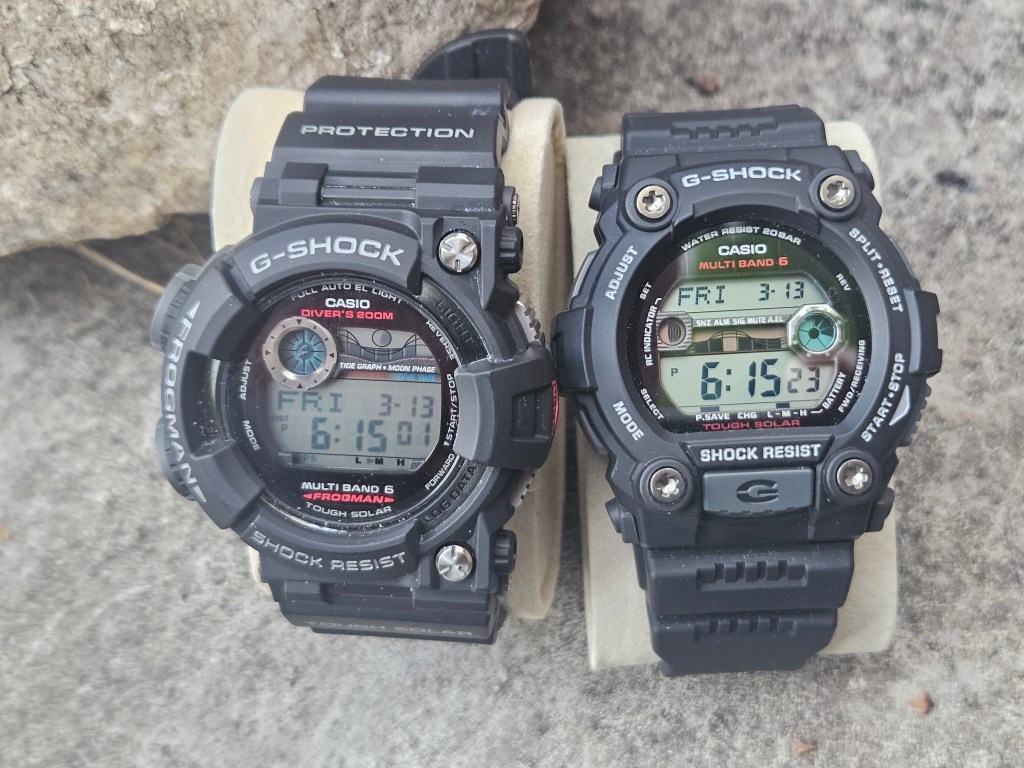
    At the moment I own two of them: the Frogman and the GW-7900. Viewers on my YouTube channel insisted the 7900 deserved a proper name. A subscriber named Dave solved the problem immediately. “Call it the Tidemaster,” he said, since the watch tracks tides.

    Perfect.

    So now I have the Frogman and the Tidemaster. One cost me $550. The other cost $110.

    Here’s the truth no luxury marketing department wants to hear: from a purely practical standpoint, the $110 Tidemaster is the better watch. Its numerals are larger, thicker, and darker. The contrast is superior. At night the backlight illuminates big bold digits that practically shout the time. The Frogman, by comparison, requires a small squint and a mild prayer.

    In other words, the cheap watch wins the legibility contest.

    A third watch is arriving next week: the G-Shock GW-6900. Like the 7900, it currently lacks a proper nickname. The watch has three round indicators above the display, which makes it look like a mildly deranged insect. I considered several possibilities. “Triple Graph” sounds like a geometry exam. “Militaire” sounds like a fragrance sold in an airport duty-free shop. So I’m going with the obvious choice:

    The 3-Eyed Monster.

    My goal is simple: settle into a stable Three-Watch G-Shock Trifecta. All three watches share the same genetic code—big heroic cases, atomic timekeeping, solar charging, digital displays, and rubber straps. That combination is my personal sweet spot.

    Now we arrive at the temptation.

    Many of you have suggested I should upgrade to the sapphire-crystal Frogman, a watch that lurks around the $1,000 mark. And believe me, that watch is occupying prime real estate in my brain. But I’d like to present a few rebuttals before I surrender to the credit card.

    First, price. The Tidemaster and the 3-Eyed Monster cost about $110 each. Even the Frogman stayed under $600. Part of the joy of G-Shock is that it delivers durability, accuracy, and ridiculous hero aesthetics without the emotional trauma of a four-figure purchase. Once you push a G-Shock toward a thousand dollars, you start undermining the very spirit that makes the watch fun.

    Second, technical overkill. The sapphire Frogman is loaded with features I will never use. Yes, the display is slightly more legible than my existing Frogman, but that problem is already solved by the Tidemaster and the 3-Eyed Monster.

    Third, rotational anxiety. Two Frogmans would cancel each other out. I doubt I could sell my current Frogman—it has already fused itself to my identity like a stubborn barnacle.

    Fourth, and perhaps most decisive, is age. If I were in my thirties or forties, building a large G-Shock collection might make sense. But I’ll be turning sixty-five this year. I don’t need a museum of watches. Between four Seiko mechanical divers, a quartz Seiko Tuna, and my three G-Shocks, I already have more watches than any reasonable human requires.

    In fact, I could easily imagine a future where I own nothing but the three G-Shocks and feel perfectly content.

    So there you have it.

    Will temptation vanish completely? Of course not. Tonight I may dream about the sapphire Frogman. In a moment of midnight weakness I might even sleep-walk to my computer and hover over the Buy Now button.

    But I like to believe that the reasonable part of my brain will prevail over the dopamine addict who lives next door.

    At least that’s the story I’m telling myself.

  • Life Is Uncertain. Porridge Is Not

    Life Is Uncertain. Porridge Is Not

    For the past week my appetite has surged like a rogue wave. That could mean several things, none of them particularly flattering. Perhaps I’m medicating stress with food. Perhaps there are subterranean stress triggers rumbling beneath the surface that I haven’t identified yet. Life, after all, provides a constant background hum of anxiety, and it’s difficult to distinguish ordinary daily strain from something more corrosive.

    Retirement is hovering in the distance like a financial fog bank. I’ve been emailing HR about the price of keeping my Kaiser coverage after I retire versus moving to my wife’s more modest plan. Her school pays less than mine, which means we’re staring at something in the neighborhood of $1,500 a month once dental and vision enter the scene. Retirement, which is supposed to represent liberation, suddenly looks like a complicated negotiation with spreadsheets, identity, and self-worth. And apparently my body’s response to this existential accounting exercise is simple: eat more chicken.

    There is, at present, a dangerous quantity of takeout chicken in this house. Fried chicken. Roasted chicken. Greasy, seductive chicken lounging in the refrigerator like a gang of edible hoodlums. I open the fridge intending to take a small, respectable bite. Five minutes later I’m standing there gnawing through a drumstick like a raccoon that has discovered civilization. The aftermath is predictable: gluttony followed immediately by anxiety.

    The anxiety, unfortunately, does not arrive alone. It brings a surveillance drone. I watch myself overeating as if my consciousness has sprouted a third eye hovering above the scene like a judgmental security camera. I am both the criminal and the detective. The more I watch myself eat, the more anxious I become. The more anxious I become, the more I eat. I have achieved what behavioral psychologists might politely call a closed loop of misery.

    Action is required.

    My proposed solution is radical in its simplicity: three meals a day, no snacking. Breakfast will be steel-cut oatmeal or buckwheat groats fortified with protein powder. Lunch will be rolled oats with yogurt and more protein powder. Dinner will consist of a sensible portion of protein, vegetables, and an apple. It is not glamorous, but glamour is precisely the problem.

    Oatmeal comforts me. It possesses the mild, reassuring neutrality of something that has no ambitions beyond keeping you alive. Perhaps it is a kind of surrogate baby food. Perhaps the approach of retirement has triggered a mild regression in which my brain seeks the emotional equivalent of warm porridge and a quiet afternoon nap. As I drift deeper into my mid-sixties, it is entirely possible that my culinary philosophy is reverting to something suitable for a kindly monastery.

    Life is uncertain. Porridge is not.

    I like the predictability of three meals a day involving some form of oatmeal. I like the idea of owning a Lenovo ThinkPad, which is the oatmeal of computers. I like the Honda Accord and Toyota Camry, which are the oatmeal of the automobile world. And I like my solar atomic G-Shocks, which are the oatmeal of timepieces—durable, accurate, incapable of drama.

    If possible, I would like to swim inside a large industrial vat of oatmeal, floating peacefully while the chaos of the modern world clangs harmlessly against the outside of the tank.

    Unfortunately, hostile forces surround the vat.

    My daughters campaign relentlessly for takeout: Dave’s Hot Chicken, Wingstop, Panda Express. Holiday gatherings appear with enough pies and brownies to launch a regional bakery franchise. A man can only resist these temptations for so long before the walls of discipline begin to buckle.

    Meanwhile, medical costs continue their relentless ascent, and retirement funds tremble nervously as global markets perform their daily interpretive dance of geopolitical uncertainty.

    Under such circumstances I find myself clinging to a personal doctrine I’ve begun to call The Porridge Principle: the instinct to confront anxiety by retreating into humble, reliable technologies and routines that promise frictionless predictability. Oatmeal breakfasts. ThinkPad laptops. Honda sedans. Solar atomic watches. These objects do not thrill, but they do not betray.

    When the world becomes chaotic, the mind begins searching for tools and rituals that behave exactly the same way every day.

    So that is the plan.

    Trader Joe’s opens in an hour. I will buy groceries for my family and a heroic supply of oatmeal. The campaign against uncertainty has begun.

    Pray for me.